
Gordon W. Allport (1897–1967)
Author of The Nature of Prejudice
About the Author
Gordon W. Allport, the chief founder of the psychological study of personality and the informal dean of American psychologists during his lifetime, was born in Montezuma, Indiana. He came East to study at Harvard University, and, while doing social work as an undergraduate, discovered that, in show more order to help people deal effectively with their problems, he needed a lifelike psychology of human personality. Developing a full-bodied theory of personality that would do justice to the attitudes, values, and traits of the unique individual life became his goal. After graduating from Harvard in 1919, he studied in Germany and traveled in Europe. At the age of 22, he managed a meeting with Sigmund Freud in Vienna, at which Freud mistook his nervous attempt to strike up a conversation by relating an incident he had just witnessed on a train for a confession of his own childhood trauma. This helped convince Allport that depth psychology often erred in slighting manifest motives in favor of probing the unconscious for hidden motives. When he returned to the United States in 1924, Allport was appointed to a teaching position at Harvard, where he remained for most of his career. His research on attitudes, values, religion, group conflict, and prejudice, as well as his extensive writings on what he called an "open system" of personality, are quoted extensively in the contemporary literature of psychology. Allport died in Cambridge, Massachusetts, in 1967. (Bowker Author Biography) show less
Image credit: Harvard College
Works by Gordon W. Allport
Que es la personalidad? 3 copies
Gordon Allport 2 copies
The Roots of Religion 2 copies
La estructura del ego 1 copy
What is the Problem? 1 copy
Formation of In-Groups 1 copy
Associated Works
The art of group conversation : a new breakthrough in social communication (2012) — Foreword, some editions — 13 copies
Tagged
Common Knowledge
- Canonical name
- Allport, Gordon W.
- Legal name
- Allport, Gordon Willard
- Birthdate
- 1897-11-11
- Date of death
- 1967-10-09
- Gender
- male
- Education
- Harvard University (BA | 1919)
Harvard University (MA | 1921)
Harvard University (PhD | 1922) - Organizations
- American Psychological Association
Eastern Psychological Association
Sigma Xi
Society for Psychological Studies of Social Issues
Phi Beta Kappa - Nationality
- USA
- Birthplace
- Montezuma, Indiana, USA
- Places of residence
- Watertown, Massachusetts, USA
- Associated Place (for map)
- USA
Members
Reviews
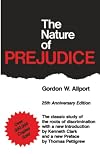
I came to this book after reading Demagoguery and Democracy. I must say, I am absolutely stunned that this isn't more well-known, let alone that I had never heard of it before! When it comes to the nature of prejudice indeed, it's not only easy to read and well-thought/ researched but, also, still highly relevant nowadays despite it having been first published 70 years ago. What about it?
Gordon W. Allport sees prejudice as errors in thinking. It's not about being stupid or irrational. It's show more merely about adhering to various cognitive processes which are flawed, hence that can only lead to flawed conclusions. He outlines, for instance, some of its key features and how they can be reinforced by whose holding them (e.g. generalization fallacy; categorisation; monolithic thinking; selection and confirmation bias etc.). As such, then, he clearly demonstrates that prejudice is about psychology or, more precisely, personality. But that's not it.
More than outlining what makes what he calls a 'prejudiced personality', he also compares it to what makes its opposite, that is, the 'tolerant personality'. He refers to it as being 'tolerant', not because such personalities cannot be victims of prejudicial attitudes too (on the contrary!) but because, when they are, their way of thinking make it easier for them to see their errors and so to correct their own biases. Tolerant personalities, in other words, emphasise individualities over group membership; they don't categorise; they are open minded and so don't feel threaten when challenged in their assumptions; and, most importantly, they are warry of and reject generalisations. Does it matter?
Gordon W. Allport shows more than the various mechanisms adopted by prejudiced people when challenged, and so preventing them to change their mindset. Anyone who has debated somebody making swift generalisations about a group and to paint say group as being threatening and/ or a problem will reckon, here, the attitudes (e.g. self-righteousness, selection bias, bifurcation etc.). As it turns out, they are textbook indeed. What he does, too, is to show how dangerous such prejudicial thinking, its key features in reasoning, and its adopted defence mechanisms when challenged can be when being validated by society as a whole. Writing post-WWII and in the 1950s, his examples are mainly centred around racism and antisemitism. Nevertheless, they are striking for demonstrating how prejudice operates on a spectrum, ranging from what he calls antilocution (language used to negatively define, mock and/ or dehumanise a group); avoidance (when manufactured fear and distrust have become so divisive that they have alienated groups against each other); and discrimination (which is self-explanatory e.g. racial segregation; Nuremberg's laws etc.). When exploited to its full conclusion, it can also lead to physical attacks and, even, extermination.
The Nature of Prejudice, then, makes for a deep and highly enlightening read. It's mostly about psychology and what make a prejudiced personality, but not only. By showing how flawed reasoning and fallacies can be exploited at higher levels (e.g. mediatic, political, institutional) it also shows how dangerous, divisive, and alienating prejudiced ideologies can be, threatening thus communities and the very fabric of our societies, besides causing considerable damages among the targeted demographics. The author, in fact, goes quite far on that score, arguing that prejudicial attitudes being tolerated and let loose are nothing but anti-democratic at the core, hence a poison to be reckon with. He proposes, here, some solutions to prevent individuals to falls into prejudicial claptraps; the biggest one being, of course, education when it comes to fallacies.
All in all, here's a book which should be read by anyone concerned about critical thinking, democracy, and the building of a truly compassionate, inclusive society, away from the categorical, monolithical and rigid thinking of demagogues (e.g. "they/ us", "'they' endanger 'us'", and other divisive claptraps). I highly, highly recommend it! show less
Gordon W. Allport sees prejudice as errors in thinking. It's not about being stupid or irrational. It's show more merely about adhering to various cognitive processes which are flawed, hence that can only lead to flawed conclusions. He outlines, for instance, some of its key features and how they can be reinforced by whose holding them (e.g. generalization fallacy; categorisation; monolithic thinking; selection and confirmation bias etc.). As such, then, he clearly demonstrates that prejudice is about psychology or, more precisely, personality. But that's not it.
More than outlining what makes what he calls a 'prejudiced personality', he also compares it to what makes its opposite, that is, the 'tolerant personality'. He refers to it as being 'tolerant', not because such personalities cannot be victims of prejudicial attitudes too (on the contrary!) but because, when they are, their way of thinking make it easier for them to see their errors and so to correct their own biases. Tolerant personalities, in other words, emphasise individualities over group membership; they don't categorise; they are open minded and so don't feel threaten when challenged in their assumptions; and, most importantly, they are warry of and reject generalisations. Does it matter?
Gordon W. Allport shows more than the various mechanisms adopted by prejudiced people when challenged, and so preventing them to change their mindset. Anyone who has debated somebody making swift generalisations about a group and to paint say group as being threatening and/ or a problem will reckon, here, the attitudes (e.g. self-righteousness, selection bias, bifurcation etc.). As it turns out, they are textbook indeed. What he does, too, is to show how dangerous such prejudicial thinking, its key features in reasoning, and its adopted defence mechanisms when challenged can be when being validated by society as a whole. Writing post-WWII and in the 1950s, his examples are mainly centred around racism and antisemitism. Nevertheless, they are striking for demonstrating how prejudice operates on a spectrum, ranging from what he calls antilocution (language used to negatively define, mock and/ or dehumanise a group); avoidance (when manufactured fear and distrust have become so divisive that they have alienated groups against each other); and discrimination (which is self-explanatory e.g. racial segregation; Nuremberg's laws etc.). When exploited to its full conclusion, it can also lead to physical attacks and, even, extermination.
The Nature of Prejudice, then, makes for a deep and highly enlightening read. It's mostly about psychology and what make a prejudiced personality, but not only. By showing how flawed reasoning and fallacies can be exploited at higher levels (e.g. mediatic, political, institutional) it also shows how dangerous, divisive, and alienating prejudiced ideologies can be, threatening thus communities and the very fabric of our societies, besides causing considerable damages among the targeted demographics. The author, in fact, goes quite far on that score, arguing that prejudicial attitudes being tolerated and let loose are nothing but anti-democratic at the core, hence a poison to be reckon with. He proposes, here, some solutions to prevent individuals to falls into prejudicial claptraps; the biggest one being, of course, education when it comes to fallacies.
All in all, here's a book which should be read by anyone concerned about critical thinking, democracy, and the building of a truly compassionate, inclusive society, away from the categorical, monolithical and rigid thinking of demagogues (e.g. "they/ us", "'they' endanger 'us'", and other divisive claptraps). I highly, highly recommend it! show less

A distinguished psychologist outlines here the need for a psychology of becoming, of the growth and development of personality that he says "can best be discovered by looking within ourselves." Modern psychology is in a dilemma, Allpost states, for it has trimmed down the image of man as a free democractic being. He appraises the present state of the psychology of personality and indicates its relevance to human welfare and religion. This volume is based on the Terry Lectures, which the show more author delivered at Yale University in 1954. show less


Octavo, hardcover, VG in lightly edgeworn beige pictorial dj. 440 pages. (Here are major essays on personality, personal growth, and prejudice, plus incisive interpretations of William Stern, William James, John Dewey, Karl Buhler, Kurt Lewin, and Richard Clarke Cabot. The author, Gordon Allport was a former president of the American Psychological Association
Lists
You May Also Like


Associated Authors
Statistics
- Works
- 27
- Also by
- 7
- Members
- 1,070
- Popularity
- #24,040
- Rating
- 4.2
- Reviews
- 6
- ISBNs
- 38
- Languages
- 6
- Favorited
- 1