
Works by Paul Vigna
The Age of Cryptocurrency: How Bitcoin and Digital Money Are Challenging the Global Economic Order (2015) 235 copies, 4 reviews
The Almightier: How Money Became God, Greed Became Virtue, and Debt Became Sin (2025) 16 copies, 2 reviews
Tagged
Common Knowledge
- Gender
- male
- Education
- Fairfield University (BA|English Language and Literature)
- Occupations
- journalist
writer
editor
reporter - Organizations
- The Wall Street Journal
Dow Jones Newswire - Places of residence
- New York, New York, USA
- Associated Place (for map)
- New York, USA
Members
Reviews
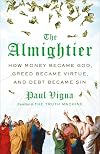
How did money become America’s god?
Sure, a lot of Americans will take offense at the idea. They believe in God Almighty. And that’s why Paul Vigna spoke of money as “the Almightier” in The Almightier: How Money Became God, Greed Became Virtue, and Debt Became Sin (galley received as part of early review program).
In it, the author considers the history of money in the “Western” world and our relationship to it. He began in Mesopotamian days with the beginning of the concept of show more money, debt, and necessary debt releases. He considers Jesus and maintains his very unique (and not a little distorted) take on Him as primarily interested in pursuing a debt release for all the poor Galileans and Judeans of the early first century.
The author’s real focus sharpens with the late medieval period in Italy, making much of Braccolini’s work seeking to justify and vindicate traders and merchants as able to maintain righteousness through commerce. He traces the influence of this work on the de Medici family of Florence in all of their doings, all the way up to Pope Leo X and Luther’s reaction to indulgences.
He continues the narrative into American history with the religious and socio-cultural development of our attitudes toward money: Puritan encouragement of finding religious meaning in vocation, Smith’s justification of the “invisible hand” of the market and baptism of self-interest, Weber justifying the Protestant work ethic, the justification of wealth inequality by means of philanthropy, and the modern justification of greed as good in and of itself.
In the end, the author strongly encourages a form of debt relief for all by essentially printing money to cover all debt and using the coercive force of the nation-state to maintain prices to combat inflation.
The author’s take on Jesus cannot be well-justified; the author could have really used better editing in this beginning section, which is the weakest in the whole book. Otherwise the author’s exploration of the history of our relationship with money is highly illustrative. I probably don’t want to know what the country has been reduced to if the day of his jubilee debt release takes place. show less
Sure, a lot of Americans will take offense at the idea. They believe in God Almighty. And that’s why Paul Vigna spoke of money as “the Almightier” in The Almightier: How Money Became God, Greed Became Virtue, and Debt Became Sin (galley received as part of early review program).
In it, the author considers the history of money in the “Western” world and our relationship to it. He began in Mesopotamian days with the beginning of the concept of show more money, debt, and necessary debt releases. He considers Jesus and maintains his very unique (and not a little distorted) take on Him as primarily interested in pursuing a debt release for all the poor Galileans and Judeans of the early first century.
The author’s real focus sharpens with the late medieval period in Italy, making much of Braccolini’s work seeking to justify and vindicate traders and merchants as able to maintain righteousness through commerce. He traces the influence of this work on the de Medici family of Florence in all of their doings, all the way up to Pope Leo X and Luther’s reaction to indulgences.
He continues the narrative into American history with the religious and socio-cultural development of our attitudes toward money: Puritan encouragement of finding religious meaning in vocation, Smith’s justification of the “invisible hand” of the market and baptism of self-interest, Weber justifying the Protestant work ethic, the justification of wealth inequality by means of philanthropy, and the modern justification of greed as good in and of itself.
In the end, the author strongly encourages a form of debt relief for all by essentially printing money to cover all debt and using the coercive force of the nation-state to maintain prices to combat inflation.
The author’s take on Jesus cannot be well-justified; the author could have really used better editing in this beginning section, which is the weakest in the whole book. Otherwise the author’s exploration of the history of our relationship with money is highly illustrative. I probably don’t want to know what the country has been reduced to if the day of his jubilee debt release takes place. show less
This was such an interesting and eye opening book! The last time I took an econ class was in high school, I somehow managed to dodge it in both undergrad and grad school. This book is like a history of money, its early ties to religion, and the evolution that it underwent to become the driving force of every society on this planet. The author discusses that in the beginning; countries, tribes, and governments bowed down the Almighty, kings, and Popes. Eventually as money lending grew, became show more accepted, and more intwined with governments and religion it grew to more importance and today Capitalism reigns supreme. Filled with so many interesting factoids, theories, and historical tidbits, this book was interesting and appealing to me as someone who has no idea how the stock market even works. As a history major, I loved the historical aspect of it and I loved learning about how we got to where we are now. I loved the final chapter where the author put forth ways that we could upend the system for better. Would any of them work? I have no idea, again I am not an economist, I am a librarian. And a poor one at that. But regardless I learned a ton and imagine that this book would cause lively debate if people in power and people with money would read it. show less
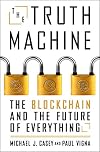
This could have been good, but they got enough details wrong (not due to facts changing, but just sloppiness and bad editing), plus a huge amount of filler (half of the book?) that it wouldn’t be worthwhile for most people. Unfortunately, I’m not aware of other better books about cryptocurrency beyond the initial bitcoin and basic blockchain tech level.
I’m a relative expert in this topic (involved in anonymous electronic cash and similar projects since 1992, currently working in the show more cryptocurrency space in technology and security) so I was already familiar with essentially all of the content in the book. The problem with a book like this is that in addition to constantly moving goalposts, a lot of projects are rather deceptive, and if you write about things with too high a level of credulity it will ultimately be misleading. There is probably some value in just summarizing what projects say they intend to do, but a lot more value in actual analysis.
The “fluff” level was high, but there was probably a solid 50-100 page book inside. If that had been combined with some deeper analysis of projects, technology, and results, it would be worth reading. show less
I’m a relative expert in this topic (involved in anonymous electronic cash and similar projects since 1992, currently working in the show more cryptocurrency space in technology and security) so I was already familiar with essentially all of the content in the book. The problem with a book like this is that in addition to constantly moving goalposts, a lot of projects are rather deceptive, and if you write about things with too high a level of credulity it will ultimately be misleading. There is probably some value in just summarizing what projects say they intend to do, but a lot more value in actual analysis.
The “fluff” level was high, but there was probably a solid 50-100 page book inside. If that had been combined with some deeper analysis of projects, technology, and results, it would be worth reading. show less
Age of Cryptocurrency: How Bitcoin and the Blockchain Are Challenging the Global Economic Order by Paul Vigna
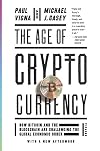
My review is based on a Blinkist summary of the book so is really a review of this summary. Nevertheless, I’ve found the Blinkist summaries to be remarkably good in terms of extracting the gems from the whole book. And I’ve extracted a few of these gems from the summary itself as below:
For money to have value, there needs to be a shared agreement on its use as a medium of exchange......If just anyone could create new money, money would lose its value. There needs to be a limited amount show more of it for the system to work.
Bitcoin functions as money because people trust that it has value–just like “normal” money. When people started to see that real things could be bought using it, trust increased.
Ultimately, we can know that Bitcoin is money simply because people accept Bitcoins as units of exchange......You can’t create gold at home–you have to work hard finding it and mining it. Bitcoin works in a similar way. Instead of pickaxes, however, Bitcoins are mined with computers.....Solving these problems requires significant amounts of computational power. When a problem is solved, a Bitcoin reward is given to the miner and a new problem is issued.
The number of Bitcoins awarded is also halved every fourth year, so there’s an incentive to mine as many as you can before they run out. In total, 21 million Bitcoins will be released. According to one estimate, the last Bitcoin will be mined in 2040.....When a new Bitcoin is mined, a new block is created, validated and added to the chain.
There’s a Bitcoin record of all owners’ balances and transactions to ensure the same Bitcoin isn’t spent twice. This is the purpose of the blockchain, which everyone has access to. Every Bitcoin owner has an address–a unique and encrypted number assigned to them in the Bitcoin network. Addresses help keep track of who is who.....It removes the middleman and makes transactions cheaper and more efficient....In the fourteenth century, the Medici family served as a middleman between savers and borrowers.....This was the birth of the banking system
Bitcoin sprung from a movement that wanted to change this system by giving power back to the people.....When you buy a coffee at Starbucks with your credit card, it usually takes three business days for them to receive the money. With Bitcoin, the transaction is completed almost instantly.
Bitcoin protects its users by keeping their identities secret. [Which is a bit of a problem when criminal s use the system].
According to one estimate, over $1 billion was spent on building “rigs” of super-fast computers designed specifically for mining Bitcoins between April 2013 and April 2014.
Some people even claim that if the industry keeps growing at its current rate, it’ll cause an environmental catastrophe because it uses up so much electricity.
Innovations created at 20Mission have included MaidSafe, a solution that lets users rent out their free disk space over a decentralized network.....Investors were initially wary of putting their money into these kinds of projects, but this attitude has changed dramatically.
There are about 2.5 billion people worldwide who don’t have money in banks. They lack many of the freedoms people in developing [I assume this is a typo and he means “developed”] countries take for granted. Bitcoin could change all this. Bitcoin can give people in developing countries more economic freedom.
So, given all these benefits, what are the downsides of Bitcoin?
On 10 February 2014 a bug had been revealed in Bitcoin’s software that made it possible to create fake transactions and receive unwarranted payments.....Mt. Gox collapsed and the price of a single Bitcoin plummeted from $703 to $535. [If there was one bug how can we be sure that there won’t be more? I guess, no system is ever perfect but the longer it’s worked on then the more the bugs get eliminated.]
Bitcoin is also difficult to control, because of its distributed network.......information is sent across the entire web. This means it’s practically impossible to shut down. There’s no Bitcoin CEO or CTO who can get slapped with a subpoena.
Another problem is that Bitcoin can be used for criminal purposes, like selling drugs or even hiring hitmen.
The key message in this book: Anything can function as money as long as people agree it has value. Bitcoin has only existed for a few years, but the industry has boomed and peoples’ trust in Bitcoin as a form of currency has only increased. It has the potential to radically change our global economy by removing middlemen and providing anonymity. Despite their currently volatile nature and other downsides, cryptocurrencies are undoubtedly the future.
My take on the book? Well the author is clearly a “booster” for cryptocurrency and the doesn’t seem at all fazed by the various problems that have shown up. There doesn’t seem to be any discussion of the incredible volatility with bitcoin and the fact that just about every issue of bitcoin seems to have had problems ...especially with people obtaining passwords etc or getting access to internal codes and draining all the funds electronically, and untraceably. I’m quite happy for others to make the forays into cryptocurrency for the moment. And, it does seem to me that there are rather more people losing money than are making money. Actually, I thought the coverage was rather superficial for something written in 2016. And there was nothing in the book that inspired me to sell the house and invest the profits in cryptocurrency. There are still elements that I don’t understand...like who sets the mathematical problems that the miners have to solve? Who checks that it’s been correctly solved? And I don’t understand how the number of new issues gets halved every four years. Also, I’m curious about the impact Artificial Intelligence may have on this process. What if AI develops an algorithm to solve the hard problems in next to zero time? Presumably they will be hauling in Bitcoin hand-over-fist? ......Anyway, only two stars from me. show less
For money to have value, there needs to be a shared agreement on its use as a medium of exchange......If just anyone could create new money, money would lose its value. There needs to be a limited amount show more of it for the system to work.
Bitcoin functions as money because people trust that it has value–just like “normal” money. When people started to see that real things could be bought using it, trust increased.
Ultimately, we can know that Bitcoin is money simply because people accept Bitcoins as units of exchange......You can’t create gold at home–you have to work hard finding it and mining it. Bitcoin works in a similar way. Instead of pickaxes, however, Bitcoins are mined with computers.....Solving these problems requires significant amounts of computational power. When a problem is solved, a Bitcoin reward is given to the miner and a new problem is issued.
The number of Bitcoins awarded is also halved every fourth year, so there’s an incentive to mine as many as you can before they run out. In total, 21 million Bitcoins will be released. According to one estimate, the last Bitcoin will be mined in 2040.....When a new Bitcoin is mined, a new block is created, validated and added to the chain.
There’s a Bitcoin record of all owners’ balances and transactions to ensure the same Bitcoin isn’t spent twice. This is the purpose of the blockchain, which everyone has access to. Every Bitcoin owner has an address–a unique and encrypted number assigned to them in the Bitcoin network. Addresses help keep track of who is who.....It removes the middleman and makes transactions cheaper and more efficient....In the fourteenth century, the Medici family served as a middleman between savers and borrowers.....This was the birth of the banking system
Bitcoin sprung from a movement that wanted to change this system by giving power back to the people.....When you buy a coffee at Starbucks with your credit card, it usually takes three business days for them to receive the money. With Bitcoin, the transaction is completed almost instantly.
Bitcoin protects its users by keeping their identities secret. [Which is a bit of a problem when criminal s use the system].
According to one estimate, over $1 billion was spent on building “rigs” of super-fast computers designed specifically for mining Bitcoins between April 2013 and April 2014.
Some people even claim that if the industry keeps growing at its current rate, it’ll cause an environmental catastrophe because it uses up so much electricity.
Innovations created at 20Mission have included MaidSafe, a solution that lets users rent out their free disk space over a decentralized network.....Investors were initially wary of putting their money into these kinds of projects, but this attitude has changed dramatically.
There are about 2.5 billion people worldwide who don’t have money in banks. They lack many of the freedoms people in developing [I assume this is a typo and he means “developed”] countries take for granted. Bitcoin could change all this. Bitcoin can give people in developing countries more economic freedom.
So, given all these benefits, what are the downsides of Bitcoin?
On 10 February 2014 a bug had been revealed in Bitcoin’s software that made it possible to create fake transactions and receive unwarranted payments.....Mt. Gox collapsed and the price of a single Bitcoin plummeted from $703 to $535. [If there was one bug how can we be sure that there won’t be more? I guess, no system is ever perfect but the longer it’s worked on then the more the bugs get eliminated.]
Bitcoin is also difficult to control, because of its distributed network.......information is sent across the entire web. This means it’s practically impossible to shut down. There’s no Bitcoin CEO or CTO who can get slapped with a subpoena.
Another problem is that Bitcoin can be used for criminal purposes, like selling drugs or even hiring hitmen.
The key message in this book: Anything can function as money as long as people agree it has value. Bitcoin has only existed for a few years, but the industry has boomed and peoples’ trust in Bitcoin as a form of currency has only increased. It has the potential to radically change our global economy by removing middlemen and providing anonymity. Despite their currently volatile nature and other downsides, cryptocurrencies are undoubtedly the future.
My take on the book? Well the author is clearly a “booster” for cryptocurrency and the doesn’t seem at all fazed by the various problems that have shown up. There doesn’t seem to be any discussion of the incredible volatility with bitcoin and the fact that just about every issue of bitcoin seems to have had problems ...especially with people obtaining passwords etc or getting access to internal codes and draining all the funds electronically, and untraceably. I’m quite happy for others to make the forays into cryptocurrency for the moment. And, it does seem to me that there are rather more people losing money than are making money. Actually, I thought the coverage was rather superficial for something written in 2016. And there was nothing in the book that inspired me to sell the house and invest the profits in cryptocurrency. There are still elements that I don’t understand...like who sets the mathematical problems that the miners have to solve? Who checks that it’s been correctly solved? And I don’t understand how the number of new issues gets halved every four years. Also, I’m curious about the impact Artificial Intelligence may have on this process. What if AI develops an algorithm to solve the hard problems in next to zero time? Presumably they will be hauling in Bitcoin hand-over-fist? ......Anyway, only two stars from me. show less
Awards

You May Also Like


Associated Authors
Statistics
- Works
- 5
- Members
- 385
- Popularity
- #62,809
- Rating
- 3.5
- Reviews
- 9
- ISBNs
- 30
- Languages
- 4