
Edward Ardizzone (1900–1979)
Author of Little Tim and the Brave Sea Captain
About the Author
Series
Works by Edward Ardizzone
War through artists' eyes : paintings and drawings by British war artists (1945) — Illustrator — 4 copies
Tom, Dick and Harriet [Novel] — Illustrator — 3 copies
Edward Ardizzone; [exhibition] Victoria & Albert Museum, 15 December 1973 - 13 January 1974 (1974) 3 copies
Little Tim Series 1 copy
Catherine and Edward Ardizzone Christmas Card 1960s - Children look in shop window [Ephemera] 1 copy
On the Illustrating of Books 1 copy
Proceedings, 11th International Conference on Image Analysis and Processing : September 26-28, 2001, Palermo, Italy (2001) 1 copy
Guinness for Strength 1 copy
Clive king Stig of the Dump 1 copy
Associated Works
Travels with a Donkey in the Cevennes (1879) — Illustrator, some editions — 1,266 copies, 26 reviews
The Innocence of Father Brown / The Wisdom of Father Brown (1990) — Illustrator, some editions — 279 copies, 2 reviews
Folk Songs of England, Ireland, Scotland, & Wales (1975) — Illustrator, some editions — 68 copies, 3 reviews
The Life and Adventures of Nicholas Nickleby [1947 film] (1996) — Cover artist, some editions — 14 copies, 1 review
Ardizzone's Kilvert : selections from the diary of the Rev. Francis Kilvert, 1870-79 (1976) — Illustrator — 13 copies
Three Brothers and a Lady — Illustrator, some editions — 2 copies
Signature 13 New Series, 1951. A Quadrimestrial of Typography and Graphic Arts (1951) — Contributor — 2 copies
Lilliput Magazine. November - December 1952. Vol. 31 no. 6. Issue no. 186. — Illustrator — 1 copy
Tagged
Common Knowledge
- Legal name
- Ardizzone, Edward Jeffrey Irving
- Other names
- Diz
- Birthdate
- 1900-10-16
- Date of death
- 1979-11-08
- Gender
- male
- Education
- Ipswich School, Ipswich, Suffolk, UK
Clayesmore School - Occupations
- illustrator
children's book author - Awards and honors
- Order of the British Empire (Commander)
Royal Academician - Relationships
- Ardizzone, Aingelda (daughter-in-law)
Brand, Christianna (cousin)
Ardizzone, Nicholas (son)
Charlotte Ardizzone (niece) - Nationality
- Italy (origin)
UK (naturalised) - Birthplace
- Haiphong, Tonkin, French Indo-China
- Places of residence
- Haiphong, Tonkin, French Indo-China
Ipswich, Suffolk, England, UK
130 Elgin Avenue, Maida Vale, London, UK - Place of death
- Rodmersham Green, Kent, England, UK
- Associated Place (for map)
- UK
Members
Reviews

Bringing a cup of water to the old sailor resting on the road near his seaside home, young Peter hears the tale of how the man had searched the world for a treasure "more valuable than gold or diamonds, rubies or pearl." It is a treasure that was described to the sailor years before by a dying old man, one stores in an iron box to which he held the golden key. Shortly after the sailor sets off once again on his quest, Peter finds the key, and moved to compassion for the old man, sets off in show more pursuit, hoping to return his possession to him. Pursued by three nefarious men - "one very fat, one very tall and one very short" - Peter has many adventures on land and on sea, always struggling to catch up with the old sailor. When he eventually does, he and Dusty - a friend he had made upon his journey - are rewarded with the treasure itself: two magical stones, one which shows the past and the present, and which makes its keeper happy, and the other which will make its keeper brave and wise...
One of the giants of twentieth-century British children's literature, Edward Ardizzone was awarded the inaugural Kate Greenaway Medal - given annually to the year's best children's book illustrations by a British subject - in 1956 for Tim All Alone. Ardizzone is probably best-known for his series of picture-books about Tim, although I first encountered his work through the illustrations he did for his cousin Christianna Brand's Nurse Matilda novels. Peter the Wanderer, originally published in 1963, is the first of his own picture-books I have happened to pick up, and it is absolutely charming! The story is engaging, the artwork delightful. I feel that if I had encountered it as a young girl, it might have become a perennial favorite. I certainly did (and do) love adventures stories, and this has adventure in spades. There is something so matter-of-factly magical about the whole tale - young Peter just taking off after the sailor, the pursuit of the three creepy men - that one just accepts the unlikely hi-jinks as completely natural. The artwork is so expressive, alternating between black & white and colored illustrations, and the use of speech bubbles adds to the sense of fun. Visually appealing, with an exciting and engrossing narrative, this is one I would recommend to more advanced picture-book readers (it's rather text-heavy) who enjoy tales of derring-do. show less
One of the giants of twentieth-century British children's literature, Edward Ardizzone was awarded the inaugural Kate Greenaway Medal - given annually to the year's best children's book illustrations by a British subject - in 1956 for Tim All Alone. Ardizzone is probably best-known for his series of picture-books about Tim, although I first encountered his work through the illustrations he did for his cousin Christianna Brand's Nurse Matilda novels. Peter the Wanderer, originally published in 1963, is the first of his own picture-books I have happened to pick up, and it is absolutely charming! The story is engaging, the artwork delightful. I feel that if I had encountered it as a young girl, it might have become a perennial favorite. I certainly did (and do) love adventures stories, and this has adventure in spades. There is something so matter-of-factly magical about the whole tale - young Peter just taking off after the sailor, the pursuit of the three creepy men - that one just accepts the unlikely hi-jinks as completely natural. The artwork is so expressive, alternating between black & white and colored illustrations, and the use of speech bubbles adds to the sense of fun. Visually appealing, with an exciting and engrossing narrative, this is one I would recommend to more advanced picture-book readers (it's rather text-heavy) who enjoy tales of derring-do. show less

When a rhinoceros with a dreadful head cold wanders into her sitting-room one winter evening, young Diana, "who was a sensible child," is not frightened like her parents. Understanding that the creature is sick, she feeds it medicine and buttered toast, defending it from the men with guns who arrive in search of it. So begins a lifelong friendship, as Diana and her rhinoceros live together for many years, eventually growing old together...
Originally published in 1964, and then reprinted in show more this 2008 edition, this delightfully quirky story from British author/illustrator Edward Ardizzone pairs a matter-of-factly magical tale with charming artwork. What could come across as silly and twee feels natural and engaging, thanks to Ardizzone's deft use of words and understated sense of humor. The artwork, which alternates between color painting (watercolor, perhaps?) and black and white drawings, is engaging and expressive. I love Ardizzone's use of hatching, in his black and white scenes, as well as his speech bubbles. All in all, an entertaining picture-book romp, one which I thank my goodreads friend Hilary for recommending it. show less
Originally published in 1964, and then reprinted in show more this 2008 edition, this delightfully quirky story from British author/illustrator Edward Ardizzone pairs a matter-of-factly magical tale with charming artwork. What could come across as silly and twee feels natural and engaging, thanks to Ardizzone's deft use of words and understated sense of humor. The artwork, which alternates between color painting (watercolor, perhaps?) and black and white drawings, is engaging and expressive. I love Ardizzone's use of hatching, in his black and white scenes, as well as his speech bubbles. All in all, an entertaining picture-book romp, one which I thank my goodreads friend Hilary for recommending it. show less
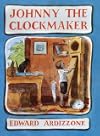
This is about a child’s unusual passion - or maybe an unusual child’s passion. Johnny is determined to make a grandfather clock, and goes to great and creative lengths to do so.
Johnny's self-belief is nearly quashed by parents who demean him, mock his ambition, and complain about the resulting noise and mess.
Fortunately, Johnny is helped by supportive friend, Susannah, and by Joe the blacksmith's generosity of time, encouragement - and metal parts
Like most good children’s books, it show more includes repetition (“Oh dear, Johnny is up to his nonsense again”), lists (clock components), and a carefully measured dose of something bad or sad.
Ardizzone, the artist and author
I loved many of the children’s books Ardizzone wrote and illustrated in his unique style: Sarah and Simon and No Red Paint and The Adventures of Tim and Ginger, including at sea. They were rather old-fashioned even when I read them (Johnny was published in 1960, but the first Tim one was pre-WW2). There was invariably at least one nasty or sinister adult, but the stories were always exciting, without being overly scary. I have fond memories of them all, but Johnny remains my favourite.
Ardizzone was also a “proper” artist (member of The Royal Academy of Arts), illustrator, and war artist. See http://www.edwardardizzone.org.uk/ for examples of his work. show less
Johnny's self-belief is nearly quashed by parents who demean him, mock his ambition, and complain about the resulting noise and mess.
Fortunately, Johnny is helped by supportive friend, Susannah, and by Joe the blacksmith's generosity of time, encouragement - and metal parts
Like most good children’s books, it show more includes repetition (“Oh dear, Johnny is up to his nonsense again”), lists (clock components), and a carefully measured dose of something bad or sad.
Ardizzone, the artist and author
I loved many of the children’s books Ardizzone wrote and illustrated in his unique style: Sarah and Simon and No Red Paint and The Adventures of Tim and Ginger, including at sea. They were rather old-fashioned even when I read them (Johnny was published in 1960, but the first Tim one was pre-WW2). There was invariably at least one nasty or sinister adult, but the stories were always exciting, without being overly scary. I have fond memories of them all, but Johnny remains my favourite.
Ardizzone was also a “proper” artist (member of The Royal Academy of Arts), illustrator, and war artist. See http://www.edwardardizzone.org.uk/ for examples of his work. show less
A classic. Valuable in its time for sure. Now, I'm afraid I just don't know if the target audience would care for it. I, personally, would recommend it to a child who loved pirates... because the freedom of the open sea (with no mother around) is a terrific motif, but pirates themselves are, after all, bad guys. I will continue to read anything written or illustrated by Ardizzone as I run across it.
Lists
Awards


You May Also Like


Associated Authors
Statistics
- Works
- 98
- Also by
- 83
- Members
- 2,460
- Popularity
- #10,416
- Rating
- 3.9
- Reviews
- 44
- ISBNs
- 159
- Languages
- 6
- Favorited
- 5