
Richard Rutt (1925–2011)
Author of A History of Hand Knitting
About the Author
Works by Richard Rutt
The Church Serves : Korea 1 copy
Associated Works
Journal of the Royal Institution of Cornwall, New Series, Vol VII, Part 4 (1977) — Contributor — 1 copy
Tagged
Common Knowledge
- Legal name
- Rutt, Cecil Richard
- Birthdate
- 1925-08-27
- Date of death
- 2011-07-27
- Gender
- male
- Education
- Huntingdon Grammar School, Huntingdon, UK
Kelham Theological College
University of Cambridge (Pembroke College) - Occupations
- Bishop of Leicester
- Awards and honors
- Commander of the Order of the British Empire (1973)
Order of Civil Merit, Peony Class (1974)
Bard of the Cornish Gorseth - Short biography
- A talented linguist, he worked at Bletchley Park during WW2 learning Japanese. He trained for the ministry at Kelham and, after ordination, took a degree in modern and medieval languages at Cambridge University. He went to Korea after graduation and worked there for 20 years, eventually as Bishop of Taejon. Returning to England, he served as Suffragan Bishop of St Germans until his appointment as Bishop of Leicester, a post he held from 1979 to his retirement in 1990. After the General Synod of the Church of England voted, in 1992, to admit women to the priesthood, he was Received into the Roman Catholic Church and served an an honorary assisstant priest in Falmouth.
Rutt was an enthusiastic knitter, attracting the sobriquet "The Knitting Bishop". - Nationality
- UK
- Places of residence
- Huntingdon, Cambridgeshire, England, UK
Bletchley Park
Anjung, South Korea
Seoul, South Korea
Leicester, Leicestershire, England, UK
Falmouth, Cornwall, England, UK - Associated Place (for map)
- England, UK
Members
Reviews
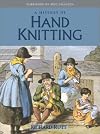
Believe it or not, I started this little history over a month ago: while I was wading through the blood and guts of Blood Meridian, I occasionally needed something with which to decompress, to take my mind off the gore and scalpings and other grotesqueries that make up McCarthy's novel. And what could be less offensive or more charming to a knitter like myself than Richard Rutt's classic treatise A History of Hand Knitting? Nothing, that's what. I leapt in and interspersed passages from Rutt show more whenever McCarthy got to be a little too much, a method that kept up my enjoyment of both books quite nicely until I finished the McCarthy and was left with unmitigated Rutt. At which point I immediately stalled. Don't get me wrong, Rutt has his excellent points: he's not only a knowledgeable guide through the history of my craft in the British Isles, but also thoroughly and unintentionally hilarious as only an Englishman can be. I could picture him (in my mind he looks a lot like John Cleese), sitting by his living-room fire with his brandy-snifter, wearing his clerical collar and discoursing with affable long-windedness about various aspects of his pet subject, perhaps boring his house-guests with his strong opinions, although they would probably be too polite to say so. Take this passage, in which he puts forth his view on the proper term for "plain knitting" (the most basic knitted fabric, flat on one side and bumpy on the other):
Oh, Bishop Rutt. So much is funny to me here: his bluntness in bemoaning the "clumsiness" of the term "stocking stitch"; his disapproval of us Americans and our inconsistency in allowing a "fancy Frenchification" to enter our vocabulary; his reversion to a superior English word (of course the English word is superior!), and his neglect of any English-speaking knitters outside the British/American dichotomy. We don't know the term used by Australian and Canadian knitters, and frankly, implies Rutt, we don't care. (As far as I know, Rutt's "fancy Frenchification" has since become the worldwide standard; an overwhelming percentage of the global population of Ravelry.com uses "stockinette.")
After the introduction and definition-of-terms sections, Rutt's style settles down to business and becomes a bit dryer. It also becomes a bit more...disorganized. Rutt seems, to me, to belong to the old school of amateur nonfiction writers, laboring away at their books in their off hours, imbuing their manuscripts with their own quirks and biases, and never being exposed to much rigor in the way of editing or streamlining their texts. At times, Rutt's book seems less like a unified narration and more like a series of marginally collected notes: in the section on knitting during the Victorian period, for example, Rutt is in full swing discussing the popularity, among women at home, of knitting for English troops during the Crimean War. Then, with no warning or transition, the reader is faced with the new section-heading "Teacosies," which begins "Teacosies were invented by the Victorians, but, though some connoisseurs of tea believe cosies spoil tea by stewing it, they are not decorative trivia." No connection is ever made between the Crimean War and the vogue for teacosies, which is understandable, because there isn't one. Nonetheless, a basic run-down in high-school-level paragraph transitions would have done a lot to streamline the logic of Rutt's text. I found that it got even choppier as it progressed, degenerating into a series of mostly-unconnected short biographies of the major designers and knitting innovators of the twentieth century.
Rutt is also big into debunking knitting myths. From a historical perspective, I respect and applaud him for his accuracy on this, but at times he comes across as a bit of a wet blanket. About half the section headings feature Rutt dismantling one errant idea or another: in the section on fishermens' ganseys, for example (a traditional form of knitted shirt made around the coastline of England in the nineteenth and early twentieth centuries), he discusses the common romantic notion that each clan or family had a characteristic set of stitch patterns that were passed down through the generations. Not true, says Rutt: all over England, ganseys looked the same. (He discredits this same idea all over again in the section on Aran cabled jumpers.) In the afore-mentioned section about the Crimean War, he discusses the popular idea that the garment "balaclava" got its name from the Battle of Balaclava, and that this is the first place soldiers wore such a thing. Untrue! cries Rutt: the garments themselves existed long before the war, and the modern name for them didn't come into use until many years afterward. Alright then. LIkewise, while it's true that the term "cardigan" derives from the title of the Earl of Cardigan, the man who led the disastrous Charge of the Light Brigade, Rutt hastens to assure us that
And so on. I certainly wouldn't want Rutt to sacrifice accuracy, but he seems to take greater glee in debunking romantic misconceptions than in communicating the truly amazing and unusual aspects of knitting history, or even conveying an interest in his subject.
And there are many interesting tidbits stashed away in this book of his, if only he would highlight them. (See that subject transition? Eh?) For example, he discusses the moral outrage that accompanied the rise of knitting during the Elizabethan era: ministers were preaching against it from the pulpit, a fact which is sure to bring a smile to any modern knitter's face. It turns out that stocking-knitting became big business in Elizabethan times, primarily because of the male fashion for extremely short "trunk hose" giving way to brilliantly-colored, tight-fitting stockings (the classic "men in tights" look). Apparently, the fashion in stockings for upper-class men changed so frequently and dramatically that poor cottagers all over England could make extra money by churning out the newest style and selling their wares to wealthy Londoners. In fact, so fickle were the fashions that, even though machine knitting had been invented, it wouldn't really be practical for another hundred years: a machine was a large capital investment that could only knit one type of stocking, whereas a hand-knitter was infinitely versatile and could start immediately. Women's stockings were less flamboyant, but still too showy for many preachers, who reprimanded Elizabethan ladies for their vanity and lack of modesty in showing off their legs. (No record of reprimands to the men, whose outfits were even more revealing.)
Anyway, not something I would recommend except to those seriously committed to learning more about the subject, who are probably the only people who would be tempted to pick it up in the first place. So it's all good. show less
This fabric is known in the British Isles as 'stocking stitch', a clumsy name including the imprecise word 'stitch.' It was formerly known as 'stockinet', which was probably derived from 'stocking-net.' In America it is called 'stockinette', with a fancy Frenchification of the spelling which is curiously at odds with the rationalism of received American spelling. The older English word has much to recommend it, and I have used it freely in this book.
Oh, Bishop Rutt. So much is funny to me here: his bluntness in bemoaning the "clumsiness" of the term "stocking stitch"; his disapproval of us Americans and our inconsistency in allowing a "fancy Frenchification" to enter our vocabulary; his reversion to a superior English word (of course the English word is superior!), and his neglect of any English-speaking knitters outside the British/American dichotomy. We don't know the term used by Australian and Canadian knitters, and frankly, implies Rutt, we don't care. (As far as I know, Rutt's "fancy Frenchification" has since become the worldwide standard; an overwhelming percentage of the global population of Ravelry.com uses "stockinette.")
After the introduction and definition-of-terms sections, Rutt's style settles down to business and becomes a bit dryer. It also becomes a bit more...disorganized. Rutt seems, to me, to belong to the old school of amateur nonfiction writers, laboring away at their books in their off hours, imbuing their manuscripts with their own quirks and biases, and never being exposed to much rigor in the way of editing or streamlining their texts. At times, Rutt's book seems less like a unified narration and more like a series of marginally collected notes: in the section on knitting during the Victorian period, for example, Rutt is in full swing discussing the popularity, among women at home, of knitting for English troops during the Crimean War. Then, with no warning or transition, the reader is faced with the new section-heading "Teacosies," which begins "Teacosies were invented by the Victorians, but, though some connoisseurs of tea believe cosies spoil tea by stewing it, they are not decorative trivia." No connection is ever made between the Crimean War and the vogue for teacosies, which is understandable, because there isn't one. Nonetheless, a basic run-down in high-school-level paragraph transitions would have done a lot to streamline the logic of Rutt's text. I found that it got even choppier as it progressed, degenerating into a series of mostly-unconnected short biographies of the major designers and knitting innovators of the twentieth century.
Rutt is also big into debunking knitting myths. From a historical perspective, I respect and applaud him for his accuracy on this, but at times he comes across as a bit of a wet blanket. About half the section headings feature Rutt dismantling one errant idea or another: in the section on fishermens' ganseys, for example (a traditional form of knitted shirt made around the coastline of England in the nineteenth and early twentieth centuries), he discusses the common romantic notion that each clan or family had a characteristic set of stitch patterns that were passed down through the generations. Not true, says Rutt: all over England, ganseys looked the same. (He discredits this same idea all over again in the section on Aran cabled jumpers.) In the afore-mentioned section about the Crimean War, he discusses the popular idea that the garment "balaclava" got its name from the Battle of Balaclava, and that this is the first place soldiers wore such a thing. Untrue! cries Rutt: the garments themselves existed long before the war, and the modern name for them didn't come into use until many years afterward. Alright then. LIkewise, while it's true that the term "cardigan" derives from the title of the Earl of Cardigan, the man who led the disastrous Charge of the Light Brigade, Rutt hastens to assure us that
There is no evidence that he wore such a garment during the three short months he spent in the Crimea...A "cardigan body warmer" might have suited his needs, but, if he had one in the Crimea, nobody recorded it. It is more likely that he used the garment during his last years at Deene Park, Northamptonshire. English country houses were notoriously cold.
And so on. I certainly wouldn't want Rutt to sacrifice accuracy, but he seems to take greater glee in debunking romantic misconceptions than in communicating the truly amazing and unusual aspects of knitting history, or even conveying an interest in his subject.
And there are many interesting tidbits stashed away in this book of his, if only he would highlight them. (See that subject transition? Eh?) For example, he discusses the moral outrage that accompanied the rise of knitting during the Elizabethan era: ministers were preaching against it from the pulpit, a fact which is sure to bring a smile to any modern knitter's face. It turns out that stocking-knitting became big business in Elizabethan times, primarily because of the male fashion for extremely short "trunk hose" giving way to brilliantly-colored, tight-fitting stockings (the classic "men in tights" look). Apparently, the fashion in stockings for upper-class men changed so frequently and dramatically that poor cottagers all over England could make extra money by churning out the newest style and selling their wares to wealthy Londoners. In fact, so fickle were the fashions that, even though machine knitting had been invented, it wouldn't really be practical for another hundred years: a machine was a large capital investment that could only knit one type of stocking, whereas a hand-knitter was infinitely versatile and could start immediately. Women's stockings were less flamboyant, but still too showy for many preachers, who reprimanded Elizabethan ladies for their vanity and lack of modesty in showing off their legs. (No record of reprimands to the men, whose outfits were even more revealing.)
Anyway, not something I would recommend except to those seriously committed to learning more about the subject, who are probably the only people who would be tempted to pick it up in the first place. So it's all good. show less
It is, alas, the reprinting which means the plates are black and white, not in color. I'll keep my eyes open for the original printing, but don't plan on mortgaging the house to get it. This is the bible for knitting historians. I can see why. He draws no conclusions, but presents an exhaustive review of knitting through the ages. He takes extant pieces, dates and analyzes them, he delves into other people's work and analyzes it, too. I've skimmed it a couple of times, and looked at the show more pictures several more times. But, like most of us I think, I have never read it cover to cover. Until now. I'm impressed. I'm educated. I'm inspired. Can't really ask for more than that, now can I? show less
This was well-written but a little too technical for me. I was thinking the book would focus on a brief history of knitting and then give examples of historical turning points with respect to knitting and textiles. What I got was a very detailed history of knitting and a lot of descriptions of many different stitches and their origins and what other stitches were influenced by them.
All in all this would be a very good book if you had a keen interest in or a developed skillset in the art of show more knitting. I have neither but I still enjoyed this book. show less
All in all this would be a very good book if you had a keen interest in or a developed skillset in the art of show more knitting. I have neither but I still enjoyed this book. show less

Although Rutt himself admits that his work is not complete, and in fact expresses his hopes that some later scholar might improve upon it, his History of Hand Knitting remains one of the most thorough histories of knitting to date. There are certainly pieces of his work that have been disputed and even disproven, but that was, I feel, part of the reason he published in the first place: to set the facts out as he found them, and invite others to continue his research.
Despite its occasional show more flaws and inaccuracies, this is still a good read, and still one of the touchstone works of knitting history. show less
Despite its occasional show more flaws and inaccuracies, this is still a good read, and still one of the touchstone works of knitting history. show less
Lists
You May Also Like


Associated Authors
Statistics
- Works
- 10
- Also by
- 1
- Members
- 677
- Popularity
- #37,311
- Rating
- 4.1
- Reviews
- 11
- ISBNs
- 14
- Favorited
- 1