
Michael D. Watkins
Author of The First 90 Days: Critical Success Strategies for New Leaders at All Levels
About the Author
Works by Michael D. Watkins
The First 90 Days: Critical Success Strategies for New Leaders at All Levels (2003) 1,935 copies, 29 reviews
Your Next Move: The Leader's Guide to Navigating Major Career Transitions (2009) 68 copies, 2 reviews
Master Your Next Move, with a New Introduction: The Essential Companion to "The First 90 Days" (2019) 40 copies, 1 review
The Six Disciplines of Strategic Thinking: Leading Your Organization into the Future (2024) 38 copies
Winning the Influence Game: What Every Business Leader Should Know about Government (2001) 12 copies
Breakthrough International Negotiation: How Great Negotiators Transformed the World's Toughest Post-Cold War Conflicts (2001) 10 copies
Los primeros 90 días (The First 90 days, Updated and Expanded edition Spanish Edition) (2017) 7 copies
The First 90 Days, Newly Revised and Updated: Proven Strategies for Getting Up to Speed Faster and Smarter (2023) 2 copies
Associated Works
Public Sector Employment in a Time of Transition (Industrial Relations Research Association Series) (1996) — Contributor — 10 copies
Tagged
Common Knowledge
- Gender
- male
- Education
- Harvard University (PhD|Decision Science)
- Organizations
- International Institute for Management Development
Members
Reviews
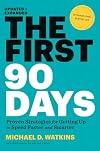
The First 90 Days: Proven Strategies for Getting Up to Speed Faster and Smarter, Updated and Expanded by Michael Watkins
Starting any new job is tough, and the pressure cooker is even hotter if the job involves leadership of some sort. There’s simply so much history and dynamics that the new leader is unaware of and so many new difficulties that have not been surmounted. Yet leaders are responsible for lots, and their actions can impact how hundreds of thousands of dollars – if not millions – are spent. How can we improve the chances of success? This book offers practical ways organizations can help show more their leaders achieve early and lasting success at their new roles.
Several of Watkins’ suggestions stand out in my mind. First, aim for early successes, no matter how small, in order to gain credibility. Second, plan out the first 90 days and stick to the plan. Third, organizations can have employees explicitly focused towards leadership transitions to smooth the waters. Finally, Watkins provides several conceptual buckets to help the new leader understand the company’s and new position’s main challenge.
This book certainly addresses an important issue in an original, novel way. It’s geared specifically towards senior leadership (leaders of leaders), where much is at stake. It does not significantly address lower levels of the organization, like managers and lower-level leaders. Likely, this is because much less is at stake. An opportunity is nonetheless missed at broadening the potential audience of this book. By focusing on the highest levels of leadership, more general job transitions are not really addressed in this work. That’s a definite shortcoming.
For its niche – executive-level enterprise leadership – this book seems to hit the nail on the head. Nonetheless, it seems to avoid other opportunities to generalize its insights. It definitely gave me a thing or two to think about, and its analytical power stands out. I just wish that it hit more than the C-suite. show less
Several of Watkins’ suggestions stand out in my mind. First, aim for early successes, no matter how small, in order to gain credibility. Second, plan out the first 90 days and stick to the plan. Third, organizations can have employees explicitly focused towards leadership transitions to smooth the waters. Finally, Watkins provides several conceptual buckets to help the new leader understand the company’s and new position’s main challenge.
This book certainly addresses an important issue in an original, novel way. It’s geared specifically towards senior leadership (leaders of leaders), where much is at stake. It does not significantly address lower levels of the organization, like managers and lower-level leaders. Likely, this is because much less is at stake. An opportunity is nonetheless missed at broadening the potential audience of this book. By focusing on the highest levels of leadership, more general job transitions are not really addressed in this work. That’s a definite shortcoming.
For its niche – executive-level enterprise leadership – this book seems to hit the nail on the head. Nonetheless, it seems to avoid other opportunities to generalize its insights. It definitely gave me a thing or two to think about, and its analytical power stands out. I just wish that it hit more than the C-suite. show less
The First 90 Days: Proven Strategies for Getting Up to Speed Faster and Smarter, Updated and Expanded by Michael Watkins
"No battle plan survives first contact with the enemy." Field Marshal Helmuth von Moltke was telling us that tactical results dictate strategy, and that's worth remembering in a new job. No amount of research into your new company will keep you from at some point wondering what the heck you got into. In my first 90 days at another new job, Michael Watkins' onboarding framework was most helpful in working through these course corrections. What seems at first like a startup business can show more instead present a growth or turnaround scenario--scaling up or scaling down--each needing a different approach. The revelation here was the advice to "accelerate everyone." Your transition is your new co-workers' transition, too. An outsider perspective helps you spot change afoot, and make it work. show less
The First 90 Days: Proven Strategies for Getting Up to Speed Faster and Smarter, Updated and Expanded by Michael Watkins
One of the clearest symptoms of modern MBA brain poisoning is that everyone knows that it takes leaders a lot of time to get up to speed on a new organization, and even longer to demonstrate results. Yet the average tenure of an executive is a bit over two years. Companies are constantly shuffling around more or less identical haircuts in the hopes of something different happening.
Stock photo of a Real Business Situation. Can you help this man draw a plot that goes up and to the right?
In the show more desolate wasteland of business books, The First 90 Days is pretty good. Watkins makes several key observations: First, your success as a leader will depend on establishing credibility early. What counts as credibility is local to each organization. As such it is important to objectively figure out what kind of situation you're in, and act appropriately.
Start-Ups have limited resources and need to scale quickly, requiring agility and inspirational leadership. Turnarounds require decisive action to cut out dead wood and restore morale in broken organizations. Aggressive growth has to take a successful project or culture and make it big, without sacrificing what made it valuable in the first place. And finally, reframing and business as usual require slower and more sensitive skills.
Watkins also recommends a clear timeline, with 30 days to get your bearings and another 60 to deliver results. Work with your superiors and subordinates so they understand the need for deliberate speed, and things will go better. And as always, the politics are foremost. show less
Stock photo of a Real Business Situation. Can you help this man draw a plot that goes up and to the right?
In the show more desolate wasteland of business books, The First 90 Days is pretty good. Watkins makes several key observations: First, your success as a leader will depend on establishing credibility early. What counts as credibility is local to each organization. As such it is important to objectively figure out what kind of situation you're in, and act appropriately.
Start-Ups have limited resources and need to scale quickly, requiring agility and inspirational leadership. Turnarounds require decisive action to cut out dead wood and restore morale in broken organizations. Aggressive growth has to take a successful project or culture and make it big, without sacrificing what made it valuable in the first place. And finally, reframing and business as usual require slower and more sensitive skills.
Watkins also recommends a clear timeline, with 30 days to get your bearings and another 60 to deliver results. Work with your superiors and subordinates so they understand the need for deliberate speed, and things will go better. And as always, the politics are foremost. show less
The First 90 Days: Proven Strategies for Getting Up to Speed Faster and Smarter, Updated and Expanded by Michael Watkins
This is a resource book that is full of useful counsel for leaders. However (ironically) I wouldn’t recommend it for leaders in the midst of transition. Reading this during my first 90 days in a new role was stressful. I wish I’d read it before so that some of these strategies were available for me to learn, prepare and use during the transition.
I also think the idea that failure is imminent without utilizing every idea outlined in the book is unhelpful - not that such an idea is ever show more explicitly stated but it is inherent in the introductory vignettes at the start of each chapter. I had to resort to skimming just so I didn’t bring a feeling of failure with me to work every day.
But I still give it 4 stars and I still really respect and value the guidance offered in this book. Just read it before day 1 or after day 90 show less
I also think the idea that failure is imminent without utilizing every idea outlined in the book is unhelpful - not that such an idea is ever show more explicitly stated but it is inherent in the introductory vignettes at the start of each chapter. I had to resort to skimming just so I didn’t bring a feeling of failure with me to work every day.
But I still give it 4 stars and I still really respect and value the guidance offered in this book. Just read it before day 1 or after day 90 show less
Lists
My List (1)
You May Also Like


Associated Authors
Statistics
- Works
- 19
- Also by
- 2
- Members
- 2,204
- Popularity
- #11,638
- Rating
- 3.6
- Reviews
- 32
- ISBNs
- 63
- Languages
- 10