
Kaveh Akbar
Author of Martyr!
About the Author
Kaveh Akbar is the author of a previous poetry collection, Calling a Wolf a Wolf, and the editor of The Penguin Book of Spiritual Verse: 100 Poets on the Divine. He serves as the poetry editor of the Nation and teaches at Purdue University and in the low-residency MFA programs at Randolph College show more and Warren Wilson. show less
Image credit: Wikipedia
Works by Kaveh Akbar
The Penguin Book of Spiritual Verse: 110 Poets on the Divine (Penguin Classics) (2022) 64 copies, 1 review
Love and War 1 copy
Associated Works
Ink Knows No Borders: Poems of the Immigrant and Refugee Experience (2019) — Contributor — 87 copies, 1 review
Bodies Built for Game: The Prairie Schooner Anthology of Contemporary Sports Writing (2019) — Contributor — 7 copies
Tagged
Common Knowledge
- Canonical name
- Akbar, Kaveh
- Birthdate
- 1989
- Gender
- male
- Occupations
- dichter
- Nationality
- Iran
- Birthplace
- Tehran, Iran
- Places of residence
- Tallahassee, Florida, USA
- Associated Place (for map)
- Tehran, Iran
Members
Reviews

Living happened until it didn't. There was no choice in it. To say no to a new day would be unthinkable. So each morning you said yes, then stepped into the consequence.
Cyrus immigrated to the US with his father when he was a baby. He was raised by a depressed single father who worked at a chicken farm and died soon after Cyrus graduated high school. Cyrus stayed in the Midwest for college and stayed in the same town after graduation, doing the same low-paying jobs he'd done in college and show more mainly drinking and taking drugs and not writing. After he gets sober, he's still not writing but he's not writing about the lives of famous martyrs, fascinated by their meaningful deaths.
I do like a sad sack doomed poet type, so I was predisposed to like this book, but it's also beautifully written. Akbar is a poet, and it shows in the word choices and how he can do so much in very few words. The novel centers Cyrus, but it's also about his absent family, with chapters told from the point of view of his mother, father and uncle, all of whom have fascinating stories to recount. And Cyrus also has a good friend, Zee, and a sponsor at AA who cares for him and sticks with him despite their differences. This is a novel that plays with language, moves around with some chapters leaning towards humor, and builds into a novel with a great deal of heart. I really loved this book and I'm looking forward to Akbar's next novel. show less
Cyrus immigrated to the US with his father when he was a baby. He was raised by a depressed single father who worked at a chicken farm and died soon after Cyrus graduated high school. Cyrus stayed in the Midwest for college and stayed in the same town after graduation, doing the same low-paying jobs he'd done in college and show more mainly drinking and taking drugs and not writing. After he gets sober, he's still not writing but he's not writing about the lives of famous martyrs, fascinated by their meaningful deaths.
I do like a sad sack doomed poet type, so I was predisposed to like this book, but it's also beautifully written. Akbar is a poet, and it shows in the word choices and how he can do so much in very few words. The novel centers Cyrus, but it's also about his absent family, with chapters told from the point of view of his mother, father and uncle, all of whom have fascinating stories to recount. And Cyrus also has a good friend, Zee, and a sponsor at AA who cares for him and sticks with him despite their differences. This is a novel that plays with language, moves around with some chapters leaning towards humor, and builds into a novel with a great deal of heart. I really loved this book and I'm looking forward to Akbar's next novel. show less
Cyrus is an Iranian American whose mother was killed shortly after he was born, shot down in the infamous Iran Air Flight 655 by an American Navy warship during the Iran-Iraq war. He and his father eventually move to the American Midwest, where Cyrus spends a gloomy childhood. He eventually goes to college, becomes an addict and an alcoholic, gets sober, and becomes obsessed with the idea of martyrs. In addition to his dead mother, his uncle served in the war doing “the strangest job in show more the Persian army”: He masqueraded as an angel in the battlefields of dying men at night, “to inspire the dying men to die with dignity, conviction. To keep them from suicide.” So that they could die as martyrs. Chronically depressed Cyrus wants his own death to be meaningful. So it’s not surprising that he is interested in visiting the performance art “Death-Speak” of Orkideh, who is dying of cancer and spending her remaining days sitting in the Brooklyn Museum just speaking with visitors.
I didn’t expect to love this as much as I did. Kaveh Akbar is a poet, and it shows in the lovely prose (as well as bits of poems from Cyrus’s book-in-progress). The plot summary sounded grim and unappealing, but this turned out to be a warm, engaging, and sometimes even funny tale about human connection. The ending is somewhat open to interpretation, but however you read it, it’s about what gives death, or life, its meaning. show less
I didn’t expect to love this as much as I did. Kaveh Akbar is a poet, and it shows in the lovely prose (as well as bits of poems from Cyrus’s book-in-progress). The plot summary sounded grim and unappealing, but this turned out to be a warm, engaging, and sometimes even funny tale about human connection. The ending is somewhat open to interpretation, but however you read it, it’s about what gives death, or life, its meaning. show less
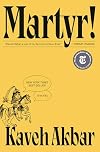
Just a beautiful fucking book. Beautifully written, beautifully structured. Witty and thought-provoking. And it made me cry in a way I haven’t in a long while. Just fucking awesome. An instant favorite I can’t wait to re-read.
This book grabbed me by the heartstrings and took me on a trip. I was drawn into the story by its sheer originality and the pacing kept me on my toes. Just when I thought I had a handle on things, starting to feel comfortable, it slapped me in the face. I was NOT hooked from the start, I was upset. I hated how vividly the bedwetting descriptions were described and I wasn't immediately drawn to the main character, Cyrus. His flaws and shortcomings made him difficult to like, but as the story show more unfolded and I learned more about his family and background, I found myself rooting for him. From laughter to tears, despair to hope, I felt it all as I followed Cyrus and his family. The book is equal parts poetry and satire, offering a thought-provoking commentary on imperialism and capitalism while also serving as a love letter to humanity. It deserves to be read and reread, and I think it will stay with me. Read it! show less
Lists
Awards


You May Also Like


Associated Authors
Statistics
- Works
- 9
- Also by
- 9
- Members
- 2,888
- Popularity
- #8,873
- Rating
- 4.1
- Reviews
- 70
- ISBNs
- 44
- Languages
- 8
- Favorited
- 1