
John Whiteside Parsons (1) (1914–1952)
Author of Freedom Is a Two-Edged Sword and Other Essays
For other authors named John Whiteside Parsons, see the disambiguation page.
Works by John Whiteside Parsons
Associated Works
Tagged
Common Knowledge
- Birthdate
- 1914
- Date of death
- 1952
- Gender
- male
- Organizations
- Ordo Templi Orientis
- Cause of death
- laboratory explosion
- Nationality
- USA
- Birthplace
- Los Angeles, California, USA
- Place of death
- Pasadena, California, USA
- Associated Place (for map)
- California, USA
Members
Reviews

This is a limited edition book of 418 copies. I'm a big admirer of Jack Parsons. He was a pioneer rocket scientist, co-founder of the Jet Propulsion Labratory and occultist. He was also a friend of Aleister Crowley, L. Ron Hubbard (long before he invented Scientology) and head of the American branch of the O.T.O. He was most likely assassinated by a government agency by a "freak" explosion at Parsons' lab in 1952. He was 37.
The book is divided up into three essays, as the title implies: show more "Freedom is a Lonely Star", "Freedom is a Two-Edged Sword", and "Doing Your Will". These essays were absolutely fantastic. I knew Parsons was a really smart guy, but I didn't know how skilled of a writer he was, that is, until now. In his essays, Parsons skillfully makes his case and exhibits remarkable prescience. I had expected them to be somewhat dated, but they still ring true and are eerily relevant even in 2008. In the final essay, "Doing Your Will", Parsons explains Crowley's LIBER AL vel LEGIS (The Book of the Law) and how Crowley's Thelemic teachings correspond with Parson's philosophy and modern politics in general. show less
The book is divided up into three essays, as the title implies: show more "Freedom is a Lonely Star", "Freedom is a Two-Edged Sword", and "Doing Your Will". These essays were absolutely fantastic. I knew Parsons was a really smart guy, but I didn't know how skilled of a writer he was, that is, until now. In his essays, Parsons skillfully makes his case and exhibits remarkable prescience. I had expected them to be somewhat dated, but they still ring true and are eerily relevant even in 2008. In the final essay, "Doing Your Will", Parsons explains Crowley's LIBER AL vel LEGIS (The Book of the Law) and how Crowley's Thelemic teachings correspond with Parson's philosophy and modern politics in general. show less
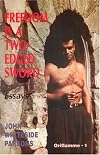
This compilation of essays by the late rocket scientist and adherent of Aleister Crowley, Jack Parsons, is stirring in its best moments, though it is too often hackneyed and derivative. There are convincing arguments made in the titular essay, where Parsons seems to distill the spirit of Crowley into a fiery and effective political manifesto. After this, we are presented with Parsons thoughts on magick in a series of essays that are for the most part comprised only of surviving fragments. show more With these, Parson's begins to lean on abstractions with little exposition, throwing around terms like love and freedom as though they were concrete in and of themselves. His voice turns artificial, attempting to mimic Crowley's poetic phrasing as a vehicle for ideas far less interesting than those of his predecessor. The foremost essay offers valuable insights, but the same cannot be said for the remaining sections here. show less

Lists
el (1)
You May Also Like


Associated Authors
Statistics
- Works
- 6
- Also by
- 1
- Members
- 228
- Popularity
- #98,696
- Rating
- 4.4
- Reviews
- 3
- ISBNs
- 10


