
Tom Griffiths (4)
Author of Algorithms to Live By: The Computer Science of Human Decisions
For other authors named Tom Griffiths, see the disambiguation page.
Works by Tom Griffiths
Tagged
Common Knowledge
- Gender
- male
Members
Reviews

When a computer alphabetizes a list of words, or fits a curve to a series of data points, or decides what it should keep handy in parts of its memory it can access quickly, what exactly is it doing? Well, it's using an algorithm, some set of instructions that give it the rules for how it should proceed in tackling the problem before it. Of course, for any given problem some algorithms may be more efficient or give better results than others, and a lot of computer science and a fair amount of show more mathematics is dedicated to finding the best algorithms for the problems we want solved. And those rules are often ones we humans can use, too, whether we're deciding which tasks to tackle first in order to miss the fewest deadlines, or re-organizing our closets, or deciding when to stop driving around looking for a better parking space.
And that's what this book is about: algorithms of the kind computers use, and their applications in the real world. Which, I admit, sounds dull. I suppose to most people, it may be dull. But, giant nerd that I am, I found it fascinating. Intellectually exciting, even. How amazing is it that a very small change in the requirements of a problem can alter the task of finding the best solution from a simple to an impossible one... or that, by going back to the simpler version of the problem and working from there, you can often come very, very close to that best solution, anyway? This book is full of things like that that made me go wow, from the notion that introducing randomness into calculations about non-random things can actually give better results, to guidelines on how to make the best possible guesses based on completely insufficient data, to the welcome confirmation that I'm already intuitively using the optimal methods for alphabetizing my bookshelves.
It's all wonderfully well-written, too: beautifully comprehensible and full of excellent examples. There's also, for my mind, exactly the right amount of math, as the authors talk us through careful mathematical thinking without ever getting bogged down in equations. Or computer code, for that matter. It's all just nice, clear, readable English.
Am I going to go out now and apply the algorithms discussed here towards improving my own life? Well... maybe. Did I come away from it feeling like I understand the world better? I think so. Did I come away feeling I understand more about the tools we have for understanding the world? Absolutely. I also may have come away regretting more than ever that I didn't major in computer science, because it really did just light up all kinds of nerdy areas in my brain. show less
And that's what this book is about: algorithms of the kind computers use, and their applications in the real world. Which, I admit, sounds dull. I suppose to most people, it may be dull. But, giant nerd that I am, I found it fascinating. Intellectually exciting, even. How amazing is it that a very small change in the requirements of a problem can alter the task of finding the best solution from a simple to an impossible one... or that, by going back to the simpler version of the problem and working from there, you can often come very, very close to that best solution, anyway? This book is full of things like that that made me go wow, from the notion that introducing randomness into calculations about non-random things can actually give better results, to guidelines on how to make the best possible guesses based on completely insufficient data, to the welcome confirmation that I'm already intuitively using the optimal methods for alphabetizing my bookshelves.
It's all wonderfully well-written, too: beautifully comprehensible and full of excellent examples. There's also, for my mind, exactly the right amount of math, as the authors talk us through careful mathematical thinking without ever getting bogged down in equations. Or computer code, for that matter. It's all just nice, clear, readable English.
Am I going to go out now and apply the algorithms discussed here towards improving my own life? Well... maybe. Did I come away from it feeling like I understand the world better? I think so. Did I come away feeling I understand more about the tools we have for understanding the world? Absolutely. I also may have come away regretting more than ever that I didn't major in computer science, because it really did just light up all kinds of nerdy areas in my brain. show less
 This review was written for LibraryThing Early Reviewers.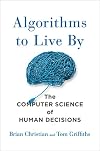
The highest praise I can give a book is to say it changed my life. This book changed my life before I had even finished reading it.
At the same time, I hesitate to recommend the book broadly because it was such a perfect book for me that I have to assume it would be less perfect for almost anyone else.
Briefly, "Algorithms to Live By" presents a series of well-known computer algorithms and explains how they are used to solve common problems in computer science. Then it takes each algorithm and show more applies it to real-world problems, discussing whether or not we, as human beings, approximate the algorithm's behavior with our own actions.
This may make the book sound incredibly dry, like the authors are trying to turn people into computers and squelch out all humanity. Instead, the authors are taking an algorithmic look the human condition. (E.g., how does the explore/exploit trade-off explain why there are certain times in our lives when it's easier or harder for us to make new friends? Can the concept of intractability free us from worrying about making perfect choices?)
If you have a strong background in computer science, you probably won't learn anything new from the algorithms presented in this book, although you may still be interested in some of the real-world applications of those algorithms. However, if you have little background in computer science, but an interest in algorithms and a patience for technical prose—seriously, this is the kind of book where you have to stop and think for a minute between each paragraph—this is the book for you.
You may even find that this book significantly changes the way you approach some aspects of your life, or at least helps you better understand why you behave the way you do. show less
At the same time, I hesitate to recommend the book broadly because it was such a perfect book for me that I have to assume it would be less perfect for almost anyone else.
Briefly, "Algorithms to Live By" presents a series of well-known computer algorithms and explains how they are used to solve common problems in computer science. Then it takes each algorithm and show more applies it to real-world problems, discussing whether or not we, as human beings, approximate the algorithm's behavior with our own actions.
This may make the book sound incredibly dry, like the authors are trying to turn people into computers and squelch out all humanity. Instead, the authors are taking an algorithmic look the human condition. (E.g., how does the explore/exploit trade-off explain why there are certain times in our lives when it's easier or harder for us to make new friends? Can the concept of intractability free us from worrying about making perfect choices?)
If you have a strong background in computer science, you probably won't learn anything new from the algorithms presented in this book, although you may still be interested in some of the real-world applications of those algorithms. However, if you have little background in computer science, but an interest in algorithms and a patience for technical prose—seriously, this is the kind of book where you have to stop and think for a minute between each paragraph—this is the book for you.
You may even find that this book significantly changes the way you approach some aspects of your life, or at least helps you better understand why you behave the way you do. show less
This review was written for LibraryThing Early Reviewers.Thought provoking on multiple levels.
Decisions, while part and parcel of the human condition, are increasingly being foisted onto computers. In order to accomplish this, the complexity of the decision must be manipulated to allow the machine to come to a "good' decision however "good" has been defined. Turns out that deconstructing decision making for computers can teach humans a thing or two about decision best practices. Authors Brian Christian and Tom Griffiths apply the problems and show more solutions of algorithm construction to humans and provide us with a manual of how to streamline some of the messy conundrums we can find ourselves in.
It's a good book and I learned a great deal about computers processes. And I did learn a number of interesting insights into human decision making. What I did not appreciate with the book was a subtle implied superiority of computers versus humans. I supposed I shouldn't be surprised as both authors are heavily involved in the artifical intelligence community but I am of the mind that the loss of data required in reversion to the mean/median can often entail the loss of the most interesting data. Plus the restricting of inputs/options which the authors labeled as a computational 'kindness' can be anything but (why does the US presidental election come to mind here?). So while I can most definitely recommend this book to just about anyone it is a recomendation that comes with reservations. show less
Decisions, while part and parcel of the human condition, are increasingly being foisted onto computers. In order to accomplish this, the complexity of the decision must be manipulated to allow the machine to come to a "good' decision however "good" has been defined. Turns out that deconstructing decision making for computers can teach humans a thing or two about decision best practices. Authors Brian Christian and Tom Griffiths apply the problems and show more solutions of algorithm construction to humans and provide us with a manual of how to streamline some of the messy conundrums we can find ourselves in.
It's a good book and I learned a great deal about computers processes. And I did learn a number of interesting insights into human decision making. What I did not appreciate with the book was a subtle implied superiority of computers versus humans. I supposed I shouldn't be surprised as both authors are heavily involved in the artifical intelligence community but I am of the mind that the loss of data required in reversion to the mean/median can often entail the loss of the most interesting data. Plus the restricting of inputs/options which the authors labeled as a computational 'kindness' can be anything but (why does the US presidental election come to mind here?). So while I can most definitely recommend this book to just about anyone it is a recomendation that comes with reservations. show less
This review was written for LibraryThing Early Reviewers.After a very long time I read a book that I could completely relate to. Having been a programmer decades ago, I loved reveling in the algorithms I had long stopped thinking about. But personal nostalgia aside, here's why I loved the book (to give it the rare 5 stars).
There are books on decision making, there are books on behavioral economics and then there are books on computer science. This book combines all three inside one cover to give a pretty comprehensive view of how people behave and show more decide things along with the underlying principles of how it's done in the computer sciences' world.
The book merely iterates or perhaps explains to us what we intrinsically know and do by citing how it's done in the computer world. That bridge between what seemed abstract and computational versus the invisible logic and processes in our own minds and lives is what sets this book apart.
It delves into some complex topics, but the authors manage to simplify it for the readers which is something very few authors can do. The duo have written a book that any student of psychology or computer science would love to read. show less
There are books on decision making, there are books on behavioral economics and then there are books on computer science. This book combines all three inside one cover to give a pretty comprehensive view of how people behave and show more decide things along with the underlying principles of how it's done in the computer sciences' world.
The book merely iterates or perhaps explains to us what we intrinsically know and do by citing how it's done in the computer world. That bridge between what seemed abstract and computational versus the invisible logic and processes in our own minds and lives is what sets this book apart.
It delves into some complex topics, but the authors manage to simplify it for the readers which is something very few authors can do. The duo have written a book that any student of psychology or computer science would love to read. show less
Lists
Awards

Statistics
- Works
- 1
- Members
- 1,875
- Popularity
- #13,735
- Rating
- 4.0
- Reviews
- 51
- ISBNs
- 62
- Languages
- 6
