
Richard R. Brettell (1949–2020)
Author of A Day in the Country: Impression and the French Landscape (cat. exp.)
About the Author
Richard Brettell is Professor of Aesthetic Studies at the University of Texas at Dallas.
Works by Richard R. Brettell
Gauguin : [cat. exp., Galeries Nationales du Grand Palais, Paris, 10 Jan- 24 April 1989; National Gallery of Washington, 1 May - 31 July 1988; Art Institute of Chicago, 17 Sept-… (1988) 174 copies, 1 review
Camille Pissarro in the Caribbean, 1850-1855 : drawings from the collection at Olana (1996) 11 copies
The Robert Lehman Collection, Volume 9: Nineteenth and Twentieth-Century European Drawings (2002) 9 copies
Retrospective CAMILLE PISSARRO. March-April 1984. Texts by Richard R. Brettell, Barbara Stern Shapiro, and Chuji Ikegami. (1984) 4 copies
On Modern Beauty – Three Paintings by Manet, Gauguin, and Cézanne (Getty Publications – (Yale)) (2019) 4 copies
Impressionist Paintings Drawings and Sculpture: From the Wendy and Emery Reves Collection (1995) 4 copies
Monet to Matisse: The Triumph of Impressionism and the Avant Garde- The Howard D. and Babette L. Sirak Collection at the Columbus Museum of Art (2004) 2 copies
Watteau and Chardin 1 copy
Paul Gauguin 1 copy
The Nabis 1 copy
“La Fin” 1 copy
The Final Exhibition 1 copy
Henri de Toulouse-Lautrec 1 copy
Spanish School of Painting 1 copy
Manet's Later Works 1 copy
Paintings by John Alexander 1 copy
20th-Century Art I and II 1 copy
American Art I and II 1 copy
Costumes and Textiles 1 copy
The Ancient New World 1 copy
European Sculpture 1 copy
European Decorative Arts 1 copy
Photographs 1 copy
Drawing and Prints 1 copy
European Painting I-IV 1 copy
Deprtures 1 copy
Ancient Egyptian Art 1 copy
Mary Cassatt 1 copy
James Magee, the Hill 1 copy
Pissarro et la Ville 1 copy
Gustave Caillebotte 1 copy
Edgar Degas 1 copy
The Third Exhibition 1 copy
Berthe Morisot 1 copy
The First Exhibition 1 copy
Paris under Siege 1 copy
The Painters of Modern Life 1 copy
The Making of the Museum 1 copy
Pierre-Auguste Renoir 1 copy
The Shock of the New 1 copy
Napoleon III's Paris 1 copy
The Realist and the Idealist 1 copy
Asian Art 1 copy
Associated Works
Color, Line, Light: French Drawings, Watercolors, and Pastels from Delacroix to Signac (2012) — Introduction — 16 copies
Pissarro : CaixaForum, Barcelona. Del 15 d'octubre de 2013 al 26 de gener de 2014 (2013) — Contributor — 2 copies
Tagged
Common Knowledge
- Legal name
- Brettell, Richard Robson
- Other names
- Brettell, Rick
- Birthdate
- 1949-01-17
- Date of death
- 2020-07-24
- Gender
- male
- Education
- Yale University (B.A.|1971|M.A.|1973|Ph.D|1977)
- Occupations
- art historian
university professor
art curator - Organizations
- University of Texas at Dallas
Art Institute of Chicago
Dallas Museum of Art
McKinney Avenue Contemporary
French Regional and American Museum Exchange - Awards and honors
- Ordre des Arts et des Lettres
American Academy of Arts and Sciences - Cause of death
- cancer, prostate
- Nationality
- USA
- Birthplace
- Rochester, New York, USA
- Place of death
- Dallas, Texas, USA
- Associated Place (for map)
- USA
Members
Reviews
This is a catalogue of an collection of art works made by Nathan Cummings, the founder of the Sarah Lee business. Clearly, Nathan made a lot of money and this collection of paintings reflects both a good eye (maybe good advice too) but also pretty deep pockets. He seems to have started collecting around 1945...I guess, just after WWII and the majority of the collection is probably directed at art from around 1900...but also includes later works by the likes of Henry Moore. As an art book and show more a catalogue, it is very well done. Each individual work is illustrated by both an overview picture but also by one or more close-ups...which I find really interesting....especially in terms of seeing how the artist applied the paint...the brush strokes etc. Or, in the case of sculpture, the finish and the patina on the works.
Each work is also accompanied by a rather erudite essay which gives some background to the piece and also to the artist and sometimes to the way in which it was acquired by Nathan Cummings. These essays are really quite masterful. I guess the text was supplied by Richard R Brettell, who is listed as the consulting curator for the Sara Lee Collection.
The Sarah Lee corporation made a millennium gift of these art works to a number of significant museums around the world ....truly a magnanimous gesture because they are all works of considerable significance...despite the fact that Nathan was supposed to have just bought what he liked..
An interesting and beautifully illustrated book. I'm tossing up whether to keep it (with my limited shelf space) or donate it to Charity. I give it 4.5 stars. show less
Each work is also accompanied by a rather erudite essay which gives some background to the piece and also to the artist and sometimes to the way in which it was acquired by Nathan Cummings. These essays are really quite masterful. I guess the text was supplied by Richard R Brettell, who is listed as the consulting curator for the Sara Lee Collection.
The Sarah Lee corporation made a millennium gift of these art works to a number of significant museums around the world ....truly a magnanimous gesture because they are all works of considerable significance...despite the fact that Nathan was supposed to have just bought what he liked..
An interesting and beautifully illustrated book. I'm tossing up whether to keep it (with my limited shelf space) or donate it to Charity. I give it 4.5 stars. show less

This wonderful book is a catalogue of an exhibition organised by the Los Angeles County Museum of Art, The Art Institute of Chicago and the Reunion des Musees Nationaux, Paris. The artists represented include Monet, Cezanne, Renoir, Seurat, Gauguin, Manet, Signac and Pissarro.
But this book is not merely a catalogue - it stands alone as an excellent and readable book about the artistic and social worlds of the artists. The essays are interesting and mercifully free of inaccessible jargon, so show more the generalist really can learn something about the context of the Impressionist movement, the paintings themselves and the artists.
An example: the opening of the essay `The Impressionist Landscape and the Image of France: " When the Impressionists began to paint the French landscape in the 1860s, they were not alone. Several satirical writers had already counted more landscape painters than tourists or peasants in their travels through the French countryside, and the official Salon exhibitions held annually in Paris were all but dominated by French landscapes. Books and manuals about landscape painting for both amateur and professional artists abounded, and if there was a national genre in French art, it was surely landscape. The painters were joined by a legion of printmakers, draftsmen, and popular illustrators in an almost frantic collective attempt to record the national physiognamy."
The essays are:
`Impressionism in Context' - includes information on the conception of the exhibition, the grouping of paintings etc; `The Impressionist Landscape and the Image of France' (extract above) which includes reference to contemporaneous politics, writing, national movements such as rejection of historical France, the concept of nature of the Impressionsts etc; `The French Landscape Sensibility'; `The Cradle of Impressionism' - about the Seine landscape and villages; `The Urban Landscape' - Paris; ` Rivers, Roads and Trains'; `Pissarro, Cezanne and the School of Pontoise'; `Private and Public Gardens'; `The Fields of France' (lots of haystacks!); `Impressionism and the Sea'; `The Retreat from Paris'; `Impressionism and the Popular Imagination'. An appendix essay is `The Landscape in French Nineteenth-Century Photography'. The paintings are grouped under each of the themes represented by the essays.
Another standout feature of the book is the amount of contextual detail accompanying each work of art. So, for example, the first work presented is Beach at Honfleur by Claude Monet. The colour reproduction is good quality, and takes a full page. The accompanying text on the facing page explains what Monet was doing , how the painting came to be painted.
A marvellous book, a valuable addition to any personal library. I would place it in the `must have' category for an art collection in a secondary school or college library where Art is a course of study, and public libraries - because of its simultaneous accessibility and depth of information - it goes so much further than a book merely of reproductions. show less
But this book is not merely a catalogue - it stands alone as an excellent and readable book about the artistic and social worlds of the artists. The essays are interesting and mercifully free of inaccessible jargon, so show more the generalist really can learn something about the context of the Impressionist movement, the paintings themselves and the artists.
An example: the opening of the essay `The Impressionist Landscape and the Image of France: " When the Impressionists began to paint the French landscape in the 1860s, they were not alone. Several satirical writers had already counted more landscape painters than tourists or peasants in their travels through the French countryside, and the official Salon exhibitions held annually in Paris were all but dominated by French landscapes. Books and manuals about landscape painting for both amateur and professional artists abounded, and if there was a national genre in French art, it was surely landscape. The painters were joined by a legion of printmakers, draftsmen, and popular illustrators in an almost frantic collective attempt to record the national physiognamy."
The essays are:
`Impressionism in Context' - includes information on the conception of the exhibition, the grouping of paintings etc; `The Impressionist Landscape and the Image of France' (extract above) which includes reference to contemporaneous politics, writing, national movements such as rejection of historical France, the concept of nature of the Impressionsts etc; `The French Landscape Sensibility'; `The Cradle of Impressionism' - about the Seine landscape and villages; `The Urban Landscape' - Paris; ` Rivers, Roads and Trains'; `Pissarro, Cezanne and the School of Pontoise'; `Private and Public Gardens'; `The Fields of France' (lots of haystacks!); `Impressionism and the Sea'; `The Retreat from Paris'; `Impressionism and the Popular Imagination'. An appendix essay is `The Landscape in French Nineteenth-Century Photography'. The paintings are grouped under each of the themes represented by the essays.
Another standout feature of the book is the amount of contextual detail accompanying each work of art. So, for example, the first work presented is Beach at Honfleur by Claude Monet. The colour reproduction is good quality, and takes a full page. The accompanying text on the facing page explains what Monet was doing , how the painting came to be painted.
A marvellous book, a valuable addition to any personal library. I would place it in the `must have' category for an art collection in a secondary school or college library where Art is a course of study, and public libraries - because of its simultaneous accessibility and depth of information - it goes so much further than a book merely of reproductions. show less
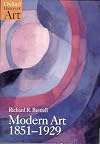
Richard R. Brettell's innovative and beautifully-illustrated account, the latest addition to the acclaimed Oxford History of Art series, explores the works of artists such as Monet, Gauguin, Picasso, and Dali--as well as lesser-known figures--in relation to expansion, colonialism, nationalism and internationalism, and the rise of the museum. Beginning with The Great Exhibition of 1851 in London, Brettell follows the development of the major European avant-garde groups: the Realists, show more Impressionists, Post-Impressionists, Symbolists, Cubists, and Surrealists. Giving attention to the changing social, economic, and political climate, the book focuses on conditions for the development of modern art such as urban capitalism, modernity, and the accessible image made possible by art museums, temporary exhibitions, lithography, and photography. Brettell examines artists' responses to modernism, including changes in representation, vision, and "the art of seeing." Combining the most recent scholarship with 140 illustrations--75 in full color--the book chronicles the change in art and image itself, from the iconology of new representations of the nude human form to the anti-iconography of "art without 'subject'": landscape painting, text and image, and abstraction.
Tracing common themes of representation, imagination, perception, and sexuality across works in a wide range of different media, and offering profuse illustration to bring the changing art forms vividly to life, Modern Art 1851-1929 presents a fresh approach to the fine art and photography of this remarkable era.Show More
Show Less show less
Tracing common themes of representation, imagination, perception, and sexuality across works in a wide range of different media, and offering profuse illustration to bring the changing art forms vividly to life, Modern Art 1851-1929 presents a fresh approach to the fine art and photography of this remarkable era.Show More
Show Less show less

The exhibition catalogue from one of the first art exhibits I ever visited. It's a beautiful book; I enjoy the impressionists, even if they're not my absolute favorite artistic movement.
Awards

You May Also Like


Associated Authors
Statistics
- Works
- 118
- Also by
- 3
- Members
- 1,789
- Popularity
- #14,390
- Rating
- 4.0
- Reviews
- 13
- ISBNs
- 76
- Languages
- 3