
Gottfried Benn (1886–1956)
Author of Primal Vision
About the Author
The publication of Gottfried Benn's first volume of poems, Morgue, in 1912, established him as a member of the European avant-garde and an enfant terrible of expressionism. A Berlin physician, Benn brought to his early poems a medically based obsession with the phenomena of physical and mental show more decay and a radical disillusionment with the bourgeois world. (Bowker Author Biography) show less
Series
Works by Gottfried Benn
Gesammelte Werke in drei Bänden. 1. Bd.: Gedichte 2. Bd.: Essays u. Aufsätze / Reden u. Vorträge / Prosa / Stücke aus dem Nachlaß / Szenen 3. Bd.… (2003) 12 copies
Hernach. Gottfried Benns Briefe an Ursula Ziebarth. Mit Nachschriften zu diesen Briefen von Ursula Ziebarth und einem Kommentar von Jochen Meyer (2001) 7 copies
Die Stimme hinter dem Vorhang 5 copies
Goethe une die Naturwissenschaften 4 copies
Gesammelte Werke 1 4 copies
Das Gottfried Benn Brevier. Aphorismen, Reflexionen, Maximen aus Werken und Briefen. (1979) 4 copies
Gottfried Benn. Der Dichter über sein Werk. Herausgegeben von Edgar Lohner [= dtv-bibliothek Literatur - Philosophie - Wissenschaft, Band 6068] (1976) 3 copies
Leben ist Brückenschlagen 3 copies
Destillationen: Gedichte 3 copies
Reden 3 copies
Gesammelte Werke 2 3 copies
Gesammelte Werke in 6 Bänden 2 copies
Gottfried Benn liest Einsamer nie : [sound recording] Gedichte und Prosa ; Aufnahmen aus den Jahren 1950 - 1956 (2006) 2 copies
Radartænkeren og andre essays 2 copies
Fragmente : Gedichte 2 copies
Giorni primari 2 copies
Auswahl aus dem Werk 2 copies
Fazit der Perspektiven 2 copies
Poeme 1 copy
Bd. 2. Gedichte (Anhang) 1 copy
Bd. 4. Reden und Vorträge 1 copy
Bd. 5. Prosa 1 copy
Bd. 7. Vermischte Schriften 1 copy
Glasblæseren og andre essays 1 copy
Gottfried Benn, Max Rychner: Briefwechsel, 1930-1956 (Cotta's Bibliothek der Moderne) (German Edition) (1986) 1 copy
Gottfried Benn, Egmont Seyerlen: Briefwechsel, 1914-1956 (Cotta's Bibliothek der Moderne) (German Edition) (1993) 1 copy
Bd. 1. Gedichte 1 copy
Hundert Gedichte 1 copy
Fragmente neue Gedichte 1 copy
Saggi 1 copy
Kunst und Macht 1 copy
Gesammelte Werke : In 4 Bden. / Gottfried Benn. Prosa und Szenen Hrsg. von Dieter Wellershoff. Zweiter Band (1962) 1 copy
Obras completas, II, Prosa (Prosa 1, 1910-1932; Prosa 2, 1933-1945; Prosa 3, 1946-1950) (2007) 1 copy
Et 1 copy
Dikter 1 copy
Über mich selbst 1 copy
Poesie 1 copy
ENSAYOS ESCOGIDOS 1 copy
Associated Works
World Poetry: An Anthology of Verse from Antiquity to Our Time (1998) — Contributor — 496 copies, 2 reviews
Against Forgetting: Twentieth-Century Poetry of Witness (1993) — Contributor — 375 copies, 2 reviews
Menschheitsdämmerung : Ein Dokument des Expressionismus : mit Biographien und Bibliographien (1920) — Contributor, some editions — 101 copies, 2 reviews
The intellectual tradition of modern Germany : A collection of writings from the eighteenth to the twentieth century (1973) — Contributor — 3 copies
Tagged
Common Knowledge
- Canonical name
- Benn, Gottfried
- Birthdate
- 1886-05-02
- Date of death
- 1956-07-07
- Gender
- male
- Education
- University of Marburg (Theology, Philosophy)
University of Berlin (Medicine) - Occupations
- arts
schrijver - Organizations
- Deutsche Akademie für Sprache und Dichtung
- Awards and honors
- Georg-Büchner-Preis (1951)
- Relationships
- Lasker-Schüler, Else (friend)
- Nationality
- Germany
- Birthplace
- Mansfeld, Brandenburg, Germany
- Places of residence
- Mansfeld, Germany (1886)
Sellin, Germany (1886-)
Frankfurt/Oder, Germany (1897-1903)
Marburg, Germany (1903-1904)
Berlin, Germany (1904-1911, 1912-1914, 1917-1938, 1945-1956)
Prenzlau, Germany (1911-1912) (show all 7)
Landsberg/Warthe, then Germany, now Poland (1938-1945) - Place of death
- Berlin, Germany
- Burial location
- Waldfriedhof, Berlin-Dahlem, Germany
- Associated Place (for map)
- Germany
Members
Reviews

If known at all, Benn is notorious for standing too close to the National Socialists (if never joining the party), but that's not even what's most interesting. He spends his essays, his fiction, perhaps even his poetry striving to relay a conviction humanity is decomposing, but despite the fervour and variety of his approaches, it's never clear to me the nature of his claim. It is history against spirit, multiplying protoplasm against creativity, action against ... what? Something in that is show more what drew Benn to Das Volk, and yet it seems hasty to dismiss him for that failure. It was a failure, to be sure. But it's not clear he was wrong.
Benn's theme of carnality combines clinical observation (Benn was a practicing physician) and sexuality. Not sure what to make of it yet: wielded to disturb the reader? -- out of cruelty or just to point out readers' hypocrisy? Or something else in culture? The emphasis is most evident in his poetry, where the effect was to lend revulsion to the scenes described, the people in the poems. This is quite distinct from the essays. There, the effect was to characterise Benn's outlook, not the objects under his scrutiny. Hmmmn.
Another theme: arationality, though he addresses it as Irrationality (following Klaus Mann's use of the term in his letter). Is there a distinction? Does Benn seem to lend credence to it?
Further along in the collection, I think: Benn seems to experience life at the level of the species, not the individual, and attempts to express that species life. It seems his POV is mistaken for the life of the race (Nazis), and perhaps he makes that same mistake in not rejecting the Nazis himself. I'm willing to take his mistake as sincere, and not simply making excuses later. But it's difficult to know for certain. It is so peculiar to feel such a strong quality to the writing, to sense there is a unifying sensibility driving his prose and his verse, his fiction and his essays, for that to be conveyed so distinctly and yet not to really understand what it is!
Post Script: Benn's POV combines science and culture, so the perspective of the species but culturally modulated. This could be distinct from a eugenicist's perspective, but was not (at least, as written in these excerpts). I wonder whether it was distinct in Benn's own conception. Clearly it was not for the National Socialists.
//
Why must a member of the literati / intelligentsia, an intelligent & observant person, somehow also have enlightened views, or morals, or have some perspective on life somehow separate from the unthinking majority? (Klaus Mann quote?) Why could it not be the case, instead, that such a person merely have an accomplished means of communicating, of expressing an outlook and experience shared by many who are unreflective? That is perhaps a useful way to read Benn.
From the selections here, Benn is not connecting to anyone or any culture in his works. He doesn't seem to be writing to give voice to others sharing his outlook. It seems likely then that others may connect to him but for reasons separate from his reasons for writing, connect to his outlook and sensibility while not sharing in that outlook. Not a demonstrable assertion (proving a negative), but it feels right from what I've read in this collection.
//
Coincidentally read a piece of Ligotti short fiction, and some essays on same, at the time I was working through Benn. Clune's LARB essay on Ligotti, especially, suggests the strangeness in Ligotti's fiction has an affinity with Benn's. Interesting to think Benn might be slipping into the vice whereof Ligotti speaks: adapt an arational, asocial perspective as a way of losing himself in it, of running away. But if so, then from what?
https://lareviewofbooks.org/article/loving-the-alien-thomas-ligotti-and-the-psyc... show less
Benn's theme of carnality combines clinical observation (Benn was a practicing physician) and sexuality. Not sure what to make of it yet: wielded to disturb the reader? -- out of cruelty or just to point out readers' hypocrisy? Or something else in culture? The emphasis is most evident in his poetry, where the effect was to lend revulsion to the scenes described, the people in the poems. This is quite distinct from the essays. There, the effect was to characterise Benn's outlook, not the objects under his scrutiny. Hmmmn.
Another theme: arationality, though he addresses it as Irrationality (following Klaus Mann's use of the term in his letter). Is there a distinction? Does Benn seem to lend credence to it?
Further along in the collection, I think: Benn seems to experience life at the level of the species, not the individual, and attempts to express that species life. It seems his POV is mistaken for the life of the race (Nazis), and perhaps he makes that same mistake in not rejecting the Nazis himself. I'm willing to take his mistake as sincere, and not simply making excuses later. But it's difficult to know for certain. It is so peculiar to feel such a strong quality to the writing, to sense there is a unifying sensibility driving his prose and his verse, his fiction and his essays, for that to be conveyed so distinctly and yet not to really understand what it is!
Post Script: Benn's POV combines science and culture, so the perspective of the species but culturally modulated. This could be distinct from a eugenicist's perspective, but was not (at least, as written in these excerpts). I wonder whether it was distinct in Benn's own conception. Clearly it was not for the National Socialists.
//
Why must a member of the literati / intelligentsia, an intelligent & observant person, somehow also have enlightened views, or morals, or have some perspective on life somehow separate from the unthinking majority? (Klaus Mann quote?) Why could it not be the case, instead, that such a person merely have an accomplished means of communicating, of expressing an outlook and experience shared by many who are unreflective? That is perhaps a useful way to read Benn.
From the selections here, Benn is not connecting to anyone or any culture in his works. He doesn't seem to be writing to give voice to others sharing his outlook. It seems likely then that others may connect to him but for reasons separate from his reasons for writing, connect to his outlook and sensibility while not sharing in that outlook. Not a demonstrable assertion (proving a negative), but it feels right from what I've read in this collection.
//
Coincidentally read a piece of Ligotti short fiction, and some essays on same, at the time I was working through Benn. Clune's LARB essay on Ligotti, especially, suggests the strangeness in Ligotti's fiction has an affinity with Benn's. Interesting to think Benn might be slipping into the vice whereof Ligotti speaks: adapt an arational, asocial perspective as a way of losing himself in it, of running away. But if so, then from what?
https://lareviewofbooks.org/article/loving-the-alien-thomas-ligotti-and-the-psyc... show less

Gottfried Benn's prose debut Gehirne. Novellen (1916) is mentioned as belonging to some of the most important early prose texts of German Expressionism. As early as 1912, Benn had already shocked readers with the Morgue und andere Gedichte, or "morge poems", describing the sick, repulsive and disgusting.
In one of the first chapters we find a description of Rönne often looking at his hands, sometimes smelling them, and moving them as if he lifted a large fruit from its rind. In another show more passage Rönne reflects on the hundreds or thousands of heads he has held in his hands, now only using his hands to hold his own head. He wonders what he could have been like if the forceps (Geburtszange) had pressed a bit stonger on his head.
The title Gehirne. Novellen is somewhat deceptive. The German word "Novellen" means "novellas", which are usually longer prose texts of between 20 - 80 pages long. For about a hundred years, the great German writers, such as Theodor Storm, Joseph von Eichendorf among many others were mostly loved for the novellas they wrote. But Benn's small book aren't novellas. Regardless of whether Gehirne. Novellen itself is a novel or a novella, it consists of a number of chapters or sections, but not of a collection of novellas.
The text of Gehirne. Novellen does not make much sense. In some ways it does, and in many ways it often doesn't. It is experimental prose, and scholars have pointed out several techniques of truncation and omission that Benn used to create a type of truncated syntax, by leaving things out, metaphor, etc. creating sentences that are particularly hard to understand or seem to have no meaning at all.
I wouldn't recommend this book to anyone, unless you are interested in German expressionist literature. show less
In one of the first chapters we find a description of Rönne often looking at his hands, sometimes smelling them, and moving them as if he lifted a large fruit from its rind. In another show more passage Rönne reflects on the hundreds or thousands of heads he has held in his hands, now only using his hands to hold his own head. He wonders what he could have been like if the forceps (Geburtszange) had pressed a bit stonger on his head.
The title Gehirne. Novellen is somewhat deceptive. The German word "Novellen" means "novellas", which are usually longer prose texts of between 20 - 80 pages long. For about a hundred years, the great German writers, such as Theodor Storm, Joseph von Eichendorf among many others were mostly loved for the novellas they wrote. But Benn's small book aren't novellas. Regardless of whether Gehirne. Novellen itself is a novel or a novella, it consists of a number of chapters or sections, but not of a collection of novellas.
The text of Gehirne. Novellen does not make much sense. In some ways it does, and in many ways it often doesn't. It is experimental prose, and scholars have pointed out several techniques of truncation and omission that Benn used to create a type of truncated syntax, by leaving things out, metaphor, etc. creating sentences that are particularly hard to understand or seem to have no meaning at all.
I wouldn't recommend this book to anyone, unless you are interested in German expressionist literature. show less
Edizione Einaudi del '72 dalla biblioteca di Scienze della Formazione (acquistato però quando c'erano ancora la Facoltà di Magistero e l'Istituto di Filologia Germanica, vittima di una razionalizzazione più presunta che reale).
Privo di sovraccoperta il libro si presenta come un compatto, leggero mattone di fango seccato.
Le pagine sono gialline, non oppongono resistenza quando le sfoglio (e sembra quasi una premura di chi ha consultato il libro prima di me). Il libro è vissuto, ma show more sostanzialmente integro.
L'introduzione è densa, sostanziosa, scritta con padronanza e proprietà assoluta di linguaggio. Ha richiesto studio, dedizione a chi l'ha scritta. Ne richiede a me che la leggo.
Poi arriva l'opera, arrivano le poesie. Statiche (per intenzione dell'autore e perché sono stampate) molto congegnate, molto poco "sentite"...
Insomma, coi miei poveri mezzi sto cercando di dirvi che l'incontro con questo libro è stato un vero piacere intellettuale e sensoriale che auguro anche a voi (con questo stesso libro oppure con altri).
Mi costerà separarmene e riconsegnarlo in biblioteca, però questa volta non posso non pensare al prossimo lettore che lo prenderà in prestito a cui avrò con simpatia allentato le pagine come hanno fatto gli altri precedenti lettori con me :-) show less
Privo di sovraccoperta il libro si presenta come un compatto, leggero mattone di fango seccato.
Le pagine sono gialline, non oppongono resistenza quando le sfoglio (e sembra quasi una premura di chi ha consultato il libro prima di me). Il libro è vissuto, ma show more sostanzialmente integro.
L'introduzione è densa, sostanziosa, scritta con padronanza e proprietà assoluta di linguaggio. Ha richiesto studio, dedizione a chi l'ha scritta. Ne richiede a me che la leggo.
Poi arriva l'opera, arrivano le poesie. Statiche (per intenzione dell'autore e perché sono stampate) molto congegnate, molto poco "sentite"...
Insomma, coi miei poveri mezzi sto cercando di dirvi che l'incontro con questo libro è stato un vero piacere intellettuale e sensoriale che auguro anche a voi (con questo stesso libro oppure con altri).
Mi costerà separarmene e riconsegnarlo in biblioteca, però questa volta non posso non pensare al prossimo lettore che lo prenderà in prestito a cui avrò con simpatia allentato le pagine come hanno fatto gli altri precedenti lettori con me :-) show less
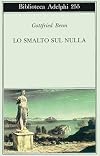
Chissa' perche' continuo a comprare libri difficilissimi, dei quali capisco a tratti. Chissa' dove ho trovato recensioni che potessero convincermi ad acquistare - neanche in prestito, proprio acquisto - questo di Benn, che non sapevo neppure chi fosse, e che al momento con tutti questi saggi in tentata giustificazione del nazismo da pure un po' noia. Quando si fa capire, quando si riesce a sciogliere la pece del discorso scopri che non era pece, ma liquirizia da Mille e una notte, e che show more quelle frasi, quell'intelligenza sono rari da trovare in un saggio, e assolutamente avulse da qualsiasi narrazione che non scada nel pedante. Pero', uffa... show less
Lists
Awards


You May Also Like


Associated Authors
Statistics
- Works
- 173
- Also by
- 13
- Members
- 1,113
- Popularity
- #23,079
- Rating
- 4.1
- Reviews
- 11
- ISBNs
- 183
- Languages
- 13
- Favorited
- 10

