
Anthony, Lester (1935–2020)
Author of Five Ideas to Fight For: How Our Freedom Is Under Threat and Why It Matters
About the Author
Works by Anthony, Lester
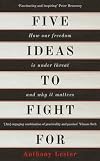
Five Ideas to Fight For: How Our Freedom Is Under Threat and Why It Matters (2016) 46 copies, 6 reviews
Talking To Myself 1 copy
Tagged
Common Knowledge
- Canonical name
- Lester, Anthony,
- Other names
- Lester, Anthony Paul (birth name)
- Birthdate
- 1935-07-03
- Date of death
- 2020-08-08
- Gender
- male
- Occupations
- lawyer
- Awards and honors
- Queen's Counsel
- Nationality
- UK
- Associated Place (for map)
- UK
Members
Reviews
THE SUBJECT:
Human Rights. Equality. Free Speech. Privacy. The Rule of Law. These are the ideas Lord Anthony Lester presents as under threat today, as well as what must be done to counteract the threat.
THE SCRIBE:
A British barrister and politician, Anthony Lester is Baron Lester of Herne Hill, who currently sits in the House of Lords as a Liberal Democrat (in the British sense) and serves on the Joint Committee for Human Rights.
THE STYLE:
Part memoir, part polemic, Five Ideas to Fight For show more narrates Lord Lester's role and beliefs in the development of British freedoms in today's world.
THE SUBSTANCE:
"Human rights are not the gift of governments. They are our birthright. Some believe human rights are part of natural law and religious teachings; for others they are the fruits of the eighteenth-century Enlightenment; for pragmatists they are the basic freedoms of the individual. Philosophers and theologians reflect about origins and sources of fundamental rights. I am neither a philosopher nor a theologian. What matters to me is whether they are observed in practice and whether there are effective remedies for victims when they are breached."
THE SPECIFICS:
The cognitive dissonance espoused by Lord Lester is staggering: "[British courts] interpret legislation in accordance with contemporary values and conditions to avoid statutes becoming ossified relics of a bygone age." Yet at the same time he pens those words he mourns the lack of a written constitution and bill of rights. To what purpose, if they in turn will be interpreted in accordance with contemporary values and conditions? As noted by Jefferson: "The constitution, on this hypothesis, is a mere thing of wax in the hands of the judiciary, which they may twist, and shape into any form they please."
THE SCOOP:
Perhaps the unwritten British constitution necessitates that such a book is written. Americans are afforded the protections codified in our Constitution and the Bill of Rights, whereas British courts "treated all Acts of Parliament as equal and equally able to be trumped by a future Act of a future Parliament." Nevertheless, it is difficult to disentangle the legitimate concerns of Lord Lester from his political and worldview leanings. For what happens when rights are in conflict--say the religious rights of the Abrahamic faiths versus the sexual rights championed under equality? If Lord Lester is neither a philosopher nor a theologian, then he can only resolve conflicting rights as a pragmatist. And therein lies the great flaw of this book--the quest for cosmic justice, be it under the auspices of pragmatism, utilitarianism, or any other -ism, is a fallacy. show less
Human Rights. Equality. Free Speech. Privacy. The Rule of Law. These are the ideas Lord Anthony Lester presents as under threat today, as well as what must be done to counteract the threat.
THE SCRIBE:
A British barrister and politician, Anthony Lester is Baron Lester of Herne Hill, who currently sits in the House of Lords as a Liberal Democrat (in the British sense) and serves on the Joint Committee for Human Rights.
THE STYLE:
Part memoir, part polemic, Five Ideas to Fight For show more narrates Lord Lester's role and beliefs in the development of British freedoms in today's world.
THE SUBSTANCE:
"Human rights are not the gift of governments. They are our birthright. Some believe human rights are part of natural law and religious teachings; for others they are the fruits of the eighteenth-century Enlightenment; for pragmatists they are the basic freedoms of the individual. Philosophers and theologians reflect about origins and sources of fundamental rights. I am neither a philosopher nor a theologian. What matters to me is whether they are observed in practice and whether there are effective remedies for victims when they are breached."
THE SPECIFICS:
The cognitive dissonance espoused by Lord Lester is staggering: "[British courts] interpret legislation in accordance with contemporary values and conditions to avoid statutes becoming ossified relics of a bygone age." Yet at the same time he pens those words he mourns the lack of a written constitution and bill of rights. To what purpose, if they in turn will be interpreted in accordance with contemporary values and conditions? As noted by Jefferson: "The constitution, on this hypothesis, is a mere thing of wax in the hands of the judiciary, which they may twist, and shape into any form they please."
THE SCOOP:
Perhaps the unwritten British constitution necessitates that such a book is written. Americans are afforded the protections codified in our Constitution and the Bill of Rights, whereas British courts "treated all Acts of Parliament as equal and equally able to be trumped by a future Act of a future Parliament." Nevertheless, it is difficult to disentangle the legitimate concerns of Lord Lester from his political and worldview leanings. For what happens when rights are in conflict--say the religious rights of the Abrahamic faiths versus the sexual rights championed under equality? If Lord Lester is neither a philosopher nor a theologian, then he can only resolve conflicting rights as a pragmatist. And therein lies the great flaw of this book--the quest for cosmic justice, be it under the auspices of pragmatism, utilitarianism, or any other -ism, is a fallacy. show less
 This review was written for LibraryThing Early Reviewers.
I'll start this review by saying that after reading this book, I suspect that I would very much enjoy meeting the author at a dinner party. Based on his career and the few stories he put in the book, I suspect that the stories that he could tell would be fascinating. I only wish that the book had been as interesting or as passionate as it should have been. It occupies an odd space somewhere between memoir, light history of British parliament acts in relation to his five ideas, with the show more barest hint of why it matters. For a book with the subtitle "How Our Freedom is Under Threat and Why it Matters" I got remarkably little evidence of how freedom is under threat nor why these specific freedoms matter to the author. Although I didn't always agree with Baron Lester the few times he expressed and opinion (he believes that the United States 1st Amendment may be too expansive, I do not, the few times he expressed his opinion I was interested to hear what he had to say. I just wish that the book had contained a little more of that and a little less parliamentary history. show less
This review was written for LibraryThing Early Reviewers.Five Ideas to Fight For is Anthony Lester's case for continuing the fight for five essential ideas which together constitute the foundation of any society that claims to care about it's citizens. Lester has long been engaged in the fight and has been instrumental in many of the changes in British law.
While the ideas and history is told primarily from a UK perspective the arguments and progress (or lack thereof) pertain to all of society and actually closely parallel progress in some other show more countries. The takeaways from this book are the foundational nature of these ideas to freedom, how they have come under fire in recent years and why they are important for every generation to vigilantly protect, defend and fight for. These concepts are not restricted by international boundaries though the battles will certainly be different in every nation.
The writing is quite good, almost too good in that it can easily be read and understood at a rapid reading pace, yet these ideas should be pondered while reading as well as revisited after reading. I highly recommend this book to anyone interested in what falls under the largely abstract concept of freedom, and it also would be of particular interest to those interested in recent UK political and legal history and how things have gotten to the point they have.
Reviewed from a copy made available by the publisher via the LibraryThing Early Reviewer program. show less
While the ideas and history is told primarily from a UK perspective the arguments and progress (or lack thereof) pertain to all of society and actually closely parallel progress in some other show more countries. The takeaways from this book are the foundational nature of these ideas to freedom, how they have come under fire in recent years and why they are important for every generation to vigilantly protect, defend and fight for. These concepts are not restricted by international boundaries though the battles will certainly be different in every nation.
The writing is quite good, almost too good in that it can easily be read and understood at a rapid reading pace, yet these ideas should be pondered while reading as well as revisited after reading. I highly recommend this book to anyone interested in what falls under the largely abstract concept of freedom, and it also would be of particular interest to those interested in recent UK political and legal history and how things have gotten to the point they have.
Reviewed from a copy made available by the publisher via the LibraryThing Early Reviewer program. show less
This review was written for LibraryThing Early Reviewers.As it is said, no country once having lost its freedom can ever regain it. This work examines freedom and how citizens are allowing it to slip away. It is safe to say that left-wing regimes have been disastrous for basic civil rights in Western democracies but certainly not all leftists are repressive even if all left-wing governments have been. Yet, individuals on both sides of the political spectrum are dedicated to ideas worth preserving. For example, this work is from a leftist show more perspective but there are enough points in common with centrists, libertarians, and rightists as well.
There are five ideas to fight for: human rights, equality, free speech, privacy, and the rule of law.
There are important points that the author makes in this largely balanced approach to controversial subjects; however, the writing style is not particularly dynamic and interesting and makes for some heavy lifting while reading. It is of particular interest for those from the EU and from a global perspective. There was at least partial support from the Open Society Institute so George Soros had a finger on these ideas. show less
There are five ideas to fight for: human rights, equality, free speech, privacy, and the rule of law.
There are important points that the author makes in this largely balanced approach to controversial subjects; however, the writing style is not particularly dynamic and interesting and makes for some heavy lifting while reading. It is of particular interest for those from the EU and from a global perspective. There was at least partial support from the Open Society Institute so George Soros had a finger on these ideas. show less
This review was written for LibraryThing Early Reviewers.Statistics
- Works
- 10
- Members
- 74
- Popularity
- #238,153
- Rating
- 3.2
- Reviews
- 6
- ISBNs
- 16
