
Steven Barnes
Author of The Legacy of Heorot
About the Author
He is the author of 15 novels & as many teleplays has been nominated for Hugo & Cable Ace Awards. He lives in Longview, Washington, with his novelist wife Tananarive Due & his daughter Nicki. (Bowker Author Biography)
Series
Works by Steven Barnes
New Suns: Original Speculative Fiction by People of Color (2019) — Contributor — 339 copies, 14 reviews
The locusts (novelette) 5 copies
Meeting the Needs of Your Most Able Pupils in History (The Gifted and Talented Series) (2007) 2 copies
The Woman in the Wall [short story] 2 copies
Book of God SC Gatefold - GM 2 copies
Retrospective 1 copy
Sand Man 1 copy
Fusion 3 1 copy
Heartspace {short story} 1 copy
Fusion 2 1 copy
How Digital Technologies can Support Positive Psychology (Positive Psychology in Practice) (2025) 1 copy
IRL {short story} 1 copy
Cestus Hilesi 1 copy
Limits 1 copy
Fusion 1 1 copy
Fusion 5 1 copy
Fusion 4 1 copy
Associated Works
Dark Matter: A Century of Speculative Fiction from the African Diaspora (2000) — Contributor — 594 copies, 11 reviews
The Year's Best Science Fiction: Thirty-Fourth Annual Collection (2017) — Contributor — 147 copies, 4 reviews
Dark Dreams: A Collection of Horror and Suspense by Black Writers (2004) — Contributor — 67 copies, 7 reviews
Strange Matings: Science Fiction, Feminism, African American Voices, and Octavia E. Butler (2013) — Contributor — 34 copies
Visions, Ventures, Escape Velocities: A Collection of Space Futures (2017) — Contributor — 22 copies, 1 review
If This Goes On: The Science Fiction Future of Today's Politics (2019) — Contributor — 21 copies, 1 review
Afro-Future Females: Black Writers Chart Science Fiction's Newest New-Wave Trajectory (2008) — Contributor — 13 copies
Gauntlet: Exploring the Limits of Free Expression, No. 6 - Black Racism (1993) — Contributor — 8 copies
Andromeda Season 1: The Sum of Its Parts — Screenwriter — 1 copy
Tagged
Common Knowledge
- Legal name
- Barnes, Steven Emory
- Birthdate
- 1952-03-01
- Gender
- male
- Education
- Pepperdine University (BA|Communication Arts)
- Occupations
- screenwriter
- Agent
- Eleanor Wood (Spectrum Literary Agency)
- Relationships
- Due, Tananarive (wife)
- Nationality
- USA
- Birthplace
- Los Angeles, California, USA
- Places of residence
- Vancouver, Washington, USA
Los Angeles, California, USA (birth) - Associated Place (for map)
- USA
Members
Discussions
SF - Female Protag, foot race, physical enhancements, Atalanta??? in Name that Book (November 2015)
Science Fiction book about Space Colonization in Name that Book (February 2012)
Reviews
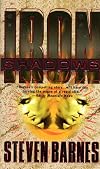
So the other day I started reading Iron Shadows by Steven Barnes. He’s apparently a bestselling author. Which is really disturbing.
Because four sentences in, he describes a woman as “a small wiry brunette”. Seriously? Does anyone actually identify women by their hair colour any more? That’s so—1940s. Isn’t it? I check. The book’s copyright is 1998. Okay. Guess not. Guess the tradition of objectifying women lives on.
We don’t do that with men. We don’t objectify them by their show more hair colour (or anything else, for that matter). Their hair colour for godsake. She’s a brunette. Or a blonde. Or a redhead. As if all women with brown hair are what, interchangeable? Because they’re completely defined by—-the colour of their hair?
Not only that, but he had to mention her size. Small. Of course. If she’s going to be a heroine, she has to be small. I’m surprised he didn’t tell us how large her breasts are.
And whereas she’s small, he’s “enormous”. Of course he is.
Could we just reverse the description with nothing odd happening, that test for sexism? “The man, a small, wiry brunette with an ugly bruise on his left cheek, wore a yellow unisex utility uniform. The woman was enormous, but barely conscious.” Not only do you find it odd to hear a man called “a small, wiry brunette”, you no doubt found it a bit disgusting to hear the woman called “enormous”.
I am, goddammit, still a little forgiving, so I read on.
But the very next woman—or maybe it’s the same woman, since the next bit happens two months earlier—the very next woman “nibbles” on dry wheat toast. Because we can’t have a woman actually eating with guilt-free enthusiasm.
And she has “an oval face framed by a cascade of small soft blonde ringlets”. Small again. And soft. And blonde. And ringlets. Ringlets?!
In case we missed it, “Her habit of peering out from behind them sometimes made her resemble a mischievous child peeking through a fence.”
In 1998. And published by Tor.
No wonder women can’t get published. As long as this insulting crap is deemed worthy. Is bestselling.
When will men finally get it? When will they finally get it right?
Robert J. Sawyer. He’s the only one. The only male sf writer who’s smart enough to create a non-sexist world. show less
Because four sentences in, he describes a woman as “a small wiry brunette”. Seriously? Does anyone actually identify women by their hair colour any more? That’s so—1940s. Isn’t it? I check. The book’s copyright is 1998. Okay. Guess not. Guess the tradition of objectifying women lives on.
We don’t do that with men. We don’t objectify them by their show more hair colour (or anything else, for that matter). Their hair colour for godsake. She’s a brunette. Or a blonde. Or a redhead. As if all women with brown hair are what, interchangeable? Because they’re completely defined by—-the colour of their hair?
Not only that, but he had to mention her size. Small. Of course. If she’s going to be a heroine, she has to be small. I’m surprised he didn’t tell us how large her breasts are.
And whereas she’s small, he’s “enormous”. Of course he is.
Could we just reverse the description with nothing odd happening, that test for sexism? “The man, a small, wiry brunette with an ugly bruise on his left cheek, wore a yellow unisex utility uniform. The woman was enormous, but barely conscious.” Not only do you find it odd to hear a man called “a small, wiry brunette”, you no doubt found it a bit disgusting to hear the woman called “enormous”.
I am, goddammit, still a little forgiving, so I read on.
But the very next woman—or maybe it’s the same woman, since the next bit happens two months earlier—the very next woman “nibbles” on dry wheat toast. Because we can’t have a woman actually eating with guilt-free enthusiasm.
And she has “an oval face framed by a cascade of small soft blonde ringlets”. Small again. And soft. And blonde. And ringlets. Ringlets?!
In case we missed it, “Her habit of peering out from behind them sometimes made her resemble a mischievous child peeking through a fence.”
In 1998. And published by Tor.
No wonder women can’t get published. As long as this insulting crap is deemed worthy. Is bestselling.
When will men finally get it? When will they finally get it right?
Robert J. Sawyer. He’s the only one. The only male sf writer who’s smart enough to create a non-sexist world. show less
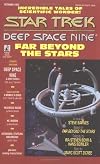
Steven Barnes’ novelization of Ira Steven Behr, Hans Beimler, and Marc Scott Zicree’s Star Trek: Deep Space Nine episode, “Far Beyond the Stars,” adapts and expands upon the original episode script. He takes what is possibly one of the best standalone episodes of DS9 and adds more depth and nuance to the story, turning it into one of the best tie-in novels. The story focuses on Captain Benjamin Sisko experiencing visions of 1950s New York City and a pulp science-fiction writer named show more Benny Russell, who begins writing stories of a future space station commander and the promise of Black Americans’ place in that future amid the segregation of the mid-twentieth century. Barnes extends further back in Benny Russell’s past, portraying him as encountering a Bajoran orb at the 1939 World’s Fair amid the symbols of the future that dominated that era and the segregation that limited Black Americans’ access to the fair. Even with time set aside for Black fairgoers, they were underrepresented or entirely absent from dioramas imagining the future, instead only finding African culture among the exhibits focusing on smaller nations. As New York City climbed to the skies, Black residents scrape by and fear to hope for more. In 1953, Russell’s life includes more commentary and context about Harlem as well as the work of Black authors. While the television episode portrayed Russell as writing a story about Ben Sisko, Barnes’ book includes mention of him writing prior adventures of Captains Kirk and Picard. The other authors at the pulp magazine provide a chance to work in references to Asimov, Harlan Ellison, and more. The result is a novelization that surpasses the episode it adapts, crafting one of the best Star Trek stories of all time that perfectly encapsulates the franchise’s message. show less
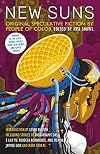
New Suns is what it says on the cover, and it is astonishingly good. I only recognized two of the authors, and as we all know an anthology of this type can be a mixed bag, but every story was good and several were great! I usually skip out on at least one story per collection, but even the weaker entries kept me intrigued. My favorites were "The Virtue of Unfaithful Translation" by Minsoo Kang , "Burn the Ships" by Alberto Yanez, and "The Shadow We Cast Through Time" by Indrapramit Das, but show more this is a strong collection.
Editor Nisi Shawl assembled this collection on the basis of identity, part of a decades long quest to get more people of color in speculative fiction, but what's fascinating is a clear thematic link. Each story is about kinship, about the kinds of people we call family, the bonds between people who are more than friends, and how those bonds linger on. This is speculative fiction descended from Octavia Butler, rather than the technocratic impulses of Campbell's vision of the genre, and the questions posed and answered are really novel.
Absolutely recommended! show less
Editor Nisi Shawl assembled this collection on the basis of identity, part of a decades long quest to get more people of color in speculative fiction, but what's fascinating is a clear thematic link. Each story is about kinship, about the kinds of people we call family, the bonds between people who are more than friends, and how those bonds linger on. This is speculative fiction descended from Octavia Butler, rather than the technocratic impulses of Campbell's vision of the genre, and the questions posed and answered are really novel.
Absolutely recommended! show less
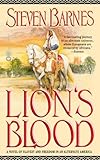
This was a difficult read. Difficult in the way, I think, the author wants it to be difficult. It's a convincing alternate history where Africans, not Europeans end up the conquering force of the world. Whites are the slaves, and Blacks are the masters. What makes it so convincing is that it eschews the fantastic, or sci-fi aspects of alternate history, and hinges merely on a few key points different in the past. History is rife with moments where things turned on such small happenstances, show more and Barnes seems to find just enough of them to shift the globe into a realistic alternative. On a more personal level, one of the main characters, captured as a child and bound into slavery is a young lad from Ireland, land of my own ancestors. It made following his horrors all the more poignant. Though mere words can only convey the barest whispers of what that life might have been like for real slaves, even still there were moments I had to take a short break from the story. Dense, luscious language, believable characters, and tense action, I look forward to the next novel in this setting, Zulu Heart. show less
Lists
Favorite Series (1)
Awards


You May Also Like


Associated Authors
Statistics
- Works
- 75
- Also by
- 36
- Members
- 13,086
- Popularity
- #1,780
- Rating
- 3.6
- Reviews
- 169
- ISBNs
- 266
- Languages
- 10
- Favorited
- 5
