
Fergus Hume (1859–1932)
Author of The Mystery of a Hansom Cab
About the Author
Image credit: Elliott & Fry, courtesy of La Trobe Picture Collection, State Library of Victoria.
Works by Fergus Hume
FERGUS HUME - The Ultimate Mystery Collection: 21 Thriller Novels in One Volume: The Mystery of a Hansom Cab, Red Money, The Bishop's Secret, The Pagan's ... The Crowned… (2016) 7 copies, 2 reviews
Under One Cover. Eleven Stories by S. Baring-Gould, Richard Marsh, Ernest G. Henham, Fergus Hume, Andrew Merry, and a. St. John Adcock, Etc. (2011) 5 copies
The blue talisman; a detective story 2 copies
The Crime of the Crystal 1 copy
The Hurton Treasure Mystery 1 copy
The Mystery of a Hansom Cab and Other Detective Stories by Fergus Hume (Halcyon Classics) (2011) 1 copy
Tales of Fairyland 1 copy
The Chronicles of Fairyland 1 copy
Traitor in London 1 copy
A Colonial Banshee 1 copy
The Enemy in the Shadows 1 copy
The Amber Beads 1 copy
El pergamino perdido 1 copy
Tajemnica broszki z opalu 1 copy
Fantoma călugărului 1 copy
The Mystery of the Shadow 1 copy
A Trick of Time 1 copy
The dark avenue 1 copy
The Man Who Vanished 1 copy
The Caretaker 1 copy
Djävulskäppen : Roman 1 copy
The Steel Crown 1 copy
Associated Works
The Rivals of Sherlock Holmes: A Collection of Victorian Detective Tales (2008) — Contributor — 140 copies, 1 review
Tagged
Common Knowledge
- Legal name
- Hume, Fergusson Wright
- Birthdate
- 1859-07-08
- Date of death
- 1932-07-12
- Gender
- male
- Education
- University of Otago
Otago Boys' High School, Dunedin, New Zealand - Occupations
- lawyer
novelist - Short biography
- over 130 novels
- Nationality
- UK
- Birthplace
- Powick, Worcestershire, England, UK
- Places of residence
- Dunedin, Otago, New Zealand
Melbourne, Victoria, Australia
London, Middlesex, England, UK
Thundersley, Essex, England, UK - Place of death
- Thundersley, Essex, England, UK
- Burial location
- Thundersley, Essex, England, UK
- Map Location
- England, UK
Members
Reviews

This is one of a large number of early science fiction texts I read this winter at the Eaton Collection at the University of California Riverside, thanks to a Mullen Fellowship that defrayed my travel and lodging expenses. My focus was on novels about future revolution in the period from 1890 to 1910, especially those featuring air-ships and/or scientists. Partly this ties into my dissertation, and partly this will feature into whatever I do after that.
The Year of Miracle is about a young show more medical doctor improbably named Francis Rebelspear trying to make it. It frequently invokes evolutionary rhetoric, such as when the narrator says of his ailing practice, "Here was a brilliant illustration of the Darwinian theory concerning the survival of the fittest. Question: Was Rebelspear one of the fittest who would survive? Answer: Entirely depends upon his capacity for holding out, or the public’s giving in." Francis has a friend improbably named Julian Delicker, one of those idlers who loaf around Victorian fiction launching verbal barbs but not contributing to society, who suggests that a plague would be awesome: "if all the weak, the sick, and the revolutionary were killed off, think of how much smoother things would go" (!).
You might not be surprised to learn that a plague does happen. A Prophet of Doom brings a deadly vial back from the Middle East and drops it in London to cleanse it (and, not incidentally, to get revenge on the guy who stole his wife). This Prophet uses both Darwinian justifications for his actions and preaches against the uselessness of science, so he's not very consistent. Also the narrator justifies the fact that the guy who stole his wife had plague-death coming, completely glossing over the thousands-- hundreds of thousands?-- of other people who died in the plague. The narrator too sneers at the science believed in by Rebelspear and Delicker but also uses Darwinism to argue that the apocalyptic ending is totally hopeful: "A great number of those poorer classes had been swept away, and in this case of the survival of the fittest those left in England to rebuild London and the social life of the British people were mostly either physically or mentally strong. The brain workers aided the physically strong in the work of rebuilding a new England out of the ruins of the old, and the twentieth century began its career under the happiest auspices."
Um, happy? Yay, plague! Also I want to suggest that Fergus Hume doesn't have the firmest grasp of the actual causes of poverty. Delicker converts to Christianity, though, so I guess it's all worth it. show less
The Year of Miracle is about a young show more medical doctor improbably named Francis Rebelspear trying to make it. It frequently invokes evolutionary rhetoric, such as when the narrator says of his ailing practice, "Here was a brilliant illustration of the Darwinian theory concerning the survival of the fittest. Question: Was Rebelspear one of the fittest who would survive? Answer: Entirely depends upon his capacity for holding out, or the public’s giving in." Francis has a friend improbably named Julian Delicker, one of those idlers who loaf around Victorian fiction launching verbal barbs but not contributing to society, who suggests that a plague would be awesome: "if all the weak, the sick, and the revolutionary were killed off, think of how much smoother things would go" (!).
You might not be surprised to learn that a plague does happen. A Prophet of Doom brings a deadly vial back from the Middle East and drops it in London to cleanse it (and, not incidentally, to get revenge on the guy who stole his wife). This Prophet uses both Darwinian justifications for his actions and preaches against the uselessness of science, so he's not very consistent. Also the narrator justifies the fact that the guy who stole his wife had plague-death coming, completely glossing over the thousands-- hundreds of thousands?-- of other people who died in the plague. The narrator too sneers at the science believed in by Rebelspear and Delicker but also uses Darwinism to argue that the apocalyptic ending is totally hopeful: "A great number of those poorer classes had been swept away, and in this case of the survival of the fittest those left in England to rebuild London and the social life of the British people were mostly either physically or mentally strong. The brain workers aided the physically strong in the work of rebuilding a new England out of the ruins of the old, and the twentieth century began its career under the happiest auspices."
Um, happy? Yay, plague! Also I want to suggest that Fergus Hume doesn't have the firmest grasp of the actual causes of poverty. Delicker converts to Christianity, though, so I guess it's all worth it. show less
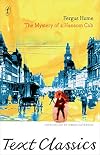
I asked a Goodreads friend from Down Under what Australian and New Zealand books she’d recommend to an ignorant Yank like me. I’d only read Australian Kerry Greenwood and Germaine Greer and Kiwi Ngaio Marsh up to that point. Magda was kind enough to send me a long list of excellent authors, including Fergus Hume. The English-born Hume grew up in New Zealand before relocating to Melbourne. Unable to get his plays even looked at — much less staged — he instead turned out his first show more mystery, The Mystery of the Hansom Cab, in 1886. It became an international sensation and inspired Sir Arthur Conan Doyle to create Sherlock Holmes and pen A Study in Scarlet.
The novel begins in colonial Australia with a cabbie picking up two gentlemen in evening dress, one of whom was falling-down drunk. The first gets out early, and, when the cabbie opens the door to let out the second at that gent’s home, the cabbie discovers that the drunk fellow’s been murdered. How can the authorities track down the accompanying gentleman, who must surely be the murderer?
Mr. Gorby, a Melbourne police detective, discovers the victim’s identity and arrests a suspect about halfway through the novel. But Mr. Gorby’s rival on the police force, Mr. Kilsip, has very different ideas. As with any good 19th century mystery, more evidence will emerge that leads Mr. Gorby to reopen the case, and the two rivals will vie — along with the defense attorney Duncan Calton — to be the one to bring the true murderer to justice. Many modern readers decry 19th century mystery novels as dry and contrived, but The Mystery of the Hansom Cab proves as exciting as any by Lawrence Block, Sue Grafton, Dean Koontz, Tony Hillerman, Elizabeth Peters, Laurie R. King, or P.D. James. I couldn’t put it down until I got to the very last chapter!
The Mystery of the Hansom Cab provides readers with a taste of an Australian classic, indeed, one that predates the Australian federation by 15 years. While the novel provides a fun read in its own right, it’s also nice to see the mystery that inspired the greatest fictional detective of all time, Sherlock Holmes. show less
The novel begins in colonial Australia with a cabbie picking up two gentlemen in evening dress, one of whom was falling-down drunk. The first gets out early, and, when the cabbie opens the door to let out the second at that gent’s home, the cabbie discovers that the drunk fellow’s been murdered. How can the authorities track down the accompanying gentleman, who must surely be the murderer?
Mr. Gorby, a Melbourne police detective, discovers the victim’s identity and arrests a suspect about halfway through the novel. But Mr. Gorby’s rival on the police force, Mr. Kilsip, has very different ideas. As with any good 19th century mystery, more evidence will emerge that leads Mr. Gorby to reopen the case, and the two rivals will vie — along with the defense attorney Duncan Calton — to be the one to bring the true murderer to justice. Many modern readers decry 19th century mystery novels as dry and contrived, but The Mystery of the Hansom Cab proves as exciting as any by Lawrence Block, Sue Grafton, Dean Koontz, Tony Hillerman, Elizabeth Peters, Laurie R. King, or P.D. James. I couldn’t put it down until I got to the very last chapter!
The Mystery of the Hansom Cab provides readers with a taste of an Australian classic, indeed, one that predates the Australian federation by 15 years. While the novel provides a fun read in its own right, it’s also nice to see the mystery that inspired the greatest fictional detective of all time, Sherlock Holmes. show less
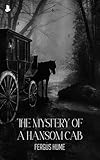
This had a strong setting: nineteenth century Melbourne, with horse drawn cabs, men who would do anything to protect women rather than actually tell them what is going on, and very precise geography. The Melbourne street names and landmarks would obviously mean more to Australians than they did to me. The narrative was varied: some interview transcripts, some newspaper articles and some straight story-telling. The plot was twisty and at times took turns I hadn't anticipated. Having said all show more that, I still skimmed most of it. Worth a skim. show less

The murder of an unidentified man in a hansom cab has all of Melbourne speculating about the murderer and his motive. The witness statements and the evidence point in one direction, but do these observations and clues tell the whole story? Is there more left to learn?
The plot hints of Dickens and Collins, but without either of those author’s polish. I get a sense that the author might not have worked from an outline. The plot makes some sudden shifts, and some of the characters show more unaccountably change temperaments in the course of the action. Despite these flaws, the story works, and it suits its setting. show less
The plot hints of Dickens and Collins, but without either of those author’s polish. I get a sense that the author might not have worked from an outline. The plot makes some sudden shifts, and some of the characters show more unaccountably change temperaments in the course of the action. Despite these flaws, the story works, and it suits its setting. show less
Lists
Awards


You May Also Like


Associated Authors
Statistics
- Works
- 105
- Also by
- 17
- Members
- 921
- Popularity
- #27,851
- Rating
- 3.6
- Reviews
- 38
- ISBNs
- 321
- Languages
- 6
- Favorited
- 1