
Colwill Brown
Author of We Pretty Pieces of Flesh
Works by Colwill Brown
Tagged
Common Knowledge
- Gender
- female
- Education
- University of Texas at Austin (MFA)
Boston College (MA | English Literature) - Nationality
- United Kingdom
- Birthplace
- Doncaster, South Yorkshire, UK
Members
Reviews
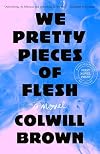
Real Rating: 4.75* of five
The Publisher Says: An exuberant and ribald debut novel about three adolescent girls coming of age in a gritty post-industrial town in Yorkshire, England in the ‘90s who are as sweetly vulnerable and funny as they are cunning and tough
“Ask anyone non-Northern, they’ll only know Donny as punchline of a joke or place they changed trains once ont way to London.” But it’s also the home of Rach, Kel, and Shaz, bezzies since childhood. From scheming one show more another’s first kisses, to sneaking vodka (or the occasional Cointreau) into school in water bottles, to accompanying one another to Family Planning for pregnancy tests, the girls come of age together, Donny lasses through and through. Never mind that Rach is skeptical of Shaz’s bolder plots; or that Shaz, who comes from a rougher end of town, feels left behind when the others begin plotting a course to uni; or that Kel sometimes feels split in two trying to keep the peace—the girls are inseparable, their friendship as indestructible as they are. But as the girls grow up and away from each other, a long-festering secret threatens to rip the trio apart. Is their shared past enough to keep them close?
Written in a Yorkshire dialect that brings a place and its people magnificently to life, We Pretty Pieces of Flesh spans decades and continents as its heroines come of age, never shying from the ugly truths of girlhood. Like Trainspotting and Shuggie Bain, it tracks hard-edged lives and makes them sing, making one overlooked and forgotten place the very center of the world.
I RECEIVED A DRC FROM THE PUBLISHER VIA NETGALLEY. THANK YOU.
My Review: You know how much people dislike, even hate, the word "moist"? That's how I feel about the word "pungent." It's a shuddersome word, one that sounds like someone tone-deaf and with a cold is trying to hum "Born in the USA."
Yet I'm about to use it, approvingly, about the narrative voice in this novel. It's pungent, in its "sharply affecting the mind, curt and expressive" (etymonline.com) sense prevalent by 1850 about writing. When I could grow them I used to eat two or three french breakfast radishes daily because, while I don't like the word, I do like pungent things.
I liked reading this Yorkshire dialect because it got into my mind sharply, evocatively. I enjoy that kind of reading experience. It breaks the sameness, the US-standard English that makes up most reading I do, fiction or non-fiction. It reaches different places in my emotional system by "sounding" different.
It's all there, it's all in that short span, and you know already if this tale is for you. It was for me so I really hope it appeals to some of y'all.
What stories we hear when we're open to listening differently, being there in a different way for what the author wants us to know. This is a braided-stories novel, one that switches tenses and PoVs to make its points and build its world. The three friends start year seven in 1998, well into the awful social Darwinism Yorkshire got chewed up by the bad economics from the successor regimes to that slime Thatcher's hatcheting of the industrial base.
Rach, a uni-directed future teacher, and Kel, the spirited escapee who moves to the US, leave Shaz behind in Donny (-caster, get it?) not entirely on purpose. As mentioned these young women tell us their stories but without reassuring you there's only one voice per narrative...possibly narrator, either, I wasn't all the way sure about that. Shaz is...she's badly damaged, she is stuck, mired in Donny because a horrible, terrible, violent thing happened to her. Moving past it feels impossible, like shifting one of the pyramids at Giza with your mind, alone. It is worse than only the trauma she suffered. It is retraumatizing because of a secret she genuinely can't share with Rach and Kel. It felt brutal to me as I read it...strong stuff indeed...but more than anything else, I was destroyed by her bitter dregs of isolation ever after.
To feel unable to speak, even to the closest friends you'll ever have, is a curse that blights a life. I speak from experience. It's possible for Shaz to speak, to heal (again I know this from experience); but it does not happen in this story.
Meeting these three after Life has happened to them was a poignant way to leave them...the fault lines still there but likewise the gravity binding them to a shared center, as they learn what adulthood has done to each of them. And of course the terrible secret is a rock forming an unclimbable obstacle; only one of them knows why, though all know it's there. I'm deeply impressed by this book and its voices; I can't quite get to a full five star rating because the nature of braided stories means things feel...hashed over, rehashed, at times and that is not a positive.
I really hope y'all who liked Shuggie Bain as much as I did will come south to Yorkshire and meet these three Donny lasses. They're good company, despite imperfections. Which, be honest, you have as much as they or I do. show less
The Publisher Says: An exuberant and ribald debut novel about three adolescent girls coming of age in a gritty post-industrial town in Yorkshire, England in the ‘90s who are as sweetly vulnerable and funny as they are cunning and tough
“Ask anyone non-Northern, they’ll only know Donny as punchline of a joke or place they changed trains once ont way to London.” But it’s also the home of Rach, Kel, and Shaz, bezzies since childhood. From scheming one show more another’s first kisses, to sneaking vodka (or the occasional Cointreau) into school in water bottles, to accompanying one another to Family Planning for pregnancy tests, the girls come of age together, Donny lasses through and through. Never mind that Rach is skeptical of Shaz’s bolder plots; or that Shaz, who comes from a rougher end of town, feels left behind when the others begin plotting a course to uni; or that Kel sometimes feels split in two trying to keep the peace—the girls are inseparable, their friendship as indestructible as they are. But as the girls grow up and away from each other, a long-festering secret threatens to rip the trio apart. Is their shared past enough to keep them close?
Written in a Yorkshire dialect that brings a place and its people magnificently to life, We Pretty Pieces of Flesh spans decades and continents as its heroines come of age, never shying from the ugly truths of girlhood. Like Trainspotting and Shuggie Bain, it tracks hard-edged lives and makes them sing, making one overlooked and forgotten place the very center of the world.
I RECEIVED A DRC FROM THE PUBLISHER VIA NETGALLEY. THANK YOU.
My Review: You know how much people dislike, even hate, the word "moist"? That's how I feel about the word "pungent." It's a shuddersome word, one that sounds like someone tone-deaf and with a cold is trying to hum "Born in the USA."
Yet I'm about to use it, approvingly, about the narrative voice in this novel. It's pungent, in its "sharply affecting the mind, curt and expressive" (etymonline.com) sense prevalent by 1850 about writing. When I could grow them I used to eat two or three french breakfast radishes daily because, while I don't like the word, I do like pungent things.
I liked reading this Yorkshire dialect because it got into my mind sharply, evocatively. I enjoy that kind of reading experience. It breaks the sameness, the US-standard English that makes up most reading I do, fiction or non-fiction. It reaches different places in my emotional system by "sounding" different.
You thought about them lasses ont bus, their painted faces and their bad sex facts, trying their hardest to grow intut only version of themsens they thought they wa allowed to be. Feminism had took one look at Donny and thought, Reckon I'll gi this a miss.
It's all there, it's all in that short span, and you know already if this tale is for you. It was for me so I really hope it appeals to some of y'all.
What stories we hear when we're open to listening differently, being there in a different way for what the author wants us to know. This is a braided-stories novel, one that switches tenses and PoVs to make its points and build its world. The three friends start year seven in 1998, well into the awful social Darwinism Yorkshire got chewed up by the bad economics from the successor regimes to that slime Thatcher's hatcheting of the industrial base.
Rach, a uni-directed future teacher, and Kel, the spirited escapee who moves to the US, leave Shaz behind in Donny (-caster, get it?) not entirely on purpose. As mentioned these young women tell us their stories but without reassuring you there's only one voice per narrative...possibly narrator, either, I wasn't all the way sure about that. Shaz is...she's badly damaged, she is stuck, mired in Donny because a horrible, terrible, violent thing happened to her. Moving past it feels impossible, like shifting one of the pyramids at Giza with your mind, alone. It is worse than only the trauma she suffered. It is retraumatizing because of a secret she genuinely can't share with Rach and Kel. It felt brutal to me as I read it...strong stuff indeed...but more than anything else, I was destroyed by her bitter dregs of isolation ever after.
To feel unable to speak, even to the closest friends you'll ever have, is a curse that blights a life. I speak from experience. It's possible for Shaz to speak, to heal (again I know this from experience); but it does not happen in this story.
Meeting these three after Life has happened to them was a poignant way to leave them...the fault lines still there but likewise the gravity binding them to a shared center, as they learn what adulthood has done to each of them. And of course the terrible secret is a rock forming an unclimbable obstacle; only one of them knows why, though all know it's there. I'm deeply impressed by this book and its voices; I can't quite get to a full five star rating because the nature of braided stories means things feel...hashed over, rehashed, at times and that is not a positive.
I really hope y'all who liked Shuggie Bain as much as I did will come south to Yorkshire and meet these three Donny lasses. They're good company, despite imperfections. Which, be honest, you have as much as they or I do. show less
As a debut novel, I think it is brilliant. The author’s technique of using written phonetics for South Yorkshire accents added a lot of color and brightness to what is otherwise a very sad, traumatic and dark novel, filled with violence, about girls growing up with few prospects, girls who, unlike the popular fictional trope, do not escape. I get that this specific place, and certainly this time — the 1990s, possibly early 2000s, does not correspond to my experience but I can still show more viscerally feel that anger and longing that fuels these girls — anger at being objectified, longing to be desired and loved. The wall of misogyny that surrounds these girls drives me to despair. Yes, it is specific to time and place, but it is also universal. I am fortunate to live in a highly educated privileged microcosm of society that sees only the fringes, and it is good to be reminded that in many ways my world is a small subset of what is experienced.
I am glad I read this book. I do not want to read it again, which for me is a criticism. I am a person who thinks readers form relationships with good books. Not this book, not for me. It is ambitious, compelling, poignant, and, as noted above, even brilliant. It deserves all the praise it has garnered. I don’t need a happy ending. But on some level the novel failed to carry me along; the novel felt boring, trite, accepting. This may be only me. This may be the state of the world. It is not what I want from my literature. show less
I am glad I read this book. I do not want to read it again, which for me is a criticism. I am a person who thinks readers form relationships with good books. Not this book, not for me. It is ambitious, compelling, poignant, and, as noted above, even brilliant. It deserves all the praise it has garnered. I don’t need a happy ending. But on some level the novel failed to carry me along; the novel felt boring, trite, accepting. This may be only me. This may be the state of the world. It is not what I want from my literature. show less
Being dragged through 20-odd years in the lives of three Donny (Doncaster) lassies does not make for a fun ride. Pre-teen girls pushing themselves toward puberty, teens desperately faking maturity, throwing their bodies at a future they don't know what will take from them. The dreary and desperate times are utterly convincing; the jerking reconciliation toward the end is less so.
7 Up came to mind while reading this, with its demonstration of how much of a child's future is rooted in their show more start. These Donny girls grew on poor, polluted, soil. show less
7 Up came to mind while reading this, with its demonstration of how much of a child's future is rooted in their show more start. These Donny girls grew on poor, polluted, soil. show less
A novel written in a Yorkshire dialect about a group of girls (Rach, Shaz, and Kel) getting into trouble, having fun and just being young. Growing up, becoming adults, and reflecting on their youth. Real slice of life stuff. A tale of female friendship and secrets, coming at you with such speed you hardly have a chance to keep up with it all. It has a fresh perspective, set in a locale I don't often come across in modern fiction. A small story with rich themes. If anything, it could have show more perhaps been a bit shorter and still maintained its power. Again, I think one of the book's strongest attributes is that it's written in a regional dialect throughout. show less
Awards


You May Also Like
Associated Authors
Statistics
- Works
- 1
- Members
- 74
- Popularity
- #238,153
- Rating
- 4.3
- Reviews
- 5
- ISBNs
- 5
- Languages
- 1