
Leonard Shlain (1937–2009)
Author of The Alphabet Versus the Goddess: The Conflict Between Word and Image
About the Author
Leonard Shlain was a best-selling author and San Francisco surgeon. Admired among artists, scientists, philosophers, anthropologists, and educators, Shlain authored three best-selling books: Art Physics, Alphabet vs. The Goddess, and Sex, Time, and Power. He delivered multimedia presentations based show more upon his books in venues around the world including Harvard, the New York Museum of Modern Art, CERN, Los Alamos, the Florence Academy of Art, and the European Council of Ministers. His fans include Al Gore, Norman Lear, and singer Bjrk. Dr. Shlain was a surgeon for thirty-eight years at California Pacific Medical Center where he headed the Laparoscopic Surgery Department and was an Associate Clinical Professor of Medicine at UCSF. He died in May 2009 at the age of seventy-one after a battle with brain cancer. show less
Image credit: http://leonardshlain.com/blog/
Works by Leonard Shlain
The Alphabet Versus the Goddess: The Conflict Between Word and Image (1998) 1,184 copies, 22 reviews
Tagged
Common Knowledge
- Birthdate
- 1937-08-28
- Date of death
- 2009-05-11
- Gender
- male
- Education
- University of Michigan (BA)
Wayne State University (MD|1961) - Occupations
- physician
surgeon
author
inventor - Organizations
- University of California, San Francisco
California Pacific Medical Center
United States Army - Cause of death
- brain cancer
- Nationality
- USA
- Birthplace
- Detroit, Michigan, USA
- Places of residence
- Mill Valley, California, USA
- Place of death
- Mill Valley, California, USA
- Associated Place (for map)
- California, USA
Members
Reviews

Ok, for bibliophiles, this book is like being told that the parents you've admired and cherished and emulated for so long were drunken, abusive, misanthropes.
But if you tough it out, accept the possibility that this habit, this passion that keeps making life worth living, has had possible side-effects, then the pay-off is astounding.
Shlain provides copious examples for his thesis--that the invention of the abstract alphabets (western and, to some extent, eastern pictograph-alphabets) subtly show more altered the brain functions of all humans.
Ultimately, what one gets from this book (aside from the elasticity of Mind) is the cautionary tale of technological progress: Do the things we make, make (or remake) us in turn? Think about this next time you pick up our cell phone--how has that changed your life and the culture around you? show less
But if you tough it out, accept the possibility that this habit, this passion that keeps making life worth living, has had possible side-effects, then the pay-off is astounding.
Shlain provides copious examples for his thesis--that the invention of the abstract alphabets (western and, to some extent, eastern pictograph-alphabets) subtly show more altered the brain functions of all humans.
Ultimately, what one gets from this book (aside from the elasticity of Mind) is the cautionary tale of technological progress: Do the things we make, make (or remake) us in turn? Think about this next time you pick up our cell phone--how has that changed your life and the culture around you? show less
Originally written June 10th, 2002:
The book's thesis is that literacy, and especially alphabetic literacy, hypertrophies the left brain's masculine hunter-killer traits and values of abstract serial linear thought at the expense of the right brain's gatherer-nurturer traits and values of concrete holistic gestalt thought. As alphabetic literacy enters a culture, the society is rocked with violence, religious intolerance, destruction of images, suppression of women, and the overthrow of show more concrete polytheist goddesses with abstract monotheistic gods. This is seen in the Hebrews, Greeks at the time of Aristotle, Orthodox vs. Gnostic Christianity, the Reformation, the Marxist revolutions of Russia, China, and Southeast Asia, Sunni vs. Shi'ite Islam, and modern Islamic fundamentalism like the Taliban. On the flip side, in the agrarian period before the appearance of writing, most cultures' central deity was a powerful Earth mother, represented by copious images, whose lesser consort/child died and was reborn every year. Men and women both worshiped goddesses, and society was fairly egalitarian (this remains the case in many hunter/gatherer cultures today). Major thinkers who spoke rather than wrote (Laozi, Buddha, Socrates, Jesus, Mohamed) tended to have fairly tolerant and pro-female attitudes. And these values as well as images tended to appear in cultures where alphabetic literacy was not widespread (including those cultures who passed from literacy to illiteracy, those near to violent literate cultures, and those who have yet to attain literacy). Furthermore, as photography and electromagnetism (with all its feminine metaphors) appeared in the forms of photography, movies, television, and computers, the West's laws, attitudes, and culture has shifted from excessive yang to a fairly balanced state. In a nutshell, a culture's communication media, perhaps more so than its content, determines the values, actions, and trends of society. For some more data, see my CWA post (about two thirds of the way down).
The book is written for the general public, so it lacks the flurry of citations found in scholarly works. It is far from New Age pseudo science, though; Shlain's bibliography spans 9 pages and ranges from Augustine and Virgil to Will Durant and Bertrand Russell. His data is the "generally accepted" story; exploration of various views of, say, ancient archaeological data is not in his scope. The events Shlain describes are large-scale and very complex, and doubtless arise from many factors and can be explained in many ways (which he acknowledges); his goal is to provide a unifying theory linking the counterpunctual rise and fall of the written word, masculine values, images, and feminine values. As a brain surgeon, Shlain's division of traits, values, and modes of thought rests on sound neurological data (and he acknowledges that the hemispheric split is more metaphorically accurate than physically accurate).
The book is excellently written, using both left hemispheric literalism and right hemispheric metaphor. Shlain doesn't claim to have proved anything, but rather to have demonstrated a correlation, from which the reader is to draw conclusions. His argument is cogent and well-documented, unlike many writers on male/female cultural interplay. He only once "falls" into "rhetorical" "damning" "quotation" marks. His language flows well and is graced by many words he has selected in the hopes that they don't fall out of the lexicon. The paradigmatic and specific ideas expressed in the book lead me to recommend it to almost everyone, from literalistic Protestants to open-minded Pagans to feminists who rail against cultural images. I can't think of many of my friends who wouldn't enjoy the book, and even fewer who would not benefit from reading it. I have found its modern perspective on yin/yang quite helpful in examining my own tendencies, beliefs, and development. (In the past, I've been big on literal interpretation, against photography and GUIs, and down on lots of right-hemispheric modes of perception. In recent years, I haven't read as much, I've watched more movies, and have adopted a more benign view of many Christians.)
Edit February 15, 2009: In the intervening years, I've become less enamored with Leonard Shlain's work. He tries a little too hard to cram the entirety of human history into some simple ideas of the brain. His books and presentations are very enjoyable and informative, but they need a heavy dose of salt. He points out a lot of connections between elements of the zeitgeist that are worth chewing on, but I think the story he tells about their unification is a little simplistic. I still think The Alphabet vs. the Goddess is a book worth reading, but readers interested in the subject should read widely; there are a lot of cognitive scientists with interesting theories who also write well "at the Scientific American level" as Prof. Paulson would say. show less
The book's thesis is that literacy, and especially alphabetic literacy, hypertrophies the left brain's masculine hunter-killer traits and values of abstract serial linear thought at the expense of the right brain's gatherer-nurturer traits and values of concrete holistic gestalt thought. As alphabetic literacy enters a culture, the society is rocked with violence, religious intolerance, destruction of images, suppression of women, and the overthrow of show more concrete polytheist goddesses with abstract monotheistic gods. This is seen in the Hebrews, Greeks at the time of Aristotle, Orthodox vs. Gnostic Christianity, the Reformation, the Marxist revolutions of Russia, China, and Southeast Asia, Sunni vs. Shi'ite Islam, and modern Islamic fundamentalism like the Taliban. On the flip side, in the agrarian period before the appearance of writing, most cultures' central deity was a powerful Earth mother, represented by copious images, whose lesser consort/child died and was reborn every year. Men and women both worshiped goddesses, and society was fairly egalitarian (this remains the case in many hunter/gatherer cultures today). Major thinkers who spoke rather than wrote (Laozi, Buddha, Socrates, Jesus, Mohamed) tended to have fairly tolerant and pro-female attitudes. And these values as well as images tended to appear in cultures where alphabetic literacy was not widespread (including those cultures who passed from literacy to illiteracy, those near to violent literate cultures, and those who have yet to attain literacy). Furthermore, as photography and electromagnetism (with all its feminine metaphors) appeared in the forms of photography, movies, television, and computers, the West's laws, attitudes, and culture has shifted from excessive yang to a fairly balanced state. In a nutshell, a culture's communication media, perhaps more so than its content, determines the values, actions, and trends of society. For some more data, see my CWA post (about two thirds of the way down).
The book is written for the general public, so it lacks the flurry of citations found in scholarly works. It is far from New Age pseudo science, though; Shlain's bibliography spans 9 pages and ranges from Augustine and Virgil to Will Durant and Bertrand Russell. His data is the "generally accepted" story; exploration of various views of, say, ancient archaeological data is not in his scope. The events Shlain describes are large-scale and very complex, and doubtless arise from many factors and can be explained in many ways (which he acknowledges); his goal is to provide a unifying theory linking the counterpunctual rise and fall of the written word, masculine values, images, and feminine values. As a brain surgeon, Shlain's division of traits, values, and modes of thought rests on sound neurological data (and he acknowledges that the hemispheric split is more metaphorically accurate than physically accurate).
The book is excellently written, using both left hemispheric literalism and right hemispheric metaphor. Shlain doesn't claim to have proved anything, but rather to have demonstrated a correlation, from which the reader is to draw conclusions. His argument is cogent and well-documented, unlike many writers on male/female cultural interplay. He only once "falls" into "rhetorical" "damning" "quotation" marks. His language flows well and is graced by many words he has selected in the hopes that they don't fall out of the lexicon. The paradigmatic and specific ideas expressed in the book lead me to recommend it to almost everyone, from literalistic Protestants to open-minded Pagans to feminists who rail against cultural images. I can't think of many of my friends who wouldn't enjoy the book, and even fewer who would not benefit from reading it. I have found its modern perspective on yin/yang quite helpful in examining my own tendencies, beliefs, and development. (In the past, I've been big on literal interpretation, against photography and GUIs, and down on lots of right-hemispheric modes of perception. In recent years, I haven't read as much, I've watched more movies, and have adopted a more benign view of many Christians.)
Edit February 15, 2009: In the intervening years, I've become less enamored with Leonard Shlain's work. He tries a little too hard to cram the entirety of human history into some simple ideas of the brain. His books and presentations are very enjoyable and informative, but they need a heavy dose of salt. He points out a lot of connections between elements of the zeitgeist that are worth chewing on, but I think the story he tells about their unification is a little simplistic. I still think The Alphabet vs. the Goddess is a book worth reading, but readers interested in the subject should read widely; there are a lot of cognitive scientists with interesting theories who also write well "at the Scientific American level" as Prof. Paulson would say. show less
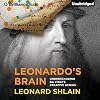
Part biography of da Vinci, part neuroscience and, part speculation, this is the last offering of the late doctor who passed away in 2009. The profile of the quintessential Renaissance man, his many accomplishments and some shortcomings, are fascinating. The neuroscience, about the two hemispheres of the brain and the Corpus Callosum which bridges them, are well and truly interesting and, presented in a way that the layman can understand. But the ideas which posit that Leonardo was able to show more bend/blend time & space, was the first cubist, first scientist, and so on... are just a couple of the many truly incredible claims that the author makes and which ruin the book by relegating it as the work of a crackpot. show less
Though I found Shlain’s theory compelling and provocative, and his writing style impressively fluid considering the complexity of his subject matter, I ultimately wasn’t able to sit still with the idea that something as simple as the mechanics of how we communicate could exert such profound influence on our attitudes toward complex, all-encompassing topics such as gender and spirituality, not to mention all the other areas which Shlain implicated as effects of our linguistic tools, such show more as our regard of the natural world and of our bodies, etc.
Shlain's primary assertion that the brain hemispheres are somehow aligned to genders is such an obviously simplistic theory that real-life experience easily trumps it. I consider myself a very left-brained person, with all that that implies – I am rarely grounded in my bodily sensations and physical surroundings, I think in more abstract than concrete terms, etc. – but I by no means disdain females, nor do I regret the fact that I am myself a female. I realize that Shlain includes a disclaimer in the beginning of the book about how gender is a social construct, and how any person, regardless of sex, contains a mixture of what are culturally deemed 'female' and 'male' attributes, but he doesn't seem to include this very weighty consideration in the actual meat of his argument.
Furthermore, I found his attribution of language to the left hemisphere and images to the right hemisphere to be too clean cut to adequately describe real-world uses of words and images. Though the holistic apprehension of images and other visual input is typically the remit of the right hemisphere, images themselves can very easily work for a left-brain agenda by reflecting its fragmented, disembodied vision of the world – as a brief foray into modern and postmodern art will readily attest to. Moving on to the question of language processing: for bureaucratic and scientific purposes, language depends on a linear procession of abstract signs to convey an explicit, literal meaning, left-brain style. But for the expression of anything besides pure, cold information – in other words, the type of situation which arises most frequently in day-to-day social intercourse – language users, even those using the written form, will depend on right-brain faculties such as affect, associative meaning, descriptive imagery, irony, humor and other non-literal devices. We cannot completely disregard the intentions with which we set out to communicate, and we cannot assume that our deeply held attitudes about the world will cede so readily to the structural impositions of our communicative medium. Poets, authors, and even the best of scientists try to find creative ways to somehow transcend the inherent logical framework of language to convey more intuitive understandings, and their intentions don't count for nothing.
The intention with which we set out to communicate surely must have more impact on how we choose to employ our tools, not the other way around. It seems to me that Shlain takes McLuhan’s adage too far, by suggesting that the nature of our tools dictates our uses of them, and not only that, but that it regiments our mindsets so definitively that our thought cannot venture outside of the limitations of the tools themselves. To accept this as true would also be to accept that thought is not possible beyond the constraints of language – and this problem is far from being resolved by current neurolinguistic research. According to Shlain’s explanation, which carries with it a lot of unchecked theoretical baggage, the technical details of language – how it depends on abstract representation, and is ordered in a linear fashion, etc. – will consequently cause us to limit our thought, too, to abstractions and linearity. Such a model of human behavior is evocative of a machine which can act only upon the software with which it has been coded, or of a circuit board whose output depends on a predetermined, linear chain of cause and effect… This is a mechanistic concept of how our minds work, and perhaps it’s how our collective left brain has primed us to think of the world and ourselves. It seems to me, then, that Shlain has himself recurred to a left-brain mode of thought in the very act of trying to warn us of its pernicious effects. We are humans, not machines, and we still have the ability to feel and act however we choose beyond language's 'coding,' because there is much more that goes on in our mind that the 'software' of language cannot even access.
I prefer to think that the causes and effects of our implements of thought don’t work nearly as linearly as left-brain conceptualization would have us believe. Our systems of signs cannot ‘program’ our thoughts about the world, because the world lies beyond those systems of signs, a lot of it too infinitely complex to ever interpret into signs. The world beyond signs must surely have greater influence on how we perceive things, one of those things being signs themselves. Far from lying in a direct, linear chain of causal relationships, I’d argue that our preferential use of one or another expressive outlet, our perceptions of gender differences, our disdain or esteem of the bodily and the concrete, our tendency to think linearly and analytically or holistically and intuitively, etc., are rather interrelated in a network of associations, and all collaborate to reinforce one another. It is impossible to extract just one component from this web of mutually reinforcing elements and name it the primary cause, just as it is impossible to designate the point where a circle begins. We may refer to such groupings of phenomena metonymically, as in "culture of writing," if you will, but that does not mean that writing is the primordial cause. Despite Shlain's skillful detection of patterns and drawing of parallels between aspects of the left brain, language at the end of the day is still just that - one aspect of an inextricably linked unity of perception brought to bear on the world by the left hemisphere.
I believe that what unifies the functions of each hemisphere is a fundamental attitude towards the world that each of the brain hemispheres has. If it’s odd to think of the brain hemispheres as having separate attitudes towards the world, as if they were two different people taking up residence inside our heads, it is certainly no odder than thinking that a computing machine is encased in our skulls, and that all it takes to ‘re-wire’ our way of thinking is to change one bit of the ‘code’ a bit, say, to process images instead of words.
Though I disagree with many premises that Shlain starts out with, he serves as an important starting point for me in the study of the mind, by providing a somewhat detached vantage point on language, with the necessary distance to analyze its often invisible effects on thought. His engaging style and captivating combination of psychology, communication studies, and anthropology has sparked a lifelong interest for me in that particular concoction of disciplines - actually, I'm doing research for my honors thesis right now on a similar concoction. So, after all the intellectual grappling I've done with it, my dog-eared, profusely highlighted and marked copy of The Alphabet Versus the Goddess will always have a special place on my bookshelf. show less
Shlain's primary assertion that the brain hemispheres are somehow aligned to genders is such an obviously simplistic theory that real-life experience easily trumps it. I consider myself a very left-brained person, with all that that implies – I am rarely grounded in my bodily sensations and physical surroundings, I think in more abstract than concrete terms, etc. – but I by no means disdain females, nor do I regret the fact that I am myself a female. I realize that Shlain includes a disclaimer in the beginning of the book about how gender is a social construct, and how any person, regardless of sex, contains a mixture of what are culturally deemed 'female' and 'male' attributes, but he doesn't seem to include this very weighty consideration in the actual meat of his argument.
Furthermore, I found his attribution of language to the left hemisphere and images to the right hemisphere to be too clean cut to adequately describe real-world uses of words and images. Though the holistic apprehension of images and other visual input is typically the remit of the right hemisphere, images themselves can very easily work for a left-brain agenda by reflecting its fragmented, disembodied vision of the world – as a brief foray into modern and postmodern art will readily attest to. Moving on to the question of language processing: for bureaucratic and scientific purposes, language depends on a linear procession of abstract signs to convey an explicit, literal meaning, left-brain style. But for the expression of anything besides pure, cold information – in other words, the type of situation which arises most frequently in day-to-day social intercourse – language users, even those using the written form, will depend on right-brain faculties such as affect, associative meaning, descriptive imagery, irony, humor and other non-literal devices. We cannot completely disregard the intentions with which we set out to communicate, and we cannot assume that our deeply held attitudes about the world will cede so readily to the structural impositions of our communicative medium. Poets, authors, and even the best of scientists try to find creative ways to somehow transcend the inherent logical framework of language to convey more intuitive understandings, and their intentions don't count for nothing.
The intention with which we set out to communicate surely must have more impact on how we choose to employ our tools, not the other way around. It seems to me that Shlain takes McLuhan’s adage too far, by suggesting that the nature of our tools dictates our uses of them, and not only that, but that it regiments our mindsets so definitively that our thought cannot venture outside of the limitations of the tools themselves. To accept this as true would also be to accept that thought is not possible beyond the constraints of language – and this problem is far from being resolved by current neurolinguistic research. According to Shlain’s explanation, which carries with it a lot of unchecked theoretical baggage, the technical details of language – how it depends on abstract representation, and is ordered in a linear fashion, etc. – will consequently cause us to limit our thought, too, to abstractions and linearity. Such a model of human behavior is evocative of a machine which can act only upon the software with which it has been coded, or of a circuit board whose output depends on a predetermined, linear chain of cause and effect… This is a mechanistic concept of how our minds work, and perhaps it’s how our collective left brain has primed us to think of the world and ourselves. It seems to me, then, that Shlain has himself recurred to a left-brain mode of thought in the very act of trying to warn us of its pernicious effects. We are humans, not machines, and we still have the ability to feel and act however we choose beyond language's 'coding,' because there is much more that goes on in our mind that the 'software' of language cannot even access.
I prefer to think that the causes and effects of our implements of thought don’t work nearly as linearly as left-brain conceptualization would have us believe. Our systems of signs cannot ‘program’ our thoughts about the world, because the world lies beyond those systems of signs, a lot of it too infinitely complex to ever interpret into signs. The world beyond signs must surely have greater influence on how we perceive things, one of those things being signs themselves. Far from lying in a direct, linear chain of causal relationships, I’d argue that our preferential use of one or another expressive outlet, our perceptions of gender differences, our disdain or esteem of the bodily and the concrete, our tendency to think linearly and analytically or holistically and intuitively, etc., are rather interrelated in a network of associations, and all collaborate to reinforce one another. It is impossible to extract just one component from this web of mutually reinforcing elements and name it the primary cause, just as it is impossible to designate the point where a circle begins. We may refer to such groupings of phenomena metonymically, as in "culture of writing," if you will, but that does not mean that writing is the primordial cause. Despite Shlain's skillful detection of patterns and drawing of parallels between aspects of the left brain, language at the end of the day is still just that - one aspect of an inextricably linked unity of perception brought to bear on the world by the left hemisphere.
I believe that what unifies the functions of each hemisphere is a fundamental attitude towards the world that each of the brain hemispheres has. If it’s odd to think of the brain hemispheres as having separate attitudes towards the world, as if they were two different people taking up residence inside our heads, it is certainly no odder than thinking that a computing machine is encased in our skulls, and that all it takes to ‘re-wire’ our way of thinking is to change one bit of the ‘code’ a bit, say, to process images instead of words.
Though I disagree with many premises that Shlain starts out with, he serves as an important starting point for me in the study of the mind, by providing a somewhat detached vantage point on language, with the necessary distance to analyze its often invisible effects on thought. His engaging style and captivating combination of psychology, communication studies, and anthropology has sparked a lifelong interest for me in that particular concoction of disciplines - actually, I'm doing research for my honors thesis right now on a similar concoction. So, after all the intellectual grappling I've done with it, my dog-eared, profusely highlighted and marked copy of The Alphabet Versus the Goddess will always have a special place on my bookshelf. show less
Lists
Awards


You May Also Like


Associated Authors
Statistics
- Works
- 11
- Members
- 2,595
- Popularity
- #9,900
- Rating
- 3.9
- Reviews
- 37
- ISBNs
- 32
- Languages
- 2
- Favorited
- 7