
Dave Eggers
Author of A Heartbreaking Work of Staggering Genius / Mistakes We Knew We Were Making
About the Author
Dave Eggers was born on March 12th, 1970, in Boston, Massachusetts. His family moved to Lake Forest, Illinois when he was a child. Eggers attended the University of Illinois at Urbana-Champaign, until his parents' deaths in 1991 and 1992. The loss left him responsible for his eight-year-old brother show more and later became the inspiration for his highly acclaimed memoir "A Heartbreaking Work of Staggering Genius". Published in 2000, the memoir was nominated for a nonfiction Pulitzer the following year. Eggers edits the popular "The Best American Nonrequired Reading" published annually. In 1998, he founded the independent publishing house, McSweeney's which publishes a variety of magazines and literary journals. Eggers has also opened several nonprofit writing centers for high school students across the United States. Eggers has written several novels and his title, A Hologram for the King, was a finalist for the 2012 National Book Award. His most recent work of fiction, entitled The Circle, was published in 2013. His recent nonfiction books are The Monk of Mokha (January 2018) and What Can a Citizen Do? (Illustrated by Shawn Harris)(September 2018). (Bowker Author Biography) show less
Disambiguation Notice:
Please do not combine this author page with "Doris Haggis-On-Whey" books. Dr. and Mr. Doris Haggis-on-Whey are a joint pseudonym of Dave Eggers and his brother Christopher Eggers. Please note that reviews of The Wild Things and Zeitoun have become confused on the Wild Things review thread.
Series
Works by Dave Eggers
A Heartbreaking Work of Staggering Genius / Mistakes We Knew We Were Making (2000) 14,069 copies, 212 reviews
Created in Darkness by Troubled Americans: The Best of McSweeney's Humor Category (2004) — Editor & Introduction — 889 copies, 16 reviews
McSweeney's 14: McSweeney's at War for the Foreseeable Future and He's Never Been So Scared (2004) — Editor — 412 copies, 5 reviews
McSweeney's 19: Old Facts, New Fiction, and a Novella by T.C. Boyle (2006) — Editor — 405 copies, 4 reviews
McSweeney's 23: Still Going Strong Like Castro (We Meant Ramón) (2007) — Editor — 303 copies, 5 reviews
Your Disgusting Head: The Darkest, Most Offensive and Moist Secrets of Your Ears, Mouth and Nose (2004) — Author — 271 copies, 2 reviews
McSweeney's 27: With Lots of Things Like This/Autophobia (2008) — Contributor — 230 copies, 4 reviews
McSweeney's 05: Sometimes Not Believing How Great This All Is (2012) — Editor — 190 copies, 2 reviews
Tomorrow Most Likely (Read Aloud Family Books, Mindfulness Books for Kids, Bedtime Books for Young Children, Bedtime Picture Books) (2019) 185 copies, 8 reviews
McSweeney's 31: Vikings, Monks, Philosophers, Whores: Old Forms Unearthed (2009) 184 copies, 4 reviews
Out of Exile: Narratives from the Abducted and Displaced People of Sudan (2008) — Interviews & Introduction — 64 copies
Most of the Better Natural Things in the World: (Juvenile Fiction, Nature Book for Kids, Wordless Picture Book) (2019) 53 copies, 4 reviews
The Alaska of Giants and Gods 3 copies
McSweeney's Books Sampler No. 1 3 copies
Hizimizi Tadacaksiniz 1 copy
What Is the What / How We Are Hungry / You Shall Know Our Velocity / A Heartbreaking Work of Staggering Genius (2009) 1 copy
Chapter One [short story] 1 copy
The Book Makers 1 copy
Phoenix 1 copy
[Title missing] 1 copy
The Very Best of McSweeney's 1 copy
Associated Works
My Bookstore: Writers Celebrate Their Favorite Places to Browse, Read, and Shop (2012) — Contributor — 617 copies, 16 reviews
Fight of the Century: Writers Reflect on 100 Years of Landmark ACLU Cases (2020) — Contributor — 259 copies, 5 reviews
Object Lessons: The Paris Review Presents the Art of the Short Story (2012) — Introduction — 253 copies, 9 reviews
One Hundred and Forty Five Stories in a Small Box: Hard to Admit and Harder to Escape, How the Water Feels to the Fishes, and Minor Robberies (2007) — Contributor — 230 copies, 1 review
Kingdom of Olives and Ash: Writers Confront the Occupation (2017) — Contributor — 165 copies, 5 reviews
An Innocent Abroad: Life-Changing Trips from 35 Great Writers (2014) — Contributor — 87 copies, 4 reviews
Voices from the Storm: The People of New Orleans on Hurricane Katrina and Its Aftermath (2006) — Series editor — 78 copies, 1 review
Can You Hear Me Now?: The Inspiration, Wisdom, and Insight of Michael Eric Dyson (2009) — Introduction — 45 copies
McSweeney's 52: In Their Faces a Landmark: Stories of Movement and Displacement (2018) — Founding Editor — 44 copies, 3 reviews
Don't Forget to Write for the Secondary Grades: 50 Enthralling and Effective Writing Lessons, Ages 11 and Up (2011) — Foreword — 33 copies
Beyond the Possible: 50 Years of Creating Radical Change in a Community Called Glide (2013) — Foreword — 29 copies
Thomas Demand: L'Esprit d'Escalier — Contributor — 1 copy
Tagged
Common Knowledge
- Canonical name
- Eggers, Dave
- Legal name
- Eggers, David
- Birthdate
- 1970-03-12
- Gender
- male
- Education
- University of Illinois, Urbana-Champaign
- Occupations
- writer
author
novelist
publisher - Organizations
- McSweeney's
826 Valencia
Might - Awards and honors
- Addison M. Metcalf Award in Literature (2001)
Brown University honorary Doctor of Letters (2005)
Heinz Award (Arts and Humanities, 2007)
TED Prize (2008)
Utne Reader 50 Visionaries Who Are Changing the World (2008)
Courage in Media Award (2009) (show all 13)
Literarian Award (2009)
Prix Médicis (2009)
Dayton Literary Peace Prize (2010)
Albatros Literaturpreis (2012)
American Academy of Arts and Letters (2015)
Carl Sandburg Literary Award (2017)
Muhammad Ali Humanitarian Award (2018) - Relationships
- Vida, Vendela (wife)
Eggers, Christopher (brother)
Demby, Constance (aunt)
Eggers, William D. (brother) - Nationality
- USA
- Birthplace
- Boston, Massachusetts, USA
- Places of residence
- Chicago, Illinois, USA
San Francisco, California, USA - Disambiguation notice
- Please do not combine this author page with "Doris Haggis-On-Whey" books. Dr. and Mr. Doris Haggis-on-Whey are a joint pseudonym of Dave Eggers and his brother Christopher Eggers.
Please note that reviews of The Wild Things and Zeitoun have become confused on the Wild Things review thread. - Associated Place (for map)
- USA
Members
Discussions
The Circle: Theological undertones in "The Circle" in One LibraryThing, One Book (January 2015)
The Circle: Introduce Yourself! in One LibraryThing, One Book (March 2014)
The Circle: Explicit References to 1984 Could Have Helped in Book talk (February 2014)
The Circle: General Likes/Dislikes in One LibraryThing, One Book (January 2014)
The Circle: First Impressions in One LibraryThing, One Book (December 2013)
The Circle: A Horror Novel? in One LibraryThing, One Book (December 2013)
The Circle: How did it go? in One LibraryThing, One Book (December 2013)
The Circle: What rang true for you? in One LibraryThing, One Book (December 2013)
The Circle: Author's Style in One LibraryThing, One Book (November 2013)
The Circle: Non-spoiler Oddities in One LibraryThing, One Book (November 2013)
Reviews
A dystopian satire (although at times it feels barely satirical) about social media and tech companies, featuring a corporation called The Circle, which is sort of like Google, Facebook, and Twitter all rolled into one and then made even more cult-like. The folks at The Circle not only fail to value privacy and cheerfully subordinate it to the desires of capitalism, they actually regard it as something akin to a moral evil. And they see it as their mission to make the world a better show more place.
It's a good premise, very Black Mirror-ish, and I appreciate the way Eggers carefully avoids straw-manning his targets (even to the extent of being willing to stipulate to some of the positive effects of the Circle's approach that I really don't personally find particularly creditable). But I'm afraid I never liked it anywhere near as much as I wanted to. The whole thing just feels entirely too heavy-handed. Certainly we did not need 400 pages to get the point, and I can't help thinking that it would have been far, far more effective if cut down to the length of a novella. show less
It's a good premise, very Black Mirror-ish, and I appreciate the way Eggers carefully avoids straw-manning his targets (even to the extent of being willing to stipulate to some of the positive effects of the Circle's approach that I really don't personally find particularly creditable). But I'm afraid I never liked it anywhere near as much as I wanted to. The whole thing just feels entirely too heavy-handed. Certainly we did not need 400 pages to get the point, and I can't help thinking that it would have been far, far more effective if cut down to the length of a novella. show less

Update: Life imitates art. I keep my distance from Facebook these days, and so it was only recently that I learned that Zuckerberg has rebranded his baby as “Meta”, as part of the Metaverse: It’s the metaverse — defined most simply as a virtual world where people can socialize, work, and play — and Facebook’s CEO Mark Zuckerberg believes it is the future of the internet and of his trillion-dollar company. The Circle, in other words…
This book made me very tense. Not in the way show more that I feel when a character in a thriller may - or may not - escape discovery, or a horrible death.
No, this was the kind of stress that, for me, comes from too little privacy and too many inputs.
At the Google-meets-1984 company that is The Circle, all personnel are required to integrate their personal social media accounts onto the company's network, and to actively participate on all social media platforms on an ongoing basis.
This would be the first level of hell for me. Aside from GR, any social media interaction has become unpleasant for me.
The next level would be the mandatory participation in social activities on The Circle campus. When reading about this I was reminded of the new COO at a company I worked for who insisted on participation in a company Happy Hour every Friday. At that time my work hours were 6:00 to 3:00, and hanging around for 2 hours for the opportunity of spending even more time with the people I worked with all day made me flinch. Doing that multiple times a week, regardless of the event, would have had me weeping.
Then there are the inputs and trackers. Multiple screens with multiple data feeds and earbuds with different messages and wristbands monitoring health and location. For crying out loud, there are times when I want to throw my Apple watch against the wall when it keeps reminding me to stand up. And I struggle with multiple simultaneous audio inputs under any circumstances. Open office environments make me nuts. At this point in the book I'm approaching that frozen wasteland that is Dante's 9th circle of hell.
And all this was before the main plot began.
So, not a book that I am going to be able to appreciate solely on its literary merits. I grew anxious to finish it just so that I could make the stress stop. (I am not kidding about this!)
But with all that said, the book was entertaining and thought-provoking. It is alluring to succumb to the ease and efficiency of integrating the electronic components of our lives - but how far is too far?
Four smiles. show less
This book made me very tense. Not in the way show more that I feel when a character in a thriller may - or may not - escape discovery, or a horrible death.
No, this was the kind of stress that, for me, comes from too little privacy and too many inputs.
At the Google-meets-1984 company that is The Circle, all personnel are required to integrate their personal social media accounts onto the company's network, and to actively participate on all social media platforms on an ongoing basis.
This would be the first level of hell for me. Aside from GR, any social media interaction has become unpleasant for me.
The next level would be the mandatory participation in social activities on The Circle campus. When reading about this I was reminded of the new COO at a company I worked for who insisted on participation in a company Happy Hour every Friday. At that time my work hours were 6:00 to 3:00, and hanging around for 2 hours for the opportunity of spending even more time with the people I worked with all day made me flinch. Doing that multiple times a week, regardless of the event, would have had me weeping.
Then there are the inputs and trackers. Multiple screens with multiple data feeds and earbuds with different messages and wristbands monitoring health and location. For crying out loud, there are times when I want to throw my Apple watch against the wall when it keeps reminding me to stand up. And I struggle with multiple simultaneous audio inputs under any circumstances. Open office environments make me nuts. At this point in the book I'm approaching that frozen wasteland that is Dante's 9th circle of hell.
And all this was before the main plot began.
So, not a book that I am going to be able to appreciate solely on its literary merits. I grew anxious to finish it just so that I could make the stress stop. (I am not kidding about this!)
But with all that said, the book was entertaining and thought-provoking. It is alluring to succumb to the ease and efficiency of integrating the electronic components of our lives - but how far is too far?
Four smiles. show less
Eggers’ protagonist in this novel is a flawed mother of two who takes her kids on an open-ended trip to Alaska to escape her ex-husband, legal troubles, and mainstream life in general. She’s thoughtful and likeable enough, but occasionally does things that are rather reckless and dangerous, probably earning the scorn of more than one reader. Where she’s going, even she can’t say. What I love about the book is its balance – there is introspection into relationships and life in show more middle age, great humor, and a few nuggets of wisdom, all without getting mired in what could otherwise have been clichés given the premise. The first chapter is fantastic and sets the tone, and the book does not let up from there. The scene where she and the kids go aboard a cruise ship with an old man to watch a magic show in which she gets sloppily drunk is priceless, as is the one much later in the book, when she jams with a bunch of local musicians. I laughed out loud when she emptied the clean-out of the RV, wondering “who could vouch for the end-to-end integrity of the shit cylinder?”, and later, on considering the tube, this very sly reference to Proust, it “containing so much remembrance of things passed”. Eggers really has a way with words, e.g. the five-year-old Ana being a “constant threat to the social contract”, and his writing is crisp and direct as always.
Warning, there are some spoilers in what follows… One truth his character arrives at, to love and accept others, culminates in a wonderful scene where her children take stones off her prone body one by one, giving her a feeling of levitation and release. She also believes firmly in the importance of being brave – brave enough to defy convention, to seek change, and to go on adventures – and that this is the most important thing to instill in children. Lastly, the ending is profound – in getting through a very scary thing, one which would have most people saying holy (bleep), I can’t believe I was stupid enough to have just done that – how wonderful it is that both her and her son are happy – happy! – with the experience, and that they’ve triumphed over what the world threw at them. If all of this sounds overly deep and possibly sappy, fear not, it’s delivered with a very deft touch – and one may think almost too deft, as readers may not ‘get it’. This is the 9th book of Eggers’ that I’ve read, and it’s right up there with his best work.
Quotes:
On America:
“She laughed at her own surprise at finding people like this here, in rural Alaska. What was she expecting? She had fled the polite, muted violence of her life in Ohio, only to drive her family into the country’s barbarian heart. We are not civilized people, she realized. All questions about national character and motivations and aggression could be answered when we acknowledged this elemental truth.”
On change:
“She was done, gone. She had been comfortable, and comfort is the death of the soul, which is by nature searching, insistent, unsatisfied. This dissatisfaction drives the soul to leave, to get lost, to be lost, to struggle and adapt. And adaptation is growth, and growth is life.”
On children, and parenting:
“She began to conceive a new theory of parenting, where the goal was not the achieving of a desired result. The object is not to raise a child for some future outcome, no! Times like these, together in the pines amid the fading light, as the kids run through the long grass, her son gravely teaching himself archery while her daughter tries to induce some self-injury, these moments alone were the object. Josie felt, fleetingly, that she could die having achieved such a day. Get to a place like this, get to a moment like this, and that alone is the object. Or it could be the object. A new way of thinking. Stretch some of these days together and that’s all one could want or expect. Raising children was not about perfecting them or preparing them for job placement. What a hollow goal! Twenty-two years of struggle for what – your child sits inside at an Ikea table staring into a screen while outside the sky changes, the sun rises and falls, hawks float like zeppelins. This was the common criminal pursuit of all contemporary humankind. Give my child an Ikea desk and twelve hours a day of sedentary typing. This will mean success for me, them, our family, our lineage. She would not pursue this. She would not subject her children to this. They would not seek these specious things, no. It was only about making them loved in a moment in the sun.”
On the power of music:
“Write a song – how long could it take? Minutes? Maybe an hour, maybe a day. Then sing the song to people who will love you for it. Who will love the music. Bring renewable joy to millions. Or just thousands. Or just hundreds. Does it matter? The music does not die. Sam Cooke, long gone, only dust now, was still with us, was now vibrating through Josie and was carving new neural pathways in her children’s minds, his voice so clear, a magnificent songbird coming through the radio and alighting on her shoulder, even here, even now, at nine o’clock, in this broken RV, somewhere between Anchorage and Homer. Though dead too soon, Sam Cooke knew how to live. Did he know he knew how to live?”
On online reviews and ‘vengeance’; this one made me reflect on being more even keeled:
“We live in a vengeful time. You didn’t get the orange chicken you ordered or the sticky rice? And now you’re already home? Meaning you’d have to drive all the way back to get the orange chicken and sticky rice you ordered? Injustice! And thus avenge. Avenge the proprietor’s crimes! This was our contemporary version of balance, of speaking truth to power. Avenge the proprietor on thy customer-review site! Right the imbalance! Josie had done it herself. Three times she’d done it, and each time it felt so good for two or three minutes, and then felt base and wasted.”
And this one, on just how spoiled the affluent are:
“Once it had been an actual place, a smallish town with an actual cobblestone square where children rode their scooters and were chased by tiny lamentable dogs, perversions of selective breeding, off leash and barking. Now the place was crowded, there was no parking, women in ponytails drove at dangerous speeds on their way to yoga and pilates, tailgating other drivers, honking, cheating at four-way stop signs. It had become an unhappy place.
The crime of the ponytail ladies was that they were always in a hurry, in a hurry to exercise, in a hurry to pick up their children from capoeira, in a hurry to examine the scores from the school’s Mandarin-immersion program, in a hurry to buy micro-greens at the new ivy-covered organic grocery, one of a newly dominant national chain begun by a libertarian megalomaniac, a store where the food had been curated, in which the women in their ponytails rushed quickly through, smiling viciously when their carts’ paths were momentarily waylaid.”
On a waterfall:
“When they got close, the volume was far greater than it had seemed from the path. For a moment the falling water seemed utterly sentient, falling with joyous aggression to the earth, spitefully suicidal. The spray reached them first, and they stopped, sat, and watched the waterfall’s ghostly white fingers. In the wall of mist, rainbows shot off like birds taking flight.” show less
Warning, there are some spoilers in what follows… One truth his character arrives at, to love and accept others, culminates in a wonderful scene where her children take stones off her prone body one by one, giving her a feeling of levitation and release. She also believes firmly in the importance of being brave – brave enough to defy convention, to seek change, and to go on adventures – and that this is the most important thing to instill in children. Lastly, the ending is profound – in getting through a very scary thing, one which would have most people saying holy (bleep), I can’t believe I was stupid enough to have just done that – how wonderful it is that both her and her son are happy – happy! – with the experience, and that they’ve triumphed over what the world threw at them. If all of this sounds overly deep and possibly sappy, fear not, it’s delivered with a very deft touch – and one may think almost too deft, as readers may not ‘get it’. This is the 9th book of Eggers’ that I’ve read, and it’s right up there with his best work.
Quotes:
On America:
“She laughed at her own surprise at finding people like this here, in rural Alaska. What was she expecting? She had fled the polite, muted violence of her life in Ohio, only to drive her family into the country’s barbarian heart. We are not civilized people, she realized. All questions about national character and motivations and aggression could be answered when we acknowledged this elemental truth.”
On change:
“She was done, gone. She had been comfortable, and comfort is the death of the soul, which is by nature searching, insistent, unsatisfied. This dissatisfaction drives the soul to leave, to get lost, to be lost, to struggle and adapt. And adaptation is growth, and growth is life.”
On children, and parenting:
“She began to conceive a new theory of parenting, where the goal was not the achieving of a desired result. The object is not to raise a child for some future outcome, no! Times like these, together in the pines amid the fading light, as the kids run through the long grass, her son gravely teaching himself archery while her daughter tries to induce some self-injury, these moments alone were the object. Josie felt, fleetingly, that she could die having achieved such a day. Get to a place like this, get to a moment like this, and that alone is the object. Or it could be the object. A new way of thinking. Stretch some of these days together and that’s all one could want or expect. Raising children was not about perfecting them or preparing them for job placement. What a hollow goal! Twenty-two years of struggle for what – your child sits inside at an Ikea table staring into a screen while outside the sky changes, the sun rises and falls, hawks float like zeppelins. This was the common criminal pursuit of all contemporary humankind. Give my child an Ikea desk and twelve hours a day of sedentary typing. This will mean success for me, them, our family, our lineage. She would not pursue this. She would not subject her children to this. They would not seek these specious things, no. It was only about making them loved in a moment in the sun.”
On the power of music:
“Write a song – how long could it take? Minutes? Maybe an hour, maybe a day. Then sing the song to people who will love you for it. Who will love the music. Bring renewable joy to millions. Or just thousands. Or just hundreds. Does it matter? The music does not die. Sam Cooke, long gone, only dust now, was still with us, was now vibrating through Josie and was carving new neural pathways in her children’s minds, his voice so clear, a magnificent songbird coming through the radio and alighting on her shoulder, even here, even now, at nine o’clock, in this broken RV, somewhere between Anchorage and Homer. Though dead too soon, Sam Cooke knew how to live. Did he know he knew how to live?”
On online reviews and ‘vengeance’; this one made me reflect on being more even keeled:
“We live in a vengeful time. You didn’t get the orange chicken you ordered or the sticky rice? And now you’re already home? Meaning you’d have to drive all the way back to get the orange chicken and sticky rice you ordered? Injustice! And thus avenge. Avenge the proprietor’s crimes! This was our contemporary version of balance, of speaking truth to power. Avenge the proprietor on thy customer-review site! Right the imbalance! Josie had done it herself. Three times she’d done it, and each time it felt so good for two or three minutes, and then felt base and wasted.”
And this one, on just how spoiled the affluent are:
“Once it had been an actual place, a smallish town with an actual cobblestone square where children rode their scooters and were chased by tiny lamentable dogs, perversions of selective breeding, off leash and barking. Now the place was crowded, there was no parking, women in ponytails drove at dangerous speeds on their way to yoga and pilates, tailgating other drivers, honking, cheating at four-way stop signs. It had become an unhappy place.
The crime of the ponytail ladies was that they were always in a hurry, in a hurry to exercise, in a hurry to pick up their children from capoeira, in a hurry to examine the scores from the school’s Mandarin-immersion program, in a hurry to buy micro-greens at the new ivy-covered organic grocery, one of a newly dominant national chain begun by a libertarian megalomaniac, a store where the food had been curated, in which the women in their ponytails rushed quickly through, smiling viciously when their carts’ paths were momentarily waylaid.”
On a waterfall:
“When they got close, the volume was far greater than it had seemed from the path. For a moment the falling water seemed utterly sentient, falling with joyous aggression to the earth, spitefully suicidal. The spray reached them first, and they stopped, sat, and watched the waterfall’s ghostly white fingers. In the wall of mist, rainbows shot off like birds taking flight.” show less
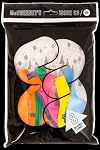
In one of the more creative packaging ideas McSweeney's has tried, issue 53 comes in a bag of party balloons with eight short, short stories printed on actual balloons. The only way these can be read is by blowing them up, which leads to all kinds of connotations about impermanence and art only existing if there's someone to observe it and give it life. The longer stories are printed in a softcover book with a fun vinyl cover.
The stories in the vinyl book are terrific and uniformly show more memorable, but, while I like the concept, the balloon stories are more like puffs of air than real tales. There's also a great excerpt from Daniel Gumbiner's forthcoming book, "The Boatbuilder," which truly made me want to buy the book. show less
The stories in the vinyl book are terrific and uniformly show more memorable, but, while I like the concept, the balloon stories are more like puffs of air than real tales. There's also a great excerpt from Daniel Gumbiner's forthcoming book, "The Boatbuilder," which truly made me want to buy the book. show less
Lists
To Read (5)
Review 1 (1)
Read in 2016 (1)
Our digital age (1)
New Orleans (1)
Tour of Africa (1)
Floods (1)
Deathreads (1)
2000s decade (1)
Disaster Books (1)
4th Grade Books (1)
Rising water (1)
First Novels (1)
Florida (1)
00 (2)
Favourite Books (2)
100 New Classics (2)
to get (2)
Unread books (3)
Overdue Podcast (1)
Five star books (1)
. (1)
2010s (1)
Best Dystopias (1)
Tagged Storms (1)
Obama Reads (1)
My TBR (1)
Hurricane Books (1)
Awards


You May Also Like


Associated Authors
Statistics
- Works
- 167
- Also by
- 49
- Members
- 73,168
- Popularity
- #173
- Rating
- 3.8
- Reviews
- 1,918
- ISBNs
- 864
- Languages
- 24
- Favorited
- 171


