
Irwin Shaw (1913–1984)
Author of Rich Man, Poor Man
About the Author
Image credit: Courtesy of the NYPL Digital Gallery (image use requires permission from the New York Public Library)
Series
Works by Irwin Shaw
Four Complete Novels: Rich Man Poor Man / Beggarman Thief / Evening in Byzantium / Nightwork (1981) 15 copies
The Eighty-Yard Run 5 copies
Collected Fiction: The Young Lions, Bread Upon the Waters, Short Stories: Five Decades, and The Troubled Air (2017) 5 copies, 1 review
Homem Rico. Homem Pobre - Volume I 2 copies
Vida que segue 2 copies
Due settimane in un'altra città 2 copies
Homem Rico Homem Pobre 1º Volume 2 copies
ثورة الموتى 2 copies
Felicidade não se compra (PE1L135) 2 copies
Aire agitado 1 copy
Богат, беден 1 copy
Acte de foi 1 copy
the book 1 copy
Просяк, крадец 1 copy
Blyg och ensam 1 copy
:Om bogat,om sarac (vol.2 ) 1 copy
Os deuses vencidos 1 copy
Om bogat,om sarac (vol.1 ) 1 copy
Pan en las aguas 1 copy
EN COMPAGNIE DES DAUPHINS 1 copy
Młode lwy T.1 1 copy
LE RICHE ET LE PAUVRE 1 copy
Om bogat, om sărac 2 1 copy
Om bogat, om sărac vol 1 1 copy
Una vita nel vuoto 1 copy
Short stories 1 copy
Зеленая Ню 1 copy
Młode lwy. tom III 1 copy
Młode lwy. tom II 1 copy
Młode lwy. tom I 1 copy
La brava gente 1 copy
The Mannichon Solution 1 copy
Welcome to the city 1 copy
Education Of The Heart 1 copy
Opere 1 copy
Medal from Jerusalem 1 copy
Selected Short Stories. 1 copy
La notte inquieta | L'uomo che sposò una ragazza francese — Author — 1 copy
Kruh na vodi 1 copy
Večer v Bizancu 1 copy
Unge løver, 1 og 2 1 copy
O cimo do monte 1 copy
O Regressado da Morte 1 copy
ZENGIN VE YOKSUL 2 1 copy
ZENGIN VE YOKSUL 1 copy
O Pobre homem rico 1 copy
O alto da colina 1 copy
Богач, бедняк 1 copy
Associated Works
The World of the Short Story: A 20th Century Collection (1986) — Contributor — 511 copies, 4 reviews
Points of View: An Anthology of Short Stories, Revised & Updated Edition (1995) — Contributor — 442 copies, 7 reviews
Reporting World War II Part Two : American Journalism 1944-1946 (1995) — Contributor — 430 copies, 3 reviews
First Fiction: An Anthology of the First Published Stories by Famous Writers (1994) — Contributor — 196 copies, 1 review
Writing New York: A Literary Anthology (Expanded 10th-Anniversary Edition) (2008) — Contributor — 101 copies, 1 review
Out of the Best Books: An Anthology of Literature, Vol. 1: The Individual and Human Values (1964) — Contributor — 40 copies
The Greatest War Stories Ever Told: Twenty-Four Incredible War Tales (2001) — Contributor — 31 copies, 1 review
Rediscoveries: Informal Essays in Which Well-Known Novelists Rediscover Neglected Works of Fiction by One of Their Favorite Authors (1971) — Contributor — 27 copies
Fifty Years of the American Short Story from the O. Henry Awards 1919-1970 (1970) — Contributor — 17 copies, 1 review
The Best Short Stories of 1941 and the Yearbook of the American Short Story (1941) — Contributor — 11 copies
The Best Short Stories of 1940 and the Yearbook of the American Short Story (1940) — Contributor — 8 copies
Fifty Years of the American Short Story from the O. Henry Awards 1919-1970, Volume 2 (1970) — Contributor — 5 copies
The Best from Cosmopolitan — Contributor — 4 copies
Reading-for-Men: The Gracious Lily Affair, Tip on a Dead Jockey, Rally Round the Flag, Boys!, They Fought for the Sky, Rascals in Paradise (1958) — Contributor — 2 copies
Modern Short Stories — Contributor — 2 copies
The Haunted Boy, Sphinx, Lead Her Like a Pigeon, Red Wind, The Eighty-Yard Run (Selections from Reader's Digst Condensed (1980) 1 copy
The Ethnic Image in Modern American Literature, 1900-1950, Volumes 1-2 (1984) — Contributor — 1 copy
The Teaching Experience: An Introduction to Education Through Literature (1976) — Contributor — 1 copy
Tagged
Common Knowledge
- Canonical name
- Shaw, Irwin
- Legal name
- Shamforoff, Irwin Gilbert
- Birthdate
- 1913-02-27
- Date of death
- 1984-05-16
- Gender
- male
- Education
- Brooklyn College (BA|1934)
- Occupations
- radio scriptwriter
playwright
novelist
short story writer
screenwriter - Organizations
- United States Army (WWII)
- Awards and honors
- American Academy of Arts and Letters Academy Award (Literature, 1946)
Playboy Award (1964, 1970, 1979) - Relationships
- Shaw, David (brother)
Shaw, Marian (spouse)
Shaw, Adam (son) - Cause of death
- cancer, prostate
- Nationality
- USA
- Birthplace
- The Bronx, New York, New York, USA
- Places of residence
- New York, New York, USA
Klosters, Graubünden, Switzerland
Southampton, New York, USA - Place of death
- Davos, Graubünden, Switzerland
- Burial location
- cremated
- Associated Place (for map)
- New York, USA
Members
Reviews

“THE TOWN SHONE IN the snowy twilight like a Christmas window, with the electric railway’s lights tiny and festive at the foot of the white slope, among the muffled winter hills of the Tyrol. People smiled at each other broadly, skiers and natives alike, in their brilliant clothes, as they passed each other on the snow-draped streets, and there were wreaths on the windows and doors of the white and brown houses because this was the eve of the new and hopeful year of 1938.”
As the novel show more opens Christian Diestl, an Austrian ski instructor, speaks with a young American woman and warns her that war is coming. The storyline follows him as he fights in France, Northern Africa, Italy, and Germany. Noah Ackerman, a young Jewish American, is living in California. He is feeling lonely and disconnected when he meets and falls in love with Hope Plowman. He enters the Army and faces anti-Semitism in his own ranks. He is deployed to England before being sent into battle. Michael Whiteacre is a writer and film producer living the “good life” in New York. He is determined to enter the Army as a private but is soon disillusioned, so he pulls strings to get assigned to non-combat duty.
Published in 1948, this book is historical fiction at its finest. It is written in realistic fashion. Shaw was a writer before joining the US Army during World War II, and the story is based on his first-hand experiences. It is a beautifully crafted novel. It is told in chronological order alternating among the three protagonists. The characters are deeply defined, and the reader senses that their stories will eventually converge.
The narrative focuses on the personal lives and military experiences of the soldiers. It does not attempt to address the military strategies or leadership decisions. It is a sweeping epic of a literary work that examines the moral quandaries presented by war. I found it easy to get immersed in the characters’ lives. At 700 pages of dense writing, it requires a significant time commitment, but I found it well worth the effort. show less
As the novel show more opens Christian Diestl, an Austrian ski instructor, speaks with a young American woman and warns her that war is coming. The storyline follows him as he fights in France, Northern Africa, Italy, and Germany. Noah Ackerman, a young Jewish American, is living in California. He is feeling lonely and disconnected when he meets and falls in love with Hope Plowman. He enters the Army and faces anti-Semitism in his own ranks. He is deployed to England before being sent into battle. Michael Whiteacre is a writer and film producer living the “good life” in New York. He is determined to enter the Army as a private but is soon disillusioned, so he pulls strings to get assigned to non-combat duty.
Published in 1948, this book is historical fiction at its finest. It is written in realistic fashion. Shaw was a writer before joining the US Army during World War II, and the story is based on his first-hand experiences. It is a beautifully crafted novel. It is told in chronological order alternating among the three protagonists. The characters are deeply defined, and the reader senses that their stories will eventually converge.
The narrative focuses on the personal lives and military experiences of the soldiers. It does not attempt to address the military strategies or leadership decisions. It is a sweeping epic of a literary work that examines the moral quandaries presented by war. I found it easy to get immersed in the characters’ lives. At 700 pages of dense writing, it requires a significant time commitment, but I found it well worth the effort. show less

Shaw knows how to write a good story. He keeps you reading until the last page. His plot is complex and interesting (albeit a tad trashy and potboilerish at times), but he really invests you in these characters and their trials and tribulations and makes you root for them to win in the end. Unfortunately, his representation of women is extremely dated and off-putting. They're sexually objectified, and only important in their relation to the men characters, who are Shaw's central focus.
The show more one exception is Gretchen, who finds several creative sparks that surprise and motivate her to pursue a handful of different careers. Out of all the women within the novel's pages, she comes the closest to being an independent character in her own right. But Shaw muddles this up too, by making the main thrust of her arc revolve completely around her failed romantic relationships and not her career.
Even the disappointing ending hinges on the "salacious" behavior of an important woman character. And, yes, it's primarily to provide a moment of pathos for one of the male characters at the novel's conclusion.
I realize sexism was normalized and accepted in the time period of the story, as well as the one in which it was written, but it doesn't make it any easier to read. And it's all the more surprising that the story ends in 1969, at the dawn of the women's liberation movement. This could've been a great opportunity for Shaw to address the events his women characters have gone through and reflect on how things are possibly beginning to change. But nope, the most he does is have his characters offhandedly criticize "those damn pot-smoking hippies" and that's as far as he delves into progressive social movements. What a waste. show less
The show more one exception is Gretchen, who finds several creative sparks that surprise and motivate her to pursue a handful of different careers. Out of all the women within the novel's pages, she comes the closest to being an independent character in her own right. But Shaw muddles this up too, by making the main thrust of her arc revolve completely around her failed romantic relationships and not her career.
Even the disappointing ending hinges on the "salacious" behavior of an important woman character. And, yes, it's primarily to provide a moment of pathos for one of the male characters at the novel's conclusion.
I realize sexism was normalized and accepted in the time period of the story, as well as the one in which it was written, but it doesn't make it any easier to read. And it's all the more surprising that the story ends in 1969, at the dawn of the women's liberation movement. This could've been a great opportunity for Shaw to address the events his women characters have gone through and reflect on how things are possibly beginning to change. But nope, the most he does is have his characters offhandedly criticize "those damn pot-smoking hippies" and that's as far as he delves into progressive social movements. What a waste. show less

This was Shaw’s last finished book and gets bagged a lot by critics who regret how different he is here from his early work. I want to be more generous than that. It’s intensely personal, derived from the author’s life. That’s how it feels and, subsequently reading a little about the end of his life, that’s how it was. Not being a fan of sitting through blow-by-blows of other people’s dreams, it was pleasing that the parts of the book where he is drifting in and out of life – show more an operation was botched and bitterly retold – are real. It reminded me of my father’s emergence with some brain damage from a coma. He talked of the most surreal things as if they could be touched. There was no difference in his brain between them and those around him. Shaw does a good job of conveying that close to death dream state.
rest here: https://alittleteaalittlechat.wordpress.com/2019/03/31/acceptable-losses-by-irwi... show less
rest here: https://alittleteaalittlechat.wordpress.com/2019/03/31/acceptable-losses-by-irwi... show less
Collected Fiction: The Young Lions, Bread Upon the Waters, Short Stories: Five Decades, and The Troubled Air by Irwin Shaw
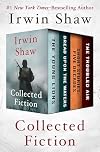
Overall rating will wait until I finish this volume - maybe in 20 or 30 years :-). (Actually, it didn't take me long to get through the short stories volume. These stories are highly readable and make you want to keep going. They struck a chord with me for sure.)
Short Stories, Five Decades **** stars
Shaw is a wonderful short story writer, and none of these many stories is unenjoyable. The early stories, taking place during the hard times before World War II, and the stories that take place show more during and immediately after the war, are more gritty, but the whole series of stories, which seems to be in chronological order, tells a pretty good history of the middle part of the American 20th Century. Only after reading deep into the collection did I begin to have a few niggling doubts. Shaw's male characters ring quite true, and it is easy to identify with their ideals and their quirks, even when Shaw is trying to make a point using some odd behavior, such as the voyeurism in the last story. But his female characters seem well out of date. Perhaps they are a good representation of how women felt about themselves then and the stereotypes they subscribed to, but perhaps not. In the end, this doesn't take away from the immense enjoyment of such a well-crafted collection of stories, but it does leave them more as consistently entertaining, usually informative historical artifacts than as masterpieces of the genre. show less
Short Stories, Five Decades **** stars
Shaw is a wonderful short story writer, and none of these many stories is unenjoyable. The early stories, taking place during the hard times before World War II, and the stories that take place show more during and immediately after the war, are more gritty, but the whole series of stories, which seems to be in chronological order, tells a pretty good history of the middle part of the American 20th Century. Only after reading deep into the collection did I begin to have a few niggling doubts. Shaw's male characters ring quite true, and it is easy to identify with their ideals and their quirks, even when Shaw is trying to make a point using some odd behavior, such as the voyeurism in the last story. But his female characters seem well out of date. Perhaps they are a good representation of how women felt about themselves then and the stereotypes they subscribed to, but perhaps not. In the end, this doesn't take away from the immense enjoyment of such a well-crafted collection of stories, but it does leave them more as consistently entertaining, usually informative historical artifacts than as masterpieces of the genre. show less
Lists
1970s (2)
Best War Stories (1)
Awards


You May Also Like


Associated Authors
Statistics
- Works
- 144
- Also by
- 91
- Members
- 4,870
- Popularity
- #5,160
- Rating
- 3.7
- Reviews
- 78
- ISBNs
- 420
- Languages
- 19
- Favorited
- 6
