
Josef Škvorecký (1924–2012)
Author of The Engineer of Human Souls
About the Author
Josef Skvorecky was born in Nachod, Czechoslovakia on September 27, 1924. Under Nazi occupation, he was forced to work in an aircraft factory. He later read Philosophy at Charles University in Prague. He worked for the state publishing house, helping to translate books by Ernest Hemingway, William show more Faulkner and Raymond Chandler. He began to write detective stories featuring Lieutenant Boruvka, which became popular with Czech readers. In 1958, his novel The Cowards was published and then banned on the grounds that it was "Titoist and Zionist." He and his wife moved to Canada after the 1968 Soviet-led invasion of Czechoslovakia that crushed the liberal reforms known as the Prague Spring. They founded 68 Publishers in 1971, which released more than 200 books by exiled Czech authors and those banned by the communists. Skvorecky's other written works include Miss Silver's Past, The Engineer of Human Souls, and The Miracle Game. In 1980, he received the Neustadt International Prize for Literature. He taught at the University of Toronto. He died on January 3, 2012 at the age of 87. (Bowker Author Biography) show less
Series
Works by Josef Škvorecký
All the Bright Young Men and Women: A Personal History of the Czech Cinema (Take One Film Book Series) (1971) 11 copies
Prima sezóna : text o nejdůležitějších věcech života ; Zbabělci ; Konec nylonového věku (1991) 5 copies
Inženjer ljudskih duša : osvrt na stare teme o životu, ženama, sudbini, sanjarenju, radničkoj klasi, uhodama, ljubavi i smrti (1989) 2 copies
Mirakl II. 2 copies
Sedmiramenny Svicen 1 copy
Psani, jazz a bláto v pásech : dopisy Josefa Škvoreckého a Lubomira Dorůžky z doby kultů (1959-1960) 1 copy
Mirakl I. 1 copy
Cud : kryminał polityczny 1 copy
O nich - o nás 1 copy
Cowards or conquerors. 1 copy
Oh, my papa! 1 copy
Humbug 1 copy
Associated Works
Who's Writing This? Notations on the Authorial I, with Self-Portraits {not Antæus} (1995) — Contributor — 76 copies
Daedalus, Winter 1990: Eastern Europe, Central Europe, Europe (1990) — Contributor — 15 copies, 1 review
Antaeus No. 64/65, Spring/Autumn 1990 - Twentieth Anniversary Issue (1990) — Contributor — 14 copies
Antaeus No. 73/74, Spring 1994 - Who’s Writing This: Notations on the Authorial I {magazine} (1994) — Contributor — 5 copies
Fingerprints : A Collection of Stories by the Crime Writers of Canada (1984) — Contributor — 2 copies
Tagged
Common Knowledge
- Canonical name
- Škvorecký, Josef
- Legal name
- Škvorecký, Josef Vaclav
- Birthdate
- 1924-09-27
- Date of death
- 2012-01-03
- Gender
- male
- Education
- Université Charles, Prague (Etudes anglaises, Philosophie)
- Occupations
- professor (Littérature)
Traducteur (Tchéque, Anglais - Organizations
- University of Toronto (Professor, Literature, 19 69 | 19 90)
Sixty-Eight Publishers (Fondateur, 19 71)
Littérature mondiale, Revue (Rédacteur, 19 56 | 19 68) - Awards and honors
- Neustadt International Prize for Literature (1980)
Order of white Lion (180)
Order of Canada (1982
Orden des Weißen Löwen (1990) - Relationships
- Salivarová, Zdena (wife)
- Nationality
- Czech Republic
Canada - Birthplace
- Náchod, Tchécoslovaquie
- Places of residence
- Toronto, Ontario, Canada (1969)
Nachod, République Tchèque - Place of death
- Toronto, Ontario, Canada
- Map Location
- République Tchèque
Czech Republic
Members
Reviews
The Cowards (Neglected books of the twentieth century) (English and Czech Edition) by Josef Škvorecký

Imagine the egocentrism of Holden Caulfield in a world where an adolescent impulse can have devastating consequences... and you have some idea of the genuine peril portrayed by Czech author Josef Škvorecký in his 1958 novel The Cowards set in a small town in Czechoslovakia during the chaos of the German retreat and the Russian advance. His character Danny is preoccupied by girls, jazz and judgmental opinions about the adults in his society, and, fuelled by rumours and naïve heroics from show more the local administration, his ambition to impress the girl of his dreams leads him into recklessness. It's an extraordinary book.
Josef Škvorecký (1924-2012) grew up in Czechoslovakia when it was a sovereign state, was a slave labourer for two years under the German Occupation, and then became a teacher, editor and translator when Czechoslovakia was part of the Eastern Bloc. He came to the attention of the Soviet authorities with the publication of The End of the Nylon Age (1956) and The Cowards (1958) but despite bans kept writing until forced to flee when the 1968 Prague Spring culminated in the Warsaw Pact invasion of Czechoslovakia. In Canada, he and his wife Zdena Salivarová, founded 68 Publishers which published banned Czech and Slovak books by dissident writers. He himself was a prolific author, winning multiple awards and a nomination for the Nobel in 1982. Although he wrote in Czech, most of his books are available in English.
Although it was published after The End of the Nylon Age, The Cowards was Škvorecký's first book and it features themes that (according to Wikipedia) recur in his later works. One of the things the Soviets didn't like was his innovative prose style which mimics mid-century American jazz. It's open-ended and improvisational, and it riffs on certain motifs the way that jazz does. Danny (who plays tenor sax) is besotted with jazz. He and his adolescent pals know all the jazz standards, and the novel, which takes place over the course of six days in May 1945, is book-ended with a band rehearsal as prelude to events on Friday May 4th, 1945, and their 'liberation' concert in the town square that meets with disapproval from the town worthies on the following Thursday. Škvorecký is a genius at evoking the sounds and rhythm of jazz.
Despite his preoccupations, Danny is aware of current events. He knows the fate of the Jewish cantor who he used to visit under the radar when it was dangerous to have Jewish associates; he's had to do forced labour in the local Messerschmidt factory; and one of the members of his band has spent time in a concentration camp newly liberated. While he is playing, Danny muses on his fruitless love for Irena and on the beauty of the Queen of Würtemberg, one of many big shots who'd come from all over the Reich to Kostelec and now things were closing in on them from all sides and there they sat in their plush upholstered rooms like in a trap. But while he hears rumours of an impending revolution and alternately believes and disbelieves them, he is bored. The front is so far away that it can only be heard in the distance, and he doesn't think there will be much resistance from the demoralised Germans anyway. His naïveté is matched only by his confidence that he knows it all.
To read the rest of my review please visit https://anzlitlovers.com/2022/09/10/the-cowards-by-josef-skvorecky-translated-by... show less
Josef Škvorecký (1924-2012) grew up in Czechoslovakia when it was a sovereign state, was a slave labourer for two years under the German Occupation, and then became a teacher, editor and translator when Czechoslovakia was part of the Eastern Bloc. He came to the attention of the Soviet authorities with the publication of The End of the Nylon Age (1956) and The Cowards (1958) but despite bans kept writing until forced to flee when the 1968 Prague Spring culminated in the Warsaw Pact invasion of Czechoslovakia. In Canada, he and his wife Zdena Salivarová, founded 68 Publishers which published banned Czech and Slovak books by dissident writers. He himself was a prolific author, winning multiple awards and a nomination for the Nobel in 1982. Although he wrote in Czech, most of his books are available in English.
Although it was published after The End of the Nylon Age, The Cowards was Škvorecký's first book and it features themes that (according to Wikipedia) recur in his later works. One of the things the Soviets didn't like was his innovative prose style which mimics mid-century American jazz. It's open-ended and improvisational, and it riffs on certain motifs the way that jazz does. Danny (who plays tenor sax) is besotted with jazz. He and his adolescent pals know all the jazz standards, and the novel, which takes place over the course of six days in May 1945, is book-ended with a band rehearsal as prelude to events on Friday May 4th, 1945, and their 'liberation' concert in the town square that meets with disapproval from the town worthies on the following Thursday. Škvorecký is a genius at evoking the sounds and rhythm of jazz.
Fonda rapped four times on the top of Winter's upright piano and we began to play. Lexa wailed shrilly in the highest register of his clarinet, Venca sank down to the explosive depths of his trombone to build up the bass, and I was playing around with some fancy little flourishes in the middle range, while Benno came out above us with his rough, dirty, sobbing tones that sounded like they came from heaven. (p.17)
Despite his preoccupations, Danny is aware of current events. He knows the fate of the Jewish cantor who he used to visit under the radar when it was dangerous to have Jewish associates; he's had to do forced labour in the local Messerschmidt factory; and one of the members of his band has spent time in a concentration camp newly liberated. While he is playing, Danny muses on his fruitless love for Irena and on the beauty of the Queen of Würtemberg, one of many big shots who'd come from all over the Reich to Kostelec and now things were closing in on them from all sides and there they sat in their plush upholstered rooms like in a trap. But while he hears rumours of an impending revolution and alternately believes and disbelieves them, he is bored. The front is so far away that it can only be heard in the distance, and he doesn't think there will be much resistance from the demoralised Germans anyway. His naïveté is matched only by his confidence that he knows it all.
To read the rest of my review please visit https://anzlitlovers.com/2022/09/10/the-cowards-by-josef-skvorecky-translated-by... show less
This is a fine collection of inter-connected short stories by Czech writer Joseph Škvorecký. Škvorecký writes of a serious subject, describing the atmosphere in Czechoslovakia as the oppressive hand of Stalinism descends upon the country in the years immediately following World War 2. But Škvorecký tells these tales with a sly, sardonic wit and a keen eye for the absurdity of the situation, (think Kafka with a strong element of Joseph Heller), as college graduates are sent to work in show more factories, farmers sent to technical engineering school, and people begin getting arrested for very little reason. One early story illustrates the process through which a dedicated anti-Communist little by little because wholly co-opted into the new paradigm under the rationale of "saving what can be saved." The stories are all told through the eyes of a political "innocent," a tenor saxophonist who measures the changing political climate by whether or not, at any given time, his band is allowed to play bebop and blues.
Here's a sampling of Škvorecký's style in these tales, from the story "How They Got Nabbed":
"Then official lightning struck several times in rapid succession as far as jazz and bebop were concerned, and some drunk sat down on top of Paul's vibes. We barely managed to scrape up a few gigs in the few joints left tor the non-builders of socialism. I lost track of Paul. He did meet me a couple of times and tried to talk me into joining up with Nutsbellow; he enticed me with trousers made over from American offers' pinks, cartons of Chesterfields and a pornographic magazine with stereoscopic glasses that made the pictures burst right out of the page. But I was wary and chose to pretend that I was lazy and liked to sleep during the day."
The stories are short and the reading is easy, but the collection leaves you with some things to ponder. show less
Here's a sampling of Škvorecký's style in these tales, from the story "How They Got Nabbed":
"Then official lightning struck several times in rapid succession as far as jazz and bebop were concerned, and some drunk sat down on top of Paul's vibes. We barely managed to scrape up a few gigs in the few joints left tor the non-builders of socialism. I lost track of Paul. He did meet me a couple of times and tried to talk me into joining up with Nutsbellow; he enticed me with trousers made over from American offers' pinks, cartons of Chesterfields and a pornographic magazine with stereoscopic glasses that made the pictures burst right out of the page. But I was wary and chose to pretend that I was lazy and liked to sleep during the day."
The stories are short and the reading is easy, but the collection leaves you with some things to ponder. show less
Delightful. The Lieutenant is a cop in Prague in the 1960s. In a linked series of stories, he solves locked-room mysteries and the like while we gradually grow to understand his character and get to know his family and his police colleagues. Classic mystery lovers will enjoy the references to Edgar Allan Poe, Vidocq, Ellery Queen, and others.
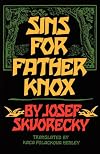
The striking cover of this English translation from the late 80s drew me in as soon as I saw it at Barbed Wire Books in Longmont, and the game of the book convinced me. The structure is 10 detective short stories, each one of which breaks one of the 10 detective story “commandments” created by Ronald Arbuthnott Knox, a priest, reader and writer of detective stories in the early 20th century. The introduction tells us he hobnobbed with all the usual suspects real and fictional: He knew show more Chesterton, who wrote the Father Brown mysteries, and founded “Holmesiana” accidentally by writing an essay as if Holmes was a historical person.
But these stories actually have little to do with Father Knox, besides the ten commandments that serve as rules to the game. At a certain point in each story, a small box notifies the reader that there has been enough information to deduce not only who the murderer was, but which commandment was broken in the story, and “ab-solutions” are found at the end of the book.
Each story is in some way about the nightclub singer and accidental detective, Eve Adam. I was really impressed with the versatility of approaches, which made each story fresh. The last story was a bit of a stretch to be considered breaking its assigned commandment, but I think that was the only way to make it a surprise, since readers who followed the rest of the book know which commandment is left.
I've been missing out on mysteries, and Europe in the 70s, apparently, so I'll be looking for books with more of each in the future. show less
But these stories actually have little to do with Father Knox, besides the ten commandments that serve as rules to the game. At a certain point in each story, a small box notifies the reader that there has been enough information to deduce not only who the murderer was, but which commandment was broken in the story, and “ab-solutions” are found at the end of the book.
Each story is in some way about the nightclub singer and accidental detective, Eve Adam. I was really impressed with the versatility of approaches, which made each story fresh. The last story was a bit of a stretch to be considered breaking its assigned commandment, but I think that was the only way to make it a surprise, since readers who followed the rest of the book know which commandment is left.
I've been missing out on mysteries, and Europe in the 70s, apparently, so I'll be looking for books with more of each in the future. show less
Lists
Translingualism (1)
Awards


You May Also Like


Associated Authors
Statistics
- Works
- 82
- Also by
- 17
- Members
- 3,280
- Popularity
- #7,807
- Rating
- 4.0
- Reviews
- 62
- ISBNs
- 266
- Languages
- 20
- Favorited
- 16


