
Works by Jan Freeman
Associated Works
American Writing : A Magazine 6 — Contributor — 1 copy
Tagged
Common Knowledge
- Gender
- female
Members
Reviews
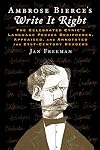
Ambrose Bierce's Write It Right: The Celebrated Cynic's Language Peeves Deciphered, Appraised, and Annotated for 21st-Century Readers by Jan Freeman
What an entertaining take on a style and usage book! It's a fun book to pick up and peruse, but I also felt compelled to read the whole thing--partly because I think Bierce himself was a pretty fascinating guy and partly because of Freeman's engaging commentary on Bierce's rules. What I found most interesting was Bierce's insistence that each word or phrase in the English language should have only one meaning, and that for each intended meaning there is one word that says it best. I enjoyed show more this book! show less
 This review was written for LibraryThing Early Reviewers.
Ambrose Bierce's Write It Right: The Celebrated Cynic's Language Peeves Deciphered, Appraised, and Annotated for 21st-Century Readers by Jan Freeman
If you're anything like me, the most exposure you've ever had to Ambrose Bierce is his famous short story "An Occurrence at Owl Creek Bridge," and it's hard to tell from that story alone what one would expect from this particular volume, particularly since texts on grammar and style tend to be more caustic than constructive. That would be the case with this edition, an "annotated" version of Bierce's original work with contemporary commentary that reads far livelier than one would show more expect.
After a brief foreword by Jan Freeman, our scholarly guide, the text consists of Bierce's original introduction, followed by his so-called "Black List" of words and phrases that are, to put it bluntly, never to be used in print. Bierce's original entries are, as you would expect, inflexible and definite: he wraps quotations around constructions that ought never see the light of print and, with few exceptions, his explanations for why the errors are as such are extremely terse and rather didactic. Those familiar with classic grammar texts like Strunk & White's The Elements of Style will find many familiar examples herein, as well as plenty that are baffling but, according to Bierce, equally damnable.
Freeman, as the annotator, does a fine job in several respects, the first and most obvious of which is lending readability to a work that is otherwise almost devoid of interest as a cover-to-cover read. Since Bierce's words are often so brief, she does an admirable job of trying to elucidate the reasons why Bierce would object to a particular construction, attempting to provide a type of narrative to the many individual points he harps on. In that respect, she gives the text a fresh update--even if it's at the expense of making the book feel less like a textbook and more like a history lesson.
History, however, is clearly Freeman's strong suit, as the text betrays the fact that she is extremely well-read in points of grammar and usage. In addition to a nine-page bibliography of recommended reading at the back of the book--a selection of works that spans multiple centuries--Freeman incorporates specific points of order from newspapers, magazines, and books by other authors throughout her annotations. The result is a work that is highly scholarly but doesn't always read like it is.
If there is criticism to be had, it is in the often uneasy balance between lighthearted commentary and fierce criticism of the original work. Though the annotations are essential and, frankly, pleasurable to read, Freeman often gives very little credence to Bierce's points. While her research is very adept at providing reasons why Bierce is bunkum, it does become a bit tiresome to read over and over why a particular rule is rubbish. (More often than not, it can be attributed to Bierce's background in journalism.)
Even more frustrating is Freeman's tendency, while putting down many of Bierce's rules, to reduce grammar to something that is perhaps far more flexible than a grammarian would want to admit. Certainly Bierce was a radically bitter cynic--one would think a true grammarian could be no less--but Freeman is often guilty of claiming that, because others have written with a particular word or phrase, then either usage is technically correct. It's a bit too loose for my liking, the kind of thing that irks writers of Standard Written English when confronted with the idiosyncrasies of spoken language. One senses that Freeman's playing fast and loose to counter Bierce's strictness, but the result is not necessarily balance as much as it is discomforting dissonance.
Ultimately, if there is a problem with the text, it is that it's a bit unsure of its identity: does it want to be a grammar text, or does it want to be a well-researched look into Bierce's ideas and thoughts? Truth be told, when it tries to be the latter, it succeeds in spite of its flaws. Freeman seems to know that she, like all great grammar cynics, is never going to be authoritative, and she treats Bierce's source work with the appropriate amount of reverence and respect while also keeping it as contemporary as possible. As an artifact of language change, Freeman's annotated edition of Write It Right is a both valuable and entertaining contribution to the never-ending language wars. show less
After a brief foreword by Jan Freeman, our scholarly guide, the text consists of Bierce's original introduction, followed by his so-called "Black List" of words and phrases that are, to put it bluntly, never to be used in print. Bierce's original entries are, as you would expect, inflexible and definite: he wraps quotations around constructions that ought never see the light of print and, with few exceptions, his explanations for why the errors are as such are extremely terse and rather didactic. Those familiar with classic grammar texts like Strunk & White's The Elements of Style will find many familiar examples herein, as well as plenty that are baffling but, according to Bierce, equally damnable.
Freeman, as the annotator, does a fine job in several respects, the first and most obvious of which is lending readability to a work that is otherwise almost devoid of interest as a cover-to-cover read. Since Bierce's words are often so brief, she does an admirable job of trying to elucidate the reasons why Bierce would object to a particular construction, attempting to provide a type of narrative to the many individual points he harps on. In that respect, she gives the text a fresh update--even if it's at the expense of making the book feel less like a textbook and more like a history lesson.
History, however, is clearly Freeman's strong suit, as the text betrays the fact that she is extremely well-read in points of grammar and usage. In addition to a nine-page bibliography of recommended reading at the back of the book--a selection of works that spans multiple centuries--Freeman incorporates specific points of order from newspapers, magazines, and books by other authors throughout her annotations. The result is a work that is highly scholarly but doesn't always read like it is.
If there is criticism to be had, it is in the often uneasy balance between lighthearted commentary and fierce criticism of the original work. Though the annotations are essential and, frankly, pleasurable to read, Freeman often gives very little credence to Bierce's points. While her research is very adept at providing reasons why Bierce is bunkum, it does become a bit tiresome to read over and over why a particular rule is rubbish. (More often than not, it can be attributed to Bierce's background in journalism.)
Even more frustrating is Freeman's tendency, while putting down many of Bierce's rules, to reduce grammar to something that is perhaps far more flexible than a grammarian would want to admit. Certainly Bierce was a radically bitter cynic--one would think a true grammarian could be no less--but Freeman is often guilty of claiming that, because others have written with a particular word or phrase, then either usage is technically correct. It's a bit too loose for my liking, the kind of thing that irks writers of Standard Written English when confronted with the idiosyncrasies of spoken language. One senses that Freeman's playing fast and loose to counter Bierce's strictness, but the result is not necessarily balance as much as it is discomforting dissonance.
Ultimately, if there is a problem with the text, it is that it's a bit unsure of its identity: does it want to be a grammar text, or does it want to be a well-researched look into Bierce's ideas and thoughts? Truth be told, when it tries to be the latter, it succeeds in spite of its flaws. Freeman seems to know that she, like all great grammar cynics, is never going to be authoritative, and she treats Bierce's source work with the appropriate amount of reverence and respect while also keeping it as contemporary as possible. As an artifact of language change, Freeman's annotated edition of Write It Right is a both valuable and entertaining contribution to the never-ending language wars. show less
This review was written for LibraryThing Early Reviewers.Ambrose Bierce's Write It Right: The Celebrated Cynic's Language Peeves Deciphered, Appraised, and Annotated for 21st-Century Readers by Jan Freeman
Bierce was a crabby old malcontent, which is one reason I'm a fan. The fun to be had from many of his black-humored stories, such as "The Bottomless Grave" proves his disdain for things like familial love. But, as he was also a journalist, his peevish ways extended to words and the way they were misused, or in many ways, the ways in which they irritated just him. Reading this book made me think that Bierce had written it with the dear hope of being called on to correct the wrongs of the show more English language across America.
This book is not a pleasurable read, no matter how much one likes Bierce. It is a book to correct the reader of their mistaken usage of many words. The problem is that many of the words and terms aren't in use these days and so much of the time I found myself saying, "Well, nobody says that now." I wouldn't recommend it, for that reason, to someone looking for help in this area.Instead, I would recommend it to someone who said, "I really wish there was someone to harangue for my misuse of the word 'to'." Bierce is the man for that job. show less
This book is not a pleasurable read, no matter how much one likes Bierce. It is a book to correct the reader of their mistaken usage of many words. The problem is that many of the words and terms aren't in use these days and so much of the time I found myself saying, "Well, nobody says that now." I wouldn't recommend it, for that reason, to someone looking for help in this area.Instead, I would recommend it to someone who said, "I really wish there was someone to harangue for my misuse of the word 'to'." Bierce is the man for that job. show less
This review was written for LibraryThing Early Reviewers.Ambrose Bierce's Write It Right: The Celebrated Cynic's Language Peeves Deciphered, Appraised, and Annotated for 21st-Century Readers by Jan Freeman

As someone who enjoys reading books on language usage and word origins, I found this book quite interesting, a quick read. Ambrose Bierce's "Write It Right" was originally published in 1909 as a reference for proper (correct) language usage. Approximately 300 entries were arranged alphabetically. Today, many of the forms Bierce insisted were incorrect are, in fact, in common usage.
Many of his entries are especially interesting, I think, simply because of his attempts to 'split hairs.' For show more example, "I am afraid it will rain" is incorrect, according to Bierce. You should instead say "I fear it will rain." Another entry goes into the difference between "generally" and "usually." He also thought the word "pants" (when used instead of "trousers") was vulgar. And he disapproved of using the words "forecasted" and "fix" among others.
For this new edition of Bierce's book, Jan Freeman has annotated each entry to give more context to the original explanations of the language usage, showing quite often that Bierce was not the expert he claimed to be. For instance, Bierce complained in some of his entries of how America was corrupting the language, when the usage could be found in Samuel Johnson's Dictionary (published 1700s), or even earlier. And he blamed "the weather bureau" for "forecasted," when in fact, it had been used since the 16th century.
I thought Bierce's "Devil's Dictionary" was wonderful satire, but here he comes off as picky and condescending. (According to another Bierce rule of language, I just misused the word "but" in the sentence above.) Familiarity with Bierce's name is what caught my attention, but Freeman's annotation is what kept me interested in reading. "Write It Right" was first published 100 years ago, and a lot (or maybe not so much, after all) has changed since then. show less
Many of his entries are especially interesting, I think, simply because of his attempts to 'split hairs.' For show more example, "I am afraid it will rain" is incorrect, according to Bierce. You should instead say "I fear it will rain." Another entry goes into the difference between "generally" and "usually." He also thought the word "pants" (when used instead of "trousers") was vulgar. And he disapproved of using the words "forecasted" and "fix" among others.
For this new edition of Bierce's book, Jan Freeman has annotated each entry to give more context to the original explanations of the language usage, showing quite often that Bierce was not the expert he claimed to be. For instance, Bierce complained in some of his entries of how America was corrupting the language, when the usage could be found in Samuel Johnson's Dictionary (published 1700s), or even earlier. And he blamed "the weather bureau" for "forecasted," when in fact, it had been used since the 16th century.
I thought Bierce's "Devil's Dictionary" was wonderful satire, but here he comes off as picky and condescending. (According to another Bierce rule of language, I just misused the word "but" in the sentence above.) Familiarity with Bierce's name is what caught my attention, but Freeman's annotation is what kept me interested in reading. "Write It Right" was first published 100 years ago, and a lot (or maybe not so much, after all) has changed since then. show less
This review was written for LibraryThing Early Reviewers.You May Also Like
Associated Authors
Statistics
- Works
- 5
- Also by
- 1
- Members
- 137
- Popularity
- #149,083
- Rating
- 3.4
- Reviews
- 18
- ISBNs
- 18
