
Stephen Leacock (1869–1944)
Author of Sunshine Sketches of a Little Town
About the Author
Born in Swanmore, England, Stephen Leacock was one of 11 children of an unsuccessful farmer and an ambitious mother, a woman to whom Leacock no doubt owed his energetic and status-conscious nature. In 1891, while teaching at the prestigious Upper Canada College in Toronto, Leacock obtained a modern show more language degree from the University of Toronto. In 1903, after receiving a Ph.D. in political economy from the University of Chicago, he joined the staff of McGill University, Montreal, as professor of politics and economics. Leacock's career as a humorist began when he had some comic pieces published as Literary Lapses in 1910. This successful book was followed by two more books of comic sketches, Nonsense Novels (1911) and Sunshine Sketches of a Little Town (1912), which is now considered his best book. Leacock continued this frantic literary output for the remainder of his career, producing more than 30 books of humor as well as biographies and social commentaries. The Stephen Leacock Medal for Humour was established after his death to honor annually an outstanding Canadian humorist. (Bowker Author Biography) show less
Image credit: Courtesy of the NYPL Digital Gallery (image use requires permission from the New York Public Library)
Works by Stephen Leacock
Too Much College; or, Education Eating up Life: With Kindred Essays in Education and Humour (1939) 16 copies
Over the footlights 14 copies
STEPHEN LEACOCK PREMIUM 12 BOOK HUMOUR COLLECTION Sunshine Sketches of a Little Town. (Timeless Wisdom Collection 2588) (2014) 4 copies
My Financial Career and Other Stories, Being the First of Two Parts of The Best of Stephen Leacock 3 copies
The Greatest Pages of American Humor 3 copies
The Original Stephen Leacock 2 copies
The perfect salesman 2 copies
My old college, 1843-1943 1 copy
Buggam Grange 1 copy
The New Food 1 copy
PUKINSORKKA 1 copy
The Greatest Pages of American Humor From Benjamin Franklin to the Radio Wits of Today (1936) 1 copy
Humoreszkek 1 copy
The Garden of Folly 1 copy
Montreal 1 copy
U svim pravcima 1 copy
The Train To Mariposa 1 copy
A Book of Funny Dramatics 1 copy
My Revelations as a Spy 1 copy
A rejtély titka 1 copy
Lincoln frees the slaves 1 copy
Associated Works
The Game Is Afoot: Parodies, Pastiches, and Ponderings of Sherlock Holmes (1994) — Contributor — 216 copies, 2 reviews
The Rivals of Sherlock Holmes: A Collection of Victorian Detective Tales (2008) — Contributor — 140 copies, 1 review
Cavalcade of the North: An Entertaining Collection of Distinguished Writing by Canadian Authors (1958) — Contributor — 70 copies, 1 review
Scoundrels & Scalawags: 51 Stories of the Most Fascinating Characters of Hoax and Fraud (1968) — Contributor — 58 copies, 1 review
The Valancourt Book of Victorian Christmas Ghost Stories, Volume 4 (2020) — Contributor — 42 copies, 2 reviews
The Best of Both Worlds: An Anthology of Stories for All Ages (1968) — Contributor — 25 copies, 1 review
The detective in fiction: a posse of eight — Contributor — 2 copies
Tagged
Common Knowledge
- Legal name
- Leacock, Stephen Butler
- Birthdate
- 1869-12-30
- Date of death
- 1944-03-28
- Gender
- male
- Education
- Upper Canada College
University of Toronto
University of Chicago (Ph.D.) - Occupations
- teacher
professor of political science
humorist - Organizations
- McGill University
- Awards and honors
- Lorne Pierce Medal (1937)
Royal Society of Canada (Fellow) - Nationality
- UK (birth)
Canada - Birthplace
- Swanmore, Hampshire, England, UK
- Places of residence
- Swanmore, Hampshire, England, UK
Sutton, Ontario, Canada
Toronto, Ontario, Canada
Uxbridge, Ontario, Canada
Montreal, Quebec, Canada
Orillia, Ontario, Canada - Place of death
- Toronto, Ontario, Canada
- Burial location
- Sibbald Point, Sutton, Ontario, Canada
- Map Location
- Canada
Members
Discussions
Canadian Author Challenge — February: Helen Humphreys & Stephen Leacock in 75 Books Challenge for 2016 (March 2016)
Short story of man (pastor?) who comes for dinner but is trapped by politeness in Name that Book (March 2016)
Reviews

This was Stephen Leacock’s last collection of essays, published posthumously with an introduction by his niece. It was easily my least favourite of his books so far. I was not impressed by the first essay, “Are Witty Women Attractive to Men?” (Spoiler alert: he does not think so.) Unfortunately, one cannot come to Stephen Leacock for nuanced discussion of gender roles. The introduction to this collection claims that he did think women should be paid properly for raising children and show more running the household, but he was less keen on women breaking the traditional gender roles. So that was a miss. I also, as a 21st-century reader, did not appreciate the essay about the British empire, especially when it talked about western Canada being “empty” until 1870. NO IT WASN’T, THERE WERE INDIGENOUS PEOPLE THERE FIRST!!! For me, Leacock is at his best when riffing on or parodying fiction, such as the essay “Living with Murder”, where Leacock obsessively times every little aspect of a dinner with a friend in case the friend is murdered and Leacock has to make an account of his whereabouts.
If you’re interested in Leacock’s work, Sunshine Sketches of a Little Town is absolutely the way to go. Last Leaves can be left on the shelf. show less
If you’re interested in Leacock’s work, Sunshine Sketches of a Little Town is absolutely the way to go. Last Leaves can be left on the shelf. show less
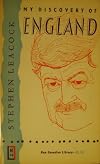
This is a series of essays in which Stephen Leacock compares England with North America in order to find similarities and differences. He is doing this in a spirit of redressing the "balance of trade" in impressions; lots of English authors have come to North America to get impressions of it, but not many North Americans have done the same for England. In a historical context, it was interesting to read because it was published in 1922, and a few essays touched on the question of German show more reparations. It's weird as a 21st-century reader to read it and know that World War 2 will happen, but the audience at the time of the book has no idea.
Overall, the essays were easy to read, and I really liked the essay on different types of humour (although he and I disagree on the hilarity of the pun -- I love puns, whereas he does not think they are terribly funny, at least not on the level the English apparently find them). However, his essay on education (and visiting Oxford) had some very dated and sexist views on the value of women's education. Despite the fact that he taught coed classes at McGill, he didn't seem to think it worthwhile for the women to be there because the vast majority of them were just going to go and get married anyway. He does acknowledge that there are women who are able to make careers for themselves and not get married or have children, but he doesn't seem to think it wrong that they should have to give up the use of their education or their jobs when they get married. He also touches on the subject of different aptitudes, but he divides them along gender lines, assuming that women do worse at math and science, for example. I do realize that this perspective is a product of his times, but he went on about it for too long for me to just brush off.
I would NOT recommend the essay about Oxford, but the humour essay was all right, and the one where he writes the same editorial for several different newspapers was an interesting literary exercise. This is also not the book to be starting out with if you've never read Leacock -- go to Sunshine Sketches of a Little Town instead. show less
Overall, the essays were easy to read, and I really liked the essay on different types of humour (although he and I disagree on the hilarity of the pun -- I love puns, whereas he does not think they are terribly funny, at least not on the level the English apparently find them). However, his essay on education (and visiting Oxford) had some very dated and sexist views on the value of women's education. Despite the fact that he taught coed classes at McGill, he didn't seem to think it worthwhile for the women to be there because the vast majority of them were just going to go and get married anyway. He does acknowledge that there are women who are able to make careers for themselves and not get married or have children, but he doesn't seem to think it wrong that they should have to give up the use of their education or their jobs when they get married. He also touches on the subject of different aptitudes, but he divides them along gender lines, assuming that women do worse at math and science, for example. I do realize that this perspective is a product of his times, but he went on about it for too long for me to just brush off.
I would NOT recommend the essay about Oxford, but the humour essay was all right, and the one where he writes the same editorial for several different newspapers was an interesting literary exercise. This is also not the book to be starting out with if you've never read Leacock -- go to Sunshine Sketches of a Little Town instead. show less

This was pure unadulterated satirical fun. The title tells you what to expect. The collection of vignettes is full of small town characters that could be found anywhere in America, and apparently in Canada, at any time from the late 19th century right up to the present time. You might have to look harder for them these days, but I know they are still out there, seeing the world from their front porches and bar stools rather than through the lenses of the Big Guys in the City. Every ordinary show more little episode is laced with cleverness and affectionate humor. My favorite by far was the disastrous (but routine) sinking of the excursion steamer on Lake Wissanoti, with about half the town aboard. Picture the Mariposa Belle settling comfortably to the bottom of the six-foot deep lake, and its passengers handily snatching their would-be rescuers from unseaworthy rowboats and dinghies in "one of the smartest pieces of rescue work ever seen on the lake." You might think of Mark Twain, or Garrison Keillor, while reading this. show less

This collection of 10 literary pastiches made me laugh out loud a LOT. At least once per story I was at least snorting, if not outright shrieking with laughter. My favourite stories were the detective story parody and the sea story parody — they were so over the top, it was perfect. I did get unironically invested in the old homestead story too.
This might almost be even funnier than Sunshine Sketches of a Little Town, although I’d have to read that again to be sure. At any rate, I would show more certainly recommend this for anyone who has a nodding acquaintance with the various genres of Victorian fiction. They may also be funny on their own, because they are so delightfully absurd. show less
This might almost be even funnier than Sunshine Sketches of a Little Town, although I’d have to read that again to be sure. At any rate, I would show more certainly recommend this for anyone who has a nodding acquaintance with the various genres of Victorian fiction. They may also be funny on their own, because they are so delightfully absurd. show less
Lists
Awards


You May Also Like


Associated Authors
Statistics
- Works
- 142
- Also by
- 65
- Members
- 3,136
- Popularity
- #8,142
- Rating
- 3.7
- Reviews
- 50
- ISBNs
- 521
- Languages
- 9
- Favorited
- 15