
Hugh Prather (1938–2010)
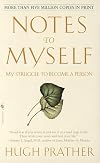
Author of Notes to Myself: My Struggle to Become a Person
About the Author
Hugh Prather is the author of sixteen books. He and his wife Gayle live in Tucson, Arizona
Image credit: Gayle Prather
Works by Hugh Prather
The Little Book of Letting Go: A Revolutionary 30-Day Program to Cleanse Your Mind, Lift Your Spirit and Replenish Your Soul (2000) 251 copies, 1 review
Spiritual Parenting: A Guide to Understanding and Nurturing the Heart of Your Child (1996) 67 copies
I Will Never Leave You: How Couples Can Achieve The Power Of Lasting Love (1995) 40 copies, 1 review
Hoe iemand te worden 2 copies
There is a Place Where You Are Not Alone (Dolphin Book) by Prather, Hugh(September 17, 1980) Paperback (1602) 1 copy
Buscando ser o que sou 1 copy
Mi propia luz 1 copy
Quiet Answer 1 copy
Associated Works
Flying Without Wings: Personal Reflections on Loss, Disability, and Healing (1988) — Foreword — 57 copies
A Bell Ringing in the Empty Sky: The Best of the Sun (Vols. I & II) (1987) — Contributor — 15 copies
Tagged
Common Knowledge
- Other names
- Prather, Hugh Edmonson, III
- Birthdate
- 1938-01-23
- Date of death
- 2010-11-15
- Gender
- male
- Education
- Southern Methodist University (BA | English)
Principia College
Columbia University
University of Texas, Austin (Psychology) - Occupations
- Self-help author
lay minister
counselor - Cause of death
- heart attack
- Nationality
- USA
- Birthplace
- Dallas, Texas, USA
- Places of residence
- Tucson, Arizona, USA
Dallas, Texas, USA
Colorado, USA - Place of death
- Tucson, Arizona, USA
- Associated Place (for map)
- USA
Members
Reviews
A Favorite with Much Gratitude
Suddenly, out of the blue, I remembered this book today!
I couldn't remember the title, but I easily rattled off the name Hugh Prather, just as easily as I would John Denver or Robert Redford or Flip Wilson. (How's that for a grab bag from the old brain cells?) After being completely absent from my mind for so long, instantly it was back. The memories were still there: tidbits of text, the calm floating leaves on the cover, the perfect size and the way it opened show more readily, the furniture in the rooms around me while I read it.
Written in the early 70s, I haven't laid eyes on it in forty years. But it was a regular companion in my mid and late teens. It inspired me and guided me to be aware of all the moments that make up a day, an hour, a minute—to be open to those moments, to contemplate them and to, most importantly, to feel them. By example he taught me to be honest with myself and when I respected my thoughts, I respected myself, an aspect that was especially important at a risky Ophelia age.
Wow, that's A LOT to gain from that little, possibly sappy 70s book. But it was a perfect fit for me at the perfect time. (And 5 million others, too.)
What prompted me to so suddenly remember it after such a long absence from my thoughts? I was working on some haiku slash journaling and the instant I wrote "airport" a little Prather ditty came to me: Prather's note about traveling one hot summer, being in a busy international airport. And among all the hundreds of stressed-out travelers there was one little girl who was the single person experiencing what it felt like to sit on a cool marble floor.
Now I will identify Prather's book as my earliest introduction to Eastern mindfulness, whether or not that is actually what it is. It gave me a longing and foundation for Eastern philosophical readings that continue to this day.
The older I get, the more my view is through a Zen lens. This book was my first teacher. show less
Suddenly, out of the blue, I remembered this book today!
I couldn't remember the title, but I easily rattled off the name Hugh Prather, just as easily as I would John Denver or Robert Redford or Flip Wilson. (How's that for a grab bag from the old brain cells?) After being completely absent from my mind for so long, instantly it was back. The memories were still there: tidbits of text, the calm floating leaves on the cover, the perfect size and the way it opened show more readily, the furniture in the rooms around me while I read it.
Written in the early 70s, I haven't laid eyes on it in forty years. But it was a regular companion in my mid and late teens. It inspired me and guided me to be aware of all the moments that make up a day, an hour, a minute—to be open to those moments, to contemplate them and to, most importantly, to feel them. By example he taught me to be honest with myself and when I respected my thoughts, I respected myself, an aspect that was especially important at a risky Ophelia age.
Wow, that's A LOT to gain from that little, possibly sappy 70s book. But it was a perfect fit for me at the perfect time. (And 5 million others, too.)
What prompted me to so suddenly remember it after such a long absence from my thoughts? I was working on some haiku slash journaling and the instant I wrote "airport" a little Prather ditty came to me: Prather's note about traveling one hot summer, being in a busy international airport. And among all the hundreds of stressed-out travelers there was one little girl who was the single person experiencing what it felt like to sit on a cool marble floor.
Now I will identify Prather's book as my earliest introduction to Eastern mindfulness, whether or not that is actually what it is. It gave me a longing and foundation for Eastern philosophical readings that continue to this day.
The older I get, the more my view is through a Zen lens. This book was my first teacher. show less
A friend introduced me to this little gem as a teenager nearly twenty years ago, and I've returned to it often over the years in times of stress. The piercing clarity and brutal honesty of these simple, yet profound, observations slows my racing thoughts and magically puts things into perspective. So find a quiet place, set aside an hour or two, and let Hugh Prather show you how to live in the moment and rid yourself of that insatiable craving for external validation. You won't regret show more it.
-Kevin Joseph, author of "The Champion Maker" show less
-Kevin Joseph, author of "The Champion Maker" show less
This book taught me two things - the first being that there's always something new to be gained from novels, and sometimes to the point that it could be life-changing. The second would be the fact that there is always some half-forgotten books lying around in your home, just waiting for your attention - finish it, before buying something new.
This book was a gift to Mom by Dad back in 2005 - and it's been with us ever since. I don't know why I suddenly got the urge to read it a week ago, but show more I found this collection of blank verses at the perfect time in my life.
Apart from a few pages scattered with tidbits that have not aged well at all - Hugh Prather was really on to something here. Orwell said that "The best books are those that tell you what you know already.", and I feel that this holds here - there's nothing that feels inaccessible, pandering, or otherworldly - in fact, Notes to Myself is utterly readable and a solid work of art. I won't spoil it, but suffice to say, there's something here for everyone. show less
This book was a gift to Mom by Dad back in 2005 - and it's been with us ever since. I don't know why I suddenly got the urge to read it a week ago, but show more I found this collection of blank verses at the perfect time in my life.
Apart from a few pages scattered with tidbits that have not aged well at all - Hugh Prather was really on to something here. Orwell said that "The best books are those that tell you what you know already.", and I feel that this holds here - there's nothing that feels inaccessible, pandering, or otherworldly - in fact, Notes to Myself is utterly readable and a solid work of art. I won't spoil it, but suffice to say, there's something here for everyone. show less

Each page is new age pith that could be performed by Stuart Smalley. Put the pages together and the process facing the contradiction of self examination of being oneself, where the examination changes the self being observed. Everything is personal becomes an abstract philosophy that depersonalizes. Then the awareness of depersonalization creates new personal emotions. Deep convoluted simplicity, perceived honesty which hides what?
This is one work worth many rereading in different times of life.
This is one work worth many rereading in different times of life.
You May Also Like


Associated Authors
Statistics
- Works
- 42
- Also by
- 7
- Members
- 2,650
- Popularity
- #9,689
- Rating
- 3.7
- Reviews
- 16
- ISBNs
- 90
- Languages
- 6