
Paul Grice (1913–1988)
Author of Studies in the Way of Words
About the Author
Paul Grice was a fellow and a tutor at St. John's College, Oxford University, from 1938 to 1967. He then taught philosophy at the University of California, Berkeley, until his death. Approaching philosophy in the post-Wittgensteinian mode through the study of ordinary language, Grice has been show more esteemed by the Anglo-American community of philosophers as "a miniaturist who changed the way other people paint big canvases" (Times Literary Supplement). Most of Grice's books are collections of articles. They have been influential among professional philosophers, not only because they present important theories, but also because they "scintillate" (Hilary Putnam's word), stimulating other philosophers to pick up the themes. The number of articles focused on Gricean themes has increased with each passing year. (Bowker Author Biography) show less
Works by Paul Grice
In Defense of a Dogma 1 copy
Associated Works
Tagged
Common Knowledge
- Legal name
- Grice, Herbert Paul
- Birthdate
- 1913-03-13
- Date of death
- 1988-08-28
- Gender
- male
- Education
- Clifton College
University of Oxford - Occupations
- philosopher of language
- Organizations
- University of Oxford
University of California, Berkeley - Relationships
- Schiffer, Stephen (student)
- Nationality
- UK
- Birthplace
- Birmingham, Warwickshire, England, UK
- Places of residence
- Oxford, Oxfordshire, England, UK
- Place of death
- Berkeley, California, USA
- Associated Place (for map)
- England, UK
Members
Reviews
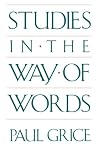
I was a grad student at Berkeley during Paul Grice’s time there. Although Grice was certainly recognized as an influential and important figure in philosophy of language, the center of gravity and attention in the department was John Searle. Since that time, I’ve come to think that I had as much or more to learn from Grice.
The first set of seven papers here (of nineteen total) are Grice’s William James Lectures, given in 1967 at Harvard. In these, he is concerned with a nest of topics show more surrounding meaning — the meanings of words and sentences, what speakers (or uttterers) mean when they say them. His emphasis is on instances of speaking and meaning. Speakers mean something by saying what they say, and what they mean in a specific instance of saying is influenced by context — conversational context.
I think one good way into thinking about Grice is to take seriously an insight that is deceptively simple. As Grice says in the Retrospective Epilogue that closes this book, “. . . what words mean is a matter of what people mean by them.” The meanings of words and sentences happen in particular and contextual instances of speaking. This is opposed to thinking of particular instances of speaking as instantiations of meanings that already exist, in some quasi-Platonic sense. The meanings of the words we use are intrinsically contextual to the conversations in which we use them.
The insight is deceptively simple, but I think it is hugely important and leads into Grice’s most noted philosophical contribution, the concept of “conversational implicature.” If we look at the meanings of words in the abstract, or as Grice discusses at the beginning of his paper, Logic and Conversation, we are going to find discrepancies between those abstract meanings and what we mean by the same words in actual instances of conversation.
Start with a very simple example that Grice gives in that same paper. Speaker A says, “I am out of petrol.” Speaker B responds, “There is a garage around the corner.” In the abstract, what Speaker B says is unresponsive — a statement of some seemingly random fact. What makes it responsive and meaningful is that the two speakers are standing next to Speaker A’s broken down car, that it needs petrol (Britishly speaking), that garages sell petrol, and that the garage is likely to be open.
What ties Speaker B’s response to what Speaker A has said is one of a number of “conversational maxims” that Grice spells out — in this case, the maxim is “Be relevant”. Other maxims have to do with the “quantity” of a speaker’s contribution to a conversation (say as much as you need to say to be informative and no more), the “quality” of her contribution (don’t say things you believe to be false or for which you don’t have evidence), and the contribution’s “manner” (avoid obscurity and ambiguity, be brief and orderly).
Above all the maxims sits a kind of super principle that Grice calls the “Cooperative Principle.” Speakers cooperate with one another in conversations, to produce outcomes. It may be that they oppose one another, argue, etc., but at least in coherent, meaningful conversations, they cooperate in the way that even participants in arguments or disputes play by the rules — responding relevantly, etc.
Within this framework of cooperative conversation, conversational implicature can arise in various ways. To keep it simple, take that same example. Grice’s gloss on the example is: “[Speaker] B would be infringing the maxim ‘Be relevant’ unless he thinks, or thinks it possible, that the garage is open, and has petrol to sell; so he implicates that the garage is, or at least may be open, etc.”
Maybe the simplest cases of conversational implicature are ones in which conversational maxims appear to be violated or are violated. The petrol case is one in which the maxim, “Be relevant,” appears to have been violated, but by virtue of implicature is not — what B implies (part of what he means by what he says) furnishes the connecting relevance.
Another example from Grice illustrates an actual violation of conversational maxims. Speaker A asks, “Where does C live?” Speaker B says, “Somewhere in the South of France.” What Speaker B says, according to Grice, violates a maxim of Quantity — he hasn’t said enough to meet A’s needs. The violation, though, is explained by what is implied in what B has said, namely that he doesn’t know more, e.g., what town C lives in.
I’ve gone on at some length about conversational maxims and conversational implicature because these are really the contributions for which Grice is best known and in which his influence, in philosophy and linguistics, has been strongest. Besides the notion of conversational implicature, Grice’s work on meaning is notable for the core role he gives to speakers’ intentions in accounting for meaning (again harkening back to his focus on conversational contexts — speakers are trying to accomplish something — an action, or a change in their listeners’ psychological states, etc. — by what they say).
And I think his theory of meaning is also notable for the importance of the role of co-speakers, or audiences. A speaker means something with respect to an audience in which she intends to produce some result. This seemingly obvious widening of perspective gets us beyond any kind of static theory of meaning to something fluid, contextual, and practical, i.e., real.
There are other papers in the book on broader philosophical topics. I’ll mention one theme on “ordinary language philosophy.”
Grice is an ordinary language philosopher. He’s also inclined toward something like ordinary knowledge, or common sense philosophy. G. E. Moore is most noted as a champion of common sense philosophy, claiming certainty for such seemingly foundational and obvious beliefs as that he (and each of us) has a body, that that body was born at some time in the past, and so on, with other beliefs that seem so obviously true, at least in ordinary circumstances, as to be beyond mention.
But Grice distinguishes between linguistic modes or practices (“ways of talking”) and what we actually say with those modes or practices. For the former, ordinary speakers hold sway — words and sentences mean what ordinary speakers mean by them. But for the latter, not so — what ordinary people believe to be true, even at the “common sense” level, may or may not be true. Grice attacks G. E. Moore (pretty mercilessly) for, without apparent argument, elevating common sense beliefs to certainty.
I do wonder if the distinction between how we speak and what we say erects an impermeable boundary. If meaning is determined by ordinary linguistic behavior, are there presumptions about what the world is like embedded in how we speak of it? Does, for example, our talk of “objects” — not just the word but how we use it — presume a world made of objects (outside our minds)? This is exactly the kind of common sense belief Moore was especially at pains to claim certain (some others of Moore’s common sense beliefs are actually “personal beliefs” in Grice’s terms and probably not candidates for such presuppositions).
If so, would such presuppositions be “certain” or “true”? That’s a hard question, and I think that’s one of the questions that Wittgenstein was grappling with in On Certainty. Saying that how we speak determines what kind of world there is and what it’s made of seems magical. But saying that it does not seems to leave us with some sort of extra-linguistic conception of truth.
At any rate, Grice’s comments on the differences between ordinary language philosophy and common sense philosophy enhance and deepen the discussion.
Grice’s work spans from the 1930s to the 1980s. He has always struck me as a paradigm of analytic philosophy, and to read all of these papers together is strong reinforcement. His clarity, precision, and care contrast strongly with the conceptual stretching, strategic leaps, and sometimes speculative nature of so many philosophers of other times and places, not just “continental” philosophers like Hegel, Nietzsche, and Heidegger, but even his own predecessors in the Anglo-philosophy world, like Hume, Locke, and Berkeley.
The time in which he worked sometimes seems like a time of philosophical crisis, in which philosophy undertook more than its usual worries about what philosophy actually is, maybe even reaching the point of wondering whether there really was anything legitimate to do that could be called philosophy. In several of the writings here, Grice goes deep on this philosophical reflection on philosophy, examining what is meant by such things as “ordinary language philosophy” and “conceptual analysis.” To be honest, I’m often left with the temptation to conclude that analytic philosophy of the time succeeded almost entirely in characterizations of method with little to say about what could actually be achieved with its method.
Grice actually addresses the deflation of the aims and scope of philosophy in his paper on Postwar Oxford Philosophy, saying, “It is no more sensible to complain that philosophy is no longer capable of solving practical problems than it is to complain that the study of the stars no longer enables one to predict the course of world events.”
I think it’s an open question whether the drawing in of philosophy’s boundaries during that time (and place) was a justified response to a discovery of inherent limitations, or rather a consequence of the adoption of the limiting methods themselves. And whether at least some of the analytic philosophers of the time came to possess precise and careful methods at the cost of having anything important to accomplish with them. show less
The first set of seven papers here (of nineteen total) are Grice’s William James Lectures, given in 1967 at Harvard. In these, he is concerned with a nest of topics show more surrounding meaning — the meanings of words and sentences, what speakers (or uttterers) mean when they say them. His emphasis is on instances of speaking and meaning. Speakers mean something by saying what they say, and what they mean in a specific instance of saying is influenced by context — conversational context.
I think one good way into thinking about Grice is to take seriously an insight that is deceptively simple. As Grice says in the Retrospective Epilogue that closes this book, “. . . what words mean is a matter of what people mean by them.” The meanings of words and sentences happen in particular and contextual instances of speaking. This is opposed to thinking of particular instances of speaking as instantiations of meanings that already exist, in some quasi-Platonic sense. The meanings of the words we use are intrinsically contextual to the conversations in which we use them.
The insight is deceptively simple, but I think it is hugely important and leads into Grice’s most noted philosophical contribution, the concept of “conversational implicature.” If we look at the meanings of words in the abstract, or as Grice discusses at the beginning of his paper, Logic and Conversation, we are going to find discrepancies between those abstract meanings and what we mean by the same words in actual instances of conversation.
Start with a very simple example that Grice gives in that same paper. Speaker A says, “I am out of petrol.” Speaker B responds, “There is a garage around the corner.” In the abstract, what Speaker B says is unresponsive — a statement of some seemingly random fact. What makes it responsive and meaningful is that the two speakers are standing next to Speaker A’s broken down car, that it needs petrol (Britishly speaking), that garages sell petrol, and that the garage is likely to be open.
What ties Speaker B’s response to what Speaker A has said is one of a number of “conversational maxims” that Grice spells out — in this case, the maxim is “Be relevant”. Other maxims have to do with the “quantity” of a speaker’s contribution to a conversation (say as much as you need to say to be informative and no more), the “quality” of her contribution (don’t say things you believe to be false or for which you don’t have evidence), and the contribution’s “manner” (avoid obscurity and ambiguity, be brief and orderly).
Above all the maxims sits a kind of super principle that Grice calls the “Cooperative Principle.” Speakers cooperate with one another in conversations, to produce outcomes. It may be that they oppose one another, argue, etc., but at least in coherent, meaningful conversations, they cooperate in the way that even participants in arguments or disputes play by the rules — responding relevantly, etc.
Within this framework of cooperative conversation, conversational implicature can arise in various ways. To keep it simple, take that same example. Grice’s gloss on the example is: “[Speaker] B would be infringing the maxim ‘Be relevant’ unless he thinks, or thinks it possible, that the garage is open, and has petrol to sell; so he implicates that the garage is, or at least may be open, etc.”
Maybe the simplest cases of conversational implicature are ones in which conversational maxims appear to be violated or are violated. The petrol case is one in which the maxim, “Be relevant,” appears to have been violated, but by virtue of implicature is not — what B implies (part of what he means by what he says) furnishes the connecting relevance.
Another example from Grice illustrates an actual violation of conversational maxims. Speaker A asks, “Where does C live?” Speaker B says, “Somewhere in the South of France.” What Speaker B says, according to Grice, violates a maxim of Quantity — he hasn’t said enough to meet A’s needs. The violation, though, is explained by what is implied in what B has said, namely that he doesn’t know more, e.g., what town C lives in.
I’ve gone on at some length about conversational maxims and conversational implicature because these are really the contributions for which Grice is best known and in which his influence, in philosophy and linguistics, has been strongest. Besides the notion of conversational implicature, Grice’s work on meaning is notable for the core role he gives to speakers’ intentions in accounting for meaning (again harkening back to his focus on conversational contexts — speakers are trying to accomplish something — an action, or a change in their listeners’ psychological states, etc. — by what they say).
And I think his theory of meaning is also notable for the importance of the role of co-speakers, or audiences. A speaker means something with respect to an audience in which she intends to produce some result. This seemingly obvious widening of perspective gets us beyond any kind of static theory of meaning to something fluid, contextual, and practical, i.e., real.
There are other papers in the book on broader philosophical topics. I’ll mention one theme on “ordinary language philosophy.”
Grice is an ordinary language philosopher. He’s also inclined toward something like ordinary knowledge, or common sense philosophy. G. E. Moore is most noted as a champion of common sense philosophy, claiming certainty for such seemingly foundational and obvious beliefs as that he (and each of us) has a body, that that body was born at some time in the past, and so on, with other beliefs that seem so obviously true, at least in ordinary circumstances, as to be beyond mention.
But Grice distinguishes between linguistic modes or practices (“ways of talking”) and what we actually say with those modes or practices. For the former, ordinary speakers hold sway — words and sentences mean what ordinary speakers mean by them. But for the latter, not so — what ordinary people believe to be true, even at the “common sense” level, may or may not be true. Grice attacks G. E. Moore (pretty mercilessly) for, without apparent argument, elevating common sense beliefs to certainty.
I do wonder if the distinction between how we speak and what we say erects an impermeable boundary. If meaning is determined by ordinary linguistic behavior, are there presumptions about what the world is like embedded in how we speak of it? Does, for example, our talk of “objects” — not just the word but how we use it — presume a world made of objects (outside our minds)? This is exactly the kind of common sense belief Moore was especially at pains to claim certain (some others of Moore’s common sense beliefs are actually “personal beliefs” in Grice’s terms and probably not candidates for such presuppositions).
If so, would such presuppositions be “certain” or “true”? That’s a hard question, and I think that’s one of the questions that Wittgenstein was grappling with in On Certainty. Saying that how we speak determines what kind of world there is and what it’s made of seems magical. But saying that it does not seems to leave us with some sort of extra-linguistic conception of truth.
At any rate, Grice’s comments on the differences between ordinary language philosophy and common sense philosophy enhance and deepen the discussion.
Grice’s work spans from the 1930s to the 1980s. He has always struck me as a paradigm of analytic philosophy, and to read all of these papers together is strong reinforcement. His clarity, precision, and care contrast strongly with the conceptual stretching, strategic leaps, and sometimes speculative nature of so many philosophers of other times and places, not just “continental” philosophers like Hegel, Nietzsche, and Heidegger, but even his own predecessors in the Anglo-philosophy world, like Hume, Locke, and Berkeley.
The time in which he worked sometimes seems like a time of philosophical crisis, in which philosophy undertook more than its usual worries about what philosophy actually is, maybe even reaching the point of wondering whether there really was anything legitimate to do that could be called philosophy. In several of the writings here, Grice goes deep on this philosophical reflection on philosophy, examining what is meant by such things as “ordinary language philosophy” and “conceptual analysis.” To be honest, I’m often left with the temptation to conclude that analytic philosophy of the time succeeded almost entirely in characterizations of method with little to say about what could actually be achieved with its method.
Grice actually addresses the deflation of the aims and scope of philosophy in his paper on Postwar Oxford Philosophy, saying, “It is no more sensible to complain that philosophy is no longer capable of solving practical problems than it is to complain that the study of the stars no longer enables one to predict the course of world events.”
I think it’s an open question whether the drawing in of philosophy’s boundaries during that time (and place) was a justified response to a discovery of inherent limitations, or rather a consequence of the adoption of the limiting methods themselves. And whether at least some of the analytic philosophers of the time came to possess precise and careful methods at the cost of having anything important to accomplish with them. show less
Paul Grice was my philosophy tutor's tutor, and his work invaluable whenever ill-prepared for tutorials; steering the discussion onto conversational implicature and off the unstudied topic. Also helpful in thinking through irony and other oddities of our everyday dialogues.
You May Also Like


Associated Authors
Statistics
- Works
- 7
- Also by
- 4
- Members
- 214
- Popularity
- #104,032
- Rating
- 3.7
- Reviews
- 2
- ISBNs
- 14
- Languages
- 1