
Jay Mathews
Author of Work Hard, Be Nice
Works by Jay Mathews
Harvard, Schmarvard: Getting beyond the Ivy League to the College That Is Best for You (2003) 24 copies
Question Everything: The Rise of AVID as America's Largest College Readiness Program (2015) 6 copies
Associated Works
The Last Word: The Best Commentary and Controversy in American Education (2007) — Foreword — 10 copies
Tagged
Common Knowledge
- Birthdate
- 1945-04-05
- Gender
- male
Members
Reviews
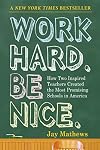
Work Hard. Be Nice.: How Two Inspired Teachers Created the Most Promising Schools in America by Jay Mathews
Jay Mathews, as a long-time education writer for the Washington Post, displays an enviable ability to produce a real page-turner on a topic far from the top of the average person's reading list. The narrative flow is far more engaging than much of what we find in contemporary novels; the emotional engagement he fosters has us rooting for his protagonists and feeling the occasional personal losses he documents. As he chronicles the story of Mike Feinberg and Dave Levinâs journey from show more being two inexperienced yet idealistic, highly energetic, and incredibly persistent Teach for America alums to running a successful chain of charter schools--the Knowledge is Power Program (KIPP)--serving disadvantaged children, he tells an archetypal tale that any trainer-teacher-learner can appreciate. As we absorb the wonderful story of how they engaged their youngest learners in actions to shame reticent school district officials into action--thereby providing a lesson in civics by inspiring the students to engage in civic action--we have an extremely important example of the importance of providing learning opportunities that are grounded in experience that puts what is being learned into action--experiential learning at its best. It's not all rosy in "Work Hard, Be Nice." Mathews and his interviewees do not shy away from acknowledging the occasional small and large failures that sometimes come from overzealous actions. We are, however, never in doubt as to where Mathews himself stands on the issue of whether KIPP is worth studying: "Over time, the debate about KIPP among educators has grown, full of misinformation and misimpressions because few of the people talking about KIPP schools have actually seen them in action," he writes (p. 281). And he fully intends to continue exploring the KIPP model, he adds: "In the search for the best schools, I still have a lot of work to do" (p. 317). show less
Work Hard. Be Nice.: How Two Inspired Teachers Created the Most Promising Schools in America by Jay Mathews
What do we really know about how well low-income children could do in school if they were given more opportunities? Jay Mathews (Washington Post education reporter) investigated the Knowledge Is Power Program (KIPP) to discover the answer. He spent two years visiting 31 KIPP schools and interviewing the founders, teachers, and parents.
KIPP is a controversial middle school education program founded in 1995 by Mike Feinberg and Dave Levin, former educators in the Teach for America program. show more Feinberg and Levin believed that with proper mentoring, teacher enthusiasm, and student incentives, kids from poor neighborhoods could excel.
Feeling defeated by their experiences in a barrio school, they came up with a model for change. They wanted to give students “something productive, constructive and fun to do, versus just hanging out on the streets." They convinced the Houston school district to try out their plan, and were wildly successful. (According to their website, http://www.kipp.org, there are now 82 KIPP schools in 19 states and the District of Columbia.)
Over 90 percent of KIPP students are African American or Hispanic/Latino, and most enter these middle schools two grade levels behind. But results have been inspirational. Some of the KIPP schools even boast 100% college attendance rates among graduates.
Their school day runs from 7:30 a.m. to 5 p.m., with classes held every other Saturday and for three weeks during the summer. A "KIPPster" spends 60 percent more time in class than a peer in a typical public school. And KIPPsters leave their nine-hour school day with another two hours of homework. Teachers are involved and enthusiastic and most importantly, convey belief in the success of their students. Both students and parents have to sign a contract expressing commitment to fulfill the requirements of attendance.
This book is a fascinating and hopeful look at what dedication and, frankly, financial investment, can do to reclaim students who get left behind. The sad part is that there aren’t more of these schools. The program’s detractors make some valid points (e.g., some say KIPP acts as an enabler giving society a pass on larger inequality issues, such as bad public schools, residential segregation, and unequal access for mothers and children to pediatric care. Others say KIPP's rigid rules requiring parental participation filter out children who might in fact need the schools more.) But given the choices, it sounds like the program is giving opportunities to some children who would not have had them regardless. If we wait until complete societal change is effected, no one would be helped.
Recommended especially if you’re in sociology or education! show less
KIPP is a controversial middle school education program founded in 1995 by Mike Feinberg and Dave Levin, former educators in the Teach for America program. show more Feinberg and Levin believed that with proper mentoring, teacher enthusiasm, and student incentives, kids from poor neighborhoods could excel.
Feeling defeated by their experiences in a barrio school, they came up with a model for change. They wanted to give students “something productive, constructive and fun to do, versus just hanging out on the streets." They convinced the Houston school district to try out their plan, and were wildly successful. (According to their website, http://www.kipp.org, there are now 82 KIPP schools in 19 states and the District of Columbia.)
Over 90 percent of KIPP students are African American or Hispanic/Latino, and most enter these middle schools two grade levels behind. But results have been inspirational. Some of the KIPP schools even boast 100% college attendance rates among graduates.
Their school day runs from 7:30 a.m. to 5 p.m., with classes held every other Saturday and for three weeks during the summer. A "KIPPster" spends 60 percent more time in class than a peer in a typical public school. And KIPPsters leave their nine-hour school day with another two hours of homework. Teachers are involved and enthusiastic and most importantly, convey belief in the success of their students. Both students and parents have to sign a contract expressing commitment to fulfill the requirements of attendance.
This book is a fascinating and hopeful look at what dedication and, frankly, financial investment, can do to reclaim students who get left behind. The sad part is that there aren’t more of these schools. The program’s detractors make some valid points (e.g., some say KIPP acts as an enabler giving society a pass on larger inequality issues, such as bad public schools, residential segregation, and unequal access for mothers and children to pediatric care. Others say KIPP's rigid rules requiring parental participation filter out children who might in fact need the schools more.) But given the choices, it sounds like the program is giving opportunities to some children who would not have had them regardless. If we wait until complete societal change is effected, no one would be helped.
Recommended especially if you’re in sociology or education! show less
 This review was written for LibraryThing Early Reviewers.
Work Hard. Be Nice.: How Two Inspired Teachers Created the Most Promising Schools in America by Jay Mathews
3.5 Stars. I read this book because my son told me his teacher's heroes are the two guys about whom this book is written. I'm not an educator, but it was good to read about people taking a new approach to educating impoverished, urban kids. The author spends a bit of time on controversy and criticism by some of their approach (long hours, strict discipline, summer and Saturday school, plenty of homework, and teachers always available by phone for answering homework questions), but comes to show more the conclusion that the KIPP program is one of the best programs out there for increasing achievement in inner city schools. show less
This book is basically the "life and times" of the KIPP program. The book is very well written, but unfortunately, the subject matter isn't the best. KIPP, in my area, is referred to as "the cult." Teachers I know that have been part of it or know others who have all say they suck the life out of you during the best years of your professional life and then spit you out when they've finished leaching off you. From what I have read in this book, I can see why that is the case.
I'm not reviewing show more the program though, so I guess I'll just say that this book is an interesting insight into the minds of a couple of madmen. I wouldn't really recommend it though. show less
I'm not reviewing show more the program though, so I guess I'll just say that this book is an interesting insight into the minds of a couple of madmen. I wouldn't really recommend it though. show less
This review was written for LibraryThing Early Reviewers.You May Also Like


Associated Authors
Statistics
- Works
- 10
- Also by
- 2
- Members
- 470
- Popularity
- #52,370
- Rating
- 3.7
- Reviews
- 30
- ISBNs
- 22
- Languages
- 1
- Favorited
- 1
