
Paul J. Silvia
Author of How to Write a Lot: A Practical Guide to Productive Academic Writing
About the Author
Works by Paul J. Silvia
How to Write a Lot: A Practical Guide to Productive Academic Writing, Second Edition (2018) 208 copies, 1 review
Public Speaking for Psychologists: A Lighthearted Guide to Research Presentation, Jobs Talks, and Other Opportunities to Embarrass Yourself (2010) 34 copies
Tagged
Common Knowledge
- Canonical name
- Silvia, Paul J.
- Legal name
- Silvia, Paul J.
- Other names
- Silvia, Paul J.
- Birthdate
- 1976
- Gender
- male
- Education
- University of Kansas (Ph.D|2001)
- Occupations
- psychologist
professor - Organizations
- University of North Carolina at Greensboro
- Awards and honors
- Daniel E. Berlyne Award (2006)
- Nationality
- USA
- Associated Place (for map)
- USA
Members
Reviews
As someone who always has lots of writing projects on the go, I just wish I'd read this book about five years ago - it would have saved me a lot of binge writing, guilt, and anxiety. I've set myself a writing schedule, as Silva recommends, and now life is so much simpler and writing is much more productive and more enjoyable. I write and work on my projects for at least an hour a day, and weekends are just that - weekends. No more guilt or last minute panics!
I really identified with show more Silvia’s description of the “binge writer” (p.14):
"After intending to write, procrastinating, and feeling guilty and anxious about procrastinating, binge writers finally devote a Saturday to nothing but writing. This creates some text and alleviates the guilt and the binge-writing cycle begins anew. Binge writers spend more time feeling guilty and anxious about not writing than schedule followers spend writing. When you follow a schedule, you no longer worry about not writing, complain about not finding time to write, or indulge in fantasies about how much you’ll write over summer. Instead, you write during your allotted times and then forget about writing. We have better things to worry about than writing. I worry about whether I drink too much coffee or whether my dog drinks from the fetid backyard pool, but I don’t worry about finding time to write this book: I know that I’ll do it tomorrow at 8:00 a.m."
It's a small book, written in simple and clear language and with an easy message: set up a writing schedule for yourself and eliminate the guilt and agony of binge writing! show less
I really identified with show more Silvia’s description of the “binge writer” (p.14):
"After intending to write, procrastinating, and feeling guilty and anxious about procrastinating, binge writers finally devote a Saturday to nothing but writing. This creates some text and alleviates the guilt and the binge-writing cycle begins anew. Binge writers spend more time feeling guilty and anxious about not writing than schedule followers spend writing. When you follow a schedule, you no longer worry about not writing, complain about not finding time to write, or indulge in fantasies about how much you’ll write over summer. Instead, you write during your allotted times and then forget about writing. We have better things to worry about than writing. I worry about whether I drink too much coffee or whether my dog drinks from the fetid backyard pool, but I don’t worry about finding time to write this book: I know that I’ll do it tomorrow at 8:00 a.m."
It's a small book, written in simple and clear language and with an easy message: set up a writing schedule for yourself and eliminate the guilt and agony of binge writing! show less

Here, Paul Silvia reveals the secret to how to write a lot: writing a lot. That's it. If you want to write a lot, you just have to sit down and do it. Go. Write a lot.
The slimness of this idea accounts for the slimness of this volume, and Silvia even pads it out with a chapter on how to write well, which alternates between good advice (don't use pointless jargon) and silly (good writers use dashes-- if that's the case, then I am surely among the best). But the fundamentals are strong: Silvia show more says that to write a lot, one must pick out a time to write, make a schedule, and stick to it no matter what. This is excellent advice, but I immediately came up with a dozen reasons I couldn't do it. Then I went onwards and found out that he had anticipated all of my objections and shot them down. Well, phooey. Silvia is a writer himself, of course, and he knows what's up, which makes this book work. It helps that he is also funny (favorite line: "Unlike fashion, APA style lacks police."), and he's peppered the book with New Yorker cartoons.
I have to point out, however, that I'm still not following Silvia's advice... but that might account for most of my current problems. show less
The slimness of this idea accounts for the slimness of this volume, and Silvia even pads it out with a chapter on how to write well, which alternates between good advice (don't use pointless jargon) and silly (good writers use dashes-- if that's the case, then I am surely among the best). But the fundamentals are strong: Silvia show more says that to write a lot, one must pick out a time to write, make a schedule, and stick to it no matter what. This is excellent advice, but I immediately came up with a dozen reasons I couldn't do it. Then I went onwards and found out that he had anticipated all of my objections and shot them down. Well, phooey. Silvia is a writer himself, of course, and he knows what's up, which makes this book work. It helps that he is also funny (favorite line: "Unlike fashion, APA style lacks police."), and he's peppered the book with New Yorker cartoons.
I have to point out, however, that I'm still not following Silvia's advice... but that might account for most of my current problems. show less
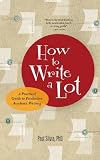
How to Write a Lot: A Practical Guide to Productive Academic Writing (LifeTools: Books for the General Public) by Paul J. Silvia
Having finished this book, my first thought was to share they joy I had in reading it, taking the time to write another “I read a book I’ve enjoyed greatly” review and share it with the greater community of readers at large. For to have such an experience with a book of this sort is something that is indeed to praise, but also to deliver. How on earth is an academic book (don’t be fooled, for despite its simplicity, is still only an academic book) allowed to provide such an pleasing show more experience while presenting advice and guidance on a not particularly exciting subject matter, especially one that deals precisely with painful craft of writing for the academia? At one point or another your mind starts to ponder about the cognitive dissonance of knowing yourself studying a boring subject and finding a great pleasure in reading about it. Why is that so?
And the answer to this question lies precisely in the kind of help this book provides. For you are here faced with that obvious (but rarely understood truth) that the only way for one to write a lot is if one, obviously, takes the time write a lot! And having that thrown at you face, so bluntly, so honestly, lets finally your guard down and offers you a well needed pause in your anxiety and in your long standing worries about not being able to produce as much as you thought you needed to progress in the academic world. Now you can put to rest that self-blaming for having born the unluckiest of academic beings, since you had a lot to write in order to get your grades, grants, articles, and whatever else academia demands from you, but you couldn’t because you weren’t ‘cut for it’. Bollocks! And this is why knowing such a simple truth is so liberating!
By making you face that obvious truth, this book opens up a window of hope, one that can finally put you onto the path of overcoming your cronic procrastination that takes you away from becoming the writer you know you have to become in order to succeed academically.
And, for that reason, once you get motivated, confident that you can finally overcome your limitations by applying the right effort, the rest of the tips and advices the author offers you all fall naturally into place. This bring you great joy, for it allows you to read this book with pleasure, boosting your spirit in a way that only a good (and honest) self-help book can provide.
On my part, to add further is to add too little. The book is too simple for me to go through the details, luring you to think you’ll find in it more that you will. Take a look at it yourself: the book is so short; so simple; and yet so helpful, that you cannot allow yourself to pass this book without giving it a read. It takes so little to read it, but you get so much out of it, that I’m betting you’ll have the same kind of joyous experience I had while reading it. Go out and get your copy. Your future academic self will thank greatly the author for having made such a good choice. The rest in upon you for scheduling your writing sessions and for putting out your academic work on time. show less
And the answer to this question lies precisely in the kind of help this book provides. For you are here faced with that obvious (but rarely understood truth) that the only way for one to write a lot is if one, obviously, takes the time write a lot! And having that thrown at you face, so bluntly, so honestly, lets finally your guard down and offers you a well needed pause in your anxiety and in your long standing worries about not being able to produce as much as you thought you needed to progress in the academic world. Now you can put to rest that self-blaming for having born the unluckiest of academic beings, since you had a lot to write in order to get your grades, grants, articles, and whatever else academia demands from you, but you couldn’t because you weren’t ‘cut for it’. Bollocks! And this is why knowing such a simple truth is so liberating!
By making you face that obvious truth, this book opens up a window of hope, one that can finally put you onto the path of overcoming your cronic procrastination that takes you away from becoming the writer you know you have to become in order to succeed academically.
And, for that reason, once you get motivated, confident that you can finally overcome your limitations by applying the right effort, the rest of the tips and advices the author offers you all fall naturally into place. This bring you great joy, for it allows you to read this book with pleasure, boosting your spirit in a way that only a good (and honest) self-help book can provide.
On my part, to add further is to add too little. The book is too simple for me to go through the details, luring you to think you’ll find in it more that you will. Take a look at it yourself: the book is so short; so simple; and yet so helpful, that you cannot allow yourself to pass this book without giving it a read. It takes so little to read it, but you get so much out of it, that I’m betting you’ll have the same kind of joyous experience I had while reading it. Go out and get your copy. Your future academic self will thank greatly the author for having made such a good choice. The rest in upon you for scheduling your writing sessions and for putting out your academic work on time. show less
How to Write a Lot: A Practical Guide to Productive Academic Writing (First Edition, 2017) by Paul J. Silvia
There secret to writing is that there isn't one. To write, you need to sit down, make time, and do it.
The difference between Silva and Sgt. Slaughter (the imaginary Marine DI who lurks around my dissertation) is that Silva backs up this statement with practical, peer reviewed advice on how to turn writing into a habit. I'm not sure if this blessed short book is the magic bullet, but hell, it seems reasonable enough. The first thing to conquer is fear, then laziness, then the writing itself...
The difference between Silva and Sgt. Slaughter (the imaginary Marine DI who lurks around my dissertation) is that Silva backs up this statement with practical, peer reviewed advice on how to turn writing into a habit. I'm not sure if this blessed short book is the magic bullet, but hell, it seems reasonable enough. The first thing to conquer is fear, then laziness, then the writing itself...
You May Also Like


Associated Authors
Statistics
- Works
- 6
- Members
- 1,054
- Popularity
- #24,449
- Rating
- 3.7
- Reviews
- 25
- ISBNs
- 22
- Languages
- 2