
Judith E. Heumann (1947–2023)
Author of Being Heumann: An Unrepentant Memoir of a Disability Rights Activist
About the Author
Image credit: TOKYO, Japan (December 4, 2014) Ambassador Caroline Kennedy welcomes Special Advisor for International Disability Rights Judith Heumann to Japan. Special Advisor Heumann is visiting Japan to discuss disability rights and initiatives during the country’s Disability Week. [State Department photo by William Ng/Public Domain]
Works by Judith E. Heumann
Associated Works
Fighting for Yes! The Story of Disability Rights Activist Judith Heumann (2022) — Afterword, some editions; Narrator, some editions — 70 copies, 4 reviews
Tagged
Common Knowledge
- Canonical name
- Heumann, Judith E.
- Legal name
- Heumann, Judith Ellen
- Other names
- Heumann, Judy
- Birthdate
- 1947
- Date of death
- 2023-03-04
- Gender
- female
- Education
- Long Island University
University of California, Berkeley (MS | Public health) - Organizations
- Disabled in Action (cofounder)
Center for Independent Living (director)
World Institute on Disability (cofounder)
US Department of Education
World Bank Group
Global Partnership for Disability and Development (show all 9)
Department of Disability Services, District of Columbia
US State Department
Ford Foundation - Awards and honors
- Henry B. Betts Award
- Agent
- Jill Marr (Sandra Dijkstra Literary)
- Short biography
- Dr. Judy Heumann was infected with polio at eighteen months and eventually became a wheelchair user. She has experienced discrimination based on her physical abilities since starting school at age five. As an adult, she works above all as a disability rights activitist and at the forefront of the independent living movement. (-karenb)
- Nationality
- USA
- Birthplace
- Brooklyn, New York, USA
- Places of residence
- Brooklyn, New York, USA
Berkeley, California, USA
Washington, D.C., USA - Associated Place (for map)
- USA
Members
Reviews
Rolling Warrior: The Incredible, Sometimes Awkward, True Story of a Rebel Girl on Wheels Who Helped Spark a Revolution by Judith E. Heumann

A memoir centered on the true story of the fight for Civil Rights for disabled people. Very historically based, but also well adapted for a young audience.
Judith Heumann is a compelling writer. Her fight to be recognized as a human being is intensely inspiring, and her eloquent and straightforward descriptions of what it is like to be a person with a disability day-to-day opens a door for understanding. I particularly appreciate how she highlights that we are all either people who need show more accommodation, or we are one illness or accident away from becoming someone who needs accommodation. The need for accessibility affects all of us, and creating a more accessible world improves the world for all of us.
This story centers on the occupation of the Federal Building in San Francisco to pressure the signing of regulation 504, but then continues to walk through some of the major legislation that followed that action, and into contemporary World politics. The book moves quickly, but explains itself well as it goes along. What a treasure, to hear this story from Heumann herself.
Advanced Readers' Copy Provided by Edelweiss. show less
Judith Heumann is a compelling writer. Her fight to be recognized as a human being is intensely inspiring, and her eloquent and straightforward descriptions of what it is like to be a person with a disability day-to-day opens a door for understanding. I particularly appreciate how she highlights that we are all either people who need show more accommodation, or we are one illness or accident away from becoming someone who needs accommodation. The need for accessibility affects all of us, and creating a more accessible world improves the world for all of us.
This story centers on the occupation of the Federal Building in San Francisco to pressure the signing of regulation 504, but then continues to walk through some of the major legislation that followed that action, and into contemporary World politics. The book moves quickly, but explains itself well as it goes along. What a treasure, to hear this story from Heumann herself.
Advanced Readers' Copy Provided by Edelweiss. show less
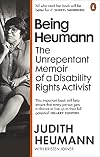
"Being Heumann" is a profound testament to the resilience and power of individuals living with disabilities. Judith Heumann's journey exemplifies that disability does not confine one to a predetermined fate; instead, it presents opportunities for advocacy, empowerment, and personal growth. As she aptly states, "Your disability does not put you in a box. It changes your life." This perspective challenges societal norms and fosters a sense of agency in navigating one's unique show more circumstances.
Heumann's advocacy serves as a beacon of inspiration, urging individuals to defy limitations and embrace their inherent worth. Through her relentless pursuit of equality and justice, she emphasizes the importance of self-advocacy and the need to challenge societal perceptions of disability. "Being Heumann" is a call to action, urging readers to stand up for their rights, pursue their dreams, and refuse to be defined by their disabilities.
In contemplating Heumann's journey, one is compelled to ponder: How would I navigate life with a disability? Would I succumb to bitterness and negativity, or would I strive to be a force of positivity and change? This question invites introspection and challenges societal biases, ultimately highlighting the transformative power of resilience and determination. show less
Heumann's advocacy serves as a beacon of inspiration, urging individuals to defy limitations and embrace their inherent worth. Through her relentless pursuit of equality and justice, she emphasizes the importance of self-advocacy and the need to challenge societal perceptions of disability. "Being Heumann" is a call to action, urging readers to stand up for their rights, pursue their dreams, and refuse to be defined by their disabilities.
In contemplating Heumann's journey, one is compelled to ponder: How would I navigate life with a disability? Would I succumb to bitterness and negativity, or would I strive to be a force of positivity and change? This question invites introspection and challenges societal biases, ultimately highlighting the transformative power of resilience and determination. show less
I first heard about Judy Heumann in the eye-opening Netflix documentary "Crip Camp," which portrayed a 1970s camp for teens with disabilities that created such camaraderie and x that several of its attendees became pioneers in the early disabilities right movement. Heumann was easily the star of the movie, and I'm glad to find her new autobiography. Written in straightforward no-frills language, she modestly tells the story of her involvement in protests and sit-ins that advocated for the show more passage of landmark legislation that ensured that people with disabilities had equal access to education, transportation, employment, etc. I'm in my mid 50's and I didn't realize that the Americans with Disabilities Act was only enacted 30 years ago. It's still shocking to me that Judy, a polio victim born in the 1950s to Holocaust survivors, wasn't allowed to attend school and was expected to be institutionalized, or at best languish in a sheltered workshop.
Covers much of the same ground as "Crip Camp" but with more specific details about Heumann's childhood, and extends the story into Heumann's position in the Obama government as well as a bleak postscript about the progress that is already being reversed in the Trump administration. I don't want to use the word "inspiring" because I don't want to be patronizing but the fact is her accomplishments would be amazing for anyone, whether they have a disability or not. show less
Covers much of the same ground as "Crip Camp" but with more specific details about Heumann's childhood, and extends the story into Heumann's position in the Obama government as well as a bleak postscript about the progress that is already being reversed in the Trump administration. I don't want to use the word "inspiring" because I don't want to be patronizing but the fact is her accomplishments would be amazing for anyone, whether they have a disability or not. show less
What a lovely mixture of a biograpy and a testimony to the disabled activists that have caused changed.
I saw a few complaints on it, but I thought the fact-based narration aided to the purpose of this book. It was less of a personal ‘story’ and more of a testimony of the change disabled activists fought for and her first hand account. The opening sections just supplied a personal background and lead up to explain her later on actions and how her activism continued to be built upon show more prior experience and be fueled by the challenges she was unfairly forced to experienced. You don't need to know all the personal heartbreak and misery and shame she felt during these moments of discrimination, you don't need to know every snide comment or instance of her being denied a basic service or human right. There's plenty of stories and account by disabled people all across the world, you already know the a
hardships they face—you should be able to sympathize with a marginalized group without voyeuristic details about their mistreatment.
Carrying on that, I also didn't find the writing dry at all! I thought it reflected on her life and how her style is obviously influenced by her positions of leadership and change. As Judith stated many times, she and other disabled people had to ARGUE and convince abled body people that discrimination against them even existed. People in positions of power don't care how you feel, she had to base her arguments in hard evidence and fact. Even as a child, she said the family dinners prepared her to be outspoken in what she believes because you always had to be prepared to defend your opinion on a subject. Personally, I viewed the style as another window to how she thought, operated, and spoke about the mistreatment she faced. Maybe in a more compassionate world, saying 'this makes me feel bad and excluded, I'm lonely and hurt' would be enough but, as we see, it wasn't. She and the countless other activists had to fight to have their lives even acknowledged, their feelings were constantly handwaved away. So the personal recounting of these major events being focused on the step by step and process was fascinating and I thought it added to the book.
I mostly treasured this not only for an inside view by one of the most known disabled activist, but also for how much emphasis is placed in building community and a support system. The attention she gives to credit and highlight how many people and other civil rights movements were involved and helped is such a beautiful reminder that together, in solidarity, we are always stronger and CAN make a change and set a new standard for what should be expected in a supportive society despite the people that try to prevent it.
I saw a few complaints on it, but I thought the fact-based narration aided to the purpose of this book. It was less of a personal ‘story’ and more of a testimony of the change disabled activists fought for and her first hand account. The opening sections just supplied a personal background and lead up to explain her later on actions and how her activism continued to be built upon show more prior experience and be fueled by the challenges she was unfairly forced to experienced. You don't need to know all the personal heartbreak and misery and shame she felt during these moments of discrimination, you don't need to know every snide comment or instance of her being denied a basic service or human right. There's plenty of stories and account by disabled people all across the world, you already know the a
hardships they face—you should be able to sympathize with a marginalized group without voyeuristic details about their mistreatment.
Carrying on that, I also didn't find the writing dry at all! I thought it reflected on her life and how her style is obviously influenced by her positions of leadership and change. As Judith stated many times, she and other disabled people had to ARGUE and convince abled body people that discrimination against them even existed. People in positions of power don't care how you feel, she had to base her arguments in hard evidence and fact. Even as a child, she said the family dinners prepared her to be outspoken in what she believes because you always had to be prepared to defend your opinion on a subject. Personally, I viewed the style as another window to how she thought, operated, and spoke about the mistreatment she faced. Maybe in a more compassionate world, saying 'this makes me feel bad and excluded, I'm lonely and hurt' would be enough but, as we see, it wasn't. She and the countless other activists had to fight to have their lives even acknowledged, their feelings were constantly handwaved away. So the personal recounting of these major events being focused on the step by step and process was fascinating and I thought it added to the book.
I mostly treasured this not only for an inside view by one of the most known disabled activist, but also for how much emphasis is placed in building community and a support system. The attention she gives to credit and highlight how many people and other civil rights movements were involved and helped is such a beautiful reminder that together, in solidarity, we are always stronger and CAN make a change and set a new standard for what should be expected in a supportive society despite the people that try to prevent it.
“We—all of us, and especially marginalized people—need to work together. In the broader civil rights movements disability was and still is absent. Visible and invisible disabilities cut across all minorities. We are African American, Latino, Asian, Native American, gay, straight, transgender, middle class, wealthy, poor, Jewish, Hindu, Christian, Muslim. We can’t be selective about which marginalized group moves forward. At the end of the day, we all need to be moving forward together, taking care of our families and the planet. When whole groups of people become segregated from others in our society, it weakens the fabric of our democracy. Distance and segregation are breeding grounds for failures of understanding and empathy and ultimately injustice and the denial of others’ rights.”show less
Lists
Awards


You May Also Like


Associated Authors
Statistics
- Works
- 2
- Also by
- 1
- Members
- 357
- Popularity
- #67,135
- Rating
- 4.2
- Reviews
- 12
- ISBNs
- 16