
Todd Whitaker
Author of What Great Teachers Do Differently: 14 Things That Matter Most
About the Author
Todd Whitaker (@toddwhitaker) is a leading presenter in the field of education and has written more than 50 books including the bestseller What Great Principals Do Differently. He is a professor of educational leadership at the University of Missouri.
Works by Todd Whitaker
Shifting the Monkey: The Art of Protecting Good People From Liars, Criers, and Other Slackers (2011) 70 copies, 1 review
John Wiley Ten-Minute Inservice: 40 Quick Training Sessions That Build Teacher Effectiveness (2013) 34 copies
Motivating & Inspiring Teachers: The Educational Leader's Guide for Building Staff Morale (2000) 30 copies
The Ultimate Teacher: The Best Experts' Advice for a Noble Profession with Photos and Stories (2009) 13 copies
Leading School Change: How to Overcome Resistance, Increase Buy-In, and Accomplish Your Goals (2018) 5 copies
For the Love of Teachers: True Stories of Amazing Teachers and the People Who Love Them (For the Love Of...(Health Communications)) (2013) 4 copies
Feeling Great: The Educator's Guide for Eating Better, Exercising Smarter, and Feeling Your Best (2002) 3 copies
Feeling great! : the educators' guide for eating better, exercising smarter, and feeling your best (2013) 2 copies
Mi primer año como docente: Gestionarlo y vivirlo (Educadores XXI nº 22) (Spanish Edition) (2018) 1 copy
Tagged
Common Knowledge
- Gender
- male
Members
Reviews
Shifting the Monkey: The Art of Protecting Good People From Liars, Criers, and Other Slackers by Todd Whitaker
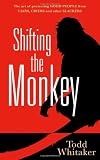
Indiana State University professor Todd Whitaker takes a humorous and insightful approach to handling slackers in the workplace using the old metaphor of "monkey on the back". Essentially, when poor performing employees force their peers or managers to take up their slack, or provide poor customer service, they are essentially "shifting the monkey" of responsibility off themselves.
Whitaker condenses his message down to three principles:
Where is the monkey?
Where should the monkey be?
How do I show more shift the monkey to its proper place?
The book details specific examples and tactics that managers can use to deal with bad employees ranging from criers and liars to complainers, from those that always have a ready excuse for their failures to those who are simply apathetic. The workplace is replete with "monkeys" of all types and some, such as Guilt Monkeys, Fear Monkeys, Worry Monkeys, and Punishment Monkeys, are not the best management approaches for dealing with bad employees.
Whitaker's scenarios reach beyond the office environment, however. It extends to service organizations, department stores, restaurants and any business that employs a staff large enough to contain a few miscreants. Shifting the Monkey details methods for putting the responsibility and accountability back where it belongs onto the bad employees, thereby allowing them to either improve their performance or continue on the path to eventual termination.
Poor management decisions and blanket policies intended to address problem customers and employees can also place unnecessary "monkeys on the backs" of valuable customers and solid employees, the results of which could easily inflict even more damage to the company through loss of business and heavy turnover.
While some of the examples cited in the book may seem simplistic, they can be adapted to just about any given business situation and further, into your personal life. How many family members or friends are constant liars, criers, complainers, or slackers? We all know them and Whitaker provides a set of transformative tools for dealing with them. show less
Whitaker condenses his message down to three principles:
Where is the monkey?
Where should the monkey be?
How do I show more shift the monkey to its proper place?
The book details specific examples and tactics that managers can use to deal with bad employees ranging from criers and liars to complainers, from those that always have a ready excuse for their failures to those who are simply apathetic. The workplace is replete with "monkeys" of all types and some, such as Guilt Monkeys, Fear Monkeys, Worry Monkeys, and Punishment Monkeys, are not the best management approaches for dealing with bad employees.
Whitaker's scenarios reach beyond the office environment, however. It extends to service organizations, department stores, restaurants and any business that employs a staff large enough to contain a few miscreants. Shifting the Monkey details methods for putting the responsibility and accountability back where it belongs onto the bad employees, thereby allowing them to either improve their performance or continue on the path to eventual termination.
Poor management decisions and blanket policies intended to address problem customers and employees can also place unnecessary "monkeys on the backs" of valuable customers and solid employees, the results of which could easily inflict even more damage to the company through loss of business and heavy turnover.
While some of the examples cited in the book may seem simplistic, they can be adapted to just about any given business situation and further, into your personal life. How many family members or friends are constant liars, criers, complainers, or slackers? We all know them and Whitaker provides a set of transformative tools for dealing with them. show less
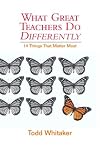
Who knew such a slim volume could be packed with so many good ideas? While indispensable for a novice teacher, What Great Teachers Do Differently: 17 Things That Matter Most will serve as a good reminder for even veteran teachers of the importance of concentrating on changing behavior instead of getting even with misbehaving students, being a better colleague and taking cues from the best students, not the worst. Why did I wait so long to read this?
This is a book to read and re-read. Highly show more recommended. show less
This is a book to read and re-read. Highly show more recommended. show less
Yuck! I had to read this for work; they assign us a book every year. Mostly common sense stuff although I admit I was much relieved that this book admitted that teachers were human instead of Gods put upon the earth to make a difference in the lives of each and every child (I believe teaching is an important job, but a lot of books idealize everything about teaching and therefore are useless when it comes to applying to what goes on in real life). It was also blessingly short.
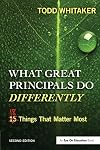
I was assigned this book for a class in supervision and administration, and actually really enjoyed it. It is very easy to read (not technical at all), and is full of practical advice. I'm sure I'll come back to it during my career to remind me of what's important.
You May Also Like


Associated Authors
Statistics
- Works
- 42
- Members
- 1,079
- Popularity
- #23,833
- Rating
- 3.7
- Reviews
- 9
- ISBNs
- 152
- Languages
- 2