
Judy Mahoney
Author of Teach Me French (Paperback and Audio Cassette): A Musical Journey Through the Day
About the Author
Series
Works by Judy Mahoney
Teach Me French (Paperback and Audio Cassette): A Musical Journey Through the Day (1996) 43 copies, 1 review
Teach Me More French (Paperback and Audio Cassette): A Musical Journey Through the Year (1989) 20 copies
Teach Me German (Paperback and Audio Cassette): A Musical Journey Through the Day (1997) 18 copies, 1 review
Teach Me Hebrew (Paperback and Audio CD): A Musical Journey Through the Day (1996) 16 copies, 2 reviews
Teach Me More Japanese (Paperback and Audio CD): A Musical Journey Through the Year (1997) 14 copies
Joyeux Noel: Learning Songs and Traditions in French (Teach Me) (Book & Audio CD) (French Edition) (2006) 8 copies
Teach Me Even More French (Paperback and Audio CD): 21 Songs to Sing and A Story About Pen Pals (1996) 7 copies
Teach Me French & More French, Bind Up Edition (French Edition) (Teach Me Series) (French and English Edition) (2005) 7 copies
Teach Me More German : A Musical Journey Through the Year (English and German Edition) (1990) 6 copies
Teach Me Everyday French Volume 2 - Celebrating the Seasons (French Edition) (Teach Me Everyday Language) (French and English Edition) (2009) 5 copies
Teach Me More Russian (Paperback and Audio Cassette): A Musical Journey Through the Year (1997) 4 copies
Teach Me Everyday Spanish Volume 2 - Celebrating the Seasons (Spanish Edition) (Teach Me Everyday Language) (2009) 4 copies
Teach Me Japanese & More Japanese, Bind Up Edition (Japanese Edition) (Japanese and English Edition) (2009) 2 copies
Sing With Me In French: A Teach Me Tape Songbook Complete with Words, Piano Accompaniment and Chord Symbols (1994) 1 copy
Everyday Spanish, Volume 1 [With CD] [TEACH ME EVERYDAY SPAN-V01-LIB] [Library Binding] (2008) 1 copy
Teach Me Chinese & More Chinese (Mandarin), Bind Up Edition (Chinese Edition) (Teach Me Series) (Chinese and English Edition) (2009) 1 copy
Teach Me Everyday Chinese (Mandarin) Volume 2: Celebrating the Seasons (Chinese Edition) (2010) 1 copy
Teach Me Everyday Italian Volume 2 - Celebrating the Seasons (Italian Edition) (Teach Me Everyday Language) (2009) 1 copy
Sing With Me In Spanish: A Teach Me Tape Songbook Complete with Words, Piano Accompaniment and Chord Symbols (1994) 1 copy
Tagged
Common Knowledge
- Gender
- female
Members
Reviews
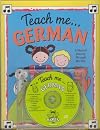
2.5 stars, rounded up. A nice idea, but the execution was disappointing. I like the idea of learning a language through song: lyrics are easy to pick up, and complicated ideas like syntax and grammar are made all the more natural through this type of learning. However, this book doesn’t really do that. It doesn’t have traditional German songs, for one thing; it has traditional English songs that have been translated into German. It also doesn’t give the English meaning for the German show more words; it simply gives the original English words. As you can probably imagine, since the songs all have the same rhyme and meter patterns as their English counterparts, the translation isn’t exact, and without knowing what any of these words actually means, it’s going to be impossible for children coming to German for the first time to understand much at all of this. It’s going to be more like singing nonsense syllables than singing something with meaning. It’s also a waste of a rich musical heritage, as there are a great many traditional German-language songs for children that might have been fun. Perhaps my biggest disappointment was that the book’s back cover specifically mentions “The More We Get Together”, which is, of course, the anglophone’s counterpart to the traditional song “Ach du lieber Augustin.” I don’t know all of the words in German—only a little bit. My mother used to sing it to me when I was a kid in a mix of German and English, “Ach du lieber Augustin, everything’s gone.” I have, of course, looked up the German lyrics as a grownup, but I was looking forward to a book CD combo. Instead, I got the completely unrelated English version, translated into the language of the original song, but with none of the same content.
Still, there is some good here. I like the coloring book pages, which will give the kids something to do while they listen to the German language, and which will also let them spend time looking at a page with German words. I liked that the songs aren’t the whole story; there are simple sentences in German, too, which provide a great opportunity for learning words, phrases, and basic grammar. Certainly not bad, but it could have been so much more. show less
Still, there is some good here. I like the coloring book pages, which will give the kids something to do while they listen to the German language, and which will also let them spend time looking at a page with German words. I liked that the songs aren’t the whole story; there are simple sentences in German, too, which provide a great opportunity for learning words, phrases, and basic grammar. Certainly not bad, but it could have been so much more. show less
2.5 stars
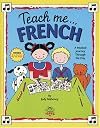
A nice idea, but the execution isn’t as good as it should be. Don’t get me wrong—I like the idea of using songs to help learn a language. I have used them myself on other occasions; they are wonderful as a language tool. Songs tend to use a slightly richer vocabulary than is found in ordinary conversation, and the music slows down the words, making it easier for children to hear the individual phonemes. I have especially enjoyed the light songs can shed on grammatical show more structure; the music makes it easy to recall the specific words, giving children a nice template for creating similar sentences.
These songs don’t do that so much. For one thing, they really aren’t traditional French songs for the most part; they’re traditional English songs that have been translated into French. Sometimes it’s awkward and stilted, and this means that the words aren’t always as fluid and natural as they should be. Second, it means that there is no translation given, just the English words, and since they worked so hard to recreate the same rhyme and meter in French, the songs’ meanings have changed a great deal. So it isn’t learning a song in a foreign language as much as it is simply repeating syllables whose real meaning has been lost. Third, the singers on the CD aren’t quite all together. They’re singing in a chorus in slightly different time (which is cute and all), but this makes it very difficult to understand the sounds.
The most useful parts of this book are the spoken bits, where the children in the story use simple words to introduce their family, their pets, and their home. But the music is more a distraction than a resource. All in all, it’s a nice diversion, but it’s unlikely to provide the linguistic aid that parents might expect. show less
A nice idea, but the execution isn’t as good as it should be. Don’t get me wrong—I like the idea of using songs to help learn a language. I have used them myself on other occasions; they are wonderful as a language tool. Songs tend to use a slightly richer vocabulary than is found in ordinary conversation, and the music slows down the words, making it easier for children to hear the individual phonemes. I have especially enjoyed the light songs can shed on grammatical show more structure; the music makes it easy to recall the specific words, giving children a nice template for creating similar sentences.
These songs don’t do that so much. For one thing, they really aren’t traditional French songs for the most part; they’re traditional English songs that have been translated into French. Sometimes it’s awkward and stilted, and this means that the words aren’t always as fluid and natural as they should be. Second, it means that there is no translation given, just the English words, and since they worked so hard to recreate the same rhyme and meter in French, the songs’ meanings have changed a great deal. So it isn’t learning a song in a foreign language as much as it is simply repeating syllables whose real meaning has been lost. Third, the singers on the CD aren’t quite all together. They’re singing in a chorus in slightly different time (which is cute and all), but this makes it very difficult to understand the sounds.
The most useful parts of this book are the spoken bits, where the children in the story use simple words to introduce their family, their pets, and their home. But the music is more a distraction than a resource. All in all, it’s a nice diversion, but it’s unlikely to provide the linguistic aid that parents might expect. show less
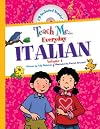
In my opinion, the book "Teach Me Everyday Italian," is a really great book for young readers. One thing I liked about this book is that it is a part of a series. There are other languages that are in this series like Russian and Russian which can help to familiarize students with those languages as well. I also like that this book comes with a CD. This way, children can actually hear how to pronounce different words and can connect the sounds to what is written in the text. I also liked how show more the words in the book are basic enough for an elementary reader. It simply introduces the Italian language by not going too far in depth or assuming background knowledge. This would be a great book for students to just get their feet wet in another language. The big idea of this book is to introduce readers to the Italian language through phrases and vocabulary. show less
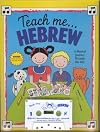
Summary: This is a great beginner book where children can learn basic Hebrew through rhyming and songs.
Personal connection: This would have been useful for me when I was younger to learn Hebrew. As part of my inquiry project, this would help the students understand some basic language that they could incorporate into what they’ve been learning about the country.
Class use: Teach students basic Hebrew words and how to relate them to Israel and their importance.
Personal connection: This would have been useful for me when I was younger to learn Hebrew. As part of my inquiry project, this would help the students understand some basic language that they could incorporate into what they’ve been learning about the country.
Class use: Teach students basic Hebrew words and how to relate them to Israel and their importance.
You May Also Like


Statistics
- Works
- 60
- Members
- 374
- Popularity
- #64,495
- Rating
- 3.2
- Reviews
- 6
- ISBNs
- 122
- Languages
- 9