
Judith Kerr (1923–2019)
Author of When Hitler Stole Pink Rabbit
About the Author
Judith Kerr was born in Berlin, Germany on June 14, 1923. Her family left Germany to escape the growing threat of Nazism and finally settled in England in 1933. She studied at the Central School of Art in London and worked as a scriptwriter for the British Broadcasting Corp, before leaving to raise show more her children. Her first book, The Tiger Who Came to Tea, was published in 1968. Her other books included When Hitler Stole Pink Rabbit, The Curse of the School Rabbit, and a series of books based on Mog the Cat including Goodbye Mog. In 2012, she was named an O.B.E. for children's literature and Holocaust education. She died on May 22, 2019 at the age of 95. (Bowker Author Biography) show less
Series
Works by Judith Kerr
Judith Kerr's Creatures: A Celebration of the Life and Work of Judith Kerr (2013) 32 copies, 4 reviews
The Mog Treasury: The illustrated adventures of the nation’s favourite cat, from the author of The Tiger Who Came To Tea (2020) 7 copies
Mog’s Bedtime Tales: An illustrated collection of Mog stories, perfect for bedtime reading! (2025) 1 copy
MOG A gata esquecida 1 copy
Geschöpfe: Mein Leben und Werk: Das Buch erscheint anlässlich des 95.Geburtstags von Judith Kerr am 14.Juni (2018) 1 copy
Co meo va ba: meo mog map 1 copy
Associated Works
The Pleasure of Reading: 43 Writers on the Discovery of Reading and the Books That Inspired Them (2015) — Contributor — 103 copies, 2 reviews
Collins Modern Classics: When Hitler Stole Pink Rabbit, Homecoming, Phantom Tollbooth (Boxed Set) (1999) — Contributor — 2 copies
Tagged
Common Knowledge
- Canonical name
- Kerr, Judith
- Other names
- Kerr, Anna Judith Gertrud Helene (birth name)
- Birthdate
- 1923-06-14
- Date of death
- 2019-05-22
- Gender
- female
- Education
- Central School of Arts and Crafts
- Occupations
- artist
scriptwriter
children's book author
memoirist - Organizations
- BBC
- Awards and honors
- Deutscher Jugendliteraturpreis (1974)
Action for Children's Arts (J. M. Barrie Award|inaugural award | 2005)
Order Of The British Empire (Officer ∙ 2012)
BookTrust Lifetime Achievement Award (2016)
British Book Awards (Illustrator of the Year | 2019) - Relationships
- Kneale, Nigel (spouse)
Kneale, Matthew (son)
Kneale, Tacy (daughter)
Kerr, Michael (brother)
Kerr, Alfred (father) - Nationality
- Germany (birth)
England (residence)
UK (naturalized 1947) - Birthplace
- Berlin, Germany
- Places of residence
- London, Middlesex, England, UK
- Place of death
- London, Middlesex, England, UK
- Map Location
- England, UK
Members
Reviews

When the Thomas family goes to America for the summer holidays, Mog is sent to stay with Granny and her cat Tibbles. Although Mog "didn't like things to be exciting. She liked them to be the same," she finds that staying with Granny isn't so bad. She's well-cared for, and she and Tibbles usually get along. But when a frightening day-dream involving Debbie being kidnapped by some 'bird-people' precipitates the alarmed feline into the centre of Granny's tea party, causing catastrophe, the show more clumsy Mog is disheartened. Then she gets a vision of the Thomases returning, and sets off to welcome them home, only to find herself chased up a tree by a local dog. How will she get down, and will it happen in time for her to welcome her family...?
Judith Kerr's thirteenth title devoted to the adventures of that adorably befuddled kitty whose story began in Mog the Forgetful Cat (1970), Mog and the Granny contained a number of themes to be found in earlier entries in the series. Mog's penchant for (unintentionally) causing trouble, and then withdrawing in hurt and confusion can be seen here, as can her proclivity towards unusual dream imagery featuring threatening bird-like creatures. The 'bird-people,' who are really 'Red Indians' participating in a show that the Thomases are enjoying over in America, reminded me of the 'mousedogbirds' that our feline heroine encountered in Mog In the Dark. The association was interesting, although I think the reader is meant to understand that the images that Mog sees in this case are visions of actual events, rather than just dreams. As a fan of the series, I wish I could say that I enjoyed this one, but I was troubled by the scenes involving Native Americans here, much as I was in Mog's Amazing Birthday Caper. Not only is there quite a bit of cultural confusion - men in full stereotypical Plains regalia, standing outside tipis, while totem poles(!) appear in the background - but the entire sequence seems to rest on the perception of Native peoples as tourist attractions and curiosities, rather than as real human beings. Symbols and myths, rather than residents of the present-day world. Although children's books in the USA and Canada still sometimes contain this kind of depiction of indigenous peoples, I think it is becoming less common. In the UK and other parts of Europe, on the other hand, the exotification of the native peoples of the western hemisphere continues, and there seems to be little awareness of why this might be problematic. Sadly, this is not one of the Mog books I recommend, and I can understand why it hasn't been published in the states... show less
Judith Kerr's thirteenth title devoted to the adventures of that adorably befuddled kitty whose story began in Mog the Forgetful Cat (1970), Mog and the Granny contained a number of themes to be found in earlier entries in the series. Mog's penchant for (unintentionally) causing trouble, and then withdrawing in hurt and confusion can be seen here, as can her proclivity towards unusual dream imagery featuring threatening bird-like creatures. The 'bird-people,' who are really 'Red Indians' participating in a show that the Thomases are enjoying over in America, reminded me of the 'mousedogbirds' that our feline heroine encountered in Mog In the Dark. The association was interesting, although I think the reader is meant to understand that the images that Mog sees in this case are visions of actual events, rather than just dreams. As a fan of the series, I wish I could say that I enjoyed this one, but I was troubled by the scenes involving Native Americans here, much as I was in Mog's Amazing Birthday Caper. Not only is there quite a bit of cultural confusion - men in full stereotypical Plains regalia, standing outside tipis, while totem poles(!) appear in the background - but the entire sequence seems to rest on the perception of Native peoples as tourist attractions and curiosities, rather than as real human beings. Symbols and myths, rather than residents of the present-day world. Although children's books in the USA and Canada still sometimes contain this kind of depiction of indigenous peoples, I think it is becoming less common. In the UK and other parts of Europe, on the other hand, the exotification of the native peoples of the western hemisphere continues, and there seems to be little awareness of why this might be problematic. Sadly, this is not one of the Mog books I recommend, and I can understand why it hasn't been published in the states... show less
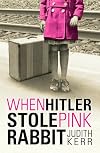
Simply put, I loved [When Hitler Stole Pink Rabbit] by Judith Kerr. This touching story of a Jewish family escaping Germany when Hitler comes into power caught the essence of the times and how this family’s forward thinking saved their lives. Written by children’s author Judith Kerr and aimed at middle grades, this is a story that appeals to all ages.
The story is semi-autobiographical based on the author’s own family’s escape from the Nazi’s. They first go to Switzerland but work show more is difficult to come by and as the father is well-known for his opposition to the Nazi’s, the Swiss are hesitant to stir up problems with their German neighbours. It is soon announced that Hitler has put a price on the father’s head. The family then moves to Paris and although the children fit in and begin to become fluent in the language, work for the author was again difficult to come by. France was suffering through a massive depression and what writing assignments there were went to French citizens first. I was happy when an English company bought a film script from the father and it was decided that they would have a better future by moving to England and as we know now, this move got them away from Hitler's clutches.
The author changed her family’s name and fictionalized portions of the book but this is essentially her family’s story. Her father was a well known newspaper columnist who had openly criticized the Nazi party. Beautifully written and illustrated by the author, this story shows the lengths that the parents went to to keep their family together and their children innocent and ignorant of the horrible fate that was hanging over them. show less
The story is semi-autobiographical based on the author’s own family’s escape from the Nazi’s. They first go to Switzerland but work show more is difficult to come by and as the father is well-known for his opposition to the Nazi’s, the Swiss are hesitant to stir up problems with their German neighbours. It is soon announced that Hitler has put a price on the father’s head. The family then moves to Paris and although the children fit in and begin to become fluent in the language, work for the author was again difficult to come by. France was suffering through a massive depression and what writing assignments there were went to French citizens first. I was happy when an English company bought a film script from the father and it was decided that they would have a better future by moving to England and as we know now, this move got them away from Hitler's clutches.
The author changed her family’s name and fictionalized portions of the book but this is essentially her family’s story. Her father was a well known newspaper columnist who had openly criticized the Nazi party. Beautifully written and illustrated by the author, this story shows the lengths that the parents went to to keep their family together and their children innocent and ignorant of the horrible fate that was hanging over them. show less

Retired shopkeeper Mr. Cleghorn, at something of a loss since selling his business, goes to visit his cousin William and his family at the seashore in this simple but engaging chapter-book from celebrated British children's author Judith Kerr. While on holiday, Mr. Cleghorn adopts an abandoned seal pup he had been observing, in order to spare its life, but finds that his plan to donate the orphaned wildling to a local zoo have hit a snag. Now he finds himself caring for Charlie, as he names show more the seal, in a small apartment where animals are forbidden. Fortunately for him, his neighbor, Miss Millicent Craig, is both sympathetic and knowledgeable about animals, and together they eventually find the best solution, for both Charlie and themselves...
Published in 2015, Mister Cleghorn's Seal was one of Kerr's last books (sadly, she died in 2019), and is based, according to the author's brief afterword, upon a story from her own father's youth. Apparently Father Kerr had once rescued a seal himself, and had attempted to care for it, with less than happy results. Judith Kerr grew up in a house which contained the stuffed remains of that unfortunate creature, and this story represents, as she herself acknowledges, an attempt to create a happier ending for this seal. It has a historical setting, which makes the premise more amenable, I think - if set today, we would hope and expect that a rescued seal would be taken to a wildlife organization that could rehabilitate it and rerelease it into the world - and an engaging hero. I enjoyed following along as Charlie leads Mister Cleghorn into both trouble, and eventually, toward happiness, and really loved the ending of the tale. The accompanying artwork has all of that vintage Kerr charm that one would expect, and adds to the reading pleasure. Recommended to beginning chapter-book readers who enjoy animal stories, as well as to fellow Kerr fans. show less
Published in 2015, Mister Cleghorn's Seal was one of Kerr's last books (sadly, she died in 2019), and is based, according to the author's brief afterword, upon a story from her own father's youth. Apparently Father Kerr had once rescued a seal himself, and had attempted to care for it, with less than happy results. Judith Kerr grew up in a house which contained the stuffed remains of that unfortunate creature, and this story represents, as she herself acknowledges, an attempt to create a happier ending for this seal. It has a historical setting, which makes the premise more amenable, I think - if set today, we would hope and expect that a rescued seal would be taken to a wildlife organization that could rehabilitate it and rerelease it into the world - and an engaging hero. I enjoyed following along as Charlie leads Mister Cleghorn into both trouble, and eventually, toward happiness, and really loved the ending of the tale. The accompanying artwork has all of that vintage Kerr charm that one would expect, and adds to the reading pleasure. Recommended to beginning chapter-book readers who enjoy animal stories, as well as to fellow Kerr fans. show less

"Once there was a cat called Mog and she lived with a family called Thomas. Mog was nice but not very clever. She didn't understand a lot of things. A lot of other things she forgot. She was a very forgetful cat." And so begins this hilarious tale of the adorable Mog, a plump kitty-cat who, while she may not have been the cleverest feline out there, had a heart full of love for her human family. When Mog's forgetfulness precipitates one crisis too many, leading to an unpleasant scene, the show more poor confused cat flees to the dark garden, where she thinks "dark thoughts," wondering if any of the Thomases even want her around anymore. But then, Mog sees a light in the kitchen...
It may sound like an odd thing for a self-professed cat-lover to say, but I have met some astoundingly dumb cats in my life. None more so than my sister's cat Sweetpea, whom I have been known to call "Substance Abuse Kitty," because of her predilection for licking unhealthy things, like photo negatives, or the gold paint on wedding invitations (hand-made for my sister's wedding - now that was a crisis! ha!). Needless to say, I have a real soft spot in my heart for such cats - I just can't help it, I feel amused by and protective of them, all at the same time - so I just wanted to scoop the adorably confused Mog out of this story, and give her a big cuddle. Her distress felt so real to me - after all, animals don't understand, for the most part, why people get upset with them - and her eventual (accidental) triumph so satisfying!
Humorous and heart-warming, this is a picture-book I would recommend to all true cat-lovers, especially any who have ever known one that was a little... well, forgetful! show less
It may sound like an odd thing for a self-professed cat-lover to say, but I have met some astoundingly dumb cats in my life. None more so than my sister's cat Sweetpea, whom I have been known to call "Substance Abuse Kitty," because of her predilection for licking unhealthy things, like photo negatives, or the gold paint on wedding invitations (hand-made for my sister's wedding - now that was a crisis! ha!). Needless to say, I have a real soft spot in my heart for such cats - I just can't help it, I feel amused by and protective of them, all at the same time - so I just wanted to scoop the adorably confused Mog out of this story, and give her a big cuddle. Her distress felt so real to me - after all, animals don't understand, for the most part, why people get upset with them - and her eventual (accidental) triumph so satisfying!
Humorous and heart-warming, this is a picture-book I would recommend to all true cat-lovers, especially any who have ever known one that was a little... well, forgetful! show less
Lists
Youth: Zoology (1)
Christmas Books (1)
1970 Club (1)
Sonlight Books (1)
Cats in Fiction (1)
Europe (1)
al.vick-series (1)
Awards


You May Also Like


Associated Authors
Statistics
- Works
- 78
- Also by
- 5
- Members
- 9,530
- Popularity
- #2,521
- Rating
- 4.0
- Reviews
- 176
- ISBNs
- 546
- Languages
- 20
- Favorited
- 7
