
Kenneth Boa
Author of Talk Thru the Bible: A Quick Guide to Help You Get More Out of the Bible
About the Author
He is the president of Reflections Ministries. He resides in Atlanta, Georgia.
Works by Kenneth Boa
Talk Thru the Bible: A Quick Guide to Help You Get More Out of the Bible (1983) — Author — 902 copies, 5 reviews
Cults, World Religions, and You: Strange Religions, New and Old, Seek Converts in Your Community, Know What They Teach and How to Deal with Their Adherents (1977) 347 copies, 1 review
Faith Has Its Reasons: Integrative Approaches to Defending the Christian Faith (2012) 324 copies, 1 review
20 Compelling Evidences That God Exists: Discover Why Believing in God Makes So Much Sense (2002) 191 copies, 1 review
Augustine To Freud: What Theologians & Psychologists Tell Us About Human Nature (And Why It Matters) (2004) 91 copies
An Unchanging Faith in a Changing World: Understanding and Responding to Critical Issues That Christians Face Today (1998) 67 copies, 1 review
Conformed to His Image, Revised Edition: Biblical, Practical Approaches to Spiritual Formation (2020) 54 copies
Hearts and Minds: Raising Your Child with a Christian View of the World (How Now in Real Life series) (2006) 38 copies
Nelson's Teacher's Resource on First Corinthians: Your Handbook, Manners & Customs, Commentary, and Teaching Outlines ALL in One Volume (2002) 27 copies
The Gospel According to The Da Vinci Code: The Truth Behind the Writings of Dan Brown (2006) 27 copies, 1 review
Shaped by Suffering: How Temporary Hardships Prepare Us for Our Eternal Home (2020) 20 copies, 2 reviews
Conformed to His Image Study Guide: Biblical, Practical Approaches to Spiritual Formation (2020) 18 copies
ScriptureTalks With God and the New King James Version of the New Testament, Psalms, and Proverbs (1990) 18 copies, 1 review
A Taste of the Classics - Volume 1: Mere Christianity, Pilgrims Progress, The Brothers Karamazov and The Imitation of Christ (2010) 16 copies
A Taste of the Classics - Volume 2: The Screwtape Letters, Paradise Lost, Confessions by Augustine and The Pursuit of God (2010) 12 copies
A Taste of the Classics - Volume 4: The Divine Comedy, Knowledge of the Holy, Pride and Prejudice and The Love of God (2010) 12 copies
A Taste of the Classics - Volume 3: Crime and Punishment, Penses, The Great Divorce and Christian Perfection (2010) 9 copies
Manual de apologética: Abordagens integrativas para a defesa da fé cristã (Portuguese Edition) (2023) 4 copies
Strength for the Coming Days 4 copies
Face to Face, Volume One: Praying the Scriptures for Intimate Worship (A 90-Day Devotional) 2 copies
Creation or Evolution? 2 copies
Paradise Lost by Milton 1 copy
Pensees by Blaise Pascal 1 copy
Moby Dick by Herman Melville 1 copy
Poems of George Herbert 1 copy
The odyssey by Homer 1 copy
Anna Karenina by Leo Tolstoy 1 copy
The City of God by Augustine 1 copy
ASEMENEA CHIPULUI SĂU 1 copy
he Open Bible Companion 1 copy
Manual de apologética: Abordagens integrativas para a defesa da fé cristã (Portuguese Edition) 1 copy
Unraveling the da Vinci Code 1 copy
Handbook to Scripture, eBook: Integrating the Bible into Everyday Life (Handbook To...) (2011) 1 copy
Apologetics 1 copy
Orthodoxy by G.K. Chesterton 1 copy
Visual Survey of the Bible 1 copy
Face to face vol 1 1 copy
Tagged
Common Knowledge
- Legal name
- Boa, Kenneth Dale
- Other names
- BOA, Kenneth Dale
BOA, Kenneth D.
BOA, Kenneth - Birthdate
- 1945-07-22
- Gender
- male
Members
Reviews
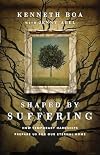
Summary: A study of how suffering may shape a person for eternity with God, based on 1 Peter.
There's a lot of suffering in the world. Even in ordinary times. Illness. Injury. Chronic pain. Broken relationships. Depression. Death. That's just a sample. We want to know why this happened. We want to know how this can be reconciled with the goodness of God. That's not what this book is about.
The authors have a more focused purpose. They are writing for those who believe, and particularly those show more whose trust in Christ includes a hope beyond this earthly life, in the words of the creed, a belief in "the resurrection of the body and the life everlasting." They believe suffering forms us in this life, and prepares us for that eternity. They write:
The qualities we most admire in people are seldom forged in times of ease but in times of adversity. All the heroes of the faith suffered in some way, whether in an internal or external, chronically or as a result of a single crisis. Some suffered even to the point of death. While no sane person eagerly runs into the arms of suffering, believers in Jesus today often avoid it at all costs. Our most earnest prayers are too often, "Take this painful thing away" instead of "Use this for your glory" or "Keep me safe" instead of "Embolden my faith in this danger or threat." This book takes a hard look at our perspective on suffering and challenges us as believers (myself included) to see it more as God would have us see it: from an eternal perspective (p. 2).
The book follows 1 Peter, a book written to Christians facing imminent persecution under Nero, making this "the Job of the New Testament.' They begin with Peter's assumption of the inevitability of suffering and the hope of restoration (1 Peter 5:10). They consider how suffering purifies as fire does gold in a crucible. They explore the meaning of hope beyond death and the present joy amid suffering in the anticipation of that hope.
Contrary to our inclination to avoid or wish to escape suffering, the authors explore how we might prepare for suffering. The invitation to suffer is a call to imitate Christ, learning submission both to God and earthly authorities. Perhaps for me some of the most challenging words were in a chapter on ministering to others, and the call to intercession that "prays through." Ultimately we live for eternal glory and as called people.
The discussion, closely following the text of 1 Peter, is mixed with stories both from Christians in history, and from the authors' own lives. This is what enables the writing to transcend the nostrums that are singularly unsatisfying to those who suffer. Boa and Abel help us listen to an apostle intimately acquainted with suffering, one who knew he was destined for more. At present we face a pandemic and economic collapse. We all want life to go back to the way it was. What if it doesn't? What does it mean to lean into Christian hope when the way to it is through suffering? This book, and perhaps the study of 1 Peter, may be for such a time as this.
________________________________
Disclosure of Material Connection: I received a complimentary review copy of this book from the publisher. The opinions I have expressed are my own. show less
There's a lot of suffering in the world. Even in ordinary times. Illness. Injury. Chronic pain. Broken relationships. Depression. Death. That's just a sample. We want to know why this happened. We want to know how this can be reconciled with the goodness of God. That's not what this book is about.
The authors have a more focused purpose. They are writing for those who believe, and particularly those show more whose trust in Christ includes a hope beyond this earthly life, in the words of the creed, a belief in "the resurrection of the body and the life everlasting." They believe suffering forms us in this life, and prepares us for that eternity. They write:
The qualities we most admire in people are seldom forged in times of ease but in times of adversity. All the heroes of the faith suffered in some way, whether in an internal or external, chronically or as a result of a single crisis. Some suffered even to the point of death. While no sane person eagerly runs into the arms of suffering, believers in Jesus today often avoid it at all costs. Our most earnest prayers are too often, "Take this painful thing away" instead of "Use this for your glory" or "Keep me safe" instead of "Embolden my faith in this danger or threat." This book takes a hard look at our perspective on suffering and challenges us as believers (myself included) to see it more as God would have us see it: from an eternal perspective (p. 2).
The book follows 1 Peter, a book written to Christians facing imminent persecution under Nero, making this "the Job of the New Testament.' They begin with Peter's assumption of the inevitability of suffering and the hope of restoration (1 Peter 5:10). They consider how suffering purifies as fire does gold in a crucible. They explore the meaning of hope beyond death and the present joy amid suffering in the anticipation of that hope.
Contrary to our inclination to avoid or wish to escape suffering, the authors explore how we might prepare for suffering. The invitation to suffer is a call to imitate Christ, learning submission both to God and earthly authorities. Perhaps for me some of the most challenging words were in a chapter on ministering to others, and the call to intercession that "prays through." Ultimately we live for eternal glory and as called people.
The discussion, closely following the text of 1 Peter, is mixed with stories both from Christians in history, and from the authors' own lives. This is what enables the writing to transcend the nostrums that are singularly unsatisfying to those who suffer. Boa and Abel help us listen to an apostle intimately acquainted with suffering, one who knew he was destined for more. At present we face a pandemic and economic collapse. We all want life to go back to the way it was. What if it doesn't? What does it mean to lean into Christian hope when the way to it is through suffering? This book, and perhaps the study of 1 Peter, may be for such a time as this.
________________________________
Disclosure of Material Connection: I received a complimentary review copy of this book from the publisher. The opinions I have expressed are my own. show less
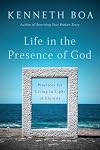
Summary: A contemporary discussion of the idea that a vital Christian life is one increasingly lived on a moment by moment basis in the presence of God.
So what exactly is an authentic Christian life? A set of activities or practices does not quite seem enough. Nor is adherence to a set of beliefs. Kenneth Boa, in this book, joins generations of Christians in proposing that a vital Christian life is led increasingly in the moment by moment presence of God. In his introduction, he frames it show more this way:
“Sure, it’s good to give the first–or the last–moments of our day to God. But what about the rest of the day? It’s so easy for our hearts and heads to end up somewhere else. Is that how God really wants us to live? Is that what he really had in mind when he said he’d give us abundant life (John 10:10)?
I’m proposing that we take our life with God–and our awareness of his presence–with us everywhere, not just into our quiet times but into our noisy times too, incorporating practices into our lives that help us keep that awareness right in front of us, throughout the day, every day.”
Boa’s book is divided into two parts. The first explores the biblical basis of this idea. This wasn’t thought up by Brother Lawrence, but rooted in the reality of what it means to be in Christ. Boa explores the biblical images, biblical exemplars culminating in Christ, and the image of “walking” with God that runs through scripture.
The second part turns to how we may learn to practice God’s presence. Here he does commend Brother Lawrence, the experiment of Frank Laubach and other practices of learning increasingly to abide moment by moment in Christ. Boa points to modern neuroscience’s understanding of the plasticity of our brains and how they may be re-wired through repeated practice. This also involves learning to re-see our world, specifically that we see that all of it matters to God and seeing it in the light of eternity. How we see our time is critical, especially in an age of busy-ness. Taking time to surrender our days to God in our waking moments, finding time to recollect ourselves through the day, and to conclude our days in thanksgiving and reflection are all important as well as establishing rhythms of work, rest, and sabbath.
Suffering and sin are also realities that intrude upon our lives. In suffering, we learn both to lament and to walk in God’s presence in the way of the cross. In sin, growth in experiencing God’s presence means learning to recognize the stages of temptation (a section that was worth the price of the book for me!) and to quickly confess and repent.
The book concludes with two chapters that focus on our visions of community and of the well-lived life. While we can have unhealthy notions of community, which Boa discusses, good communities practice encouragement that leads to growth, accountability, and living the gospel with “one another” in communities where good soul care is practiced. Finally, to live in God’s presence is to become who we were meant to be–to live into our calling–even as Strider the Ranger must become Aragorn the King in Lord of the Rings. To be in the Lord’s presence is to live with a different vision of the “good life” centered around a vision of eternity.
Each chapter concludes with practical exercises that help us hear God’s Word and to practice his presence. It is the practical element, combined with good biblical grounding and Boa’s own experience, that makes this book so helpful whether you are a recent convert or a lifelong believer. Boa focuses his attention on the everyday in our lives, which in fact make up most of life. To live in God’s presence here is to discover God’s presence in all of our lives from the seemingly mundane to the moments of crisis. And to live in God’s presence is to take creatures rooted in time, and help them live in the light of eternity. Could anything be more important?
____________________________
Disclosure of Material Connection: I received this book free from the publisher. I was not required to write a positive review. The opinions I have expressed are my own. show less
So what exactly is an authentic Christian life? A set of activities or practices does not quite seem enough. Nor is adherence to a set of beliefs. Kenneth Boa, in this book, joins generations of Christians in proposing that a vital Christian life is led increasingly in the moment by moment presence of God. In his introduction, he frames it show more this way:
“Sure, it’s good to give the first–or the last–moments of our day to God. But what about the rest of the day? It’s so easy for our hearts and heads to end up somewhere else. Is that how God really wants us to live? Is that what he really had in mind when he said he’d give us abundant life (John 10:10)?
I’m proposing that we take our life with God–and our awareness of his presence–with us everywhere, not just into our quiet times but into our noisy times too, incorporating practices into our lives that help us keep that awareness right in front of us, throughout the day, every day.”
Boa’s book is divided into two parts. The first explores the biblical basis of this idea. This wasn’t thought up by Brother Lawrence, but rooted in the reality of what it means to be in Christ. Boa explores the biblical images, biblical exemplars culminating in Christ, and the image of “walking” with God that runs through scripture.
The second part turns to how we may learn to practice God’s presence. Here he does commend Brother Lawrence, the experiment of Frank Laubach and other practices of learning increasingly to abide moment by moment in Christ. Boa points to modern neuroscience’s understanding of the plasticity of our brains and how they may be re-wired through repeated practice. This also involves learning to re-see our world, specifically that we see that all of it matters to God and seeing it in the light of eternity. How we see our time is critical, especially in an age of busy-ness. Taking time to surrender our days to God in our waking moments, finding time to recollect ourselves through the day, and to conclude our days in thanksgiving and reflection are all important as well as establishing rhythms of work, rest, and sabbath.
Suffering and sin are also realities that intrude upon our lives. In suffering, we learn both to lament and to walk in God’s presence in the way of the cross. In sin, growth in experiencing God’s presence means learning to recognize the stages of temptation (a section that was worth the price of the book for me!) and to quickly confess and repent.
The book concludes with two chapters that focus on our visions of community and of the well-lived life. While we can have unhealthy notions of community, which Boa discusses, good communities practice encouragement that leads to growth, accountability, and living the gospel with “one another” in communities where good soul care is practiced. Finally, to live in God’s presence is to become who we were meant to be–to live into our calling–even as Strider the Ranger must become Aragorn the King in Lord of the Rings. To be in the Lord’s presence is to live with a different vision of the “good life” centered around a vision of eternity.
Each chapter concludes with practical exercises that help us hear God’s Word and to practice his presence. It is the practical element, combined with good biblical grounding and Boa’s own experience, that makes this book so helpful whether you are a recent convert or a lifelong believer. Boa focuses his attention on the everyday in our lives, which in fact make up most of life. To live in God’s presence here is to discover God’s presence in all of our lives from the seemingly mundane to the moments of crisis. And to live in God’s presence is to take creatures rooted in time, and help them live in the light of eternity. Could anything be more important?
____________________________
Disclosure of Material Connection: I received this book free from the publisher. I was not required to write a positive review. The opinions I have expressed are my own. show less
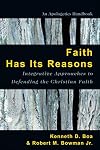
Faith Has Its Reasons is a broad treatment of Christian apologetics, analyzing the five major modern approaches and discussing the application of those apologetic methods in both theory and reality. The authors treated each approach to apologetics with care and respect, giving a balanced evaluation of each. This examination is done critically, so it finds issues with each view to some degree, but it also finds positive contributions from each view. The authors sought to trace the historical show more roots of various apologetic methods and thus lay the foundation of the modern-day offshoots. They did well establishing and fleshing out these historical roots and the proceeding views. The writing is heavy, as it is, after all, an academic work. Still, the chapters near the end of each topical section are especially beneficial as they give a summation of each apologetic approach. The final product is well worth reading, and those review chapters make for excellent reference material. show less

The authors assume they have come up with every possibility and logically answered them, leaving only one possibility. They actually do so accurately enough, but are so convinced they have covered all the bases that they come off sounding arrogant. While I agree that they come up with the correct answer, there are several places where someone could argue with their logic and therefore come up with a wrong answer.
Still, very useful book. If you've ever wondered which astronomical object the show more Star of Bethlehem was, read this before deciding you know. show less
Still, very useful book. If you've ever wondered which astronomical object the show more Star of Bethlehem was, read this before deciding you know. show less
Lists
Awards

You May Also Like


Associated Authors
Statistics
- Works
- 135
- Members
- 6,106
- Popularity
- #4,031
- Rating
- 3.9
- Reviews
- 32
- ISBNs
- 159
- Languages
- 6
- Favorited
- 2