
Mark Penn
Author of Microtrends: The Small Forces Behind Tomorrow's Big Changes
About the Author
Works by Mark Penn
Microtrends Squared: The New Small Forces Driving Today's Big Disruptions (2018) 30 copies, 1 review
Tagged
Common Knowledge
- Birthdate
- 1954-01-15
- Gender
- male
- Nationality
- USA
- Birthplace
- New York, New York, USA
- Associated Place (for map)
- New York, USA
Members
Reviews
Microtrends: The Small Forces Behind Today's Big Changes. Mark J. Penn with E. Kinney Zalesne by Mark Penn
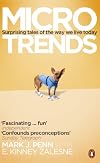
These is a lot that is of interest in this book, for example the perceptions of parental strictness, with some reservations. Firstly, it is written by a pollster. He puts great stress on the importance of data, but at a fairly superficial level. For instance, there is no mention of the fact that correlation doesn't imply causation, nor that self-reporting risks systematic bias. No actual statistical analysis is included, just graphs, and most of sources mentioned at the end are newspaper show more articles or press releases. As an academic, this rings a lot of alarm bells. It may be that I am a data snob, as I spend quite a bit of time wading through papers that do cluster analysis, multiple regression, etc. I want to know sample sizes, how they were selected, p values, and so forth.
Nonetheless, this book is meant to be accessible, so I can overlook this lack of rigour to a point. I am more leery about some of cultural assumptions and stereotypes being batted around, especially with regard to women. To be fair, one major message of 'Microtrends' is that women's traditional roles are being eroded and they are increasingly powerful in various spheres. I do get tired, though, of reading so many variations on, 'The ladies are of course more emotional...' These are essentially the same assumptions that were applied to the 1871 'pétroleuses' in another recent read.
This aside, I did find this book thought-provoking, especially given the time of its writing; apparently March 2007. Penn gets points for name-checking sub-prime mortgages and the concentration of wealth and power in the 1%. His overall thesis that many small trends are determining the direction of change in the US and abroad is however undermined by the financial crisis. The impact of this reaches across demographic boundaries, albeit to differing degrees and in different ways. In fact, to me the most interesting thing about this book is its ideology, which it wears proudly: free market individuality. To Penn, this signals a fragmentation of interests and aims, a wider range of opportunities for marketers to sell stuff to people, and a prioritisation of economic rights over political ones (worldwide, apparently). That last point to me seems far more important and alarming than Penn really addresses, if indeed it can be observed. It deserves a lot more consideration than it gets.
Although the tone of the book is quite relentlessly optimistic, to me it paints a far more equivocal portrait of America. (The chapters dealing with international trends are more superficial and basically just pick out single eccentricities.) In terms of racial, gender, and religious trends there were some very interesting points. I remain a little unsettled, though, by the presentation of these as essentially the same as product choices in a market ('More women buy cars! More Americans buy Judaism!'). Added to this, their exposition as marketing opportunities is somewhat distasteful. That would be my (British?) cultural squeamishness at limitless commoditisation showing itself. Moreover, Penn's agenda seems quite resistant to behavioural economics; he claims that most people are more rational than is generally assumed.
In conclusion, this book is worth reading as anecdotage-with-graphs, but I reject the idea that 'microtrends' are the only trends left. The collapse of America's debt mountain seems a little greater than micro to me. Moreover, this book is underpinned by a specific set of assumptions, which may make you uncomfortable. Finally, if you are used to academic-level data analysis you will grind your teeth at, 'It's in a graph so it must be significant!'. show less
Nonetheless, this book is meant to be accessible, so I can overlook this lack of rigour to a point. I am more leery about some of cultural assumptions and stereotypes being batted around, especially with regard to women. To be fair, one major message of 'Microtrends' is that women's traditional roles are being eroded and they are increasingly powerful in various spheres. I do get tired, though, of reading so many variations on, 'The ladies are of course more emotional...' These are essentially the same assumptions that were applied to the 1871 'pétroleuses' in another recent read.
This aside, I did find this book thought-provoking, especially given the time of its writing; apparently March 2007. Penn gets points for name-checking sub-prime mortgages and the concentration of wealth and power in the 1%. His overall thesis that many small trends are determining the direction of change in the US and abroad is however undermined by the financial crisis. The impact of this reaches across demographic boundaries, albeit to differing degrees and in different ways. In fact, to me the most interesting thing about this book is its ideology, which it wears proudly: free market individuality. To Penn, this signals a fragmentation of interests and aims, a wider range of opportunities for marketers to sell stuff to people, and a prioritisation of economic rights over political ones (worldwide, apparently). That last point to me seems far more important and alarming than Penn really addresses, if indeed it can be observed. It deserves a lot more consideration than it gets.
Although the tone of the book is quite relentlessly optimistic, to me it paints a far more equivocal portrait of America. (The chapters dealing with international trends are more superficial and basically just pick out single eccentricities.) In terms of racial, gender, and religious trends there were some very interesting points. I remain a little unsettled, though, by the presentation of these as essentially the same as product choices in a market ('More women buy cars! More Americans buy Judaism!'). Added to this, their exposition as marketing opportunities is somewhat distasteful. That would be my (British?) cultural squeamishness at limitless commoditisation showing itself. Moreover, Penn's agenda seems quite resistant to behavioural economics; he claims that most people are more rational than is generally assumed.
In conclusion, this book is worth reading as anecdotage-with-graphs, but I reject the idea that 'microtrends' are the only trends left. The collapse of America's debt mountain seems a little greater than micro to me. Moreover, this book is underpinned by a specific set of assumptions, which may make you uncomfortable. Finally, if you are used to academic-level data analysis you will grind your teeth at, 'It's in a graph so it must be significant!'. show less
You pick up a book with a title like this and a back cover listing:
*”People are retiring but continuing to work.”
*”Teens are turning to knitting.”
*“Geeks are becoming the most sociable people around.” …. You think: “Hey, this sounds just like my friend, Charlie…”
*”Women are driving technology.” …. and wonder, “I am…?”
*Dads are older than ever and spending more time with their kids than in the past.”
You flip to a page and soon become so engrossed in it that show more you don’t know you’re beginning to smile. Then you start to chuckle. Wait, you do know someone just like that—yourself! Before you know it, you’ve chortled your way through a humorous chapter. A lot of the details are plain hilarious!
Mark Penn just has a way with words. His wit lends a lot of levity to what easily could have been one of those tedious analytical tomes for intellectual heavyweights (just a nice euphemism for pedantic bores). He could write fiction and be a hit! He is just that funny.
But don’t let this lead you to thinking that this book is too breezy to be serious reading. Microtrends is a serious analysis. It’s a fascinating account of emerging social behaviors that are or will be powerful enough to influence how society will think, act, and be in the next several years. Penn writes:
“In fact, the whole idea that there are a few huge trends that determine how America and the world work is breaking down. There are no longer a couple of megaforces sweeping us all along. Instead, America and the world are being pulled apart by an intricate maze of choices, accumulating in “microtrends”—small, under-the-radar forces that can involve as little as 1 percent of the population, but which are powerfully shaping our society. It’s just not that small is the new big. It’s that in order to truly know what’s going on,…we need the equivalent of magnifying glasses and microscopes…polls, surveys, and statistics. They take a slice of the matter being studied and lay it open…and inside, you will find yourself, your friends, your clients, your customers, and your competition, clearer than you ever thought you might.”
Microtrends is really about “small ideas that can lead to large changes”. “A microtrend is an intense identity group, that is growing, which has needs and wants unmet by the current crop of companies, marketers, policymakers, and others who would influence society’s behavior.”
Although Penn’s focus is trending American society, he does go further to include similar global behavior. In a global economy, trends spread fast and could become international driving forces that may, in the future, upset or enhance established social norms around the world.
Who should read this book? Those who need to be one step ahead of competition have to watch and be aware of these growing groups whose unique requirements are changing the way things are. But it would do most of us, “go with the flow” people, a lot of good to be enlightened. Let us not wake up one day and say, “What’s the world gotten into?” ; but say, “ “We’ve known , we’ve read, and we’ve been watching.”
So, grab a copy. I guarantee an easy, fast read—a page-turner! For a non-fiction novel on sociology, that’s saying a lot! If only more analytical books were written like this, we would all be more “in the know”. Well, hey, maybe Penn just started a trend!
My Mark : Excellent show less
*”People are retiring but continuing to work.”
*”Teens are turning to knitting.”
*“Geeks are becoming the most sociable people around.” …. You think: “Hey, this sounds just like my friend, Charlie…”
*”Women are driving technology.” …. and wonder, “I am…?”
*Dads are older than ever and spending more time with their kids than in the past.”
You flip to a page and soon become so engrossed in it that show more you don’t know you’re beginning to smile. Then you start to chuckle. Wait, you do know someone just like that—yourself! Before you know it, you’ve chortled your way through a humorous chapter. A lot of the details are plain hilarious!
Mark Penn just has a way with words. His wit lends a lot of levity to what easily could have been one of those tedious analytical tomes for intellectual heavyweights (just a nice euphemism for pedantic bores). He could write fiction and be a hit! He is just that funny.
But don’t let this lead you to thinking that this book is too breezy to be serious reading. Microtrends is a serious analysis. It’s a fascinating account of emerging social behaviors that are or will be powerful enough to influence how society will think, act, and be in the next several years. Penn writes:
“In fact, the whole idea that there are a few huge trends that determine how America and the world work is breaking down. There are no longer a couple of megaforces sweeping us all along. Instead, America and the world are being pulled apart by an intricate maze of choices, accumulating in “microtrends”—small, under-the-radar forces that can involve as little as 1 percent of the population, but which are powerfully shaping our society. It’s just not that small is the new big. It’s that in order to truly know what’s going on,…we need the equivalent of magnifying glasses and microscopes…polls, surveys, and statistics. They take a slice of the matter being studied and lay it open…and inside, you will find yourself, your friends, your clients, your customers, and your competition, clearer than you ever thought you might.”
Microtrends is really about “small ideas that can lead to large changes”. “A microtrend is an intense identity group, that is growing, which has needs and wants unmet by the current crop of companies, marketers, policymakers, and others who would influence society’s behavior.”
Although Penn’s focus is trending American society, he does go further to include similar global behavior. In a global economy, trends spread fast and could become international driving forces that may, in the future, upset or enhance established social norms around the world.
Who should read this book? Those who need to be one step ahead of competition have to watch and be aware of these growing groups whose unique requirements are changing the way things are. But it would do most of us, “go with the flow” people, a lot of good to be enlightened. Let us not wake up one day and say, “What’s the world gotten into?” ; but say, “ “We’ve known , we’ve read, and we’ve been watching.”
So, grab a copy. I guarantee an easy, fast read—a page-turner! For a non-fiction novel on sociology, that’s saying a lot! If only more analytical books were written like this, we would all be more “in the know”. Well, hey, maybe Penn just started a trend!
My Mark : Excellent show less
A good effort by Clinton's Karl Rove: A book categorizing approximately 75 trends the author sees in the modern world (American-focused).
Written so that the ideas presented can be processed in everything from bite-sized individual morsels to sectional chunks (e.g. Love, Sex, and Relationships).
Cons:
-Sometimes staid writing
-Use of book to plug commercial contacts
(Microsoft's Zune, Mark, as leading some kind of social music revolution? the Zune? C'mon!)
-tendency to generalize anecdotes show more or a handful of data points he has seen into opinions he thinks are held by significant amounts of people
-highly timely, and will not age well
Microtrends is intriguing; for any watcher of society, Penn's book will likely tell you about social changes you already knew, will likely crystallize broader happenings you have-been-seeing-but-have-not-yet-realized or put a name to, and will likely introduce you to entirely new trends (and it is in these startling moments that the book becomes particularly worth the read).
Mark should be applauded for showing the value of numbers, and of data, in modern society. My only qualm with his idea-sourcing is how he never looks to the numbers to disprove a trend. Instead, he looks at them to justify what he already suspects. This is one of humanity's cognitive biases: the need to confirm what we think is true (rather than taking the alternate, harder, and ultimately more rewarding route of trying to disprove whether something is true, as real science does). While Penn is often right in his trends, that does not mean he will always be right, or that his methodology, as it stands, is not flawed.
Still, Penn effectively yanks the reader's attention in such a way that we can't help but notice new things about our daily world. Armed, often, with convincing data and the power of demographics, he makes predictions that seem sensible (and though perhaps originally startling, also seem quickly convincing in their effect).
Microtrends grabbed me, personally, in the way that I like: rather than telling me stuff, it made me think about things on my own, it made me puzzle and question and conjecture and ultimately conclude things about this crazy world of ours.
I liked Microtrends; I think you will too. show less
Written so that the ideas presented can be processed in everything from bite-sized individual morsels to sectional chunks (e.g. Love, Sex, and Relationships).
Cons:
-Sometimes staid writing
-Use of book to plug commercial contacts
(Microsoft's Zune, Mark, as leading some kind of social music revolution? the Zune? C'mon!)
-tendency to generalize anecdotes show more or a handful of data points he has seen into opinions he thinks are held by significant amounts of people
-highly timely, and will not age well
Microtrends is intriguing; for any watcher of society, Penn's book will likely tell you about social changes you already knew, will likely crystallize broader happenings you have-been-seeing-but-have-not-yet-realized or put a name to, and will likely introduce you to entirely new trends (and it is in these startling moments that the book becomes particularly worth the read).
Mark should be applauded for showing the value of numbers, and of data, in modern society. My only qualm with his idea-sourcing is how he never looks to the numbers to disprove a trend. Instead, he looks at them to justify what he already suspects. This is one of humanity's cognitive biases: the need to confirm what we think is true (rather than taking the alternate, harder, and ultimately more rewarding route of trying to disprove whether something is true, as real science does). While Penn is often right in his trends, that does not mean he will always be right, or that his methodology, as it stands, is not flawed.
Still, Penn effectively yanks the reader's attention in such a way that we can't help but notice new things about our daily world. Armed, often, with convincing data and the power of demographics, he makes predictions that seem sensible (and though perhaps originally startling, also seem quickly convincing in their effect).
Microtrends grabbed me, personally, in the way that I like: rather than telling me stuff, it made me think about things on my own, it made me puzzle and question and conjecture and ultimately conclude things about this crazy world of ours.
I liked Microtrends; I think you will too. show less
This book alternates between facinating and infuriating. The author's thesis that America is hardly a melting pot, but a pointalism painting that must be examined on the small-scale to be appreciated as a whole is rivetting and enlightening. However, the slightest knowledge of statistics, research methods, or polling methods makes his use of numbers and polls down-right frustrating. He never really properly addresses the problems of bias, skewed results, or problems with the ways questions show more are formed. And while many of his assertions are interesting, some of them are too hastily made (and many are down-right silly), which distracts from the overall message. However, by ignoring his playing fast and loose with numbers and rush to hypothesis, it's a great book. In other words, if your looking for an interesting introduction to polling, go for this book. Most people can find themselves in at least one of the categories-I'm a bit of an oddball so I was suprised that I was only in the "Upscaled Tattoo" group (in which he makes NUMEROUS errors in assumptions-the Macdonaldization of tattooing is a terrible idea). This helps support his overall thesis-we can't insist everyone be "American," when there are so many ways to be American. Plus, he points out many things that are easy to overlook. For instance, railing against illegal immigrants may not be a great idea for politicians because, even though the aliens can't vote, chances are they have family and friends in country who CAN.
But if you want serious numbers and accounting of actual trends in America, this book will leave you wanting. show less
But if you want serious numbers and accounting of actual trends in America, this book will leave you wanting. show less
You May Also Like


Associated Authors
Statistics
- Works
- 3
- Members
- 926
- Popularity
- #27,711
- Rating
- 3.3
- Reviews
- 14
- ISBNs
- 23
- Languages
- 2