
Ovid
Author of Metamorphoses [in translation]
About the Author
Publius Ovidius Naso (20 March 43 BC--AD 17/18), known as Ovid. Born of an equestrian family in Sulmo, Ovid was educated in rhetoric in Rome but gave it up for poetry. He counted Horace and Propertius among his friends and wrote an elegy on the death of Tibullus. He became the leading poet of Rome show more but was banished in 8 A.D. by an edict of Augustus to remote Tomis on the Black Sea because of a poem and an indiscretion. Miserable in provincial exile, he died there ten years later. His brilliant, witty, fertile elegiac poems include Amores (Loves), Heroides (Heroines), and Ars Amatoris (The Art of Love), but he is perhaps best known for the Metamorphoses, a marvelously imaginative compendium of Greek mythology where every story alludes to a change in shape. Ovid was admired and imitated throughout the Middle Ages and Renaissance. Chaucer, Spenser, Shakespeare, and Jonson knew his works well. His mastery of form, gift for narration, and amusing urbanity are irresistible. (Bowker Author Biography) show less
Series
Works by Ovid
Amores + Ars amatoria + Medicamina faciei femineae + Remedia amoris [in translation] (1990) — Author — 1,229 copies, 5 reviews
Art of love + Cosmetics + Remedies for love + Ibis + Walnut-tree + Sea Fishing + Consolation [bilingual Latin English] (1929) — Author — 266 copies, 3 reviews
Ovid : Amores + Metamorphoses : Selections : Latin text, Introduction, Vocabulary, Notes [2nd edition] (0008) — Author — 93 copies
L'Art d'aimer -Les Remèdes de l'amour - Les Produits de beauté pour le visage de la femme (1974) 74 copies, 2 reviews
Selections from Ovid: with Notes and Vocabulary (Focus Classical Library|Latin) (1974) 64 copies, 2 reviews
P. Ovidi Nasonis: Tristium Libri Quinque; Ibis; Ex Ponto Libri Quattuor; Halieutica; Fragmenta (Oxford Classical Texts) (Vol 1) (Latin Edition) (1922) — Author — 53 copies
The Student's Ovid: Selections from the Metamorphoses (Oklahoma Series in Classical Culture) (2000) 39 copies
Ovid: Selections from Ars Amatoria [and] selections from Remedia Amoris (Latin text) (1997) 36 copies
The Aeneid of Vergil Books I-VI [and] selections from The Metamorphoses of Ovid (1928) 26 copies, 2 reviews
Ovid : Metamorphoses III : Edited with introduction, notes and vocabulary (1979) — Writer — 26 copies
The Epistles of Ovid (English) 25 copies
Art of Love, Remedy of Love, Art of Beauty, Court of Love, History of Love, Amours (English) 24 copies
Libellus: Selections from Horace, Martial, Ovid, and Catullus. Handbook (Cambridge Latin Texts) (1978) 15 copies
Selected works (unspecified) 14 copies
The Offense of Love: Ars Amatoria, Remedia Amoris, and Tristia 2 (Wisconsin Studies in Classics) (2014) 12 copies, 1 review
Metamorfosis ( vol.I) Llibres I-VII (Bernat Metge Essencial) (Catalan and Latin Edition) (2019) 10 copies
Virgil's Aeneid The First Six Books and the Completion of the Story and Ovid's Metamorphoses (1923) — Author — 10 copies
Ovid: Metamorphoses XIII-XV - And Indexes to Metamorphoses I-XV (Classical Texts) (2000) — Author — 10 copies
Excerpta ex scriptis Publii Ovidii Nasonis. Accedunt notulae anglicae et questiones. In usum scholae bostoniensis. Cura (1849) 6 copies, 1 review
Ovid 6 copies
Ovid, "Heroides": Introduction and Latin Text, with Greek Translation of Maximus Planudes v. 1 (Classic Editions) (2005) 5 copies
Selections from Ovid's Metamorphoses: Edited with an introduction, notes and vocabulary (1971) 5 copies
Werke in zwei Bänden. Zweiter Band. Liebeselegien, Briefe berühmter Frauen, Die Liebeskunst, Heilmittel gegen die Liebe, Gedichte der Trauer (1973) 5 copies
P. Ovidii Nasonis Epistorlarum Heroidum liber: interpretatione & notis illustravit Daniel Crispinus Helvetius 5 copies, 1 review
Ovid 5 copies
Les Metamorfosis, III (unspecified) 5 copies
Ibis + Ex Ponto + Tristia [Latin] — Author — 4 copies
Opera Omnia: Edited by Peter Burman 4 copies
Ars Amatoria, or the Art of Love: Latin Text and English Prose (English and Latin Edition) (2016) 4 copies
Amores + Ars amatoria + Epistulae + Medicamina faciei femineae + Metamorphoses + Remedia amoris + Tristia + Ibis + Ex Ponto Libri + Fasti [in Latin] (1916) — Author — 4 copies
Publii Ovidii Nasonis operum 4 copies
Ovid : Metamorphoses VIII : Edited with introduction, notes and vocabulary (Latin) (2008) — Writer — 3 copies
Metamorphoses 3 copies
Metamorphoses [Latin & translation] 3 copies
Ovid's Epistles with his Amours 3 copies
Písně lásky a žalu 3 copies
Metamorphoses Book VIII 3 copies
Morceaux Choisis des Métamorphoses 3 copies
Decerpta ex P. Ovidii Nasonis Metamorphoseon libris : notis Anglicis illustrata, in usum scholarum (2016) 3 copies
Ovidius metamorfoser : Urval för latingymnasiet med förklaringar och ordlista af Bernhard Risberg 3 copies
Certain of Ovid's Elegies 3 copies
Ovidius verseiből 2 copies
Amori e Rimedii all'amore 2 copies
The Metamorphoses Of Ovid Selections Required For Entrance To College In The Years 1926-1928 2 copies
P. Ovidii Nasonis Carmina Selecta 2 copies
Opere vol. I 2 copies
MÉTAMORPHOSES EXTRAITS 2 copies
Publius Ovidius Naso : bloemlezing uit de Metamorphosen, Tristia en Ars Amatoria Deel 2: Hulpboekje 2 copies
2: I testimoni oltre l'autografo ordinamento stemmatico e storia della tradizione (2009) — Author — 2 copies
Opere. Vol. II 2 copies
Les metamorfosis. II 2 copies
Orpheus et Eurydice 2 copies
Sztuka rybołówstwa 2 copies
Selections from Ovid: chosen to meet the new requirements of the college entrance examination board 2 copies
Ovid's Metamorphoses Englished, Mythologize'd, And Represented in Figures, An Essay to the Translation of Virgil's Aeneis. By G.S. (2010) 2 copies
Gedichte aus der Verbannung : Eine Auswahl aus Tristia und Episulae ex ponto [bilingual Latin German] (2013) 2 copies
Remedia Amoris, Medicamina Faciei 2 copies
Ibis 2 copies
Ovidius Naso Publius Opera 2 copies
P. Ovidius Naso: Metamorphosen: Kommentar (Wissenschaftliche Kommentare zu greichischen und lateinischen Schriftstellern) (German Edition) (1969) 2 copies
The Library of Latin Literature Collection: Metamorphoses (Ovid), The Satires (Juvenal), The Aeneid (Virgil), & The Art of Love (Ovid) (1961) 2 copies
Stories from Metamorphoses 2 copies
Metamorphoseon LIbri XV cum appositis italico carmine, interpretationibus ac notis, volumen secundum 1 copy
Metamorphoseon LIbri XV cum appositis italico carmine, interpretationibus ac notis, volumen I 1 copy
Arte de amar. Edición bilingüe (trad. de Juan Manuel Rodríguez Tobal|Latin Spanish bilingual) 1 copy
El Arte de Amar Metamorfosis 1 copy
Metamorphosen - Ovid 1 copy
Tristes, vol. 2 1 copy
METAMORFOSIS II 1 copy
Tristezas 1 copy
La poesia delle forme 1 copy
Nowele Rzymskie — Contributor — 1 copy
Les Metamorfosis, I 1 copy
Heroides + Amores [Latin] 1 copy
変身物語 上 1 copy
Metamorfosi. Vol. I 1 copy
Poezje wybrane 1 copy
Le metamorfosi. Volume 3 1 copy
Poesie d'amore .... 1 copy
変身物語 下 1 copy
Metamorphoseon LIbri XV cum appositis italico carmine, interpretationibus ac notis, volumen tertium 1 copy
poesie d'amore e ** 1 copy
Ovidio, antología (Incluye La metamorfosis, Amores, El Arte de Amar, Las tristezas y Las Pónticas) (Spanish Edition) (2013) 1 copy
Metamorfoses - I 1 copy
Opera - ed. 1722 - Antuerpia 1 copy
Ovide. Les Métamorphoses . Traduction nouvelle, avec introduction et notes par J. Chamonard,... 1 copy
Quelques beaux vers d'Ovide 1 copy
Poesie d'amore e dell'esilio 1 copy
Choix des Métamorphoses d'Ovide, et fragments des Fastes, des Tristes, des Pontiques, etc. (1875) 1 copy
Les metamorfosis. Vol II 1 copy
Les metamorfosis (vol. III) 1 copy
Pòntiques, vol. II i últim 1 copy
Pòntiques, vol. I 1 copy
Lieky proti láske 1 copy
Scrisori din exil 1 copy
Ovid, Volume 1 1 copy
Fastorum, Books I and II 1 copy
Fastorum, Books V and VI 1 copy
Fastorum, Books III and IV 1 copy
Amores (tr. Guy Lee) 1 copy
Ovid: Metamorphoses, I., II. 1-400. Edited with a translation by A. H. Allcroft ... and J. F. Stout — Writer — 1 copy
Ovid: Metamorphoses, Book I. lines 1-150. Edited by A. H. Allcroft ... and B. J. Hayes — Writer — 1 copy
**REPRINT** P. OvidII Nasonis Fastorum Liber Primus : with English Notes and a Vocabulary (1883) 1 copy
Heroides (tr. Harold Isbell) 1 copy
Ovid's Art of Love; Remedy of love; and Art of beauty. To which is added Chaucer's Court of love. Also several miscellaneous pieces 1 copy, 1 review
[Midi-Set AMOR - ROMA: Liebe und Erotik im alten Rom, Tusculum] (Sammlung Tusculum) (German Edition) (2023) 1 copy
SPQR Study Guides : Publius Ovidius Naso : Amores : Latin + English + vocabulary (2013) — Writer — 1 copy
A Bitter Harvest 1 copy
Carmina 1 copy
An elegy 1 copy
Heroides I-X 1 copy
Ovid Nux 1 copy
[Maxi-Set AMOR - ROMA: Liebe und Erotik im alten Rom] (Sammlung Tusculum) (German Edition) (2023) 1 copy
The Oxford Book of Poetry: Latin Verse, English Verse, Book of Ballads & Modern Poetry, With Oxford Lectures on Poetry (2022) 1 copy
The Perseus Myth 1 copy
Le Metamorfosi e I Fasti - — Author — 1 copy
Pygmalion 1 copy
The Masque of Comus 1 copy
The Metamorphoses of Ovid, Translated by William Caxton, 1480 Volume II books 10-15 the Pepys Manuscript (1968) 1 copy
der kaledonische Eber 1 copy
The Complete Ovid Anthology 1 copy
Ordagrann översättning över valda stycken ur Ovidii Metamorfoser : till vägledning för nybegynnare 1 copy
Skorbnye Elegii. Pisma s Ponta / Tristia . Epistulae ex Ponto (Russian Edition) / Скорбные элегии. Письма с Понта (1982) 1 copy
Metamorfosen fragmenten 1 copy
Jak léčiti lásku 1 copy
Lásky [Love] 1 copy
P. Ovidii Nasonis amores = Publius Ovidius Naso szerelmek : latinul es magyarul [Latin & Hungarian] 1 copy
Ovid Texte 1 copy
Elegiac Poems of Ovid, Vol. 3: Letters From Exile Selected From the Tristia and the Epitulae Ex Ponto (Classic Reprint) (2015) 1 copy
Metamorphosen / druk 17 1 copy
Metamorphosen / druk 10 1 copy
Carmina Latīna 1 copy
Ovidius usum Delphini 1 copy
Helen of Troy 1 copy
Medicamina Faciei Femineae 1 copy
Tristien. Nachdichtung aus dem Lateinischen sowie Nachwort und Anmerkungen von Volker Ebersbach (1984) 1 copy
Ovidius Metamorphoses VI-X 1 copy
Associated Works
The Canterbury Tales [Norton Critical Edition, 2nd ed.] (2005) — Contributor — 677 copies, 5 reviews
World Poetry: An Anthology of Verse from Antiquity to Our Time (1998) — Contributor — 496 copies, 2 reviews
Christopher Marlowe: The Complete Poems and Translations (1971) — Contributor, some editions — 311 copies, 4 reviews
Poems Bewitched and Haunted (Everyman's Library Pocket Poets Series) (2005) — Contributor — 231 copies
The Smiles of Rome: A Literary Companion for Readers and Travelers (2005) — Contributor — 68 copies, 2 reviews
Games of Venus: An Anthology of Greek and Roman Erotic Verse from Sappho to Ovid (The New Ancient World) (1991) — Contributor — 55 copies, 1 review
The Dedalus Book of Roman Decadence: Emperors of Debauchery (Decadence from Dedalus) (1994) — Contributor — 53 copies
Women in Power: Classical Myths and Stories, from the Amazons to Cleopatra (2024) — Contributor — 34 copies
Iliad, Odyssey, Aeneid, Oedipus, Jason and the Argonauts and Much More - ULTIMATE MYTHOLOGY COLLECTION 50 BOOKS - Complete Works of Homer, ALL Plays by Sophocles, Euripides and… (2011) — Author, some editions — 23 copies
The Ribald Reader: 2000 Years of Lusty Love and Laughter (1906) — Contributor — 19 copies, 2 reviews
Oogst Der Tijden. keur uit de werken van schrijvers en dichters aller volken en eeuwen (1940) — Contributor — 12 copies
The Orphic Mysteries: Digest (Rosicrucian Order AMORC Kindle Edition) (2015) — Contributor — 8 copies, 1 review
Van Homerus tot Van Lennep : Griekse en Latijnse literatuur in Nederlandse vertaling (1992) — Author — 7 copies
Fantastic Imaginings: A Journey Through 3500 Years of Imaginative Writing, Comprising Fantasy, Horror, and Science Fiction (2012) — Contributor — 4 copies
American Aphrodite: A Quarterly for the Fancy-Free Volume 5 Number 17 (1955) — Contributor — 3 copies
Ode to Boy: An Anthology of Same-Sex Attraction in Literature, Volume One: From Antiquity Through the Eighteenth Century (2014) — Contributor — 3 copies
Tagged
Common Knowledge
- Legal name
- Ovidius Naso, Publius
- Other names
- Ovid
- Birthdate
- 0043-03-20 BCE
- Date of death
- 0017 CE
- Gender
- male
- Occupations
- poet
- Nationality
- Roman Empire
- Birthplace
- Sulmona, Italy
- Places of residence
- Sulmo, Italy
Tomis, Romania (Constanta)
Rome, Italy - Map Location
- Italy
Members
Discussions
Metamorphoses Deluxe Limited Edition, Item 6486, 840 USD in Easton Press Collectors (December 2025)
Folio Archives 432: The Art of Love by Ovid 1993 in Folio Society Devotees (June 2025)
Metamorphoses translation in Geeks who love the Classics (January 2022)
GROUP READ Mythology March: Ovid's Metamorphoses in 75 Books Challenge for 2018 (September 2020)
Reviews
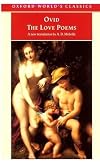
28. Ovid : The Love Poems (Oxford World's Classics) translated by A. D. Melville
Introduction: E. J. Kenney
other translations used B. P. Moore's 1935 translation of The Art of Love, & Christopher Marlowe translations for Amores 1.5, 3.7 & 3.14
published: 1990
format: Paperback
acquired: Library
read: June 18 - July 7
rating: ??
Contains four collections of poems:
Amores - 16 bce
Cosmetics for Ladies - date unclear, but before The Art of Love
The Art of Love - 2 ce
Cures for Love - date unknown, show more probably close to 2 ce
What first struck me about Ovid's [Amores] was how unromantic they are. I think I was expecting beautiful musings or something like that. While Ovid plays with muses and especially on the idea of Cupid and his arrows, these poems are largely on petty problems with woman who are married or suspicious or whatnot. They are full-out sarcasm and humor on the surface, often quite rude or offensive in a way that leaves one suspecting that was the intention. It seems Ovid was first and foremost being clever, and intent on showing how clever he is. And most of what he accomplishes, he does so through cleverness. Melville tells me Ovid successfully undermined the whole of Roman love poetry, which had a long tradition, even has he wrote it, exposing it while mastering it.
As a reader, I was left with the impression of writer who was never entirely serious, but also, at the same time, very serious. The poems drift from practical issues to mythology and back again, referencing a wide assortment of well known and obscure mythology (obscure even to well educated Romans). He also brings in a wide sense of world knowledge, referencing many writers and many oddities, even Judaism twice.
[Amores] is the most complex of the works here and hard to summarize other than to say love poetry or humor based on it. [The Art of Love] is a faux-handbook for young men on how to find love. Full of humor, it crosses lines, mainly by implication. It apparently may have been the cause of Ovid's exile from Rome, announced personally by Augustus. [Cures for Love] is pure humor on ways to get over a relationship. It reads as if it was intended to be pared with [The Art of Love]. [Cosmetics for Ladies] is only partially preserved and is the guide the title suggests it is, but just done in clever poetry, mock seriousness and humor.
Overall the tone lets the reader relax and just enjoy what Ovid's doing. I was entertained, and pretty content reading through these, casually. Sometimes I would get lost, but mostly he's fairly straightforward and Melville's translations are clear and his notes are good. Melville rhymes everything, which brings out some of the sense of play. But he's a little bland, and he can't replicate the Latin complexity. Moore read practically the same as Melville. Marlowe's additions were kind of special, but also, as I have just discovered, heavily altered by Melville.
from Amores book 3, elegia vii - "Marlowe's version slightly modernized"
(Marlowe's actual version can be found here (it helps to search for "Scythian"): https://www.gutenberg.org/files/21262/21262-h/21262-h.htm#ovid )
2017
https://www.librarything.com/topic/260412#6117227 show less
Introduction: E. J. Kenney
other translations used B. P. Moore's 1935 translation of The Art of Love, & Christopher Marlowe translations for Amores 1.5, 3.7 & 3.14
published: 1990
format: Paperback
acquired: Library
read: June 18 - July 7
rating: ??
Contains four collections of poems:
Amores - 16 bce
Cosmetics for Ladies - date unclear, but before The Art of Love
The Art of Love - 2 ce
Cures for Love - date unknown, show more probably close to 2 ce
What first struck me about Ovid's [Amores] was how unromantic they are. I think I was expecting beautiful musings or something like that. While Ovid plays with muses and especially on the idea of Cupid and his arrows, these poems are largely on petty problems with woman who are married or suspicious or whatnot. They are full-out sarcasm and humor on the surface, often quite rude or offensive in a way that leaves one suspecting that was the intention. It seems Ovid was first and foremost being clever, and intent on showing how clever he is. And most of what he accomplishes, he does so through cleverness. Melville tells me Ovid successfully undermined the whole of Roman love poetry, which had a long tradition, even has he wrote it, exposing it while mastering it.
As a reader, I was left with the impression of writer who was never entirely serious, but also, at the same time, very serious. The poems drift from practical issues to mythology and back again, referencing a wide assortment of well known and obscure mythology (obscure even to well educated Romans). He also brings in a wide sense of world knowledge, referencing many writers and many oddities, even Judaism twice.
[Amores] is the most complex of the works here and hard to summarize other than to say love poetry or humor based on it. [The Art of Love] is a faux-handbook for young men on how to find love. Full of humor, it crosses lines, mainly by implication. It apparently may have been the cause of Ovid's exile from Rome, announced personally by Augustus. [Cures for Love] is pure humor on ways to get over a relationship. It reads as if it was intended to be pared with [The Art of Love]. [Cosmetics for Ladies] is only partially preserved and is the guide the title suggests it is, but just done in clever poetry, mock seriousness and humor.
Overall the tone lets the reader relax and just enjoy what Ovid's doing. I was entertained, and pretty content reading through these, casually. Sometimes I would get lost, but mostly he's fairly straightforward and Melville's translations are clear and his notes are good. Melville rhymes everything, which brings out some of the sense of play. But he's a little bland, and he can't replicate the Latin complexity. Moore read practically the same as Melville. Marlowe's additions were kind of special, but also, as I have just discovered, heavily altered by Melville.
from Amores book 3, elegia vii - "Marlowe's version slightly modernized"
Yes, she was beautiful and well turned out,
The girl that I'd so often dream about,
Yet I lay with her limp as if I loved not,
A shameful burden on the bed that moved not.
Thought both of us were sure of our intent,
Yet could I not cast anchor where I meant.
She round my neck her ivory arms did throw,
Her arms far whiter than Scythian snow,
And eagerly she kissed me with her tongue,
And under mine her wanton thigh she flung.
Yes, and she soothed me up, and called me sire,
And used all speech that might provoke and stir.
Yet like as if cold hemlock I had drunk,
It humbled me, hung down the head, and sunk.
(Marlowe's actual version can be found here (it helps to search for "Scythian"): https://www.gutenberg.org/files/21262/21262-h/21262-h.htm#ovid )
2017
https://www.librarything.com/topic/260412#6117227 show less
https://fromtheheartofeurope.eu/metamorphoses-by-publius-ovidius-naso-translated....
Way way back 40 years ago, I studied Latin for what were then called O-levels, and one of the set texts was a Belfast-teenager-friendly translation of Ovid’s Metamorphoses. I loved it. If you don’t know, it’s a narrative poem in fifteen books re-telling classical legends, concentrating in particular on those where there is a change of shape – usually humans turned into animals, vegetables or minerals, show more though with other variations too. It’s breezy, vivid and sometimes funny, and it’s been a store of easily accessible ancient lore for centuries.
I’d always meant to get back to it properly, and it finally popped up on my list of books that I owned but had not yet blogged here. However, my 40-year-old copy is safely in Northern Ireland, so I acquired both the latest Penguin translation, by Stephanie McCarter, and Ted Hughes’ selection of twenty-four choice chapters, and read them – I took the McCarter translation in sequence, and then jumped across to read the relevant sections if Hughes had translated them, though he put them in a different order.
I do find Ovid fascinating. In some ways he speaks to the present day reader very directly – a lot of the emotions in the Ars Amatoria could be expressed by lovers two thousand years later. But here he’s taking material that was already very well known, the Greek and Roman classical legendarium, and repackaging it for a sophisticated audience in the greatest city in the world. The book ends (McCarter’s translation):
Where Roman power spreads through conquered lands,
I will be read on people’s lips. My fame
will last across the centuries. If poets’
prophecies can hold any truth, I’ll live.
And he did. I have been particularly struck by Ovid’s popularity among the patrons of my favourite 17th-century stuccador, Jan Christiaan Hansche. A number of his most interesting ceilings feature stories from Ovid, some of them well known, some less so. Sixteen centuries after Ovid laid down his pen, his work was still part of the standard canon of literature known to all educated Western Europeans.
So. The two translations are different and serve different purposes. McCarter’s mandate was to translate the whole of the Metamorphoses into iambic pentameter in English. She is necessarily constrained to giving us an interpretation of Ovid’s text, with all of its limitations, and confining her own original thoughts to footnotes and other supporting material.
In a very interesting introduction, she is clear about the many scenes of rape in the story. But she also makes it clear that Ovid has a lot more active female characters than are in his sources, and they get more to do. She gives some telling examples of previous translators projecting later concepts of femininity onto Ovid’s fairly unambiguous original words.
Given the contemporary debate, it’s also interesting that Ovid has several examples of gender fluidity – not really presented as a standard part of everyday life, but nonetheless as a phenomenon that happens. For Ovid, we must simply accept that someone’s current gender may not be the one that they were born with.
Ted Hughes, on the other hand, was translating favourite bits of Ovid because he had reached the stage of his career where he could do what he wanted. He could leave out all the bits he found boring (I haven’t counted, but I think he translates about only 40% of Ovid’s text), and he could add his own flourishes at will. Inevitably this makes for a more satisfactory reading experience, though it is incomplete.
Both translations bring to life Ovid’s vivid imagery, which really throws you into the narrative. For a compare and contrast passage, here is the beginning of their treatment of the story of Phaethon, the son of the Sun who crashed to disaster trying to drive his father’s chariot (a favourite topic for Hansche). I think that the differences speak for themselves:
McCarter:
The Sun’s child Phaethon equaled him in age
and mind. But Epaphus could not endure
his boasts, his smugness, and his arrogance
that Phoebus was his father and declared,
“You crazily trust all your mother says!
Your head is swollen by a phony father!”
Phaethon blushed as shame repressed his wrath.
He took these taunts to Clymene, his mother,
and told her, “Mother, to upset you more,
although I am free-spoken and quick-tempered,
I could not speak, ashamed these insults could
be uttered and that I could not refute them.
If I am truly born of holy stock,
give me a sign and claim me for the heavens!”
Wrapping his arms around his mother’s neck,
he begged—by his life, Merops’ life, his sisters’
weddings—that she give proof of his true father.
Hughes:
When Phaethon bragged about his father, Phoebus
The sun-god,
His friends mocked him.
‘Your mother must be crazy
Or you’re crazy to believe her.
How could the sun be anybody’s father?’
In a rage of humiliation
Phaethon came to his mother, Clymene.
‘They’re all laughing at me,
And I can’t answer. What can I say? It’s horrible.
I have to stand like a dumb fool and be laughed at.
‘If it’s true, Mother,’ he cried, ‘if the sun,
The high god Phoebus, if he is my father,
Give me proof.
Give me evidence that I belong to heaven.’
Then he embraced her. ‘I beg you,
‘On my life, on your husband Merops’ life,
And on the marriage hopes of my sisters,
Only give me proof that the sun is my father.’
I think I’d recommend that a reader unfamiliar with Ovid start with Hughes and then go on to McCarter to get the full story. show less
Way way back 40 years ago, I studied Latin for what were then called O-levels, and one of the set texts was a Belfast-teenager-friendly translation of Ovid’s Metamorphoses. I loved it. If you don’t know, it’s a narrative poem in fifteen books re-telling classical legends, concentrating in particular on those where there is a change of shape – usually humans turned into animals, vegetables or minerals, show more though with other variations too. It’s breezy, vivid and sometimes funny, and it’s been a store of easily accessible ancient lore for centuries.
I’d always meant to get back to it properly, and it finally popped up on my list of books that I owned but had not yet blogged here. However, my 40-year-old copy is safely in Northern Ireland, so I acquired both the latest Penguin translation, by Stephanie McCarter, and Ted Hughes’ selection of twenty-four choice chapters, and read them – I took the McCarter translation in sequence, and then jumped across to read the relevant sections if Hughes had translated them, though he put them in a different order.
I do find Ovid fascinating. In some ways he speaks to the present day reader very directly – a lot of the emotions in the Ars Amatoria could be expressed by lovers two thousand years later. But here he’s taking material that was already very well known, the Greek and Roman classical legendarium, and repackaging it for a sophisticated audience in the greatest city in the world. The book ends (McCarter’s translation):
Where Roman power spreads through conquered lands,
I will be read on people’s lips. My fame
will last across the centuries. If poets’
prophecies can hold any truth, I’ll live.
And he did. I have been particularly struck by Ovid’s popularity among the patrons of my favourite 17th-century stuccador, Jan Christiaan Hansche. A number of his most interesting ceilings feature stories from Ovid, some of them well known, some less so. Sixteen centuries after Ovid laid down his pen, his work was still part of the standard canon of literature known to all educated Western Europeans.
So. The two translations are different and serve different purposes. McCarter’s mandate was to translate the whole of the Metamorphoses into iambic pentameter in English. She is necessarily constrained to giving us an interpretation of Ovid’s text, with all of its limitations, and confining her own original thoughts to footnotes and other supporting material.
In a very interesting introduction, she is clear about the many scenes of rape in the story. But she also makes it clear that Ovid has a lot more active female characters than are in his sources, and they get more to do. She gives some telling examples of previous translators projecting later concepts of femininity onto Ovid’s fairly unambiguous original words.
Given the contemporary debate, it’s also interesting that Ovid has several examples of gender fluidity – not really presented as a standard part of everyday life, but nonetheless as a phenomenon that happens. For Ovid, we must simply accept that someone’s current gender may not be the one that they were born with.
Ted Hughes, on the other hand, was translating favourite bits of Ovid because he had reached the stage of his career where he could do what he wanted. He could leave out all the bits he found boring (I haven’t counted, but I think he translates about only 40% of Ovid’s text), and he could add his own flourishes at will. Inevitably this makes for a more satisfactory reading experience, though it is incomplete.
Both translations bring to life Ovid’s vivid imagery, which really throws you into the narrative. For a compare and contrast passage, here is the beginning of their treatment of the story of Phaethon, the son of the Sun who crashed to disaster trying to drive his father’s chariot (a favourite topic for Hansche). I think that the differences speak for themselves:
McCarter:
The Sun’s child Phaethon equaled him in age
and mind. But Epaphus could not endure
his boasts, his smugness, and his arrogance
that Phoebus was his father and declared,
“You crazily trust all your mother says!
Your head is swollen by a phony father!”
Phaethon blushed as shame repressed his wrath.
He took these taunts to Clymene, his mother,
and told her, “Mother, to upset you more,
although I am free-spoken and quick-tempered,
I could not speak, ashamed these insults could
be uttered and that I could not refute them.
If I am truly born of holy stock,
give me a sign and claim me for the heavens!”
Wrapping his arms around his mother’s neck,
he begged—by his life, Merops’ life, his sisters’
weddings—that she give proof of his true father.
Hughes:
When Phaethon bragged about his father, Phoebus
The sun-god,
His friends mocked him.
‘Your mother must be crazy
Or you’re crazy to believe her.
How could the sun be anybody’s father?’
In a rage of humiliation
Phaethon came to his mother, Clymene.
‘They’re all laughing at me,
And I can’t answer. What can I say? It’s horrible.
I have to stand like a dumb fool and be laughed at.
‘If it’s true, Mother,’ he cried, ‘if the sun,
The high god Phoebus, if he is my father,
Give me proof.
Give me evidence that I belong to heaven.’
Then he embraced her. ‘I beg you,
‘On my life, on your husband Merops’ life,
And on the marriage hopes of my sisters,
Only give me proof that the sun is my father.’
I think I’d recommend that a reader unfamiliar with Ovid start with Hughes and then go on to McCarter to get the full story. show less

The Metamorphoses is not a modest work in scope: in his 12,000-line epic, Ovid tells us that he's attempting nothing less than to give us the history of the world from its creation out of Chaos right up to the time of Julius Caesar. The opening section is a grand, orchestral description of the creation in the spirit of Epicurean philosophy, and the final section includes a long speech by Pythagoras exposing a number of his scientific ideas (and arguments for vegetarianism), but what everyone show more remembers - and what gives the poem its usual title - is the material that fills the middle 13 books, a vast and unruly collection of stories of sex, violence and magical transformation gleaned from authors like Hesiod, Vergil and Homer (or simply made up on the spot by Ovid himself). Gods (of either sex) lust for mortals (of either sex) and have their wicked way or are frustrated; mortals lust for the wrong other mortals; individuals make rash promises or accidentally find themselves in the wrong place; revenge and jealousy get out of hand; or there is simply too much testosterone and alcohol about. And when things go wrong or a god gets peeved, then it's usually the unfortunate mortal who gets changed into an animal, tree, or rock, according to taste. According to Bernard Knox, there are over 250 transformations in the course of the poem (and that's presumably not counting the unnumbered myrmidons and dragon's teeth...). Most of them seem to end unhappily for the mortal in question - in a few cases the transformation saves someone from an imminent danger of rape, but then they are stuck as a tree for the rest of their life. Iphis and Ianthe are the one couple who seem to profit long-term - Iphis is turned into a boy on the eve of the wedding so that they don't violate the Cretan same-sex marriage ban in force at the time. (This is the story Ali Smith uses in Girl meets boy.)
One moral that really comes out of the story is that we should be very careful not to give our children names that sound like animals or plants. That's just asking for trouble. Especially if they happen to be called "Cycnus" - there are three separate characters with this name, in Books II, VII and XII, and they all get turned into swans. Nominative determinism gone crazy...!
Of course, Ovid being such an accessible source for subsequent poets, painters, dramatists, opera librettists and others, many of the stories are very familiar, but what is really striking when you read the whole thing is the pace. Ovid rarely lingers over descriptions (when he does, he's usually making some sort of satirical point), but hammers through the story at maximum speed, and segues into a new and quite different story - connected or not - as soon as he gets to the climax of the previous one. Or inserts a story in the middle of another one, down to two or three levels (not quite as much deep recursion as the Panchatantra, though). From the Big Bang to the moment when "terra sub Augusto est", the music never stops. Even the transition from one book to the next is usually just the flick of an eye - Ovid knows all about cliffhangers and doesn't hesitate to use them.
The speed and efficiency of his storytelling come across most obviously in Books XII-XIV, where we cover essentially everything Ovid thinks we need to know about the Iliad, Odyssey and Aenead. The Iliad, in particular, is masterfully handled as a single "brain vs. brawn" debate between Ajax and Ulysses, in which the two of them make speeches as if in court to justify their respective contributions to the war effort. In case we hadn't guessed it already from all the scenes where Ovid gleefully shows us muscle-bound heroes acting like dangerous idiots, the poet is firmly on the side of Ulysses. Ovid enjoys himself making gentle fun of the conventions of Big Epic and can't resist teasing Vergil about some small continuity errors in the Aenead. But it's all quite respectful fun - Ovid isn't suggesting for a moment that we don't need to read these great poets.
Working out where Ovid himself stands isn't easy at this distance. And he presumably doesn't want it to be easy either - he's writing at the height of Augustus's somewhat hypocritical clampdown on the morals of the Roman upper classes, and whatever he thinks himself, he certainly doesn't want to say anything that counts as explicit blasphemy or corrupting public morals. He's only reporting well-known bits of Greek mythology, after all. It's all the fault of our own dirty minds if we get the impression that the gods and goddesses as portrayed in Ovid are a pretty rotten lot, with only one important claim on our piety, their power to harm us if we annoy them (rather like Augustus, in fact...). And it's for us to decide whether a belief in petulant supernatural interventions is compatible with the logical Epicurean world-view set out in Book I or the Pythagorean pantheism gently mocked in Book XV. From this distance, we can't really know what Ovid expected his sophisticated Roman readers to think, but on the whole I'm inclined to suspect that there's more mockery than piety going on.
The Charles Martin translation
My Latin is just about good enough to work my way through Ovid in the Loeb parallel text, but when I tried that it quickly became obvious that I couldn't possibly keep up with Ovid's frenetic narrative pace, so I switched to the Charles Martin translation, mostly because of the few that came to hand, it seemed the best compromise between closeness to the text and readability.
Martin chooses to translate Ovid's hexameters into a loose and free-running version of English blank verse (which is based on the iambic pentameter line, of course). This turns out to be a really good choice. It's a form with a very solid track-record, of course, and we're so used to hearing it that it reads very naturally. It does mean that the book gets longer, though - it seems to take Martin about 30-40% more lines than Ovid to say something, so it's not easy to go backwards and forwards between translation and original.
The language Martin uses occasionally looks alarmingly modern and American, but he avoids gratuitous anachronisms, and is conscientious about not putting anything in that doesn't have a proper basis in the original text. The one place where he really lets himself go is in the contest between the Muses and the daughters of Pierus in Book V, which he reads as a satire on bad poetry
...and even that isn't very far from what it says in the Latin, and Martin apologises for it in the introduction and tells us he couldn't help it.
Here and there he gives us an editorial interjection if it's needed to explain something like a pun that is only obvious in Latin, but he always marks them off clearly with square brackets. The text also comes with short and unpedantic notes and a very handy index/glossary of names and places that you will need for all those times when you really can't work out whether Jupiter is that person's grandfather, father-in-law, or uncle - or all three.
An oddity in this book is that the publishers have used as Introduction an essay Bernard Knox published in the NYRB in 1998, in which he compares the currently-available translations of Ovid and finds them all wanting, except for the work-in-progress by Martin, whose completion he eagerly awaits. Of the current ones, Ted Hughes gets most points for style, but not many for accuracy. That feels almost like the Elizabethan habit of binding favourable blurbs from other poets as part of your book! show less
One moral that really comes out of the story is that we should be very careful not to give our children names that sound like animals or plants. That's just asking for trouble. Especially if they happen to be called "Cycnus" - there are three separate characters with this name, in Books II, VII and XII, and they all get turned into swans. Nominative determinism gone crazy...!
Of course, Ovid being such an accessible source for subsequent poets, painters, dramatists, opera librettists and others, many of the stories are very familiar, but what is really striking when you read the whole thing is the pace. Ovid rarely lingers over descriptions (when he does, he's usually making some sort of satirical point), but hammers through the story at maximum speed, and segues into a new and quite different story - connected or not - as soon as he gets to the climax of the previous one. Or inserts a story in the middle of another one, down to two or three levels (not quite as much deep recursion as the Panchatantra, though). From the Big Bang to the moment when "terra sub Augusto est", the music never stops. Even the transition from one book to the next is usually just the flick of an eye - Ovid knows all about cliffhangers and doesn't hesitate to use them.
The speed and efficiency of his storytelling come across most obviously in Books XII-XIV, where we cover essentially everything Ovid thinks we need to know about the Iliad, Odyssey and Aenead. The Iliad, in particular, is masterfully handled as a single "brain vs. brawn" debate between Ajax and Ulysses, in which the two of them make speeches as if in court to justify their respective contributions to the war effort. In case we hadn't guessed it already from all the scenes where Ovid gleefully shows us muscle-bound heroes acting like dangerous idiots, the poet is firmly on the side of Ulysses. Ovid enjoys himself making gentle fun of the conventions of Big Epic and can't resist teasing Vergil about some small continuity errors in the Aenead. But it's all quite respectful fun - Ovid isn't suggesting for a moment that we don't need to read these great poets.
Working out where Ovid himself stands isn't easy at this distance. And he presumably doesn't want it to be easy either - he's writing at the height of Augustus's somewhat hypocritical clampdown on the morals of the Roman upper classes, and whatever he thinks himself, he certainly doesn't want to say anything that counts as explicit blasphemy or corrupting public morals. He's only reporting well-known bits of Greek mythology, after all. It's all the fault of our own dirty minds if we get the impression that the gods and goddesses as portrayed in Ovid are a pretty rotten lot, with only one important claim on our piety, their power to harm us if we annoy them (rather like Augustus, in fact...). And it's for us to decide whether a belief in petulant supernatural interventions is compatible with the logical Epicurean world-view set out in Book I or the Pythagorean pantheism gently mocked in Book XV. From this distance, we can't really know what Ovid expected his sophisticated Roman readers to think, but on the whole I'm inclined to suspect that there's more mockery than piety going on.
The Charles Martin translation
My Latin is just about good enough to work my way through Ovid in the Loeb parallel text, but when I tried that it quickly became obvious that I couldn't possibly keep up with Ovid's frenetic narrative pace, so I switched to the Charles Martin translation, mostly because of the few that came to hand, it seemed the best compromise between closeness to the text and readability.
Martin chooses to translate Ovid's hexameters into a loose and free-running version of English blank verse (which is based on the iambic pentameter line, of course). This turns out to be a really good choice. It's a form with a very solid track-record, of course, and we're so used to hearing it that it reads very naturally. It does mean that the book gets longer, though - it seems to take Martin about 30-40% more lines than Ovid to say something, so it's not easy to go backwards and forwards between translation and original.
The language Martin uses occasionally looks alarmingly modern and American, but he avoids gratuitous anachronisms, and is conscientious about not putting anything in that doesn't have a proper basis in the original text. The one place where he really lets himself go is in the contest between the Muses and the daughters of Pierus in Book V, which he reads as a satire on bad poetry
We’ll show you girls just what real class is
Give up tryin’ to deceive the masses
Your rhymes are fake: accept our wager
Learn which of us is minor and which is major
There’s nine of us here and there’s nine of you
And you’ll be nowhere long before we’re through {...}
So take the wings off, sisters, get down and jam
And let the nymphs be the judges of our poetry slam!
...and even that isn't very far from what it says in the Latin, and Martin apologises for it in the introduction and tells us he couldn't help it.
Here and there he gives us an editorial interjection if it's needed to explain something like a pun that is only obvious in Latin, but he always marks them off clearly with square brackets. The text also comes with short and unpedantic notes and a very handy index/glossary of names and places that you will need for all those times when you really can't work out whether Jupiter is that person's grandfather, father-in-law, or uncle - or all three.
An oddity in this book is that the publishers have used as Introduction an essay Bernard Knox published in the NYRB in 1998, in which he compares the currently-available translations of Ovid and finds them all wanting, except for the work-in-progress by Martin, whose completion he eagerly awaits. Of the current ones, Ted Hughes gets most points for style, but not many for accuracy. That feels almost like the Elizabethan habit of binding favourable blurbs from other poets as part of your book! show less

Rereading after decades.
Phew, mostly rape, murder, and incest. In ten-beat, unrhymed lines.
Then at the end he throws in Mr. Vegetarian, Pythagoras, and the deification of Julius Caesar. The metamorphoses in these are a bit of a stretch. Pythagoras saying that all things change into other things, and a man becoming a god to justify the deification of his son. Augustus is such a swell guy, his dad must be a god! Make it so, Mr. Crusher.
The remarkable things, one of which I noticed as a 14 year show more old, was the trans story. And it turns out there are two. Both trans-men, of course. And the dual-gender of Hermaphroditus. Neither of these very trans- or bi-friendly, but notable all the same.
The Story of Salmacis (dual gender, but the fountain waters thenceforth to weaken males)
The Story of Iphis and Ianthe (daughter passed off as a son set to marry another woman transformed on their wedding day)
The Story of Caeneus (woman tired of rape asking her rapist to no longer be a woman so to never suffer that again - rapist, as usual, was a god who could arrange this - and the trans-man then becomes a great warrior)
People turning into plants, animals, and stone eventually gets tiresome. But it's in the title. show less
Phew, mostly rape, murder, and incest. In ten-beat, unrhymed lines.
Then at the end he throws in Mr. Vegetarian, Pythagoras, and the deification of Julius Caesar. The metamorphoses in these are a bit of a stretch. Pythagoras saying that all things change into other things, and a man becoming a god to justify the deification of his son. Augustus is such a swell guy, his dad must be a god! Make it so, Mr. Crusher.
The remarkable things, one of which I noticed as a 14 year show more old, was the trans story. And it turns out there are two. Both trans-men, of course. And the dual-gender of Hermaphroditus. Neither of these very trans- or bi-friendly, but notable all the same.
The Story of Salmacis (dual gender, but the fountain waters thenceforth to weaken males)
The Story of Iphis and Ianthe (daughter passed off as a son set to marry another woman transformed on their wedding day)
The Story of Caeneus (woman tired of rape asking her rapist to no longer be a woman so to never suffer that again - rapist, as usual, was a god who could arrange this - and the trans-man then becomes a great warrior)
People turning into plants, animals, and stone eventually gets tiresome. But it's in the title. show less
Lists
Metamorphoses (1)
Folio Society (1)
My List (1)
Book wishlist (1)
Epistolary Books (1)
Unread books (1)
Poetry Corner (1)
A Reading List (1)
Antigua Roma (1)
Western Canon (3)
Lectuurlijst (2)
el (1)
Reading Queue (1)
A Novel Cure (1)
Read in school (1)
Reading LIst (1)
Five star books (1)
Writers at Risk (1)
. (1)
Awards


You May Also Like


Associated Authors
Statistics
- Works
- 628
- Also by
- 42
- Members
- 26,962
- Popularity
- #766
- Rating
- 4.0
- Reviews
- 233
- ISBNs
- 1,256
- Languages
- 26
- Favorited
- 86


