
Jacob F. Field
Author of The History of Europe in Bite-sized Chunks
About the Author
Works by Jacob F. Field
Associated Works
The Mythology Book: Big Ideas Simply Explained (2018) — Contributor, some editions — 518 copies, 1 review
Tagged
Common Knowledge
- Birthdate
- 1983
- Gender
- male
- Education
- University of Oxford
Newcastle University - Occupations
- historian
university professor - Organizations
- Cambridge Group for History of Population and Social Structure
Massey University
University of Waikato - Nationality
- UK
- Birthplace
- Lambeth, London, England, UK
- Places of residence
- London, England, UK
New Zealand - Associated Place (for map)
- London, England, UK
Members
Reviews

This was a pretty good idea for a book that could have devolved into a longwinded background by the editor or it could have been an easy cut-and-paste without much thought. Fields chooses from a great array of historic individuals, some well-known and some lesser. He adds a setup opener to each speech that gives the reader some context of what is going on for the speech to take place. What's also nice is that after each speech, Field gives us what happens as a result of the speech - and some show more outcomes, like history, don't always wind up well.
I decided to add this to our after-dinner reading with the family so that we could add some history onto our theology and reading them out loud just as these speeches would have been heard. While our 8 and 6-year-old girls didn't know all the points and people and places and positions for each speech, they've been subjected to enough history from their parents to understand and appreciate them enough. Those ins and outs from Field were just the right size. This could have been a quick read if you're just reading it for leisure, but maybe take the time to read out loud to yourself to see if you would have been inspired to follow each leader into history to victory - or defeat. Final Grade - A- show less
I decided to add this to our after-dinner reading with the family so that we could add some history onto our theology and reading them out loud just as these speeches would have been heard. While our 8 and 6-year-old girls didn't know all the points and people and places and positions for each speech, they've been subjected to enough history from their parents to understand and appreciate them enough. Those ins and outs from Field were just the right size. This could have been a quick read if you're just reading it for leisure, but maybe take the time to read out loud to yourself to see if you would have been inspired to follow each leader into history to victory - or defeat. Final Grade - A- show less
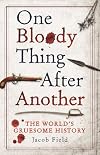
*Warning: Much violence described in this review. Not for those with weak stomachs. Seriously.
Weak and cowardly - that's what the people of this book would believe of us in the developed world today. We'd call ourselves civilised and our forbears barbarians, but humanity's managed to survive through some exceptionally horrific times. Many lessons can certainly be learned from our history.
Some Survival Tips:
✻ Expedition of exploration is code for "suicide mission".
✻ If a relative or show more close friend is/could be in a position of power and authority, run far away and go into hiding.
✻ Never love anyone. They can be used against you or slaughtered in front of you.
✻ Never own anything worth killing for.
✻ When war breaks out, relocate from the warzone.
✻ Be willing to switch religion at a moment's notice.
✻ Any weapon you possess may be used against you.
✻ If you're an executioner, always keep your blade sharp.
✻ Hide all books in a fireproof place, behind lock and key.
Funny, informative and riveting. One Bloody Thing After Another reads like an adult version of Horrible Histories, divulging all the best bits and possibly the least well known parts of our bloody world history in an engrossing and funny manner. Illustrations and maps of territories belonging to different empires throughout the ages are included. All were perfectly rendered on my Kindle.
Events are covered up to 1900 and range from the natural disasters like plague, earthquake and volcanic eruption, to the man-made horrors of war, genocide, serial killers, assassinations, and the crazy inventive methods and devices of torture. Brief but detailed summaries of events are given in easily digestible chunks, each one taking up only a handful of paragraphs so it was hard to get bored. Origin stories of certain fictional works are described, for example, Gilles de Rais was the inspiration for Bluebeard by [a:Charles Perrault|35760|Charles Perrault|http://photo.goodreads.com/authors/1267516341p2/35760.jpg].
The torture. Yikes. Be careful what you invent in the way of devices because someone might turn around and use it against you, as in the case of the Brazen Bull. I wouldn't mind if the Wall Street Bull was converted so we can roast a few fat cat bankers. I'll provide the marshmallows.
While we're on the subject, I'm calling shenanigans on the double standard regarding female torturers and serial killers receiving lame punishments when their male counterparts were tortured and killed for their crimes. Examples:
❶ Elizabeth Báthory had her servant girls 'beaten and their lips pierced with pins' and 'red-hot irons were pressed on to the feet and mouths'. 'Victims were dragged naked into the snow and had water poured onto them until they froze to death. One servant girl was stripped, covered with honey and left overnight to be stung and bitten by insects.' At age 44 her husband died (1604). New servant girls were acquired and 'daughters of the gentry were invited to live in her castle.' 'At least 300 girls and women, nobly born as well as commoners ... were put to death in an inhuman and cruel manner. She cut their flesh and made them grill it; afterwards she would make them eat bits of their own body.'
Punishment: 'Lifelong house arrest in the castle where she had committed her foul deeds.'
❷ Darya Saltykova in 1756 inherited 600 serfs from her husband and promptly started torturing them for pleasure. Several years and the unexplained disappearance of 138 girls later, she was found guilty of murdering 38 serfs.
Punishment: 1 hour in a pillory in Moscow and imprisoned in an underground cell in a convent where she experienced total darkness until death in 1801.
❸ Ranavalona proclaimed herself queen of Madagascar in 1828 and began torturing, crucifying and beheading Christians. 'Brigands, runaway slaves and rebels were flayed alive, sawn in half or had their testicles slowly crushed.' *winces* She also tested for treason in arbitrary ways similar to the identification of witches, one of which involved 'progressive amputation'. 'After each amputation, the victim was invited to confess their crimes.' Most died from shock and blood loss.
Punishment: In 1861 she died in her sleep. No punishment meted out.
Hardly justice for those that suffered at their soft, pampered hands. Perhaps being rich has its perks.
But successful innocent women were also suspicious. Poor Hypatia, 'head of the Platonist School in the city [Alexandria, Egypt] and possibly the first major female mathematician' was rumoured to practise witchcraft. Of course, she was. She was also vocally against the persecutions of Jews. What happened to her? Apprehended, taken to a church to be stripped and beaten to death. Charming.
Boudica and Joan of Arc also met violent ends, but they participated in and started wars so it was a hazard of the job. Surprisingly, there were methods of violence against women I had never considered, for instance the ripping out of foetuses and either killing them or sewing them to the mouths/breasts of their mothers. Sadistic. Breast mutilation and removal, also quite common. And now my mind is conceiving of methods not mentioned.
I apologise to friends and followers for my over-eager and excessive status updates for this 190-page book clogging up your feeds. Honestly, I tried to limit them in number and keep the most gruesome parts out to protect any weak stomachs.
Boring history is boring no longer with this book. Anyone even vaguely interested should give it a go, because I thoroughly enjoyed it.
Currently available for £1.09 in the UK Kindle Sale! show less
Weak and cowardly - that's what the people of this book would believe of us in the developed world today. We'd call ourselves civilised and our forbears barbarians, but humanity's managed to survive through some exceptionally horrific times. Many lessons can certainly be learned from our history.
Some Survival Tips:
✻ Expedition of exploration is code for "suicide mission".
✻ If a relative or show more close friend is/could be in a position of power and authority, run far away and go into hiding.
✻ Never love anyone. They can be used against you or slaughtered in front of you.
✻ Never own anything worth killing for.
✻ When war breaks out, relocate from the warzone.
✻ Be willing to switch religion at a moment's notice.
✻ Any weapon you possess may be used against you.
✻ If you're an executioner, always keep your blade sharp.
✻ Hide all books in a fireproof place, behind lock and key.
Funny, informative and riveting. One Bloody Thing After Another reads like an adult version of Horrible Histories, divulging all the best bits and possibly the least well known parts of our bloody world history in an engrossing and funny manner. Illustrations and maps of territories belonging to different empires throughout the ages are included. All were perfectly rendered on my Kindle.
Events are covered up to 1900 and range from the natural disasters like plague, earthquake and volcanic eruption, to the man-made horrors of war, genocide, serial killers, assassinations, and the crazy inventive methods and devices of torture. Brief but detailed summaries of events are given in easily digestible chunks, each one taking up only a handful of paragraphs so it was hard to get bored. Origin stories of certain fictional works are described, for example, Gilles de Rais was the inspiration for Bluebeard by [a:Charles Perrault|35760|Charles Perrault|http://photo.goodreads.com/authors/1267516341p2/35760.jpg].
The torture. Yikes. Be careful what you invent in the way of devices because someone might turn around and use it against you, as in the case of the Brazen Bull. I wouldn't mind if the Wall Street Bull was converted so we can roast a few fat cat bankers. I'll provide the marshmallows.
While we're on the subject, I'm calling shenanigans on the double standard regarding female torturers and serial killers receiving lame punishments when their male counterparts were tortured and killed for their crimes. Examples:
❶ Elizabeth Báthory had her servant girls 'beaten and their lips pierced with pins' and 'red-hot irons were pressed on to the feet and mouths'. 'Victims were dragged naked into the snow and had water poured onto them until they froze to death. One servant girl was stripped, covered with honey and left overnight to be stung and bitten by insects.' At age 44 her husband died (1604). New servant girls were acquired and 'daughters of the gentry were invited to live in her castle.' 'At least 300 girls and women, nobly born as well as commoners ... were put to death in an inhuman and cruel manner. She cut their flesh and made them grill it; afterwards she would make them eat bits of their own body.'
Punishment: 'Lifelong house arrest in the castle where she had committed her foul deeds.'
❷ Darya Saltykova in 1756 inherited 600 serfs from her husband and promptly started torturing them for pleasure. Several years and the unexplained disappearance of 138 girls later, she was found guilty of murdering 38 serfs.
Punishment: 1 hour in a pillory in Moscow and imprisoned in an underground cell in a convent where she experienced total darkness until death in 1801.
❸ Ranavalona proclaimed herself queen of Madagascar in 1828 and began torturing, crucifying and beheading Christians. 'Brigands, runaway slaves and rebels were flayed alive, sawn in half or had their testicles slowly crushed.' *winces* She also tested for treason in arbitrary ways similar to the identification of witches, one of which involved 'progressive amputation'. 'After each amputation, the victim was invited to confess their crimes.' Most died from shock and blood loss.
Punishment: In 1861 she died in her sleep. No punishment meted out.
Hardly justice for those that suffered at their soft, pampered hands. Perhaps being rich has its perks.
But successful innocent women were also suspicious. Poor Hypatia, 'head of the Platonist School in the city [Alexandria, Egypt] and possibly the first major female mathematician' was rumoured to practise witchcraft. Of course, she was. She was also vocally against the persecutions of Jews. What happened to her? Apprehended, taken to a church to be stripped and beaten to death. Charming.
Boudica and Joan of Arc also met violent ends, but they participated in and started wars so it was a hazard of the job. Surprisingly, there were methods of violence against women I had never considered, for instance the ripping out of foetuses and either killing them or sewing them to the mouths/breasts of their mothers. Sadistic. Breast mutilation and removal, also quite common. And now my mind is conceiving of methods not mentioned.
I apologise to friends and followers for my over-eager and excessive status updates for this 190-page book clogging up your feeds. Honestly, I tried to limit them in number and keep the most gruesome parts out to protect any weak stomachs.
Boring history is boring no longer with this book. Anyone even vaguely interested should give it a go, because I thoroughly enjoyed it.
Currently available for £1.09 in the UK Kindle Sale! show less
These accounts may be one paragraph or a few pages, but they are true tales of the worst of humanity: wars, earthquakes, famine, cruel rulers and torture. I knew about Elizabeth Bathory, but I was surprised to find that there were a couple of other female nutjobs who took it out on their subjects. There are few happy endings here, and reading a whole book about all the most horrible things in history one right after another turns out to be a bit disturbing. Who knew?
Some people are repeated a lot. But good overview of speeches.
You May Also Like


Statistics
- Works
- 16
- Also by
- 1
- Members
- 270
- Popularity
- #85,637
- Rating
- 3.6
- Reviews
- 4
- ISBNs
- 33
- Languages
- 4