
Richard H. Dillon
Author of Encyclopedia of North American Indian Tribes.
About the Author
Works by Richard H. Dillon
Associated Works
Tagged
Common Knowledge
- Canonical name
- Dillon, Richard H.
- Legal name
- Dillon, Richard Hugh
- Birthdate
- 1924-01-16
- Gender
- male
- Education
- University of California, Berkeley
- Occupations
- Head Librarian, Sutro Library
- Organizations
- Sutro Library
University of California, Berkeley - Relationships
- Sutherland, Barbara Allester
Dillon, Brian D. (son) - Short biography
- Richard Hugh Dillon (1924- ) was a librarian and the author of many articles and books on California, including California trail herd (1961), The legend of Grizzly Adams (1966), Fool's gold: the biography of John Sutter (1967), Humbugs and heroes: a gallery of California pioneers (1970), and Delta country (1982). The collection consists of ca. 300 photographs of old and new San Francisco Chinatown and the Mother Lode country, as well as photostats, captions, and signed mounts. There are also illustrative photographs used in Richard H. Dillon's Hatchet men (1962).
Background
Richard Hugh Dillon was born January 16, 1924 in Sausalito, California; AB (1948), AM (1949), and BLS (1950), UC Berkeley; assistant librarian (1950-53) and librarian (1953-79), Sutro Library, San Francisco; author of many articles and books on California, including California trail herd (1961), The legend of Grizzly Adams (1966), Fool's gold: the biography of John Sutter (1967), Humbugs and heroes: a gallery of California pioneers (1970), and Delta country (1982). - Nationality
- USA
- Birthplace
- Sausalito, California, USA
- Associated Place (for map)
- California, USA
Members
Reviews
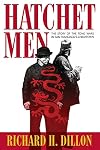
The book is a well researched look at the Chinese Emigrant society of the nineteenth century in San Francisco, California. As a popular work there is a tendency to sensationalize the narrative.
This was another book read for the sake of novel research as I delve into San Francisco as it was before the 1906 earthquake. In particular, I wanted to learn more about the Tongs: their structure, their names, how they functioned, and so on. That information isn't available online.
Hatchet Men was originally published in 1962; it has now been re-released by a small press. There were numerous typographical errors throughout the book that sometimes distracted me as I read.
Did the book supply show more me with the information I wanted? Yes. It was a fascinating read and gave me the insights I wanted, down to hand signals, rituals, and Chinese phrases. I had no idea that the Tongs (or anyone else a century ago) used chain mail as bullet-proof vests! I can also use key words from the text to search more on my own.
It's by no means a perfect book, typos aside. It's a book written by a white man about Chinatown. He doesn't write with intimacy of the place or the people--more with a journalist's plain prose. It's not that he's outright anti-Chinese, more that it has the definite feel of an outsider looking in. Sometimes Hatchet Men felt repetitive, but it never bored me. I also worry about accuracy. At the end of the book, he quotes the propaganda figure for the death toll from the 1906 quake--a mere 450 fatalities. This is flat out wrong. There were probably singular buildings with death tolls that high.
That kind of "fact" makes me worry about the accuracy of other points, but the problem is that there just hasn't been much written on the specific subject of Tongs in San Francisco. I'm thankful for this resource and I'll have to follow up as much as I can. show less
Hatchet Men was originally published in 1962; it has now been re-released by a small press. There were numerous typographical errors throughout the book that sometimes distracted me as I read.
Did the book supply show more me with the information I wanted? Yes. It was a fascinating read and gave me the insights I wanted, down to hand signals, rituals, and Chinese phrases. I had no idea that the Tongs (or anyone else a century ago) used chain mail as bullet-proof vests! I can also use key words from the text to search more on my own.
It's by no means a perfect book, typos aside. It's a book written by a white man about Chinatown. He doesn't write with intimacy of the place or the people--more with a journalist's plain prose. It's not that he's outright anti-Chinese, more that it has the definite feel of an outsider looking in. Sometimes Hatchet Men felt repetitive, but it never bored me. I also worry about accuracy. At the end of the book, he quotes the propaganda figure for the death toll from the 1906 quake--a mere 450 fatalities. This is flat out wrong. There were probably singular buildings with death tolls that high.
That kind of "fact" makes me worry about the accuracy of other points, but the problem is that there just hasn't been much written on the specific subject of Tongs in San Francisco. I'm thankful for this resource and I'll have to follow up as much as I can. show less
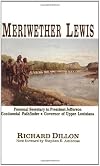
Dillon's biography of Meriwether is a worshipful paean to the memory of the star-crossed explorer.
Written in 1964, Dillon's account seems rooted in its time. There is no balance of Spanish or native American perspectives into the expedition. Indeed, Dillon frequently uses rather unkind labels such as savages to refer to the latter. There is a pile of great information distilled from the Reuben Thwaites edition of the journals, as well as Donald Jackson's Letters of the Lewis and Clark show more Expedition.
Dillon's narrative covers Lewis's life pre and post expedition as well as his efforts during the Corps of Discovery's mission. I thought the writing devoted to his life after the expedition was particularly interesting and filled in more blank spaces in my knowledge.
However, there is little time devoted to Lewis's many flaws. He was almost certainly an alcoholic and drug addict (laudanum,) and he quite likely suffered from a mental illness. Dillon was even unwilling to acknowledge his suicide, which is widely accepted today, asserting that it must have been murder. Not being one especially accepting of conspiracies, I'm not buying it.
Dillon's biography certainly has plenty to reccommend it, but it reads like a a John Wayne movie script. We don't get to see the character warts and all, and are left only with a monument to ponder. show less
Written in 1964, Dillon's account seems rooted in its time. There is no balance of Spanish or native American perspectives into the expedition. Indeed, Dillon frequently uses rather unkind labels such as savages to refer to the latter. There is a pile of great information distilled from the Reuben Thwaites edition of the journals, as well as Donald Jackson's Letters of the Lewis and Clark show more Expedition.
Dillon's narrative covers Lewis's life pre and post expedition as well as his efforts during the Corps of Discovery's mission. I thought the writing devoted to his life after the expedition was particularly interesting and filled in more blank spaces in my knowledge.
However, there is little time devoted to Lewis's many flaws. He was almost certainly an alcoholic and drug addict (laudanum,) and he quite likely suffered from a mental illness. Dillon was even unwilling to acknowledge his suicide, which is widely accepted today, asserting that it must have been murder. Not being one especially accepting of conspiracies, I'm not buying it.
Dillon's biography certainly has plenty to reccommend it, but it reads like a a John Wayne movie script. We don't get to see the character warts and all, and are left only with a monument to ponder. show less

Although in something of a coffee-table picture-book format, this is useful for covering a lot of the more obscure conflicts in addition to the obvious ones like Little Big Horn
Awards


You May Also Like


Associated Authors
Statistics
- Works
- 50
- Also by
- 2
- Members
- 751
- Popularity
- #33,865
- Rating
- 3.8
- Reviews
- 7
- ISBNs
- 67
- Languages
- 1