
Stuart Kauffman
Author of At Home in the Universe: The Search for the Laws of Self-Organization and Complexity
About the Author
Biophysicist Stuart A. Kauffman works at the University of Pennsylvania and is assocated with a think tank at the Santa Fe Institute. Kauffman has written At Home in the Universe: The Search for Laws of Self-Organization and Complexity and The Origin of Order: Self-Organization and Selection in show more Evolution. (Bowker Author Biography) show less
Image credit: Alton Jenkins
Works by Stuart Kauffman
At Home in the Universe: The Search for the Laws of Self-Organization and Complexity (1995) 1,071 copies, 12 reviews
Associated Works
The Next Fifty Years: Science in the First Half of the Twenty-first Century (2002) — Contributor — 411 copies, 10 reviews
Tagged
Common Knowledge
- Birthdate
- 1939-09-28
- Gender
- male
- Education
- Dartmouth College (BA | 1960)
University of Oxford (BA | 1963)
University of California, San Francisco (MD | 1968) - Occupations
- professor
- Organizations
- Santa Fe Institute
- Nationality
- USA
- Associated Place (for map)
- USA
Members
Reviews
At Home in the Universe: The Search for the Laws of Self-Organization and Complexity by Stuart Kauffman
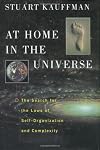
This is an astonishing book which explores the nature of self organising processes and their role in the origins of life. At its heart is a profound question. `Is life and humankind the product of an incredibly luck and unlikely accident, or is humankind the natural product of order emerging from chaos.
Stuart Kaufman has an engaging style and an enviable talent for illuminating and explaining ideas which might otherwise be impenetrable.
He constructs a powerful case for the emergence of show more order from seeming chaos, and challenges some of our most basic scientific beliefs. He begins with the second law of thermodynamics which defines entropy as a measure of disorder that is claimed to always increase. Yet as he writes these words he looks from his window and all he can see is order, lovely order.
From this simple starting point he begins an exploration of the limitations in adequately explaining the world we experience, of a scientific mindset framed by Newtonian thinking. Kaufman constructs a compelling case that the belief in a controllable `clockwork universe' is inadequate.
He explores a wide range of examples of self-organisation and with his biological background homes in one of the most intriguing examples, `Ontology' the process by which a single cell repeatedly subdivides and creates the complex structure of a creature such as you or I.
I think I wrote more notes reading this book than any other I've read. It covers some complex ground but whenever the going began to become challenging he would revert to a simple illustration to bring a new concept into focus.
An absolutely stunning book. show less
Stuart Kaufman has an engaging style and an enviable talent for illuminating and explaining ideas which might otherwise be impenetrable.
He constructs a powerful case for the emergence of show more order from seeming chaos, and challenges some of our most basic scientific beliefs. He begins with the second law of thermodynamics which defines entropy as a measure of disorder that is claimed to always increase. Yet as he writes these words he looks from his window and all he can see is order, lovely order.
From this simple starting point he begins an exploration of the limitations in adequately explaining the world we experience, of a scientific mindset framed by Newtonian thinking. Kaufman constructs a compelling case that the belief in a controllable `clockwork universe' is inadequate.
He explores a wide range of examples of self-organisation and with his biological background homes in one of the most intriguing examples, `Ontology' the process by which a single cell repeatedly subdivides and creates the complex structure of a creature such as you or I.
I think I wrote more notes reading this book than any other I've read. It covers some complex ground but whenever the going began to become challenging he would revert to a simple illustration to bring a new concept into focus.
An absolutely stunning book. show less
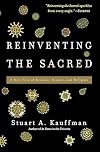
For those people who say that the evidence for God is in nature, Stuart Kauffman is a good way to bridge the gap between a godless universe and one where spirituality pervades the fabric of existence. After reading Niall Shanks’s God, the Devil, and Darwin, I got an understanding of the differing theories of complexity and how they sometimes form the basis for creationist thought. Kauffman’s analysis of nature and molecular complexity goes even deeper than that, however. In Reinventing show more the Sacred, Kauffman plunges into a scientific universe of systemic breakdowns and synthesis to rechristen what we think of spontaneous, divine, and even religious.
I will confess to having to run to the Internet many times while reading this one to get more context for his concepts and phrases. Things like “the adjacent possible” and “autocatalytic sets” took me a minute to wrap my head around, but in the end, his thorough reading of the universe leads him take God out of the heavens and put him in the helix of DNA. Kauffman’s spirituality lies in the magnificence of molecular spontaneity and the emergence of the human consciousness. I think this is a better way of thinking about the universe. There are still dark places where science cannot yet shed light, and while we shouldn’t immediately ascribe their beginnings to God, we can hold them in a place of wonder until understanding comes. This book takes some effort to get through, but the best conclusions usually come after a bit of struggle. A dense but rewarding book. show less
I will confess to having to run to the Internet many times while reading this one to get more context for his concepts and phrases. Things like “the adjacent possible” and “autocatalytic sets” took me a minute to wrap my head around, but in the end, his thorough reading of the universe leads him take God out of the heavens and put him in the helix of DNA. Kauffman’s spirituality lies in the magnificence of molecular spontaneity and the emergence of the human consciousness. I think this is a better way of thinking about the universe. There are still dark places where science cannot yet shed light, and while we shouldn’t immediately ascribe their beginnings to God, we can hold them in a place of wonder until understanding comes. This book takes some effort to get through, but the best conclusions usually come after a bit of struggle. A dense but rewarding book. show less
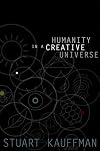
Humanity in a Creative Universe is yet another insightful general science book from Stuart A. Kauffman that challenges at the same time it informs. This is not a simple read but it is also not a particularly difficult read either. Any additional information the reader needs to look up will be richly rewarded by Kauffman's integration of that knowledge into a larger narrative.
There are plenty of reviews that address the particulars of the science discussed, each reflecting both the reviewer's show more interests as well as the author's work. If the main thing you are looking for is a good book that provides wonderful discussions on topical scientific issues, this book will absolutely satisfy that desire and I highly recommend it on those terms. Rather than mention any specific areas I found especially interesting I'll give my own big picture takeaway from the book (which may or may not coincide with another reader's reception).
As we have gained so much knowledge and answered so many questions, and of course generated many more questions to be answered, we have become so focused on the particular, on the minuscule in some ways, that we seem to almost be following a guide that says "once you have ascertained x, your next goal is to ascertain y." This is not entirely bad, we have to build on what came before. The danger, to paraphrase an old saying, is that we could lose sight of the forest for the trees. It is in looking larger that we can use our creativity most effectively. So we make discoveries at the nano scale, excellent and important, but in addition to pointing toward the next discovery at that scale we need to see what it might say or suggest about, for example, the organism as a whole, about the ecosystem as a whole, etc.
I don't want to put words in Kauffman's mouth or claim my understanding as his purpose. What I want a potential reader to take from this review is that this book can make you think, can perhaps make you see whatever it is you do from a different perspective as well as teach you something about science. In doing so, it might (re)kindle your creativity and help to make your life, life in general, and society better. I know, this is beyond the intended scope and may just be me blathering about the effect it had on me. But hey, its my review and this was what I got from the book.
Reviewed from a copy made available by the publisher via NetGalley. show less
There are plenty of reviews that address the particulars of the science discussed, each reflecting both the reviewer's show more interests as well as the author's work. If the main thing you are looking for is a good book that provides wonderful discussions on topical scientific issues, this book will absolutely satisfy that desire and I highly recommend it on those terms. Rather than mention any specific areas I found especially interesting I'll give my own big picture takeaway from the book (which may or may not coincide with another reader's reception).
As we have gained so much knowledge and answered so many questions, and of course generated many more questions to be answered, we have become so focused on the particular, on the minuscule in some ways, that we seem to almost be following a guide that says "once you have ascertained x, your next goal is to ascertain y." This is not entirely bad, we have to build on what came before. The danger, to paraphrase an old saying, is that we could lose sight of the forest for the trees. It is in looking larger that we can use our creativity most effectively. So we make discoveries at the nano scale, excellent and important, but in addition to pointing toward the next discovery at that scale we need to see what it might say or suggest about, for example, the organism as a whole, about the ecosystem as a whole, etc.
I don't want to put words in Kauffman's mouth or claim my understanding as his purpose. What I want a potential reader to take from this review is that this book can make you think, can perhaps make you see whatever it is you do from a different perspective as well as teach you something about science. In doing so, it might (re)kindle your creativity and help to make your life, life in general, and society better. I know, this is beyond the intended scope and may just be me blathering about the effect it had on me. But hey, its my review and this was what I got from the book.
Reviewed from a copy made available by the publisher via NetGalley. show less
At Home in the Universe: The Search for the Laws of Self-Organization and Complexity by Stuart Kauffman

I think I should have picked up Reinventing the Sacred instead, as a recent interview shows Kauffman's thinking has gotten deeper and more critical about the problem of scientific reductionism and the problem of mechanistic models in the life sciences. But there are useful ideas here, laying the foundations of the work he's known for now. For example, "order for free," the tendency of systems at a certain level of complexity to become self-organizing, or auto-catalytic, as he calls it. His show more understanding that living systems are open-ended, non-linear and non-equilibrium means they cannot be fully explained by the reduction of biology to chemistry, and chemistry to physics, as in the old school model. (As a consequence, this also means that the 2nd Law of Thermodynamics has little application to them - overall they tend to build order up rather than diminish it.) And the idea that evolution thrives on the "edge of chaos" is another interesting one - certainly western artists have borne this one out...
When he went into Game Theory and liberal economic paradigms as an extension of his ideas about biology and evolution, he lost me. In the last 20 years it's become painfully clear that they are the constructs of an expansionist Western mindset that is too rapidly piling up corpses, extinctions, and exhausted ecosystems to be taken seriously as a model for the future. So I'm hoping he's a little clearer on that now too. show less
When he went into Game Theory and liberal economic paradigms as an extension of his ideas about biology and evolution, he lost me. In the last 20 years it's become painfully clear that they are the constructs of an expansionist Western mindset that is too rapidly piling up corpses, extinctions, and exhausted ecosystems to be taken seriously as a model for the future. So I'm hoping he's a little clearer on that now too. show less
Lists
Awards

You May Also Like


Associated Authors
Statistics
- Works
- 7
- Also by
- 4
- Members
- 2,289
- Popularity
- #11,217
- Rating
- 3.8
- Reviews
- 29
- ISBNs
- 45
- Languages
- 10
- Favorited
- 5