
Philip Kapleau (1912–2004)
Author of The Three Pillars of Zen
About the Author
Works by Philip Kapleau
The Wheel of Death: A Collection of Writings from Zen Buddhist and Other Sources on Death, Rebirth, Dying (1971) 77 copies, 1 review
Contemporary Zen Classics: The 3 Pillars of Zen, Zen Mind, Beginners Mind, Zen Fresh, Zen Bones (Classic Zen) (1998) 5 copies
Three Pillars of Zen 2 copies
Zen East and West 1 copy
Tagged
Common Knowledge
- Canonical name
- Kapleau, Philip
- Birthdate
- 1912-08-20
- Date of death
- 2004-05-06
- Gender
- male
- Occupations
- court reporter
Zen Buddhist teacher
author
Zen Buddhist priest - Relationships
- Suzuki, D.T. (teacher)
- Nationality
- USA
- Places of residence
- New Haven, Connecticut, USA
Japan
Rochester, New York, USA - Associated Place (for map)
- USA
Members
Reviews
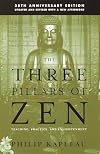
Three Pillars of Zen is rightfully a classic in its field. Philip Kapleau ably provides an insider's view of Zen, focusing on the experience of zazen, the proper term for Zen style meditation, as done during sesshin, the week-long spiritual intensive that providently culminates in kensho, enlightenment.
The object of Zen is to discard the delusions of the discriminatory mind: sensation, thought, self, so words are of little use, like mistaking a finger pointing at the moon for the moon. But show more there is a state of still tension, taut like a bowstring, that enables a person to break through to a higher level of understanding. This takes effort, devotion, and faith, but it is eminently possible. The best parts of the book concern eight personal accounts of reaching enlightenment from a mix of contemporary Japanese and Western seekers, more or less ordinary people who did a few years of meditation, a few sesshins, and focused on the koan Mu until they found what they were seeking. A second standout is the records of dokusan, the one-on-one encounters between a teacher and student that are the heart of the mind-to-mind transmission of Zen, and which by long tradition (though apparently no hard rule) are not written down.
There's some things I did not much care for. Kapleau includes a large amount of commentary which I found boring and irrelevant next to the first-hand experiences. The goal of this book was to transmit Zen to the West, since it was fading in Japan. This missionary impulse carries with it a great sense of superiority, over academic theologians, tantric yoga, and slightly different schools of zen. And somewhat surprising to me, sesshin is more active and aggressive than I expected. Poor sitting is corrected with thwacks of a baton, violent strikes intended to goad the student through to their goal, but which seem at odds with a religion of peace. show less
The object of Zen is to discard the delusions of the discriminatory mind: sensation, thought, self, so words are of little use, like mistaking a finger pointing at the moon for the moon. But show more there is a state of still tension, taut like a bowstring, that enables a person to break through to a higher level of understanding. This takes effort, devotion, and faith, but it is eminently possible. The best parts of the book concern eight personal accounts of reaching enlightenment from a mix of contemporary Japanese and Western seekers, more or less ordinary people who did a few years of meditation, a few sesshins, and focused on the koan Mu until they found what they were seeking. A second standout is the records of dokusan, the one-on-one encounters between a teacher and student that are the heart of the mind-to-mind transmission of Zen, and which by long tradition (though apparently no hard rule) are not written down.
There's some things I did not much care for. Kapleau includes a large amount of commentary which I found boring and irrelevant next to the first-hand experiences. The goal of this book was to transmit Zen to the West, since it was fading in Japan. This missionary impulse carries with it a great sense of superiority, over academic theologians, tantric yoga, and slightly different schools of zen. And somewhat surprising to me, sesshin is more active and aggressive than I expected. Poor sitting is corrected with thwacks of a baton, violent strikes intended to goad the student through to their goal, but which seem at odds with a religion of peace. show less
Although I had heard of Kapleau's book when I began zazen in earnest, 20 years ago, I never got around to reading it. I was satisfied with Suzuki Roshi's Zen Mind, Beginner's Mind as a "beginner book" and didn't see any need to go back to what I imagined were concepts I had already learned and let go of. Well I was wrong but I'm glad I was wrong because it meant I could read this book with some experience. Yes, it is a so called beginner book. It does a lot of introductory work that anyone show more starting out with Zen will really appreciate.
That said, the orientation provided here is nothing to gloss over for experienced practitioners. This book revitalized my practice. It nourished me. It inspired me to remember the importance of kensho.
I highly recommend this book to both new and experienced students of Zen. It will either keep you steadfast or set you on a proper course of study. show less
That said, the orientation provided here is nothing to gloss over for experienced practitioners. This book revitalized my practice. It nourished me. It inspired me to remember the importance of kensho.
I highly recommend this book to both new and experienced students of Zen. It will either keep you steadfast or set you on a proper course of study. show less

An agreeable, often stimulating collection of odds and ends by the noted Zen Master. Kapleau spent 13 years studying Zen in Japanese monasteries, then wrote his widely read Three Pillars of Zen (1965), and founded the Zen Center in Rochester, N.Y., which he now heads. Here he brings together transcriptions of question-and-answer sessions at the Center, correspondence with his disciples, ""encouragement talks"" given to participants in seven-day closed retreats (sesshin), translations of some show more key Zen texts, an autobiographical sketch, and various other things. This could have been just another shapeless compilation by somebody too busy to write a book, but it holds up nicely. Kapleau's own personality--calm, clear-headed, incisive, dryly witty, everything one imagines a roshi to be--fuses the disparate pieces into a sort of unity. And the book has been well edited, with a glossary, notes, and an annotated list of recommended books. ""Reading about enlightenment,"" as Kapleau says, ""is like scratching an itch through your shoe,"" but readers who have at least a rudimentary notion of Zen will find him helpful on a broad range of subjects, from morality to meditation, and may even be led to try sitting zazen and other Zen practices. Of course, they would first have to seek out a director at the nearest Zen center, and Kapleau implicitly urges his readers to do just that. Though many people will doubtless balk at his unblinking presentation of the doctrine of reincarnation, Kapleau is such a persuasive teacher, and Zen is so full of practical wisdom, that almost anyone could profit from his lessons. show less
Although I had heard of Kapleau's book when I began zazen in earnest, 20 years ago, I never got around to reading it. I was satisfied with Suzuki Roshi's Zen Mind, Beginner's Mind as a "beginner book" and didn't see any need to go back to what I imagined were concepts I had already learned and let go of. Well I was wrong but I'm glad I was wrong because it meant I could read this book with some experience. Yes, it is a so called beginner book. It does a lot of introductory work that anyone show more starting out with Zen will really appreciate.
That said, the orientation provided here is nothing to gloss over for experienced practitioners. This book revitalized my practice. It nourished me. It inspired me to remember the importance of kensho.
I highly recommend this book to both new and experienced students of Zen. It will either keep you steadfast or set you on a proper course of study. show less
That said, the orientation provided here is nothing to gloss over for experienced practitioners. This book revitalized my practice. It nourished me. It inspired me to remember the importance of kensho.
I highly recommend this book to both new and experienced students of Zen. It will either keep you steadfast or set you on a proper course of study. show less
Lists
Favourite Books (1)
You May Also Like


Associated Authors
Statistics
- Works
- 26
- Members
- 2,623
- Popularity
- #9,785
- Rating
- 4.0
- Reviews
- 28
- ISBNs
- 75
- Languages
- 10
- Favorited
- 1