
Preeta Samarasan
Author of Evening is the Whole Day
About the Author
Image credit: eric forbes
Works by Preeta Samarasan
Associated Works
Tagged
Common Knowledge
- Birthdate
- 1976
- Gender
- female
- Education
- United World College
Hamilton College
Eastman School of Music
University of Michigan - Short biography
- Preeta Samarasan was born in Malaysia and moved to the United States to finish high school at the United World College U.S.A, and attend Hamilton College. She was enrolled in a Ph.D. program in musicology at the Eastman School of Music, University of Rochester, and had begun work on a dissertation on Gypsy music festivals in France when she left to complete her novel. She earned her MFA in creative writing from the University of Michigan, where an earlier version of Evening Is The Whole Day won the Avery and Jule Hopwood Novel Award. She also recently won the Asian American Writer's Workshop/Hyphen Magazine short-story award.Her short fiction and nonfiction has been published or is forthcoming in the Asian Literary Review, Five Chapters, Hyphen, the Michigan Quarterly Review, EGO Magazine, A Public Space, and in the anthology Urban Odysseys: KL Stories.She currently lives in central France with her husband and dog
- Nationality
- Malaysia
- Birthplace
- Malaysia
- Places of residence
- Malaysia
USA
France - Associated Place (for map)
- Malaysia
Members
Reviews
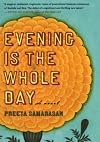
In 1980 in Ipoh, Malaysia, a few jarring events sweep over 6-year old Aasha: the dismissal of an 18 year-old servant in shame and disgrace, the departure of the oldest sister to university in America, and the recent, troubling death of Aasha’s grandmother Paati. The ensuing story is a portrait of a family whose dysfunction and secrets insidiously consume all of its members, with a narrative that slowly moves backwards to reveal past wounds in layers like geologic events told in rock show more strata. I found this book to be unrelentingly sad, particularly as it chronicles the experience and interpretations of the family’s children and a very vulnerable servant. Aasha, whose companions are the household’s ghosts, is watchful and vigilant, trailing her silent and closed older sister Uma like a shadow in the desperate hope that she might catch a glimpse of the old Uma, the one who played with her and doted on her, before she loses her to America forever. Uma’s exclusion of her sister and emotional distance from the family is selfish and unforgivable, until the reader reaches the Uma layer and gains insight into her cold self-defense. Other characters are likewise excavated and explored: mother Amma’s bitterness and cruelty, grandmother Paati’s manipulation and willful decline, Chellamservant’s wretchedness, and jovial but perpetually down-on-his-luck Uncle Ballroom. Perhaps most complex of all is father Appa -- we trace his path as he navigates the toxic family dynamic, his children’s adoration-turned-guardedness, and his politically idealist hopes and dreams for the nascent nation of Malaysia, a diverse patchwork of Malays, Indians, and Chinese struggling with identity, belonging, and racial and class issues following independence from the British Empire. These interweaving elements are told with wildly playful and humorous language, breathtaking, visceral descriptions of Malaysia, and a distinct Indian-Malay music and rhythm.
The book is too depressing for an unqualified recommendation, but I do admire Ms. Samarasan’s storytelling skill. The family story is too complicated and intricate to assign blame. The Malaysian history is fascinating, and intimately, subtly told, and the language is simply captivating, right from the first page:
The book is too depressing for an unqualified recommendation, but I do admire Ms. Samarasan’s storytelling skill. The family story is too complicated and intricate to assign blame. The Malaysian history is fascinating, and intimately, subtly told, and the language is simply captivating, right from the first page:
“There is, stretching delicate as a bird’s head from the thin neck of Kra Isthmus, a land that makes up half of the country called Malaysia. Where it dips its beak in the South China Sea, Singapore hovers like a bubble escaped from its throat. This bird’s head is a springless summerless autumnless winterless land. One day might be a drop wetter or a mite drier than the last, but almost all are hot, damp, bright, bursting with lazy tropical life, conducive to endless tea breaks and mad, jostling, honking rushes through town to get home before the afternoon downpour. These are the most familiar rains, the violent silver ropes that flood the playing fields and force office workers to wade to bus stops in shoes that fill like buckets. Blustering and melodramatic, the afternoon rains cause traffic jams at once terrible -- choked with the black smoke of lorries and the screeching brakes of schoolbuses -- and beautiful: aglow with winding lanes of watery yellow headlights that go on forever, with blue streetlamps reflected in burgeoning puddles, with the fluorescent melancholy of empty roadside stalls. Every day appears to begin with a blaze and end with this deluge, so that past and present and future run together in an infinite, steaming river.show less
In truth, though, there are days that do not blaze and rains less fierce. Under a certain kind of mild morning drizzle the very earth breathes slow and deep. Mist rises from the dark treetops on the limestone hills outside Ipoh town. Grey mist, glowing green hills: on such mornings it is obvious how sharply parts of this land must have reminded the old British rulers of their faraway country.”
This novel begins and ends with the departure of Chellam, the doomed and disgraced servant girl the wealthy Rajasekharan family of Ipoh, Malyasia had hired the previous year to care for the demanding Paati (grandmother). During the year of Chellam's stay we come to know and care for the family, and its flawed and damaged members.
Central is Aasha, the 6-year old daughter, who, having accepted her mother's rejection and disdain of her, now has to contend with her beloved older sister Uma's show more withdrawal of her affections and imminent departure for college in the US. Aasha watches and observes her family, with her only companions the ghosts that only she can see and hear. Suresh, Aasha's 11 year old brother, like 11 year old boys the world over, provides comic relief. Then there is Appa, the brilliant Oxford-educated attorney who, to his mother's (Paati's) dismay chose to marry a simple poorly-educated girl, rather than a more modern woman. The years pass, Appa regrets his decision, and is more and more absent from the home. Amma, the mother, has been transformed from a sweet, caring young woman to a social-climbing harridan, with no empathy for plights of her daughters, or for Chellam or Paati.
This beautiful, sad and hopeful book can be characterized by Tolstoy's line that every unhappy family is unhappy in its own way. Samarasan brilliantly tells this family's story against the backdrop of newly-indpendent Malaysia. show less
Central is Aasha, the 6-year old daughter, who, having accepted her mother's rejection and disdain of her, now has to contend with her beloved older sister Uma's show more withdrawal of her affections and imminent departure for college in the US. Aasha watches and observes her family, with her only companions the ghosts that only she can see and hear. Suresh, Aasha's 11 year old brother, like 11 year old boys the world over, provides comic relief. Then there is Appa, the brilliant Oxford-educated attorney who, to his mother's (Paati's) dismay chose to marry a simple poorly-educated girl, rather than a more modern woman. The years pass, Appa regrets his decision, and is more and more absent from the home. Amma, the mother, has been transformed from a sweet, caring young woman to a social-climbing harridan, with no empathy for plights of her daughters, or for Chellam or Paati.
This beautiful, sad and hopeful book can be characterized by Tolstoy's line that every unhappy family is unhappy in its own way. Samarasan brilliantly tells this family's story against the backdrop of newly-indpendent Malaysia. show less

Evening Is The Whole Day starts with the ignominious departure of a disgraced maidservant from the Big House, a blue-painted mansion on a quiet street in Ipoh, Malaysia. Her mistress is sitting at the kitchen table, spitting out angry and embittered words towards the two youngest children of the house, who are sitting as quietly as they can in the hope that no-one will notice them. The eldest daughter left the previous week, to study in the US. The father of the house is at his office.
The show more story then works its way backwards, unpeeling the onion-like layers of secrets, misunderstandings, suspicions, betrayals and petty inhumanities which have created this broken, unhappy family.
Although the events are increasingly harrowing, the lushness and beauty of the language stop this from being a depressing book.
Salman Rushdie's influence is clear, in the book's punning, multi-linguistic exuberance, the pungent smells and spiciness in the air, and the fact that many family milestones take place at the same time as significant events in the development of the country. But this is more a family saga than a Malaysian Midnight's Children, although along with the hints of family difficulties there are rumbling undercurrents of the country's racial tensions. (I am not sure if the resentments and suspicions, passed down the generations, are meant to be a metaphor for communal relations in Malaysia. It's possible, but this is not overplayed.)
This was a phenomenal read - fantastic writing, a vivid sense of place, and a powerful story. show less
The show more story then works its way backwards, unpeeling the onion-like layers of secrets, misunderstandings, suspicions, betrayals and petty inhumanities which have created this broken, unhappy family.
Although the events are increasingly harrowing, the lushness and beauty of the language stop this from being a depressing book.
Salman Rushdie's influence is clear, in the book's punning, multi-linguistic exuberance, the pungent smells and spiciness in the air, and the fact that many family milestones take place at the same time as significant events in the development of the country. But this is more a family saga than a Malaysian Midnight's Children, although along with the hints of family difficulties there are rumbling undercurrents of the country's racial tensions. (I am not sure if the resentments and suspicions, passed down the generations, are meant to be a metaphor for communal relations in Malaysia. It's possible, but this is not overplayed.)
This was a phenomenal read - fantastic writing, a vivid sense of place, and a powerful story. show less

It’s a twenty to ten on a September morning in 1980, and the Rajasekharan family of Big House, 79, Kingfisher lane, Ipoh family are assembled to pack their disgraced servant, Chellum, back on the bus to Gopeng. Lawyer Raju Rajasekharan (known throughout the novel simply as Appa) stands at the gate in the rain with Chellum’s wheedling, drunken father, while the two youngest children, Aasha and Suresh are kept at the breakfast table to bear witness to their mother’s scarcely contained show more fury as the hapless girl bumps three-wheeled, broken-strapped suitcase down the stairs.
We don’t immediately know Chellum’s crime (though Amma plants the rumour that she may be pregnant) but we are told that a year from now Chellum will be dead. This is not at all the spoiler it may at first seem, because this is a novel entirely concerned with excavating the past: the narrative seeks causes, and causes of causes, moving backwards in tiny increments of time, even while unveiling the larger story of an immigrant family’s rise from humble beginnings.
We soon learn that there’s been a death in the family. Appa’s formidable mother, Paati has died under mysterious circumstances in the bathroom, and Chellum is to be blamed for it. But just as the 1980 TV series Dallas (much loved by Malaysian audiences) invited viewers to ponder “Who killed J.R.?” so it appears as the novel unfolds that Chellum isn’t the only one complicit in her death. And as it turns out, this isn’t the only skeleton rattling round in the family cupboard. As the layers of lies and evasions are peeled away, no-one (not even Paati, not even sweet little Aasha) is entirely innocent, and convenient and face-saving fiction is invented to hide uncomfortable truths.
Since the powerless are always the most convenient scapegoats, carrying away in a metaphoric sense the sins of the rest, and so it is with Chellum and Appa’s brother (the quaintly named Uncle Ballroom). Both are unceremoniously packed off baseless pretexts when their real crime was actually to have been witness to much more.
Despite the god-like authority of the narrator, the narrative stays closest to six-year old Aasha, the latest in a long literary line of child protagonists drawn into an adult world in a way they cannot understand or really cope with. (There is, incidentally, a beautiful nod to Ian McEwan’s Atonement in the scene where the children put on a play for their parents.)
Watchful and aware, Aasha is the main witness the novel’s events and the keeper of secrets. She is even on speaking terms with the Big House’s ghosts, the most permanent of which are the daughter of the previous owner of the house, forever trapped in her last memory of being pulled into a mining pond as her abandoned mother committed suicide, and the ghost of Paati, who returns from the ashes of her funeral pyre even more grotesque and lizard-like than when she was alive.
The dispatch of Chellum is only the last in a series of events which have rocked Aasha’s world. The most painful has been the sudden change in her once doting older sister Uma before she leaves to study in America, and the child’s heartbreak is palpable.
Although on a the surface a story about a particular, dysfunction family in Ipoh, the novel must also be read on a higher level, the personal and domestic reflecting the national and political. For, just as Saleem Sinai in Rushdie’s Midnight’s Children is born at the exact moment his country gains independence, and his own fortunes are closely paralleled by those of India, so too the events taking place in the house on Kingfisher Lane echo those of the wider nation. At Independence, the house is taken over from Mr. MacDougall, a dyspeptic Scottish tin-miner, and on the stroke of midnight 31st Aug 1957, Appa’s father, Tata, switches on the light switches for the first time. Appa himself has great schemes, both personal and political, and in 1959 sets out to find a bride as “the first part of his five year plan”.
Chapter 7 is the only part of the novel where the action moves beyond the claustrophobic atmosphere of Big House, opening the novel up to light and air in much the same way as a garden courtyard serves an old Malaysian mansion. Uma and her mother make a trip to visit family in Kuala Lumpur. Amma is heavily pregnant with Suresh. Riots break out in the city, preventing their return home, and Amma is about to deliver and needs to get to hospital. The date : May 13th 1969.
May 13th has left deep scars the Malaysian psyche, yet the race riots and their causes have remained the great unwritten about in Malaysia fiction. The only other author willing to enter this territory was Lloyd Fernando with Green is the Colour, and even then the actual conflict remains largely in the background. Samarasan plunges her characters into the thick of the action and exposes the racist sentiments of the various groups in a way that Malaysian readers may indeed find unsettling.
So much remains unanswered about this dark incident in Malaysian history and so it is fitting that the author handles this part of the using personified Rumour (in a red dress) and Fact (in coat and tales) dancing a grotesque tango in the streets. “Some events and emotions are so huge that they don’t seem to be governed by the laws of realism,” Samarasan has said. Malaysian readers will of course know only too well that Rumour and Fact will continue to dance in a country where press freedoms are limited.
Samarasan is clearly critical of the insularity of her characters. Despite living in an ostensibly multi-cultural society, the Rajasekharan family have little contact with Malaysians of different races, and don’t even deign to learn the national language. It is ironic of course, that at the same time the children’s frame of reference includes so much that is imported from the west such as Wrigley’s chewing gum, Hawaii Five-O, The Wind in the Willows and Simon and Garfunkel. Malaysians of all racial backgrounds will recognise the phenomena of the cultural cocoon.
Just as we have our scapegoats in the foreground of the novel, so too they appear in the background. Appa is involved in the conduct of a murder case of one Angela Lim found stuffed sown a manhole near Tarcian convent school. Is Shamsuddin bin Yusof really the murderer, or has he been conveniently framed? Malaysian readers will of course immediately spot the anachronistic references, to more recent murder cases and tabloid scandals which have captured the national imagination.
Not only is Evening is the Whole Day an extremely intelligent novel which works on different levels, and explores a variety of themes, the writing is simply stunning. The style, while evocative of other Indian authors influenced by the exuberance Rushdie such as Arundhati Roy and Kiran Desai (against whose work comparisons are bound to be made), also draws on the darkness of the gothic, and as far as I’m aware, no other writer has managed to better use absolute misery for such comic effect since Stella Gibbon’s Cold Comfort Farm.
There’s a playfulness and a sensual love of the language which means that every sentence, every single paragraph gives an almost physical pleasure and must be fully savoured, and the imagery is fresh and frequently surprising. There is too a sharp eye for the tiniest of details and Samarasan delights in long lists with one object piled onto another which not only achieve a kind of a poetry, but also add to the cluttered and claustrophobic atmosphere of Big House.
Samarasan has moved away from the frangipani and jasmine scents of much Asian fiction, confounding perhaps a Western audience’s expectations of a certain kind of exoticism. There are to put it bluntly, and awful lot of scatological references: shit seeps into many of the scenes whether the stench from Amma’s mother improvised chamber pot doing battle with the smells of the family dinner, or Chellum’s “volcanic attack of diarrhea, all rapid fire bangs and squeaks and liquiescent bursts”, or the anonymous “sly lingering fart” on Ipoh railway station platform.
Perhaps more remarkably, in a novel published overseas and aimed at an international market, a great many local words, both Tamil and Malay are woven into dialogue in the way that Malaysian speakers actually do speak These words are not italicized, not footnoted, not explained in a glossary and not in any sense apologised for. This is as much a political decision as a literary one. As Samarasan has pointed out in an interview with Quill magazine : “Schoolchildren studying literature in the colonies had to navigate Cockney speech patterns, imagine for themselves what toad-in-the-hole might taste like, picture moors and bogs and fens and determine the emotional significance of each of these landscapes. Now we get to tell our own stories, and this requires your dealing with my rubber estates and char kuay teow and cursing in Tamil. In the long run, this will be good for all of us. A little cultural immersion never did anyone any harm.”
Samarasan is an astonishingly self-assured young author who seems to have hit the ground running at first attempt. She plays with our expectations of an Asian novel in Evening is the Whole Day, revisiting the well-worked genre of the Indian family saga with a freshness that easily transcends all the stereotypes. And for a Malaysian reading public hungry for fiction that explores political and social issues unflinchingly, and Evening is the Whole Day will be seen a fearless burst into new territory.
Perhaps we’re getting a little blasé these days, but our Malaysian authors have done enormously well on the world stage recently, winning and being nominated for major international awards. I think we can expect Samarasan to add one or two more to the national mantelpiece. show less
We don’t immediately know Chellum’s crime (though Amma plants the rumour that she may be pregnant) but we are told that a year from now Chellum will be dead. This is not at all the spoiler it may at first seem, because this is a novel entirely concerned with excavating the past: the narrative seeks causes, and causes of causes, moving backwards in tiny increments of time, even while unveiling the larger story of an immigrant family’s rise from humble beginnings.
We soon learn that there’s been a death in the family. Appa’s formidable mother, Paati has died under mysterious circumstances in the bathroom, and Chellum is to be blamed for it. But just as the 1980 TV series Dallas (much loved by Malaysian audiences) invited viewers to ponder “Who killed J.R.?” so it appears as the novel unfolds that Chellum isn’t the only one complicit in her death. And as it turns out, this isn’t the only skeleton rattling round in the family cupboard. As the layers of lies and evasions are peeled away, no-one (not even Paati, not even sweet little Aasha) is entirely innocent, and convenient and face-saving fiction is invented to hide uncomfortable truths.
Since the powerless are always the most convenient scapegoats, carrying away in a metaphoric sense the sins of the rest, and so it is with Chellum and Appa’s brother (the quaintly named Uncle Ballroom). Both are unceremoniously packed off baseless pretexts when their real crime was actually to have been witness to much more.
Despite the god-like authority of the narrator, the narrative stays closest to six-year old Aasha, the latest in a long literary line of child protagonists drawn into an adult world in a way they cannot understand or really cope with. (There is, incidentally, a beautiful nod to Ian McEwan’s Atonement in the scene where the children put on a play for their parents.)
Watchful and aware, Aasha is the main witness the novel’s events and the keeper of secrets. She is even on speaking terms with the Big House’s ghosts, the most permanent of which are the daughter of the previous owner of the house, forever trapped in her last memory of being pulled into a mining pond as her abandoned mother committed suicide, and the ghost of Paati, who returns from the ashes of her funeral pyre even more grotesque and lizard-like than when she was alive.
The dispatch of Chellum is only the last in a series of events which have rocked Aasha’s world. The most painful has been the sudden change in her once doting older sister Uma before she leaves to study in America, and the child’s heartbreak is palpable.
Although on a the surface a story about a particular, dysfunction family in Ipoh, the novel must also be read on a higher level, the personal and domestic reflecting the national and political. For, just as Saleem Sinai in Rushdie’s Midnight’s Children is born at the exact moment his country gains independence, and his own fortunes are closely paralleled by those of India, so too the events taking place in the house on Kingfisher Lane echo those of the wider nation. At Independence, the house is taken over from Mr. MacDougall, a dyspeptic Scottish tin-miner, and on the stroke of midnight 31st Aug 1957, Appa’s father, Tata, switches on the light switches for the first time. Appa himself has great schemes, both personal and political, and in 1959 sets out to find a bride as “the first part of his five year plan”.
Chapter 7 is the only part of the novel where the action moves beyond the claustrophobic atmosphere of Big House, opening the novel up to light and air in much the same way as a garden courtyard serves an old Malaysian mansion. Uma and her mother make a trip to visit family in Kuala Lumpur. Amma is heavily pregnant with Suresh. Riots break out in the city, preventing their return home, and Amma is about to deliver and needs to get to hospital. The date : May 13th 1969.
May 13th has left deep scars the Malaysian psyche, yet the race riots and their causes have remained the great unwritten about in Malaysia fiction. The only other author willing to enter this territory was Lloyd Fernando with Green is the Colour, and even then the actual conflict remains largely in the background. Samarasan plunges her characters into the thick of the action and exposes the racist sentiments of the various groups in a way that Malaysian readers may indeed find unsettling.
So much remains unanswered about this dark incident in Malaysian history and so it is fitting that the author handles this part of the using personified Rumour (in a red dress) and Fact (in coat and tales) dancing a grotesque tango in the streets. “Some events and emotions are so huge that they don’t seem to be governed by the laws of realism,” Samarasan has said. Malaysian readers will of course know only too well that Rumour and Fact will continue to dance in a country where press freedoms are limited.
Samarasan is clearly critical of the insularity of her characters. Despite living in an ostensibly multi-cultural society, the Rajasekharan family have little contact with Malaysians of different races, and don’t even deign to learn the national language. It is ironic of course, that at the same time the children’s frame of reference includes so much that is imported from the west such as Wrigley’s chewing gum, Hawaii Five-O, The Wind in the Willows and Simon and Garfunkel. Malaysians of all racial backgrounds will recognise the phenomena of the cultural cocoon.
Just as we have our scapegoats in the foreground of the novel, so too they appear in the background. Appa is involved in the conduct of a murder case of one Angela Lim found stuffed sown a manhole near Tarcian convent school. Is Shamsuddin bin Yusof really the murderer, or has he been conveniently framed? Malaysian readers will of course immediately spot the anachronistic references, to more recent murder cases and tabloid scandals which have captured the national imagination.
Not only is Evening is the Whole Day an extremely intelligent novel which works on different levels, and explores a variety of themes, the writing is simply stunning. The style, while evocative of other Indian authors influenced by the exuberance Rushdie such as Arundhati Roy and Kiran Desai (against whose work comparisons are bound to be made), also draws on the darkness of the gothic, and as far as I’m aware, no other writer has managed to better use absolute misery for such comic effect since Stella Gibbon’s Cold Comfort Farm.
There’s a playfulness and a sensual love of the language which means that every sentence, every single paragraph gives an almost physical pleasure and must be fully savoured, and the imagery is fresh and frequently surprising. There is too a sharp eye for the tiniest of details and Samarasan delights in long lists with one object piled onto another which not only achieve a kind of a poetry, but also add to the cluttered and claustrophobic atmosphere of Big House.
Samarasan has moved away from the frangipani and jasmine scents of much Asian fiction, confounding perhaps a Western audience’s expectations of a certain kind of exoticism. There are to put it bluntly, and awful lot of scatological references: shit seeps into many of the scenes whether the stench from Amma’s mother improvised chamber pot doing battle with the smells of the family dinner, or Chellum’s “volcanic attack of diarrhea, all rapid fire bangs and squeaks and liquiescent bursts”, or the anonymous “sly lingering fart” on Ipoh railway station platform.
Perhaps more remarkably, in a novel published overseas and aimed at an international market, a great many local words, both Tamil and Malay are woven into dialogue in the way that Malaysian speakers actually do speak These words are not italicized, not footnoted, not explained in a glossary and not in any sense apologised for. This is as much a political decision as a literary one. As Samarasan has pointed out in an interview with Quill magazine : “Schoolchildren studying literature in the colonies had to navigate Cockney speech patterns, imagine for themselves what toad-in-the-hole might taste like, picture moors and bogs and fens and determine the emotional significance of each of these landscapes. Now we get to tell our own stories, and this requires your dealing with my rubber estates and char kuay teow and cursing in Tamil. In the long run, this will be good for all of us. A little cultural immersion never did anyone any harm.”
Samarasan is an astonishingly self-assured young author who seems to have hit the ground running at first attempt. She plays with our expectations of an Asian novel in Evening is the Whole Day, revisiting the well-worked genre of the Indian family saga with a freshness that easily transcends all the stereotypes. And for a Malaysian reading public hungry for fiction that explores political and social issues unflinchingly, and Evening is the Whole Day will be seen a fearless burst into new territory.
Perhaps we’re getting a little blasé these days, but our Malaysian authors have done enormously well on the world stage recently, winning and being nominated for major international awards. I think we can expect Samarasan to add one or two more to the national mantelpiece. show less
Awards


You May Also Like


Associated Authors
Statistics
- Works
- 3
- Also by
- 2
- Members
- 439
- Popularity
- #55,771
- Rating
- 3.6
- Reviews
- 14
- ISBNs
- 27
- Languages
- 8