Emma Bernet 11/2/11
Mr. Cartier/period 2 Critical Review
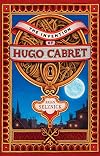
The author of The Invention of Hugo Cabret, Brian Selznick, was born in 1966 in New Jersey. He has also written The Boy of A Thousand Faces, The Houdini Box, and also illustrated books such as Frindle by Andrew Clements, The Doll People by Ann Martin and Laura Godwin, Amelia and Eleanor Go for a Ride by Pam Muñoz Ryan and The Dinosaurs of Waterhouse Hawkins by Barbara Kerley. He studied at The Rhode Island School of Design and after he graduated her worked at a children’s book store in New York City called Eeyore’s. In The Invention of Hugo Cabret Brian Selznick uses pictures to help the reader figure out the story. It is a very creative way to write because the reader must use their mind in a different way.
A little orphan, Hugo Cabret, must learn to work all the clocks in a train station in Paris with his Uncle after his father dies. Hugo learns quickly but when his Uncle goes out drinking and never comes back, Hugo carries on his life so the police officer at the station won’t get suspicious. His dad died in a fire at a museum while fixing a robot called an automaton. The robot, when working properly, can write a message. Hugo finds the robot in the ruins of the fire and decides to take it home and finish it. He somehow thinks that the robot can write a message his dad left for him. I would compare Brian Selznick to Andrew Clements who wrote Frindle.
As I was reading the story I was completely lost. As show more Brian Selznick was talking about one problem he changed to another problem. Also, what you thought were minor details happen to be a major part of the story in the end. Every detail in the story comes together to form one big plot. I thought the main idea was definitely a good topic because it is not like every other book. This is about a boy fixing clocks in Paris. I can’t think of any other book that comes close to this. I would recommend this book to young or old people who like mysteries or suspense. People may think that since there are pictures it’s an easy read but without the pictures there would be no story. The pictures are a major part of the story. I would give this a 6.5 out of 5. I loved it, and I also think he should make a sequel. show less
Mr. Cartier/period 2 Critical Review
The author of The Invention of Hugo Cabret, Brian Selznick, was born in 1966 in New Jersey. He has also written The Boy of A Thousand Faces, The Houdini Box, and also illustrated books such as Frindle by Andrew Clements, The Doll People by Ann Martin and Laura Godwin, Amelia and Eleanor Go for a Ride by Pam Muñoz Ryan and The Dinosaurs of Waterhouse Hawkins by Barbara Kerley. He studied at The Rhode Island School of Design and after he graduated her worked at a children’s book store in New York City called Eeyore’s. In The Invention of Hugo Cabret Brian Selznick uses pictures to help the reader figure out the story. It is a very creative way to write because the reader must use their mind in a different way.
A little orphan, Hugo Cabret, must learn to work all the clocks in a train station in Paris with his Uncle after his father dies. Hugo learns quickly but when his Uncle goes out drinking and never comes back, Hugo carries on his life so the police officer at the station won’t get suspicious. His dad died in a fire at a museum while fixing a robot called an automaton. The robot, when working properly, can write a message. Hugo finds the robot in the ruins of the fire and decides to take it home and finish it. He somehow thinks that the robot can write a message his dad left for him. I would compare Brian Selznick to Andrew Clements who wrote Frindle.
As I was reading the story I was completely lost. As show more Brian Selznick was talking about one problem he changed to another problem. Also, what you thought were minor details happen to be a major part of the story in the end. Every detail in the story comes together to form one big plot. I thought the main idea was definitely a good topic because it is not like every other book. This is about a boy fixing clocks in Paris. I can’t think of any other book that comes close to this. I would recommend this book to young or old people who like mysteries or suspense. People may think that since there are pictures it’s an easy read but without the pictures there would be no story. The pictures are a major part of the story. I would give this a 6.5 out of 5. I loved it, and I also think he should make a sequel. show less