Friends of the Unrighteous Mammon: Northern Christians and Market Capitalism, 1815-1860 by Stewart Davenport
This is an important book that helps explain how religious people in the Antebellum U.S. adjusted to the Market Revolution. As the book introduction notes, this is a subject that has recieved relatively little attention from scholars. This is intellectual/social history where one should have a strong basic knowledge of history to enjoy.
In my rating scheme, 5 star books are rare. Where a 3-star book has to deliver strong basic knowledge, a 5-star book has to make me think about a subject or issue much differently. This book is a a 5-star-a paradigm changer for me in the area of Paleo-Geography, or how the North American continent evolved over billions of years. Due to my background in college where I took a lot of elective geology courses, I consider myself to know more than an average layperson on the subject of geology but less than a professional geologist. In addition to the aforementioned college courses, I've read a lot of fairly technical materials on paleogeography events in North America's past such as the different orogenies that helped shape the current North American West. However, what I lacked was an easy way to "see" all of these processes occuring in sequence in a way that had enough detail to retain vitality important information, yet simple enough to be told in an easy to understand narrative that can be remembered as a story. This book accomplished this for me. Although there was little I hadn't read about before, the way it was presented made me "see" the evolution of the North American continent for the first time. The historical information about the immigrants and the trails is interesting as well. Very highly recommended.
Very good overall. However, some of the authors are biased in that sometimes they put their opinions in portions of their work when opinions aren't necessary. Additionally, some of the authors made mistaken conclusions due to not understanding basic technical aspects of taxation, accounting and financial ratios. This didn't diminish the overall utility of their work however. However, it does point out that, in the future, more historians who plan to write business history, should be required to take some basic courses in accounting, finance, strategy and law so that they can more intelligently interpret the evidence they use to draw conclusions. Overall, though, a fine work with some insights into some little know aspects of of post-WWII business. A good read.
Troubled Waters: Steamboat Disasters, River Improvements, and American Public Policy, 1821-1860 by Paul F. Paskoff
From a superb scholar that I know personally and is one of the leading authorities on the subject. Great read and reference!
American Catholic:: The Saints and Sinners Who Built America's Most Powerful Church by Charles Morris
Important for me because this is the book that I read that got me interested in the fascinating field of Catholic political history and doctrine evolution. Good survey of American Catholics.
The Institutional Revolution: Measurement and the Economic Emergence of the Modern World (Markets and Governments in Economic History) by Douglas W. Allen
As I state in my profile section describing my ranking system for books, I give very few 5 star ratings. Specifically, a 5 star book has to change the way I understand something in a fundamental way. Well, this book does that for how I understand relationships of power before modern times. Even if you don't agree with Allen's thesis in total, even the gist of his theories, which are easy enough to understand provided the reader has a good understanding of history, is enough for anyone to see power relationships in a new light. Sometimes it takes someone with a different set of view and skills, in this case of an economist, to point out important factors that no one else has noticed before. If you read this book, you should have a decent understanding of the history of England both before, during and after the Industrial Revolution to get the most benefit out of it. Mr. Allen has produced a superb monograph. Highly recommended.
America's First Great Depression: Economic Crisis and Political Disorder After the Panic of 1837 by Alasdair Roberts
This was a well written book that is easy to read. If you know 19th century United States history, this book isn't going to have very much new for you with one exception. Specifically, the book spends time discussing in detail the number of states that defaulted on their "state" debt during the business depression and how that affected the United State's relationship with Britain. I knew about these defaults in a general way, but had never read a more detailed history about it. It's no wonder since the last monograph related specifically to these defaults is about fifty years old.
If you are not strong in your 19th century U.S. history, this monograph will very beneficial to you.
If you are not strong in your 19th century U.S. history, this monograph will very beneficial to you.
I give very few 5 star ratings to any books that I read. However, I found this to be a rare exception in that the author has done an excellent job in synthesizing a large amount of primary research that others have done into a very readable narrative. This book is a joy to read and brings to light a little known part of the spread of Christian religion that few realize. Highly recommended.
The Spiritual Franciscans: From Protest to Persecution in the Century After Saint Francis by David Burr
Magnificent account of the 12th and 13th century Spiritual Franciscans and Pope John XXII over the amount of property the Franciscan monastics were allowed to have and who were the "true" Christians. Great read, but you will need to have a decent background in Middle Age Church history to understand it well.
Not only is this subject very interesting, but the author has done a magnificent job in writing a monograph that is very easy to read. He does a good job of explaining the topic and sub-topics in a way that even those with little historical knowledge can profitably the monograph. Highly recommended.

An interesting biography about a now obscure priest.
A good book about a now fairly obscure historical character.
Two Churches: England and Italy in the Thirteenth Century, With an additional essay by the Author. by Robert Brentano
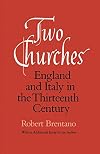
I had to read this for a graduate history seminar. The information he provides discussing the differences in church organization between the areas that would one day become Italy and England was very useful and interesting. My only complaint is his writing style. Specifically, he is one of those historians that thinks he has to write "beautiful" literature. As a result, in my opinion, half of the book is fluff with unneeded detail and the over use of metaphor. Still, many readers enjoy this style and the book is considered a classic. Very good overall despite these factors.
Interesting episodes lithe known in American history