This topic is currently marked as "dormant"—the last message is more than 90 days old. You can revive it by posting a reply.
1Samantha_kathy
I finally took the plunge and started to actively get involved with this challenge, so it's time to start a thread!
I love reading historical fiction (and I've got quite a bit of them on my TBR stack) yet somehow I read very little HF when looking at what I read in a year. Hopefully this group will be that little push I need to pick up those books and read them!
In my Time Travel So Far post below I've added all books read that are set in the World War 2 era or earlier (sometimes pushing this boundary a bit), starting from January 2011 onwards. Classics like Jane Austen, Charles Dickens and Jules Verne do not count.
I love reading historical fiction (and I've got quite a bit of them on my TBR stack) yet somehow I read very little HF when looking at what I read in a year. Hopefully this group will be that little push I need to pick up those books and read them!
In my Time Travel So Far post below I've added all books read that are set in the World War 2 era or earlier (sometimes pushing this boundary a bit), starting from January 2011 onwards. Classics like Jane Austen, Charles Dickens and Jules Verne do not count.
2Samantha_kathy
Time Travel So Far:
Prehistory
Raptor Red by Robert T. Bakker (120 million years ago, Age of the Dinosaurs)
Promise of the Wolves by Dorothy Hearst (14,000 years ago)
Ancient and Biblical Times
Death Comes As the End by Agatha Christie (2000 BC, Ancient Egypt)
Gods and Kings by Lynn Austin (Biblical, 730 BC, Judah)
Lily of the Nile by Stephanie Dray (around 30 BC, Ancient Rome mainly)
The Forgotten Legion by Ben Kane (around 56 BC, Ancient Rome mainly)
Medieval Europe
Beowulf by Caitlin Kiernan (Late 5th century Scandinavia, modern re-telling)
The Three-Arched Bridge by Ismail Kadare (14th century Albania)
A Plague on Both Your Houses by Susanna Gregory (1348-1349, Cambridge, England)
A Place Beyond Courage by Elizabeth Chadwick (The Anarchy, 1135-1153, England)
The Killing Way by Tony Hays (5th or 6th century, Arthurian Britain)
The Divine Sacrifice by Tony Hays (5th or 6th century, Arthurian Britain)
The Beloved Dead by Tony Hays (5th or 6th century, Arthurian Britain)
The Greatest Knight by Elizabeth Chadwick (12th century, Britain)
16th Century
Dissolution by C.J. Sansom (1537, England)
The Confessions of Catherine de Medici by C.W. Gortner (1529-1589, France)
18th Century
Fever 1793 by Laurie Halse Anderson (1793, Philadelphia, USA)
19th Century
To Desire a Wicked Duke by Nicole Jordan (British Regency Period, early 19th century)
Death at Daisy's Folly by Robin Paige (Victorian era, late 19th century Britain)
A Different Kind of Christmas by Alex Haley (1855, USA)
The Cater Street Hangman by Anne Perry (Victorian ere, late 19th century Britain)
The Abyssinian Proof by Jenny White (end 19th century Ottoman Empire)
Sixteen Brides by Stephanie Grace Whitson (1872, Nebraska, USA)
Dandy Detects by M. Louisa Locke (1879, San Fransisco, USA)
Still Life with Murder by P.B. Ryan (1868, Boston, USA)
La Desperada by Patricia Burroughs (1881, Texas, USA)
The Secret History of the Pink Carnation by Lauren Willig (1803, Paris, France)
Sea Scoundrel by Annette Blair (British Regency Period, early 19th century)
No Place for a Lady by Maggie Brendan (1892, Colorado, USA)
20th Century
The Eye of the Needle by Ken Follett (World War 2, England)
The Last Kashmiri Rose by Barbara Cleverly (1920s British India)
The Poisonwood Bible by Barbara Kingsolver (1959 Belgian Congo and onward)
The Use of Man by Aleksandar Tisma (late 1930s Serbia and onward)
My Enemy's Cradle by Sara Young (World War 2, the Netherlands and Germany)
Mr. Churchill's Secretary by Susan Elia MacNeal (World War 2, England)
Mrs. Pollifax on Safari by Dorothy Gilman (1970s, Zambia)
Orion's Belt by Jon Michelet (1977, Svalbard)
The Burnt-Out Town of Miracles by Roy Jacobsen (World War 2, Finland)
Seawitch by Alistair MacLean (1970s, USA and at sea)
Rachel's Secret by Shelly Sanders (1903, Russia (now Moldova))
Shout at the Devil by Wilbur Smith (World War 1, Africa)
The Help by Kathryn Stockett (1960s, Mississippi, USA)
Timesweep Novels - spanning more than one century
Roots by Alex Haley (late 18th century - 1960s, Africa and USA)
Timetravel novels
Timecachers by Glenn R. Petrucci (travel to 1838, USA) (DNF)
Prehistory
Raptor Red by Robert T. Bakker (120 million years ago, Age of the Dinosaurs)
Promise of the Wolves by Dorothy Hearst (14,000 years ago)
Ancient and Biblical Times
Death Comes As the End by Agatha Christie (2000 BC, Ancient Egypt)
Gods and Kings by Lynn Austin (Biblical, 730 BC, Judah)
Lily of the Nile by Stephanie Dray (around 30 BC, Ancient Rome mainly)
The Forgotten Legion by Ben Kane (around 56 BC, Ancient Rome mainly)
Medieval Europe
Beowulf by Caitlin Kiernan (Late 5th century Scandinavia, modern re-telling)
The Three-Arched Bridge by Ismail Kadare (14th century Albania)
A Plague on Both Your Houses by Susanna Gregory (1348-1349, Cambridge, England)
A Place Beyond Courage by Elizabeth Chadwick (The Anarchy, 1135-1153, England)
The Killing Way by Tony Hays (5th or 6th century, Arthurian Britain)
The Divine Sacrifice by Tony Hays (5th or 6th century, Arthurian Britain)
The Beloved Dead by Tony Hays (5th or 6th century, Arthurian Britain)
The Greatest Knight by Elizabeth Chadwick (12th century, Britain)
16th Century
Dissolution by C.J. Sansom (1537, England)
The Confessions of Catherine de Medici by C.W. Gortner (1529-1589, France)
18th Century
Fever 1793 by Laurie Halse Anderson (1793, Philadelphia, USA)
19th Century
To Desire a Wicked Duke by Nicole Jordan (British Regency Period, early 19th century)
Death at Daisy's Folly by Robin Paige (Victorian era, late 19th century Britain)
A Different Kind of Christmas by Alex Haley (1855, USA)
The Cater Street Hangman by Anne Perry (Victorian ere, late 19th century Britain)
The Abyssinian Proof by Jenny White (end 19th century Ottoman Empire)
Sixteen Brides by Stephanie Grace Whitson (1872, Nebraska, USA)
Dandy Detects by M. Louisa Locke (1879, San Fransisco, USA)
Still Life with Murder by P.B. Ryan (1868, Boston, USA)
La Desperada by Patricia Burroughs (1881, Texas, USA)
The Secret History of the Pink Carnation by Lauren Willig (1803, Paris, France)
Sea Scoundrel by Annette Blair (British Regency Period, early 19th century)
No Place for a Lady by Maggie Brendan (1892, Colorado, USA)
20th Century
The Eye of the Needle by Ken Follett (World War 2, England)
The Last Kashmiri Rose by Barbara Cleverly (1920s British India)
The Poisonwood Bible by Barbara Kingsolver (1959 Belgian Congo and onward)
The Use of Man by Aleksandar Tisma (late 1930s Serbia and onward)
My Enemy's Cradle by Sara Young (World War 2, the Netherlands and Germany)
Mr. Churchill's Secretary by Susan Elia MacNeal (World War 2, England)
Mrs. Pollifax on Safari by Dorothy Gilman (1970s, Zambia)
Orion's Belt by Jon Michelet (1977, Svalbard)
The Burnt-Out Town of Miracles by Roy Jacobsen (World War 2, Finland)
Seawitch by Alistair MacLean (1970s, USA and at sea)
Rachel's Secret by Shelly Sanders (1903, Russia (now Moldova))
Shout at the Devil by Wilbur Smith (World War 1, Africa)
The Help by Kathryn Stockett (1960s, Mississippi, USA)
Timesweep Novels - spanning more than one century
Roots by Alex Haley (late 18th century - 1960s, Africa and USA)
Timetravel novels
Timecachers by Glenn R. Petrucci (travel to 1838, USA) (DNF)
3Samantha_kathy
The Last Kashmiri Rose by Barbara Cleverly - 1920s (November 2011 theme)

In a land of saffron sunsets and blazing summer heat, an Englishwoman has been found dead, her wrists slit, her body floating in a bathtub of blood and water. But is it suicide or murder? The case falls to Scotland Yard inspector Joe Sandilands, who survived the horror of the Western Front and has endured six sultry months in English-ruled Calcutta. Sandilands is ordered to investigate, and soon discovers that there have been other mysterious deaths, hearkening sinister ties to the present case. Now, as the sovereignty of Britain is in decline and an insurgent India is on the rise, Sandilands must navigate the treacherous corridors of political decorum to bring a cunning killer to justice…knowing the next victim is already marked to die.
Set in the early 1920s in British India The Last Kashmiri Rose is the first book of the Detective Joe Sandilands series. And I’ll tell you, if the rest of them are as good as this one I’ll be a very happy girl. The plot is well thought out, the setting is crucial to the plot and, unusual for this type of book, the why of the murders is more important than the who, although for about half the book the killer’s identity isn’t known. This book scores very well on all fronts, plot, setting and characters are great and make this a page-turner despite the slow simmering of happenings.
But what I loved most about this book was the setting. India is described so vividly that I felt as if I were there. While Anglo-India is most prominent, something of the native people and culture is also shown in this book. The time period is also an interesting one. There is unrest simmering under the surface due to tension between the British and the natives, and an uprising resulting in a lot of casualties is not that long ago. Not to mention that World War I is only just over and nobody was left untouched by that. The early 1920s is also an interesting time for forensics and criminal psychology, which were just up and coming in being used in investigations, and of which Joe Sandilands is a fervent fan. But perhaps most striking of all did I find the gap between Joe, who hasn’t spent that much time in India, and the English living in India that he meets. Time is ‘behind’ in India, often Joe thinks ‘it could have been the 90s’ by which he means the 1890s. This contrast puts you even more in the 1920s frame of mind than mere descriptions of the time period could have done.
All in all I really liked this book and I’m looking forward to reading the rest of the series. Highly recommended!

In a land of saffron sunsets and blazing summer heat, an Englishwoman has been found dead, her wrists slit, her body floating in a bathtub of blood and water. But is it suicide or murder? The case falls to Scotland Yard inspector Joe Sandilands, who survived the horror of the Western Front and has endured six sultry months in English-ruled Calcutta. Sandilands is ordered to investigate, and soon discovers that there have been other mysterious deaths, hearkening sinister ties to the present case. Now, as the sovereignty of Britain is in decline and an insurgent India is on the rise, Sandilands must navigate the treacherous corridors of political decorum to bring a cunning killer to justice…knowing the next victim is already marked to die.
Set in the early 1920s in British India The Last Kashmiri Rose is the first book of the Detective Joe Sandilands series. And I’ll tell you, if the rest of them are as good as this one I’ll be a very happy girl. The plot is well thought out, the setting is crucial to the plot and, unusual for this type of book, the why of the murders is more important than the who, although for about half the book the killer’s identity isn’t known. This book scores very well on all fronts, plot, setting and characters are great and make this a page-turner despite the slow simmering of happenings.
But what I loved most about this book was the setting. India is described so vividly that I felt as if I were there. While Anglo-India is most prominent, something of the native people and culture is also shown in this book. The time period is also an interesting one. There is unrest simmering under the surface due to tension between the British and the natives, and an uprising resulting in a lot of casualties is not that long ago. Not to mention that World War I is only just over and nobody was left untouched by that. The early 1920s is also an interesting time for forensics and criminal psychology, which were just up and coming in being used in investigations, and of which Joe Sandilands is a fervent fan. But perhaps most striking of all did I find the gap between Joe, who hasn’t spent that much time in India, and the English living in India that he meets. Time is ‘behind’ in India, often Joe thinks ‘it could have been the 90s’ by which he means the 1890s. This contrast puts you even more in the 1920s frame of mind than mere descriptions of the time period could have done.
All in all I really liked this book and I’m looking forward to reading the rest of the series. Highly recommended!
4Samantha_kathy
A Different Kind of Christmas by Alex Haley - Christmas (December 2011 theme)

It is 1855. Fletcher Randall is the son of a Southern plantation owner who is pro-slavery, as it is all he’s ever known. But when he goes to school up North, he’s exposed to the anti-slavery sentiments of several of his classmates. It is the start of a personal journey for Fletcher which culminates in a risky undertaking on Christmas Eve that could cost him his life.
This book is short but packs quite a punch. The writing style fits the story beautifully, and that’s not something I say lightly. The emotional journey Fletcher makes is believable and even when he’s still pro-slavery he’s easy to empathize with, despite not sharing his views at all. The ending is a little unexpected, but I thought it was a fitting end to the book.

It is 1855. Fletcher Randall is the son of a Southern plantation owner who is pro-slavery, as it is all he’s ever known. But when he goes to school up North, he’s exposed to the anti-slavery sentiments of several of his classmates. It is the start of a personal journey for Fletcher which culminates in a risky undertaking on Christmas Eve that could cost him his life.
This book is short but packs quite a punch. The writing style fits the story beautifully, and that’s not something I say lightly. The emotional journey Fletcher makes is believable and even when he’s still pro-slavery he’s easy to empathize with, despite not sharing his views at all. The ending is a little unexpected, but I thought it was a fitting end to the book.
5Samantha_kathy
I'm a bit behind in updating this thread, so here are two reviews from the end of 2011.
6Samantha_kathy
The Poisonwood Bible by Barbara Kingsolver - Freedom (July 2010 theme)

Nathan Price, a fierce, evangelical Baptist who takes his family – a wife and four daughters – on a mission to the Belgian Congo in 1959. They carry with them everything they believe they will need from home, but soon find that all of it—from garden seeds to Scripture—is calamitously transformed on African soil. What follows is a suspenseful epic of one family's tragic undoing and remarkable reconstruction over the course of three decades in postcolonial Africa.
The Poisonwood Bible is narrated by Orleana Price and her daughters, who are all very different people with their own unique perspective. This gave the book a unique 3-D picture of the situation, both their private situation as the more general situation of the country they live in which is in turmoil. Right from the beginning I knew things were going to go wrong, and as the book followed the family as things slid from bad to worse without them knowing it, it seems, until it was too late. Every time there was a point at which they could turn things around I was hoping they would, but didn’t really expect it.
What I liked very much was that the story continued after the main happenings in the Belgian Congo, that it showed how the events there affected the family for decades afterwards and how they ended up living their lives. That, for me, was perhaps the best part of the book.
All in all, this was a heavy book (both in subject as in size), but very, very good. It will stick with me for a good long while and I highly recommend it!

Nathan Price, a fierce, evangelical Baptist who takes his family – a wife and four daughters – on a mission to the Belgian Congo in 1959. They carry with them everything they believe they will need from home, but soon find that all of it—from garden seeds to Scripture—is calamitously transformed on African soil. What follows is a suspenseful epic of one family's tragic undoing and remarkable reconstruction over the course of three decades in postcolonial Africa.
The Poisonwood Bible is narrated by Orleana Price and her daughters, who are all very different people with their own unique perspective. This gave the book a unique 3-D picture of the situation, both their private situation as the more general situation of the country they live in which is in turmoil. Right from the beginning I knew things were going to go wrong, and as the book followed the family as things slid from bad to worse without them knowing it, it seems, until it was too late. Every time there was a point at which they could turn things around I was hoping they would, but didn’t really expect it.
What I liked very much was that the story continued after the main happenings in the Belgian Congo, that it showed how the events there affected the family for decades afterwards and how they ended up living their lives. That, for me, was perhaps the best part of the book.
All in all, this was a heavy book (both in subject as in size), but very, very good. It will stick with me for a good long while and I highly recommend it!
7Samantha_kathy
The Cater Street Hangman by Anne Perry - 19th Century (June 2010 theme)

While the Ellison girls were out paying calls and drinking tea like proper Victorian ladies, a maid in their household was strangled to death. The quiet and young Inspector Pitt investigates the scene and finds no one above suspicion. As his intense questioning causes many a composed facade to crumble, Pitt finds himself curiously drawn to pretty Charlotte Ellison. Yet, a romance between a society girl and so unsuitable a suitor was impossible in the midst of a murder....
I must admit, this book was not at all what I expected. I figured on a romance with a bit of murder mystery thrown in, or perhaps a gritty investigative novel told from Thomas Pitt’s point of view. It was neither. It was a cozy mystery told from the point of view of almost everyone in the Ellison family, and at no point did we find out firsthand what Thomas Pitt was thinking or doing. While that surprised me, it was a pleasant surprise and I absolutely loved the atmosphere of the book.
Anne Perry did a great job at evoking the Victorian era with its complicated manners and caste system. While Charlotte didn’t fall in love with Thomas immediately – something I liked a lot, by the way – she does eventually and for once the story doesn’t gloss over the problems such a relationship would have evoked back then. All in all this novel was great, realistic and cozy and a very good first book in a series I think I’ll quite enjoy.

While the Ellison girls were out paying calls and drinking tea like proper Victorian ladies, a maid in their household was strangled to death. The quiet and young Inspector Pitt investigates the scene and finds no one above suspicion. As his intense questioning causes many a composed facade to crumble, Pitt finds himself curiously drawn to pretty Charlotte Ellison. Yet, a romance between a society girl and so unsuitable a suitor was impossible in the midst of a murder....
I must admit, this book was not at all what I expected. I figured on a romance with a bit of murder mystery thrown in, or perhaps a gritty investigative novel told from Thomas Pitt’s point of view. It was neither. It was a cozy mystery told from the point of view of almost everyone in the Ellison family, and at no point did we find out firsthand what Thomas Pitt was thinking or doing. While that surprised me, it was a pleasant surprise and I absolutely loved the atmosphere of the book.
Anne Perry did a great job at evoking the Victorian era with its complicated manners and caste system. While Charlotte didn’t fall in love with Thomas immediately – something I liked a lot, by the way – she does eventually and for once the story doesn’t gloss over the problems such a relationship would have evoked back then. All in all this novel was great, realistic and cozy and a very good first book in a series I think I’ll quite enjoy.
8Samantha_kathy
Sixteen Brides by Stephanie Grace Whitson - Number in the Title (January 2012 theme)

Sixteen Civil War widows living in St. Louis respond to a series of meetings conducted by a land speculator who lures them west by promising "prime homesteads" in a "booming community." Unbeknownst to them, the speculator's true motive is to find an excuse to bring women out West in hopes they will accept marriage proposals shortly after their arrival! When the women discover the truth on the way, six of them decide to stay in the fledgling community Plum Grove, Nebraska and try to make their original plan of homesteading work anyway. But each woman carries her own burden which she must overcome to make life on the frontier a success.
The historical setting in this book is amazing. The details are part of the story, never interfering with the plot, yet they paint the picture of 1872 Nebraska in great detail. No lengthy expositions, just information sprinkled through the story in a logical fashion – something that’s hard to do and Stephanie Grace Whitson does with seeming ease.
What I also really liked was the way these women felt so real. All of them were different, had different reasons for trying to homestead alone, yet they never felt like a modern woman transposed into a historical setting. It was the same with faith – this book is technically Christian fiction – it was woven into the story in a believable way; there’s no beating anyone on the head with a stick with the moral of the story or with God. Just simple faith of people in a setting where that faith existed, and each one believing in their own way. No cookie cutter characters to be found here!
However, the amount of characters make slow reading a must to avoid getting confused. Especially in the beginning it was hard to keep track of who was who. It took me until about half-way through the book before I could easily remember, but then the story truly took off for me. Don’t get me wrong, it's not a bad book by any means, but I think it could have been so much better if there were less characters that it focused on, or if it was just told from one POV, or even if each character she uses as a POV character had her own chapter. Even just a list of characters to refer to would have helped a lot.
But, all in all, I found this a very enjoyable book. Stephanie Grace Whitson has a way of bringing the historical setting alive using nothing more than some well-placed details while telling a compelling story with realistic characters. I will definitely try more of this author’s books.

Sixteen Civil War widows living in St. Louis respond to a series of meetings conducted by a land speculator who lures them west by promising "prime homesteads" in a "booming community." Unbeknownst to them, the speculator's true motive is to find an excuse to bring women out West in hopes they will accept marriage proposals shortly after their arrival! When the women discover the truth on the way, six of them decide to stay in the fledgling community Plum Grove, Nebraska and try to make their original plan of homesteading work anyway. But each woman carries her own burden which she must overcome to make life on the frontier a success.
The historical setting in this book is amazing. The details are part of the story, never interfering with the plot, yet they paint the picture of 1872 Nebraska in great detail. No lengthy expositions, just information sprinkled through the story in a logical fashion – something that’s hard to do and Stephanie Grace Whitson does with seeming ease.
What I also really liked was the way these women felt so real. All of them were different, had different reasons for trying to homestead alone, yet they never felt like a modern woman transposed into a historical setting. It was the same with faith – this book is technically Christian fiction – it was woven into the story in a believable way; there’s no beating anyone on the head with a stick with the moral of the story or with God. Just simple faith of people in a setting where that faith existed, and each one believing in their own way. No cookie cutter characters to be found here!
However, the amount of characters make slow reading a must to avoid getting confused. Especially in the beginning it was hard to keep track of who was who. It took me until about half-way through the book before I could easily remember, but then the story truly took off for me. Don’t get me wrong, it's not a bad book by any means, but I think it could have been so much better if there were less characters that it focused on, or if it was just told from one POV, or even if each character she uses as a POV character had her own chapter. Even just a list of characters to refer to would have helped a lot.
But, all in all, I found this a very enjoyable book. Stephanie Grace Whitson has a way of bringing the historical setting alive using nothing more than some well-placed details while telling a compelling story with realistic characters. I will definitely try more of this author’s books.
9countrylife
Nice review. And now snugly on my wishlist. I love historical fiction and being from Nebraska myself, this looks right up my alley. I also took a quick look at your blog and came away with yet another book for my wishlist - Serving Up the Harvest.
10Samantha_kathy
Both are very worthy books for your wishlist! If you love historical fiction set in Nebraska, you should check out the rest of Stephanie Grace Whitson's books. Most of them seem to be set in Nebraska, which is her home state, if I gathered it correctly from her website.
I know I've got my eye on The Key on the Quilt - a new novel from her appearing sometime this year. Nothing more than the title is known, but it sounds so good!
Her Prairie Winds trilogy - starting with Walks the Fire - is set in Nebraska and got very favorable reviews. I'm not sure about her other books, but as I said, I do believe many of them are set in Nebraska (if not all) and they are all historical.
I know I've got my eye on The Key on the Quilt - a new novel from her appearing sometime this year. Nothing more than the title is known, but it sounds so good!
Her Prairie Winds trilogy - starting with Walks the Fire - is set in Nebraska and got very favorable reviews. I'm not sure about her other books, but as I said, I do believe many of them are set in Nebraska (if not all) and they are all historical.
11Samantha_kathy
Short Story: Dandy Detects by M. Louisa Locke - Gilded Age (February 2012 theme)

In the fall of 1879, San Francisco swelters under a heat wave while Barbara Hewitt, a reserved school-teacher, uncovers a mystery with the help of her son’s dog, Dandy.
This is a story from the author of the full novel Maids of Misfortune, and this short story uses a minor character from that novel as the main character. I liked the fact that because a minor character from Maids of Misfortune was used (and not the main character), I didn’t feel like I was missing something even though I haven’t read that novel. But after reading this charming short story I would very much like to read Maids of Misfortune. I did figure things out before Barbara Hewitt did, but that didn’t dampen my enjoyment in the least.

In the fall of 1879, San Francisco swelters under a heat wave while Barbara Hewitt, a reserved school-teacher, uncovers a mystery with the help of her son’s dog, Dandy.
This is a story from the author of the full novel Maids of Misfortune, and this short story uses a minor character from that novel as the main character. I liked the fact that because a minor character from Maids of Misfortune was used (and not the main character), I didn’t feel like I was missing something even though I haven’t read that novel. But after reading this charming short story I would very much like to read Maids of Misfortune. I did figure things out before Barbara Hewitt did, but that didn’t dampen my enjoyment in the least.
12Samantha_kathy
Raptor Red by Robert T. Bakker - Prehistory (Quarterly Theme Read Feb-March 2012)

A year in the life of a dinosaur named Raptor Red, this book is unique in the fact that the dinosaur is the main character and we see the world from her point of view. Written by a professional paleontologist, the Age of Dinosaurs truly comes to life in this book.
The story is good and gripping, and the author is very skilled in showing more than just Raptor Red’s narrow worldview by drawing other dinosaurs into her story, interweaving several small storylines into the big plot of Raptor Red’s struggle for survival. Only when the author gives too much scientific detail – a mistake he makes mainly in the first few chapters – the pace of the story stops and that’s a real shame. But other than that, I loved this book. A very unique prehistoric novel that deserves the four stars I gave it.

A year in the life of a dinosaur named Raptor Red, this book is unique in the fact that the dinosaur is the main character and we see the world from her point of view. Written by a professional paleontologist, the Age of Dinosaurs truly comes to life in this book.
The story is good and gripping, and the author is very skilled in showing more than just Raptor Red’s narrow worldview by drawing other dinosaurs into her story, interweaving several small storylines into the big plot of Raptor Red’s struggle for survival. Only when the author gives too much scientific detail – a mistake he makes mainly in the first few chapters – the pace of the story stops and that’s a real shame. But other than that, I loved this book. A very unique prehistoric novel that deserves the four stars I gave it.
13Samantha_kathy
Still Life with Murder by P.B. Ryan - Gilded Age (February 2012 theme)

Boston 1868: The wealthy are enjoying the height of the Gilded Age--but not all are wealthy. As governess to the Hewitt family, Irish immigrant Nell Sweeney is sent to discover the truth behind the rumor that their son--thought to be killed in the Civil War--is still alive and in prison.
I loved this Gilded Age mystery. Nell Sweeney is a great character and very well thought out by the author. Her position as a governess coupled with her background gives her the ability to move through virtually all layers of society. How she got to where she is plausible, and on the whole she felt like a real person from that time. Coupled with a great plot with interesting twists and turns, this book was really great. I have high hopes for the rest of this series and will definitely seek them out.

Boston 1868: The wealthy are enjoying the height of the Gilded Age--but not all are wealthy. As governess to the Hewitt family, Irish immigrant Nell Sweeney is sent to discover the truth behind the rumor that their son--thought to be killed in the Civil War--is still alive and in prison.
I loved this Gilded Age mystery. Nell Sweeney is a great character and very well thought out by the author. Her position as a governess coupled with her background gives her the ability to move through virtually all layers of society. How she got to where she is plausible, and on the whole she felt like a real person from that time. Coupled with a great plot with interesting twists and turns, this book was really great. I have high hopes for the rest of this series and will definitely seek them out.
14Roro8
Good on You Samantha, you finished just in time - 2 Gilded age books! I am busy with my prehistoric book still Stonehenge.
15majkia
I've got to get Still life with Murder. sounds just up my street.
16Samantha_kathy
14> Well, Dandy Detects is really just a short story, although it was pretty good, especially the setting was spot on.
15> Let me know what you think about it if you read it.
15> Let me know what you think about it if you read it.
17Samantha_kathy
A Plague on Both Your Houses by Susanna Gregory - Medicine and Illness (March 2012 theme)

A Plague on Both Your Houses introduces the physician Matthew Bartholomew, whose unorthodox but effective treatment of his patients frequently draws accusations of heresy from his more traditional colleagues. Besides his practice, Bartholomew is teacher of Medicine at Michaelhouse, part of the fledgling University of Cambridge. In 1348, the inhabitants of Cambridge live under the shadow of a terrible pestilence that has ravaged Europe and is travelling relentlessly eastward towards England. Bartholomew, however, is distracted by the sudden and inexplicable death of the Master of Michaelhouse - a death the University authorities do not want investigated. When three more scholars die in mysterious circumstances, Bartholomew defies the University and begins his own enquiry. His pursuit for the truth leads him into a complex tangle of lies and intrigue that causes him to question the innocence of his closest friends, and even his family. And then the Black Death finally arrives and Bartholomew is dragged deeper and deeper into a quagmire which threatens not only his life, but the continued existence of the University and the future of the town.
I loved this book! Really, really loved this book! The historical setting is done perfectly, it’s very realistic. The characters think and act like medieval people without being so alien to modern readers that you don’t make a connection to them, not something that’s easy to do. And the mystery – oh, that was brilliant. Sure, it takes a bit of getting used to the limited knowledge that can be gather about the crimes – no fingerprints or other forensics, like in modern mysteries, and not even fledgling criminal investigative tools like in historical mysteries set in the Victorian period and later. But on the other hand, people were much more superstitious, and feared God and hell, making them confess to things modern day criminals would keep their mouths shut about. Also, people knew each other’s business far better, so odd behavior was noticed. All in all, the mystery in this book was well thought out, had many twists and turns, and managed to surprise me right until the end. Susanna Gregory has truly written a great novel and I will definitely be reading the rest of this series!

A Plague on Both Your Houses introduces the physician Matthew Bartholomew, whose unorthodox but effective treatment of his patients frequently draws accusations of heresy from his more traditional colleagues. Besides his practice, Bartholomew is teacher of Medicine at Michaelhouse, part of the fledgling University of Cambridge. In 1348, the inhabitants of Cambridge live under the shadow of a terrible pestilence that has ravaged Europe and is travelling relentlessly eastward towards England. Bartholomew, however, is distracted by the sudden and inexplicable death of the Master of Michaelhouse - a death the University authorities do not want investigated. When three more scholars die in mysterious circumstances, Bartholomew defies the University and begins his own enquiry. His pursuit for the truth leads him into a complex tangle of lies and intrigue that causes him to question the innocence of his closest friends, and even his family. And then the Black Death finally arrives and Bartholomew is dragged deeper and deeper into a quagmire which threatens not only his life, but the continued existence of the University and the future of the town.
I loved this book! Really, really loved this book! The historical setting is done perfectly, it’s very realistic. The characters think and act like medieval people without being so alien to modern readers that you don’t make a connection to them, not something that’s easy to do. And the mystery – oh, that was brilliant. Sure, it takes a bit of getting used to the limited knowledge that can be gather about the crimes – no fingerprints or other forensics, like in modern mysteries, and not even fledgling criminal investigative tools like in historical mysteries set in the Victorian period and later. But on the other hand, people were much more superstitious, and feared God and hell, making them confess to things modern day criminals would keep their mouths shut about. Also, people knew each other’s business far better, so odd behavior was noticed. All in all, the mystery in this book was well thought out, had many twists and turns, and managed to surprise me right until the end. Susanna Gregory has truly written a great novel and I will definitely be reading the rest of this series!
18countrylife
So, a cliff-hanger review! Nice review, so had to go to the work page to finish reading, and whilst there, hefted it onto the wishlist.
19Samantha_kathy
18> I have no idea what happened, but it definitely wasn't meant to be a cliffhanger review! Thanks for pointing that out, it's fixed now. And I hope you enjoy the book!
20Samantha_kathy
Promise of the Wolves by Dorothy Hearst - Prehistory (Quarterly Theme Read Feb-March 2012)
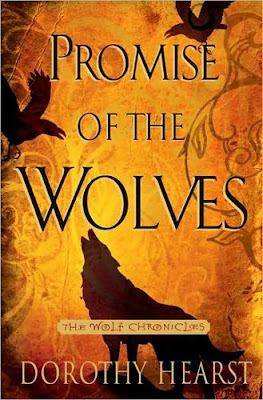
The time is 14,000 years ago. Kaala, a young wolf of mixed blood, should have died at birth. But against all rules, she was allowed to live. But as she grows up, she continues to break the rules that rule the Wide Valley wolves. It could mean the end of her pack, the Swift River Wolves, or it could be their salvation – and that of the humans living in the valley.
This book raises very mixed feelings in me. I liked the fact that it was told from Kaala’s point of view, and I liked the characters in it. Dorothy Hearst obviously has extensive knowledge of how a wolf pack works and manages to portray the wolves in such a way that the reader can relate to them, while still keeping them as wolves, not humans in a wolf skin. And within those confines, she manages to tell a story about the bond between humans and wolves and how that might have evolved all those thousands of years ago.
But what kept me from saying “wow, this book is so good!” was the whole spiritual/religious concept in the book. I could have dealt with legends that wolves tell each other, I could have dealt with a ghost wolf helping Kaala. I could even have dealt with them seeing the Earth and the Moon and the Sun as a sort of gods. But the whole organized religion thing they had going, with the Greatwolves and rules and chosen packs to enforce those rules – that was taking things a step too far. It felt so contrived – so human, in a way. The pieces where the whole religion thing wasn’t at the foreground were great and pulled me into the story. And then the religion came up again – it was an important driving force of the story, so it came up fairly often – and I had to put in a lot of effort to keep reading.
In the end, I am still not sure if I can say I like this book. It wasn’t a bad book, just the opposite. But the religious aspect felt off to me – too much for the story to feel in any way realistic. So instead of a good book I would heartily recommend, it remained a middle of the road kind of book. Not bad, but not particularly great either.
The time is 14,000 years ago. Kaala, a young wolf of mixed blood, should have died at birth. But against all rules, she was allowed to live. But as she grows up, she continues to break the rules that rule the Wide Valley wolves. It could mean the end of her pack, the Swift River Wolves, or it could be their salvation – and that of the humans living in the valley.
This book raises very mixed feelings in me. I liked the fact that it was told from Kaala’s point of view, and I liked the characters in it. Dorothy Hearst obviously has extensive knowledge of how a wolf pack works and manages to portray the wolves in such a way that the reader can relate to them, while still keeping them as wolves, not humans in a wolf skin. And within those confines, she manages to tell a story about the bond between humans and wolves and how that might have evolved all those thousands of years ago.
But what kept me from saying “wow, this book is so good!” was the whole spiritual/religious concept in the book. I could have dealt with legends that wolves tell each other, I could have dealt with a ghost wolf helping Kaala. I could even have dealt with them seeing the Earth and the Moon and the Sun as a sort of gods. But the whole organized religion thing they had going, with the Greatwolves and rules and chosen packs to enforce those rules – that was taking things a step too far. It felt so contrived – so human, in a way. The pieces where the whole religion thing wasn’t at the foreground were great and pulled me into the story. And then the religion came up again – it was an important driving force of the story, so it came up fairly often – and I had to put in a lot of effort to keep reading.
In the end, I am still not sure if I can say I like this book. It wasn’t a bad book, just the opposite. But the religious aspect felt off to me – too much for the story to feel in any way realistic. So instead of a good book I would heartily recommend, it remained a middle of the road kind of book. Not bad, but not particularly great either.
21Roro8
Great review for Promise of the Wolves. I think you are spot on. I know I did enjoy the book, but I would agree with you about the "religion" thing. I hadn't given that part as much thought as you obviously have. I think I must have focused more on the parts I liked and that felt right. But I guess you can see why I didn't rush out for the sequel now. I still think it has potential for a Disney animation though.
22Samantha_kathy
I think it might be excellent as a Disney animation. But I can definitely see why you wouldn't rush out for the sequel. I might read it someday, but I wouldn't go out of my way to find it.
23Samantha_kathy
My Enemy's Cradle by Sara Young

The Netherlands, 1941. Cousins Anneke and Cyrla are identical in every respect but one: Cyrla is half-Jewish and in hiding, and her neighbors have started to whisper. Anneke, carrying a German soldier’s child, is destined to move to the maternity home which houses the Lebensborn programme. But Anneke’s death and the danger Cyrla is in just by being Jewish push Cyrla into a terrible situation as she takes on Anneke’s identity and place in the Lebensborn. She will need to fool everyone around her – both doctors and fellow mothers-to-be – if she and her unborn baby are to survive.
It took a few chapters for me to get into this story, but once I did I was totally engrossed. When reading about a Jewish character in the Second World War, often a stay in one of the Holocaust camps is included in the book. Those scenes are always horrible to read. But the understated horror of the Lebensborn and all it stands for – all it did and the consequences that are still felt today because of it – are much less known and hit me quite hard. This story hit something deep inside of me, right at the core of my womanhood – I simply cannot describe it in any other way. It were sometimes the most simple things that chilled me to the bone in this story. It’s very good, story-wise, but I think it’s even more important history-wise. Highly recommended – I wish this was mandatory reading for everyone.

The Netherlands, 1941. Cousins Anneke and Cyrla are identical in every respect but one: Cyrla is half-Jewish and in hiding, and her neighbors have started to whisper. Anneke, carrying a German soldier’s child, is destined to move to the maternity home which houses the Lebensborn programme. But Anneke’s death and the danger Cyrla is in just by being Jewish push Cyrla into a terrible situation as she takes on Anneke’s identity and place in the Lebensborn. She will need to fool everyone around her – both doctors and fellow mothers-to-be – if she and her unborn baby are to survive.
It took a few chapters for me to get into this story, but once I did I was totally engrossed. When reading about a Jewish character in the Second World War, often a stay in one of the Holocaust camps is included in the book. Those scenes are always horrible to read. But the understated horror of the Lebensborn and all it stands for – all it did and the consequences that are still felt today because of it – are much less known and hit me quite hard. This story hit something deep inside of me, right at the core of my womanhood – I simply cannot describe it in any other way. It were sometimes the most simple things that chilled me to the bone in this story. It’s very good, story-wise, but I think it’s even more important history-wise. Highly recommended – I wish this was mandatory reading for everyone.
24Roro8
My Enemy's Cradle sounds like a really interesting read. I am going to look for it at my library. Were tissues required? It certainly sounds like they might be, as it sounds pretty sad.
25Samantha_kathy
Actually, there were far less tissues required than I thought. A few moments here and there, perhaps. But the ending was uplifting, so that helps.
26Samantha_kathy
Fever 1793 by Laurie Halse Anderson - Medicine and Illness (March 2012 theme)

Fever 1793 is based on an actual epidemic of yellow fever in Philadelphia that wiped out 5,000 people--or 10 percent of the city's population--in three months. During the hot mosquito-infested summer of 1793, the dreaded yellow fever spread like wildfire, killing people overnight. The rich fled to the country, abandoning the city to looters, forsaken corpses, and frightened survivors. In the foreground of this story is 16-year-old Mattie Cook, whose mother and grandfather own a popular coffee house on High Street. Mattie's comfortable and interesting life is shattered by the epidemic, as her mother is felled and the girl and her grandfather must flee for their lives.
This book is a quick read, but thoroughly enjoyable. The author really knows what she’s talking about. The historical details are amazing, but they never take over the story. And the story itself is really a coming-of-age tale, where the difficult circumstances force Mattie to grow up. I liked this book, it’s a good read for anyone who likes a historical story despite the fact that it’s fairly light reading.

Fever 1793 is based on an actual epidemic of yellow fever in Philadelphia that wiped out 5,000 people--or 10 percent of the city's population--in three months. During the hot mosquito-infested summer of 1793, the dreaded yellow fever spread like wildfire, killing people overnight. The rich fled to the country, abandoning the city to looters, forsaken corpses, and frightened survivors. In the foreground of this story is 16-year-old Mattie Cook, whose mother and grandfather own a popular coffee house on High Street. Mattie's comfortable and interesting life is shattered by the epidemic, as her mother is felled and the girl and her grandfather must flee for their lives.
This book is a quick read, but thoroughly enjoyable. The author really knows what she’s talking about. The historical details are amazing, but they never take over the story. And the story itself is really a coming-of-age tale, where the difficult circumstances force Mattie to grow up. I liked this book, it’s a good read for anyone who likes a historical story despite the fact that it’s fairly light reading.
27Samantha_kathy
La Desperada by Patricia Burroughs

With her husband dead and his brother trying to kill her, Elizabeth Dougherty breaks into the jail and holds a cold-blooded murderer at gunpoint, promising to release him if he’ll agree to her terms. “Take me with you.” But when Boone Coulter grudgingly agrees, he has no idea that her would-be killer is the sheriff — an enemy from his past who now wants them both dead.
Set in the Texas and New Mexico of Billy the Kid, their passionate tale of love and sacrifice becomes the stuff of legend... The legend of “La Desperada.”
Originally titled What Wild Ecstasy, this edition also has Patricia Burroughs’ award-winning script Redemption in it, which was based on What Wild Ecstasy. The problem I had with that is that I’m not too keen on reading a script – especially not when it’s the same basic story as I just read – and it makes the book seem longer than it actually is, since only 2/3 of the book is the actual story.
But, when looking at the story itself, I loved it! This had it all – romance, great historical setting, the old West gun-slinger feeling, a sensitive hero who’s still very much a man, and a woman who’s strong without being modern. The only minor quibble I had was that in the end there’s a solution that leads to the situation as it is in the epilogue, yet we never learn what that solution is. That’s a shame, but it doesn’t otherwise detract from a wonderful story! Highly recommended.

With her husband dead and his brother trying to kill her, Elizabeth Dougherty breaks into the jail and holds a cold-blooded murderer at gunpoint, promising to release him if he’ll agree to her terms. “Take me with you.” But when Boone Coulter grudgingly agrees, he has no idea that her would-be killer is the sheriff — an enemy from his past who now wants them both dead.
Set in the Texas and New Mexico of Billy the Kid, their passionate tale of love and sacrifice becomes the stuff of legend... The legend of “La Desperada.”
Originally titled What Wild Ecstasy, this edition also has Patricia Burroughs’ award-winning script Redemption in it, which was based on What Wild Ecstasy. The problem I had with that is that I’m not too keen on reading a script – especially not when it’s the same basic story as I just read – and it makes the book seem longer than it actually is, since only 2/3 of the book is the actual story.
But, when looking at the story itself, I loved it! This had it all – romance, great historical setting, the old West gun-slinger feeling, a sensitive hero who’s still very much a man, and a woman who’s strong without being modern. The only minor quibble I had was that in the end there’s a solution that leads to the situation as it is in the epilogue, yet we never learn what that solution is. That’s a shame, but it doesn’t otherwise detract from a wonderful story! Highly recommended.
28Samantha_kathy
A Place Beyond Courage by Elizabeth Chadwick - Medieval Times (April 2012 theme)

The early twelfth century is a time for ambitious men to prosper, and royal servant John FitzGilbert Marshal is one of them. But when the kin of the deceased King Henry battle each other for England's throne, John’s relatively easy life ends and he has to fight in order to protect all he has. His wife, fragile, naive Aline is hopelessly unequipped to cope with the demands of a life lived on the edge. Sybilla, bright, forthright sister to the Earl of Salisbury, finds herself used as a bargaining tool when her brother seeks to seal a truce with his troublesome neighbor, John FitzGilbert. But unlike Aline she’s no shrinking violet. Will John and his family get through the war for the crown intact?
Absolutely amazing! There’s no other words to describe this book. I thought it was better than A Plague on Both Your Houses – which I loved. Now I see what people meant by A Plague on Both Your Houses not being authentic enough for the medieval time period it portrays. There’s so much historical detail here, so much research that has gone into this book – yet never does it detract from the story. In fact, it enhances it and makes it all the richer. I highly, highly recommend this book!

The early twelfth century is a time for ambitious men to prosper, and royal servant John FitzGilbert Marshal is one of them. But when the kin of the deceased King Henry battle each other for England's throne, John’s relatively easy life ends and he has to fight in order to protect all he has. His wife, fragile, naive Aline is hopelessly unequipped to cope with the demands of a life lived on the edge. Sybilla, bright, forthright sister to the Earl of Salisbury, finds herself used as a bargaining tool when her brother seeks to seal a truce with his troublesome neighbor, John FitzGilbert. But unlike Aline she’s no shrinking violet. Will John and his family get through the war for the crown intact?
Absolutely amazing! There’s no other words to describe this book. I thought it was better than A Plague on Both Your Houses – which I loved. Now I see what people meant by A Plague on Both Your Houses not being authentic enough for the medieval time period it portrays. There’s so much historical detail here, so much research that has gone into this book – yet never does it detract from the story. In fact, it enhances it and makes it all the richer. I highly, highly recommend this book!
29pooks
This is a book that had that effect on me, as well. Amazing view of that world and that time. I like Barbara Kingsolver's ANIMAL VEGETABLE MIRACLE, if you haven't read it. You seem to like books about food and that one is incredible nonfiction.
30christina_reads
@ 28 -- Funnily enough, I'm reading an Elizabeth Chadwick novel, The Marsh King's Daughter, right now! She's definitely a good author for the Middle Ages, although I think I like Sharon Kay Penman more...
31Samantha_kathy
29> That one is somewhere on my massive TBR list.
30> I've got one book by Sharon Kay Penman lying around, waiting to be read. It's Here Be Dragons. So once I read that one (probably not for several more months), I'll be able to compare.
30> I've got one book by Sharon Kay Penman lying around, waiting to be read. It's Here Be Dragons. So once I read that one (probably not for several more months), I'll be able to compare.
32christina_reads
@ 31 -- Love Here Be Dragons! I hope you enjoy it when you get to it.
33Samantha_kathy
Death Comes As the End by Agatha Christie - Ancient and Biblical Times (Quarterly Theme Read April-June 2012) & Historical Mystery or Crime (May 2012 theme)

After the death of her husband, Renisenb returns to the house of her father, the ka-priest Imhotep. But soon after her father brings home a concubine and everything changes. Dark things that have always been buried now come to the surface, starting with the death of the concubine. Renisenb must face that someone in her family is a murderer – but does she really want to know who it is? Can she afford to stay ignorant, or will that end in her own death?
The murder mystery in this book is classic Agatha Christie - small cast of characters who could have done it, all of them close to the one another. But different from her usual novels, this one is set in Ancient Egypt. And that right there is my problem with this book. Agatha Christie has done a lot of research to write this book and the setting is very authentic, I'll give you that. It’s also as detailed as ever. But that "I'm really there" feeling I have with Agatha Christie's contemporary novels (now kind-of historical), that's not present here. Quite frankly, I've seen the Ancient Egypt setting done far and far better by other authors. It doesn't detract from the rest of the book, just keeps it from being the masterpiece it could have been. The mystery is engaging as always with Agatha Christie’s books and the setting doesn’t seem so important when it gets really going. The ultimate solution is so logical looking back on it, yet I didn’t catch on until the reveal. All in all, I did like this book a lot.

After the death of her husband, Renisenb returns to the house of her father, the ka-priest Imhotep. But soon after her father brings home a concubine and everything changes. Dark things that have always been buried now come to the surface, starting with the death of the concubine. Renisenb must face that someone in her family is a murderer – but does she really want to know who it is? Can she afford to stay ignorant, or will that end in her own death?
The murder mystery in this book is classic Agatha Christie - small cast of characters who could have done it, all of them close to the one another. But different from her usual novels, this one is set in Ancient Egypt. And that right there is my problem with this book. Agatha Christie has done a lot of research to write this book and the setting is very authentic, I'll give you that. It’s also as detailed as ever. But that "I'm really there" feeling I have with Agatha Christie's contemporary novels (now kind-of historical), that's not present here. Quite frankly, I've seen the Ancient Egypt setting done far and far better by other authors. It doesn't detract from the rest of the book, just keeps it from being the masterpiece it could have been. The mystery is engaging as always with Agatha Christie’s books and the setting doesn’t seem so important when it gets really going. The ultimate solution is so logical looking back on it, yet I didn’t catch on until the reveal. All in all, I did like this book a lot.
34Samantha_kathy
Gods and Kings by Lynn Austin - Ancient and Biblical Times (Quarterly Theme Read April-June 2012)

Gods and Kings is the story of King Hezekiah, heir to the throne of King David. When his evil father plots to sacrifice him, Hezekiah's mother, Abijah, searches frantically for a way to save him. But only two men can help her, and neither of them seems trustworthy. In a time and place engulfed by violence, treachery, and infidelity to Yahweh, Abijah and her son must discover the one true Source of strength if they are to save themselves and their country.
Christian fiction – yes. I’ll admit it right from the start. But, this book is so incredibly well written. Lynn Austin takes the bible story of Hezekiah and turns it into one of the best historical fiction books set in biblical times I’ve ever read. The multiple viewpoints offer us a chance to see each of the main characters of this story as real-life, 3-D people. No cliché evil person to find in this novel, not even Hezekiah’s father.
The historical details are very good, and even if you know nothing about Hezekiah or the Bible, Lynn Austin sweeps you away to ancient Judah, where a king rules who’s squandering his land and the brutal Assyrians are encroaching on every bit of land they can reach. And in the midst of all this chaos the Jewish religion is slowly being forgotten in favor of other gods and idols. And it’s this religious shift that threatens Hezekiah as he grows up.
All in all, heartily recommended for anyone who loves historical fiction! Please, don’t be scared away by the Christian background of this book! If you love a good story, set in ancient times, this is the book for you!

Gods and Kings is the story of King Hezekiah, heir to the throne of King David. When his evil father plots to sacrifice him, Hezekiah's mother, Abijah, searches frantically for a way to save him. But only two men can help her, and neither of them seems trustworthy. In a time and place engulfed by violence, treachery, and infidelity to Yahweh, Abijah and her son must discover the one true Source of strength if they are to save themselves and their country.
Christian fiction – yes. I’ll admit it right from the start. But, this book is so incredibly well written. Lynn Austin takes the bible story of Hezekiah and turns it into one of the best historical fiction books set in biblical times I’ve ever read. The multiple viewpoints offer us a chance to see each of the main characters of this story as real-life, 3-D people. No cliché evil person to find in this novel, not even Hezekiah’s father.
The historical details are very good, and even if you know nothing about Hezekiah or the Bible, Lynn Austin sweeps you away to ancient Judah, where a king rules who’s squandering his land and the brutal Assyrians are encroaching on every bit of land they can reach. And in the midst of all this chaos the Jewish religion is slowly being forgotten in favor of other gods and idols. And it’s this religious shift that threatens Hezekiah as he grows up.
All in all, heartily recommended for anyone who loves historical fiction! Please, don’t be scared away by the Christian background of this book! If you love a good story, set in ancient times, this is the book for you!
35Her_Royal_Orangeness
Wow, you make this book sound amazingly good. I gave up on Biblical fiction after a few rather disappointing experiences.....but I think I'll have to check out Gods and Kings!
36Samantha_kathy
I thought it was absolutely engrossing, and compared to other Biblical fiction it was very, very good. Then again, most of the Biblical fiction I've read was rated around 3 - 3.5 stars for me, so maybe my expectations are lower. *LOL*
37countrylife
Glowing review! Thumbed and wishlisted!
38Samantha_kathy
Thanks for the thumb!
39Samantha_kathy
Lily of the Nile by Stephanie Dray - Ancient and Biblical Times (Quarterly Theme Read April-June 2012)

In the aftermath of Alexandria's tragic fall, Princess Selene is taken from Egypt, the only home she's ever known. Along with her two surviving brothers, she's put on display as a war trophy in Rome. Selene's captors mock her royalty and drag her through the streets in chains, but on the brink of death, the children are spared as a favor to the emperor's sister, who takes them to live as hostages in the so-called lamentable embassy of royal orphans...
Trapped in a Roman court of intrigue that reviles her heritage and suspects her faith, Selene can't hide the hieroglyphics that carve themselves into her flesh. Nor can she stop the emperor from using her for his own political ends. Faced with a new and ruthless Caesar who is obsessed with having a Cleopatra of his very own, Selene is determined to honor her mother's lost legacy. The magic of Egypt and Isis remain within her. Can she succeed where her mother failed? And what will it cost her in a political game where the only rule is win or die?
I liked Lily of the Nile a lot better than Michelle Moran’s Cleopatra’s Daughter. This Selene was likable, strong, and in no way a whiny little girl who’d never have made it as far as she did in real life. I like the way she takes after her mother, without being so obvious about it that it will be her downfall in Rome. The magical elements took a bit of getting used to, but they are not as overpowering as I thought they might be. The only thing I wasn’t as enamored with was Selene’s relationship with Juba, but that’s probably more because I’m a hopeless romantic and I would have liked to have seen them have a better relationship. But all in all, highly recommended!

In the aftermath of Alexandria's tragic fall, Princess Selene is taken from Egypt, the only home she's ever known. Along with her two surviving brothers, she's put on display as a war trophy in Rome. Selene's captors mock her royalty and drag her through the streets in chains, but on the brink of death, the children are spared as a favor to the emperor's sister, who takes them to live as hostages in the so-called lamentable embassy of royal orphans...
Trapped in a Roman court of intrigue that reviles her heritage and suspects her faith, Selene can't hide the hieroglyphics that carve themselves into her flesh. Nor can she stop the emperor from using her for his own political ends. Faced with a new and ruthless Caesar who is obsessed with having a Cleopatra of his very own, Selene is determined to honor her mother's lost legacy. The magic of Egypt and Isis remain within her. Can she succeed where her mother failed? And what will it cost her in a political game where the only rule is win or die?
I liked Lily of the Nile a lot better than Michelle Moran’s Cleopatra’s Daughter. This Selene was likable, strong, and in no way a whiny little girl who’d never have made it as far as she did in real life. I like the way she takes after her mother, without being so obvious about it that it will be her downfall in Rome. The magical elements took a bit of getting used to, but they are not as overpowering as I thought they might be. The only thing I wasn’t as enamored with was Selene’s relationship with Juba, but that’s probably more because I’m a hopeless romantic and I would have liked to have seen them have a better relationship. But all in all, highly recommended!
40Roro8
I'm glad you enjoyed Lily of the Nile. I think the sequel Song of the Nile is just as good too. I think there is a third one still in the writing process.
41Samantha_kathy
I know it was supposed to be a trilogy, at any rate. I will definitely pick up Song of the Nile, but I'm not sure when. I'm trying to read from my bookshelves as the moment, and that one is not on there.
42Roro8
I often tell myself that I am to read what is on my shelf or books from the library. Being able to buy ebooks just makes it worse, as not only do I have books to read sitting on the bookshelf, they are also in all sorts of apps on my iPad and in my kindle. Plus I constantly get more books than I could ever possibly read from the library. I must have a book problem :-)
43Samantha_kathy
You're not the only one with a book problem! Which is why I'm trying to cut down on spending money on books. Plenty left to read without buying more!
44Samantha_kathy
The Killing Way by Tony Hays - Arthurian Britain (Quarterly Theme Read July-Sep 2012)

It is the time of Arthur, but this is not his storied epic. Arthur is a young and powerful warrior who some would say stands on the brink of legend. Britain's leaders have come to elect a new supreme king, and Arthur is favored. But when a young woman is brutally murdered and the blame is placed at Merlin's feet, Arthur's reputation is at stake and his enemies are poised to strike. Arthur turns to Malgwyn ap Cuneglas, a man whose knowledge of battle and keen insight into how the human mind works has helped Arthur come to the brink of kingship.
Malgwyn is also the man who hates Arthur most in the world.
After the death of Malgwyn's wife by Saxon hands, he became Mad Malgwyn, killer of Saxons and right-hand lieutenant to the warrior Arthur. Right hand, that is, until a Saxon cut his sword arm off and left him to die on the battlefield. Arthur rescued him. Now a one-armed scribe and a heavy drinker, Malgwyn rejects the half-life that his liege gave him. But loyalty is sometimes stronger than loathing and Malgwyn is pulled toward a puzzle that he can't walk away from.
Oh, where to begin with this review? Let’s start by saying that this book is absolutely amazing in all aspects! The mystery itself is well plotted, well thought-out and so complicated while still being so incredibly logical. The fact that we’re in a time period where forensics weren’t available and evidence is scarce, means that everything has to be thought out. There’s an added complication of politics, tricky in any time, more so in a time where it can literally cost several people their head and Arthur’s people their freedom.
The man who is the main character of this novel is Malgwyn, a shrew character that’s not particularly happy with his life at the beginning of the story. He’s a man of many depths and, unlike many characters I’ve encountered in mysteries, actually capable of changing during the story. He’s not static, but actually reads like a living, breathing human being. In fact, Tony Hays’ characters, even the bad guys, all read like complex, realistic people.
The historical details feel incredibly authentic, despite the fact that very little is known about this time, it’s very clear that the author has done his homework. Not only the time period rings true – it’s a feast of recognition for lovers of the Arthur legends. Except for a few characters that the author explains in the author’s notes at the end are clearly later additions to the story, most familiar characters are present: Arthur, Merlin, Guinevere, Kay, Gawain, Mordred, to name a few. And all those magical, mystical things in the Arthur legends are given a place – without it ever straying from a story that could have taken place. From where the name ‘Camelot’ could have come from, to Merlin as a wizard, to the sword in the stone, this story shows historically possible happenings that could have grown over time into the myth we know today. It’s masterfully done!
All in all, this was a very, very good read. And the best part? It’s the first book in a series, which means more of where this came from! I, for one, cannot wait to get my hands on the next book in this series! Highly, highly recommended! Perhaps the best historical mystery I’ve read in years.

It is the time of Arthur, but this is not his storied epic. Arthur is a young and powerful warrior who some would say stands on the brink of legend. Britain's leaders have come to elect a new supreme king, and Arthur is favored. But when a young woman is brutally murdered and the blame is placed at Merlin's feet, Arthur's reputation is at stake and his enemies are poised to strike. Arthur turns to Malgwyn ap Cuneglas, a man whose knowledge of battle and keen insight into how the human mind works has helped Arthur come to the brink of kingship.
Malgwyn is also the man who hates Arthur most in the world.
After the death of Malgwyn's wife by Saxon hands, he became Mad Malgwyn, killer of Saxons and right-hand lieutenant to the warrior Arthur. Right hand, that is, until a Saxon cut his sword arm off and left him to die on the battlefield. Arthur rescued him. Now a one-armed scribe and a heavy drinker, Malgwyn rejects the half-life that his liege gave him. But loyalty is sometimes stronger than loathing and Malgwyn is pulled toward a puzzle that he can't walk away from.
Oh, where to begin with this review? Let’s start by saying that this book is absolutely amazing in all aspects! The mystery itself is well plotted, well thought-out and so complicated while still being so incredibly logical. The fact that we’re in a time period where forensics weren’t available and evidence is scarce, means that everything has to be thought out. There’s an added complication of politics, tricky in any time, more so in a time where it can literally cost several people their head and Arthur’s people their freedom.
The man who is the main character of this novel is Malgwyn, a shrew character that’s not particularly happy with his life at the beginning of the story. He’s a man of many depths and, unlike many characters I’ve encountered in mysteries, actually capable of changing during the story. He’s not static, but actually reads like a living, breathing human being. In fact, Tony Hays’ characters, even the bad guys, all read like complex, realistic people.
The historical details feel incredibly authentic, despite the fact that very little is known about this time, it’s very clear that the author has done his homework. Not only the time period rings true – it’s a feast of recognition for lovers of the Arthur legends. Except for a few characters that the author explains in the author’s notes at the end are clearly later additions to the story, most familiar characters are present: Arthur, Merlin, Guinevere, Kay, Gawain, Mordred, to name a few. And all those magical, mystical things in the Arthur legends are given a place – without it ever straying from a story that could have taken place. From where the name ‘Camelot’ could have come from, to Merlin as a wizard, to the sword in the stone, this story shows historically possible happenings that could have grown over time into the myth we know today. It’s masterfully done!
All in all, this was a very, very good read. And the best part? It’s the first book in a series, which means more of where this came from! I, for one, cannot wait to get my hands on the next book in this series! Highly, highly recommended! Perhaps the best historical mystery I’ve read in years.
45countrylife
Love enthusiastic reviews! Thumbs up!
46Her_Royal_Orangeness
I would never have given a second thought to The Killing Way because the cover art is so POD/self-published looking (which I am a wretched snob about). But your review makes it sound amazing! Well done! :)
47Samantha_kathy
46> Thanks. I actually found it through a tag search here on LT, and they have the series in my library. I figured, why not try it? I like historical mysteries, and this one sounded interesting. It turned out so much better than I expected it to be!
48Samantha_kathy
The Forgotten Legion by Ben Kane (August 2012 theme)
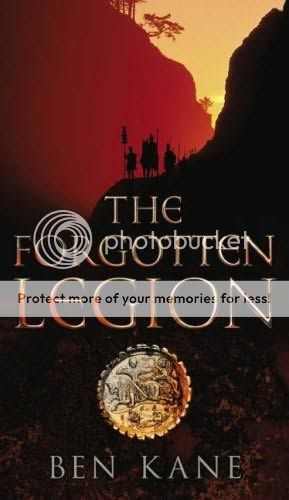
Tarquinius is an Etruscan, a warrior and a soothsayer, born enemy of Rome, but doomed to fight for the Republic in the Forgotten Legion. Brennus is a Gaul: the Romans killed his entire family. He rises to become one of the most famous and feared gladiators of his day – and mentor to the boy slave, Romulus, who dreams night and day of escape and revenge. Romulus and Fabiola are twins, born into slavery after their mother is raped by a drunken nobleman. At thirteen years old they are sold: Romulus to gladiator school, Fabiola into prostitution, where she will catch the eye of one of the most powerful men in Rome.
The lives of these four characters are bound and interwoven in this story, which begins in a Rome riven by corruption, violence and political enemies, but ends far away at the very border of the known world, where Romulus, Brennus and Tarquinius find themselves fighting against the Parthians and impossible odds.
The Forgotten Legion, first in a trilogy, is a fast-paced, gritty story set in the Republican Roman Empire at the time Caesar’s star is risings. Unlike many of the historical fiction I’ve read, this does not revolve around the higher echelons of society. Instead, it takes place at the lowest of social classes – those of slaves, prostitutes and mercenaries. It gives a different point of view of the Roman empire, and it’s not a very pretty sight.
Although very well written, there was one big point of irritation throughout this novel. Ben Kane is very fond of using the Latin terms for things like coins, gladiator types, and weapons. That’s not a problem on its own, but it does become a problem when it starts to confuse the reader. There’s very little explanation of those terms in the story – there’s never a real explanation of Roman monetary systems, so I’ve got no clue what the different coins are worth. Sure, the occasional mention of gold or the reaction of the character gives a hint, but that’s it. Some of the gladiator types get an explanation, others never do – and the terms are thrown around enough that it’s impossible to keep them apart. The same goes for weapons – in the middle of a fight scene, I’ve got no clue what it is that they are fighting with! Are they using spears, axes, swords? Something else? Color me confused. This would have been easily solved with a glossary at the back, giving definitions of the terms. Would have saved me a lot of confusion along the way!
But apart from that, this was a well written, fast-paced, action packed book. The characters are engaging, grow throughout the story, and are sympathetic without being out of character for that time. A nice book if you like gritty stories, but beware that the details are fairly graphic. Recommended for lovers of this genre. I’ll be picking up the sequel for sure.
Tarquinius is an Etruscan, a warrior and a soothsayer, born enemy of Rome, but doomed to fight for the Republic in the Forgotten Legion. Brennus is a Gaul: the Romans killed his entire family. He rises to become one of the most famous and feared gladiators of his day – and mentor to the boy slave, Romulus, who dreams night and day of escape and revenge. Romulus and Fabiola are twins, born into slavery after their mother is raped by a drunken nobleman. At thirteen years old they are sold: Romulus to gladiator school, Fabiola into prostitution, where she will catch the eye of one of the most powerful men in Rome.
The lives of these four characters are bound and interwoven in this story, which begins in a Rome riven by corruption, violence and political enemies, but ends far away at the very border of the known world, where Romulus, Brennus and Tarquinius find themselves fighting against the Parthians and impossible odds.
The Forgotten Legion, first in a trilogy, is a fast-paced, gritty story set in the Republican Roman Empire at the time Caesar’s star is risings. Unlike many of the historical fiction I’ve read, this does not revolve around the higher echelons of society. Instead, it takes place at the lowest of social classes – those of slaves, prostitutes and mercenaries. It gives a different point of view of the Roman empire, and it’s not a very pretty sight.
Although very well written, there was one big point of irritation throughout this novel. Ben Kane is very fond of using the Latin terms for things like coins, gladiator types, and weapons. That’s not a problem on its own, but it does become a problem when it starts to confuse the reader. There’s very little explanation of those terms in the story – there’s never a real explanation of Roman monetary systems, so I’ve got no clue what the different coins are worth. Sure, the occasional mention of gold or the reaction of the character gives a hint, but that’s it. Some of the gladiator types get an explanation, others never do – and the terms are thrown around enough that it’s impossible to keep them apart. The same goes for weapons – in the middle of a fight scene, I’ve got no clue what it is that they are fighting with! Are they using spears, axes, swords? Something else? Color me confused. This would have been easily solved with a glossary at the back, giving definitions of the terms. Would have saved me a lot of confusion along the way!
But apart from that, this was a well written, fast-paced, action packed book. The characters are engaging, grow throughout the story, and are sympathetic without being out of character for that time. A nice book if you like gritty stories, but beware that the details are fairly graphic. Recommended for lovers of this genre. I’ll be picking up the sequel for sure.
49Samantha_kathy
The Divine Sacrifice by Tony Hays - Arthurian Britain (Quarterly Theme Read July-Sep 2012)

Arthur and Malgwyn are called to the abbey of Glastonbury to settle a matter of great political importance - tin is being mined for export to the Empire. While there, Malgwyn and Arthur meet St. Patrick, a legend in the Church who is there on a mission of his own, to root out the heresy of Pelagius.
When an aged monk is found cruelly murdered in his cell, Malgwyn is set with a problem that will test his skills as an investigator. His search for the truth may uncover a conspiracy that could endanger the kingdom.
Just like the first book in this series, this is a very good mystery. I kept turning page after page, wanting to know what was going on. Malgwyn remains an interesting character, who keeps learning from his experiences and changes accordingly. Also, Christian religion plays a large role in this book – and all that it entailed during this time. So that made it interesting from a historical perspective as well. I could expound on all of the things that made this book just as amazing as the first one, but I think the best thing about this book is that it didn’t disappoint. After such an amazing first book, it could have paled in comparison, yet it did not. Highly, highly recommended!

Arthur and Malgwyn are called to the abbey of Glastonbury to settle a matter of great political importance - tin is being mined for export to the Empire. While there, Malgwyn and Arthur meet St. Patrick, a legend in the Church who is there on a mission of his own, to root out the heresy of Pelagius.
When an aged monk is found cruelly murdered in his cell, Malgwyn is set with a problem that will test his skills as an investigator. His search for the truth may uncover a conspiracy that could endanger the kingdom.
Just like the first book in this series, this is a very good mystery. I kept turning page after page, wanting to know what was going on. Malgwyn remains an interesting character, who keeps learning from his experiences and changes accordingly. Also, Christian religion plays a large role in this book – and all that it entailed during this time. So that made it interesting from a historical perspective as well. I could expound on all of the things that made this book just as amazing as the first one, but I think the best thing about this book is that it didn’t disappoint. After such an amazing first book, it could have paled in comparison, yet it did not. Highly, highly recommended!
50Samantha_kathy
The Beloved Dead by Tony Hays - Arthurian Britain (Quarterly Theme Read July-Sep 2012)

To consolidate his power, Arthur decides that it is time to take a noble wife. But in this Malgwyn knows not only his lord's ambition but his personal grief, because in order to take a queen Arthur must set aside his love Guinevere, because he believes that the scandal surrounding their affair has tainted her for the crown.
Malgwyn is sent north to fetch the young woman who is to be Arthur's bride. The way is fraught with tension and disaster for there are forces who would not see the king wed. When Malgwyn discovers a string of killings involving young virginal women who are slaughtered in a horrific manner - not unlike a ritual sacrifice - he is left with a question that he must answer quickly. Are these murders portents of the gods taking vengeance on the intrusion of a new faith? Or mortal men plotting to unseat the king?
The third book in the Arthurian Mysteries series by Tony Hays. Like the two before, this is a very strong, amazing mystery. The setting is ever vibrant and real, and the characters are evolving, living, breathing people – except for the fact that they are of course fictional, although I’d believe you if you said they truly existed back then. That’s how well they are written. This time the mystery central to this book hits a lot of characters – including Malgwyn – very personally. Because by this time I’d become so involved with these characters, the story kept me on the edge of my seat, especially in the last quarter of the book.
I really, really love this series. Each book seems to be just as well written as the previous ones. But what I love most about it is that events in the previous books effect character interactions and the plot of subsequent books. There are no ‘oh, there was a murder, but everything is back the way it was’ summary moments, which I see a lot in cozy mysteries where “village life” continues on as if there hasn’t been dead after dead which were solved by the main character. That, most of all, makes this series worth reading. But beware, while all the books in this series are fairly gritty and graphic in places, the murders in this book are especially gruesome. It’s not for the faint of heart! But otherwise, The Beloved Dead is another great installment in an amazing series.

To consolidate his power, Arthur decides that it is time to take a noble wife. But in this Malgwyn knows not only his lord's ambition but his personal grief, because in order to take a queen Arthur must set aside his love Guinevere, because he believes that the scandal surrounding their affair has tainted her for the crown.
Malgwyn is sent north to fetch the young woman who is to be Arthur's bride. The way is fraught with tension and disaster for there are forces who would not see the king wed. When Malgwyn discovers a string of killings involving young virginal women who are slaughtered in a horrific manner - not unlike a ritual sacrifice - he is left with a question that he must answer quickly. Are these murders portents of the gods taking vengeance on the intrusion of a new faith? Or mortal men plotting to unseat the king?
The third book in the Arthurian Mysteries series by Tony Hays. Like the two before, this is a very strong, amazing mystery. The setting is ever vibrant and real, and the characters are evolving, living, breathing people – except for the fact that they are of course fictional, although I’d believe you if you said they truly existed back then. That’s how well they are written. This time the mystery central to this book hits a lot of characters – including Malgwyn – very personally. Because by this time I’d become so involved with these characters, the story kept me on the edge of my seat, especially in the last quarter of the book.
I really, really love this series. Each book seems to be just as well written as the previous ones. But what I love most about it is that events in the previous books effect character interactions and the plot of subsequent books. There are no ‘oh, there was a murder, but everything is back the way it was’ summary moments, which I see a lot in cozy mysteries where “village life” continues on as if there hasn’t been dead after dead which were solved by the main character. That, most of all, makes this series worth reading. But beware, while all the books in this series are fairly gritty and graphic in places, the murders in this book are especially gruesome. It’s not for the faint of heart! But otherwise, The Beloved Dead is another great installment in an amazing series.
51Samantha_kathy
The Greatest Knight by Elizabeth Chadwick - The Middle Ages (Quarterly Theme Read Oct-Dec 2012)

The Greatest Knight is about the first part of William Marshal’s life, because, as Elizabeth Chadwick herself describes it, he lived so much in his life that it could not fit into one book. This story takes us from his meager beginnings as a new, impoverished knight to his marriage – with his triumphs, downfalls and political maneuvering in the Angevin court between it.
Just like the book about William’s father John, A Place Beyond Courage, the writing was superb. However, I did not connect with William as much as I did with John. For much of the book William seemed to just be going with the flow, only doing enough to keep his head above the water. His ambition had to be spurned on by others, while it burned in his father. This, perhaps, is why I was sometimes annoyed with him and did not enjoy this book as much as I did A Place Beyond Courage. Having said that, The Greatest Knight is still a very good book and highly recommended.

The Greatest Knight is about the first part of William Marshal’s life, because, as Elizabeth Chadwick herself describes it, he lived so much in his life that it could not fit into one book. This story takes us from his meager beginnings as a new, impoverished knight to his marriage – with his triumphs, downfalls and political maneuvering in the Angevin court between it.
Just like the book about William’s father John, A Place Beyond Courage, the writing was superb. However, I did not connect with William as much as I did with John. For much of the book William seemed to just be going with the flow, only doing enough to keep his head above the water. His ambition had to be spurned on by others, while it burned in his father. This, perhaps, is why I was sometimes annoyed with him and did not enjoy this book as much as I did A Place Beyond Courage. Having said that, The Greatest Knight is still a very good book and highly recommended.
52Samantha_kathy
Death at Devil's bridge by Robin Paige - The Victorian Era (December 2012 theme)

Charles and Kathryn are newlyweds and living at Bishop’s Keep. Bradford Marsden asks Charles for a favor: to host an automotive exhibition and a balloon race at Bishop’s Keep. None of them could envision the troubles that would bring or the tragedy that would end a life – or is it more than a simple tragedy?
As with all of the mysteries in this series, there are some historical figures occupying the pages. Charles Rolls, Henry Royce, and Harry John Lawson (called Harry Dunstable in the novel). All of them are of course connected to automotive history, which plays a bit part in this book. As I’ve come to expect, it was a good story, with great mystery that had many unexpected twists and turns. It culminated in a realistic, yet satisfying ending. I thought it was nice to see all the historical and scientific details, but I can imagine that for some readers it will be too much “boring” details. However, I felt it took a while for the mystery to get going, and the slow start makes me give this 4 stars instead of five. For lovers of historical mysteries, I would certainly recommend it.

Charles and Kathryn are newlyweds and living at Bishop’s Keep. Bradford Marsden asks Charles for a favor: to host an automotive exhibition and a balloon race at Bishop’s Keep. None of them could envision the troubles that would bring or the tragedy that would end a life – or is it more than a simple tragedy?
As with all of the mysteries in this series, there are some historical figures occupying the pages. Charles Rolls, Henry Royce, and Harry John Lawson (called Harry Dunstable in the novel). All of them are of course connected to automotive history, which plays a bit part in this book. As I’ve come to expect, it was a good story, with great mystery that had many unexpected twists and turns. It culminated in a realistic, yet satisfying ending. I thought it was nice to see all the historical and scientific details, but I can imagine that for some readers it will be too much “boring” details. However, I felt it took a while for the mystery to get going, and the slow start makes me give this 4 stars instead of five. For lovers of historical mysteries, I would certainly recommend it.
53Samantha_kathy
Mr. Churchill's Secretary by Susan Elia MacNeal

Despite what the title and blurb might have you expect, this book is not in any way a cozy mystery. It has a dark tone, violence, and even in the lighter moments there’s a thread of desperation beneath the merriment that feels real in the face of war. It’s a compelling story of life in London in World War Two, and the historical details are superbly done. It felt like stepping back in time.
The characters of the series are all well fleshed-out, complicated, and none were simply black-and-white, not even the villains. I loved the main character, Maggie, and empathized with. Maggie’s frustration at being shunted aside despite her abilities and intelligence just because she’s a woman sparkles off the page. It made me stop and think about how far we’ve come with emancipation since then – even though we might not be completely there yet.
But the crowning glory of this book, in my opinion, was the plot. It was far more intricate than I had expected – in a good way. It was believable, the pace was realistic, and it wasn’t a ‘one woman show’ where Maggie did everything alone. This gave the plot that ‘it could have really happened’ spark that I like so much in historical novels. I’m not going to say more about the plot, despite the fact that I want to gush about it, so as not to spoil it for anyone. I’ll simply say: read the book, take the ride the plot offers, and let the story unfold. You won’t regret it. Highly recommended!

Despite what the title and blurb might have you expect, this book is not in any way a cozy mystery. It has a dark tone, violence, and even in the lighter moments there’s a thread of desperation beneath the merriment that feels real in the face of war. It’s a compelling story of life in London in World War Two, and the historical details are superbly done. It felt like stepping back in time.
The characters of the series are all well fleshed-out, complicated, and none were simply black-and-white, not even the villains. I loved the main character, Maggie, and empathized with. Maggie’s frustration at being shunted aside despite her abilities and intelligence just because she’s a woman sparkles off the page. It made me stop and think about how far we’ve come with emancipation since then – even though we might not be completely there yet.
But the crowning glory of this book, in my opinion, was the plot. It was far more intricate than I had expected – in a good way. It was believable, the pace was realistic, and it wasn’t a ‘one woman show’ where Maggie did everything alone. This gave the plot that ‘it could have really happened’ spark that I like so much in historical novels. I’m not going to say more about the plot, despite the fact that I want to gush about it, so as not to spoil it for anyone. I’ll simply say: read the book, take the ride the plot offers, and let the story unfold. You won’t regret it. Highly recommended!
54Samantha_kathy
Mrs. Pollifax on Safari by Dorothy Gilman - The Cold War (January 2013 theme)

Mrs. Pollifax is given what seems like an easy and relatively danger-free assignment in this book. All she has to do is go on safari in Zambia and take lots of pictures of the people going on safari with her. For one of them is an assassin and having pictures of all suspects will make it easier for the CIA to figure out which one. However, since this involves Mrs. Pollifax, nothing goes as planned and she ends up in great danger – only this time, it does not seem to have anything to do with her current case, but with an old friend.
Reading this book means having a lovely trip through Zambia with Mrs. Pollifax. It’s clearly set in the 70s, considering the political situation in the country, but it in no way feels dated. There’s humor, a great cast of characters, and danger – exactly what I’ve come to expect from the Mrs. Pollifax books. The story is great, and it has nice twists and turns – both with the case and on a more personal level for Mrs. Pollifax. But I do have the feeling that the situations Mrs. Pollifax finds herself in get more dangerous with every book – like as if now that she’s got more experience, the danger level is adjusted accordingly. The series seems to be maturing, and that’s a good thing.

Mrs. Pollifax is given what seems like an easy and relatively danger-free assignment in this book. All she has to do is go on safari in Zambia and take lots of pictures of the people going on safari with her. For one of them is an assassin and having pictures of all suspects will make it easier for the CIA to figure out which one. However, since this involves Mrs. Pollifax, nothing goes as planned and she ends up in great danger – only this time, it does not seem to have anything to do with her current case, but with an old friend.
Reading this book means having a lovely trip through Zambia with Mrs. Pollifax. It’s clearly set in the 70s, considering the political situation in the country, but it in no way feels dated. There’s humor, a great cast of characters, and danger – exactly what I’ve come to expect from the Mrs. Pollifax books. The story is great, and it has nice twists and turns – both with the case and on a more personal level for Mrs. Pollifax. But I do have the feeling that the situations Mrs. Pollifax finds herself in get more dangerous with every book – like as if now that she’s got more experience, the danger level is adjusted accordingly. The series seems to be maturing, and that’s a good thing.
56Samantha_kathy
They're fun - definitely one of my go-to series when I want something to read I know I'll enjoy.
57Trifolia
Yes, we need this sort of books sometimes, don't we? Well, at least I do. They're like a comfy chair after a long day at the office.
58Samantha_kathy
57> Exactly! So glad someone understands! Not every book needs to be deep, or intense, or such a thriller that it keeps you up at night. A nice, comfy read is sometimes just what the doctor ordered.
59Roro8
I liked your review of Mr Churchill's Secretary so much that I just bought it on my kindle.
60Samantha_kathy
59> I hope you like it just as much as I did!
62Samantha_kathy
61 > Glad you enjoyed it!
63Samantha_kathy
Orion’s Belt by John Michelet - The Cold War (January 2013 theme)

Orion’s Belt is a Cold War thriller that takes place in 1977 in Svalbard. This book is not a fast-paced, action-packed thriller. Instead the tension and malevolence simmers under the surface, keeping me riveted. The bleak prospects for main character are evident right from the start and you just know the chances of a happy ending are slim to none. Still, I kept reading as the story slowly unfolded. The writing style was harsh and direct, with no lyrical prose, which fit the tone of the book. But what I liked most was that Svalbard – the land, the ice, the weather, the spirit of the place – is almost like another character in the book. Recommended!
Orion’s Belt is a Cold War thriller that takes place in 1977 in Svalbard. This book is not a fast-paced, action-packed thriller. Instead the tension and malevolence simmers under the surface, keeping me riveted. The bleak prospects for main character are evident right from the start and you just know the chances of a happy ending are slim to none. Still, I kept reading as the story slowly unfolded. The writing style was harsh and direct, with no lyrical prose, which fit the tone of the book. But what I liked most was that Svalbard – the land, the ice, the weather, the spirit of the place – is almost like another character in the book. Recommended!
64Samantha_kathy
The Burnt-Out Town of Miracles by Roy Jacobsen

This book is a historical novel dealing with the Winter War, which was part of World War Two. The Winter War was a conflict between Finland and the Soviet Union, and this novel tells the story of the months of conflict seen through the eyes of Timo. Timo is an inhabitant of Suomussalmi, one of the main battlegrounds of the war. Yet despite the fact that this book deals with a violent conflict, it’s mostly a quiet novel with many psychological aspects. Timo is often called the village idiot by other characters, and while reading you do realize he does not see the world as most people. Yet at the same time, Timo has his own brand of wisdom. This novel is about a war and about Timo, but above all it is a story of how the unlikeliest of people can be strong in war, yet how those same people can struggle in the peace that follows. It’s a novel that made me think, that touched me, and kept me riveted. It doesn’t have many pages, but it sure packs a punch.

This book is a historical novel dealing with the Winter War, which was part of World War Two. The Winter War was a conflict between Finland and the Soviet Union, and this novel tells the story of the months of conflict seen through the eyes of Timo. Timo is an inhabitant of Suomussalmi, one of the main battlegrounds of the war. Yet despite the fact that this book deals with a violent conflict, it’s mostly a quiet novel with many psychological aspects. Timo is often called the village idiot by other characters, and while reading you do realize he does not see the world as most people. Yet at the same time, Timo has his own brand of wisdom. This novel is about a war and about Timo, but above all it is a story of how the unlikeliest of people can be strong in war, yet how those same people can struggle in the peace that follows. It’s a novel that made me think, that touched me, and kept me riveted. It doesn’t have many pages, but it sure packs a punch.
65Samantha_kathy
Roots by Alex Haley - Civil Rights (February 2013 theme)

Roots by Alex Haley is the story of six generations of African-Americans. It starts with Kunta Kinte, an African man who is captured by slavers, and ends with the author himself. Though the book is fiction, it’s based on the real genealogy of the author. There has been some controversy about the fact part of this story, especially the Africa part. I just call it a fictional story based on true facts. Then it doesn’t matter which parts are not correct, because it’s fictional, but it still gives credit to the research done and the fact that a lot of it is in fact true.
I have to say, this book disappointed me. It was interesting, but not as good as I was expecting. After my father (who is not a reader at all) recognized the title and raved about the mini-series, and all of the things I'd heard about it, I was expecting more. For a book that's about 6 generations, it sure seems to be mostly about one. Almost 400 pages of the book are about Kunta, the other generations are squeezed into the remaining 250 or so pages. I don't mind that Haley wanted to tell Kunta's story, but don't advertise it as a book about six generations if you're going to squeeze five of them in 200 pages! Just write a book about Kunta, and maybe tell us in an afterword how he's related? Or give the other generations their own book - a sort of sequel to Kunta's story. Or even a series if you really want to, one book per generation. Because in the end, this book felt hugely out of balance – long, sometimes overly descriptive of Kunta’s life, and a much faster paced story for the next two generations, while the rest of the generations are more sketches than anything else. I think that's my greatest problem with Roots, no matter how well written it is.
Don’t get me wrong, Roots is a well written book. Although the Africa part of Kunta’s story was a bit too drawn out for my taste – it got repetitive a lot – it did draw me into the story. Sometimes there was a bit of a didactic feel to the writing, but the whole story gives a full picture of the life slaves led – and for that alone this book is worth reading. The contrast between Kunta’s life in Africa and his captured life is large, horrifying, and difficult to read at times. You had better have a strong stomach in order to read about the sea journey Kunta undertakes, or some of the other atrocities he and his descendants underwent.
What one of the largest teaching moments was for me in this book was the hierarchy between the slaves. Kunta is looked down upon as being African and I know, also from other books, that house slaves often considered themselves better than field slaves. It’s both funny and sad how oppressed people divide themselves with their own prejudice, instead of banding together. The fear of the white people towards their slaves was also poignant. The constant threat of an uprising, the frankly ridiculous responses of the slave holders at times, and the slaves playing dumb to avoid punishment. It all turns into a vicious circle that held slavery together for far longer than it should have.
In the end, there were parts of this book I would have liked to have seen shorter, and parts that I would have liked to see more of. But what my genealogy heart really wants to know is where Haley got all the information from – and then I’m talking relationship information of the primary line he follows throughout the book. The book is based on oral history, and in the last chapters Haley tells a little of the research he did, but it’s never quite clear if he managed to corroborate all the oral family history with sources. Leaving the controversy of the African ancestor out of the picture, it’s a miracle that he seems to know every father of the children. I don’t know a lot about African-American ancestor research, but the little I do know indicates that while mothers names were written down, fathers names are often missing. So did he take educated guesses, did he build a case for each father based on indirect evidence, did he actually find evidence for the fathers, or did he just make the fathers up (some or all of them) to make a story? A factual family tree based on sources, marked with which names were corroborated through research and which were taken from oral history alone, would have been appreciated. But I do realize Roots is primarily a fiction book, giving a face to all of the history African-Americans share, that of slavery. And despite its flaws, Roots is a book that tells a story worth telling.

Roots by Alex Haley is the story of six generations of African-Americans. It starts with Kunta Kinte, an African man who is captured by slavers, and ends with the author himself. Though the book is fiction, it’s based on the real genealogy of the author. There has been some controversy about the fact part of this story, especially the Africa part. I just call it a fictional story based on true facts. Then it doesn’t matter which parts are not correct, because it’s fictional, but it still gives credit to the research done and the fact that a lot of it is in fact true.
I have to say, this book disappointed me. It was interesting, but not as good as I was expecting. After my father (who is not a reader at all) recognized the title and raved about the mini-series, and all of the things I'd heard about it, I was expecting more. For a book that's about 6 generations, it sure seems to be mostly about one. Almost 400 pages of the book are about Kunta, the other generations are squeezed into the remaining 250 or so pages. I don't mind that Haley wanted to tell Kunta's story, but don't advertise it as a book about six generations if you're going to squeeze five of them in 200 pages! Just write a book about Kunta, and maybe tell us in an afterword how he's related? Or give the other generations their own book - a sort of sequel to Kunta's story. Or even a series if you really want to, one book per generation. Because in the end, this book felt hugely out of balance – long, sometimes overly descriptive of Kunta’s life, and a much faster paced story for the next two generations, while the rest of the generations are more sketches than anything else. I think that's my greatest problem with Roots, no matter how well written it is.
Don’t get me wrong, Roots is a well written book. Although the Africa part of Kunta’s story was a bit too drawn out for my taste – it got repetitive a lot – it did draw me into the story. Sometimes there was a bit of a didactic feel to the writing, but the whole story gives a full picture of the life slaves led – and for that alone this book is worth reading. The contrast between Kunta’s life in Africa and his captured life is large, horrifying, and difficult to read at times. You had better have a strong stomach in order to read about the sea journey Kunta undertakes, or some of the other atrocities he and his descendants underwent.
What one of the largest teaching moments was for me in this book was the hierarchy between the slaves. Kunta is looked down upon as being African and I know, also from other books, that house slaves often considered themselves better than field slaves. It’s both funny and sad how oppressed people divide themselves with their own prejudice, instead of banding together. The fear of the white people towards their slaves was also poignant. The constant threat of an uprising, the frankly ridiculous responses of the slave holders at times, and the slaves playing dumb to avoid punishment. It all turns into a vicious circle that held slavery together for far longer than it should have.
In the end, there were parts of this book I would have liked to have seen shorter, and parts that I would have liked to see more of. But what my genealogy heart really wants to know is where Haley got all the information from – and then I’m talking relationship information of the primary line he follows throughout the book. The book is based on oral history, and in the last chapters Haley tells a little of the research he did, but it’s never quite clear if he managed to corroborate all the oral family history with sources. Leaving the controversy of the African ancestor out of the picture, it’s a miracle that he seems to know every father of the children. I don’t know a lot about African-American ancestor research, but the little I do know indicates that while mothers names were written down, fathers names are often missing. So did he take educated guesses, did he build a case for each father based on indirect evidence, did he actually find evidence for the fathers, or did he just make the fathers up (some or all of them) to make a story? A factual family tree based on sources, marked with which names were corroborated through research and which were taken from oral history alone, would have been appreciated. But I do realize Roots is primarily a fiction book, giving a face to all of the history African-Americans share, that of slavery. And despite its flaws, Roots is a book that tells a story worth telling.
66cbl_tn
>65 Samantha_kathy: Good review of Roots! Alex Haley's papers are held by the University of Tennessee's library. The collection includes research materials for Roots. The finding aid for the collection is available online.
Several years ago there was a media splash when Alex Haley's nephew received confirmation that his Y-DNA matched a man in Scotland with the surname Baff. The name is pronounced the same as Baugh, the surname of the white plantation overseer that Alex Haley had named as the father of one of his ancestors.
The Library of Congress has assigned a non-fiction classification number to Roots. I'm not comfortable with that for reasons you mention in your review. There's a lot of fact in the book, but the telling leans too heavily toward fiction for me to be comfortable with placing it with non-fiction.
Several years ago there was a media splash when Alex Haley's nephew received confirmation that his Y-DNA matched a man in Scotland with the surname Baff. The name is pronounced the same as Baugh, the surname of the white plantation overseer that Alex Haley had named as the father of one of his ancestors.
The Library of Congress has assigned a non-fiction classification number to Roots. I'm not comfortable with that for reasons you mention in your review. There's a lot of fact in the book, but the telling leans too heavily toward fiction for me to be comfortable with placing it with non-fiction.
67Samantha_kathy
66> Interesting about the Y-DNA match. I might take a look at the finding aid, but to really know what's true and not the research should be actually looked at. Hmm...wonder if I can get someone to pay for a research trip to Tennessee ;).
I agree with you, I wouldn't give family histories a non-fiction classification. The simply fact of novelizing (sp?) a genealogy makes it fiction because you have to "invent" emotions, conversations, and storylines for those times you don't have documentation off. I have written a biography of one of my ancestors keeping to the facts and just the facts - that's non-fiction and it reads like it. If I were to make it into a narrative that reads like a novel, I would have to add to the story with my imagination, depsite how much information I have over this man's life. So, it's fiction - historical fiction based on true facts - like most historical fiction is.
I agree with you, I wouldn't give family histories a non-fiction classification. The simply fact of novelizing (sp?) a genealogy makes it fiction because you have to "invent" emotions, conversations, and storylines for those times you don't have documentation off. I have written a biography of one of my ancestors keeping to the facts and just the facts - that's non-fiction and it reads like it. If I were to make it into a narrative that reads like a novel, I would have to add to the story with my imagination, depsite how much information I have over this man's life. So, it's fiction - historical fiction based on true facts - like most historical fiction is.
68Samantha_kathy
Dissolution by C.J. Sansom - Tudor Era & Renaissance (March 2013 theme & Quarterly Theme Read Jan-March 2013)

It’s hard to write a review about Dissolution without giving too much of the plot away. The most brilliant thing of the entire book is the plot and how all the different strands were woven into a cohesive whole. Aside from the plot itself, I also loved how the events in the book impacted on the main character. Matthew Shardlake is a hunchback lawyer and avid Reformer who works for Thomas Cromwell. When he is tasked with investigating the dead of one of Cromwell’s commissioners who had been tasked with closing down a monastery, things spiral out of control fast. Shardlake is not unaffected by what he finds in the monastery – in fact, he is much changed by the end of the book. I like this, as it’s far more realistic that extraordinary events make a person reassess their worldview.
Aside from the wonderful plot and characters, the situation of 1537 in Tudor England comes to life on the page. Enough historical details abound to make the reader really feel like they’re there, but it never becomes an exercise in showing off research. All in all, Dissolution is historical fiction at its best and I highly recommend it to both mystery lovers and historical fiction fanatics!

It’s hard to write a review about Dissolution without giving too much of the plot away. The most brilliant thing of the entire book is the plot and how all the different strands were woven into a cohesive whole. Aside from the plot itself, I also loved how the events in the book impacted on the main character. Matthew Shardlake is a hunchback lawyer and avid Reformer who works for Thomas Cromwell. When he is tasked with investigating the dead of one of Cromwell’s commissioners who had been tasked with closing down a monastery, things spiral out of control fast. Shardlake is not unaffected by what he finds in the monastery – in fact, he is much changed by the end of the book. I like this, as it’s far more realistic that extraordinary events make a person reassess their worldview.
Aside from the wonderful plot and characters, the situation of 1537 in Tudor England comes to life on the page. Enough historical details abound to make the reader really feel like they’re there, but it never becomes an exercise in showing off research. All in all, Dissolution is historical fiction at its best and I highly recommend it to both mystery lovers and historical fiction fanatics!
69Samantha_kathy
The Confessions of Catherine de Medici by C.W. Gortner - Tudor Era & Renaissance (March 2013 theme & Quarterly Theme Read Jan-March 2013)

This fabulous historical novel follows the life of Catherine de Medici from her time in Italy as a little girl, through her marriage with the eventual king of France, until her time as regent and power behind the throne of her sons and eventual death. The story flows very naturally, the writing pulls you in and that makes this book a fairly quick read, despite the sometimes heavy topic.
The one part of this book that might deter some historical novel fans from picking it up is the fact that Catherine sometimes has visions. But, as the author explains, this is based on historical evidence – many of Catherine’s friends and acquaintances wrote down instances of these visions. Only those instances were put into the story by Gortner. I, myself, did not find it out of place in this novel. Catherine’s attitude to religion, her visions, and the paranormal are in keeping with the time period.
What I liked most about this book is the fact that the author took a woman history has painted black and made her human. He looked at the evidence – the true evidence, not the propaganda spouted by her political enemies – and found a complex woman living in a complex time. She was more tolerant than most Catholic rulers in her time, but she had flaws and made mistakes – sometimes with tragic and bloody consequences. In the end, it is Catherine who made this novel amazing for me. I loved it from beginning to end and I highly recommend it!

This fabulous historical novel follows the life of Catherine de Medici from her time in Italy as a little girl, through her marriage with the eventual king of France, until her time as regent and power behind the throne of her sons and eventual death. The story flows very naturally, the writing pulls you in and that makes this book a fairly quick read, despite the sometimes heavy topic.
The one part of this book that might deter some historical novel fans from picking it up is the fact that Catherine sometimes has visions. But, as the author explains, this is based on historical evidence – many of Catherine’s friends and acquaintances wrote down instances of these visions. Only those instances were put into the story by Gortner. I, myself, did not find it out of place in this novel. Catherine’s attitude to religion, her visions, and the paranormal are in keeping with the time period.
What I liked most about this book is the fact that the author took a woman history has painted black and made her human. He looked at the evidence – the true evidence, not the propaganda spouted by her political enemies – and found a complex woman living in a complex time. She was more tolerant than most Catholic rulers in her time, but she had flaws and made mistakes – sometimes with tragic and bloody consequences. In the end, it is Catherine who made this novel amazing for me. I loved it from beginning to end and I highly recommend it!
70Roro8
I also really liked The Confessions of Catherine de Medici. Have you read The Last Queen by Gortner? It was also a great read about a misunderstood woman.
Great review of Dissolution too. I will have that book seed planted in the back of my mind now.
Great review of Dissolution too. I will have that book seed planted in the back of my mind now.
71Samantha_kathy
70 > No, I haven't read anything else by Gortner, but he's definitely a writer that's now on my radar!
72Samantha_kathy
The Secret History of the Pink Carnation by Lauren Willig - The Napoleonic Era (Quarterly Theme Read Oct-Dec 2013)

A historical romance with a dash of mystery best describes this book. I liked the light-hearted tone with some humor in it, augmented by the more serious backdrop of Napoleon threatening England and the ensuing bits of adventure. There’s also some contemporary chapters of Eloise who’s reading documents that tell the story of what happened in 1803, with a dash of romance for her as well – although that wasn’t resolved in this book. I will admit that at first the modern day chapter interruptions of the main story annoyed me, but I got used to it and I did like to see Eloise’s guesses as to who the Pink Carnation was and her reactions to the unfolding stories. All in all, I liked this book a lot, but the modern day chapters I could’ve done without and made me give this book 4 instead of 5 stars.
As an aside, for everyone who reviewed The Secret History of the Pink Carnation and complained it was too much a romance and not enough straight-up historical novel… Did you even read the back of the book? The blurbs? Anything? Because this book (cover and all!) couldn't spell historical romance any better than it already does. Seriously. This book does not in any way market itself as a serious historical novel, but squarely places itself in the historical romance corner. So I really don't understand people complaining about that aspect of the book in their reviews. How can you not know this when you pick the book up to read?

A historical romance with a dash of mystery best describes this book. I liked the light-hearted tone with some humor in it, augmented by the more serious backdrop of Napoleon threatening England and the ensuing bits of adventure. There’s also some contemporary chapters of Eloise who’s reading documents that tell the story of what happened in 1803, with a dash of romance for her as well – although that wasn’t resolved in this book. I will admit that at first the modern day chapter interruptions of the main story annoyed me, but I got used to it and I did like to see Eloise’s guesses as to who the Pink Carnation was and her reactions to the unfolding stories. All in all, I liked this book a lot, but the modern day chapters I could’ve done without and made me give this book 4 instead of 5 stars.
As an aside, for everyone who reviewed The Secret History of the Pink Carnation and complained it was too much a romance and not enough straight-up historical novel… Did you even read the back of the book? The blurbs? Anything? Because this book (cover and all!) couldn't spell historical romance any better than it already does. Seriously. This book does not in any way market itself as a serious historical novel, but squarely places itself in the historical romance corner. So I really don't understand people complaining about that aspect of the book in their reviews. How can you not know this when you pick the book up to read?
73christina_reads
@ 72 -- I agree with you; the modern parts of Pink Carnation are definitely not as interesting as the historical parts! That's a trend that continues throughout the series, in my opinion. I will say that not every cover of the book screams "historical romance" as much as that one does...my cover (to the original hardcover edition) looks much more like a regular historical fiction novel. But I'm OK with some romance, so I still really liked it! Will you continue with the series?
74Samantha_kathy
73, Christina > I know that not every cover will have the "historical romance" feeling, but the blurbs and everything do. I don't see them being very different between different book covers/editions.
The modern parts were less interesting, but there weren't that many of them (and they made good break points to stop reading). So yes, I'll continue the series, although I've got no idea when I'll get to the next book.
The modern parts were less interesting, but there weren't that many of them (and they made good break points to stop reading). So yes, I'll continue the series, although I've got no idea when I'll get to the next book.
75Samantha_kathy
DNF: Timecachers by Glenn R. Petrucci (December 2013 theme)

The best I can say about this book is that it’s writing was amateuristic. The story starts out slow, but fairly intriguing, as the readers divines very quickly there’s more going on than the main characters are being told. However, that’s coupled with a very technical talk about measuring positions on the Earth and in space, which could get a bit difficult to follow when it came to moving objects. Both title of the book and back blurb already gave away that that professor Odan is lying when he says he doesn’t know where the anomalies lead, especially since he specifies early American history knowledge as a requisite for doing the field testing as well as taking notes more manually than usual.
The somewhat clunky beginning could’ve been forgiven if the story had picked up after that, but it didn’t. The flaws kept coming. From repeating information unnecessarily to a very slow moving plot, it all bogged down the story the author is trying to tell. I hoped the story would pick up in pace when the main characters were finally transported into the past and for a little while it seemed like it would. But then the fatal flaw of this book came to light. I could forgive the fairly easy acceptance from not one, but two characters from the past about the main characters being from the future. However, two characters from 1838 talking to each other as if giving a history lesson? Yeah, I’m not swallowing that. Especially since it’s not necessary, as we’re in the point of view of a main character who knows his history and would thus be able to give the necessary information to the reading in his inner narrative. At that point, 125 pages in, I gave up on this book. The story premise has potential and it might turn into an enjoyable book if you can forgive the clumsy writing. For that, it gets 2 stars.

The best I can say about this book is that it’s writing was amateuristic. The story starts out slow, but fairly intriguing, as the readers divines very quickly there’s more going on than the main characters are being told. However, that’s coupled with a very technical talk about measuring positions on the Earth and in space, which could get a bit difficult to follow when it came to moving objects. Both title of the book and back blurb already gave away that that professor Odan is lying when he says he doesn’t know where the anomalies lead, especially since he specifies early American history knowledge as a requisite for doing the field testing as well as taking notes more manually than usual.
The somewhat clunky beginning could’ve been forgiven if the story had picked up after that, but it didn’t. The flaws kept coming. From repeating information unnecessarily to a very slow moving plot, it all bogged down the story the author is trying to tell. I hoped the story would pick up in pace when the main characters were finally transported into the past and for a little while it seemed like it would. But then the fatal flaw of this book came to light. I could forgive the fairly easy acceptance from not one, but two characters from the past about the main characters being from the future. However, two characters from 1838 talking to each other as if giving a history lesson? Yeah, I’m not swallowing that. Especially since it’s not necessary, as we’re in the point of view of a main character who knows his history and would thus be able to give the necessary information to the reading in his inner narrative. At that point, 125 pages in, I gave up on this book. The story premise has potential and it might turn into an enjoyable book if you can forgive the clumsy writing. For that, it gets 2 stars.
76Samantha_kathy
Sea Scoundrel by Annette Blair

Sea Scoundrel is the first book in the Knave of Hearts series and the extended version of Annette Blair’s 1999 novel Lady Patience. I never read that novel, so for me the entire story of Sea Scoundrel was new. And I loved it! There was so much humor in this book, I had a smile on my face throughout. The main characters as well as the minor characters were well drawn, rounded human beings and their interactions were realistic. All in all, it was well written.
The sea journey, part I of the book, was hilarious and filled with tension at the right moments. Part II, set in London, was more about family than anything else. I liked the wider look of the book, as it went beyond just the relationship between the main characters. It also showed very well how thin the proper veneer of high society in that time really was. As is usual in these types of books the ending is predictable, but the way to the ending is the real draw. Definitely recommended for everyone who like humorous historical romances.

Sea Scoundrel is the first book in the Knave of Hearts series and the extended version of Annette Blair’s 1999 novel Lady Patience. I never read that novel, so for me the entire story of Sea Scoundrel was new. And I loved it! There was so much humor in this book, I had a smile on my face throughout. The main characters as well as the minor characters were well drawn, rounded human beings and their interactions were realistic. All in all, it was well written.
The sea journey, part I of the book, was hilarious and filled with tension at the right moments. Part II, set in London, was more about family than anything else. I liked the wider look of the book, as it went beyond just the relationship between the main characters. It also showed very well how thin the proper veneer of high society in that time really was. As is usual in these types of books the ending is predictable, but the way to the ending is the real draw. Definitely recommended for everyone who like humorous historical romances.
77Roro8
It sounds like you really enjoyed Sea Scoundrel. I don;t know that I've ever read a humorous historical before.
78Samantha_kathy
77, Roro > I've read humoristic romances before and I like them. They're a bit like candy fluff - fun and quickly gone.
79Samantha_kathy
DNF: De Valse Meesters (The False Masters) by Javier Gonzalez (May 2014 theme)

De Valse Meesters is a book that combines a contemporary storyline with a historical storyline. The historical storyline is set in around World War Two and deals with the Spanish Civil War, Nazis and a painting. The contemporary storyline involves a man who goes to look for his great-aunt’s fiancé’s body, who died in World War Two and the director of a museum who discovers a family secret.
Right from the start I wasn’t that enthusiastic about the book. It sounded great from the blurb, but once I started reading it I quickly discovered that the flashbacks depicting the historical storyline are the best bits. But the modern day parts come off as...tacky, I think is the best word, and the modern part of the story takes up the majority of the book. The two main characters in the modern parts just don't grab me, they come off as superficial and whiny. There's a bit of a mystery as the main plot, but that's (after almost 100 pages) still not really taking off. Bit disappointing really. I really wish this was just a straight-up historical novel, without the modern (supposedly) thriller plotline, because that would have been a book worth reading. This book, not so much.

De Valse Meesters is a book that combines a contemporary storyline with a historical storyline. The historical storyline is set in around World War Two and deals with the Spanish Civil War, Nazis and a painting. The contemporary storyline involves a man who goes to look for his great-aunt’s fiancé’s body, who died in World War Two and the director of a museum who discovers a family secret.
Right from the start I wasn’t that enthusiastic about the book. It sounded great from the blurb, but once I started reading it I quickly discovered that the flashbacks depicting the historical storyline are the best bits. But the modern day parts come off as...tacky, I think is the best word, and the modern part of the story takes up the majority of the book. The two main characters in the modern parts just don't grab me, they come off as superficial and whiny. There's a bit of a mystery as the main plot, but that's (after almost 100 pages) still not really taking off. Bit disappointing really. I really wish this was just a straight-up historical novel, without the modern (supposedly) thriller plotline, because that would have been a book worth reading. This book, not so much.
80Samantha_kathy
DNF: No Place for a Lady by Maggie Brendan (Quarterly Theme Read July-Sep 2014)

No Place for a Lady is set in 1892. Crystal Clark moves from the South to Colorado, where her aunt owns a cattle ranch. It’s supposed to be just a visit, but when tragedy strikes she must try to save the ranch. All the while, she battles against the very different environment and the opinions of some those around her that a cattle ranch is no place for a lady.
It sounds like a good book, an interesting historical romance with an interesting setting. However, 87 pages in everything is still so very bland. There’s no real spark between the two main characters and I feel no real connection to the book. It’s not a bad book by any definition of the word, but there’s nothing there holding my attention either. In the end, I can only conclude this is not a book for me. Maybe someone else will enjoy it more than I did.

No Place for a Lady is set in 1892. Crystal Clark moves from the South to Colorado, where her aunt owns a cattle ranch. It’s supposed to be just a visit, but when tragedy strikes she must try to save the ranch. All the while, she battles against the very different environment and the opinions of some those around her that a cattle ranch is no place for a lady.
It sounds like a good book, an interesting historical romance with an interesting setting. However, 87 pages in everything is still so very bland. There’s no real spark between the two main characters and I feel no real connection to the book. It’s not a bad book by any definition of the word, but there’s nothing there holding my attention either. In the end, I can only conclude this is not a book for me. Maybe someone else will enjoy it more than I did.
81Samantha_kathy
Badge of Honor by Robert J. Thomas (Quarterly Theme Read July-Sep 2014)
Badge of Honor is the tenth book in the Jess Williams series. Although it stands mostly alone, you do miss some things as events and relationships are referenced without background. Other than that, it’s a typical western – lots of threats and shooting, not much substance to the plot. The characters are all overdrawn, becoming caricatures. The writing is okay, but not very inspiring. But despite all this it’s a very entertaining read.
The plot gets a tiny bit better when Clay Finch is introduced about half-way through, but it never does rise above the obvious. Almost every Western cliché is in this book and that’s what makes it so entertaining. And yes, the clichés include a gunfight at high noon! But the book doesn’t pretend to be anything but what it is – a cliché Western written to entertain lovers of Westerns.
I would like to offer a word of warning. The bodies drop pretty rapidly and there’s a lot of violence in this book. There are no real graphic descriptions that linger on the violence, but the descriptions are very matter-of-fact. Sexual violence isn’t shown, but it is mentioned several times.
All in all, this was a nice, quick and easy read. It was nothing special, but very entertaining and the type of thing you think about when someone says Western.
Badge of Honor is the tenth book in the Jess Williams series. Although it stands mostly alone, you do miss some things as events and relationships are referenced without background. Other than that, it’s a typical western – lots of threats and shooting, not much substance to the plot. The characters are all overdrawn, becoming caricatures. The writing is okay, but not very inspiring. But despite all this it’s a very entertaining read.
The plot gets a tiny bit better when Clay Finch is introduced about half-way through, but it never does rise above the obvious. Almost every Western cliché is in this book and that’s what makes it so entertaining. And yes, the clichés include a gunfight at high noon! But the book doesn’t pretend to be anything but what it is – a cliché Western written to entertain lovers of Westerns.
I would like to offer a word of warning. The bodies drop pretty rapidly and there’s a lot of violence in this book. There are no real graphic descriptions that linger on the violence, but the descriptions are very matter-of-fact. Sexual violence isn’t shown, but it is mentioned several times.
All in all, this was a nice, quick and easy read. It was nothing special, but very entertaining and the type of thing you think about when someone says Western.
82Samantha_kathy
Seawitch by Alistair MacLean (October 2014 theme)
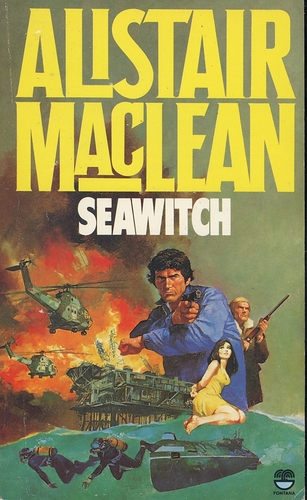
Seawitch is the story and name of a new type of oil drilling platforms, large, sophisticated and mobile. It’s set in the latter half of the 1970s, after the 1973 oil crisis. The Seawitch is owned by billionaire Lord Worth, who plans to greatly undercut the established oil companies. This, not surprisingly, makes him a lot of powerful enemies who will do anything to stop him. Thrown in some Cold War and anti-US countries looking to make trouble as well, and you have a right mess. But when the two daughters of Lord Worth are kidnapped, the two private detectives who are in friends with them get involved.
Now, that sounds like a thrilling story, full of action. And in a way it is. There’s action and explosions and tension…well, maybe not that last one. The story is told in a third person omniscient voice and that narrative voice sounds, quite frankly, bored. The story style is more summarizing, hand waving, ‘oh, this happened’ than anything else. Not even the most tense moments managed to actually come across as exciting. It all fell very flat. This was not helped by the fact that the characters seemed very much like caricatures. There was no depth to any of them.
The story had a lot of promise, the premise was great, the events in the book would make a good story, but the way it was told makes it rather boring. All in all, this book disappointed me. It was a fairly fast read, but hardly the thrilling thriller I expected.
Seawitch is the story and name of a new type of oil drilling platforms, large, sophisticated and mobile. It’s set in the latter half of the 1970s, after the 1973 oil crisis. The Seawitch is owned by billionaire Lord Worth, who plans to greatly undercut the established oil companies. This, not surprisingly, makes him a lot of powerful enemies who will do anything to stop him. Thrown in some Cold War and anti-US countries looking to make trouble as well, and you have a right mess. But when the two daughters of Lord Worth are kidnapped, the two private detectives who are in friends with them get involved.
Now, that sounds like a thrilling story, full of action. And in a way it is. There’s action and explosions and tension…well, maybe not that last one. The story is told in a third person omniscient voice and that narrative voice sounds, quite frankly, bored. The story style is more summarizing, hand waving, ‘oh, this happened’ than anything else. Not even the most tense moments managed to actually come across as exciting. It all fell very flat. This was not helped by the fact that the characters seemed very much like caricatures. There was no depth to any of them.
The story had a lot of promise, the premise was great, the events in the book would make a good story, but the way it was told makes it rather boring. All in all, this book disappointed me. It was a fairly fast read, but hardly the thrilling thriller I expected.
83Samantha_kathy
Last book of this year:
Rachel's Secret by Shelly Sanders (Quarterly Theme Read October-December 2014)

Rachel’s Secret is a historical novel set in Kishinev in 1903. Back then, Kishinev was still Russian, though now it’s the capital of Moldova. Early in the year, the Jewish Rachel witnesses the murder of a Christian boy. Forced to keep silent, suspicion falls to the Jewish community. Tensions rise as prejudice and rumors abound and eventually it all comes to a head.
I really enjoyed this story. Rachel’s Secret is a well written book, with writing that flows and makes reading this books fast and easy, despite the topic. It’s well researched and that shows, without letting the details overwhelm the story. I don’t know if this book is marketed as young adult, but I think it would be a good book for young adults. At its core, the story is a coming of age tale. It’s also the first in a trilogy, and I do think I’d be interested in reading the other two. But, the story stands very well on its own. Recommended for those who like historical fiction and coming of age stories.
Rachel's Secret by Shelly Sanders (Quarterly Theme Read October-December 2014)

Rachel’s Secret is a historical novel set in Kishinev in 1903. Back then, Kishinev was still Russian, though now it’s the capital of Moldova. Early in the year, the Jewish Rachel witnesses the murder of a Christian boy. Forced to keep silent, suspicion falls to the Jewish community. Tensions rise as prejudice and rumors abound and eventually it all comes to a head.
I really enjoyed this story. Rachel’s Secret is a well written book, with writing that flows and makes reading this books fast and easy, despite the topic. It’s well researched and that shows, without letting the details overwhelm the story. I don’t know if this book is marketed as young adult, but I think it would be a good book for young adults. At its core, the story is a coming of age tale. It’s also the first in a trilogy, and I do think I’d be interested in reading the other two. But, the story stands very well on its own. Recommended for those who like historical fiction and coming of age stories.
84Samantha_kathy
Shout at the Devil by Wilbur Smith (Quarterly Theme Read January-March 2015)

I’m writing this review nine months after reading this book and the plot and characters are still clear as day in my mind. That alone says how much impact this book had. It’s a brilliant book, although it had its flaws regarding attitudes towards race since it was written in 1968. But the characters and the plot are very strong and the book resonated with me.
Although the blurb on the back of the book talks about the story being set in the early days of World War One, about half of the book is actually set in the early 1930s. It starts off slow, but that slow beginning drew me in masterfully and made the impact of the second half of the book even harder. The main story is about elephant poacher Flynn O’Flynn and his feud with a German Commissioner, Herman Fleischer. When the war breaks out, that feud is a reflection of the world at large, and their personal conflict suddenly reaches global importance. There is, however, a small subplot running through the book that also centers around Flynn and reminded me of the storyline in Moby Dick, only instead of the hunt for the white whale, this was the hunt for a very specific elephant. I’m not quite sure I liked that subplot, even though it did much to show Flynn’s character.
I do want to give one word of warning to those wanting to read this book. There is one scene that, while not even the most graphic I’ve ever read, deals with extreme violence against a very young child and that might be disturbing to read. It certainly was disturbing to me and while it was important to the plot and not gratuitous violence, I think it’s worth warning for.
All in all, I really liked this book. For history lovers who want to read about World War One in the African theater this is definitely a book I’d recommend.

I’m writing this review nine months after reading this book and the plot and characters are still clear as day in my mind. That alone says how much impact this book had. It’s a brilliant book, although it had its flaws regarding attitudes towards race since it was written in 1968. But the characters and the plot are very strong and the book resonated with me.
Although the blurb on the back of the book talks about the story being set in the early days of World War One, about half of the book is actually set in the early 1930s. It starts off slow, but that slow beginning drew me in masterfully and made the impact of the second half of the book even harder. The main story is about elephant poacher Flynn O’Flynn and his feud with a German Commissioner, Herman Fleischer. When the war breaks out, that feud is a reflection of the world at large, and their personal conflict suddenly reaches global importance. There is, however, a small subplot running through the book that also centers around Flynn and reminded me of the storyline in Moby Dick, only instead of the hunt for the white whale, this was the hunt for a very specific elephant. I’m not quite sure I liked that subplot, even though it did much to show Flynn’s character.
I do want to give one word of warning to those wanting to read this book. There is one scene that, while not even the most graphic I’ve ever read, deals with extreme violence against a very young child and that might be disturbing to read. It certainly was disturbing to me and while it was important to the plot and not gratuitous violence, I think it’s worth warning for.
All in all, I really liked this book. For history lovers who want to read about World War One in the African theater this is definitely a book I’d recommend.
85Samantha_kathy
The Help by Kathryn Stockett - (Quarterly Theme Read October-December 2015)

An awesome book that’s set in Jackson, Mississippi in the 1960s. Racial segregation is in full swing, but civil rights protesters are trying to make a change. Tensions are high, and so is the fear in the black community. In the midst of that are two black maids – one who has always spoken her mind, to her detriment – and one who has kept silent for years but finds that since her son died she cannot keep the bitterness inside anymore. And then there’s the white socialite who wants to be a journalist. Together, these women embark on a dangerous project because all three of them are fighting against the invisible lines and rules that restrict them.
This is a book that makes the big issues of the 1960s very personal. It’s a difficult book to capture in words, so I am just going to suggest you read it. This is by far the best book I’ve read this year, and I might even say that it’s the best book I’ve read in years. Highly recommended.

An awesome book that’s set in Jackson, Mississippi in the 1960s. Racial segregation is in full swing, but civil rights protesters are trying to make a change. Tensions are high, and so is the fear in the black community. In the midst of that are two black maids – one who has always spoken her mind, to her detriment – and one who has kept silent for years but finds that since her son died she cannot keep the bitterness inside anymore. And then there’s the white socialite who wants to be a journalist. Together, these women embark on a dangerous project because all three of them are fighting against the invisible lines and rules that restrict them.
This is a book that makes the big issues of the 1960s very personal. It’s a difficult book to capture in words, so I am just going to suggest you read it. This is by far the best book I’ve read this year, and I might even say that it’s the best book I’ve read in years. Highly recommended.

