This topic is currently marked as "dormant"—the last message is more than 90 days old. You can revive it by posting a reply.
1readeron
A new year, a new thread! I really can't predict how many books I'll read this year. We'll see.
My previous threads can be found here:
1st - http://www.librarything.com/topic/42186
2nd - http://www.librarything.com/topic/70518
3rd - http://www.librarything.com/topic/96216
4th - http://www.librarything.com/topic/107834
My previous threads can be found here:
1st - http://www.librarything.com/topic/42186
2nd - http://www.librarything.com/topic/70518
3rd - http://www.librarything.com/topic/96216
4th - http://www.librarything.com/topic/107834
2readeron
#1 Remarkable Creatures by Tracy Chevalier
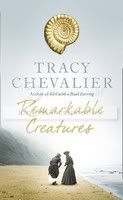
352 pages
5 stars
"In the early nineteenth century, a windswept beach along the English coast brims with fossils for those with the eye! From the moment she's struck by lightning as a baby, it is clear Mary Anning is marked for greatness. When she uncovers unknown dinosaur fossils in the cliffs near her home, she sets the scientific world alight, challenging ideas about the world's creation and stimulating debate over our origins. In an arena dominated by men, however, Mary is soon reduced to a serving role, facing prejudice from the academic community, vicious gossip from neighbours, and the heartbreak of forbidden love. Even nature is a threat, throwing bitter cold, storms, and landslips at her. Luckily Mary finds an unlikely champion in prickly, intelligent Elizabeth Philpot, a middle-class spinster who is also fossil-obsessed. Their relationship strikes a delicate balance between fierce loyalty and barely suppressed envy. Despite their differences in age and background, Mary and Elizabeth discover that, in struggling for recognition, friendship is their strongest weapon. Remarkable Creatures is Tracy Chevalier's stunning new novel of how one woman's gift transcends class and gender to lead to some of the most important discoveries of the nineteenth century. Above all, it is a revealing portrait of the intricate and resilient nature of female friendship." /goodreads/
"Tracy Chevalier does a wonderful job of taking true events/historical people and placing them in their cultural and societal constraints, exploring their world and that world's significance to the characters. Yes, it's made up, though based on fact and research, but it's also a revealing look at history through the eyes of those who lived it. If only all history texts could do that." /Abby, goodreads/
"Wonderful! Author Tracy Chevalier did an incredible job of bringing two little known women to life for us all and intriguing us with their stories.
Mary Anning is an uneducated young girl who has been searching the beaches of Lyme, England her entire life for fossils to sell at the families shop. Mary's father has taught her what he knows, but Mary has the eye for finding fossils and that just can't be taught. The story opens with Mary's first recollection; the feeling of being struck by lightning as a baby. Mary swears that the lightning became part of her and still lives within her, helping her with her special gift of finding unusual "curies", as these fossil curiosities were known.
Elizabeth Philpot and her two spinster sisters have just been moved to Lyme by their brother and his new wife who have taken over the family home in London. Elizabeth has developed a fascination for fish fossils and begins to wander the beach in search of them. It is only natural that Elizabeth and Mary would become friends, even with the distance in their ages.
When Mary finds a fossil of an animal that is not known in this world, it raises questions from the superstisious religious community and many of the townspeople are afraid, shunning Mary and her family. The creature is very large and well known fossil collectors want it and any other's that Mary's eye may find.
The author did such a fantastic job with these two women, showcasing their strengths and weakness' both in an era that women were not given the credits that they deserved for their contributions to science. I found myself really liking both women, hating a few of the men and cheering for a couple of the others. I completely recommend this intriguing story. You'll read it in just a couple of sittings!"
/Paula, goodreads/
352 pages
5 stars
"In the early nineteenth century, a windswept beach along the English coast brims with fossils for those with the eye! From the moment she's struck by lightning as a baby, it is clear Mary Anning is marked for greatness. When she uncovers unknown dinosaur fossils in the cliffs near her home, she sets the scientific world alight, challenging ideas about the world's creation and stimulating debate over our origins. In an arena dominated by men, however, Mary is soon reduced to a serving role, facing prejudice from the academic community, vicious gossip from neighbours, and the heartbreak of forbidden love. Even nature is a threat, throwing bitter cold, storms, and landslips at her. Luckily Mary finds an unlikely champion in prickly, intelligent Elizabeth Philpot, a middle-class spinster who is also fossil-obsessed. Their relationship strikes a delicate balance between fierce loyalty and barely suppressed envy. Despite their differences in age and background, Mary and Elizabeth discover that, in struggling for recognition, friendship is their strongest weapon. Remarkable Creatures is Tracy Chevalier's stunning new novel of how one woman's gift transcends class and gender to lead to some of the most important discoveries of the nineteenth century. Above all, it is a revealing portrait of the intricate and resilient nature of female friendship." /goodreads/
"Tracy Chevalier does a wonderful job of taking true events/historical people and placing them in their cultural and societal constraints, exploring their world and that world's significance to the characters. Yes, it's made up, though based on fact and research, but it's also a revealing look at history through the eyes of those who lived it. If only all history texts could do that." /Abby, goodreads/
"Wonderful! Author Tracy Chevalier did an incredible job of bringing two little known women to life for us all and intriguing us with their stories.
Mary Anning is an uneducated young girl who has been searching the beaches of Lyme, England her entire life for fossils to sell at the families shop. Mary's father has taught her what he knows, but Mary has the eye for finding fossils and that just can't be taught. The story opens with Mary's first recollection; the feeling of being struck by lightning as a baby. Mary swears that the lightning became part of her and still lives within her, helping her with her special gift of finding unusual "curies", as these fossil curiosities were known.
Elizabeth Philpot and her two spinster sisters have just been moved to Lyme by their brother and his new wife who have taken over the family home in London. Elizabeth has developed a fascination for fish fossils and begins to wander the beach in search of them. It is only natural that Elizabeth and Mary would become friends, even with the distance in their ages.
When Mary finds a fossil of an animal that is not known in this world, it raises questions from the superstisious religious community and many of the townspeople are afraid, shunning Mary and her family. The creature is very large and well known fossil collectors want it and any other's that Mary's eye may find.
The author did such a fantastic job with these two women, showcasing their strengths and weakness' both in an era that women were not given the credits that they deserved for their contributions to science. I found myself really liking both women, hating a few of the men and cheering for a couple of the others. I completely recommend this intriguing story. You'll read it in just a couple of sittings!"
/Paula, goodreads/
3readeron
#2 Prince Caspian by C.S. Lewis
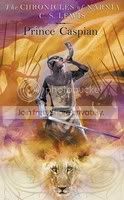
256 pages
4 stars
"Prince Caspian, the 4th installment (...), brings back the original cast of characters and follows an adventure-quest plot more similar to The Lion, the Witch, and the Wardrobe. Our heroes are pulled back to Narnia after some time, only to discover things are not as wonderful as when they left. The rulers of the land fear the woods and the sea, and oppress animals that can talk.
The crew arrives as school children, but morph into the warriors we know them to be, and lead the young Prince Caspian to victory, and a restoration of Narnia as the Lion intended." /cfink, LibraryThing/
"I really like the premise of this section of the Narnia Chronicles, how Lucy, Edmund, Susan, and Peter – children still with their memories of their royal lives – move through time to appear far in Narnia’s future. I like how the world evolved, yet legends of the past lived on. I really enjoyed much of this book more than I’ve enjoyed any of the Chronicles thus far, although I thought it got too cutesy at the end with all the talking animals dancing.
Lucy: “Wouldn’t it be dreadful if some day in our own world, at home, men started going wild inside, like the animals here, and still looked like men, so that you’d never know which were which?” (p. 101)" /Othemts, LibraryThing/
256 pages
4 stars
"Prince Caspian, the 4th installment (...), brings back the original cast of characters and follows an adventure-quest plot more similar to The Lion, the Witch, and the Wardrobe. Our heroes are pulled back to Narnia after some time, only to discover things are not as wonderful as when they left. The rulers of the land fear the woods and the sea, and oppress animals that can talk.
The crew arrives as school children, but morph into the warriors we know them to be, and lead the young Prince Caspian to victory, and a restoration of Narnia as the Lion intended." /cfink, LibraryThing/
"I really like the premise of this section of the Narnia Chronicles, how Lucy, Edmund, Susan, and Peter – children still with their memories of their royal lives – move through time to appear far in Narnia’s future. I like how the world evolved, yet legends of the past lived on. I really enjoyed much of this book more than I’ve enjoyed any of the Chronicles thus far, although I thought it got too cutesy at the end with all the talking animals dancing.
Lucy: “Wouldn’t it be dreadful if some day in our own world, at home, men started going wild inside, like the animals here, and still looked like men, so that you’d never know which were which?” (p. 101)" /Othemts, LibraryThing/
4readeron
#3 The Voyage of the Dawn Treader by C.S. Lewis
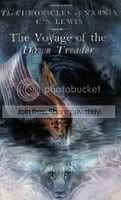
288 pages
4 stars
"A voyage to the very ends of the world. Narnia... where a dragon awakens... where stars walk the earth... where anything can happen. A king and some unexpected companions embark on a voyage that will take them beyond all known lands. As they sail father and farther from charted waters, they discover that their quest is more than they imagined and that the world's end is only the beginning." /goodreads/
"Voyage of the Dawn Treader is quite a fun adventure book. We are introduced to Eustace, a spoiled cousin of the Pevensies. Lucy and Edmond go to stay with Eustace and his family one summer and are whisked back into Narnia, with Eustace along for the ride. They are hauled aboard a ship called the Dawn Treader where they find their old friends Caspian, Reepicheep, and others. The ship is sailing to find the seven lost Lords of Narnia.
Through their search, they encounter strange islands and odd creatures. This is where the story really gets going. In my opinion this is one of the lighter and more fun books in the series. I thoroughly enjoyed it and I regret that I didn't read it twenty years ago. It could almost be read as a stand-alone book if someone was not familiar with the rest of the series." /tipsister, LibraryThing/
IMO, it's the second best sequel in the series (so far).
288 pages
4 stars
"A voyage to the very ends of the world. Narnia... where a dragon awakens... where stars walk the earth... where anything can happen. A king and some unexpected companions embark on a voyage that will take them beyond all known lands. As they sail father and farther from charted waters, they discover that their quest is more than they imagined and that the world's end is only the beginning." /goodreads/
"Voyage of the Dawn Treader is quite a fun adventure book. We are introduced to Eustace, a spoiled cousin of the Pevensies. Lucy and Edmond go to stay with Eustace and his family one summer and are whisked back into Narnia, with Eustace along for the ride. They are hauled aboard a ship called the Dawn Treader where they find their old friends Caspian, Reepicheep, and others. The ship is sailing to find the seven lost Lords of Narnia.
Through their search, they encounter strange islands and odd creatures. This is where the story really gets going. In my opinion this is one of the lighter and more fun books in the series. I thoroughly enjoyed it and I regret that I didn't read it twenty years ago. It could almost be read as a stand-alone book if someone was not familiar with the rest of the series." /tipsister, LibraryThing/
IMO, it's the second best sequel in the series (so far).
5readeron
#4 The Elementary Particles by Michel Houellebecq
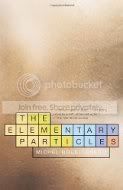
272 pages
5 stars
A brilliant, unputdownable dystopian satire in which (IMO) Huxley meets Updike. Highly recommended, especially if you like dark humour and postmodernist fiction.
"Houellebecq is telling us that "free" market, "free" love and "free" individuality are all an illusion. Sure, it's been said before, but not like this. Read it. Shake your head at the silly parts and give it a good think.
As you read The Elementary Particles, you are reminded of so many French philosophical writers. He takes his personal experiences with absolute misery and frustration and carefully reworks them into a surreal parable in which every twist of the plot is pedantically underlined with a unifying world view.
Just as the Marquis de Sade's sex crazed characters rave on for pages about atheism and Nature, Houellebecq's poor creations deliver speech after speech, sewing up Houellebecq's own enormous thesis. Houellebecq has no time for a clear plot or believable character development, but that's not suprising. He is trying to take on western civilization and he does an admirable job.
As a writer, Houellebecq is an imitator, but in the novel, he makes mention of almost all of his ancestors, Sade, Celine, Camus, Sartre and even Kafka. As a thinker, he comes to the table heavily armed, and although he falters time and again, his second novel cannot be dismissed as cynical nonsense. Even more shocking than Houellebecq's novel is the fact that writers don't try this more often." /Christa Payne, Amazon/
272 pages
5 stars
A brilliant, unputdownable dystopian satire in which (IMO) Huxley meets Updike. Highly recommended, especially if you like dark humour and postmodernist fiction.
"Houellebecq is telling us that "free" market, "free" love and "free" individuality are all an illusion. Sure, it's been said before, but not like this. Read it. Shake your head at the silly parts and give it a good think.
As you read The Elementary Particles, you are reminded of so many French philosophical writers. He takes his personal experiences with absolute misery and frustration and carefully reworks them into a surreal parable in which every twist of the plot is pedantically underlined with a unifying world view.
Just as the Marquis de Sade's sex crazed characters rave on for pages about atheism and Nature, Houellebecq's poor creations deliver speech after speech, sewing up Houellebecq's own enormous thesis. Houellebecq has no time for a clear plot or believable character development, but that's not suprising. He is trying to take on western civilization and he does an admirable job.
As a writer, Houellebecq is an imitator, but in the novel, he makes mention of almost all of his ancestors, Sade, Celine, Camus, Sartre and even Kafka. As a thinker, he comes to the table heavily armed, and although he falters time and again, his second novel cannot be dismissed as cynical nonsense. Even more shocking than Houellebecq's novel is the fact that writers don't try this more often." /Christa Payne, Amazon/
6readeron
#5 Breakfast of Champions by Kurt Vonnegut
302 pages
5 stars
"In Breakfast of Champions, one of Kurt Vonnegut’s most beloved characters, the aging writer Kilgore Trout, finds to his horror that a Midwest car dealer is taking his fiction as truth. What follows is murderously funny satire, as Vonnegut looks at war, sex, racism, success, politics, and pollution in America and reminds us how to see the truth." /goodreads/
"Kurt Vonnegut's novel "Breakfast of Champions" follows the odyssey of oddball science fiction writer Kilgore Trout from his melancholy childhood in Bermuda, to the sleazy underside of New York City, and eventually to a fateful encounter with car dealer Wayne Hoover, a man "on the brink of going insane." Within this framework Vonnegut weaves an amazing satiric tapestry that looks at racism, mental illness, environmental crises, the nature and function of art, and many other issues. The book is filled with Vonnegut's own quirky illustrations.
""Breakfast" is harsh, even cruel, but also tender and compassionate; it's laugh-out-loud funny, yet haunting and tragic. It's also a reality-warping metaphysical triumph; Vonnegut breaks down the barriers between reality and fiction, and invites the reader into the very process of the novel's creation. He creates a more intimate bond between author, reader, and fictional character than any other writer I can think of.
Vonnegut presents some of American literature's most memorable characters in "Breakfast." But my favorite is undoubtedly Trout. Throughout the book we also get glimpses of Trout's own voluminous body of work, and meet some of his bizarre sci-fi characters. The book as a whole is also enriched by Vonnegut's unique style; he writes as if for an extraterrestrial audience to whom humanity is utterly alien.
"Breakfast" is a profane, naughty, yet profoundly spiritual book. Filled with strange and vivid details, it's an oddly comforting modern-day testament for our fractured world. Thanks, Kurt." /Michael J. Mazza, Amazon/
"Is it possible to say anything new about a book that has been in print for ~30 years, that has been read by millions, and which is widely studied in schools and universities?
No... but I do want to say that I loved every word (and illustration). You can pick up this old novel and get a very fresh outlook both on the human condition and on how novels ought to be written.
Vonnegut writes like he is explaining life on Earth to alien children. It is a tool that produces incredibly poignant satire, which he uses effectively to give commentary on conditions of life that the vast majority of us accept without even noticing. The language used is very simple but wonderfully lyrical, less-than-average readers will fly right through it.
Although clearly sadenned by his life, and by his observations of the planet, Vonnegut wrote a masterpiece that remains hopeful in its despair.
Kurt Vonnegut is a genius, and will no doubt be recognized as one of the 20th Century's greatest." /Count Zero, Amazon/
It was my 10th Vonnegut. And I want more. Now.:)
302 pages
5 stars
"In Breakfast of Champions, one of Kurt Vonnegut’s most beloved characters, the aging writer Kilgore Trout, finds to his horror that a Midwest car dealer is taking his fiction as truth. What follows is murderously funny satire, as Vonnegut looks at war, sex, racism, success, politics, and pollution in America and reminds us how to see the truth." /goodreads/
"Kurt Vonnegut's novel "Breakfast of Champions" follows the odyssey of oddball science fiction writer Kilgore Trout from his melancholy childhood in Bermuda, to the sleazy underside of New York City, and eventually to a fateful encounter with car dealer Wayne Hoover, a man "on the brink of going insane." Within this framework Vonnegut weaves an amazing satiric tapestry that looks at racism, mental illness, environmental crises, the nature and function of art, and many other issues. The book is filled with Vonnegut's own quirky illustrations.
""Breakfast" is harsh, even cruel, but also tender and compassionate; it's laugh-out-loud funny, yet haunting and tragic. It's also a reality-warping metaphysical triumph; Vonnegut breaks down the barriers between reality and fiction, and invites the reader into the very process of the novel's creation. He creates a more intimate bond between author, reader, and fictional character than any other writer I can think of.
Vonnegut presents some of American literature's most memorable characters in "Breakfast." But my favorite is undoubtedly Trout. Throughout the book we also get glimpses of Trout's own voluminous body of work, and meet some of his bizarre sci-fi characters. The book as a whole is also enriched by Vonnegut's unique style; he writes as if for an extraterrestrial audience to whom humanity is utterly alien.
"Breakfast" is a profane, naughty, yet profoundly spiritual book. Filled with strange and vivid details, it's an oddly comforting modern-day testament for our fractured world. Thanks, Kurt." /Michael J. Mazza, Amazon/
"Is it possible to say anything new about a book that has been in print for ~30 years, that has been read by millions, and which is widely studied in schools and universities?
No... but I do want to say that I loved every word (and illustration). You can pick up this old novel and get a very fresh outlook both on the human condition and on how novels ought to be written.
Vonnegut writes like he is explaining life on Earth to alien children. It is a tool that produces incredibly poignant satire, which he uses effectively to give commentary on conditions of life that the vast majority of us accept without even noticing. The language used is very simple but wonderfully lyrical, less-than-average readers will fly right through it.
Although clearly sadenned by his life, and by his observations of the planet, Vonnegut wrote a masterpiece that remains hopeful in its despair.
Kurt Vonnegut is a genius, and will no doubt be recognized as one of the 20th Century's greatest." /Count Zero, Amazon/
It was my 10th Vonnegut. And I want more. Now.:)
7billiejean
I finally found your new thread! Happy New Year! You are off to a great start with your reading this year already.
I have plunged into a bunch of long books, and I am not really finishing anything. But I am sticking with them and also starting a reading of the Asimov Foundation series, which I have never read before. I hope that I can read through that more quickly.
Which 1001 list are you using? I have the 2006 book, but there are lots of other titles out there not in that first book. The latest group read is not in my book, but I checked it out of the library. It looks pretty interesting.
I have plunged into a bunch of long books, and I am not really finishing anything. But I am sticking with them and also starting a reading of the Asimov Foundation series, which I have never read before. I hope that I can read through that more quickly.
Which 1001 list are you using? I have the 2006 book, but there are lots of other titles out there not in that first book. The latest group read is not in my book, but I checked it out of the library. It looks pretty interesting.
8readeron
Happy New Year, BJ! I have your new thread starred, too!
I'm still struggling/juggling with several books that I started to read in 2011, plus I keep getting interested in new ones, so the list of the books I'm sticking with is getting longer and longer almost every day. At the same time, there are books that just grab me and they get finished before I could think twice. Sometimes I feel really lucky that reading is just a hobby - there's no system in this madness at all, but I guess such is (my reading) life.:)
Asimov sounds great, I used to read a lot of short stories by him when I was younger, but I've never given a try to his longer works yet. I'm always a bit worried that I would find them boring or something, and then one of my idols would fall off his pedestal. It's really crazy sometimes how silly ideas can keep one (me) back from reading something cool. Anyway, I hope you'll like the Foundation series! Someday I really should overcome my worries, too, especially because it's been on my TBR list for ages...
I'm using the listology list: (http://www.listology.com/ukaunz/list/1001-books-you-must-read-you-die), and I think it must have been taken from the 2006 book, as well. There seem to be some newer, modified lists, but so far I've been too lazy to look them up (which may change later:). After all, I think these books were written to give us a wide choice of books worth reading rather than to restrict us in any way.
Thanks for stopping by!
Happy reading and have a great day!:)
I'm still struggling/juggling with several books that I started to read in 2011, plus I keep getting interested in new ones, so the list of the books I'm sticking with is getting longer and longer almost every day. At the same time, there are books that just grab me and they get finished before I could think twice. Sometimes I feel really lucky that reading is just a hobby - there's no system in this madness at all, but I guess such is (my reading) life.:)
Asimov sounds great, I used to read a lot of short stories by him when I was younger, but I've never given a try to his longer works yet. I'm always a bit worried that I would find them boring or something, and then one of my idols would fall off his pedestal. It's really crazy sometimes how silly ideas can keep one (me) back from reading something cool. Anyway, I hope you'll like the Foundation series! Someday I really should overcome my worries, too, especially because it's been on my TBR list for ages...
I'm using the listology list: (http://www.listology.com/ukaunz/list/1001-books-you-must-read-you-die), and I think it must have been taken from the 2006 book, as well. There seem to be some newer, modified lists, but so far I've been too lazy to look them up (which may change later:). After all, I think these books were written to give us a wide choice of books worth reading rather than to restrict us in any way.
Thanks for stopping by!
Happy reading and have a great day!:)
9readeron
#6 Für Elise by Magda Szabó

417 pages
4 stars
"Szabó's memoirs (?) Für Elise (2002), once again recalling the Debrecen of her youth in a magical, half-realistic, half-fairy-tale-like manner." /Guardian/
The whole article about the author can be read here:
http://www.guardian.co.uk/news/2007/nov/28/guardianobituaries.booksobituaries
A quite enjoyable (though occasionally a bit too melodramatic for my taste) story about two young girls growing up in Hungary between the two world wars. It was a relatively fast read. I must admit that I read the novel as pure fiction: although it obviously includes a lot of autobiographical elements, noone seems to be sure about way too many details. IMO it's a typical case of autofiction (a term coined in 1977, according to wikipedia, - more can be read about the genre here: http://en.wikipedia.org/wiki/Autofiction). I think Szabó has written several novels with the same concept in her mind. Finding the playful intertextuality of her oeuvre quite amusing, I think I will read more by the author, even though I can't really imagine yet when could I do so.
(For example, I'm some 50 pages in the second volume of Don Quixote, and I'm quite enjoying it, but sometimes I worry that it will never end... Plus, right now it seems I should read 8 novels in 4 weeks if I want to take seriously the library deadlines... It seems pretty hopeless that I can do it.)
417 pages
4 stars
"Szabó's memoirs (?) Für Elise (2002), once again recalling the Debrecen of her youth in a magical, half-realistic, half-fairy-tale-like manner." /Guardian/
The whole article about the author can be read here:
http://www.guardian.co.uk/news/2007/nov/28/guardianobituaries.booksobituaries
A quite enjoyable (though occasionally a bit too melodramatic for my taste) story about two young girls growing up in Hungary between the two world wars. It was a relatively fast read. I must admit that I read the novel as pure fiction: although it obviously includes a lot of autobiographical elements, noone seems to be sure about way too many details. IMO it's a typical case of autofiction (a term coined in 1977, according to wikipedia, - more can be read about the genre here: http://en.wikipedia.org/wiki/Autofiction). I think Szabó has written several novels with the same concept in her mind. Finding the playful intertextuality of her oeuvre quite amusing, I think I will read more by the author, even though I can't really imagine yet when could I do so.
(For example, I'm some 50 pages in the second volume of Don Quixote, and I'm quite enjoying it, but sometimes I worry that it will never end... Plus, right now it seems I should read 8 novels in 4 weeks if I want to take seriously the library deadlines... It seems pretty hopeless that I can do it.)
10billiejean
I have two books due at the library Wednesday and I haven't even started either one.
12readeron
#7 Szerelemlék by Edit Sohonyai
176 pages
4 stars
(first published: 1991)
A cute, undemanding young adult novel from the very beginning of the 90s. Somehow, I had no time (wasn't in the right mood?) for girly books in those years. Altough the story has nothing to do with the cover art until the very last pages, I really enjoyed it now. I especially enjoyed the author's sense of humour.
(No touchstones to the book, probably no info about it on LT at all - strange.)
(Now I go and finish Don Quixote in a hurry, it's only 200 more pages and I'm more and more curious about where the story goes next.:)
176 pages
4 stars
(first published: 1991)
A cute, undemanding young adult novel from the very beginning of the 90s. Somehow, I had no time (wasn't in the right mood?) for girly books in those years. Altough the story has nothing to do with the cover art until the very last pages, I really enjoyed it now. I especially enjoyed the author's sense of humour.
(No touchstones to the book, probably no info about it on LT at all - strange.)
(Now I go and finish Don Quixote in a hurry, it's only 200 more pages and I'm more and more curious about where the story goes next.:)
13readeron
8. Don Quixote (1605) by Miguel de Cervantes

1056 pages
5 stars
"There is nothing else like Cervantes' masterpiece. It's enchanting, humorous, philosophical, outrageous, absurd, beautiful and all around mesmerizing. There simply aren't words I can use here that wouldn't be totally trite and cliche to try expressing the tremendous value of this great two-part work. (...) There are many, many marvelous descriptions and lovely tableaux of words ingeniously welded into the picaresque tales of Don Quixote, the nobleman from La Mancha who has been deluded by an excess of reading about the knights-errant, accompanied by his loyal squire Sancho Panza upon his donkey Dapple. Their many interchanges are cleverly amusing and humorous. There's just something magical, enchanting and pure about the stories of Don Quixote in spite of all the grandiose absurdity and inexhaustible web of misfortunes in which the two main characters constantly find themselves. It's a work of mammoth scholarship, built on a world of knowledge surrounding medieval literature and all the tales about chivalry and knightly romance, yet stamped all over with an unforgettable uniqueness that makes Don Quixote a totally original work. There's nothing else like Don Quixote and I feel greatly, greatly enriched as a lover of literature having read this literary gold mine." /Daniel Pecheur, goodreads/
"Entertaining, funny, bawdy, inventive, comic, ironic...this is one fantastic piece of literature. It stoops occasionally towards slapstick and toilet humor, but other than that it is sheer genius. Cervantes was inventing the modern novel as he went along. All the forms the modern reader is used to are here. Cervantes never forgets that his job is to entertain, and he skips around, narrating as the author, the editor, anyone and any point of view he needs. It's post-modern! He openly refers to his contemporaries, his rivals, his readers, society at large. He will stop the story dead in order to have one of the characters launch into a side-story. The language is poetic, and it is amazing and enlightening to learn that people 400 years ago were calling each other "blockhead," for example. Go read this masterpiece! /keith koenigsberg, goodreads/
Just what I kept thinking! Why do they call it the first modern novel when it's soooo definitely and obviously post-modern! (And what a brilliant read as such!:)

1056 pages
5 stars
"There is nothing else like Cervantes' masterpiece. It's enchanting, humorous, philosophical, outrageous, absurd, beautiful and all around mesmerizing. There simply aren't words I can use here that wouldn't be totally trite and cliche to try expressing the tremendous value of this great two-part work. (...) There are many, many marvelous descriptions and lovely tableaux of words ingeniously welded into the picaresque tales of Don Quixote, the nobleman from La Mancha who has been deluded by an excess of reading about the knights-errant, accompanied by his loyal squire Sancho Panza upon his donkey Dapple. Their many interchanges are cleverly amusing and humorous. There's just something magical, enchanting and pure about the stories of Don Quixote in spite of all the grandiose absurdity and inexhaustible web of misfortunes in which the two main characters constantly find themselves. It's a work of mammoth scholarship, built on a world of knowledge surrounding medieval literature and all the tales about chivalry and knightly romance, yet stamped all over with an unforgettable uniqueness that makes Don Quixote a totally original work. There's nothing else like Don Quixote and I feel greatly, greatly enriched as a lover of literature having read this literary gold mine." /Daniel Pecheur, goodreads/
"Entertaining, funny, bawdy, inventive, comic, ironic...this is one fantastic piece of literature. It stoops occasionally towards slapstick and toilet humor, but other than that it is sheer genius. Cervantes was inventing the modern novel as he went along. All the forms the modern reader is used to are here. Cervantes never forgets that his job is to entertain, and he skips around, narrating as the author, the editor, anyone and any point of view he needs. It's post-modern! He openly refers to his contemporaries, his rivals, his readers, society at large. He will stop the story dead in order to have one of the characters launch into a side-story. The language is poetic, and it is amazing and enlightening to learn that people 400 years ago were calling each other "blockhead," for example. Go read this masterpiece! /keith koenigsberg, goodreads/
Just what I kept thinking! Why do they call it the first modern novel when it's soooo definitely and obviously post-modern! (And what a brilliant read as such!:)
14billiejean
My daughter and I were just discussing this wonderful book last night. She read it in the original Spanish, but I had to read it in English. I thought it was terrific!
15readeron
I loved it too!:)
It was one of the (nowadays more and more) novels I've read entirely in Hungarian and while I was reading I had to stop quite often, partly because the books had to be returned to the library once or twice in the meantime. (I guess I borrowed the novel for the first time in June or July.:)
Anyway, my copy had a wonderful and very informative essay (or whatever, plus pages and pages of notes) about the life of Cervantes, the social, historical and economic background of the novel, the literary world of Europe in Cervantes' time - so I could enjoy the novel on several different levels without googling a bit or using Sparknotes.:) The translation of my copy was also absolutely outstanding (as far as I could judge it without knowing a word of Spanish), it really made the whole novel enjoyable and easily accessible to me.
(Unfortunately, nowadays I read more and more books in Hungarian (shame on the libraries and my usual curiousity/impatience as well, of course:) (plus the silly deadlines:), even though I quite often do have the English copies, too. Still, I think here, on LT, the point is not really the language practice (even though I keep feeling guilty and often reproach myself whenever I read an English or American work in Hungarian) but rather the actual texts. Of course, I plan to read more books in English again, but I haven't considered it a special goal for a while. (Shame on me again, but I already keep telling to myself that I really, really should!:)
Reading Don Quixote in Spanish must be a special treat, I bet, though! And I read only good things about the English translations too.:)
It was one of the (nowadays more and more) novels I've read entirely in Hungarian and while I was reading I had to stop quite often, partly because the books had to be returned to the library once or twice in the meantime. (I guess I borrowed the novel for the first time in June or July.:)
Anyway, my copy had a wonderful and very informative essay (or whatever, plus pages and pages of notes) about the life of Cervantes, the social, historical and economic background of the novel, the literary world of Europe in Cervantes' time - so I could enjoy the novel on several different levels without googling a bit or using Sparknotes.:) The translation of my copy was also absolutely outstanding (as far as I could judge it without knowing a word of Spanish), it really made the whole novel enjoyable and easily accessible to me.
(Unfortunately, nowadays I read more and more books in Hungarian (shame on the libraries and my usual curiousity/impatience as well, of course:) (plus the silly deadlines:), even though I quite often do have the English copies, too. Still, I think here, on LT, the point is not really the language practice (even though I keep feeling guilty and often reproach myself whenever I read an English or American work in Hungarian) but rather the actual texts. Of course, I plan to read more books in English again, but I haven't considered it a special goal for a while. (Shame on me again, but I already keep telling to myself that I really, really should!:)
Reading Don Quixote in Spanish must be a special treat, I bet, though! And I read only good things about the English translations too.:)
16readeron
#9 The Silver Chair (Chronicles of Narnia)
by C.S. Lewis, Pauline Baynes (Illustrator)
272 pages
4 stars
"Once again C.S. Lewis went beyond the borders of Narnia for another "Narnian" book - and once again, he came up with a new character with enormous humor and appeal for children.
In this case, the character is Puddleglum the Marsh-Wiggle. He guides Jill Pole and Eustace Scrubb as they "follow the signs" on a quest given them by Aslan. They must rescue the lost Prince Rilian, son of Prince Caspian.
There are several points at which characters are irritatingly oblivious to the obvious, throughout the book. I'll give no spoilers, but they're rather obvious. And Aslan comes off as something of a nagging wanker; what's with the mysterious "signs"? Jerking people around with hints and confusing portents may represent some sort of divine test of their moral fiber, but in my book it's just irritating. As Lewis himself seems to realize, since Aslan says at the end "I shall not always be scolding."
It's towards the very end of the book that we get a flash of that imagination that made The Voyage of the Dawn Treader such a refreshing change in the Narnia series. The deep land of Bism sounds quite interesting, and I wish Lewis had set a Narnia story there.
All in all, The Silver Chair is quite an exciting and well-told story. It's clear that Lewis' considerable talents as a writer continued to develop over time. The later Narnia books are better than the earlier ones, although The Lion, the Witch, and the Wardrobe does have a special quality that makes it particularly memorable.
(As always, I must note that recent editions have been burdened with an incorrect ordering by the publisher. The books should be read in the order in which they were written and published, NOT the order indicated by the numbering of modern editions. The publisher's recommended order spoils many of the nicest surprises, and I regard it as pure idiocy.)" /Peter Maranci, goodreads/
by C.S. Lewis, Pauline Baynes (Illustrator)
272 pages
4 stars
"Once again C.S. Lewis went beyond the borders of Narnia for another "Narnian" book - and once again, he came up with a new character with enormous humor and appeal for children.
In this case, the character is Puddleglum the Marsh-Wiggle. He guides Jill Pole and Eustace Scrubb as they "follow the signs" on a quest given them by Aslan. They must rescue the lost Prince Rilian, son of Prince Caspian.
There are several points at which characters are irritatingly oblivious to the obvious, throughout the book. I'll give no spoilers, but they're rather obvious. And Aslan comes off as something of a nagging wanker; what's with the mysterious "signs"? Jerking people around with hints and confusing portents may represent some sort of divine test of their moral fiber, but in my book it's just irritating. As Lewis himself seems to realize, since Aslan says at the end "I shall not always be scolding."
It's towards the very end of the book that we get a flash of that imagination that made The Voyage of the Dawn Treader such a refreshing change in the Narnia series. The deep land of Bism sounds quite interesting, and I wish Lewis had set a Narnia story there.
All in all, The Silver Chair is quite an exciting and well-told story. It's clear that Lewis' considerable talents as a writer continued to develop over time. The later Narnia books are better than the earlier ones, although The Lion, the Witch, and the Wardrobe does have a special quality that makes it particularly memorable.
(As always, I must note that recent editions have been burdened with an incorrect ordering by the publisher. The books should be read in the order in which they were written and published, NOT the order indicated by the numbering of modern editions. The publisher's recommended order spoils many of the nicest surprises, and I regard it as pure idiocy.)" /Peter Maranci, goodreads/
17readeron
#10 The Last Battle by C.S. Lewis
229 pages
4 stars
"This is the culmination of the Narnia series. As the earlier works are based on aspects of Christianity and the Bible, so too is this work conceived around themes found in Revelations / Apocalypse. Here we find Lewis making some of his strongest pronouncements of right and wrong." /AlexTheHunn, LibraryThing/
"A strong and startling conclusion to the Narnia series. This is not the usual children's fare, but includes a great deal about loss, betrayal, and collective insanity. Sample quote: "An honorable death is a treasure which no man is too poor to buy." The end is, like Bach's Cantata 21, a breakthrough into stunning joy." /Patentnonsense, LibraryThing/
"The Last Battle is the final, and darkest of the books in The Chronicles of Narnia. In the novel, the story of the end of Narnia is told, closely following the Book of Revelations.
People who are not familiar with the last book of The Bible might be surprised by the bleakness of Last Battle. This is the first book where you feel any of the protagonists could be killed in the novel. There is also very little of Lewis's humor in the book. There is little doubt that Lewis is taking his subject very seriously.
I've been reading a bit on the internet about The Chronicles of Narnia. I was surprised to find that some people consider the reason that Susan never returned to Narnia as a statement of sexism on the part of Lewis. I am not a scholar of Lewis's writing, but I read this as Lewis attempting to write himself out of a corner.
The Book of Revelation makes heavy use of the numbers seven and twelve. In attempting to follow Revelation Lewis needed to have seven Champions of Narnia, and he had written eight in the preceding books. To keep the numbers straight, someone had to not come back.
It is clear from some of the other writing of Lewis's that he had a very traditional view of the roll of women. However, what is written in The Last Battle does not indicate that Lewis considered an interest in sex as an obstacle to faith.
Overall, The Last Battle closes the Chronicles of Narnia quite cleanly. It is the final lesson intended by Lewis, and delivers the lesson effectively." /Christopher Sears, goodreads/
-- even more SPOILERS coming up! -----
-
-
-
-
"THEY ALL DIE IN A TRAIN CRASH? What the hell kind of ending is that? And how could Lewis have been so heartlessly cavalier and brief and matter-of-fact about his manner of presenting this great tragedy?
And what the hell is the meaning of leaving Susan out of eternal bliss simply because she's currently enamored with lipstick?
And I guess, for staunch Christians, eternal life is their highest aim. Of course it is. But to dismiss the value of life on earth, or in Narnia, because they are only "shadowlands" is, I think, a piss poor message for a book that claims to be for children. Give us a little more of the doing good deeds part and less about the fact that it all doesn't matter in the end, anyway, as long as you are a true believer. If you believe you can act any damn way you please and, by the way, dying ain't no big deal. So go ahead and don't be careful or anything. Deal?" /Krista Blackwood, goodreads/
"The main part of the story was interesting, although I found that it stretched even my great capacity to suspend disbelief. Hmnh. I think from here on out, this will be spoilerish, so consider yourself warned . . .
(...)
Perhaps one of my problems with this book was that I found it the most overtly allegorical of Christianity, in a way that doesn't "speak" to me. Jesus vs. the Devil (Aslan vs. Tash) is not part of my own religious view. That's not necessarily a problem for me when reading fiction, but for some reason, in this particular book it seemed over-the-top and too obvious, and annoyed me just a bit. I got the feeling I was being preached at, something I don't enjoy. I also found the last section of the book overly long and tedious - all the stuff about swimming up the waterfall, etc. Yeah, I GET it, Aslan's country ROX, now can we wrap this up already? :D
(...)
The things mentioned above, though, are of less importance than my feelings about the very ending. Maybe I'll feel differently in time, or after a subsequent reading, but I'm just not sure I found it satisfying. I hadn't guessed about the train wreck (although in looking back, yes, it was most assuredly foreshadowed). But argh! While I love the idea of the Pevensies (especially Lucy) getting to stay with their beloved Aslan, OMG, they were so young, and it just seemed so sudden and violent and somehow gratuitous. (...) And does Lucy, now, never get to grow up? Oh, I guess we're not supposed to think about that, but I found it really shocking, and sort of an uncomfortable way to end what was otherwise a fanciful and very charming series of books.
I guess Lewis wanted to make the point that Heaven is the real destination, and the only one that matters, but yow. I felt a bit battered by it, when all is said and done. Perhaps it's just that his vision doesn't conform to my own, but I found myself feeling sad at the end of things, rather than uplifted.
After saying all that, I suppose it might be surprising that I'm rating the book 7/10 - but I really did enjoy it. Well, most of it, anyway. /herebedragons, LibraryThing/
That's how I feel about this sequel, too, in a nutshell.
And Tash was soooo wonderfully creepy when he appeared unexpectedly first!:) - the Horror-Fan-in-Me adds quietly.
----
Found another review that I just must quote here, too, because it made me laugh out loud and because I think it's so very true:
"I agree with the reviewer who said this was the worst ending ever. Not only does it have the worst ending, but the book itself is the worst ending to any series that I have ever read. Period.
Seriously, Mr. Lewis, what the hell is this though? Aside from the phenomenally craptacular ending--where we're supposed to believe that the very best thing that could possibly happen is for everybody to die--this book was just a whole lot of suck. It seemed to have no point whatsoever, except that Lewis decided he was done writing Narnia stories, and instead of leaving it open for fans to imagine what adventures might've come after, he figured he could cram some more Christian allegory in there and thoroughly traumatize his young audience by killing off every single character they'd come to love. Except Susan, because we shun the nonbeliever, shuuuunnnn.
Whatever. It was completely unnecessary, and the "but it's okay because they went to heaven" ending made me roll my eyes so hard they were in danger of falling out, but it didn't piss me off half so much as the convoluted End Times theme. What the fuck? There was absolutely no rhyme or reason to it whatsoever, at least that I could pinpoint. Basically some jerkass old ape (I see what you did there, Mr. Lewis) dresses up this gullible ass in a lion skin and starts ordering the Narnians around as the mouthpiece of Aslan, so instead of punishing Shift for his wickedness, Aslan DESTROYS THE WORLD. Because that's not overreacting or anything. Apparently Lewis ascribed to the angry, vengeful God of the old testament. I mean, wow. Was it because the Narnians were so easily deceived by the false Aslan and their love for him turned to fear and revulsion? Because it seems to me to be largely a result of Aslan's long absence, combined with the apparent inherent stupidity of Narnians, that made them susceptible to the lies of Shift and the Calormenes, which Aslan in his omniscience would've known would happen if he stayed away. So, in other words, he punished THE ENTIRE WORLD for something that he could've prevented and chose not to. Nice."
/Daniella, goodreads/
I still give the book 4 stars because I enjoyed it most of the time while I was reading. Somehow I can't get so upset about religious themes nowadays, and as a story in itself, (minus the allegory's more and more preachy tone) the book was quite exciting (and Tash was soooo creeepy:) until Ashlan appeared, even though I felt shunned a bit by the author, too (like Susan?) later, I was exited to get to know what's next. Like I've probably said before: who should/could be tolerant towards the exaggerations of a religious author if not the non-believer? (One can't help getting used to being preached at after a while...) So let it be 4 stars.
Well, Mr Lewis, I really wanted to like your series a lot more.
229 pages
4 stars
"This is the culmination of the Narnia series. As the earlier works are based on aspects of Christianity and the Bible, so too is this work conceived around themes found in Revelations / Apocalypse. Here we find Lewis making some of his strongest pronouncements of right and wrong." /AlexTheHunn, LibraryThing/
"A strong and startling conclusion to the Narnia series. This is not the usual children's fare, but includes a great deal about loss, betrayal, and collective insanity. Sample quote: "An honorable death is a treasure which no man is too poor to buy." The end is, like Bach's Cantata 21, a breakthrough into stunning joy." /Patentnonsense, LibraryThing/
"The Last Battle is the final, and darkest of the books in The Chronicles of Narnia. In the novel, the story of the end of Narnia is told, closely following the Book of Revelations.
People who are not familiar with the last book of The Bible might be surprised by the bleakness of Last Battle. This is the first book where you feel any of the protagonists could be killed in the novel. There is also very little of Lewis's humor in the book. There is little doubt that Lewis is taking his subject very seriously.
I've been reading a bit on the internet about The Chronicles of Narnia. I was surprised to find that some people consider the reason that Susan never returned to Narnia as a statement of sexism on the part of Lewis. I am not a scholar of Lewis's writing, but I read this as Lewis attempting to write himself out of a corner.
The Book of Revelation makes heavy use of the numbers seven and twelve. In attempting to follow Revelation Lewis needed to have seven Champions of Narnia, and he had written eight in the preceding books. To keep the numbers straight, someone had to not come back.
It is clear from some of the other writing of Lewis's that he had a very traditional view of the roll of women. However, what is written in The Last Battle does not indicate that Lewis considered an interest in sex as an obstacle to faith.
Overall, The Last Battle closes the Chronicles of Narnia quite cleanly. It is the final lesson intended by Lewis, and delivers the lesson effectively." /Christopher Sears, goodreads/
-- even more SPOILERS coming up! -----
-
-
-
-
"THEY ALL DIE IN A TRAIN CRASH? What the hell kind of ending is that? And how could Lewis have been so heartlessly cavalier and brief and matter-of-fact about his manner of presenting this great tragedy?
And what the hell is the meaning of leaving Susan out of eternal bliss simply because she's currently enamored with lipstick?
And I guess, for staunch Christians, eternal life is their highest aim. Of course it is. But to dismiss the value of life on earth, or in Narnia, because they are only "shadowlands" is, I think, a piss poor message for a book that claims to be for children. Give us a little more of the doing good deeds part and less about the fact that it all doesn't matter in the end, anyway, as long as you are a true believer. If you believe you can act any damn way you please and, by the way, dying ain't no big deal. So go ahead and don't be careful or anything. Deal?" /Krista Blackwood, goodreads/
"The main part of the story was interesting, although I found that it stretched even my great capacity to suspend disbelief. Hmnh. I think from here on out, this will be spoilerish, so consider yourself warned . . .
(...)
Perhaps one of my problems with this book was that I found it the most overtly allegorical of Christianity, in a way that doesn't "speak" to me. Jesus vs. the Devil (Aslan vs. Tash) is not part of my own religious view. That's not necessarily a problem for me when reading fiction, but for some reason, in this particular book it seemed over-the-top and too obvious, and annoyed me just a bit. I got the feeling I was being preached at, something I don't enjoy. I also found the last section of the book overly long and tedious - all the stuff about swimming up the waterfall, etc. Yeah, I GET it, Aslan's country ROX, now can we wrap this up already? :D
(...)
The things mentioned above, though, are of less importance than my feelings about the very ending. Maybe I'll feel differently in time, or after a subsequent reading, but I'm just not sure I found it satisfying. I hadn't guessed about the train wreck (although in looking back, yes, it was most assuredly foreshadowed). But argh! While I love the idea of the Pevensies (especially Lucy) getting to stay with their beloved Aslan, OMG, they were so young, and it just seemed so sudden and violent and somehow gratuitous. (...) And does Lucy, now, never get to grow up? Oh, I guess we're not supposed to think about that, but I found it really shocking, and sort of an uncomfortable way to end what was otherwise a fanciful and very charming series of books.
I guess Lewis wanted to make the point that Heaven is the real destination, and the only one that matters, but yow. I felt a bit battered by it, when all is said and done. Perhaps it's just that his vision doesn't conform to my own, but I found myself feeling sad at the end of things, rather than uplifted.
After saying all that, I suppose it might be surprising that I'm rating the book 7/10 - but I really did enjoy it. Well, most of it, anyway. /herebedragons, LibraryThing/
That's how I feel about this sequel, too, in a nutshell.
And Tash was soooo wonderfully creepy when he appeared unexpectedly first!:) - the Horror-Fan-in-Me adds quietly.
----
Found another review that I just must quote here, too, because it made me laugh out loud and because I think it's so very true:
"I agree with the reviewer who said this was the worst ending ever. Not only does it have the worst ending, but the book itself is the worst ending to any series that I have ever read. Period.
Seriously, Mr. Lewis, what the hell is this though? Aside from the phenomenally craptacular ending--where we're supposed to believe that the very best thing that could possibly happen is for everybody to die--this book was just a whole lot of suck. It seemed to have no point whatsoever, except that Lewis decided he was done writing Narnia stories, and instead of leaving it open for fans to imagine what adventures might've come after, he figured he could cram some more Christian allegory in there and thoroughly traumatize his young audience by killing off every single character they'd come to love. Except Susan, because we shun the nonbeliever, shuuuunnnn.
Whatever. It was completely unnecessary, and the "but it's okay because they went to heaven" ending made me roll my eyes so hard they were in danger of falling out, but it didn't piss me off half so much as the convoluted End Times theme. What the fuck? There was absolutely no rhyme or reason to it whatsoever, at least that I could pinpoint. Basically some jerkass old ape (I see what you did there, Mr. Lewis) dresses up this gullible ass in a lion skin and starts ordering the Narnians around as the mouthpiece of Aslan, so instead of punishing Shift for his wickedness, Aslan DESTROYS THE WORLD. Because that's not overreacting or anything. Apparently Lewis ascribed to the angry, vengeful God of the old testament. I mean, wow. Was it because the Narnians were so easily deceived by the false Aslan and their love for him turned to fear and revulsion? Because it seems to me to be largely a result of Aslan's long absence, combined with the apparent inherent stupidity of Narnians, that made them susceptible to the lies of Shift and the Calormenes, which Aslan in his omniscience would've known would happen if he stayed away. So, in other words, he punished THE ENTIRE WORLD for something that he could've prevented and chose not to. Nice."
/Daniella, goodreads/
I still give the book 4 stars because I enjoyed it most of the time while I was reading. Somehow I can't get so upset about religious themes nowadays, and as a story in itself, (minus the allegory's more and more preachy tone) the book was quite exciting (and Tash was soooo creeepy:) until Ashlan appeared, even though I felt shunned a bit by the author, too (like Susan?) later, I was exited to get to know what's next. Like I've probably said before: who should/could be tolerant towards the exaggerations of a religious author if not the non-believer? (One can't help getting used to being preached at after a while...) So let it be 4 stars.
Well, Mr Lewis, I really wanted to like your series a lot more.
18readeron
#11 Deadeye Dick (1982) by Kurt Vonnegut
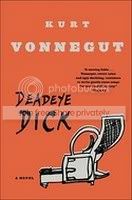
271 pages
4 stars
"It had plenty of the dark humor, wit, and satire that you come to expect from Vonnegut. It didn't really break any new ground. We have a society that places a lot of importance on war, violence, and weapons. This isn't anything too shocking. It was funny. I give it four stars for being well-written, but I can't give it that fifth star because it wasn't a book that will be that memorable for me." /fuzzypatters, LibraryThing/
"Yet another Vonnegut story set in Midland City. This one tells the tale of a group of people who have failed at nearly everything they have attempted in their lives simply because they are no good at anything.
It seems like a rather depressing plot, I know. But, it is touched with that classic Vonnegut charm and satirical wit that illuminates the book with a whole different sort of tone." /Travis Roberson, goodreads/
271 pages
4 stars
"It had plenty of the dark humor, wit, and satire that you come to expect from Vonnegut. It didn't really break any new ground. We have a society that places a lot of importance on war, violence, and weapons. This isn't anything too shocking. It was funny. I give it four stars for being well-written, but I can't give it that fifth star because it wasn't a book that will be that memorable for me." /fuzzypatters, LibraryThing/
"Yet another Vonnegut story set in Midland City. This one tells the tale of a group of people who have failed at nearly everything they have attempted in their lives simply because they are no good at anything.
It seems like a rather depressing plot, I know. But, it is touched with that classic Vonnegut charm and satirical wit that illuminates the book with a whole different sort of tone." /Travis Roberson, goodreads/
19readeron
#12 And Then There Were None by Agatha Christie
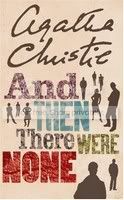
224 pages
4 stars
"And Then There Were None by Agatha Christie is one of the greatest murder mysteries ever written. Putting aside the various updates of racially offensive wording within the pages (including the original title), this story remains a timeless classic.
Ten guests are invited to a secluded island vacation home, all under false pretenses. When the island's mysterious host never appears and people begin dying one by one, the remaining guests realize they are caught in a sinister trap.
Once you begin reading you won't stop until you discover whodunit." /Daniel.Estes, LibraryThing/
(I actually guessed whodunit quite early, but wanted to be 100% sure, which made me hurry up even more.:)
224 pages
4 stars
"And Then There Were None by Agatha Christie is one of the greatest murder mysteries ever written. Putting aside the various updates of racially offensive wording within the pages (including the original title), this story remains a timeless classic.
Ten guests are invited to a secluded island vacation home, all under false pretenses. When the island's mysterious host never appears and people begin dying one by one, the remaining guests realize they are caught in a sinister trap.
Once you begin reading you won't stop until you discover whodunit." /Daniel.Estes, LibraryThing/
(I actually guessed whodunit quite early, but wanted to be 100% sure, which made me hurry up even more.:)
20readeron
#13 The French Lieutenant's Woman by John Fowles
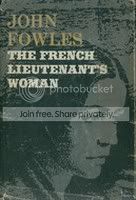
371 pages
5 stars
"It’s the 1860s. An English couple, Ernestina and Charles, walk together along a beach. He is a member of the aristocracy; she is spoiled and rich. They see from afar a mysterious woman standing still, staring out to sea. Ernestina tells Charles that the woman is variously called “the French lieutenant’s whore” and “Tragedy”; she had an affair with a French lieutenant who went home and was never heard from again. Charles becomes curious.
The mysterious woman, Sarah, will keep you guessing throughout, right to the very end. You’ll think she’s pitiful, then you’ll wonder if she’s crazy, then you think she may be mean, and round and round.
THE FRENCH LIEUTENANT’S WOMAN by John Fowles, written in 1969, is a Victorian-sounding novel. Fowles mimics the style of, maybe, Jane Austen or maybe Charles Dickens. At the same time, he interjects his own voice and compares the Victorian age with modern (1969) times.
This book is, although long, not long enough. When you read it, get very comfortable; you won’t want to put it down. And you’ll hate to see it end." /Beth, goodreads/
/techeditor, LibraryThing/
"A stunningly brilliant novel, which unfolds like chinese boxes and keeps you both emotionally and intellectually invested in the characters even as it plays with the very fact that it is a fictional exercise.
Equally a love story and a romantic tragedy or perphaps neither; this powerful book evokes the Victorian era as we believe it to be through the lense of literature and then debunks those notions both by the use of historical facts and an unsentimental "modern" questioning of it's values. However, it does so with deep understanding and sympathy and with the realization that we in the "future" suffer from our own existential dilemmas.
Seldom does a writer so perfectly juggle so many different elements so successfully, but this novel overflows with soul wrenching desire, soul searching angst, rollicking plot twists and colorful characters. In fact, the story bears many of the hallmarks of fiction from the time it portrays, particularly the novels of Thomas Hardy, and yet it is very postmodern in it's construction.
The plot is quite compelling on it's own merits but the periodic authorial expostions actually heighten the power of the narrative, illuminating not only the story but the motivations of the artist behind the story. The author even makes a couple of brief appearances as a minor character at pivotal points in the plot.
In a word - exhilarating!" /textbitreader,goodreads/
"At the core of this unconventional novel lies a very conventional Victorian love story. Charles Smithson is, in 1867, the heir to a baronetcy and in want of a wife to end his days of idle bachelorhood. Ernestina Freeman is the only child of a wealthy merchant and in want of a title to legitimize her family's climb up the social ladder. The two are fond enough of each other to make this mating of status and fortune a successful one. Then along comes passion in the form of Sarah Woodruff, the former governess once jilted and left forever disgraced by a French lieutenant.
But from the first page, the author John Fowles lets us know that he, too, is a character in this novel. He interjects frequently his observations on the life and mind of the nineteenth century, the way it has been portrayed in other novels, and how it differs from the time of his writing a century later. There are mini-lectures, often in the form of footnotes, about technological developments, intellectual trends, fashion, and the latest scientific discoveries. Fowles discusses with us the nature of his novel as he writes it, how and why his characters are what they are, and how he might choose to end the story. A couple of times he even puts on his top hat and greatcoat and steps into the pages himself, the better to study his creations at short range.
Fowles principal thesis is that, at no other time in history, has there been as great a disparity between the urges of the body and the restraints of conscience as the nineteenth century. He contrasts, for example, the strict dress code of the day with the fact that there were ten times as many houses of prostitution in London in the 1860s as in the 1960s. This battle of the ego versus the id was most fittingly depicted in Dr Jekyll and Mr Hyde, and, ironically, helped make the nineteenth perhaps the most spectacular century in history in terms of scientific, social and intellectual development. And, of course, in the novel the dichotomy is represented by the two women in Charles's life: Tina, the one he needs, and Sarah, the one he loves.
What makes The French Lieutenant's Woman such a great novel is that the story itself not only survives all of the author's punditry and metafictional gimmickry, but thrives under it. Right down to and including the three alternate endings, the novel is both engrossing and intriguing. Because of the occasional references to the literature of the period, I would recommend that you first have read such novels as Jane Austen's Persuasion, Charles Dickens's The Pickwick Papers and David Copperfield, Robert Louis Stevenson's Dr Jekyll and Mr Hyde, and Thomas Hardy's Tess of the d'Urbervilles."
/steven03tx, LibraryThing/
(The touchstone won't work...)
371 pages
5 stars
"It’s the 1860s. An English couple, Ernestina and Charles, walk together along a beach. He is a member of the aristocracy; she is spoiled and rich. They see from afar a mysterious woman standing still, staring out to sea. Ernestina tells Charles that the woman is variously called “the French lieutenant’s whore” and “Tragedy”; she had an affair with a French lieutenant who went home and was never heard from again. Charles becomes curious.
The mysterious woman, Sarah, will keep you guessing throughout, right to the very end. You’ll think she’s pitiful, then you’ll wonder if she’s crazy, then you think she may be mean, and round and round.
THE FRENCH LIEUTENANT’S WOMAN by John Fowles, written in 1969, is a Victorian-sounding novel. Fowles mimics the style of, maybe, Jane Austen or maybe Charles Dickens. At the same time, he interjects his own voice and compares the Victorian age with modern (1969) times.
This book is, although long, not long enough. When you read it, get very comfortable; you won’t want to put it down. And you’ll hate to see it end." /Beth, goodreads/
/techeditor, LibraryThing/
"A stunningly brilliant novel, which unfolds like chinese boxes and keeps you both emotionally and intellectually invested in the characters even as it plays with the very fact that it is a fictional exercise.
Equally a love story and a romantic tragedy or perphaps neither; this powerful book evokes the Victorian era as we believe it to be through the lense of literature and then debunks those notions both by the use of historical facts and an unsentimental "modern" questioning of it's values. However, it does so with deep understanding and sympathy and with the realization that we in the "future" suffer from our own existential dilemmas.
Seldom does a writer so perfectly juggle so many different elements so successfully, but this novel overflows with soul wrenching desire, soul searching angst, rollicking plot twists and colorful characters. In fact, the story bears many of the hallmarks of fiction from the time it portrays, particularly the novels of Thomas Hardy, and yet it is very postmodern in it's construction.
The plot is quite compelling on it's own merits but the periodic authorial expostions actually heighten the power of the narrative, illuminating not only the story but the motivations of the artist behind the story. The author even makes a couple of brief appearances as a minor character at pivotal points in the plot.
In a word - exhilarating!" /textbitreader,goodreads/
"At the core of this unconventional novel lies a very conventional Victorian love story. Charles Smithson is, in 1867, the heir to a baronetcy and in want of a wife to end his days of idle bachelorhood. Ernestina Freeman is the only child of a wealthy merchant and in want of a title to legitimize her family's climb up the social ladder. The two are fond enough of each other to make this mating of status and fortune a successful one. Then along comes passion in the form of Sarah Woodruff, the former governess once jilted and left forever disgraced by a French lieutenant.
But from the first page, the author John Fowles lets us know that he, too, is a character in this novel. He interjects frequently his observations on the life and mind of the nineteenth century, the way it has been portrayed in other novels, and how it differs from the time of his writing a century later. There are mini-lectures, often in the form of footnotes, about technological developments, intellectual trends, fashion, and the latest scientific discoveries. Fowles discusses with us the nature of his novel as he writes it, how and why his characters are what they are, and how he might choose to end the story. A couple of times he even puts on his top hat and greatcoat and steps into the pages himself, the better to study his creations at short range.
Fowles principal thesis is that, at no other time in history, has there been as great a disparity between the urges of the body and the restraints of conscience as the nineteenth century. He contrasts, for example, the strict dress code of the day with the fact that there were ten times as many houses of prostitution in London in the 1860s as in the 1960s. This battle of the ego versus the id was most fittingly depicted in Dr Jekyll and Mr Hyde, and, ironically, helped make the nineteenth perhaps the most spectacular century in history in terms of scientific, social and intellectual development. And, of course, in the novel the dichotomy is represented by the two women in Charles's life: Tina, the one he needs, and Sarah, the one he loves.
What makes The French Lieutenant's Woman such a great novel is that the story itself not only survives all of the author's punditry and metafictional gimmickry, but thrives under it. Right down to and including the three alternate endings, the novel is both engrossing and intriguing. Because of the occasional references to the literature of the period, I would recommend that you first have read such novels as Jane Austen's Persuasion, Charles Dickens's The Pickwick Papers and David Copperfield, Robert Louis Stevenson's Dr Jekyll and Mr Hyde, and Thomas Hardy's Tess of the d'Urbervilles."
/steven03tx, LibraryThing/
(The touchstone won't work...)
21readeron
#14 Csokonai Lili - Tizenhét hattyúk (seventeen Swans) by Esterházy Péter
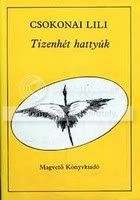
136 pages
3 stars
first published: 1987
"1987 Tizenhét hattyúk (et. Seventeen Swans) The novel was published under the pseudonym Lili Csokonai; the narrative pretends to be the diary of a young uneducated woman. Esterházy's stylistic brilliance is shown in the way the contemporary setting is presented in seventeenth century language." /http://www.frankfurt.matav.hu/angol/irok/esterhazy/public.htm/
"In his book entitled Psziché, the poet Sándor Weöres invented a poetess, with a whole œuvre, biography and network, and gives her as lover an author who really existed, in order to blur the boundaries between reality and fiction. Péter Esterházy's novel published in 1987 (Lili Csokonai: Tizenhét hattyúk) is based on a similar idea: he published this work - in which the female narrator writes of her unhappy love and sexual adventures in a Hungarian spoken four hundred years before - under the name of Lili Csokonai, and for a long time did not reveal the real identity of its author."
/Gabriella Györe, Translated by Kinga Dornacher/
It was amusing in places, but it was hard to care about the characters who weren't much more than cliches and the plot was rather unconvincing (and pretty depressive, too - I wish people would stop thinking that only ancient depressive cliches can have artistic or literary value). I can't for the life of me tell why this novel was recommended to me by a Hungarian fellow reader. Watched the movie, as well, but I still have no clue. What a letdown..., but at least it was a short read.
It was my first Esterházy. I have been hearing so many good things about the author, I really need to read some more of his books. Hopefully I'll like those more.
136 pages
3 stars
first published: 1987
"1987 Tizenhét hattyúk (et. Seventeen Swans) The novel was published under the pseudonym Lili Csokonai; the narrative pretends to be the diary of a young uneducated woman. Esterházy's stylistic brilliance is shown in the way the contemporary setting is presented in seventeenth century language." /http://www.frankfurt.matav.hu/angol/irok/esterhazy/public.htm/
"In his book entitled Psziché, the poet Sándor Weöres invented a poetess, with a whole œuvre, biography and network, and gives her as lover an author who really existed, in order to blur the boundaries between reality and fiction. Péter Esterházy's novel published in 1987 (Lili Csokonai: Tizenhét hattyúk) is based on a similar idea: he published this work - in which the female narrator writes of her unhappy love and sexual adventures in a Hungarian spoken four hundred years before - under the name of Lili Csokonai, and for a long time did not reveal the real identity of its author."
/Gabriella Györe, Translated by Kinga Dornacher/
It was amusing in places, but it was hard to care about the characters who weren't much more than cliches and the plot was rather unconvincing (and pretty depressive, too - I wish people would stop thinking that only ancient depressive cliches can have artistic or literary value). I can't for the life of me tell why this novel was recommended to me by a Hungarian fellow reader. Watched the movie, as well, but I still have no clue. What a letdown..., but at least it was a short read.
It was my first Esterházy. I have been hearing so many good things about the author, I really need to read some more of his books. Hopefully I'll like those more.
22readeron
#15 Egy őrült őrgrófnő naplója by Pallavicini Zita
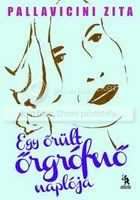
188 pages
2 stars
first published: 2011
My disappointment is partly my fault: the title and the book cover made me expect some sort of lighthearted chick lit or a fluffy romantic novel. Instead, I got the memoirs of a journalist about whom I've never heard before. Just my luck. (It made me realize though that I'm quite ignorant about German popular culture. So, while reading the memoirs, I googled Falco, Gunter Sachs and Thomas Gottschalk, for instance. It was fun, as usual.:)
Anyway, I wish the author good luck on her future works.
Judging on the basis of the first few pages (chapters?), I think she really could write better stories than this.
(There are no touchstones to this book.)
#16 Kire ütött ez a gyerek? (Just Who Does This Child Take After?) by Éva Janikovszky
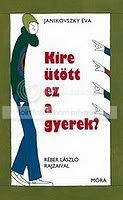
5 stars
56 pages
First published: 1974
Published in English: 1974, 2011
Translator: Andrew C. Rouse
"When I was little and clever, and kind and pretty everyone knew who I looked like... Now that I'm big and crazy and insolent and stupid, they just sit and sigh and wonder: Just who does this child take after?! This is how Eva Janikovszky's teenage hero complains to readers, and if those readers happen to have hit teenage recently, then they'll get plenty of laughs out of the kind of things that grown-ups keep going on about. On the other hand, should they have survived this troublesome period and gone on to be parents themselves, they will delight in discovering that they are not the only ones battling with teenage kids. This bestselling book still never fails to raise a smile with its fresh prose and comical illustrations. Times may be changing but one thing never will: those terrible teens!" /libri.hu/
Well, that was fun! Cute, witty, hilarious though a bit too short children's book (YA lit?). It absolutely made my day.:)
Update: Found it in "1001 Children's Books You Must Read Before You Grow Up", as well. Wow!:)
188 pages
2 stars
first published: 2011
My disappointment is partly my fault: the title and the book cover made me expect some sort of lighthearted chick lit or a fluffy romantic novel. Instead, I got the memoirs of a journalist about whom I've never heard before. Just my luck. (It made me realize though that I'm quite ignorant about German popular culture. So, while reading the memoirs, I googled Falco, Gunter Sachs and Thomas Gottschalk, for instance. It was fun, as usual.:)
Anyway, I wish the author good luck on her future works.
Judging on the basis of the first few pages (chapters?), I think she really could write better stories than this.
(There are no touchstones to this book.)
#16 Kire ütött ez a gyerek? (Just Who Does This Child Take After?) by Éva Janikovszky
5 stars
56 pages
First published: 1974
Published in English: 1974, 2011
Translator: Andrew C. Rouse
"When I was little and clever, and kind and pretty everyone knew who I looked like... Now that I'm big and crazy and insolent and stupid, they just sit and sigh and wonder: Just who does this child take after?! This is how Eva Janikovszky's teenage hero complains to readers, and if those readers happen to have hit teenage recently, then they'll get plenty of laughs out of the kind of things that grown-ups keep going on about. On the other hand, should they have survived this troublesome period and gone on to be parents themselves, they will delight in discovering that they are not the only ones battling with teenage kids. This bestselling book still never fails to raise a smile with its fresh prose and comical illustrations. Times may be changing but one thing never will: those terrible teens!" /libri.hu/
Well, that was fun! Cute, witty, hilarious though a bit too short children's book (YA lit?). It absolutely made my day.:)
Update: Found it in "1001 Children's Books You Must Read Before You Grow Up", as well. Wow!:)
23readeron
#17 The Solitaire Mystery: a novel about family and destiny by Jostein Gaarder
309 pages
5 stars
first published: 1990
"This book is a modern fairy tale, a lighthearted philosophy lesson, and a reminder that life is a miraculous and beautiful gift. As the story begins, Hans Thomas and his father are traveling to Greece in search of Hans Thomas' long-lost mother. The plot thickens when a strange little man gives Hans Thomas a magnifying glass, and a kind old baker gives Hans Thomas a sticky bun containing a tiny book that can only be read using the magnifying glass. The book contains a fantastic fairy tale about a shipwrecked sailor and a magical island populated by a suit of cards that mysteriously came to life. But as Hans Thomas reads further, he realizes that the story in the sticky bun book relates to him and his family, and it might not be entirely fictional. The story switches back and forth between philosophical conversations between Hans Thomas and his father, and the fantastic story in the sticky bun book. This keeps the book balanced so it does not become too silly. I thoroughly enjoyed this book, and I recommend it to anyone who is looking for light, uplifting summer reading. This story will leave you smiling.
Though the book is shelved in the adult section of the library, it contains no content that is inappropriate for older children or teens." /Jen, goodreads/
"The Solitaire Mystery follows a young boy, Hans Thomas, and his father on their way to find their runaway mother. Along the way, they encounter various people, each connected by a strange world long ago, leading ultimately to the unraveling of the mysterious pasts of Hans and his family.
The Solitaire Mystery explores the strange world of coincidences and determinism. It dabbles in the philosophy of consciousness, reminding one of Descartes's elegant statement, "Cogito ergo sum," except declared this time by a pack of living playing cards. While definitely surreal, Gaarder touches questions intrinsic in every culture in the world. (...)
This is a fairytale a la Alice-in-Wonderland, but at the same time, deep and profound." /szng, Amazon/
"Hans Thomas and his father set out on a car trip through Europe, from Norway to Greece - the birthplace of philosophy - in search of Hans Thomas's mother, who left them many years earlier. On the way, Hans Thomas receives a mysterious miniature book - the fantastic memoir of a sailor shipwrecked in 1842 on a strange island where a deck of cards come to life.
Structured as a deck of cards - each chapter is one in the deck - "The Solitaire Mystery" weaves together fantasy and reality, fairy tales and family history. /goodreads/
Highly recommended for any age group. It didn't change my life (would've been surprised if it did), but I think it's fun!:)
309 pages
5 stars
first published: 1990
"This book is a modern fairy tale, a lighthearted philosophy lesson, and a reminder that life is a miraculous and beautiful gift. As the story begins, Hans Thomas and his father are traveling to Greece in search of Hans Thomas' long-lost mother. The plot thickens when a strange little man gives Hans Thomas a magnifying glass, and a kind old baker gives Hans Thomas a sticky bun containing a tiny book that can only be read using the magnifying glass. The book contains a fantastic fairy tale about a shipwrecked sailor and a magical island populated by a suit of cards that mysteriously came to life. But as Hans Thomas reads further, he realizes that the story in the sticky bun book relates to him and his family, and it might not be entirely fictional. The story switches back and forth between philosophical conversations between Hans Thomas and his father, and the fantastic story in the sticky bun book. This keeps the book balanced so it does not become too silly. I thoroughly enjoyed this book, and I recommend it to anyone who is looking for light, uplifting summer reading. This story will leave you smiling.
Though the book is shelved in the adult section of the library, it contains no content that is inappropriate for older children or teens." /Jen, goodreads/
"The Solitaire Mystery follows a young boy, Hans Thomas, and his father on their way to find their runaway mother. Along the way, they encounter various people, each connected by a strange world long ago, leading ultimately to the unraveling of the mysterious pasts of Hans and his family.
The Solitaire Mystery explores the strange world of coincidences and determinism. It dabbles in the philosophy of consciousness, reminding one of Descartes's elegant statement, "Cogito ergo sum," except declared this time by a pack of living playing cards. While definitely surreal, Gaarder touches questions intrinsic in every culture in the world. (...)
This is a fairytale a la Alice-in-Wonderland, but at the same time, deep and profound." /szng, Amazon/
"Hans Thomas and his father set out on a car trip through Europe, from Norway to Greece - the birthplace of philosophy - in search of Hans Thomas's mother, who left them many years earlier. On the way, Hans Thomas receives a mysterious miniature book - the fantastic memoir of a sailor shipwrecked in 1842 on a strange island where a deck of cards come to life.
Structured as a deck of cards - each chapter is one in the deck - "The Solitaire Mystery" weaves together fantasy and reality, fairy tales and family history. /goodreads/
Highly recommended for any age group. It didn't change my life (would've been surprised if it did), but I think it's fun!:)
24readeron
#18 Billiards at Half-Past Nine by Heinrich Böll
5 stars
288 pages
first published: 1959
"This novel is one of the quintessential works of 20th C. German Literature, dealing as it does with the haunted legacy of Nazism, Germany's collective guilt in the post-war years, and the burden of memory, as reflected in the account of one German family, the Faehmels. Their history unfolds through the reminiscences of three generations, Grandfather, Father, and Son, all architects by trade; it eventually goes back as far as the old man's arrival in Cologne in 1907 and ends with the single, fateful day in September 1958 in which the novel is set, the same man's 80th birthday. Through each man's flashes of memory and varying viewpoints, we bear witness to the terrible price this one family paid for the strains of nationalism and militarism that defined the Kaiser's Germany and which reached their terrible climax in the rise of the Nazis. For the Faehmels, it is a legacy of young and agonizingly futile deaths, betrayals of friends and family, soul-crushing guilt and madness. Each of the men bear deep emotional scars from this legacy, it soon becomes clear; crucially, they are all now architects who no longer desire to build anything, a potent symbol of their loss of faith in mankind and the future. In some of the novel's most harrowing sections, the story's narration shifts to the institutionalized wife of the old man, who was finally driven mad by so much loss and pain during the course of WWII. That madness and its concommitant anger eventually finds its ultimate expression at the novel's climax, in a shocking act of reprisal.
On another level, the novel is an indictment of indifferent complicity in the face of evil -- of those Germans who remained silent and aquiesced as their neighbors were brutalized, and particularly that of the Catholic Church in Germany, the dominant faith in the region in which the novel is set and of the story's protagonists, leading to their crisis of faith. /Rob Atkinson, goodreads/
"A tale of coming to terms with the past and reconciliation set against the background of a family drama in post WW2 Germany." /Paul Servini, goodreads/
"brilliant writing: informal, self-referential, poetic. almost a prose poem, with it's liberal use of repitition and imagery." /Joe, goodreads/
Exactly. Brilliant style, it reads almost like a poem. It's moving and absolutely unputdownable. One more novel like this and Böll becomes one of my favourite authors.
"Billiards at Half-Past Nine is a complex novel with narration rotating from chapter to chapter offering perspectives of different family members, work colleagues and friends of the family. The time-scale and place are also affected by frequent flashbacks and memories to different places and times. All this is woven together well to show different perspectives on people and events in the novel.
Religious overtones are strong in this novel. The imagery of the lamb, referring to meek or sacrificial characters is used often. The lamb also comes up in allusion to Biblical passages such as "Feed my lambs" and "Lamb of God." Meanwhile, those drawn to Nazism are described as taking the "Host of the Beast" and their actions are akin to Satan worship. Interestingly enough, while there presence is felt throughout the novel, the words "Nazi" and "Hitler" never appear in the text.
This is an excellent book, probably worth puzzling through again to get a better sense of the German zeitgeist in the aftermath of World War II." /Othemts, LibraryThing/
More info about the book:
- http://en.wikipedia.org/wiki/Billiards_at_Half-past_Nine
- http://www.history.ucsb.edu/faculty/marcuse/classes/133c/133cTexts/BoellBilliard...
- http://web.grinnell.edu/courses/HIS/f04/his238-01/Handouts/Billiards_Guide.htm
I think I'll read it again someday.
5 stars
288 pages
first published: 1959
"This novel is one of the quintessential works of 20th C. German Literature, dealing as it does with the haunted legacy of Nazism, Germany's collective guilt in the post-war years, and the burden of memory, as reflected in the account of one German family, the Faehmels. Their history unfolds through the reminiscences of three generations, Grandfather, Father, and Son, all architects by trade; it eventually goes back as far as the old man's arrival in Cologne in 1907 and ends with the single, fateful day in September 1958 in which the novel is set, the same man's 80th birthday. Through each man's flashes of memory and varying viewpoints, we bear witness to the terrible price this one family paid for the strains of nationalism and militarism that defined the Kaiser's Germany and which reached their terrible climax in the rise of the Nazis. For the Faehmels, it is a legacy of young and agonizingly futile deaths, betrayals of friends and family, soul-crushing guilt and madness. Each of the men bear deep emotional scars from this legacy, it soon becomes clear; crucially, they are all now architects who no longer desire to build anything, a potent symbol of their loss of faith in mankind and the future. In some of the novel's most harrowing sections, the story's narration shifts to the institutionalized wife of the old man, who was finally driven mad by so much loss and pain during the course of WWII. That madness and its concommitant anger eventually finds its ultimate expression at the novel's climax, in a shocking act of reprisal.
On another level, the novel is an indictment of indifferent complicity in the face of evil -- of those Germans who remained silent and aquiesced as their neighbors were brutalized, and particularly that of the Catholic Church in Germany, the dominant faith in the region in which the novel is set and of the story's protagonists, leading to their crisis of faith. /Rob Atkinson, goodreads/
"A tale of coming to terms with the past and reconciliation set against the background of a family drama in post WW2 Germany." /Paul Servini, goodreads/
"brilliant writing: informal, self-referential, poetic. almost a prose poem, with it's liberal use of repitition and imagery." /Joe, goodreads/
Exactly. Brilliant style, it reads almost like a poem. It's moving and absolutely unputdownable. One more novel like this and Böll becomes one of my favourite authors.
"Billiards at Half-Past Nine is a complex novel with narration rotating from chapter to chapter offering perspectives of different family members, work colleagues and friends of the family. The time-scale and place are also affected by frequent flashbacks and memories to different places and times. All this is woven together well to show different perspectives on people and events in the novel.
Religious overtones are strong in this novel. The imagery of the lamb, referring to meek or sacrificial characters is used often. The lamb also comes up in allusion to Biblical passages such as "Feed my lambs" and "Lamb of God." Meanwhile, those drawn to Nazism are described as taking the "Host of the Beast" and their actions are akin to Satan worship. Interestingly enough, while there presence is felt throughout the novel, the words "Nazi" and "Hitler" never appear in the text.
This is an excellent book, probably worth puzzling through again to get a better sense of the German zeitgeist in the aftermath of World War II." /Othemts, LibraryThing/
More info about the book:
- http://en.wikipedia.org/wiki/Billiards_at_Half-past_Nine
- http://www.history.ucsb.edu/faculty/marcuse/classes/133c/133cTexts/BoellBilliard...
- http://web.grinnell.edu/courses/HIS/f04/his238-01/Handouts/Billiards_Guide.htm
I think I'll read it again someday.
25readeron
#19 Tesco titok by G.M.
(Tesco secret)

243 pages
4 stars
first published: 2006
I've really no idea why I haven't read this before. Overall it was a pretty good book, a really fun read, and very short. Not my new favorite thing, but worth the read. (It was written by a young man who has worked at the company for some years and he claims to reveal some dirty "secrets" here about this experience. Bad enough for everyone if half of what he says is true.:)
#20 A tanú (The Witness) by Péter Bacsó
140 pages
5 stars
A brilliant satire. I picked up the book from the library on Monday and read it in one sitting at home, on the very same day. I almost laughed my head off half the time (and the other half the time it made me a bit sad), plus I kept reading chapters out loud to my family, even though I knew for sure that they had seen the movie several times, as well. (One of my favourite chapters was the one set in the amusement park.)
The novel has basically the same plot as the movie. (I actually had no idea for years which came first: the movie or the book, since the director wrote the novel himself. Now I think that probably the movie came out first.)
"Banned for over a decade for its outspoken criticism of the post-WWII communist regime in Hungary, Péter Bacsó's 'The Witness' has since then achieved unparalleled cult status in its native land. Known as the best satire about communism, 'The Witness' has become a cult classic, which was also well received by critics and general audiences alike when it was finally released outside of Hungary. Its candid and realistic portrayal of the incompetent communist regime has earned great acclaim for both the director and the film itself when it was shown at Cannes Film Festival in 1981. 'The Witness' takes place during the height of the Rákosi Era, which was closely modeled after the ruthless and brutal Stalin regime. The film follows the life of an ordinary dike keeper, József Pelikán, who has been caught for illegally slaughtering his pig, Dezsõ. Instead of doing hard time for his "heinous" crime, Pelikán is elevated into an important position, generally reserved for the communist elite. Of course, Pelikán is utterly clueless about his newfound luck, not to mention his new job. Even his new benefactor, the mysterious Comrade Virág, is reluctant to reveal the real reason behind Pelikán's preferential treatment. Thus, begins Pelikán's hilarious adventure deep within the "sophisticated" communist society. One failure after another the incompetent Pelikán is elevated higher and higher on the communist echelon, all the while remaining completely clueless about his promotions. Until one day, when he gets called for to return the "favour" by falsely testifying against his long-time friend in a mock-up show trial." /Zoltan Furedi, IMDb, about the movie/
More info can be found about the movie here:
http://en.wikipedia.org/wiki/The_Witness_%281969_Hungarian_film%29
Also found a review about the movie here:
http://www.nytimes.com/1981/09/26/movies/film-witness-hungarian-satire.html
I highly recommend this movie to anyone who likes satires and is aware of the fact that life is not a rose garden (or more exactly, in this case, that "Life is not a whipped-cream cake". If the novel is/gets translated, it's definitely a must read, too.
Finally, I decided to borrow some quotes in English from the IMDb:
(http://www.imdb.com/title/tt0065067/quotes)
Gulyás Elemér: Back again?
Pelikán József, gátõr: Shut up. The regime can thrive without me, too.
Gulyás Elemér: Not for long.
Pelikán József, gátõr: Why?
Gulyás Elemér: The Americans are coming.
Pelikán József, gátõr: Truman on a white horse? Don't you know anything new?
-----
Virág Árpád: That's a new skirt, isnt't it?
Gogolák elvtársnõ: It is, Comrade Virág.
Virág Árpád: It's too short. Leave the sexuality to be the opium of the declining Western.
-------------------
Pelikán József, gátõr: As of today, the ghost train shall be know as The Socialist Ghost Train. We'll get rid of the skeletons and other old junk. We'll replace them with portraits of our great leaders, especially Comrade Bástya.
--------------------------------
Bástya elvtárs: What's this?
Pelikán József, gátõr: An orange.
Bástya elvtárs: An orange?
Pelikán József, gátõr: The new Hungarian orange. It's slightly yellower, it's slightly sharper, but our own.
-------------------
Virág Árpád: The international situation is intensifying. We've caught up with the latest group of inner parasites.
------------------
Pelikán József, gátõr: I feel a bit bad about it, though. Why do we have to make such a fuss over it? We deceived the people after all.
Virág Árpád: Who did we deceieve? Ourselves? We know what it's all about. The researchers? They're happy to have their medals. The masses? They don't eat lemons or oranges, but they're happy to celebrate. The imperialists? We've given them a thorough beating. I wouldn't like to be in their shoes. We proclaimed a slogan: let there be a Hungarian orange! And there it was! We made no empty promises, Pelikán!
--------------------
Virág Árpád: But remember: those who don't trust us, don't trust themselves and those who don't trust us don't trust our bright future, either. And those who don't trust our happy, bright future... are traitors.
---------------
Bástya elvtárs: (after reading the testimony of Pelikán) What's this? People don't even want to murder Comrade Bástya anymore? I'm worth shit nowadays?
Tuschinger: The previous trial... I didn't want to repeat myself. But I'll correct it. After our wise leader, Comrade Bástya was to be murdered.
---------------
Pelikán József, gátõr: I met Zoltán Dániel in 1942. I didn't yet suspect at that time...
judge: What didn't you suspect?
Pelikán József, gátõr: That I would meet frogmen.
--------------------
Virág Árpád: Life is not a whipped-cream cake, Pelikán.
---------------------
Trivia:
"Several scenes, including a visit by Pelikán (Ferenc Kállai) at Dániel's (Zoltán Fábri) prison cell was cut by state-censorship." (IMDB)
More trivia:
http://www.imdb.com/title/tt0065067/trivia
Update: I couldn't resist, and watched the movie today again.:)
(Tesco secret)
243 pages
4 stars
first published: 2006
I've really no idea why I haven't read this before. Overall it was a pretty good book, a really fun read, and very short. Not my new favorite thing, but worth the read. (It was written by a young man who has worked at the company for some years and he claims to reveal some dirty "secrets" here about this experience. Bad enough for everyone if half of what he says is true.:)
#20 A tanú (The Witness) by Péter Bacsó
140 pages
5 stars
A brilliant satire. I picked up the book from the library on Monday and read it in one sitting at home, on the very same day. I almost laughed my head off half the time (and the other half the time it made me a bit sad), plus I kept reading chapters out loud to my family, even though I knew for sure that they had seen the movie several times, as well. (One of my favourite chapters was the one set in the amusement park.)
The novel has basically the same plot as the movie. (I actually had no idea for years which came first: the movie or the book, since the director wrote the novel himself. Now I think that probably the movie came out first.)
"Banned for over a decade for its outspoken criticism of the post-WWII communist regime in Hungary, Péter Bacsó's 'The Witness' has since then achieved unparalleled cult status in its native land. Known as the best satire about communism, 'The Witness' has become a cult classic, which was also well received by critics and general audiences alike when it was finally released outside of Hungary. Its candid and realistic portrayal of the incompetent communist regime has earned great acclaim for both the director and the film itself when it was shown at Cannes Film Festival in 1981. 'The Witness' takes place during the height of the Rákosi Era, which was closely modeled after the ruthless and brutal Stalin regime. The film follows the life of an ordinary dike keeper, József Pelikán, who has been caught for illegally slaughtering his pig, Dezsõ. Instead of doing hard time for his "heinous" crime, Pelikán is elevated into an important position, generally reserved for the communist elite. Of course, Pelikán is utterly clueless about his newfound luck, not to mention his new job. Even his new benefactor, the mysterious Comrade Virág, is reluctant to reveal the real reason behind Pelikán's preferential treatment. Thus, begins Pelikán's hilarious adventure deep within the "sophisticated" communist society. One failure after another the incompetent Pelikán is elevated higher and higher on the communist echelon, all the while remaining completely clueless about his promotions. Until one day, when he gets called for to return the "favour" by falsely testifying against his long-time friend in a mock-up show trial." /Zoltan Furedi, IMDb, about the movie/
More info can be found about the movie here:
http://en.wikipedia.org/wiki/The_Witness_%281969_Hungarian_film%29
Also found a review about the movie here:
http://www.nytimes.com/1981/09/26/movies/film-witness-hungarian-satire.html
I highly recommend this movie to anyone who likes satires and is aware of the fact that life is not a rose garden (or more exactly, in this case, that "Life is not a whipped-cream cake". If the novel is/gets translated, it's definitely a must read, too.
Finally, I decided to borrow some quotes in English from the IMDb:
(http://www.imdb.com/title/tt0065067/quotes)
Gulyás Elemér: Back again?
Pelikán József, gátõr: Shut up. The regime can thrive without me, too.
Gulyás Elemér: Not for long.
Pelikán József, gátõr: Why?
Gulyás Elemér: The Americans are coming.
Pelikán József, gátõr: Truman on a white horse? Don't you know anything new?
-----
Virág Árpád: That's a new skirt, isnt't it?
Gogolák elvtársnõ: It is, Comrade Virág.
Virág Árpád: It's too short. Leave the sexuality to be the opium of the declining Western.
-------------------
Pelikán József, gátõr: As of today, the ghost train shall be know as The Socialist Ghost Train. We'll get rid of the skeletons and other old junk. We'll replace them with portraits of our great leaders, especially Comrade Bástya.
--------------------------------
Bástya elvtárs: What's this?
Pelikán József, gátõr: An orange.
Bástya elvtárs: An orange?
Pelikán József, gátõr: The new Hungarian orange. It's slightly yellower, it's slightly sharper, but our own.
-------------------
Virág Árpád: The international situation is intensifying. We've caught up with the latest group of inner parasites.
------------------
Pelikán József, gátõr: I feel a bit bad about it, though. Why do we have to make such a fuss over it? We deceived the people after all.
Virág Árpád: Who did we deceieve? Ourselves? We know what it's all about. The researchers? They're happy to have their medals. The masses? They don't eat lemons or oranges, but they're happy to celebrate. The imperialists? We've given them a thorough beating. I wouldn't like to be in their shoes. We proclaimed a slogan: let there be a Hungarian orange! And there it was! We made no empty promises, Pelikán!
--------------------
Virág Árpád: But remember: those who don't trust us, don't trust themselves and those who don't trust us don't trust our bright future, either. And those who don't trust our happy, bright future... are traitors.
---------------
Bástya elvtárs: (after reading the testimony of Pelikán) What's this? People don't even want to murder Comrade Bástya anymore? I'm worth shit nowadays?
Tuschinger: The previous trial... I didn't want to repeat myself. But I'll correct it. After our wise leader, Comrade Bástya was to be murdered.
---------------
Pelikán József, gátõr: I met Zoltán Dániel in 1942. I didn't yet suspect at that time...
judge: What didn't you suspect?
Pelikán József, gátõr: That I would meet frogmen.
--------------------
Virág Árpád: Life is not a whipped-cream cake, Pelikán.
---------------------
Trivia:
"Several scenes, including a visit by Pelikán (Ferenc Kállai) at Dániel's (Zoltán Fábri) prison cell was cut by state-censorship." (IMDB)
More trivia:
http://www.imdb.com/title/tt0065067/trivia
Update: I couldn't resist, and watched the movie today again.:)
26readeron
#21 Skylark by Dezső Kosztolányi
240 pages (6 hours)
3 stars
(1923)
Listened to it in Hungarian
(February 16)
"Nothing of great consequence happens in this short novel. The action is mostly internal. Even the minor characters are interesting. While on the surface this is a lighthearted novel and there are several humorous scenes, the underlying mood is one of melancholy, disappointment, and resignation, with a tinge of apathy." /cbl_tn, LibraryThing/
"A sort of slice-of-life novel about a middle-aged couple and their grown daughter in a dull Hungarian provincial town at around 1900. The couple has always depended on their daughter, Skylark, to be there and run things and take care of them, and they're at a bit of a loss after Skylark goes to visit relatives for a week. But they actually become a lot more outgoing in her absence, meeting old friends, going to the theater, etc. However, once Skylark comes back you get the impression that things are just going to return to the way they were.
This wasn't my kind of book, but it wasn't bad. The author did a good job of setting the atmosphere -- a sense of dull gray hopelessness pervaded every scene." /meggyweg, LibraryThing/
"Skylark is a woman in her mid-30's, an "old maid", living with her mother and father. They've fallen into such a groove that they have become pathetically dependent on each other. Skylark is also butt ugly, which has given her family much shame in not being able to marry her off. They still save up for her dowry, but try not to harbor any hope for her marrying off, as they have been disappointed many times before.
In the beginning of the book, Skylark leaves for a week to go visit a relative. We do not see any more of her until the last chapter, when she returns. However, her presence is felt in her absence: we see just how this family is tied together, and how easily it falls apart; mother and father seem not to live but to be carried along by their re-enforced beliefs and daily patterns.
For a while, Skylark almost seems like the parent here, and mother and father are like the kids who are cautiously experimenting with 1. eating out 2. going to the theater 3. talking with their friends who they have not talked to since they have isolated themselves in their own self sufficient home 4. partying and drinking 5. playing the piano 6. getting drunk 7. gambling
Of course, even while having fun, they deny that it is fun or good. These are people who, when faced with a problem, try to look the other way. Out of sight, out of mind. They will not talk about any of their problems directly. But you really feel for them, they are so pathetic, and so sad, but wanting happiness desperately.
The rest of the town is not any better. They cavort and get drunk and gamble every Thursday night and don't retire until Friday night. You could see why the family withdrew to themselves after awhile. The writing is simple and elegant, and didn't feel heavy. I loved the chapter titles, especially the last one: "XIII: in which, on the eighth of September 1899, the novel is concluded, without coming to an end" and it's true. Things will probably go on as they always have." /JimmyChanga, LibraryThing/
Exactly. I gave the novel three stars because the style was brilliant. On the other hand, I hated the plot and the scene. Rare reaction from me, but I couldn't really enjoy even the narrator's irony, I just wanted to make the characters to act (and especially to think) wiser (to grow up?) half the time. (I rooted for them all, but they just couldn't win: the author seemed to be completely under the spell of Freud.) I also tried to pigeonhole the novel as a psychothriller, but since nothing really extraordinary happened, I had to abandon this idea, as well.
"So anyway, a short, bleak, bitter novel if that is your poison." /Paul Bryant , goodreads/
240 pages (6 hours)
3 stars
(1923)
Listened to it in Hungarian
(February 16)
"Nothing of great consequence happens in this short novel. The action is mostly internal. Even the minor characters are interesting. While on the surface this is a lighthearted novel and there are several humorous scenes, the underlying mood is one of melancholy, disappointment, and resignation, with a tinge of apathy." /cbl_tn, LibraryThing/
"A sort of slice-of-life novel about a middle-aged couple and their grown daughter in a dull Hungarian provincial town at around 1900. The couple has always depended on their daughter, Skylark, to be there and run things and take care of them, and they're at a bit of a loss after Skylark goes to visit relatives for a week. But they actually become a lot more outgoing in her absence, meeting old friends, going to the theater, etc. However, once Skylark comes back you get the impression that things are just going to return to the way they were.
This wasn't my kind of book, but it wasn't bad. The author did a good job of setting the atmosphere -- a sense of dull gray hopelessness pervaded every scene." /meggyweg, LibraryThing/
"Skylark is a woman in her mid-30's, an "old maid", living with her mother and father. They've fallen into such a groove that they have become pathetically dependent on each other. Skylark is also butt ugly, which has given her family much shame in not being able to marry her off. They still save up for her dowry, but try not to harbor any hope for her marrying off, as they have been disappointed many times before.
In the beginning of the book, Skylark leaves for a week to go visit a relative. We do not see any more of her until the last chapter, when she returns. However, her presence is felt in her absence: we see just how this family is tied together, and how easily it falls apart; mother and father seem not to live but to be carried along by their re-enforced beliefs and daily patterns.
For a while, Skylark almost seems like the parent here, and mother and father are like the kids who are cautiously experimenting with 1. eating out 2. going to the theater 3. talking with their friends who they have not talked to since they have isolated themselves in their own self sufficient home 4. partying and drinking 5. playing the piano 6. getting drunk 7. gambling
Of course, even while having fun, they deny that it is fun or good. These are people who, when faced with a problem, try to look the other way. Out of sight, out of mind. They will not talk about any of their problems directly. But you really feel for them, they are so pathetic, and so sad, but wanting happiness desperately.
The rest of the town is not any better. They cavort and get drunk and gamble every Thursday night and don't retire until Friday night. You could see why the family withdrew to themselves after awhile. The writing is simple and elegant, and didn't feel heavy. I loved the chapter titles, especially the last one: "XIII: in which, on the eighth of September 1899, the novel is concluded, without coming to an end" and it's true. Things will probably go on as they always have." /JimmyChanga, LibraryThing/
Exactly. I gave the novel three stars because the style was brilliant. On the other hand, I hated the plot and the scene. Rare reaction from me, but I couldn't really enjoy even the narrator's irony, I just wanted to make the characters to act (and especially to think) wiser (to grow up?) half the time. (I rooted for them all, but they just couldn't win: the author seemed to be completely under the spell of Freud.) I also tried to pigeonhole the novel as a psychothriller, but since nothing really extraordinary happened, I had to abandon this idea, as well.
"So anyway, a short, bleak, bitter novel if that is your poison." /Paul Bryant , goodreads/
27readeron
#22 The Inspector General by Nikolai Gogol
80 pages
5 stars
"When rumors of a visit from a high-ranking bureaucrat reach a small town, the chief of police scrambles to conceal the evidence of bribery and other misdeeds. Considered the high point of Gogol's stagecraft and a masterpiece of dramatic satire, this play lampoons the stupidity and greed of provincial Russian officials." /goodreads/
"Timeless tale of small town corruption, greed and avarice. Brilliant comic play." /Casey, goodreads/
"I'm astounded tha this was written in the early 19th century. It seems so descriptive of how we live now." /Dashdotdotdot, goodreads/
"The Government Inspector is a short, fast-paced satirical farce." /391, LibraryThing/
#23 Mici néni két élete by György Hámos
(The title of the movie: Auntie Who Was Respectable)
134 pages
5 stars
Published: 1962
The novel reads a bit like a Hitchcock parody. And a brilliant comedy.
"Plot Summary:
The once celebrated actress, Aunt Mici, refuses to go and spend her old days in the old actors' home. She lets her apartment, in exchange for being taken care of, to a young couple. Laci and Kati care for the old woman with loving tenderness. Suddenly, Mici's one time lover, Alfréd turns up. Alfréd used to work as a coachman in his younger days, now he is an elegantly old fashioned taxi driver. His courting quite rejuvenates Aunt Mici. The young couple do not disclose that they are expecting a baby, fearing that they would then lose the apartment. Aunt Mici does not disclose the fact that she has a suitor, fearing that she would be laughed at. The secretiveness leads to a row of misunderstandings. The inhabitants of the block of flats as well as Mici's colleagues are jealous of Laci and Kati. The old lady's motorcycle trip with Alfréd ends in the haystack. This is where they spend the night, while everybody believes Mici to be dead. Her enemies accuse the young couple. By next morning, misunderstandings and secrets are cleared away. The old couple becomes a young couple, and the four people are looking forward to the birth of the baby together." /Magyar Nemzeti Digitális Archívum, about the movie/
(I couldn't watch the movie after reading the novel. I wouldn't say that it's a bad movie, it's actually a great old comedy. But, though the story is basically the same, the lack of several details made the movie a constant source of irritation to me, so I stopped watching it soon. Plus, IMO, the novel feels a lot fresher than the movie: it lets your fantasy make your inner movie a bit more colorful, a bit more up-to-date and a bit creepier, of course.:)
80 pages
5 stars
"When rumors of a visit from a high-ranking bureaucrat reach a small town, the chief of police scrambles to conceal the evidence of bribery and other misdeeds. Considered the high point of Gogol's stagecraft and a masterpiece of dramatic satire, this play lampoons the stupidity and greed of provincial Russian officials." /goodreads/
"Timeless tale of small town corruption, greed and avarice. Brilliant comic play." /Casey, goodreads/
"I'm astounded tha this was written in the early 19th century. It seems so descriptive of how we live now." /Dashdotdotdot, goodreads/
"The Government Inspector is a short, fast-paced satirical farce." /391, LibraryThing/
#23 Mici néni két élete by György Hámos
(The title of the movie: Auntie Who Was Respectable)
134 pages
5 stars
Published: 1962
The novel reads a bit like a Hitchcock parody. And a brilliant comedy.
"Plot Summary:
The once celebrated actress, Aunt Mici, refuses to go and spend her old days in the old actors' home. She lets her apartment, in exchange for being taken care of, to a young couple. Laci and Kati care for the old woman with loving tenderness. Suddenly, Mici's one time lover, Alfréd turns up. Alfréd used to work as a coachman in his younger days, now he is an elegantly old fashioned taxi driver. His courting quite rejuvenates Aunt Mici. The young couple do not disclose that they are expecting a baby, fearing that they would then lose the apartment. Aunt Mici does not disclose the fact that she has a suitor, fearing that she would be laughed at. The secretiveness leads to a row of misunderstandings. The inhabitants of the block of flats as well as Mici's colleagues are jealous of Laci and Kati. The old lady's motorcycle trip with Alfréd ends in the haystack. This is where they spend the night, while everybody believes Mici to be dead. Her enemies accuse the young couple. By next morning, misunderstandings and secrets are cleared away. The old couple becomes a young couple, and the four people are looking forward to the birth of the baby together." /Magyar Nemzeti Digitális Archívum, about the movie/
(I couldn't watch the movie after reading the novel. I wouldn't say that it's a bad movie, it's actually a great old comedy. But, though the story is basically the same, the lack of several details made the movie a constant source of irritation to me, so I stopped watching it soon. Plus, IMO, the novel feels a lot fresher than the movie: it lets your fantasy make your inner movie a bit more colorful, a bit more up-to-date and a bit creepier, of course.:)
28readeron
#24 Jo's Boys by Louisa May Alcott
5 stars
336 pages
"It's obvious at the end that it's the last book she'll write about the March family as the last page lists what happens to every character - which is a bit sad, as Alcott's novels are always such sweet, simple reads. (...) I once read the synopsis of one of Alcott's older, less-popular novels on Amazon, and it was described as a collection of "wholesome and moralistic stories" which I think is a perfect description of Jo's Boys. A lot of people these days don't like stories which have meanings and morals, but I do. I guess I'm kind of old fashioned in that way - I would love to live in a family similar to that of Jo March's." /rachel Ropper, goodreads/
"A long, sometimes tedious, but almost always charming epilogue to Little Women and Little Men. Alcott wrote it in 1886, eighteen years after Little Women and two years before her death. She must have known, feeling the effects of mercury poisoning from her time as a Civil War nurse, that the lights were really going out, the curtain about to fall.
In this book Alcott continues to find a platform for her ideas, including women's suffrage, co-education, rehabilitation for criminals, and temperance, and makes a mini-Republic out of Plumfield where they can play out. Also interesting were Jo's troubles with being a famous writer, which must have echoed Alcott's.
This is the only book in the series that often strays from New England - out west, to London, to a shipwreck at sea - and these parts seemed to be either very sparingly drawn or leaning toward melodramatic. It took some suspension of disbelief to read about Emil's shipwreck and daring heroism, and Dan's rescue of twenty men from a flooded mine.
Still, I though Jo's Boys gave an interesting window into Alcott's ideas and the changing world of the late 19th century (the telephone and camera both make apperances). It's hard not to read it as a what could have been, given the differences between the characters and the people on which Alcott based them. By the time she wrote Jo's Boys, two of Alcott's sisters had died, one had lost a husband, and Alcott herself had never gotten married.
This was a compelling read for me, though, more for its famliar characters and the world it created for them than for its literary genius, and I felt a little sad at the end knowing the curtain had indeed closed on the March family." /Zoe Castro, goodreads/
"This was a delightful read. Very simple, easy to put down and pick up again, and true to the style of Louisa May Alcott, leaves little nuggets of wisdom all along the way. It's fairly short, and a good supplement to read while you're reading something depressing yet beautiful, (...), to lift your spirits when his story gets too sad." /Katie Hoyos, goodreads/
"Standing by the 5 stars. As I've said before, these people are too intimately wound up with my psyche to be rated objectively.
There's some preaching but to my eye it's not as heavy-handed as in Little Women. There are lots of great female role-models (with respect to the times). All of the young women are working toward careers, with the exception of Daisy (that natural housewife!). The young men are supportive and for the most part, respectful. There are anachronisms aplenty, but there's also love and joy in abundance." /Melody, goodreads/
5 stars
336 pages
"It's obvious at the end that it's the last book she'll write about the March family as the last page lists what happens to every character - which is a bit sad, as Alcott's novels are always such sweet, simple reads. (...) I once read the synopsis of one of Alcott's older, less-popular novels on Amazon, and it was described as a collection of "wholesome and moralistic stories" which I think is a perfect description of Jo's Boys. A lot of people these days don't like stories which have meanings and morals, but I do. I guess I'm kind of old fashioned in that way - I would love to live in a family similar to that of Jo March's." /rachel Ropper, goodreads/
"A long, sometimes tedious, but almost always charming epilogue to Little Women and Little Men. Alcott wrote it in 1886, eighteen years after Little Women and two years before her death. She must have known, feeling the effects of mercury poisoning from her time as a Civil War nurse, that the lights were really going out, the curtain about to fall.
In this book Alcott continues to find a platform for her ideas, including women's suffrage, co-education, rehabilitation for criminals, and temperance, and makes a mini-Republic out of Plumfield where they can play out. Also interesting were Jo's troubles with being a famous writer, which must have echoed Alcott's.
This is the only book in the series that often strays from New England - out west, to London, to a shipwreck at sea - and these parts seemed to be either very sparingly drawn or leaning toward melodramatic. It took some suspension of disbelief to read about Emil's shipwreck and daring heroism, and Dan's rescue of twenty men from a flooded mine.
Still, I though Jo's Boys gave an interesting window into Alcott's ideas and the changing world of the late 19th century (the telephone and camera both make apperances). It's hard not to read it as a what could have been, given the differences between the characters and the people on which Alcott based them. By the time she wrote Jo's Boys, two of Alcott's sisters had died, one had lost a husband, and Alcott herself had never gotten married.
This was a compelling read for me, though, more for its famliar characters and the world it created for them than for its literary genius, and I felt a little sad at the end knowing the curtain had indeed closed on the March family." /Zoe Castro, goodreads/
"This was a delightful read. Very simple, easy to put down and pick up again, and true to the style of Louisa May Alcott, leaves little nuggets of wisdom all along the way. It's fairly short, and a good supplement to read while you're reading something depressing yet beautiful, (...), to lift your spirits when his story gets too sad." /Katie Hoyos, goodreads/
"Standing by the 5 stars. As I've said before, these people are too intimately wound up with my psyche to be rated objectively.
There's some preaching but to my eye it's not as heavy-handed as in Little Women. There are lots of great female role-models (with respect to the times). All of the young women are working toward careers, with the exception of Daisy (that natural housewife!). The young men are supportive and for the most part, respectful. There are anachronisms aplenty, but there's also love and joy in abundance." /Melody, goodreads/
29billiejean
I finally got all caught up on your reviews. :) I was especially glad to see the review of The French Lt.'s Woman, as I have been wanting to read that. What if I have not read all the recommended reading beforehand?
I got my Grandma an audio of Little Women for her 93rd birthday. I was trying to decide between that and Jane Austen. Maybe I will get her Austen next time.
Have a great day!
I got my Grandma an audio of Little Women for her 93rd birthday. I was trying to decide between that and Jane Austen. Maybe I will get her Austen next time.
Have a great day!
30readeron
I think the story (The French Lt.'s Woman) can be enjoyed perfectly well without any recommended readings, too.:) I have no idea why I kept putting off reading it - probably the cover didn't look inviting enough, probably I thought that whatever Fowles writes must be something like the movie "The Collector" which I didn't enjoy so much.
But this year I was lucky, because Chevalier's Remarkable Creatures made me google Lyme Regis (and the Cobb with all those fossils and dinosaur skellies): as soon as I saw the cute small town I declared at once that I would love to be there NOW, so I was happy to be able to start another novel which is set there.:) After starting the novel I felt sorry that I didn't read it ten years earlier or more, then I could've reread it a lot of times by now.:) All in all, if you feel like, do start reading it today, it's really a great and entertaining novel on its own!
Both Little Women and Austen make the nicest presents, I'm quite sure!
Thanks for stopping by!
Have a great weekend!
But this year I was lucky, because Chevalier's Remarkable Creatures made me google Lyme Regis (and the Cobb with all those fossils and dinosaur skellies): as soon as I saw the cute small town I declared at once that I would love to be there NOW, so I was happy to be able to start another novel which is set there.:) After starting the novel I felt sorry that I didn't read it ten years earlier or more, then I could've reread it a lot of times by now.:) All in all, if you feel like, do start reading it today, it's really a great and entertaining novel on its own!
Both Little Women and Austen make the nicest presents, I'm quite sure!
Thanks for stopping by!
Have a great weekend!
31readeron
#25 How to Talk about Books You Haven't Read by Pierre Bayard
185 pages
3 stars
"The author freely admits that as a college professor he spends most of his time talking about books he hasn't read. According to his thesis, everyone who discusses books talks about books they haven't read, and that's OK. The acting of reading one book means that there are other books you are not reading. And anyway, you could never read even a tiny fraction of what is available (a depressing thought to me). Bayard argues that the important is to know about books and to know about books' place in the grand pantheon of literature." /markfinl, LibraryThing/
"This book actually really offended me. I picked it up because reviews commented on how witty and inventive it was, and so I was expecting a humourous manual on how to babble about Jane Austen or Herman Melville.
Not so. Instead I got a boring, repetetive book that took itself way too seriously. Bayard states over and over again how people that skim books actually end up more knowledgeable than those that sit and read them and everybody who has ever read a classic is lying. It is more important, apparently, to know where a book sits on the intellectual shelf of life than to actually read it.
He implies that all readers are pretentious and only read in order to make themselves look intelligent. God forbid we actually enjoy reading.
He barely mentions the well-known classics such as Jane Eyre or Moby Dick, even though they do feature on the cover. Instead he quotes huge excerpts (...) that last for pages and pages and often have very little relevance except to pad out his book.
I did enjoy the concept of 'true books' and 'shelf books' - that every book is different for every person. So that copy of The Lion, the Witch and the Wardrobe exists as a 'shelf book' but the way you remember it and the influences your imagination had is the 'true book.'
I'm sure Mr. Bayard would state that I just don't 'get it' but as he's a Literature Professor that proudly states he hasn't read a book in years, I don't think his opinion would count for much."
/generalkala, Librarything/
"Catchy title. Was it a parody? Was the author writing in earnest? I heard an interview with the author on NPR and realized there might be more to this book than I’d initially thought. Bayard defines “books you haven’t read” broadly, including the obvious “books never opened”, but adding “books skimmed”, “books you’ve heard about but that you’ve never read”, and “books you’ve read but that you’ve forgotten.” Whew! That doesn’t leave much to put into the book log for the year, does it? How many books, read cover to cover, remain vivid in one’s mind, long after the book has been returned to the shelf?I took away from this book what I found to be Bayard’s main thought: Don’t let anything stop you from talking about books. Reading, he says, is imperfect. A reader won’t take away from a book the same things another reader will nor the same things the author might have hoped his readers would take away from the book. It is okay, Bayard assures us, to skim books. It is okay to misunderstand books. It is okay to forget books. But, Bayard continues, don’t let any of these things stop you from reading books, from talking about books, from writing about books, from thinking about books.But, then again, I may have misunderstood the whole thing." /debnance. Librarything/
"Funnily enough, I actually ended up reading this whole book, which seems its inherent irony (...).
First of all, this is a book tailor made for book academics -- so if you are in the engineering field or have otherwise never made it through a literature seminar on either side of the table, you can skip this book. But for those English grad students and, better yet, professors and authors out there, this little book is a gem. Here's what happens every few pages:
1. Laughing out loud ("ah hahahahaha!")
2. A pause ("oh, wait...")
3. Realization and acknowledgement ("actually, that's quite true")
I genuinely laughed at the witticisms, the tongue-in-cheek situations, the deliberately skewed allusions (the author admits that he has not "read" all of the books from which he has quoted in this volume)... but inevitably there were moments of pause, in which I realized that real scholarship was being snuck in under the radar, and that the really, really funny stuff was also true. Bayard's expansion on the idea of the "screen book" or the construct of memory that is a particular book to a particular individual -- he threads out some solid cultural theory here, in explaining how each of us has our own mental library of said constructs which we draw from when interacting with others on the subject of books -- is both fascinating and useful. I pondered as much as I chuckled, and came away from this text with a lot to think about in terms of how people read, remember, and discuss literature."
/beserene, LibraryThing/
I have ambiguous feelings, as usual.:) It was a fun read. I love David Lodge's books (especially Small World), I also love Lost Illusions by Balzac, I did enjoy Groundhog Day, I've been planning to to read The Name of the Rose for ages, I quite often skim or scan books, I do love to read and write perfectly subjective "reviews", probably that's why I felt quite at home in the book, and that's why I also felt that it wasn't useful enough for me.
In numbers:
Entertainment level: 5 stars.
New-to-me and/or helpful ideas: 2 stars.
I expected something else andsomething more.
Too much padding and irrelevant examples: minus 1 star.
All in all: 3 stars
And finally, a review that clarified for me the idea of the collective library. I think reading this one review we may get the essence of the whole work (which is also really short, but not short enough):
"It is sorely tempting to review an imaginary humourous gift book here; a sort of Bluffers Guide to Reading because Bayard's thesis is that many conversations about books are dialogues of the deaf. He postulates that we operate within three 'libraries': the virtual, the inner, and the collective. The collective is the true intersection of the inner libraries of the participants in a discussion whereas the virtual is the stated or implied intersection. Furthermore, the contents of our inner library is a fluid mixture of fluid constructs. Our memories and perceptions of each book are in constant flux. This has a profound effect on our attitude to reading and to the discussion of books.
All of this is explored in a series of essays in which a specific book about books is both the subject and object. Eco's post-modern Name of the Rose is likely to be widely familar to an anglophone reader but most of the references are to French works. Bayard is so punctilious about his descriptions of each work that the reader need feel no discomfort at any ignorance even though, by his own account, the author is as unreliable as any narrator.
I picked this up intending to give it a quick skim but I found myself devouring every word. And in so doing I undermine part of Bayard's structure: He has no abbreviation for close reading." /TheoClarke, Librarything/
What else could I write about this short essay? Oh, yes: it added to my endless TBR list Musil (The Man Without Qualities).
A fast and thought-provoking read. I mean Bayard, not MUsil.
"If cultured people are expected to have read all the significant works of literature, and thousands more are published each year, what are we supposed to do in those inevitable social situations where we're forced to talk about books we haven't read?
In this delightfully witty, provocative book, a huge hit in France that has drawn attention from critics and readers around the world, literature professor and psychoanalyst Pierre Bayard argues that not having read a book need not be an impediment to having an interesting conversation about it. (In fact, he says, in certain situations reading the book is the worst thing you could do). Using examples from such writers as Graham Greene, Oscar Wilde, Montaigne, and Umberto Eco, he describes the varieties of "non-reading"—from books that you've never heard of to books that you've read and forgotten—and offers advice on how to turn a sticky social situation into an occasion for creative brilliance. Practical, funny, and thought-provoking, How to Talk About Books You Haven't Read is in the end a love letter to books, offering a whole new perspective on how we read and absorb them. It's a book for book lovers everywhere to enjoy, ponder, and argue about—and perhaps even read.
Pierre Bayard is a professor of French literature at the University of Paris VIII and a psychoanalyst. He is the author of Who Killed Roger Ackroyd? and of many other books.
Jeffrey Mehlman is a professor of French at Boston University and the author of a number of books, including Emigré New York. He has translated works by Derrida, Lacan, Blanchot, and other authors." /goodreads/
"Bayard explores the oft-overlooked reader-responce theory with an expanded definition of "reader". His overall argument is that it is not so important to have read an "actual" book as it is to have an understanding of the book as it exists in within society and within both the collective and individual psyche. Through this understanding of the "essence" of a book - which Bayard argues is clouded by ones choice to read one book, and thus passively not-read every other book - one is more free to access his or her own creative role in truth-building and is not bound by those truths imposed by the author. " /Tom Beck, goodreads/
"When you meet somebody, you form an opinion about him/her in a matter of minutes. Deciding if you like or dislike somebody doesn't take long. Really getting to know somebody takes a little longer, but you don't have to take ages to form a definite opinion about what he is like. This initial opinion forms the basis of your future view of him, although your opinion might change quite a bit as time passes.
This is the basic strategy that Pierre Bayard proposes we should follow with books as well. Regard books as people you meet. You don't wait until people die of old age before you venture an opinion of them, although you surely haven't "read" their life story until well after their death. And even then, you have probably witnessed only a minuscule fraction of what their life really consisted of.
In a book, you get a whole "life" between the first and the last page, and to form an opinion of it, you need but a few minutes. To be sure, the ability to do that, improves with practice, as any book reviewer or library cataloger experiences.
A convincing and well written book with plenty of amusing anecdotes." /sias, goodreads/
"This book, which I read in its entirety, is about 25% sensible commentary wrapped in an irritating froth of supercilious bullshit. Professor Bayard has a number of observations to make about the whole exercise of reading, some of which are insightful and on point and many of which are bloody obvious. The irritating part is that each little nugget is presented with the kind of self-congratulatory smugness befitting a Faberge egg. But, for the most part, the professor doesn't scintillate nearly as much as he imagines.
As other reviewers have noted, the title is misleading - Bayard is not interested in providing you with a bluffer's guide. Instead, his tongue-in-cheek advocacy of non-reading is used as a point of departure to explore the whole exercise of reading from a variety of perspectives. An odd feature of the book is the amount of time spent exhorting us to overcome the feelings of guilt and inadequacy we are assumed to experience because we read so little. The assumption seems ill-founded and says more about the author's potential insecurities than anything else.
So, the book is sporadically witty and makes a number of decent points. Why didn't I like it more? Probably because it is neither as witty or as clever as the author obviously believes it to be." /David Giltinan, goodreads/
"What I managed to glean painfully through the smoke-and-mirrors:
Bayard's thesis is that it is immaterial to one's cultural literacy (an object he never establishes the supremacy of over, say, literacy) to have actually read every, or even one, book in our "collective library" (a term he unnecessarily substitutes for Western literary canon). His supporting arguments, consisting of how we relate to books and how we use books to relate to each other, are occasionally interesting but never convincing. He actually confuses his own newly minted terms, using "inner-book" (there are also "collective books" and "inner-libraries") to refer alternately to one's personal interpretation of a book (which, in case you were just about getting a grip on things, may also be called the "screen book") or an ill-defined miasma of abstract preconceptions that will color our interpretation of the book a priori. (Oh, and don't think one can disregard the auxiliary influence of the "collective inner-book.")
His main argument is that our concept of reading is essentially a wrong one - that the intellect does not deepen or expand when confronted with the products of great minds, but by its own pig-headed, self-preservative nature can only wholly reject (through mis- or disremembrance) new ideas, or else transmute them into our old preconceptions, like a poor translation.
At one point, Bayard cites himself (or, rather, one of his own essays "Enquete sur Hamlet: Le dialogue de sourds," or "Enquiry into Hamlet: The Dialogue of the Deaf" to support this proposition. (Here, I have to pause to explain a system of notation Bayard invented to categorize all the books he cites: Unknown Book is UB, Skimmed Book is SB, Heard-of Book is HB, and Forgotten Book is FB. Then there are pluses and minuses as in "double ungood!" to indicate his opinion of said UB or HB. Don't try to tease any underlying logic out of this arbitrary taxonomy.) He cites his own essay as "FB-," which I suppose is supposed to convey a certain self-deprecatory playfulness which, since Socrates first used it to encourage mental rigor in his pupils, has been appropriated by all manner of pseudo-intellectuals to excuse their own mental laziness. ("No one's taking me seriously, are they?") And in this instance it's even worse, because the mask of self-deprecation is meant to hide how self-referential and without substance his arguments are.
I agree with Bayard so far as he posits we interact with books on a deeply individual, and sometimes cognitively flawed level. Also, that there are simply too many books, good books even, to ever hope to read even the bulk of... But I do not agree with his conclusion that we must therefore abandon any value-judgments, which he proposing we do both on the level of individual books and by considering others' opinions of those books equally with the books themselves.
...One can see where this philosophy must be of great personal significance to you, Mr. Bayard, otherwise you'd have to actually read great and important books instead of diluting their number with trash like How to Talk... - and if your disposition renders such self-control and humility impossible (which I suspect it does), you can always abdicate your position as a literary intellectual entirely, and openly pursue a career selling snake-oil door-to-door." /Genevieve, goodreads/
"Each chapter has a theme that he illustrates with a book (or once, the movie Groundhog Day(!)) that deals with the theme. He doesn't appear to think it very important that the books he uses as examples are usually satires of the attitudes they espouse: Balzac's character deals with cynical publishers and know-it-alls who convince him that the quality of a book depends on how famous the writer is and the cleverness of the arguments for and against it.
Fairly short, amusing, and clever, so I certainly don't think it was a waste of my time." /John Schwabacher, goodreads/
And so on, and so on...
185 pages
3 stars
"The author freely admits that as a college professor he spends most of his time talking about books he hasn't read. According to his thesis, everyone who discusses books talks about books they haven't read, and that's OK. The acting of reading one book means that there are other books you are not reading. And anyway, you could never read even a tiny fraction of what is available (a depressing thought to me). Bayard argues that the important is to know about books and to know about books' place in the grand pantheon of literature." /markfinl, LibraryThing/
"This book actually really offended me. I picked it up because reviews commented on how witty and inventive it was, and so I was expecting a humourous manual on how to babble about Jane Austen or Herman Melville.
Not so. Instead I got a boring, repetetive book that took itself way too seriously. Bayard states over and over again how people that skim books actually end up more knowledgeable than those that sit and read them and everybody who has ever read a classic is lying. It is more important, apparently, to know where a book sits on the intellectual shelf of life than to actually read it.
He implies that all readers are pretentious and only read in order to make themselves look intelligent. God forbid we actually enjoy reading.
He barely mentions the well-known classics such as Jane Eyre or Moby Dick, even though they do feature on the cover. Instead he quotes huge excerpts (...) that last for pages and pages and often have very little relevance except to pad out his book.
I did enjoy the concept of 'true books' and 'shelf books' - that every book is different for every person. So that copy of The Lion, the Witch and the Wardrobe exists as a 'shelf book' but the way you remember it and the influences your imagination had is the 'true book.'
I'm sure Mr. Bayard would state that I just don't 'get it' but as he's a Literature Professor that proudly states he hasn't read a book in years, I don't think his opinion would count for much."
/generalkala, Librarything/
"Catchy title. Was it a parody? Was the author writing in earnest? I heard an interview with the author on NPR and realized there might be more to this book than I’d initially thought. Bayard defines “books you haven’t read” broadly, including the obvious “books never opened”, but adding “books skimmed”, “books you’ve heard about but that you’ve never read”, and “books you’ve read but that you’ve forgotten.” Whew! That doesn’t leave much to put into the book log for the year, does it? How many books, read cover to cover, remain vivid in one’s mind, long after the book has been returned to the shelf?I took away from this book what I found to be Bayard’s main thought: Don’t let anything stop you from talking about books. Reading, he says, is imperfect. A reader won’t take away from a book the same things another reader will nor the same things the author might have hoped his readers would take away from the book. It is okay, Bayard assures us, to skim books. It is okay to misunderstand books. It is okay to forget books. But, Bayard continues, don’t let any of these things stop you from reading books, from talking about books, from writing about books, from thinking about books.But, then again, I may have misunderstood the whole thing." /debnance. Librarything/
"Funnily enough, I actually ended up reading this whole book, which seems its inherent irony (...).
First of all, this is a book tailor made for book academics -- so if you are in the engineering field or have otherwise never made it through a literature seminar on either side of the table, you can skip this book. But for those English grad students and, better yet, professors and authors out there, this little book is a gem. Here's what happens every few pages:
1. Laughing out loud ("ah hahahahaha!")
2. A pause ("oh, wait...")
3. Realization and acknowledgement ("actually, that's quite true")
I genuinely laughed at the witticisms, the tongue-in-cheek situations, the deliberately skewed allusions (the author admits that he has not "read" all of the books from which he has quoted in this volume)... but inevitably there were moments of pause, in which I realized that real scholarship was being snuck in under the radar, and that the really, really funny stuff was also true. Bayard's expansion on the idea of the "screen book" or the construct of memory that is a particular book to a particular individual -- he threads out some solid cultural theory here, in explaining how each of us has our own mental library of said constructs which we draw from when interacting with others on the subject of books -- is both fascinating and useful. I pondered as much as I chuckled, and came away from this text with a lot to think about in terms of how people read, remember, and discuss literature."
/beserene, LibraryThing/
I have ambiguous feelings, as usual.:) It was a fun read. I love David Lodge's books (especially Small World), I also love Lost Illusions by Balzac, I did enjoy Groundhog Day, I've been planning to to read The Name of the Rose for ages, I quite often skim or scan books, I do love to read and write perfectly subjective "reviews", probably that's why I felt quite at home in the book, and that's why I also felt that it wasn't useful enough for me.
In numbers:
Entertainment level: 5 stars.
New-to-me and/or helpful ideas: 2 stars.
I expected something else andsomething more.
Too much padding and irrelevant examples: minus 1 star.
All in all: 3 stars
And finally, a review that clarified for me the idea of the collective library. I think reading this one review we may get the essence of the whole work (which is also really short, but not short enough):
"It is sorely tempting to review an imaginary humourous gift book here; a sort of Bluffers Guide to Reading because Bayard's thesis is that many conversations about books are dialogues of the deaf. He postulates that we operate within three 'libraries': the virtual, the inner, and the collective. The collective is the true intersection of the inner libraries of the participants in a discussion whereas the virtual is the stated or implied intersection. Furthermore, the contents of our inner library is a fluid mixture of fluid constructs. Our memories and perceptions of each book are in constant flux. This has a profound effect on our attitude to reading and to the discussion of books.
All of this is explored in a series of essays in which a specific book about books is both the subject and object. Eco's post-modern Name of the Rose is likely to be widely familar to an anglophone reader but most of the references are to French works. Bayard is so punctilious about his descriptions of each work that the reader need feel no discomfort at any ignorance even though, by his own account, the author is as unreliable as any narrator.
I picked this up intending to give it a quick skim but I found myself devouring every word. And in so doing I undermine part of Bayard's structure: He has no abbreviation for close reading." /TheoClarke, Librarything/
What else could I write about this short essay? Oh, yes: it added to my endless TBR list Musil (The Man Without Qualities).
A fast and thought-provoking read. I mean Bayard, not MUsil.
"If cultured people are expected to have read all the significant works of literature, and thousands more are published each year, what are we supposed to do in those inevitable social situations where we're forced to talk about books we haven't read?
In this delightfully witty, provocative book, a huge hit in France that has drawn attention from critics and readers around the world, literature professor and psychoanalyst Pierre Bayard argues that not having read a book need not be an impediment to having an interesting conversation about it. (In fact, he says, in certain situations reading the book is the worst thing you could do). Using examples from such writers as Graham Greene, Oscar Wilde, Montaigne, and Umberto Eco, he describes the varieties of "non-reading"—from books that you've never heard of to books that you've read and forgotten—and offers advice on how to turn a sticky social situation into an occasion for creative brilliance. Practical, funny, and thought-provoking, How to Talk About Books You Haven't Read is in the end a love letter to books, offering a whole new perspective on how we read and absorb them. It's a book for book lovers everywhere to enjoy, ponder, and argue about—and perhaps even read.
Pierre Bayard is a professor of French literature at the University of Paris VIII and a psychoanalyst. He is the author of Who Killed Roger Ackroyd? and of many other books.
Jeffrey Mehlman is a professor of French at Boston University and the author of a number of books, including Emigré New York. He has translated works by Derrida, Lacan, Blanchot, and other authors." /goodreads/
"Bayard explores the oft-overlooked reader-responce theory with an expanded definition of "reader". His overall argument is that it is not so important to have read an "actual" book as it is to have an understanding of the book as it exists in within society and within both the collective and individual psyche. Through this understanding of the "essence" of a book - which Bayard argues is clouded by ones choice to read one book, and thus passively not-read every other book - one is more free to access his or her own creative role in truth-building and is not bound by those truths imposed by the author. " /Tom Beck, goodreads/
"When you meet somebody, you form an opinion about him/her in a matter of minutes. Deciding if you like or dislike somebody doesn't take long. Really getting to know somebody takes a little longer, but you don't have to take ages to form a definite opinion about what he is like. This initial opinion forms the basis of your future view of him, although your opinion might change quite a bit as time passes.
This is the basic strategy that Pierre Bayard proposes we should follow with books as well. Regard books as people you meet. You don't wait until people die of old age before you venture an opinion of them, although you surely haven't "read" their life story until well after their death. And even then, you have probably witnessed only a minuscule fraction of what their life really consisted of.
In a book, you get a whole "life" between the first and the last page, and to form an opinion of it, you need but a few minutes. To be sure, the ability to do that, improves with practice, as any book reviewer or library cataloger experiences.
A convincing and well written book with plenty of amusing anecdotes." /sias, goodreads/
"This book, which I read in its entirety, is about 25% sensible commentary wrapped in an irritating froth of supercilious bullshit. Professor Bayard has a number of observations to make about the whole exercise of reading, some of which are insightful and on point and many of which are bloody obvious. The irritating part is that each little nugget is presented with the kind of self-congratulatory smugness befitting a Faberge egg. But, for the most part, the professor doesn't scintillate nearly as much as he imagines.
As other reviewers have noted, the title is misleading - Bayard is not interested in providing you with a bluffer's guide. Instead, his tongue-in-cheek advocacy of non-reading is used as a point of departure to explore the whole exercise of reading from a variety of perspectives. An odd feature of the book is the amount of time spent exhorting us to overcome the feelings of guilt and inadequacy we are assumed to experience because we read so little. The assumption seems ill-founded and says more about the author's potential insecurities than anything else.
So, the book is sporadically witty and makes a number of decent points. Why didn't I like it more? Probably because it is neither as witty or as clever as the author obviously believes it to be." /David Giltinan, goodreads/
"What I managed to glean painfully through the smoke-and-mirrors:
Bayard's thesis is that it is immaterial to one's cultural literacy (an object he never establishes the supremacy of over, say, literacy) to have actually read every, or even one, book in our "collective library" (a term he unnecessarily substitutes for Western literary canon). His supporting arguments, consisting of how we relate to books and how we use books to relate to each other, are occasionally interesting but never convincing. He actually confuses his own newly minted terms, using "inner-book" (there are also "collective books" and "inner-libraries") to refer alternately to one's personal interpretation of a book (which, in case you were just about getting a grip on things, may also be called the "screen book") or an ill-defined miasma of abstract preconceptions that will color our interpretation of the book a priori. (Oh, and don't think one can disregard the auxiliary influence of the "collective inner-book.")
His main argument is that our concept of reading is essentially a wrong one - that the intellect does not deepen or expand when confronted with the products of great minds, but by its own pig-headed, self-preservative nature can only wholly reject (through mis- or disremembrance) new ideas, or else transmute them into our old preconceptions, like a poor translation.
At one point, Bayard cites himself (or, rather, one of his own essays "Enquete sur Hamlet: Le dialogue de sourds," or "Enquiry into Hamlet: The Dialogue of the Deaf" to support this proposition. (Here, I have to pause to explain a system of notation Bayard invented to categorize all the books he cites: Unknown Book is UB, Skimmed Book is SB, Heard-of Book is HB, and Forgotten Book is FB. Then there are pluses and minuses as in "double ungood!" to indicate his opinion of said UB or HB. Don't try to tease any underlying logic out of this arbitrary taxonomy.) He cites his own essay as "FB-," which I suppose is supposed to convey a certain self-deprecatory playfulness which, since Socrates first used it to encourage mental rigor in his pupils, has been appropriated by all manner of pseudo-intellectuals to excuse their own mental laziness. ("No one's taking me seriously, are they?") And in this instance it's even worse, because the mask of self-deprecation is meant to hide how self-referential and without substance his arguments are.
I agree with Bayard so far as he posits we interact with books on a deeply individual, and sometimes cognitively flawed level. Also, that there are simply too many books, good books even, to ever hope to read even the bulk of... But I do not agree with his conclusion that we must therefore abandon any value-judgments, which he proposing we do both on the level of individual books and by considering others' opinions of those books equally with the books themselves.
...One can see where this philosophy must be of great personal significance to you, Mr. Bayard, otherwise you'd have to actually read great and important books instead of diluting their number with trash like How to Talk... - and if your disposition renders such self-control and humility impossible (which I suspect it does), you can always abdicate your position as a literary intellectual entirely, and openly pursue a career selling snake-oil door-to-door." /Genevieve, goodreads/
"Each chapter has a theme that he illustrates with a book (or once, the movie Groundhog Day(!)) that deals with the theme. He doesn't appear to think it very important that the books he uses as examples are usually satires of the attitudes they espouse: Balzac's character deals with cynical publishers and know-it-alls who convince him that the quality of a book depends on how famous the writer is and the cleverness of the arguments for and against it.
Fairly short, amusing, and clever, so I certainly don't think it was a waste of my time." /John Schwabacher, goodreads/
And so on, and so on...
32readeron
#26 The Pale Horse by Agatha Christie
5 stars
276 pages
""Tell us more about MACBETH, Mark, and the awful witches. I know how I'd produce the witches if I were doing a production ... I'd make them very ordinary. Just sly quiet old women. Like the witches in a country village."
There are three witches living in the old pub that used to be called The Pale Horse. They claim to be able to do an extraordinary thing. To kill at a distance without a trace! Is it possible to believe in this modern day and age, or have they tapped into something old and very evil?
Someone may have to risk their very life to find out what is really going on before more people die." /Nan Silvernail, goodreads/
"The story begins with narrator Mark Easterbrook, historian and writer of some merit, witnessing a catfight in a Chelsea coffee bar. He notices that one of the girls, Thomasina, has her hair pulled out in handfuls in the altercation, and he is shocked by this, especially when she claims it did not hurt. He is even more surprised a week later when he reads her name in the paper and learns that she has died before coming of age, and since she was due to receive a substantial fortune at that time, someone profited handsomely by her death.
Meanwhile, a dying Catholic woman sends for a priest to read her the last rites and hear her confession. Evidently there is something particularly amiss in her confession, because the priest writes down a list of names that the dying woman mentions. He leaves after the woman dies, then he himself is killed on his way home. What did the woman confess? What was the priest silenced for?
Well! It is quite the story. The listed persons all died seemingly of natural causes, and all the deaths provided a benefit to someone. And there's a group of three women claiming that they have supernatural power, and that they can kill someone merely by activating that person's "death wish". The person will then get sick and die, seemingly because their body wants them to die. But Mark's not so sure about this. He has to investigate what's happening...
As you can see, this is quite the crackerjack plot. Black magic, amateur detectives, a cameo appearance by Christie caricature Ariadne Oliver? Bring it on. The story did suffer from some pacing issues, although that could have been me being impatient because I already knew how all the victims died; I was just waiting to see how it was inserted into the story. The ending definitely did not disappoint, with me doing a double-take at the end. "Wait, what?! How is HE the murderer??" And the suspense of not knowing when Ginger would be taken ill was quite agonizing at a couple of points -- I almost couldn't keep reading because I couldn't bear to see the plucky young amateur detectives getting hurt. But it was worth it." /rabitprincess, LibraryThing/
Hell House meets Delafield and Shakespeare here.:)
5 stars
276 pages
""Tell us more about MACBETH, Mark, and the awful witches. I know how I'd produce the witches if I were doing a production ... I'd make them very ordinary. Just sly quiet old women. Like the witches in a country village."
There are three witches living in the old pub that used to be called The Pale Horse. They claim to be able to do an extraordinary thing. To kill at a distance without a trace! Is it possible to believe in this modern day and age, or have they tapped into something old and very evil?
Someone may have to risk their very life to find out what is really going on before more people die." /Nan Silvernail, goodreads/
"The story begins with narrator Mark Easterbrook, historian and writer of some merit, witnessing a catfight in a Chelsea coffee bar. He notices that one of the girls, Thomasina, has her hair pulled out in handfuls in the altercation, and he is shocked by this, especially when she claims it did not hurt. He is even more surprised a week later when he reads her name in the paper and learns that she has died before coming of age, and since she was due to receive a substantial fortune at that time, someone profited handsomely by her death.
Meanwhile, a dying Catholic woman sends for a priest to read her the last rites and hear her confession. Evidently there is something particularly amiss in her confession, because the priest writes down a list of names that the dying woman mentions. He leaves after the woman dies, then he himself is killed on his way home. What did the woman confess? What was the priest silenced for?
Well! It is quite the story. The listed persons all died seemingly of natural causes, and all the deaths provided a benefit to someone. And there's a group of three women claiming that they have supernatural power, and that they can kill someone merely by activating that person's "death wish". The person will then get sick and die, seemingly because their body wants them to die. But Mark's not so sure about this. He has to investigate what's happening...
As you can see, this is quite the crackerjack plot. Black magic, amateur detectives, a cameo appearance by Christie caricature Ariadne Oliver? Bring it on. The story did suffer from some pacing issues, although that could have been me being impatient because I already knew how all the victims died; I was just waiting to see how it was inserted into the story. The ending definitely did not disappoint, with me doing a double-take at the end. "Wait, what?! How is HE the murderer??" And the suspense of not knowing when Ginger would be taken ill was quite agonizing at a couple of points -- I almost couldn't keep reading because I couldn't bear to see the plucky young amateur detectives getting hurt. But it was worth it." /rabitprincess, LibraryThing/
Hell House meets Delafield and Shakespeare here.:)
33readeron
#27 Miss Marple's Final Cases by Agatha Christie
160 pages
5 stars
"Some of these stories most Miss Marple fans will be familiar with, though two stories aren't even Miss Marple stories. They were, of course, all entertaining, but they also showed that Agatha Christie's writing subjects extend past her most popular characters. She especially shows a darker, supernatural side in many of her stories, which makes me wonder if she were writing today, with today's standards, how her stories might be different. We know Christie started writing to earn a living, so she would have written what sold (at least in the beginning), but now so many types of books sell. Speculation on the subject would make a good topic. Well, it was an interesting book and another step in my goal to read all the Christie stories." /Denise, goodreads/
The stories:
- Sanctuary: 3 stars
- Strange Jest: 5 stars
- Tape-Measure Murder: 4 stars
- The Case of the Caretaker: 5 stars
- The Case of the Perfect Maid: 5 stars
- Miss Marple Tells a Story: 3 stars
- The Dressmaker's Doll: 5 stars
- In a Glass Darkly: 3 stars
Ok, I admit that I gave it 5 stars because the whole collection can be finished real fast, and the five-star-to-me short stories made me love the whole little book.:)
#28 The Seagull by Anton Chekhov
90 pages
5 stars
"Anton Chekhov's play THE SEAGULL was first performed in 1896. The play addresses and explores many themes but one that affected me most is Trigorin's view of his writing. B. A. Trigorin is an accomplished writer who speaks of his insecurities to Nina, a naive actress. Trigorin's writing is his obsession and he cannot get away from it because he cannot get away from himself.
"A minor writer, especially, if he hadn't had much luck, sees himself as clumsy, awkward, and unwanted...drawn towards people connected with literature, or art, but then he just wanders among them unrecognized and unnoticed, unable to look them straight and courageously in the eye, like a passionate gambler who hasn't any money."
The gambler metaphor is profound in the way it captures the writer's condition. It also acts as in the introduction to Trigorin's biggest fear which is that "when I die, my friends as they pass my grave will say: "Here lies Trigorin. He was a good writer, but not as good as Turgenev.""
Writers and artists are all plagued by insecurity. But it is these doubts that allow them to grow and be better at their craft. If there were no fears of failure or of being irrelevant, then there would be no great art. It is a price one must pay.
Nina is an interesting character and one that changes the most throughout the play. At first, she wants to be an actress for fame and fortune but two years later she wants to be an actress for art. She understands Trigorin's insecurities and refers to herself as a seagull.
"I'm a seagull...I think now I know, Kostya, that what matters in our work- whether you act on stage or write stories- what really matters is not fame, or glamour, not the things I used to dream about- but knowing how to endure things. How to bear one's cross and have faith. I have faith now and I'm not suffering quite so much, and when I think about my vocation I'm not afraid of life."" /Kate, goodreads/
"This is the Chekhov play that brought his name to the forefront of Dramatic literature and created the moscow Art theatre that used as it's symbol the seagull in flight. Nina the young actress, beloved by Constantin Treplev, falls in love with his Mother's lover, Trigorin, runs away with him only to return, a fallen but oddly hopeful woman. She identifies with the seaqull who is shot by Treplev in the first scene and placed at her feet. Trigorin comments: A man comes along and shoots a seagull for no good reason, a subject for a short story. The play is rich. Every time I see it or read it, I learn something new." /Sherry Landrum, goodreads/
I plan to rearead it, too. It's worth it.
Highly recomended.
160 pages
5 stars
"Some of these stories most Miss Marple fans will be familiar with, though two stories aren't even Miss Marple stories. They were, of course, all entertaining, but they also showed that Agatha Christie's writing subjects extend past her most popular characters. She especially shows a darker, supernatural side in many of her stories, which makes me wonder if she were writing today, with today's standards, how her stories might be different. We know Christie started writing to earn a living, so she would have written what sold (at least in the beginning), but now so many types of books sell. Speculation on the subject would make a good topic. Well, it was an interesting book and another step in my goal to read all the Christie stories." /Denise, goodreads/
The stories:
- Sanctuary: 3 stars
- Strange Jest: 5 stars
- Tape-Measure Murder: 4 stars
- The Case of the Caretaker: 5 stars
- The Case of the Perfect Maid: 5 stars
- Miss Marple Tells a Story: 3 stars
- The Dressmaker's Doll: 5 stars
- In a Glass Darkly: 3 stars
Ok, I admit that I gave it 5 stars because the whole collection can be finished real fast, and the five-star-to-me short stories made me love the whole little book.:)
#28 The Seagull by Anton Chekhov
90 pages
5 stars
"Anton Chekhov's play THE SEAGULL was first performed in 1896. The play addresses and explores many themes but one that affected me most is Trigorin's view of his writing. B. A. Trigorin is an accomplished writer who speaks of his insecurities to Nina, a naive actress. Trigorin's writing is his obsession and he cannot get away from it because he cannot get away from himself.
"A minor writer, especially, if he hadn't had much luck, sees himself as clumsy, awkward, and unwanted...drawn towards people connected with literature, or art, but then he just wanders among them unrecognized and unnoticed, unable to look them straight and courageously in the eye, like a passionate gambler who hasn't any money."
The gambler metaphor is profound in the way it captures the writer's condition. It also acts as in the introduction to Trigorin's biggest fear which is that "when I die, my friends as they pass my grave will say: "Here lies Trigorin. He was a good writer, but not as good as Turgenev.""
Writers and artists are all plagued by insecurity. But it is these doubts that allow them to grow and be better at their craft. If there were no fears of failure or of being irrelevant, then there would be no great art. It is a price one must pay.
Nina is an interesting character and one that changes the most throughout the play. At first, she wants to be an actress for fame and fortune but two years later she wants to be an actress for art. She understands Trigorin's insecurities and refers to herself as a seagull.
"I'm a seagull...I think now I know, Kostya, that what matters in our work- whether you act on stage or write stories- what really matters is not fame, or glamour, not the things I used to dream about- but knowing how to endure things. How to bear one's cross and have faith. I have faith now and I'm not suffering quite so much, and when I think about my vocation I'm not afraid of life."" /Kate, goodreads/
"This is the Chekhov play that brought his name to the forefront of Dramatic literature and created the moscow Art theatre that used as it's symbol the seagull in flight. Nina the young actress, beloved by Constantin Treplev, falls in love with his Mother's lover, Trigorin, runs away with him only to return, a fallen but oddly hopeful woman. She identifies with the seaqull who is shot by Treplev in the first scene and placed at her feet. Trigorin comments: A man comes along and shoots a seagull for no good reason, a subject for a short story. The play is rich. Every time I see it or read it, I learn something new." /Sherry Landrum, goodreads/
I plan to rearead it, too. It's worth it.
Highly recomended.
36readeron
#29 The Drowned World by J. G. Ballard
5 stars
176 pages
1962
"Everything you've ever heard about Ballard's view of the world is here in his first novel: distopian, lyrical and prophetic - all from a man bringing up three children on his own in a semi-detached house in Middlesex. JGB uses rich language to conjour a vivd sense of a broken planet and the pull of our more primordial tendencies. Dark and beautiful all at once." /Parthurbook, LibraryThing/
"The Drowned World has much in common with Joseph Conrad's Heart of Darkness. It is set in a future just a couple of generations hence. Freak solar flares have wrought havoc on the Earth's climate, resulting in temperature rises of tens of degrees. Massive flooding and silting have completely changed the landscape, leaving most of the cities of the temperate zone submerged in tepid swamp water and overgrown with jungle. Thus, London, where the novel takes place, has come to resemble Conrad's Congo.
The remnants of humanity have withdrawn to the arctic and antarctic, but survey teams still penetrate the drowned cities looking for scavengeable materials and assessing the still-evolving climate. Members of these teams cope well with the oppressive heat and aggressive jungle life, but find themselves strangely beset by dreams of primitive scenes from mankind's distant past. They become withdrawn, unsociable, and experience an irrational desire to push south into the equatorial inferno. One scientist theorizes that racial memories of our species' distant past are buried in our chromosomes, ready to be triggered by contact with the corresponding environment.
Whatever the cause, something compels certain men to turn away from the comforts and companionship of civilization and push into the darkness. Ballard's contribution to the literature of that phenomenon is concise and well-written. There is a palpable sense of decay and smothering heat in his descriptions of the fetid swamps and ever-encroaching jungle growth. The reader begins to share the character's sense that the jungle is "right," and that civilization is best left entombed.
It's tempting to read The Drowned World as a cautionary tale on global warming, but Ballard, writing in 1962, probably had no such intent. In a way, his version is even more frightening, because it depicts catastrophic changes utterly beyond man's control--changes that affect not only our world, but ourselves as well." /steven03tx, LibraryThing/
More info about the book:
http://en.wikipedia.org/wiki/The_Drowned_World
"This torrid, powerful 1962 novel was a major turning point in J.G. Ballard's career. In this future our old world has been gradually drowned as global warming melts the ice-caps and primordial jungles and swamps have returned to tropical London, recreating the ancient ecology of the Triassic age. According to the logic of Ballardian "inner space", these Turkish-bath surroundings evoke the psychological suction of the deep past, calling the human "hindbrain" back to the enfolding warmth of the womb. The text is rich with dreamy phrases like "the fata morgana of the terminal lagoon" and "the brighter day of the interior, archaeopsychic sun". As various members of an expedition to London busy themselves with more or less futile schemes like draining Leicester Square in hope of loot, the passive central character Kerans moves in his own "neuronic odyssey" to a strange acceptance of and assimilation by this lushly transformed world, vanishing into a final epiphany of heat and light. There is little narrative drive or sense of story (fans of rip-roaring, action-adventure SF tend not to get on with Ballard). The Drowned World is a potent, sensual mood-piece--static, jewelled and unforgettable.
In the 21st century, fluctuations in solar radiation have caused the ide-caps to melt and the seas to rise. Global temperatures have climbed, and civilization has retreated to the Arctic and Antarctic circles. London is a city now inundated by a primeval swamp, to which an expedition travels to record the flora and fauna of this new Triassic Age.
This early novel by the author of CRASH and EMPIRE OF THE SUN is at once a fast paced narrative, a stunning evocation of a flooded, tropical London of the near future and a speculative foray into the workings of the unconscious mind." /antimuzak, Librarything/
"This classic SF novel was published in 1962 but is surely due for a revival, or even a Hollywood blockbuster, as it deals with intense and sudden global warming (caused by sunspots, rather than carbon). The story centres on a military/scientific outpost in the superheated tropical lagoons around an inundated London, the civilized world has retreated to the Poles, and this groups is about to decamp and head north ahead of a rain-belt and the superheated air of up to 180 degrees, which is moving north behind the rain. Of the main characters; Kerans, Bostock, Colonel Riggs and Beatrice Dahl, only Riggs is still in his right mind.
The world conjured up by Ballard is rich and vivid, I loved the albino freebooter, Strangman and his army of scavengers with crocodile outriders. Kerans is the hero and like many Ballard heroes he is passive and an odd fish. The rather silly conceit of the book is that greenhouse earth is causing 'higher' animals to revert back along the spinal cord, following coded memories, back to pre-mamailan evolution, at the same time radiation is causing massive mutations resulting in super fast evolution of primitive plant and animal types. Dr Bostock, explaining this theory, claims that bit isn't merely Lamarckism in reverse, and, of course, it isn't, it's far more barking mad even than that.
However, it's still an atmospheric and compelling read." /greatrakes, LibraryThing/
5 stars
176 pages
1962
"Everything you've ever heard about Ballard's view of the world is here in his first novel: distopian, lyrical and prophetic - all from a man bringing up three children on his own in a semi-detached house in Middlesex. JGB uses rich language to conjour a vivd sense of a broken planet and the pull of our more primordial tendencies. Dark and beautiful all at once." /Parthurbook, LibraryThing/
"The Drowned World has much in common with Joseph Conrad's Heart of Darkness. It is set in a future just a couple of generations hence. Freak solar flares have wrought havoc on the Earth's climate, resulting in temperature rises of tens of degrees. Massive flooding and silting have completely changed the landscape, leaving most of the cities of the temperate zone submerged in tepid swamp water and overgrown with jungle. Thus, London, where the novel takes place, has come to resemble Conrad's Congo.
The remnants of humanity have withdrawn to the arctic and antarctic, but survey teams still penetrate the drowned cities looking for scavengeable materials and assessing the still-evolving climate. Members of these teams cope well with the oppressive heat and aggressive jungle life, but find themselves strangely beset by dreams of primitive scenes from mankind's distant past. They become withdrawn, unsociable, and experience an irrational desire to push south into the equatorial inferno. One scientist theorizes that racial memories of our species' distant past are buried in our chromosomes, ready to be triggered by contact with the corresponding environment.
Whatever the cause, something compels certain men to turn away from the comforts and companionship of civilization and push into the darkness. Ballard's contribution to the literature of that phenomenon is concise and well-written. There is a palpable sense of decay and smothering heat in his descriptions of the fetid swamps and ever-encroaching jungle growth. The reader begins to share the character's sense that the jungle is "right," and that civilization is best left entombed.
It's tempting to read The Drowned World as a cautionary tale on global warming, but Ballard, writing in 1962, probably had no such intent. In a way, his version is even more frightening, because it depicts catastrophic changes utterly beyond man's control--changes that affect not only our world, but ourselves as well." /steven03tx, LibraryThing/
More info about the book:
http://en.wikipedia.org/wiki/The_Drowned_World
"This torrid, powerful 1962 novel was a major turning point in J.G. Ballard's career. In this future our old world has been gradually drowned as global warming melts the ice-caps and primordial jungles and swamps have returned to tropical London, recreating the ancient ecology of the Triassic age. According to the logic of Ballardian "inner space", these Turkish-bath surroundings evoke the psychological suction of the deep past, calling the human "hindbrain" back to the enfolding warmth of the womb. The text is rich with dreamy phrases like "the fata morgana of the terminal lagoon" and "the brighter day of the interior, archaeopsychic sun". As various members of an expedition to London busy themselves with more or less futile schemes like draining Leicester Square in hope of loot, the passive central character Kerans moves in his own "neuronic odyssey" to a strange acceptance of and assimilation by this lushly transformed world, vanishing into a final epiphany of heat and light. There is little narrative drive or sense of story (fans of rip-roaring, action-adventure SF tend not to get on with Ballard). The Drowned World is a potent, sensual mood-piece--static, jewelled and unforgettable.
In the 21st century, fluctuations in solar radiation have caused the ide-caps to melt and the seas to rise. Global temperatures have climbed, and civilization has retreated to the Arctic and Antarctic circles. London is a city now inundated by a primeval swamp, to which an expedition travels to record the flora and fauna of this new Triassic Age.
This early novel by the author of CRASH and EMPIRE OF THE SUN is at once a fast paced narrative, a stunning evocation of a flooded, tropical London of the near future and a speculative foray into the workings of the unconscious mind." /antimuzak, Librarything/
"This classic SF novel was published in 1962 but is surely due for a revival, or even a Hollywood blockbuster, as it deals with intense and sudden global warming (caused by sunspots, rather than carbon). The story centres on a military/scientific outpost in the superheated tropical lagoons around an inundated London, the civilized world has retreated to the Poles, and this groups is about to decamp and head north ahead of a rain-belt and the superheated air of up to 180 degrees, which is moving north behind the rain. Of the main characters; Kerans, Bostock, Colonel Riggs and Beatrice Dahl, only Riggs is still in his right mind.
The world conjured up by Ballard is rich and vivid, I loved the albino freebooter, Strangman and his army of scavengers with crocodile outriders. Kerans is the hero and like many Ballard heroes he is passive and an odd fish. The rather silly conceit of the book is that greenhouse earth is causing 'higher' animals to revert back along the spinal cord, following coded memories, back to pre-mamailan evolution, at the same time radiation is causing massive mutations resulting in super fast evolution of primitive plant and animal types. Dr Bostock, explaining this theory, claims that bit isn't merely Lamarckism in reverse, and, of course, it isn't, it's far more barking mad even than that.
However, it's still an atmospheric and compelling read." /greatrakes, LibraryThing/
37readeron
#30 Sparkling Cyanide by Agatha Christie
288 pages
4 stars
(1943)
"Six people reunite to remember beautiful Rosemary Barton, who died nearly a year before. The loving sister, the long-suffering husband, the devoted secretary, the lovers, the betrayed wife - none of them can forget Rosemary.
But did one of them murder her? " /goodreads/
"Sparkling Cyanide begins with 18-year-old Iris Morse reminiscing about the suicide of her sister Rosemary at a dinner party. Because this is Agatha Christie, the suicide is really a murder in disguise. When Iris reminiscence about the different dinner guests and how ghastly it all was, what she is doing is introducing the suspects. The narrative then switches the point-of-view of another of the party guests. Each one remembers Rosemary, and the scene is set for the solving of a murder.
This is not a Poirot or Miss Marple, so there is no regular detective to unravel the clues. Instead, investigating is headed by Colonel Race (a minor character from other books) and it is nice to see him again. The sudden appearance of an intelligence agent is a bit of a coincidence, but I’ll give it a pass because I like the character. I especially liked the minor character Lord Kiddenmeister. As usual, the mystery is good and the characters sympathetic and believable." /Caroline, goodreads/
"A highly enjoyable murder mystery, Sparkling Cyanide features none of Agatha Christie's recurring sleuths, but 'sparkles' nonetheless with a cast of familiar but well-drawn characters.
A lovely but airheaded young wife has been done in by the eponymous poison, and who's to blame? The list of suspects comprises several highly-plausible possibilities, featuring the victim's cuckolded husband, plus her uneasy lover and his iron-willed wife.
The story is excellent for period detail (1940s) and for strong pacing and dialogue. The only downside is the ending, which is satisfactory in 'whodunit' terms, but disappointing in its technicalities.
Never the less, this one's recommended." /mrtall, LibraryThing/
"Although intriguing and stumping, it was also a little lacking in clues, and somewhat disappointing that the killer is someone who seems to come out of no where. How could anyone guess it was ... I challenge anyone to correctly guess the murder without cheating and reading the last page.
I am a great fan of mystery novels and, despite its shortcomings, this was one of the better who-done-its I have read for a long time. It's easy to see why the woman is rated one of the best writers of her genre." /LarissaBookGirl , LibraryThing/
288 pages
4 stars
(1943)
"Six people reunite to remember beautiful Rosemary Barton, who died nearly a year before. The loving sister, the long-suffering husband, the devoted secretary, the lovers, the betrayed wife - none of them can forget Rosemary.
But did one of them murder her? " /goodreads/
"Sparkling Cyanide begins with 18-year-old Iris Morse reminiscing about the suicide of her sister Rosemary at a dinner party. Because this is Agatha Christie, the suicide is really a murder in disguise. When Iris reminiscence about the different dinner guests and how ghastly it all was, what she is doing is introducing the suspects. The narrative then switches the point-of-view of another of the party guests. Each one remembers Rosemary, and the scene is set for the solving of a murder.
This is not a Poirot or Miss Marple, so there is no regular detective to unravel the clues. Instead, investigating is headed by Colonel Race (a minor character from other books) and it is nice to see him again. The sudden appearance of an intelligence agent is a bit of a coincidence, but I’ll give it a pass because I like the character. I especially liked the minor character Lord Kiddenmeister. As usual, the mystery is good and the characters sympathetic and believable." /Caroline, goodreads/
"A highly enjoyable murder mystery, Sparkling Cyanide features none of Agatha Christie's recurring sleuths, but 'sparkles' nonetheless with a cast of familiar but well-drawn characters.
A lovely but airheaded young wife has been done in by the eponymous poison, and who's to blame? The list of suspects comprises several highly-plausible possibilities, featuring the victim's cuckolded husband, plus her uneasy lover and his iron-willed wife.
The story is excellent for period detail (1940s) and for strong pacing and dialogue. The only downside is the ending, which is satisfactory in 'whodunit' terms, but disappointing in its technicalities.
Never the less, this one's recommended." /mrtall, LibraryThing/
"Although intriguing and stumping, it was also a little lacking in clues, and somewhat disappointing that the killer is someone who seems to come out of no where. How could anyone guess it was ... I challenge anyone to correctly guess the murder without cheating and reading the last page.
I am a great fan of mystery novels and, despite its shortcomings, this was one of the better who-done-its I have read for a long time. It's easy to see why the woman is rated one of the best writers of her genre." /LarissaBookGirl , LibraryThing/
38readeron
#31 Unfinished Portrait by Mary Westmacott (Agatha Christie)
304 pages
4 stars
"Oh my god. What an amazing novel.
It's so clearly autobiographical if you know the basic facts of Christie's life and that's why it's so fascinating in this way that horrifies you with its ruthless psychological detail but also imbues you with a sort of ... responsibility, a commitment to see it through because this is, as her second husband says on the back of my book, "nearly than anywhere else a portrait of Agatha."
So because you're so wrapped up in the awful intimacy and inescapable authenticity of the story, the way Christie suddenly pulls back and twists the end in pure literary triumph ... just totally thumped me in the chest with awe. (...)
I had a feeling at the start of the novel that this story was going to break my heart. I knew it would make me very sad in that piercing way Christie has. But I totally did not expect the joyful sense of resolution I feel now.
Oh man. What a legend Christie is. To take her life and make a small careful literary triumph out of it. Perfectly unassuming and all the more precious for it. And that title! All the better when you know what Christie did find after.
*sighs happily*" /Nisha-Anne, goodreads/
"**vague spoilers**
Very interesting to read a Christie "romance", not that there's much romance in it. Great insight into human behaviour in the context of the social structure of the time (1930s).
The best thing about the book is the contrast between Celia's cosetted dreamworld of a childhood, where she was shielded from everything, had nannies and staff running after her and a doting mother, and her bleak adult life; poor, married to an emotionless husband with a daughter who turns out like her "sensible" father rather than her "silly" mother.
The ending is a bit rushed but I thought it was clever how the "Gun Man" of her childhood nightmares came back into the conclusion of the book.
Overall, a very well-written story which proves that Christie wasn't just the Queen of Crime. After reading Unfinished Portrait, I will now go out of my way to find more Westmacott novels to enjoy." /Alexa Lewis, goodreads/
304 pages
4 stars
"Oh my god. What an amazing novel.
It's so clearly autobiographical if you know the basic facts of Christie's life and that's why it's so fascinating in this way that horrifies you with its ruthless psychological detail but also imbues you with a sort of ... responsibility, a commitment to see it through because this is, as her second husband says on the back of my book, "nearly than anywhere else a portrait of Agatha."
So because you're so wrapped up in the awful intimacy and inescapable authenticity of the story, the way Christie suddenly pulls back and twists the end in pure literary triumph ... just totally thumped me in the chest with awe. (...)
I had a feeling at the start of the novel that this story was going to break my heart. I knew it would make me very sad in that piercing way Christie has. But I totally did not expect the joyful sense of resolution I feel now.
Oh man. What a legend Christie is. To take her life and make a small careful literary triumph out of it. Perfectly unassuming and all the more precious for it. And that title! All the better when you know what Christie did find after.
*sighs happily*" /Nisha-Anne, goodreads/
"**vague spoilers**
Very interesting to read a Christie "romance", not that there's much romance in it. Great insight into human behaviour in the context of the social structure of the time (1930s).
The best thing about the book is the contrast between Celia's cosetted dreamworld of a childhood, where she was shielded from everything, had nannies and staff running after her and a doting mother, and her bleak adult life; poor, married to an emotionless husband with a daughter who turns out like her "sensible" father rather than her "silly" mother.
The ending is a bit rushed but I thought it was clever how the "Gun Man" of her childhood nightmares came back into the conclusion of the book.
Overall, a very well-written story which proves that Christie wasn't just the Queen of Crime. After reading Unfinished Portrait, I will now go out of my way to find more Westmacott novels to enjoy." /Alexa Lewis, goodreads/
39billiejean
I really enjoyed the review of the Ballard book. I had never heard of it before, but I added it to my wishlist.
Are you reading all of Christie's works? I used to read her a lot, but I haven't in a long time.
Are you reading all of Christie's works? I used to read her a lot, but I haven't in a long time.
40readeron
Yes, the Ballard book was such a nice surprise, it's quite hard to find really good books for certain moods sometimes. It made me want to read more sci-fi classics again.
I started to read the A.C. books for a challenge. (There's a Hungarian site like librarything, and one must read ten books by Christie there to get a medal.:) I started to collect medals for fun there a months ago or so. It may sound silly, but it seems to motivate me to read more and faster.) I used to read Christie when I began to learn English, she uses such a simple language, the stories are quite logical and I like her gentle humor (Ariadne Oliver is one of my favourite characters:) and the friendly, cosy English countryside that she depicts is definitely soothing my nerves any time. I plan to start (re)reading her books in Italian later, too: if they worked with the English, they really must work with other languages, as well. At least I hope so.:)
Thanks so much for stopping by! Have a great day!
I started to read the A.C. books for a challenge. (There's a Hungarian site like librarything, and one must read ten books by Christie there to get a medal.:) I started to collect medals for fun there a months ago or so. It may sound silly, but it seems to motivate me to read more and faster.) I used to read Christie when I began to learn English, she uses such a simple language, the stories are quite logical and I like her gentle humor (Ariadne Oliver is one of my favourite characters:) and the friendly, cosy English countryside that she depicts is definitely soothing my nerves any time. I plan to start (re)reading her books in Italian later, too: if they worked with the English, they really must work with other languages, as well. At least I hope so.:)
Thanks so much for stopping by! Have a great day!
41readeron
#32 Ne féljetek! (Don't Be Afraid) by Anna Jókai

342 pages
3 stars
An interesting, occasionally quite touching novel about aging and death. Not as well-written as I hoped, but I quite enjoyed it nevertheless. (But... I just needed some audio book to cheer myself up while curing my pink eye, so I chose this one at random from the public domain. Just my luck, again... How on earth could I have known that it is actually about death and aging???)
The title also appeared on the Hungarian version of the BBC Big Read list, which made me persevere and stick to the book until the end of every single four-hour long chapter.
Now I definitely need some lighter read.
342 pages
3 stars
An interesting, occasionally quite touching novel about aging and death. Not as well-written as I hoped, but I quite enjoyed it nevertheless. (But... I just needed some audio book to cheer myself up while curing my pink eye, so I chose this one at random from the public domain. Just my luck, again... How on earth could I have known that it is actually about death and aging???)
The title also appeared on the Hungarian version of the BBC Big Read list, which made me persevere and stick to the book until the end of every single four-hour long chapter.
Now I definitely need some lighter read.
42readeron
#33 The Woman in Black by Susan Hill
160 pages
5 stars
"The Woman in Black is a 1983 horror fiction novel by Susan Hill about a menacing spectre that haunts a small English town, foreshadowing the death of children." /Wikipedia/
"The Woman in Black is a delightfully chilly tale – in the best tradition of such stories. We do have all the ingredients of the traditional ghost story, a remote location buffeted by the elements, the ghostly figure of a young woman, the sound of a child in distress. Susan Hill has been quite clever in being ambiguous about the date and the exact of location of the story although there are some clues – this adds wonderfully to the sense of mystery and other worldliness. I particularly liked the atmospheric setting of the novel; the descriptions of the landscape, weather and the creepy isolated house are extremely vivid.
The novel opens with Arthur Kipps’s family telling ghost stories on Christmas Eve. For Arthur these tales – regarded as nothing more than jolly entertainment by his step children - recall to him events from his past, when as a young man he was required to go to Eel Marsh house to sort through the papers of a recently deceased elderly woman. As an eager 23 year old, delighted to be given some extra responsibility Arthur sets out for Eel Marsh house little expecting what he’ll encounter when he arrives. Arthur finds a village of local people who are quite obviously scared of whatever it is that lies across the salt marshes and the Nine Lives Causeway, that must be taken at low tide to reach the isolated house. The sight of a strange young woman at the funeral service of his firm’s client – leaves him with a growing sense of unease. This unease is only increased when he goes to the house itself to start the job of sorting through the papers of Mrs Drablow. Stormy nights, terrible cries out on the marshes, the sound of a ghostly pony and trap, a locked door, the figure of the woman in black prove a chilling distraction to the work Arthur has to do. Yet the papers that Arthur is searching through begin to tell him of a tragic story from fifty or sixty years earlier. Events slowly start to take an even more sinister turn, the tension building nicely as we reach the dreadful conclusion to Arthur’s story.
I have to say though I wasn’t terrified – thankfully – I really didn’t want to be. Maybe that is because I don’t really believe in ghosts – and there are too many real things to be afraid of out there. I really enjoyed the chilling nature of this book and it made for a lovely curl up with all the lamps on book – I enjoy being given the slight shudders rather than being actually frightened. Having said all that – would I stay overnight in a reportedly haunted house – no! So maybe my disbelief is not that secure."
/Heaven-Ali, LibraryThing/
160 pages
5 stars
"The Woman in Black is a 1983 horror fiction novel by Susan Hill about a menacing spectre that haunts a small English town, foreshadowing the death of children." /Wikipedia/
"The Woman in Black is a delightfully chilly tale – in the best tradition of such stories. We do have all the ingredients of the traditional ghost story, a remote location buffeted by the elements, the ghostly figure of a young woman, the sound of a child in distress. Susan Hill has been quite clever in being ambiguous about the date and the exact of location of the story although there are some clues – this adds wonderfully to the sense of mystery and other worldliness. I particularly liked the atmospheric setting of the novel; the descriptions of the landscape, weather and the creepy isolated house are extremely vivid.
The novel opens with Arthur Kipps’s family telling ghost stories on Christmas Eve. For Arthur these tales – regarded as nothing more than jolly entertainment by his step children - recall to him events from his past, when as a young man he was required to go to Eel Marsh house to sort through the papers of a recently deceased elderly woman. As an eager 23 year old, delighted to be given some extra responsibility Arthur sets out for Eel Marsh house little expecting what he’ll encounter when he arrives. Arthur finds a village of local people who are quite obviously scared of whatever it is that lies across the salt marshes and the Nine Lives Causeway, that must be taken at low tide to reach the isolated house. The sight of a strange young woman at the funeral service of his firm’s client – leaves him with a growing sense of unease. This unease is only increased when he goes to the house itself to start the job of sorting through the papers of Mrs Drablow. Stormy nights, terrible cries out on the marshes, the sound of a ghostly pony and trap, a locked door, the figure of the woman in black prove a chilling distraction to the work Arthur has to do. Yet the papers that Arthur is searching through begin to tell him of a tragic story from fifty or sixty years earlier. Events slowly start to take an even more sinister turn, the tension building nicely as we reach the dreadful conclusion to Arthur’s story.
I have to say though I wasn’t terrified – thankfully – I really didn’t want to be. Maybe that is because I don’t really believe in ghosts – and there are too many real things to be afraid of out there. I really enjoyed the chilling nature of this book and it made for a lovely curl up with all the lamps on book – I enjoy being given the slight shudders rather than being actually frightened. Having said all that – would I stay overnight in a reportedly haunted house – no! So maybe my disbelief is not that secure."
/Heaven-Ali, LibraryThing/
43readeron
#34 The Voyage Out by Virginia Woolf
382 pages
4 stars
Woolf’s first novel is a haunting book, full of light and shadow. It takes Mr. and Mrs. Ambrose and their niece, Rachel, on a sea voyage from London to a resort on the South american coast. “It is a strange, tragic, inspired book whose scene is a South americanca not found on any map and reached by a boat which would not float on any sea, an americanca whose spiritual boundaries touch Xanadu and Atlantis” (E. M. Forster).
"This novel is not necessarily the best overall story that I have read in terms of style and content. The plot follows a simplistic, sequential pattern and the supposed climax is not as surprising as it is portrayed to be. Luckily, this is not the reason to read this novel. The Voyage Out is in no way the greatest novel ever written, but the ideas that it represents and the thought that it provokes on topics ranging from imperialism to gender roles in society to love among intellectuals is more than worth the read.
We first meet Rachel aboard her father's ship and from the first conversation we are privey to, it is obvious that she is not an ordinary woman. She in no way realistically approaches her proper place in London Society and of course it is through Woolf's feminist viewpoint that we discover how much more of a human being Rachel can become by not following those patterns. In fact, we are introduced to many women throughout the novel, all ranging in their places from aristocratic wife to single author to inexperienced flirt to old widow and all that is in between. Woolf never truly tells which she prefers, but the reader is given an in depth look into the advantages of each lifestyle." /Trilby "Jon", Amazon/
"Rachel Vinrace is a naive and vulnerable 24-year-old young woman on a sea voyage from London to a South American resort with her aunt and uncle. Having been sheltered the first 24 years of her life, Rachel is exceptionally shy and startled when meeting new people on the ship, particularly when they show genuine interest in her as a person and as an intellectual. The relationships she forms with these people affect her greatly, and she even falls in love. This isn't just a book about a sea voyage; the voyage here is a girl growing into her own woman, emotionally and intellectually. She comes alive before the reader's eyes in a surprisingly non-saccharine manner." /El, Goodreads/
"An impressive first novel that took 9 years to write. (Sound familiar?) A voyage out from England to some South American port where the novel's miscellany are all vacationing. And a voyage out of a highly cloistered youth for the 24-year-old heroine. Interesting to reflect on how much this is NOT Jane Austen. The difference is that Woolf is suffused with the hope and promise of the early twentieth century to move beyond all the social bonds and injustices of the 19th, coupled with a tragic lack of imagination for how to do so. Especially, of course, where women are concerned. The conclusion is just as rich and baffling as in Woolf's later prose, though the style has less of the experimental about it. A very competent building of imagery to this effect.
For example, note this nearly Lovecraftian image from the beginning of the novel as the protagonist stares down into the sea: "...beneath it was green and dim, and it grew dimmer and dimmer until the sand at the bottom was only a pale blur. One could scarcely see the black ribs of wrecked ships, or the spiral towers made by the burrowings of great eels, or the smooth green-sided monsters who came by flickering this way and that." (23)
Then, this description from near the end, as the same protagonist sinks into a deep fever thwarting her recent discovery of love with a young man: "While all her tormentors thought that she was dead, she was not dead, but curled up at the bottom of the sea. There she lay, sometimes seeing darkness, somtimes light, while every now and then some one turned her over at the bottom of the sea." (353)
The voyage out turns into a plumbing of the depths (or a sinking into them), wherein lie monsters, where there are states of being that defy human communication and our limited powers of love. To truly voyage out is for Woolf's heroines a far more elusive journey than for Austen's.
An interesting side-note. The men in this novel are not villified, I think. However, they are profoundly limited by their understandable immersion in the wonders of upper class modern English life. The men talk much and think some. The best of them still cannot quite fathom how to help the young women discover themselves. A task which, to be sure, the young women find insurmountably difficult themselves." /Evan Winet, goodreads/
"Aside from depicting some interesting and amusing characters in a colorful setting, The Voyage Out, even in its title, reflects the intellectual search for life's meaning at a time when traditional beliefs and values have been overturned by Darwin, Marx, Freud, Nietzsche, etc. Woolf certainly wasn't the only author of the day to address this. She does so by placing her characters in a new world, where they cautiously explore their new surroundings while at the same time trying to preserve the comfortable forms and habits of the old." /steven03tx, LibraryThing/
More info on wiki: http://en.wikipedia.org/wiki/The_Voyage_Out
#35 Bestsellers: Popular Fiction of the 1970s by John Sutherland
282 pages
5 stars
"First published in 1981, this book offers a study of British and American popular fiction in the 1970s, a decade in which the quest for the superseller came to dominate the lives of publishers on both sides of the Atlantic. Illustrated by examples of the lurid incidents that catapult so many books into the bestseller charts, this comprehensive study covers the work of Robbins, Hailey and Maclean, the 'bodice rippers', the disaster craze, horror, war stories and media tie-ins such as The Godfather, Jaws and Star Wars."
Intelligent and exceedingly funny! I want to read more up-to-date books on the topic by the author. (I felt it a bit unfair though when he blamed the huge success of The Omen and The Exorcist purely on poor Dr. Spock.:)
382 pages
4 stars
Woolf’s first novel is a haunting book, full of light and shadow. It takes Mr. and Mrs. Ambrose and their niece, Rachel, on a sea voyage from London to a resort on the South american coast. “It is a strange, tragic, inspired book whose scene is a South americanca not found on any map and reached by a boat which would not float on any sea, an americanca whose spiritual boundaries touch Xanadu and Atlantis” (E. M. Forster).
"This novel is not necessarily the best overall story that I have read in terms of style and content. The plot follows a simplistic, sequential pattern and the supposed climax is not as surprising as it is portrayed to be. Luckily, this is not the reason to read this novel. The Voyage Out is in no way the greatest novel ever written, but the ideas that it represents and the thought that it provokes on topics ranging from imperialism to gender roles in society to love among intellectuals is more than worth the read.
We first meet Rachel aboard her father's ship and from the first conversation we are privey to, it is obvious that she is not an ordinary woman. She in no way realistically approaches her proper place in London Society and of course it is through Woolf's feminist viewpoint that we discover how much more of a human being Rachel can become by not following those patterns. In fact, we are introduced to many women throughout the novel, all ranging in their places from aristocratic wife to single author to inexperienced flirt to old widow and all that is in between. Woolf never truly tells which she prefers, but the reader is given an in depth look into the advantages of each lifestyle." /Trilby "Jon", Amazon/
"Rachel Vinrace is a naive and vulnerable 24-year-old young woman on a sea voyage from London to a South American resort with her aunt and uncle. Having been sheltered the first 24 years of her life, Rachel is exceptionally shy and startled when meeting new people on the ship, particularly when they show genuine interest in her as a person and as an intellectual. The relationships she forms with these people affect her greatly, and she even falls in love. This isn't just a book about a sea voyage; the voyage here is a girl growing into her own woman, emotionally and intellectually. She comes alive before the reader's eyes in a surprisingly non-saccharine manner." /El, Goodreads/
"An impressive first novel that took 9 years to write. (Sound familiar?) A voyage out from England to some South American port where the novel's miscellany are all vacationing. And a voyage out of a highly cloistered youth for the 24-year-old heroine. Interesting to reflect on how much this is NOT Jane Austen. The difference is that Woolf is suffused with the hope and promise of the early twentieth century to move beyond all the social bonds and injustices of the 19th, coupled with a tragic lack of imagination for how to do so. Especially, of course, where women are concerned. The conclusion is just as rich and baffling as in Woolf's later prose, though the style has less of the experimental about it. A very competent building of imagery to this effect.
For example, note this nearly Lovecraftian image from the beginning of the novel as the protagonist stares down into the sea: "...beneath it was green and dim, and it grew dimmer and dimmer until the sand at the bottom was only a pale blur. One could scarcely see the black ribs of wrecked ships, or the spiral towers made by the burrowings of great eels, or the smooth green-sided monsters who came by flickering this way and that." (23)
Then, this description from near the end, as the same protagonist sinks into a deep fever thwarting her recent discovery of love with a young man: "While all her tormentors thought that she was dead, she was not dead, but curled up at the bottom of the sea. There she lay, sometimes seeing darkness, somtimes light, while every now and then some one turned her over at the bottom of the sea." (353)
The voyage out turns into a plumbing of the depths (or a sinking into them), wherein lie monsters, where there are states of being that defy human communication and our limited powers of love. To truly voyage out is for Woolf's heroines a far more elusive journey than for Austen's.
An interesting side-note. The men in this novel are not villified, I think. However, they are profoundly limited by their understandable immersion in the wonders of upper class modern English life. The men talk much and think some. The best of them still cannot quite fathom how to help the young women discover themselves. A task which, to be sure, the young women find insurmountably difficult themselves." /Evan Winet, goodreads/
"Aside from depicting some interesting and amusing characters in a colorful setting, The Voyage Out, even in its title, reflects the intellectual search for life's meaning at a time when traditional beliefs and values have been overturned by Darwin, Marx, Freud, Nietzsche, etc. Woolf certainly wasn't the only author of the day to address this. She does so by placing her characters in a new world, where they cautiously explore their new surroundings while at the same time trying to preserve the comfortable forms and habits of the old." /steven03tx, LibraryThing/
More info on wiki: http://en.wikipedia.org/wiki/The_Voyage_Out
#35 Bestsellers: Popular Fiction of the 1970s by John Sutherland
282 pages
5 stars
"First published in 1981, this book offers a study of British and American popular fiction in the 1970s, a decade in which the quest for the superseller came to dominate the lives of publishers on both sides of the Atlantic. Illustrated by examples of the lurid incidents that catapult so many books into the bestseller charts, this comprehensive study covers the work of Robbins, Hailey and Maclean, the 'bodice rippers', the disaster craze, horror, war stories and media tie-ins such as The Godfather, Jaws and Star Wars."
Intelligent and exceedingly funny! I want to read more up-to-date books on the topic by the author. (I felt it a bit unfair though when he blamed the huge success of The Omen and The Exorcist purely on poor Dr. Spock.:)
44readeron
#36 The Long Voyage (a.k.a. The Cattle Truck) by Jorge Semprun
240 pages
4 stars
(1963)
"Gasping for breath in a cattle truck occupied by 119 other men, a young Spaniard captured fighting with the French Resistance counts off the days and nights as the train rolls slowly but inexorably toward Buchenwald. On the five seemingly endless days of the journey, he has conversations that send him into daydreams about his childhood or set him fighting Resistance battles over again. He describes the temporary holding prison where the names of distant concentration camps are spoken of in whispers - their individual horrors discussed, rated, contemplated. In chilling detail, the trip with those 119 men - some fearful, some defiant - is evoked, along with his own confusion, anger, and bitter resignation. When at last the fantastic, Wagnerian gates to Buchenwald come into sight, the young Spaniard is left alone to face the camp." /blurb, and goodreads/
"One of the most powerful accounts of the Holocaust I know of." /CliffBurns , LibraryThing/
"Jorge Semprun has lived the novel he writes. He was in the French Resistance, captured, and deported to Buchenwald, where he spent two years. He was 21 years old when he was liberated. Yet, Semprun choses to write this, his first novel, as fiction. He uses as the structure of the book, his five-day train ride to the concentration camp in the winter of 1943. Within this basic frame, Semprun reflects on the decisions that led him to being in that cattle car with 199 other men, the nature of freedom and captivity, and his life back on the outside post-liberation. The unique method of organization, with flashbacks and forwards, provides depth to the story and mimics the way our minds travel, when our bodies can not." /labfs39, Librarything/
240 pages
4 stars
(1963)
"Gasping for breath in a cattle truck occupied by 119 other men, a young Spaniard captured fighting with the French Resistance counts off the days and nights as the train rolls slowly but inexorably toward Buchenwald. On the five seemingly endless days of the journey, he has conversations that send him into daydreams about his childhood or set him fighting Resistance battles over again. He describes the temporary holding prison where the names of distant concentration camps are spoken of in whispers - their individual horrors discussed, rated, contemplated. In chilling detail, the trip with those 119 men - some fearful, some defiant - is evoked, along with his own confusion, anger, and bitter resignation. When at last the fantastic, Wagnerian gates to Buchenwald come into sight, the young Spaniard is left alone to face the camp." /blurb, and goodreads/
"One of the most powerful accounts of the Holocaust I know of." /CliffBurns , LibraryThing/
"Jorge Semprun has lived the novel he writes. He was in the French Resistance, captured, and deported to Buchenwald, where he spent two years. He was 21 years old when he was liberated. Yet, Semprun choses to write this, his first novel, as fiction. He uses as the structure of the book, his five-day train ride to the concentration camp in the winter of 1943. Within this basic frame, Semprun reflects on the decisions that led him to being in that cattle car with 199 other men, the nature of freedom and captivity, and his life back on the outside post-liberation. The unique method of organization, with flashbacks and forwards, provides depth to the story and mimics the way our minds travel, when our bodies can not." /labfs39, Librarything/
45readeron
#37 The Case Worker (A látogató) by George Konrad (Konrád György)
5 stars
172 pages
(first published 1969)
"This novel completely blew me away. I had to finish it quickly, because it hovered over my days like a spectre while I was reading it. Pitch black, grim, relentlessly hopeless account of a social worker in 60's Budapest. He sees the complete trainwreck of modern society in his clients; abuse, extreme poverty, suicides. The social worker knows there's very little he can do to change their situation, he is only there to keep the circus of useless processes going. Being confronted by this grief and misery every day, will he be able to keep it all at a professional distance?
This account brings the dark side that is present in every town to life with such clarity, you can almost smell the mould on the walls of the deadbeat waiting-to-die families. To be sure, this is not a pleasant book, but it's an important one. I have never seen hopelessness portrayed more vividly. The style is also remarkable. It's filled with page-long sentences sometimes go overboard with summaries, but it does in one breath clue you in on the way things have gone so horribly wrong.
Highly recommended. " /Stefan, goodreads/
"The world of Konrad's case worker smells like old tobacco, rotting vegetables and people, and an old leather sofa from "imperial" times that seems wildly out of place (and seems to know it).
This story follows a government child welfare bureaucrat in the damp, dirty, hopeless 1960s Budapest who has a brief excursion into the world of his "clients": the mentally and physically undesirable." /Pierce, goodreads/
"This is a bleak and grim book. I know there are lots of readers who quite understandably prefer not to read books like this. But if you can handle it, the writing is stellar, and the questions raised are profound." /arubabookwoman, LibraryThing/
"This book is one long howl of anger and frustration at everything wrong in the world. It is as relevant in 21st-century America as it was to Hungary under communism. "
/N. Gold "trismegistus", Amazon/
Yes, it could've been written anytime, anywhere.
The novel can be found on the 1001 books list.
(However, I don't plan to reread it any time soon. Actually, I almost gave it only four stars at some point.)
5 stars
172 pages
(first published 1969)
"This novel completely blew me away. I had to finish it quickly, because it hovered over my days like a spectre while I was reading it. Pitch black, grim, relentlessly hopeless account of a social worker in 60's Budapest. He sees the complete trainwreck of modern society in his clients; abuse, extreme poverty, suicides. The social worker knows there's very little he can do to change their situation, he is only there to keep the circus of useless processes going. Being confronted by this grief and misery every day, will he be able to keep it all at a professional distance?
This account brings the dark side that is present in every town to life with such clarity, you can almost smell the mould on the walls of the deadbeat waiting-to-die families. To be sure, this is not a pleasant book, but it's an important one. I have never seen hopelessness portrayed more vividly. The style is also remarkable. It's filled with page-long sentences sometimes go overboard with summaries, but it does in one breath clue you in on the way things have gone so horribly wrong.
Highly recommended. " /Stefan, goodreads/
"The world of Konrad's case worker smells like old tobacco, rotting vegetables and people, and an old leather sofa from "imperial" times that seems wildly out of place (and seems to know it).
This story follows a government child welfare bureaucrat in the damp, dirty, hopeless 1960s Budapest who has a brief excursion into the world of his "clients": the mentally and physically undesirable." /Pierce, goodreads/
"This is a bleak and grim book. I know there are lots of readers who quite understandably prefer not to read books like this. But if you can handle it, the writing is stellar, and the questions raised are profound." /arubabookwoman, LibraryThing/
"This book is one long howl of anger and frustration at everything wrong in the world. It is as relevant in 21st-century America as it was to Hungary under communism. "
/N. Gold "trismegistus", Amazon/
Yes, it could've been written anytime, anywhere.
The novel can be found on the 1001 books list.
(However, I don't plan to reread it any time soon. Actually, I almost gave it only four stars at some point.)
46readeron
#38 Asszony a fronton by Alaine Polcz
(One Woman in the War: Hungary 1944-1945)
163 pages
5 stars
"This autobiographic account of the experiences of a woman, then 19-20, in the closing months of the Second World War was first published in Hungarian in 1991 and has since been translated into a number of languages. Exciting, shocking and revealing, it is a journey into a piece of Central European history and a testament to the fighting spirit of a woman whose every moment was a challenge and protest against the inhumanity of war." /barnesandnoble/
"A very raw but delicately told story. Polcz's voice is incredibly intimate, and her account is jarring in the way she (seemingly so quickly) grew accustomed to the atrocities she endured on a regular basis, all while still nurturing a hint of hysteria, a sense of being so near breaking. Amazing what one can get used to and endure." /Rebecca Schmidt Castka, goodreads/
I gave it five stars because I don't think that I've ever read any war memoirs written by women before.
#39 The Name of the Rose by Umberto Eco
5 stars
502 pages
first published: 1980
"It is November, 1327. Adso of Melk, the narrator, has accompanied William of Baskerville to a remote, wealthy Franciscan abbey in the mountains of northern Italy. Upon arriving, William discovers that a murder has taken place and the body of the monk, Adelmo, has been discovered outside the abbey walls. The abbot, Abo, is very concerned and charges William with solving the murders. For, not only is the safety of the monks in jeopardy, a papal delegation from Pope John XXII in Avignon could well use the murders as an excuse for investigating the abbey, something Abo definitely wants to avoid. By the time the papal delegation, led by two inquisitors arrives, the situation at the abbey has worsened. Two more monks are dead and two more die soon afterward. The abbot's worst fears are realized when the papal inquisitors learn he has been sheltering monks who were once followers of the condemed heretic, Fra Dolcino. Although the abott dismisses Willliam, he remains and a few hours later, the mystery is solved, two more monks have died and the monastery has been consumed by fire. The Name of the Rose is first and foremost a mystery of the highest order, and it is possible to enjoy it on that level alone. But it is also a charming roman a clef, something I think many readers have missed. We don't have to look far to realize Sherlock Holmes in the guise of William of Baskerville or Adso as Dr. Watson. The blind Spaniard, Jorge of Burgos is easily recognized as the Argentinian writer Jorge Luis Borges. Eco also challenges us by thinly disguising figures from postwar Italian politics as various other members of the abbey. The figures in the book thus correspond to other figures in different books or in real life. Each figure also represents a metaphysical concept: William, reason; Adso, mysticism; Jorge, evil, and then, in true medieval fashion, characters are thus pitted one against the other as opposing forces." /A Customer, Amazon/
(I wish this customer hadn't started to compare the book to some other novel I've never even heard about, now I have no idea if I would agree or not with that part of the review...concerning the other book.)
I actually accelerated a bit the reading process by converting the novel into an audiobook (a machine-generated one). I stopped playing it whenever I found signs to decipher, maps to look at, or texts in Latin and other info to be checked in the Notes. I also used Wikipedia to check stuff like who is who before reading the book, plus whenever I couldn't find a clue in the Notes (or simply forgot something and felt lazy to look up the details in the novel). The Bayard book that I read not so long ago included a whole chapter of spoilers about the story, as well. Still, I needed some days to warm up to it and to be able to really and fully appreciate, for example, the author's humor.
Usually I prefer quoting more reviews, but haven't found the description of my reading experience this time anywhere.
So, IMO, don't skip stuff in this novel, read faster instead.:) Highly reccommended, since it's really entertaining. (Can be called even educative, if you are only a young high school student yet. If you are older than that, read it for fun.:) It's probably not a masterpiece but well worth reading at least once. (I do plan to reread it someday in the future.)
(One Woman in the War: Hungary 1944-1945)
163 pages
5 stars
"This autobiographic account of the experiences of a woman, then 19-20, in the closing months of the Second World War was first published in Hungarian in 1991 and has since been translated into a number of languages. Exciting, shocking and revealing, it is a journey into a piece of Central European history and a testament to the fighting spirit of a woman whose every moment was a challenge and protest against the inhumanity of war." /barnesandnoble/
"A very raw but delicately told story. Polcz's voice is incredibly intimate, and her account is jarring in the way she (seemingly so quickly) grew accustomed to the atrocities she endured on a regular basis, all while still nurturing a hint of hysteria, a sense of being so near breaking. Amazing what one can get used to and endure." /Rebecca Schmidt Castka, goodreads/
I gave it five stars because I don't think that I've ever read any war memoirs written by women before.
#39 The Name of the Rose by Umberto Eco
5 stars
502 pages
first published: 1980
"It is November, 1327. Adso of Melk, the narrator, has accompanied William of Baskerville to a remote, wealthy Franciscan abbey in the mountains of northern Italy. Upon arriving, William discovers that a murder has taken place and the body of the monk, Adelmo, has been discovered outside the abbey walls. The abbot, Abo, is very concerned and charges William with solving the murders. For, not only is the safety of the monks in jeopardy, a papal delegation from Pope John XXII in Avignon could well use the murders as an excuse for investigating the abbey, something Abo definitely wants to avoid. By the time the papal delegation, led by two inquisitors arrives, the situation at the abbey has worsened. Two more monks are dead and two more die soon afterward. The abbot's worst fears are realized when the papal inquisitors learn he has been sheltering monks who were once followers of the condemed heretic, Fra Dolcino. Although the abott dismisses Willliam, he remains and a few hours later, the mystery is solved, two more monks have died and the monastery has been consumed by fire. The Name of the Rose is first and foremost a mystery of the highest order, and it is possible to enjoy it on that level alone. But it is also a charming roman a clef, something I think many readers have missed. We don't have to look far to realize Sherlock Holmes in the guise of William of Baskerville or Adso as Dr. Watson. The blind Spaniard, Jorge of Burgos is easily recognized as the Argentinian writer Jorge Luis Borges. Eco also challenges us by thinly disguising figures from postwar Italian politics as various other members of the abbey. The figures in the book thus correspond to other figures in different books or in real life. Each figure also represents a metaphysical concept: William, reason; Adso, mysticism; Jorge, evil, and then, in true medieval fashion, characters are thus pitted one against the other as opposing forces." /A Customer, Amazon/
(I wish this customer hadn't started to compare the book to some other novel I've never even heard about, now I have no idea if I would agree or not with that part of the review...concerning the other book.)
I actually accelerated a bit the reading process by converting the novel into an audiobook (a machine-generated one). I stopped playing it whenever I found signs to decipher, maps to look at, or texts in Latin and other info to be checked in the Notes. I also used Wikipedia to check stuff like who is who before reading the book, plus whenever I couldn't find a clue in the Notes (or simply forgot something and felt lazy to look up the details in the novel). The Bayard book that I read not so long ago included a whole chapter of spoilers about the story, as well. Still, I needed some days to warm up to it and to be able to really and fully appreciate, for example, the author's humor.
Usually I prefer quoting more reviews, but haven't found the description of my reading experience this time anywhere.
So, IMO, don't skip stuff in this novel, read faster instead.:) Highly reccommended, since it's really entertaining. (Can be called even educative, if you are only a young high school student yet. If you are older than that, read it for fun.:) It's probably not a masterpiece but well worth reading at least once. (I do plan to reread it someday in the future.)
47readeron
#40 Remény ( Szent Johanna Gimi 5) by Laura Leiner
488 pages
3 stars
Cons:
- Too much padding.
- Too much repetition.
- Too much whining.
- Some characters became too childish for their age.
- Found it so boring that it took me 3 month to complete this simple YA book.
Pros:
- Whenever I felt like a braindead zombie, it always cheered me up.
- Happy ending...sort of.
Sorry, but I expected more. I really wanted to love the whole series. (Fortunately, I'm definitely not the target audience.)
488 pages
3 stars
Cons:
- Too much padding.
- Too much repetition.
- Too much whining.
- Some characters became too childish for their age.
- Found it so boring that it took me 3 month to complete this simple YA book.
Pros:
- Whenever I felt like a braindead zombie, it always cheered me up.
- Happy ending...sort of.
Sorry, but I expected more. I really wanted to love the whole series. (Fortunately, I'm definitely not the target audience.)
48readeron
#41 The Vagina Monologues by Eve Ensler
185 pages
4 stars
(1996)
"I'm sorry to slam something that has moved as many people as has this collection of monologues. I also hasten to note that I'm frequently out of step with the tastes of general public, so feel free to take what I'm about to say with a grain of salt....
I do NOT, in ANY way, get the merits of this book/play! What are we going to read about next -- our anuses? The spaces between our toes? Our tongues? ("My tongue, when it curls -- warmly, trustingly, joyously -- against my hard palate... brings me home to myself....")
This piece of work strikes me as the HUGEST fit of public navel-gazing (except lower down, of course) in the past 30 years -- and when you think about some of the writing we've seen in that time, that's going some." /donitamblyn, librarything/
First of all, it reminded me of Maude Lebowski, of course... And the New Age Centre /new age commune/summer camp in The Elementary Particles by Houellebecq (and some more similar places and characters in many other books). It also reminded me of the war memoirs I recently read. So overall, I think, I've read/heard it all before in other contexts. The effect of the book/play, on the other hand, is valuable: if it helps preventing violence against women anywhere in the world, it can't be appreciated enough.
(As a simple work of literature, it didn't really appeal to me though.)
"I have my share of problems with Eve Ensler and what she does, as well as her rather simplistic and repetitive writing style. However, the Monologues stand on their own as a work, and are shakingly good (...), if one keeps in mind the context of their author, time period, history, and purpose." /snazzysnaffy, LibraryThing/
185 pages
4 stars
(1996)
"I'm sorry to slam something that has moved as many people as has this collection of monologues. I also hasten to note that I'm frequently out of step with the tastes of general public, so feel free to take what I'm about to say with a grain of salt....
I do NOT, in ANY way, get the merits of this book/play! What are we going to read about next -- our anuses? The spaces between our toes? Our tongues? ("My tongue, when it curls -- warmly, trustingly, joyously -- against my hard palate... brings me home to myself....")
This piece of work strikes me as the HUGEST fit of public navel-gazing (except lower down, of course) in the past 30 years -- and when you think about some of the writing we've seen in that time, that's going some." /donitamblyn, librarything/
First of all, it reminded me of Maude Lebowski, of course... And the New Age Centre /new age commune/summer camp in The Elementary Particles by Houellebecq (and some more similar places and characters in many other books). It also reminded me of the war memoirs I recently read. So overall, I think, I've read/heard it all before in other contexts. The effect of the book/play, on the other hand, is valuable: if it helps preventing violence against women anywhere in the world, it can't be appreciated enough.
(As a simple work of literature, it didn't really appeal to me though.)
"I have my share of problems with Eve Ensler and what she does, as well as her rather simplistic and repetitive writing style. However, the Monologues stand on their own as a work, and are shakingly good (...), if one keeps in mind the context of their author, time period, history, and purpose." /snazzysnaffy, LibraryThing/
49readeron
#42 The Stars, Like Dust by Isaac Asimov
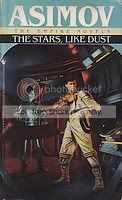
304 pages
3 stars
"Biron Farrell was young and naïve, but he was growing up fast. A radiation bomb planted in his dorm room changed him from an innocent student at the University of Earth to a marked man, fleeing desperately from an unknown assassin.
He soon discovers that, many light-years away, his father, the highly respected Rancher of Widemos, has been murdered. Stunned, grief-stricken, and outraged, Biron is determined to uncover the reasons behind his father’s death, and becomes entangled in an intricate saga of rebellion, political intrigue, and espionage.
The mystery takes him deep into space where he finds himself in a relentless struggle with the power-mad despots of Tyrann. Now it is not just a case of life or death for Biron, but a question of freedom for the galaxy… " /the blurb/
"The Stars Like Dust... No more than 3 stars. I've been saying forever that Asimov can't write a bad story but in this one he starts pretty miserably and almost amateurish. Well past a quarter into the story I feel like I'm watching a thinly plotted over melodramatic B movie with bad actors. Two thirds into the novel there are some interesting twists in the plot, enough to develop a desire to read onward. I know that usually this must be accomplished long before it happens in this story, desirably in the first 10 or 20 pages. Still the characters don't get much more interesting. In the last third of the novel, despite it's many glaring shortcomings the plot twists and turns add enough tension and suspense to hold a reader's attention. In the final pages of the book Asimov puts a few delightful surprises that ultimately make the story a success. By success in this case I mean that despite all that I've reported negatively I'm still rather satisfied with the story as a whole (...). This is an adventure story with elements of a space opera and twinges of a mystery." /Norm Davis, goodreads/
"One of the best titles in all of science fiction isn't quite enough to make this more than a fair novel." /wanack, LibraryThing/
"The Stars, Like Dust has what I consider to be one of the most evocative titles of any science fiction novel. Unfortunately, the novel itself is, at best, mediocre. With Pebble in the Sky and The Currents of Space, this book forms the Galactic Empire trilogy, although there is very little Galactic Empire in this book.
The book is more or less a standard adventure story with a helping of political intrigue, a serving of betrayals and backstabbing, and a somewhat groan-inducing ending (although, to be fair, the attachment of the "ultimate secret weapon" at the end of the novel was apparently not Asimov's idea, but was insisted upon by his editor). The story is, like a lot of Golden Age science fiction, somewhat dated as Asimov didn't anticipate developments in computers, but it is still readable. The Tyranni are a fairly stock enemy, but are drawn malevolently enough to make the fight against them worth reading. Some of the characters are fairly wooden, but the protagonist is reasonably engaging, even if he is overly naive and foolish at times.
The Stars, Like Dust ends up as a serviceable Asimov science fiction novel. There isn't anything particularly good or bad about it. A fan of Golden Age science fiction will find it worth reading, especially to see how the novel bridges the gap between the pulpy adventure stories of earlier science fiction and the more involved stories that came after it - one can see the seeds of stories like Foundation and The Caves of Steel in this book, and for that, it is probably worth a read for the science fiction fan." /StormRaven, LibraryThing/
304 pages
3 stars
"Biron Farrell was young and naïve, but he was growing up fast. A radiation bomb planted in his dorm room changed him from an innocent student at the University of Earth to a marked man, fleeing desperately from an unknown assassin.
He soon discovers that, many light-years away, his father, the highly respected Rancher of Widemos, has been murdered. Stunned, grief-stricken, and outraged, Biron is determined to uncover the reasons behind his father’s death, and becomes entangled in an intricate saga of rebellion, political intrigue, and espionage.
The mystery takes him deep into space where he finds himself in a relentless struggle with the power-mad despots of Tyrann. Now it is not just a case of life or death for Biron, but a question of freedom for the galaxy… " /the blurb/
"The Stars Like Dust... No more than 3 stars. I've been saying forever that Asimov can't write a bad story but in this one he starts pretty miserably and almost amateurish. Well past a quarter into the story I feel like I'm watching a thinly plotted over melodramatic B movie with bad actors. Two thirds into the novel there are some interesting twists in the plot, enough to develop a desire to read onward. I know that usually this must be accomplished long before it happens in this story, desirably in the first 10 or 20 pages. Still the characters don't get much more interesting. In the last third of the novel, despite it's many glaring shortcomings the plot twists and turns add enough tension and suspense to hold a reader's attention. In the final pages of the book Asimov puts a few delightful surprises that ultimately make the story a success. By success in this case I mean that despite all that I've reported negatively I'm still rather satisfied with the story as a whole (...). This is an adventure story with elements of a space opera and twinges of a mystery." /Norm Davis, goodreads/
"One of the best titles in all of science fiction isn't quite enough to make this more than a fair novel." /wanack, LibraryThing/
"The Stars, Like Dust has what I consider to be one of the most evocative titles of any science fiction novel. Unfortunately, the novel itself is, at best, mediocre. With Pebble in the Sky and The Currents of Space, this book forms the Galactic Empire trilogy, although there is very little Galactic Empire in this book.
The book is more or less a standard adventure story with a helping of political intrigue, a serving of betrayals and backstabbing, and a somewhat groan-inducing ending (although, to be fair, the attachment of the "ultimate secret weapon" at the end of the novel was apparently not Asimov's idea, but was insisted upon by his editor). The story is, like a lot of Golden Age science fiction, somewhat dated as Asimov didn't anticipate developments in computers, but it is still readable. The Tyranni are a fairly stock enemy, but are drawn malevolently enough to make the fight against them worth reading. Some of the characters are fairly wooden, but the protagonist is reasonably engaging, even if he is overly naive and foolish at times.
The Stars, Like Dust ends up as a serviceable Asimov science fiction novel. There isn't anything particularly good or bad about it. A fan of Golden Age science fiction will find it worth reading, especially to see how the novel bridges the gap between the pulpy adventure stories of earlier science fiction and the more involved stories that came after it - one can see the seeds of stories like Foundation and The Caves of Steel in this book, and for that, it is probably worth a read for the science fiction fan." /StormRaven, LibraryThing/
50readeron
#43 Egy polgár vallomásai by Sándor Márai
456 pages
5 stars
"(The Confessions of a Haut-Bourgeois) 1934-35
A novel, it is one of Márai's best writings and a turning point in his art, a personal account of the writer's childhood in small-town Hungary, an objective but dramatic description of middle-class life. The novel's second part tells about Márai's youth and his life as an artist living and travelling in Western Europe.
"This is the Hungarian middle-class whose way of life I was born into, observed, came to know and scrutinised in all its features to the very roots, and now I see the whole disintegrating. Perhaps this is my life's, my writing's sole duty: to delineate the course of this disintegration." (Sándor Márai) " /HUNLIT/
I realized for the first time here that Márai had a good sense of humor. While having read Embers, I really doubted it. Feeling better now.
#44 Budapesti kalauz marslakók számára by Antal Szerb
(A Martian's Guide to Budapest)
38 pages
5 stars
Especially loved the illustrations and the author's irony. (Gave it 5 stars partly for emotional reasons.)
""The Chain Bridge is infernally long. But you must try it once, Sir, and you won't regret it. Stroll, with a woman on your arm, across to Buda and then stroll back again - possibly with the same woman."
A delightfully whimsical and idiosyncratic look at his native city by an author who eschews the obvious and displays his erudition lightly. The illustrations and some of the initials are from the essay's first publication in book form. The translation is by Len Rix, who is the translator of Szerb's two novels." /The Hungarian Quarterly/
You can read some pages of the novel here: http://www.hungarianquarterly.com/no180/5.shtml
#45 Fanni hagyományai by József Kármán
("Fanny's testament")
68 pages
5 stars
We should've read it in high school, but, of course, I didn't. I read it now instead.
"The most important contribution to Urania (the first Hungarian quarterly) was his sentimental novel, Fanni hagyományai, much in the style of La nouvelle Héloise and Sorrows of Young Werther, the most exquisite product of Hungarian prose in the 18th century and one of the finest psychological romances in the literature." /Wikipedia/
The novel also reads a bit like Bronte, or like Jane Austen minus the usual happy ending and her irony. I really could've read it in high school, it took me less than an hour now. I've read neither Heloise nor Young Werther yet. How ignorant one can get? *sighs* (They must be pretty depressive, too, I guess.)
456 pages
5 stars
"(The Confessions of a Haut-Bourgeois) 1934-35
A novel, it is one of Márai's best writings and a turning point in his art, a personal account of the writer's childhood in small-town Hungary, an objective but dramatic description of middle-class life. The novel's second part tells about Márai's youth and his life as an artist living and travelling in Western Europe.
"This is the Hungarian middle-class whose way of life I was born into, observed, came to know and scrutinised in all its features to the very roots, and now I see the whole disintegrating. Perhaps this is my life's, my writing's sole duty: to delineate the course of this disintegration." (Sándor Márai) " /HUNLIT/
I realized for the first time here that Márai had a good sense of humor. While having read Embers, I really doubted it. Feeling better now.
#44 Budapesti kalauz marslakók számára by Antal Szerb
(A Martian's Guide to Budapest)
38 pages
5 stars
Especially loved the illustrations and the author's irony. (Gave it 5 stars partly for emotional reasons.)
""The Chain Bridge is infernally long. But you must try it once, Sir, and you won't regret it. Stroll, with a woman on your arm, across to Buda and then stroll back again - possibly with the same woman."
A delightfully whimsical and idiosyncratic look at his native city by an author who eschews the obvious and displays his erudition lightly. The illustrations and some of the initials are from the essay's first publication in book form. The translation is by Len Rix, who is the translator of Szerb's two novels." /The Hungarian Quarterly/
You can read some pages of the novel here: http://www.hungarianquarterly.com/no180/5.shtml
#45 Fanni hagyományai by József Kármán
("Fanny's testament")
68 pages
5 stars
We should've read it in high school, but, of course, I didn't. I read it now instead.
"The most important contribution to Urania (the first Hungarian quarterly) was his sentimental novel, Fanni hagyományai, much in the style of La nouvelle Héloise and Sorrows of Young Werther, the most exquisite product of Hungarian prose in the 18th century and one of the finest psychological romances in the literature." /Wikipedia/
The novel also reads a bit like Bronte, or like Jane Austen minus the usual happy ending and her irony. I really could've read it in high school, it took me less than an hour now. I've read neither Heloise nor Young Werther yet. How ignorant one can get? *sighs* (They must be pretty depressive, too, I guess.)
51readeron
#46 Beszterce ostroma by Kálmán Mikszáth
178 pages
4 stars
1895
"In 1894 he published his first novel, Beszterce ostroma (“The Siege of Beszterce”), the story of an eccentric Hungarian aristocrat. Mikszáth’s early art is romantic."
/Encyclopædia Britannica/
"The Siege of Beszterce (1896) contains more irony and less straightforward idealism than does St. Peter’s Umbrella, with its young lovers. The plot of the novel is an expanded anecdote about an eccentric aristocrat who is completely wrapped up in his delusions: he believes himself to be a medieval oligarch. The eccentric Count Pongrácz lives in his faraway castle in the Carpathian mountains. His ‘court’ is full of bizarre characters who are on his payroll. The daydreaming becomes absurd when Count Pongrácz decides to lay siege to the city of Beszterce with his private army for an alleged omission of feudal dues. His influential friends persuade the aldermen of the city to play the game to save the Count from the ridicule of the Press: the aldermen hire and send a fair ‘hostage’ to please his lordship, who falls in love with her till his make-believe world is shattered by the truth. Old Pongrácz is perhaps the most minutely-drawn character of Mikszáth; his fantasy-world reveals Mikszáth’s sound psychological knowledge. At first, Pongrácz is merely a capricious old man whose fancy ideas might make him look ridiculous; but in the end, when he collapses in a confrontation with reality, he becomes a tragicomic figure whose self-torment creates an atmosphere of pity around him. The pity is derived from Mikszáth’s compassion for his quixotic hero; his ridicule is reserved for the social institutions which perpetuate the possibility of the eccentricity described in the novel. At first sight it might seem nothing more than a bizarre story when old Pongrácz’s peasants (who adore him for the free entertainment), dressed as medieval warriors, fight mock battles with units of the Austro-Hungarian army who have been sent on manoeuvres to the region, but – and this is the point Mikszáth makes – if something were to go wrong, Count Pongrácz would be protected, as no local authority may charge him; only the committee of immunity in the Upper House has the power of impeaching him – and those gentlemen in the Upper House do not really want to defame a hereditary peer of the realm.
The strange Count might behave like a lunatic old man, yet he also possesses a certain grandeur, lent him by his strict observance of the rules of his own game, his absolute acceptance of the norms of bygone ages. His ‘normal’ contemporaries are not only mediocre compared with him but their empty lives, undisguised greed, corruption, and equally ridiculous pretensions provide no alternative to Count Pongrácz’s make-believe world. In other words, criticism is directed against contemporary society which has a twofold responsibility for its anomalies, not only tolerating their existence, but actually covering them up. Mikszáth, however, is not bitter about the social order; he merely exposes its features – perhaps for his own pleasure, or perhaps to show his wisdom in his disclosure of its absurdity.
The world whose petty secrets he is so keen to disclose is of course the world of the gentry, which rarely has any grandeur in its decline." /Lóránt Czigány: A History of Hungarian Literature/
#47 Love Virtually by Daniel Glattauer
272 pages
4 stars
"It's a virtual romance that begins by chance. When Leo mistakenly receives e-mails from a stranger named Emmi, he replies--and Emmi writes back. Soon, secrets are shared, sparks fly, and erotic tension simmers. Even though Emmi is married, it seems only a matter of time till they meet. But will their feelings survive a real-life encounter? And, if so-what then? Funny and fast-paced, Love Virtually offers plenty of twists, turns, and satisfaction" /goodreads/
"It starts simply enough: Emmi Rothner tries to cancel a magazine subscription, but mistypes the address and her email ends up in Leo Leike’s inbox. He notifies her of the mistake, and all is forgotten until, months later, Leo receives Emmi’s automated Christmas message and yet another email meant for the magazine. So begins an intimate email correspondence underpinned by something that may yet turn out to be love.
Love Virtually is told entirely through the medium of Emmi’s and Leo’s emails (...). At first, I was unsure of this device, as, by their nature, such correspondences are always going to be more interesting for the participants than for outside observers. And, sure enough, there were times when the tone of the emails – enticingly drawn-out for Leo and Emmi, but rather long-winded for this reader – tried my patience.
But, as I got further in (and the novel was swift and snappy enough that this didn’t take long), I warmed to the ebb and flow of the exchange, which is a kind of courtship dance that creates personae for the two correspondents whilst occasionally offering glimpses of the real characters underneath. Both protagonists could gain or lose from the dialogue: Leo is single, though the sparks of his recently-ended relationship have not yet burnt out entirely; Emmi is married with children, but seems to drive the correspondence more than Leo, as it provides her with something that her existing relationship does not. Whatever reservations I might have had towards the beginning, by the end of Love Virtually I was gripped, wanting to know what happened. The ending is judged perfectly, and paves the way for the sequel," /David Hebblethwaite, Goodreads/
Yes. I must admit that after completing the book I opened the sequel and read how it ends.
"Daniel Glattauer is an Austrian author, most famous for his column in Austrian newspaper “Standard”. Gut gegen Nordwind (translates to “Good Against North Wind”) is an epistolary novel, written entirely in emails. (...)
Plot:
Emmi mistakenly sends Leo an email about quitting her subscription to a magazine. A few months later, the same mistake happens again. With time, their correspondence grows more frequent and more intimate. Even though Leo just wants to finally put his ex-girlfriend behind him and Emmi is happily married, the desire to meet and make more of their relationship grows stronger for both of them.
Glattauer works the email format perfectly – there are longer ones, drunken emails, short chat-like conversations and everything in between. In the beginning, he also captures the different voices and styles of his characters. Towards the end, though, the differences between them get blurred. Nevertheless it’s worth reading, especially since it’s a very quick read." /kalafudra, LibraryThing/
I wish they hadn't changed the original title!
I'll hopefully finish Cold Mountain pretty soon, as well.
178 pages
4 stars
1895
"In 1894 he published his first novel, Beszterce ostroma (“The Siege of Beszterce”), the story of an eccentric Hungarian aristocrat. Mikszáth’s early art is romantic."
/Encyclopædia Britannica/
"The Siege of Beszterce (1896) contains more irony and less straightforward idealism than does St. Peter’s Umbrella, with its young lovers. The plot of the novel is an expanded anecdote about an eccentric aristocrat who is completely wrapped up in his delusions: he believes himself to be a medieval oligarch. The eccentric Count Pongrácz lives in his faraway castle in the Carpathian mountains. His ‘court’ is full of bizarre characters who are on his payroll. The daydreaming becomes absurd when Count Pongrácz decides to lay siege to the city of Beszterce with his private army for an alleged omission of feudal dues. His influential friends persuade the aldermen of the city to play the game to save the Count from the ridicule of the Press: the aldermen hire and send a fair ‘hostage’ to please his lordship, who falls in love with her till his make-believe world is shattered by the truth. Old Pongrácz is perhaps the most minutely-drawn character of Mikszáth; his fantasy-world reveals Mikszáth’s sound psychological knowledge. At first, Pongrácz is merely a capricious old man whose fancy ideas might make him look ridiculous; but in the end, when he collapses in a confrontation with reality, he becomes a tragicomic figure whose self-torment creates an atmosphere of pity around him. The pity is derived from Mikszáth’s compassion for his quixotic hero; his ridicule is reserved for the social institutions which perpetuate the possibility of the eccentricity described in the novel. At first sight it might seem nothing more than a bizarre story when old Pongrácz’s peasants (who adore him for the free entertainment), dressed as medieval warriors, fight mock battles with units of the Austro-Hungarian army who have been sent on manoeuvres to the region, but – and this is the point Mikszáth makes – if something were to go wrong, Count Pongrácz would be protected, as no local authority may charge him; only the committee of immunity in the Upper House has the power of impeaching him – and those gentlemen in the Upper House do not really want to defame a hereditary peer of the realm.
The strange Count might behave like a lunatic old man, yet he also possesses a certain grandeur, lent him by his strict observance of the rules of his own game, his absolute acceptance of the norms of bygone ages. His ‘normal’ contemporaries are not only mediocre compared with him but their empty lives, undisguised greed, corruption, and equally ridiculous pretensions provide no alternative to Count Pongrácz’s make-believe world. In other words, criticism is directed against contemporary society which has a twofold responsibility for its anomalies, not only tolerating their existence, but actually covering them up. Mikszáth, however, is not bitter about the social order; he merely exposes its features – perhaps for his own pleasure, or perhaps to show his wisdom in his disclosure of its absurdity.
The world whose petty secrets he is so keen to disclose is of course the world of the gentry, which rarely has any grandeur in its decline." /Lóránt Czigány: A History of Hungarian Literature/
#47 Love Virtually by Daniel Glattauer
272 pages
4 stars
"It's a virtual romance that begins by chance. When Leo mistakenly receives e-mails from a stranger named Emmi, he replies--and Emmi writes back. Soon, secrets are shared, sparks fly, and erotic tension simmers. Even though Emmi is married, it seems only a matter of time till they meet. But will their feelings survive a real-life encounter? And, if so-what then? Funny and fast-paced, Love Virtually offers plenty of twists, turns, and satisfaction" /goodreads/
"It starts simply enough: Emmi Rothner tries to cancel a magazine subscription, but mistypes the address and her email ends up in Leo Leike’s inbox. He notifies her of the mistake, and all is forgotten until, months later, Leo receives Emmi’s automated Christmas message and yet another email meant for the magazine. So begins an intimate email correspondence underpinned by something that may yet turn out to be love.
Love Virtually is told entirely through the medium of Emmi’s and Leo’s emails (...). At first, I was unsure of this device, as, by their nature, such correspondences are always going to be more interesting for the participants than for outside observers. And, sure enough, there were times when the tone of the emails – enticingly drawn-out for Leo and Emmi, but rather long-winded for this reader – tried my patience.
But, as I got further in (and the novel was swift and snappy enough that this didn’t take long), I warmed to the ebb and flow of the exchange, which is a kind of courtship dance that creates personae for the two correspondents whilst occasionally offering glimpses of the real characters underneath. Both protagonists could gain or lose from the dialogue: Leo is single, though the sparks of his recently-ended relationship have not yet burnt out entirely; Emmi is married with children, but seems to drive the correspondence more than Leo, as it provides her with something that her existing relationship does not. Whatever reservations I might have had towards the beginning, by the end of Love Virtually I was gripped, wanting to know what happened. The ending is judged perfectly, and paves the way for the sequel," /David Hebblethwaite, Goodreads/
Yes. I must admit that after completing the book I opened the sequel and read how it ends.
"Daniel Glattauer is an Austrian author, most famous for his column in Austrian newspaper “Standard”. Gut gegen Nordwind (translates to “Good Against North Wind”) is an epistolary novel, written entirely in emails. (...)
Plot:
Emmi mistakenly sends Leo an email about quitting her subscription to a magazine. A few months later, the same mistake happens again. With time, their correspondence grows more frequent and more intimate. Even though Leo just wants to finally put his ex-girlfriend behind him and Emmi is happily married, the desire to meet and make more of their relationship grows stronger for both of them.
Glattauer works the email format perfectly – there are longer ones, drunken emails, short chat-like conversations and everything in between. In the beginning, he also captures the different voices and styles of his characters. Towards the end, though, the differences between them get blurred. Nevertheless it’s worth reading, especially since it’s a very quick read." /kalafudra, LibraryThing/
I wish they hadn't changed the original title!
I'll hopefully finish Cold Mountain pretty soon, as well.
52readeron
#48 Someone I Loved by Anna Gavalda
336 pages
3 stars
"Someone I Loved is Anna Gavalda's first novel and is obviously inspired by the dissolution of her own marriage. Told from the perspective of a woman in her late 30s, Chloe, it begins with her decision to take her children to her in-laws' lake house after her husband leaves her for another woman. Chloe's father-in-law decides to come along. What ensues is a loaded conversation by the fireplace about love found, love lost, and the realization that no one is truly who you think they are. While Chloe has always believed her father-in-law to be an "old bastard," it turns out he is human, has flaws, had the option to do to his family what Chloe's husband did to his, and took the nobler path.
This novel feels more like a play, with very little description and nearly 100% dialogue. In the end Chloe and Pierre realize that the right thing to do, ultimately, is the thing that makes you happy, even if you think it might hurt someone. If you change nothing and are miserable because of it then you'll make everyone else around you miserable. The last line of the book really drives this home, "Wouldn't that stubborn little girl have preferred living with a father who was happier?" Despite Chloe's pain at having lost her marriage, she must realize that the alternative would have been far worse: living with an unhappy man and perpetuating the life of her in-laws'. While the majority of the writing isn't anything special, this must have been a catharsis for Gavalda to write. There are some gems from the father-in-law toward the end of the book, but overall, the book is mostly forgettable." /Shelley, goodreads/
I wish publishers would print on books like this in huge capital letters that "Sorry, it's actually just a therapy for the author". Then I could avoid them more easily and choose a less boring, a less trivial book instead. It could make me so very, very grateful.
As to the story, IMO, happy grandads are able to be the same mean as unhappy ones if they happen to be meany by nature, that was probably the stupidest moral of a story I've ever heard (so far). It makes me grumble.
336 pages
3 stars
"Someone I Loved is Anna Gavalda's first novel and is obviously inspired by the dissolution of her own marriage. Told from the perspective of a woman in her late 30s, Chloe, it begins with her decision to take her children to her in-laws' lake house after her husband leaves her for another woman. Chloe's father-in-law decides to come along. What ensues is a loaded conversation by the fireplace about love found, love lost, and the realization that no one is truly who you think they are. While Chloe has always believed her father-in-law to be an "old bastard," it turns out he is human, has flaws, had the option to do to his family what Chloe's husband did to his, and took the nobler path.
This novel feels more like a play, with very little description and nearly 100% dialogue. In the end Chloe and Pierre realize that the right thing to do, ultimately, is the thing that makes you happy, even if you think it might hurt someone. If you change nothing and are miserable because of it then you'll make everyone else around you miserable. The last line of the book really drives this home, "Wouldn't that stubborn little girl have preferred living with a father who was happier?" Despite Chloe's pain at having lost her marriage, she must realize that the alternative would have been far worse: living with an unhappy man and perpetuating the life of her in-laws'. While the majority of the writing isn't anything special, this must have been a catharsis for Gavalda to write. There are some gems from the father-in-law toward the end of the book, but overall, the book is mostly forgettable." /Shelley, goodreads/
I wish publishers would print on books like this in huge capital letters that "Sorry, it's actually just a therapy for the author". Then I could avoid them more easily and choose a less boring, a less trivial book instead. It could make me so very, very grateful.
As to the story, IMO, happy grandads are able to be the same mean as unhappy ones if they happen to be meany by nature, that was probably the stupidest moral of a story I've ever heard (so far). It makes me grumble.
53readeron
#49 Cold Mountain by Charles Frazier
491 pages
4 stars
1997
"This book came highly recommended. It tells the story of Inman, badly wounded in the Civil War, deserting to walk home to Cold Mountain, and of Ada, the preacher's daughter he loves, who after the death of her father has to make a life on a derelict farmand that her education has not prepared her for.
(...) Inman is sometimes a bit too good to be true, and so is the relationship between Ada and Ruby, the girl who turns up like a deus ex machina and without whom Ada would have no choice but to return to Charleston and life in the city." /mojacobs, LibraryThing/
"Ada and Inman are both very interesting to read about, even more so as the story progresses, but the characters they meet and run into are even more indearing and interesting. When one of their stories begins, you are immediately drawn in." /Sammy, goodreads/
"I came away with mixed feelings about Cold Mountain. The basic story had great possibility and is at times interesting. The author painted what seemed to be a realistic description of hard scrabble farm life for those left behind to survive while the men folk fought for slavery and state's rights. Many descriptions of how ordinary people used nature to make a working farm in an age without many conveniences seemed true to form and tested the mettle of the characters.
The hospital experiences of Inman and trials encountered during his long desertion from Lee's embattled 1864 army toward home (Cold Mountain, along the western North Carolinian border) were also interesting and realistic.
This is basically a story of journey's on two levels. First is the physical journey of Inman as he makes his way home. He must dodge hunger and the Home Guard, a posse band hunting down the what had become a horde of army deserters at that time. The other journey is inward and occurs among four major characters. Inman has become a pacifist an turns toward his own interests and an imagined better life without war and with his true love, Ada. Ada, a Charleston belle left kept without any practical skills by a doting father, must fend for herself after he dies. She is first shocked by real life and then learns to work with the aid of Ruby, who has a seemingly endless store of knowledge to address every situation. Ruby was, I found, the most interesting character. A self-raised waif, she is sent to Ada's farm by a neighbor woman who knows Ruby's great skills at survival and Ada's need for someone with a clue about how to milk cows, pick apples, raise chickens and generally make a productive farm run.
The chapters alternate between Inman's long migration west and Ada's coming to grips with her new and harder life (but one in which she learns to take great pride) as a mountain farmer.
The pacing is somewhat slow and languid. The author almost never fails to detail scenery and much of the book is taken up with the color of the sky, rising of various constellations, glistening of leaves in rainy weather or qualities of various snowfalls when the story moves to the late months. The book is very heavy on description, which is a plus if that's what you like in a novel. It is somewhat short on action, although there are interesting situations and characters met along the way (primarily by Inman, though Ruby's ne'er-do-well father makes an welcome diversion).
This is a love story as well as a story of journeys, although the love story angle was perhaps the weakest part (save at the ending, which by the way will be unsatisfying to some). During the first hundred pages while Ada is either milling about the farm on her way to death by starvation or learning to adjust to her harsh reality in the early Ruby part of the book, her thoughts turn not once to Inman, the great love of her life. In fact, during the first half of the book, the reader is wondering if Ada even knew (or remembered) Inman. I did find it odd that Ada, in her despair and mentally wishing for a life-line thinks only of her father or her Charleston youth and not of the one man who we later learn touched her soul before he donned the rebel grey.
I think readers who like a more literary approach to fiction and enjoy nuanced descriptive writing will probably enjoy this book a lot. Those looking for a good yarn and a gripping escape may feel under-nourished by the end. " /Wayne A. Smith, Amazon/
"This book came highly recommended to me by a (...) friend whose opinion I regard highly. And, of course, I had been exposed to all the hype. I was therefore shocked when I discovered it to be dull, repetitive, and riddled with cliches.
The prose is plodding, and I found it an effort to read. (...), I was surprised at how difficult it was to wade through Frazier's lumpy, overstuffed prose.
The characters are cliches as well. Inman is the archetypical American loner, with an inner life of the approximate depth of an old John Wayne character. Virtually all the situations he confronts during his chapters involve his having to deal with cardboard "bad guys" straight out of a western. He copes with them with the unfailing competence of an old Clint Eastwood movie. He has no inner life worthy of the name. I know that he has PTSD, but it is clear from the flashback sections that he has always been inarticulate and distant. I found it extraordinarily hard to care what happens to him.
Even more troubling are the Ada/Ruby chapters. The chapter that I thought most interesting in the whole novel was Ada's first, in which her despair and desperation are deftly presented. Alas, Ruby shortly appears. She is the supremely intelligent illiterate so beloved of all anti-intellectuals. Not only is she masterfully competent at all aspects of running a farm (with no satisfactory explanation of how a desperately neglected child could learn so much), but her observations of nature are so keen that she independently works out Darwinian adaptation (cf. the scene in which she explains why dogwoods change color earlier than other trees). This anti-intellectual theme is very strong. Frazier is forceful in his contrast of Ada's pretentious, Emerson-obsessed father with the strong, simple wisdom of the country folk he encounters. What a tired theme! It's almost as over-worked as the idea that "war is hell." Gee, the Civil War was destructive to the social fabric of the United States! Imagine that!" /A Customer, Amazon/
Yes, yes and yes!!! Ruby's source of her obviously endless knowledge of nature and farming has been a perfect mystery to me all the time. And the anti-intellectual theme made the whole story a lot more depressing than the lack of a happy ending ever could. The novel was simply chock full of little tidbits that may appeal to the typical 21st century bestseller reader but these details had absolutely nothing to do with literature or the Civil War era, as we know it. Don't get me wrong: it was entertaining to notice/look for these tidbits, but I had to start and complete reading several other books whenever I got bored with the lazily meandering storyline (quite often). Otherwise, I simply couldn't/wouldn't have finished the novel.
"Interesting style of writing but the story is too episodic and formulaic. The chapters alternate back and forth between Inman and Ada, which isn't the worst thing in the world but it does get wearyingly predictable. This happens to him. That happens to her. This happens to him. That happens to her. And so on. The ending is depressing and need not have been. I disagree with comments about this was the only ending possible. I don't want to give it away for those who haven't read it, but the ending brings it down at least one star." /A customer, Amazon/
I must admit that I also considered three stars, but then I should've given only 2 stars both to Gavalda and Glattauer, and I didn't want to do that. I feel really so generous nowadays.:)
"The only thing I didn't care for was how the main characters seemed to be inhabitants of the 21st Century. The anti-war Inman and the independent-minded Ada struck me as what I would see in 2004 - not what I'd expect in 1864 North Carolina. While true that North Carolina wasn't thrilled about participating in the Civil War, it's still something that struck me as just a little self-conscious. Maybe that's just me. As for the anti-war sentiment itself, I'm pretty certain that Fraiser wasn't alluding that the Civil War shouldn't have been fought. Inman was just lamenting the fact that war had to be waged at all. It's a worthy read." /A Customer, Amazon/
"I really think I'm going to stop reading "debut" novels. I know that isn't very nice but most of them are a major disappointment and this is no exception. The characters are cliches, rather than being fully developed, so it's hard to impossible to care about any one of them. Unlike some of the other reviewers, I found the prose lumpy and laborious. Frazier also falls into many pitfalls of the novice writer, such as the "he said" syndrome. An example is found on page 335 of the hardcover edition--I can't get to sleep, she said. I'm awake, Ada said. What's keeping me from sleeping is I'm thinking about what I'll do with him if he lives, Ruby said. With Inman, Ada said. With Pap. We'll take him home and care for him is what, Ada siad. I'm obliged, Ruby said. You've never been obliged to anyone before, Ada said. That too, Ruby said. After about ten pages of this easily-corrected mistake, I had to put the book down or go nuts. I wondered if Frazier even READ the manuscript he wrote. He DOES have promise, I'll give him that, but he needs a few lessons on the art and craft of novel writing before continuing, something any editor or even first-reader should have spotted immediately. " /A Customer, Amazon/
"This book has a good story line which could be much better than it is. Fraizer writes a novel with great imagery. Inman's journey across the embattled south is an epic one. However, the book's biggest detractor is the slowness of the plot at times. Some parts of the book are quite entertaining and just wish to be finished whilst others feel laborious to finish. (...) Its underlying plot is of excellent caliber but it is the slowness of some parts of this book that keep it from being as good as it could potentially be. "
/"alwhkanda" , Amazon/
"If I had to read about what Inman and Ada ate one more time I was going to eat the darn book. Thankfully, the story ended. The author probably couldn't come up with yet one more disgusting discription of roadkill. When Inman ate the bear I burst out laughing. Yes, I know people eat bear but it was just a little farout as to how Inman got the bear in the first place.
All that aside, the book is quite boring although I recognize that the author worked very hard on it. He just didn't come through for me. " /A Customer, Amazon/
I couldn't agree more. This novel made me feel that an average mountain in America must be a bit like a large and sterile, well equipped kitchen, combined with a herb garden and several abandoned gocery stores. It also suggested that sleeping on the frozen ground is definitely comfortable and almost good for your health. All in all, nature was depicted in the novel like a nice and very well-directed hotel. (A cosy war story?)
OK, enough said. Overall, I still have mixed feelings about this book and maybe it shows. Still, from time to time, I enjoyed immersing myself in this strange, almost gothic Civil War tale. So it gets 4 stars now. (I'm glad that I've finally slogged through it.)
491 pages
4 stars
1997
"This book came highly recommended. It tells the story of Inman, badly wounded in the Civil War, deserting to walk home to Cold Mountain, and of Ada, the preacher's daughter he loves, who after the death of her father has to make a life on a derelict farmand that her education has not prepared her for.
(...) Inman is sometimes a bit too good to be true, and so is the relationship between Ada and Ruby, the girl who turns up like a deus ex machina and without whom Ada would have no choice but to return to Charleston and life in the city." /mojacobs, LibraryThing/
"Ada and Inman are both very interesting to read about, even more so as the story progresses, but the characters they meet and run into are even more indearing and interesting. When one of their stories begins, you are immediately drawn in." /Sammy, goodreads/
"I came away with mixed feelings about Cold Mountain. The basic story had great possibility and is at times interesting. The author painted what seemed to be a realistic description of hard scrabble farm life for those left behind to survive while the men folk fought for slavery and state's rights. Many descriptions of how ordinary people used nature to make a working farm in an age without many conveniences seemed true to form and tested the mettle of the characters.
The hospital experiences of Inman and trials encountered during his long desertion from Lee's embattled 1864 army toward home (Cold Mountain, along the western North Carolinian border) were also interesting and realistic.
This is basically a story of journey's on two levels. First is the physical journey of Inman as he makes his way home. He must dodge hunger and the Home Guard, a posse band hunting down the what had become a horde of army deserters at that time. The other journey is inward and occurs among four major characters. Inman has become a pacifist an turns toward his own interests and an imagined better life without war and with his true love, Ada. Ada, a Charleston belle left kept without any practical skills by a doting father, must fend for herself after he dies. She is first shocked by real life and then learns to work with the aid of Ruby, who has a seemingly endless store of knowledge to address every situation. Ruby was, I found, the most interesting character. A self-raised waif, she is sent to Ada's farm by a neighbor woman who knows Ruby's great skills at survival and Ada's need for someone with a clue about how to milk cows, pick apples, raise chickens and generally make a productive farm run.
The chapters alternate between Inman's long migration west and Ada's coming to grips with her new and harder life (but one in which she learns to take great pride) as a mountain farmer.
The pacing is somewhat slow and languid. The author almost never fails to detail scenery and much of the book is taken up with the color of the sky, rising of various constellations, glistening of leaves in rainy weather or qualities of various snowfalls when the story moves to the late months. The book is very heavy on description, which is a plus if that's what you like in a novel. It is somewhat short on action, although there are interesting situations and characters met along the way (primarily by Inman, though Ruby's ne'er-do-well father makes an welcome diversion).
This is a love story as well as a story of journeys, although the love story angle was perhaps the weakest part (save at the ending, which by the way will be unsatisfying to some). During the first hundred pages while Ada is either milling about the farm on her way to death by starvation or learning to adjust to her harsh reality in the early Ruby part of the book, her thoughts turn not once to Inman, the great love of her life. In fact, during the first half of the book, the reader is wondering if Ada even knew (or remembered) Inman. I did find it odd that Ada, in her despair and mentally wishing for a life-line thinks only of her father or her Charleston youth and not of the one man who we later learn touched her soul before he donned the rebel grey.
I think readers who like a more literary approach to fiction and enjoy nuanced descriptive writing will probably enjoy this book a lot. Those looking for a good yarn and a gripping escape may feel under-nourished by the end. " /Wayne A. Smith, Amazon/
"This book came highly recommended to me by a (...) friend whose opinion I regard highly. And, of course, I had been exposed to all the hype. I was therefore shocked when I discovered it to be dull, repetitive, and riddled with cliches.
The prose is plodding, and I found it an effort to read. (...), I was surprised at how difficult it was to wade through Frazier's lumpy, overstuffed prose.
The characters are cliches as well. Inman is the archetypical American loner, with an inner life of the approximate depth of an old John Wayne character. Virtually all the situations he confronts during his chapters involve his having to deal with cardboard "bad guys" straight out of a western. He copes with them with the unfailing competence of an old Clint Eastwood movie. He has no inner life worthy of the name. I know that he has PTSD, but it is clear from the flashback sections that he has always been inarticulate and distant. I found it extraordinarily hard to care what happens to him.
Even more troubling are the Ada/Ruby chapters. The chapter that I thought most interesting in the whole novel was Ada's first, in which her despair and desperation are deftly presented. Alas, Ruby shortly appears. She is the supremely intelligent illiterate so beloved of all anti-intellectuals. Not only is she masterfully competent at all aspects of running a farm (with no satisfactory explanation of how a desperately neglected child could learn so much), but her observations of nature are so keen that she independently works out Darwinian adaptation (cf. the scene in which she explains why dogwoods change color earlier than other trees). This anti-intellectual theme is very strong. Frazier is forceful in his contrast of Ada's pretentious, Emerson-obsessed father with the strong, simple wisdom of the country folk he encounters. What a tired theme! It's almost as over-worked as the idea that "war is hell." Gee, the Civil War was destructive to the social fabric of the United States! Imagine that!" /A Customer, Amazon/
Yes, yes and yes!!! Ruby's source of her obviously endless knowledge of nature and farming has been a perfect mystery to me all the time. And the anti-intellectual theme made the whole story a lot more depressing than the lack of a happy ending ever could. The novel was simply chock full of little tidbits that may appeal to the typical 21st century bestseller reader but these details had absolutely nothing to do with literature or the Civil War era, as we know it. Don't get me wrong: it was entertaining to notice/look for these tidbits, but I had to start and complete reading several other books whenever I got bored with the lazily meandering storyline (quite often). Otherwise, I simply couldn't/wouldn't have finished the novel.
"Interesting style of writing but the story is too episodic and formulaic. The chapters alternate back and forth between Inman and Ada, which isn't the worst thing in the world but it does get wearyingly predictable. This happens to him. That happens to her. This happens to him. That happens to her. And so on. The ending is depressing and need not have been. I disagree with comments about this was the only ending possible. I don't want to give it away for those who haven't read it, but the ending brings it down at least one star." /A customer, Amazon/
I must admit that I also considered three stars, but then I should've given only 2 stars both to Gavalda and Glattauer, and I didn't want to do that. I feel really so generous nowadays.:)
"The only thing I didn't care for was how the main characters seemed to be inhabitants of the 21st Century. The anti-war Inman and the independent-minded Ada struck me as what I would see in 2004 - not what I'd expect in 1864 North Carolina. While true that North Carolina wasn't thrilled about participating in the Civil War, it's still something that struck me as just a little self-conscious. Maybe that's just me. As for the anti-war sentiment itself, I'm pretty certain that Fraiser wasn't alluding that the Civil War shouldn't have been fought. Inman was just lamenting the fact that war had to be waged at all. It's a worthy read." /A Customer, Amazon/
"I really think I'm going to stop reading "debut" novels. I know that isn't very nice but most of them are a major disappointment and this is no exception. The characters are cliches, rather than being fully developed, so it's hard to impossible to care about any one of them. Unlike some of the other reviewers, I found the prose lumpy and laborious. Frazier also falls into many pitfalls of the novice writer, such as the "he said" syndrome. An example is found on page 335 of the hardcover edition--I can't get to sleep, she said. I'm awake, Ada said. What's keeping me from sleeping is I'm thinking about what I'll do with him if he lives, Ruby said. With Inman, Ada said. With Pap. We'll take him home and care for him is what, Ada siad. I'm obliged, Ruby said. You've never been obliged to anyone before, Ada said. That too, Ruby said. After about ten pages of this easily-corrected mistake, I had to put the book down or go nuts. I wondered if Frazier even READ the manuscript he wrote. He DOES have promise, I'll give him that, but he needs a few lessons on the art and craft of novel writing before continuing, something any editor or even first-reader should have spotted immediately. " /A Customer, Amazon/
"This book has a good story line which could be much better than it is. Fraizer writes a novel with great imagery. Inman's journey across the embattled south is an epic one. However, the book's biggest detractor is the slowness of the plot at times. Some parts of the book are quite entertaining and just wish to be finished whilst others feel laborious to finish. (...) Its underlying plot is of excellent caliber but it is the slowness of some parts of this book that keep it from being as good as it could potentially be. "
/"alwhkanda" , Amazon/
"If I had to read about what Inman and Ada ate one more time I was going to eat the darn book. Thankfully, the story ended. The author probably couldn't come up with yet one more disgusting discription of roadkill. When Inman ate the bear I burst out laughing. Yes, I know people eat bear but it was just a little farout as to how Inman got the bear in the first place.
All that aside, the book is quite boring although I recognize that the author worked very hard on it. He just didn't come through for me. " /A Customer, Amazon/
I couldn't agree more. This novel made me feel that an average mountain in America must be a bit like a large and sterile, well equipped kitchen, combined with a herb garden and several abandoned gocery stores. It also suggested that sleeping on the frozen ground is definitely comfortable and almost good for your health. All in all, nature was depicted in the novel like a nice and very well-directed hotel. (A cosy war story?)
OK, enough said. Overall, I still have mixed feelings about this book and maybe it shows. Still, from time to time, I enjoyed immersing myself in this strange, almost gothic Civil War tale. So it gets 4 stars now. (I'm glad that I've finally slogged through it.)
54readeron
#50 The Burden by Mary Westmacott (Agatha Christie)
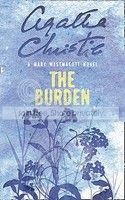
4 stars
224 pages
(1973)
"Mary Westmacott, the now well-known pseudonym of Agatha Christie, delves into relationships, particularly those of an older sister/younger sister.
At first Laura hates her younger sister. She prays for her to die, attempts to entice the family cat to smother her, and in general, hates this new person who will get the love she wants. But a tragic accident changes everything and younger sister Shirley becomes the total focus of Laura's life. Laura's every thought and action centers on Shirley and making sure she is happy and protected.
The story covers many years and sees Shirley making a terrible choice for a husband and living to reap the fall-out from such a choice. Can Laura step in again to save Shirley? And at what price to herself?
I thought this was an interesting story until the last section and the introduction of Llewellyn Knox. The heretofore interesting tale then downgraded into long winded discussions of philosophy and religion that seemed out-of-place. Be prepared for a rather fantastical ending, but as always with Christie, a highly readable tale."
/Antoinette Klein , Amazon/
"We first meet Laura as a child standing beside the font where her baby sister Shirley is being christened. nobody around her knows her thoughts, though Mr. Baldock, "Baldy", the distinguished, grumpy old scholar who is to be her faithful friend thoroughout his life, has a very shrewd idea. The keynote of Laura's childhood is a longing to be loved; followed by the discovery that to love is far more rewarding. That this, too can be dangerous, she learns in the end (...)" /AbeBooks/
"Baldy" was definitely my favorite character in the story.
4 stars
224 pages
(1973)
"Mary Westmacott, the now well-known pseudonym of Agatha Christie, delves into relationships, particularly those of an older sister/younger sister.
At first Laura hates her younger sister. She prays for her to die, attempts to entice the family cat to smother her, and in general, hates this new person who will get the love she wants. But a tragic accident changes everything and younger sister Shirley becomes the total focus of Laura's life. Laura's every thought and action centers on Shirley and making sure she is happy and protected.
The story covers many years and sees Shirley making a terrible choice for a husband and living to reap the fall-out from such a choice. Can Laura step in again to save Shirley? And at what price to herself?
I thought this was an interesting story until the last section and the introduction of Llewellyn Knox. The heretofore interesting tale then downgraded into long winded discussions of philosophy and religion that seemed out-of-place. Be prepared for a rather fantastical ending, but as always with Christie, a highly readable tale."
/Antoinette Klein , Amazon/
"We first meet Laura as a child standing beside the font where her baby sister Shirley is being christened. nobody around her knows her thoughts, though Mr. Baldock, "Baldy", the distinguished, grumpy old scholar who is to be her faithful friend thoroughout his life, has a very shrewd idea. The keynote of Laura's childhood is a longing to be loved; followed by the discovery that to love is far more rewarding. That this, too can be dangerous, she learns in the end (...)" /AbeBooks/
"Baldy" was definitely my favorite character in the story.
55readeron
#51 The Man in the High Castle by Philip K. Dick
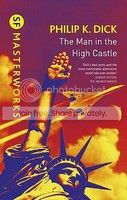
249 pages
4 stars
"Philip K. Dick, as some reading this might be aware, was a science fiction writer whose stories served (loosely) as the basis for the films "Blade Runner" and "Total Recall." His short fiction exemplifies the maxim that science fiction is a "literature of ideas." The "idea" behind "The Man in the High Castle" is that of the alternative history: the Axis powers actually prevailed in World War II, and modern-day America (meaning, in this case, the 1960's, when the book was first published) has been roughly split into two spheres of influence, German and Japanese.
How pleasantly surprising, then, to discover that this central "idea" is nothing more than a backdrop; that while plot and characters are certainly shaped by the imagined circumstances, the actual concern of the book is not the situation but the people within it. As a result, rather than reading as a description of an alternate reality, we are treated to a full experience of lives in a world that differs profoundly from our own. As a result, this novel is more than just science fiction. It succeeds in transcending the genre ghetto and meriting consideration among the best of modern writing.
Examples of how carefully, and how well, this book was thought out are too numerous to list, but one example: the titular "Man" is an American maverick writer of an alternative history in which America and its allies prevail in World War II. How simple, how convenient it would have been to have this alternative-history-within-an-alternative-history perfectly reflect our own reality. But it isn't so; the imagined history is completely different. Brilliantly conceived and executed, this is a truly rewarding book." /Michael Bulger, Amazon/
More info about the book (map, etc.):
http://en.wikipedia.org/wiki/Man_in_the_high_castle
249 pages
4 stars
"Philip K. Dick, as some reading this might be aware, was a science fiction writer whose stories served (loosely) as the basis for the films "Blade Runner" and "Total Recall." His short fiction exemplifies the maxim that science fiction is a "literature of ideas." The "idea" behind "The Man in the High Castle" is that of the alternative history: the Axis powers actually prevailed in World War II, and modern-day America (meaning, in this case, the 1960's, when the book was first published) has been roughly split into two spheres of influence, German and Japanese.
How pleasantly surprising, then, to discover that this central "idea" is nothing more than a backdrop; that while plot and characters are certainly shaped by the imagined circumstances, the actual concern of the book is not the situation but the people within it. As a result, rather than reading as a description of an alternate reality, we are treated to a full experience of lives in a world that differs profoundly from our own. As a result, this novel is more than just science fiction. It succeeds in transcending the genre ghetto and meriting consideration among the best of modern writing.
Examples of how carefully, and how well, this book was thought out are too numerous to list, but one example: the titular "Man" is an American maverick writer of an alternative history in which America and its allies prevail in World War II. How simple, how convenient it would have been to have this alternative-history-within-an-alternative-history perfectly reflect our own reality. But it isn't so; the imagined history is completely different. Brilliantly conceived and executed, this is a truly rewarding book." /Michael Bulger, Amazon/
More info about the book (map, etc.):
http://en.wikipedia.org/wiki/Man_in_the_high_castle
56readeron
#52 The Bloody Chamber and Other Stories by Angela Carter
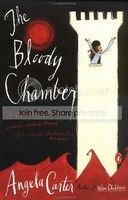
126 pages
4 stars
(First published: 1979)
"Before it was trendy to adapt fairy tale themes into adult fiction, there was Angela Carter.
In _The Bloody Chamber_, Carter works with a variety of fairy tale and folkloric themes, crafting them into very adult stories written in a style all her own. Somehow, her prose manages to be hauntingly strange and deliciously earthy at once. I didn't like all of the stories in this collection, but I very much liked some of them, and I'm glad I read the book. I especially enjoyed the title story (a retelling of "Bluebeard"), and "The Lady of the House of Love", quite possibly my favorite vampire tale ever. In it, the tragic lady Nosferatu reads her Tarot cards every night, and every night draws cards signifying death--until one night she draws Les Amoureux, the Lovers, and everything changes. Splendid.
There is more here--a raunchy "Puss in Boots", two takes on "Beauty and the Beast", several stories dealing with werewolves and/or Red Riding Hood, and much more." /Kelly (Fantasy Literature), Amazon/
126 pages
4 stars
(First published: 1979)
"Before it was trendy to adapt fairy tale themes into adult fiction, there was Angela Carter.
In _The Bloody Chamber_, Carter works with a variety of fairy tale and folkloric themes, crafting them into very adult stories written in a style all her own. Somehow, her prose manages to be hauntingly strange and deliciously earthy at once. I didn't like all of the stories in this collection, but I very much liked some of them, and I'm glad I read the book. I especially enjoyed the title story (a retelling of "Bluebeard"), and "The Lady of the House of Love", quite possibly my favorite vampire tale ever. In it, the tragic lady Nosferatu reads her Tarot cards every night, and every night draws cards signifying death--until one night she draws Les Amoureux, the Lovers, and everything changes. Splendid.
There is more here--a raunchy "Puss in Boots", two takes on "Beauty and the Beast", several stories dealing with werewolves and/or Red Riding Hood, and much more." /Kelly (Fantasy Literature), Amazon/
57readeron
#53 The Satanic Verses by Salman Rushdie
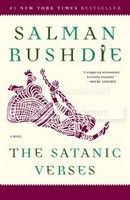
576 pages
5 stars
(1988)
"Rushdie's novel is a dense patchwork of satire and cultural criticism abound with so many references that I am certain the large majority of them eluded me. This book provokes a bevy of emotions. One minute you are laughing, the next you are frowning, and the next you are scratching your head in either a state of dumbstruck stupor or disbelief. That is only to be expected with a work that deftly combines magical realism, along with postmodern and postcolonial literary traditions. In a truly postmodern way, Rushdie borrows techniques from Nabokov and Borges. He tells stories both ancient and modern, and interweaves them in a somewhat loose but effective way. He cooks up a strange potpourri of allusion and illusion, a fresh mythology. This is a fever dream of cultural upheaval. He tackles the question of the tumultuous convergence of East and West while all the more digging into the internal discordance of man, and how this man utilizes his capabilities for good or ill. Tanizaki and Nabokov have done the same, but never with their tongue lodged this far in their cheek, never so mischievously, and perhaps never so thoroughly. A serious book that doesn't take itself too seriously." /poetontheone, LibraryThing/
"Excellent. Maybe not worth a death sentence, but excellent."
/Adam, goodreads/
"The Satanic Verses has been dubbed (amongst many other things!) `the most famous book most people will never read'. If true it's is a real shame, because at the centre of all the extreme opinion that surrounds the book, the condemnation, acclaim and analysis, is an incredible and accessible novel far greater than the sum of its few controversial parts. Gibreel Farishta and Saladin Chamcha `crash land' together in England from India and are both profoundly transformed by the experience. Farishta begins to develop an angelic halo, while Chamcha metamorphoses into a cloven-hoofed devil complete with horns and bad breath. Both men suffer, in different ways, the brutality and indignity of their transformations in Rushdie's evocation of a tense and brooding London. Ultimately it is the `demonic' Chamcha who finds fulfilment by returning to India, the `angelic' Farishta is not so fortunate. Merging fantasy and reality, Rushdie uses the subversive excesses of `magical realism' to explore the demands of migration and how those demands can destroy the fragile assurances of identity and belonging most of us take for granted. Farishta is haunted by the nightmares of his lost Muslim faith, Chamcha by the impossible dream of reinventing himself as an Englishman. Through these and the experiences of other often outrageously conceived characters, Rushdie reflects on how people suffer, and are made to suffer, for the sake of a little certainty. If it all sounds a little heavy, don't be put off. Above all this is a great piece of story-telling, funny, extraordinary and completely absorbing. Rushdie works his usual narrative magic, writing on a grand exuberant scale that takes in everything from sex and death to flying carpets and hot wax, but also the delicate intimacies of desire and despair. Poignant and staggeringly imaginative, The Satanic Verses explores continuing cultural obsessions with purity and stability in a world increasingly lacking in either. " /Darren Hughes, Amazon/
"Satanic Verses: A Composition
He had just finished his thirty-fourth reading of the play. The unsaid hate, the unseen events, the half-imagined wrongs; they tormented him. What could cause such evil to manifest, he just could not figure. He loved him too much to believe the simple explanation.
And then the idea starts growing on him - to explore the growth of evil just as Shakespeare showed, explored the tragic culmination of it. And because you show the growth, it can no longer be a tragedy, no, no it has to be a comedy. A tragi-comedy. Yes. And he set to it. He painted Othello as an Indian actor, worshiped and adored and off on a mad canter to get his Ice Queen, his Desdemona. On his way he meets him - the poor man trying to forget his own roots and desperately reinventing himself, his Iago.
Yes Iago too was once a man. What twists of fate made him evil incarnate? He sets out his prime motif: The question that’s asked here remains as large as ever it was: which is, the nature of evil, how it’s born, why it grows, how it takes unilateral possession of a many-sided human soul.
Wait a minute, he blinks at his notes, if Iago is evil incarnate, does that not also mean that he is Satan incarnate? Chamcha then is Satan incarnate? Then Othello has to be God? A little bit more corruptible maybe? Let us make him the angel Gibreel, he decided. As an aside, as the angel, he can slip into that reality in his dreams and reenact the story (history?) of Prophet Mohammad in inflammatory fashion, maybe talk about the 'Satanic Verses' since his Satan can't help but gloat over his little jokes. Why not call the novel so too, except that it would mean something else - the verses that the real Satan of the story, Iago, sings in Othello's ear. He knows that this might be cause for misunderstanding, might ruffle a few feathers, but it is just a digression, the real story is beyond that - it is not the Event Horizon. But he can't help himself. He never could keep a story simple.
Ah, now something beyond mere Othello is taking shape is it not? If Iago is Satan, then surely it is in character to enjoy with consummate pleasure the sight of his own jealousy consuming himself - the green-eyed monster that feeds on itself. So Satan decides to narrate the story of one of his incarnations? Or rather, possessions? The questions that are to run his plot are flowing freely now. How an ordinary man when in contact with an angel inevitably had to transform into Lucifer himself. How can one exist without the other. They meet and the spiral ensues and Iago mutates and agitates and like a cancerous growth his strange fate builds until he turns his wrath square on his angel, his Othello. And how can he then not try to destroy what he is not, what he can not be. There is the moment before evil, then the moment of, then the time after; and each subsequent stride becomes progressively easier. But what about before and after the madness? It surely must be an ordinary life, with ordinary joys and pains. It is a cosmic drama, he concludes.
In the process, every insinuated implication in the play is to be played out in this story - Cassio does sleep with Iago's wife, Iago is madly lustful of Desdemona, Othello is a deserving victim of directed revenge for very real ills and Iago needs no invented or unbelievable reasons for his actions. He is justified. It was inevitable.
Salman Rushdie sets down his pen.
He has vindicated Iago, many a literature lover's favorite character.
And for that, I am eternally thankful."
/Riku Sayuj, goodreads/
"It is a story of India and Britain, and the inevitable clashes between, brought on by their long, and turbulent history together. It is a story about personal identity, racial identity and religious identity. It is a story of damnation and redemption, love and betrayal, betrayal and forgiveness. But most of all, it is a story about people. Deep, colorful and live, full of passion, humor and questions for the Almighty. It is, in short, a human story, so well crafted, that anyone, even someone like me who has little experience with India or Islam, can relate to its message.
Perhaps this accessibility is just what worried the Ayatollah Khomeni. By issuing his death sentence upon Salman Rushdie's head, he drew widespread attention and sympathy for a talented writer who might otherwise have gone unnoticed outside his own circle of interest. Khomeni also demonstrated what power mere words could hold over those who rule by the absolutism of ideas.
"What does a poet write? Verses. What jingle-jangles in Gibreel's brain? Verses. What broke his heart? Verses and again verses."
Rushdie's criticism for the religion of Islam/Submission, as spread by the Prophet Mohammed/Mahound, is sharp, angry and completely unapologetic. He even goes so far as to suggest that Mahound invented a lot of the "rules" of this religion for the sake of convenience, or compromise, in businesslike fashion,
for the more successful spread and maintenance of power of the Idea and its officials.
Throughout the story, Rushdie asks the question, Where are the words, or verses, attributed to God/Allah really coming from?
"All around him, he thinks as he half-dreams, half-wakes, are people hearing voices, being seduced by words. But not his; never his original material. - Then whose? Who is whispering in their ears, enabling them to move mountains, halt clocks, diagnose disease? He can't work it out."
No wonder Khomeni was afraid.
One amusing thing is that Rushdie was clearly aware of the danger he was creating for himself by writing and publishing his opinions.
"'And now Mahound is coming in triumph; so I shall lose my life after all. And his power has grown too great for me to unmake him now.' Baal asked: 'Why are you sure he will kill you?' Salman the Persian answered: 'It's his Word against mine'."
I did not, however, get the sense that Rushdie was arguing against belief in God or even Allah. The book has too much life-affirming optimism for such a stance. His argument is against God's misuse for the purpose of controlling or subjugating people; that submission is not for normal human beings. Normal
human beings wrestle with God, have doubts, questions, even anger. "What kind of idea are you?" He asks repeatedly throughout the book. "How do you behave when you are weak?" - Bend, compromise, in order to survive? "How do you behave when you are strong?" Hard, unyielding, pure? or Forgiving and merciful?
But even while all these heavy questions are being considered and discussed, Rushdie never loses his sense of humor.
"Gibreel's vision of the Supreme Being was not abstract in the least. He saw, sitting on the bed, a man of about the same age as himself, of medium height, fairly heavily built, with salt-and-pepper beard cropped close to the jaw. What struck him most was that the apparition was balding, seemed to suffer from dandruff and wore glasses."
With his lightning-fast wit and willingness to satire even himself, he reminds us all that, Hey, this is a book, a novel, and its first purpose is to entertain. The Ayatollahs, Imams and religious dictators need to lighten up. " /Peter Wang, Amazon/
Highly recommended. I absolutely loved it and I plan to reread it a lot of times. I finally decided to read the novel because it was mentioned in one of my favourite books, White Teeth. I think I found a real gem. A brilliant, highly enjoyable, occasionally really touching, postmodern satire.
576 pages
5 stars
(1988)
"Rushdie's novel is a dense patchwork of satire and cultural criticism abound with so many references that I am certain the large majority of them eluded me. This book provokes a bevy of emotions. One minute you are laughing, the next you are frowning, and the next you are scratching your head in either a state of dumbstruck stupor or disbelief. That is only to be expected with a work that deftly combines magical realism, along with postmodern and postcolonial literary traditions. In a truly postmodern way, Rushdie borrows techniques from Nabokov and Borges. He tells stories both ancient and modern, and interweaves them in a somewhat loose but effective way. He cooks up a strange potpourri of allusion and illusion, a fresh mythology. This is a fever dream of cultural upheaval. He tackles the question of the tumultuous convergence of East and West while all the more digging into the internal discordance of man, and how this man utilizes his capabilities for good or ill. Tanizaki and Nabokov have done the same, but never with their tongue lodged this far in their cheek, never so mischievously, and perhaps never so thoroughly. A serious book that doesn't take itself too seriously." /poetontheone, LibraryThing/
"Excellent. Maybe not worth a death sentence, but excellent."
/Adam, goodreads/
"The Satanic Verses has been dubbed (amongst many other things!) `the most famous book most people will never read'. If true it's is a real shame, because at the centre of all the extreme opinion that surrounds the book, the condemnation, acclaim and analysis, is an incredible and accessible novel far greater than the sum of its few controversial parts. Gibreel Farishta and Saladin Chamcha `crash land' together in England from India and are both profoundly transformed by the experience. Farishta begins to develop an angelic halo, while Chamcha metamorphoses into a cloven-hoofed devil complete with horns and bad breath. Both men suffer, in different ways, the brutality and indignity of their transformations in Rushdie's evocation of a tense and brooding London. Ultimately it is the `demonic' Chamcha who finds fulfilment by returning to India, the `angelic' Farishta is not so fortunate. Merging fantasy and reality, Rushdie uses the subversive excesses of `magical realism' to explore the demands of migration and how those demands can destroy the fragile assurances of identity and belonging most of us take for granted. Farishta is haunted by the nightmares of his lost Muslim faith, Chamcha by the impossible dream of reinventing himself as an Englishman. Through these and the experiences of other often outrageously conceived characters, Rushdie reflects on how people suffer, and are made to suffer, for the sake of a little certainty. If it all sounds a little heavy, don't be put off. Above all this is a great piece of story-telling, funny, extraordinary and completely absorbing. Rushdie works his usual narrative magic, writing on a grand exuberant scale that takes in everything from sex and death to flying carpets and hot wax, but also the delicate intimacies of desire and despair. Poignant and staggeringly imaginative, The Satanic Verses explores continuing cultural obsessions with purity and stability in a world increasingly lacking in either. " /Darren Hughes, Amazon/
"Satanic Verses: A Composition
He had just finished his thirty-fourth reading of the play. The unsaid hate, the unseen events, the half-imagined wrongs; they tormented him. What could cause such evil to manifest, he just could not figure. He loved him too much to believe the simple explanation.
And then the idea starts growing on him - to explore the growth of evil just as Shakespeare showed, explored the tragic culmination of it. And because you show the growth, it can no longer be a tragedy, no, no it has to be a comedy. A tragi-comedy. Yes. And he set to it. He painted Othello as an Indian actor, worshiped and adored and off on a mad canter to get his Ice Queen, his Desdemona. On his way he meets him - the poor man trying to forget his own roots and desperately reinventing himself, his Iago.
Yes Iago too was once a man. What twists of fate made him evil incarnate? He sets out his prime motif: The question that’s asked here remains as large as ever it was: which is, the nature of evil, how it’s born, why it grows, how it takes unilateral possession of a many-sided human soul.
Wait a minute, he blinks at his notes, if Iago is evil incarnate, does that not also mean that he is Satan incarnate? Chamcha then is Satan incarnate? Then Othello has to be God? A little bit more corruptible maybe? Let us make him the angel Gibreel, he decided. As an aside, as the angel, he can slip into that reality in his dreams and reenact the story (history?) of Prophet Mohammad in inflammatory fashion, maybe talk about the 'Satanic Verses' since his Satan can't help but gloat over his little jokes. Why not call the novel so too, except that it would mean something else - the verses that the real Satan of the story, Iago, sings in Othello's ear. He knows that this might be cause for misunderstanding, might ruffle a few feathers, but it is just a digression, the real story is beyond that - it is not the Event Horizon. But he can't help himself. He never could keep a story simple.
Ah, now something beyond mere Othello is taking shape is it not? If Iago is Satan, then surely it is in character to enjoy with consummate pleasure the sight of his own jealousy consuming himself - the green-eyed monster that feeds on itself. So Satan decides to narrate the story of one of his incarnations? Or rather, possessions? The questions that are to run his plot are flowing freely now. How an ordinary man when in contact with an angel inevitably had to transform into Lucifer himself. How can one exist without the other. They meet and the spiral ensues and Iago mutates and agitates and like a cancerous growth his strange fate builds until he turns his wrath square on his angel, his Othello. And how can he then not try to destroy what he is not, what he can not be. There is the moment before evil, then the moment of, then the time after; and each subsequent stride becomes progressively easier. But what about before and after the madness? It surely must be an ordinary life, with ordinary joys and pains. It is a cosmic drama, he concludes.
In the process, every insinuated implication in the play is to be played out in this story - Cassio does sleep with Iago's wife, Iago is madly lustful of Desdemona, Othello is a deserving victim of directed revenge for very real ills and Iago needs no invented or unbelievable reasons for his actions. He is justified. It was inevitable.
Salman Rushdie sets down his pen.
He has vindicated Iago, many a literature lover's favorite character.
And for that, I am eternally thankful."
/Riku Sayuj, goodreads/
"It is a story of India and Britain, and the inevitable clashes between, brought on by their long, and turbulent history together. It is a story about personal identity, racial identity and religious identity. It is a story of damnation and redemption, love and betrayal, betrayal and forgiveness. But most of all, it is a story about people. Deep, colorful and live, full of passion, humor and questions for the Almighty. It is, in short, a human story, so well crafted, that anyone, even someone like me who has little experience with India or Islam, can relate to its message.
Perhaps this accessibility is just what worried the Ayatollah Khomeni. By issuing his death sentence upon Salman Rushdie's head, he drew widespread attention and sympathy for a talented writer who might otherwise have gone unnoticed outside his own circle of interest. Khomeni also demonstrated what power mere words could hold over those who rule by the absolutism of ideas.
"What does a poet write? Verses. What jingle-jangles in Gibreel's brain? Verses. What broke his heart? Verses and again verses."
Rushdie's criticism for the religion of Islam/Submission, as spread by the Prophet Mohammed/Mahound, is sharp, angry and completely unapologetic. He even goes so far as to suggest that Mahound invented a lot of the "rules" of this religion for the sake of convenience, or compromise, in businesslike fashion,
for the more successful spread and maintenance of power of the Idea and its officials.
Throughout the story, Rushdie asks the question, Where are the words, or verses, attributed to God/Allah really coming from?
"All around him, he thinks as he half-dreams, half-wakes, are people hearing voices, being seduced by words. But not his; never his original material. - Then whose? Who is whispering in their ears, enabling them to move mountains, halt clocks, diagnose disease? He can't work it out."
No wonder Khomeni was afraid.
One amusing thing is that Rushdie was clearly aware of the danger he was creating for himself by writing and publishing his opinions.
"'And now Mahound is coming in triumph; so I shall lose my life after all. And his power has grown too great for me to unmake him now.' Baal asked: 'Why are you sure he will kill you?' Salman the Persian answered: 'It's his Word against mine'."
I did not, however, get the sense that Rushdie was arguing against belief in God or even Allah. The book has too much life-affirming optimism for such a stance. His argument is against God's misuse for the purpose of controlling or subjugating people; that submission is not for normal human beings. Normal
human beings wrestle with God, have doubts, questions, even anger. "What kind of idea are you?" He asks repeatedly throughout the book. "How do you behave when you are weak?" - Bend, compromise, in order to survive? "How do you behave when you are strong?" Hard, unyielding, pure? or Forgiving and merciful?
But even while all these heavy questions are being considered and discussed, Rushdie never loses his sense of humor.
"Gibreel's vision of the Supreme Being was not abstract in the least. He saw, sitting on the bed, a man of about the same age as himself, of medium height, fairly heavily built, with salt-and-pepper beard cropped close to the jaw. What struck him most was that the apparition was balding, seemed to suffer from dandruff and wore glasses."
With his lightning-fast wit and willingness to satire even himself, he reminds us all that, Hey, this is a book, a novel, and its first purpose is to entertain. The Ayatollahs, Imams and religious dictators need to lighten up. " /Peter Wang, Amazon/
Highly recommended. I absolutely loved it and I plan to reread it a lot of times. I finally decided to read the novel because it was mentioned in one of my favourite books, White Teeth. I think I found a real gem. A brilliant, highly enjoyable, occasionally really touching, postmodern satire.
58readeron
#54 Silk by Alessandro Baricco
2 stars
91 pages
"Most readers seem to find this book haunting and poetic, but I'm not so sure. It is certainly clever and elegant in its presentation of the story: the folktale-like structure with short chapters and extensive use of repetition, the delicate use of blank pages (where the publishers really make their profits), the imagery of birds and silk, etc. I haven't seen the film, but the book is clearly drafted in such a way that you could slot in a few headings and have a ready-made filmscript, so I'm sure it works very well on the screen.
On the other hand, it seems to be little more than a shameless recycling of the old cliché of the industrial West and the passive East, dolled up with a few ironic touches to make it respectable. The eroticism struck me as no more convincing than that of a lingerie advertisement - again, cleverly done, building up slowly, and with an ironic get-out clause so that the author can't quite be accused of sexism or orientalism, but it still seems to be exploiting all the ways of representing women (passive, mysterious, sensual, silent,...) that go with the classic orientalist approach." /thoroid, LibraryThing/
"Silk is a short novel--so short that I finished reading it within the space of an hour two. It's the story of Herve Joncour, a French merchant of silkworm eggs, who travels to Japan. While there, his attention is caught by a young woman, with whom he has an affair.
As I've said, this is a pretty short novella--my edition is only about 90 pages, most of which is white space. There are lots of short chapters in this book, lots of short sentences, ideas half realized. The love affair between Herve and the young woman in Japan is so muted and mysterious that it's nearly indiscernible. There's not much characterization, so we don't ever really get to know Herve or any of the other characters in this book (his love interest isn't even given a name!). This makes it very hard for the reader, in the end, to really care about the characters--or the love story.
For such a short book, there's a lot of repetition, too; the author mentions over and over again how Herve's paramour doesn't have oriental eyes, or Herve's numerous trips from France to Japan and back again. And what's with the obsession with Lake Baikal, which has nothing to do with the story? I'm sure there's a lot of emotional wealth to this book, but I just didn't "get" it, I guess." /K. Huff, Amazon/ /Kasthu, Librarything/
A short, but disappointing read.
2 stars
91 pages
"Most readers seem to find this book haunting and poetic, but I'm not so sure. It is certainly clever and elegant in its presentation of the story: the folktale-like structure with short chapters and extensive use of repetition, the delicate use of blank pages (where the publishers really make their profits), the imagery of birds and silk, etc. I haven't seen the film, but the book is clearly drafted in such a way that you could slot in a few headings and have a ready-made filmscript, so I'm sure it works very well on the screen.
On the other hand, it seems to be little more than a shameless recycling of the old cliché of the industrial West and the passive East, dolled up with a few ironic touches to make it respectable. The eroticism struck me as no more convincing than that of a lingerie advertisement - again, cleverly done, building up slowly, and with an ironic get-out clause so that the author can't quite be accused of sexism or orientalism, but it still seems to be exploiting all the ways of representing women (passive, mysterious, sensual, silent,...) that go with the classic orientalist approach." /thoroid, LibraryThing/
"Silk is a short novel--so short that I finished reading it within the space of an hour two. It's the story of Herve Joncour, a French merchant of silkworm eggs, who travels to Japan. While there, his attention is caught by a young woman, with whom he has an affair.
As I've said, this is a pretty short novella--my edition is only about 90 pages, most of which is white space. There are lots of short chapters in this book, lots of short sentences, ideas half realized. The love affair between Herve and the young woman in Japan is so muted and mysterious that it's nearly indiscernible. There's not much characterization, so we don't ever really get to know Herve or any of the other characters in this book (his love interest isn't even given a name!). This makes it very hard for the reader, in the end, to really care about the characters--or the love story.
For such a short book, there's a lot of repetition, too; the author mentions over and over again how Herve's paramour doesn't have oriental eyes, or Herve's numerous trips from France to Japan and back again. And what's with the obsession with Lake Baikal, which has nothing to do with the story? I'm sure there's a lot of emotional wealth to this book, but I just didn't "get" it, I guess." /K. Huff, Amazon/ /Kasthu, Librarything/
A short, but disappointing read.
59readeron
#55 The Strange Case of Dr Jekyll and Mr Hyde by Robert Louis Stevenson
86 pages
4 stars
"Along with FRANKENSTEIN and DRACULA, this short novel makes up the holy triumvirate of early horror. It asks the question: What is the nature of man's soul? The answer is that we all have a dark side, a side without a conscience, that lives only for its own pleasure without regard for anyone else. This is the Mr. Hyde that emerges when Jekyll drinks his magic potion, and he repulses everyone he meets. As Jekyll discovers, if we give free reign to the Hyde imprisoned within us, he grows stronger and asserts himself more and more, until he threatens to take over entirely.
Despite being afflicted by the usual Victorian floridness of language (...), DR. JEKYLL AND MR. HYDE is a highly readable, if rather circuitous, story. I would recommend it to anyone interested in the evolution of the horror genre." /sturlington, LibraryThing/
"Here's the plot, you all know it: a man, by arcane means, becomes another man. Now, here's the argument of the book: suspense comes from not knowing what questions to ask, not merely ignorance of their answers. Stevenson makes this technical argument by means of POV placement, interior monologues, and placement in time. He doesn't start the book by showing you Dr. Jekyll as he concocts his transformative substance and then becomes Mr. Hyde, as I had assumed he would. Instead, he begins with a secondary character's story-within-a-story, where we learn of the horrific personage that is Mr. Hyde.
In these enfolded aspects, the book most closely resembles Mary Shelley's Frankenstein (the original novel, not the movie): readers encounter the thick of the plot by abstruse means that initially entice and perhaps bewilder before revealing secrets that the first readers might not have even suspected were there. How wonderfully terrifying it must've been to read about Frankenstein's creation, before ever hearing about the monster? Similarly, Stevenson starts us off with a story from a somber lawyer, lending this tale a detective-mystery aspect that may have also taken slight inspiration from Poe. Critical abrogation of Poe's murder mysteries may have had time to slack off by the time Stevenson reached New York in the 1880s.
This POV positing may be no surprise to those who have seen Jekyll and Hyde movies (I haven't), but Stevenson here is making a case for narrative fiction. His claims on us as readers have more to do with indirection and guile than indiscretion and gusto. We know that something's a bit off about this Hyde character, but we're not supposed to know exactly what. The more cinematic aspects of King's The Dark Half hold more sway on our sense of encroaching terror - we know exactly what has gone bad, and we're waiting to see just how bad it's going to get. Stevenson's aesthetic appeal to our capacity to be astounded lies not just in his imagery, dialogue, or plot, but also in the discrete manner with which he presents us this material." /Nathanial, goodreads/
86 pages
4 stars
"Along with FRANKENSTEIN and DRACULA, this short novel makes up the holy triumvirate of early horror. It asks the question: What is the nature of man's soul? The answer is that we all have a dark side, a side without a conscience, that lives only for its own pleasure without regard for anyone else. This is the Mr. Hyde that emerges when Jekyll drinks his magic potion, and he repulses everyone he meets. As Jekyll discovers, if we give free reign to the Hyde imprisoned within us, he grows stronger and asserts himself more and more, until he threatens to take over entirely.
Despite being afflicted by the usual Victorian floridness of language (...), DR. JEKYLL AND MR. HYDE is a highly readable, if rather circuitous, story. I would recommend it to anyone interested in the evolution of the horror genre." /sturlington, LibraryThing/
"Here's the plot, you all know it: a man, by arcane means, becomes another man. Now, here's the argument of the book: suspense comes from not knowing what questions to ask, not merely ignorance of their answers. Stevenson makes this technical argument by means of POV placement, interior monologues, and placement in time. He doesn't start the book by showing you Dr. Jekyll as he concocts his transformative substance and then becomes Mr. Hyde, as I had assumed he would. Instead, he begins with a secondary character's story-within-a-story, where we learn of the horrific personage that is Mr. Hyde.
In these enfolded aspects, the book most closely resembles Mary Shelley's Frankenstein (the original novel, not the movie): readers encounter the thick of the plot by abstruse means that initially entice and perhaps bewilder before revealing secrets that the first readers might not have even suspected were there. How wonderfully terrifying it must've been to read about Frankenstein's creation, before ever hearing about the monster? Similarly, Stevenson starts us off with a story from a somber lawyer, lending this tale a detective-mystery aspect that may have also taken slight inspiration from Poe. Critical abrogation of Poe's murder mysteries may have had time to slack off by the time Stevenson reached New York in the 1880s.
This POV positing may be no surprise to those who have seen Jekyll and Hyde movies (I haven't), but Stevenson here is making a case for narrative fiction. His claims on us as readers have more to do with indirection and guile than indiscretion and gusto. We know that something's a bit off about this Hyde character, but we're not supposed to know exactly what. The more cinematic aspects of King's The Dark Half hold more sway on our sense of encroaching terror - we know exactly what has gone bad, and we're waiting to see just how bad it's going to get. Stevenson's aesthetic appeal to our capacity to be astounded lies not just in his imagery, dialogue, or plot, but also in the discrete manner with which he presents us this material." /Nathanial, goodreads/
60readeron
#56 The Giver by Lois Lowry
1 star
179 pages
Young Adult Fantasy
(First published: 1993)
What utter nonsense!
"Jonas's world is perfect. Everything is under control. There is no war or fear or pain. There are no choices. Every person is assigned a role in the Community. When Jonas turns twelve, he is singled out to receive special training from The Giver. The Giver alone holds the memories of the true pain and pleasure of life. Now, it is time for Jonas to receive the truth. There is no turning back." /goodreads/
"The beginning was kind of promising, the middle fairly lame, and the ending flat-out stupid." /Aerin, goodreads/
"This is supposed to be 1984 for children.
Jonas, the protagonist, is a 12 year old boy who lives in a world without war, pain, hunger, death, misery or, even, bad weather, where everyone is happy and has their place in society. Yet gradually a much more disquieting picture emerges of a world where all personal choice has been taken away, where every decision is made for the individual by the "state" (I have put state in quotation marks here because really we never find out exactly who makes these decisions and choices) and where nothing is private, not even your own dreams.
I am a firm believer that children's books have to be written the same as adult books, but better. I also think it is much harder to write good children's books, than it is to write for adults. And, ultimately, with children's literatiure, you have to satisfy both.
I'm afraid, for me, Lowry's book failed as both a children's book and as an adult book because her world just didn't make sense. And I do not accept, as a few goodreaders have stated in their reviews, that that's ok because it's a kid's book. I would have thought the opposite should be true. That it is especially important for the world that the author is creating to make sense, because it is a children's book.
This books does raise important questions about the price of happiness, freedom, responsibility and the importance of adversity but how can we expect kids to learn any of its lessons when there is no explanation of how such a society has arisen, barely any description of how it functions and lack of any sort of logic to the way it does.
The inability of the population to see in colour. How did that come about? Why is Jonas able to see it? There is a climate control system which ensures the sameness of the weather, yet there does not appear to be any physical barrier separating this world from the mysterious Elsewhere. The whole society seemed to be a series of loosely connected communes with a very strong cult flavour (brainwashing - tick, isolation - tick, control - tick) governed by a counsel but it is not clear how a counsel of so few is able to control and effectively govern all these people, particularly given the apparent extent of their involvement in the day-to day oversight and running of things like allocation of careers to 12 year olds.
I don't know what on earth was going on with the collective purge of all memory and its transfer to a single individual (through touch!!!). I found that whole aspect of the book ridiculous and unnecessary as the same could have been achieved by suppression of history and having Jonas and the Giver actually read some of those many books that are repeatedly mentioned but never even opened. I understand that sexual urges are suppressed by the pills but how do they manage to suppress love? It is in people's nature to become attached to and feel affection for other people and that would be inevitable in family units, even if unrelated by birth. The build up around "release" was another ridiculous aspect as it was patently obvious what it involved from pretty much the first time it is mentioned. It is unclear how this society with its severely restricted birth rate and commonplace release of anyone from petty rulebreakers to infants who don't sleep through the night is able to sustain itself or why such severe population control is necessary given there appear to be vast stretches of unoccupied land surrounding the community. I could go on and on.
I wish I could end this by saying, yes there were problems in the world building but the story and writing were fantastic. Yet I am not able to do that either. There was barely any story there at all. Most of the book concentrated on world-building with the plot only really taking off in the last few pages. The book felt far too short and rushed. The characters were flat and indistinguishable (the fact that Jonas' little sister Lily seemed to talk in exactly the same way as his parents particularly grated) and the writing was simplistic and uninspired." /Gloria Mundi, goodreads/
Literary Awards:
Newbery Medal (1994), Horn Book Fanfare Best Book (1994), Garden State Book Award for Teen Fiction Grades 6-8 (1996), Rebecca Caudill Young Reader's Book Award (1996), Grand Canyon Reader Award for Teen Book (1995)
Pacific Northwest Library Association Young Reader's Choice Award for Senior (1996), New Mexico Land of Enchantment Award (1997)
Huh???
(I've read even the sparknotes, only the "Themes, Motifs & Symbols" though. I still think that it's utter nonsense.) Read 1984, instead (IMO).
Another interesting review I liked:
"Lowry's book is a piece of nationalist propaganda, using oversimplification, emotional appeals, and dualistic morality to shut down her readers' minds. More troubling is that it is aimed at children, who don't yet have the critical faculties to defend themselves from such underhanded methods.
Unsurprisingly, Lowry adopts the structure of the monomyth, equating a spiritual journey with a moral one. Her Christ-figure uses literal magic powers to rebel against his society. This rebellion and the morality behind it are presented as 'natural', to contrast with the 'abnormal morality' around him.
Lowry doesn't seem to understand that we get our morality from our culture, it isn't something in-born that we 'lose'. This is the first hint of Lowry's misunderstanding of the human mind. She assumes her own morality is correct, and then builds her story to fit it.
She also makes the character act and think like we do, despite never adequately explaining how he came up with such unusual notions. It's the same trick many historical fiction authors use, leaving us scratching our heads as to why a Fourteenth Century French peasant speaks like a second-wave feminist. I'd suggest that Lowry falls to this fault for the same reason they do: she has no talent for imagining how others might think differently.
Lowry's book ends with the standard nonspecific transgressive spiritual event that marks all monomyths. Since the book is not a progressive presentation of ideas, it does not suggest any conclusion. Instead, the climax is a symbolic faux-death event (symbolic of what, none can say). Confusingly, Lowry later redacts the ending in the sequels, undermining the pseudo-spiritual journey she created.
Though some call this book 'Dystopian', it's closer to the truth to say Lowry borrows elements from the Dystopian authors, attempting to combine the spiritual uplift of the monomyth with the political and social deconstruction of the Dystopia. What she doesn't recognize is that the faith of the one conflicts with the cynicism of the other. She draws on ideas and images from many other authors: Bradbury, Huxley, Orwell, Burgess, but doesn't improve upon them.
These authors created novels that reflected the world around them. They based them on the political events of the times, presented with realism and careful psychology. Though they presented the struggle between the individual and the society, they portrayed morality as grey, and suffering as the result of individual human faults, not political systems. Lowry doesn't realize that the best way to critique Fascism or Communism is not to present it as 'evil', but to simply present it as it was.
But Lowry's world is not based in reality, it is symbolic and hyperbolic. Instead of writing about how poverty makes the world seem small and dull, she has the characters magically unable to experience life. Instead of an impersonal government, she presents a sort of evil hippy commune.
The only political system it resembles is a school, which is a neat little trick to get the kids interested. The idea that 'school=unfeeling totalitarian hell' is not an uncommon one, but it's one I'm surprised teachers would support. The book also suggests a creche, but lacking similarity to any real-world system, it doesn't work as a political criticism.
Lowry creates this artificial world to suit her purposes, but it is not a symbolic exercise like 'Animal Farm'. We understand that the pigs of animal farm are symbolic, because there are no talking pigs. Lowry's world is more insidious, since its oversimplification is hidden. She builds an artificial world to support the dualist morality that she's pushing. She presents the same knee-jerk fears about euthanasia and abortion that people use against Women's Rights or Health Care.
Worse than these Straw Man arguments is the fact that she never deals with the economic causes of totalitarianism. Tyrants don't just rise up and take control by their own force of will, they come into power because of the socioeconomic situations that surround them. Lean times produce strong, fascist leaders while profitable times produce permissive, liberal societies.
Strong, centralized leadership simply doesn't self-propagate in cultures where everyone is clothed, fed, and housed. The Holocaust was socially about some ideal of 'change' and 'purity', but it was economically about the transmission of wealth from Jews, Poles, and Catholics to Germans (and more specifically, to those Germans who had elected the new ruling party).
The atrocities of war are, for the most, part committed by normal people to other normal people. By presenting the power structure as 'amoral' and 'inhuman', Lowry ignores the fact that people will willingly cause others to suffer. Painting the enemy as 'evil' and 'alien' is just an unsophisticated propagandist method.
She contrasts her 'evil' with the idealized 'goodness' of emotion, beauty, and freedom. This is nothing more than the American dream of 'specialness' that Mr. Rogers was pushing for so many years. We are all special, we are all good, we all deserve love and happiness. Sure, it sounds good, but what does it mean?
Where does this 'specialness' come from? If it is just the 'sanctity of human life', then it's not really special, because it's all-encompassing. If all of us are special, then none of us are. There's nothing wrong with valuing life, but when Lowry presents one mode of life as valuable and another as reprehensible, she ceases to actually value humanity as a whole. Instead, she values a small, idealized chunk of humanity. 'People are good, except the ones I don't like' is not a moral basis, nor is it a good message to send to kids.
If the specialness is only based on fitting in with a certain moral and social guideline, then Lowry isn't praising individuality, she's praising herd behavior. The protagonist is only 'special' because he has magic powers. His specialness is not a part of his character, it is an emotional appeal.
The idea of being a special individual is another piece of propaganda, and its one kids are especially prone to, because kids aren't special: they are carefully controlled and powerless. Giving a character special powers and abilities and then using that character to feed a party line to children is not merely disingenuous, it's disturbing.
There is also a darker side to universal specialness: giving a child a sense of importance without anything to back it up creates egotism and instability. Adults noticed that children with skills and friends had high self-esteems, but instead of teaching their children social skills and knowledge, they misunderstood the causal relationship and tried to give them self-worth first.
Unfortunately, the moment unsupported self-worth is challenged, the child finds they have nothing to fall back on. Their entitlement didn't come from their skills or experiences, and so they have nothing to bolster that sense of worth. Instead, any doubt sends them down a spiral of emotional instability.
A single book like this wouldn't be the cause of such a state in a child, but it does act as part of the social structure built to give a sense of worth without a solid base for that worth. People like to believe they are special, kids especially so, but being a remarkable person is not a result of belief but of actions. If the book had informed them, then it would leave them better off, but giving them a conclusion based on emotional appeals does nothing to build confidence or character.
Many people have told me this book is good because it appeals to children, but children often fall for propaganda. Children develop deep relationships with pop stars, breakfast cereals, and Japanese monsters. This does not make them good role models for children.
Feeding 'specialness' to kids along with a political message is no better than the fascist youth programs Lowry intends to criticize. The obsession with individuality is just another form of elitism. It's ironic that people in America most often describe themselves as individuals when pointing out the things they do to align themselves with groups.
But banding together in a community is not a bad thing. For Lowry and other 'Red Scare' children, any mention of 'communal' can turn into a witch hunt, but we all give up some personal rights and some individuality in order to live in relatively safe, structured societies. There are benefits to governmental social controls and there are drawbacks, and it's up to us to walk the line between the two. Anarchy and Totalitarianism never actually exist for long: we are social animals.
It's not difficult to understand why Lowry is so popular, especially amongst educators. The message she gives aligns perfectly with what they were taught as kids, from Red Scare reactionism to the hippy-dippy 'unique snowflake' mantra. These ideas aren't entirely misguided, either. It's good to recognize the benefits of difference and the dangers of allowing other to control our lives.
If a reader believes that fascism and socialism are inherently wrong and that their own individuality is their greatest asset, they will likely sympathize with Lowry's work. However, this doesn't make the book honest, nor beneficial. One of the hardest things we can do as readers is disagree with the methods of authors we agree with ideologically.
It makes us feel good to find authors who agree with us, but this is when we should be at our most skeptical. Searching the world for self-justification is not a worthwhile goal, it simply turns you into another short-sighted, argumentative know-it-all. 'Yes men' never progress.
Lowry is toeing the party line. She does not base her book around difficult questions, like the Dystopian authors, but around easy answers. She doesn't force the reader to decide for themselves what is best, she makes it clear what she wants us to think. Her book is didactic, which means that it instructs the reader what to believe.
Even if her conclusions about Individuality vs. Community are correct, she doesn't present arguments, she only presents conclusions. Like rote memorization or indoctrination, she teaches nothing about the politics, social order, economics, or psychology of totalitarianism or individuality. The reader is not left with an understanding, just an opinion.
The baseless 'individuality' of the book lets the reader imagine that they are rebels--that they are bucking the system even as they fall into lock-step. By letting the reader think they are already free-thinking, Lowry tricks them into forgetting their skepticism.
She is happy to paint a simple world of black and white, and this is likely the world she sees. I doubt she is purposefully creating an insidious text, she just can't see past her own opinions. She writes this book with a point to make, and makes it using emotional appeals and symbolism. She doesn't back it up with arguments because she doesn't seem to have developed her opinions from cogent arguments.
In the end, she doesn't show us that the structure of this society is wrong, she says nothing poignant about individuality vs. community; instead, she relies on threats to the life of an innocent infant. Yet nowhere does she provide an argument for why communal living or the sacrifice of freedoms for safety must necessarily lead to infanticide.
In politics, making extreme claims about the opposing side is called mud-slinging, it is an underhanded and dishonest tactic. It works. Arguing intelligently is difficult, accusing is easy, so that's what Lowry does.
She is another child of WWII and the Cold War who hasn't learned her lesson. She quickly condemns the flaws of others while failing to search out her own. Even after the Holocaust, there are many racist, nationalist, violent Jews; conflict rarely breeds a new understanding.
America condemned the faceless communal life of the Second World, and yet America created The Projects. We critiqued strong governmental controls, but we still have the bank bailout, socialized medicine, socialized schooling, and socialized charity. America condemned the Gulags and Work Camps, and yet we imprison one out of every hundred citizens; far more than Stalin ever did. Some are killed, all are dehumanized.
As a little sci fi adventure, the book isn't terrible. It's really the pretension that goes along with it. Lowry cobbles together religious symbolism and Dystopic tropes and then tries to present it as something as complex and thoughtful as the authors she copied. Copying isn't a crime, but copying poorly is.
Like Dan Brown or Michael Crichton, she creates a political pamphlet of her own ideals, slaps a pretense of authority on it, and then waits for the money and awards to roll in--and they did. Many people I've discussed this book with have pointed to those awards as the surest sign of this book's eminent worth.
Award committees are bureaucratic organizations. Their decisions are based on political machinations. This book is a little piece of Nationalism, and so it was lauded by the political machine that Lowry supports. The left hand helps the right. If awards are the surest sign of worth, then Titanic is a better movie than Citizen Kane.
What surprises me is how many of those who brought up the award as their argument were teachers. If a politically-charged administrative committee is the best way to teach children, then why do you take umbrage when the principal tells you that bigger class sizes (and fewer benefits) are fine? Listen to him: doesn't he have award plaques?
The other argument is usually that 'kids like it'. I usually respond that kids also like candy, so why not teach that? Some people also get angry at me for analyzing a book written for children:
"Of course it's not a great book, it's for kids! If you want a good book, go read Ulysses!"
I prefer to give children good books rather than pieces of political propaganda (even if they agreed with me). Children van be as skeptical, quick-witted, and thoughtful as adults if you give them the chance, so I see no excuse for feeding them anything less.
Kids aren't stupid, they just lack knowledge, and that's a fine distinction. It's easy for adults to take advantage of their naivete, their emotionality, and their sense of worth. Just because it's easier for the teacher doesn't mean it's better for the child.
When we show children something that is over-simplified, presenting an idealized, crudely moralizing world, we aren't preparing them for the actual world. If you give a child a meaningless answer to repeat, he will repeat it, but he won't understand why.
Why not give the child a book that presents many complex ideas, but no rote answers, and let them make up their own minds? If they don't learn how to separate the wheat from the chaff and form their own opinions early, in a safe, nurturing environment, what chance will they have on their own as adults?" /Keely, goodreads/
1 star
179 pages
Young Adult Fantasy
(First published: 1993)
What utter nonsense!
"Jonas's world is perfect. Everything is under control. There is no war or fear or pain. There are no choices. Every person is assigned a role in the Community. When Jonas turns twelve, he is singled out to receive special training from The Giver. The Giver alone holds the memories of the true pain and pleasure of life. Now, it is time for Jonas to receive the truth. There is no turning back." /goodreads/
"The beginning was kind of promising, the middle fairly lame, and the ending flat-out stupid." /Aerin, goodreads/
"This is supposed to be 1984 for children.
Jonas, the protagonist, is a 12 year old boy who lives in a world without war, pain, hunger, death, misery or, even, bad weather, where everyone is happy and has their place in society. Yet gradually a much more disquieting picture emerges of a world where all personal choice has been taken away, where every decision is made for the individual by the "state" (I have put state in quotation marks here because really we never find out exactly who makes these decisions and choices) and where nothing is private, not even your own dreams.
I am a firm believer that children's books have to be written the same as adult books, but better. I also think it is much harder to write good children's books, than it is to write for adults. And, ultimately, with children's literatiure, you have to satisfy both.
I'm afraid, for me, Lowry's book failed as both a children's book and as an adult book because her world just didn't make sense. And I do not accept, as a few goodreaders have stated in their reviews, that that's ok because it's a kid's book. I would have thought the opposite should be true. That it is especially important for the world that the author is creating to make sense, because it is a children's book.
This books does raise important questions about the price of happiness, freedom, responsibility and the importance of adversity but how can we expect kids to learn any of its lessons when there is no explanation of how such a society has arisen, barely any description of how it functions and lack of any sort of logic to the way it does.
The inability of the population to see in colour. How did that come about? Why is Jonas able to see it? There is a climate control system which ensures the sameness of the weather, yet there does not appear to be any physical barrier separating this world from the mysterious Elsewhere. The whole society seemed to be a series of loosely connected communes with a very strong cult flavour (brainwashing - tick, isolation - tick, control - tick) governed by a counsel but it is not clear how a counsel of so few is able to control and effectively govern all these people, particularly given the apparent extent of their involvement in the day-to day oversight and running of things like allocation of careers to 12 year olds.
I don't know what on earth was going on with the collective purge of all memory and its transfer to a single individual (through touch!!!). I found that whole aspect of the book ridiculous and unnecessary as the same could have been achieved by suppression of history and having Jonas and the Giver actually read some of those many books that are repeatedly mentioned but never even opened. I understand that sexual urges are suppressed by the pills but how do they manage to suppress love? It is in people's nature to become attached to and feel affection for other people and that would be inevitable in family units, even if unrelated by birth. The build up around "release" was another ridiculous aspect as it was patently obvious what it involved from pretty much the first time it is mentioned. It is unclear how this society with its severely restricted birth rate and commonplace release of anyone from petty rulebreakers to infants who don't sleep through the night is able to sustain itself or why such severe population control is necessary given there appear to be vast stretches of unoccupied land surrounding the community. I could go on and on.
I wish I could end this by saying, yes there were problems in the world building but the story and writing were fantastic. Yet I am not able to do that either. There was barely any story there at all. Most of the book concentrated on world-building with the plot only really taking off in the last few pages. The book felt far too short and rushed. The characters were flat and indistinguishable (the fact that Jonas' little sister Lily seemed to talk in exactly the same way as his parents particularly grated) and the writing was simplistic and uninspired." /Gloria Mundi, goodreads/
Literary Awards:
Newbery Medal (1994), Horn Book Fanfare Best Book (1994), Garden State Book Award for Teen Fiction Grades 6-8 (1996), Rebecca Caudill Young Reader's Book Award (1996), Grand Canyon Reader Award for Teen Book (1995)
Pacific Northwest Library Association Young Reader's Choice Award for Senior (1996), New Mexico Land of Enchantment Award (1997)
Huh???
(I've read even the sparknotes, only the "Themes, Motifs & Symbols" though. I still think that it's utter nonsense.) Read 1984, instead (IMO).
Another interesting review I liked:
"Lowry's book is a piece of nationalist propaganda, using oversimplification, emotional appeals, and dualistic morality to shut down her readers' minds. More troubling is that it is aimed at children, who don't yet have the critical faculties to defend themselves from such underhanded methods.
Unsurprisingly, Lowry adopts the structure of the monomyth, equating a spiritual journey with a moral one. Her Christ-figure uses literal magic powers to rebel against his society. This rebellion and the morality behind it are presented as 'natural', to contrast with the 'abnormal morality' around him.
Lowry doesn't seem to understand that we get our morality from our culture, it isn't something in-born that we 'lose'. This is the first hint of Lowry's misunderstanding of the human mind. She assumes her own morality is correct, and then builds her story to fit it.
She also makes the character act and think like we do, despite never adequately explaining how he came up with such unusual notions. It's the same trick many historical fiction authors use, leaving us scratching our heads as to why a Fourteenth Century French peasant speaks like a second-wave feminist. I'd suggest that Lowry falls to this fault for the same reason they do: she has no talent for imagining how others might think differently.
Lowry's book ends with the standard nonspecific transgressive spiritual event that marks all monomyths. Since the book is not a progressive presentation of ideas, it does not suggest any conclusion. Instead, the climax is a symbolic faux-death event (symbolic of what, none can say). Confusingly, Lowry later redacts the ending in the sequels, undermining the pseudo-spiritual journey she created.
Though some call this book 'Dystopian', it's closer to the truth to say Lowry borrows elements from the Dystopian authors, attempting to combine the spiritual uplift of the monomyth with the political and social deconstruction of the Dystopia. What she doesn't recognize is that the faith of the one conflicts with the cynicism of the other. She draws on ideas and images from many other authors: Bradbury, Huxley, Orwell, Burgess, but doesn't improve upon them.
These authors created novels that reflected the world around them. They based them on the political events of the times, presented with realism and careful psychology. Though they presented the struggle between the individual and the society, they portrayed morality as grey, and suffering as the result of individual human faults, not political systems. Lowry doesn't realize that the best way to critique Fascism or Communism is not to present it as 'evil', but to simply present it as it was.
But Lowry's world is not based in reality, it is symbolic and hyperbolic. Instead of writing about how poverty makes the world seem small and dull, she has the characters magically unable to experience life. Instead of an impersonal government, she presents a sort of evil hippy commune.
The only political system it resembles is a school, which is a neat little trick to get the kids interested. The idea that 'school=unfeeling totalitarian hell' is not an uncommon one, but it's one I'm surprised teachers would support. The book also suggests a creche, but lacking similarity to any real-world system, it doesn't work as a political criticism.
Lowry creates this artificial world to suit her purposes, but it is not a symbolic exercise like 'Animal Farm'. We understand that the pigs of animal farm are symbolic, because there are no talking pigs. Lowry's world is more insidious, since its oversimplification is hidden. She builds an artificial world to support the dualist morality that she's pushing. She presents the same knee-jerk fears about euthanasia and abortion that people use against Women's Rights or Health Care.
Worse than these Straw Man arguments is the fact that she never deals with the economic causes of totalitarianism. Tyrants don't just rise up and take control by their own force of will, they come into power because of the socioeconomic situations that surround them. Lean times produce strong, fascist leaders while profitable times produce permissive, liberal societies.
Strong, centralized leadership simply doesn't self-propagate in cultures where everyone is clothed, fed, and housed. The Holocaust was socially about some ideal of 'change' and 'purity', but it was economically about the transmission of wealth from Jews, Poles, and Catholics to Germans (and more specifically, to those Germans who had elected the new ruling party).
The atrocities of war are, for the most, part committed by normal people to other normal people. By presenting the power structure as 'amoral' and 'inhuman', Lowry ignores the fact that people will willingly cause others to suffer. Painting the enemy as 'evil' and 'alien' is just an unsophisticated propagandist method.
She contrasts her 'evil' with the idealized 'goodness' of emotion, beauty, and freedom. This is nothing more than the American dream of 'specialness' that Mr. Rogers was pushing for so many years. We are all special, we are all good, we all deserve love and happiness. Sure, it sounds good, but what does it mean?
Where does this 'specialness' come from? If it is just the 'sanctity of human life', then it's not really special, because it's all-encompassing. If all of us are special, then none of us are. There's nothing wrong with valuing life, but when Lowry presents one mode of life as valuable and another as reprehensible, she ceases to actually value humanity as a whole. Instead, she values a small, idealized chunk of humanity. 'People are good, except the ones I don't like' is not a moral basis, nor is it a good message to send to kids.
If the specialness is only based on fitting in with a certain moral and social guideline, then Lowry isn't praising individuality, she's praising herd behavior. The protagonist is only 'special' because he has magic powers. His specialness is not a part of his character, it is an emotional appeal.
The idea of being a special individual is another piece of propaganda, and its one kids are especially prone to, because kids aren't special: they are carefully controlled and powerless. Giving a character special powers and abilities and then using that character to feed a party line to children is not merely disingenuous, it's disturbing.
There is also a darker side to universal specialness: giving a child a sense of importance without anything to back it up creates egotism and instability. Adults noticed that children with skills and friends had high self-esteems, but instead of teaching their children social skills and knowledge, they misunderstood the causal relationship and tried to give them self-worth first.
Unfortunately, the moment unsupported self-worth is challenged, the child finds they have nothing to fall back on. Their entitlement didn't come from their skills or experiences, and so they have nothing to bolster that sense of worth. Instead, any doubt sends them down a spiral of emotional instability.
A single book like this wouldn't be the cause of such a state in a child, but it does act as part of the social structure built to give a sense of worth without a solid base for that worth. People like to believe they are special, kids especially so, but being a remarkable person is not a result of belief but of actions. If the book had informed them, then it would leave them better off, but giving them a conclusion based on emotional appeals does nothing to build confidence or character.
Many people have told me this book is good because it appeals to children, but children often fall for propaganda. Children develop deep relationships with pop stars, breakfast cereals, and Japanese monsters. This does not make them good role models for children.
Feeding 'specialness' to kids along with a political message is no better than the fascist youth programs Lowry intends to criticize. The obsession with individuality is just another form of elitism. It's ironic that people in America most often describe themselves as individuals when pointing out the things they do to align themselves with groups.
But banding together in a community is not a bad thing. For Lowry and other 'Red Scare' children, any mention of 'communal' can turn into a witch hunt, but we all give up some personal rights and some individuality in order to live in relatively safe, structured societies. There are benefits to governmental social controls and there are drawbacks, and it's up to us to walk the line between the two. Anarchy and Totalitarianism never actually exist for long: we are social animals.
It's not difficult to understand why Lowry is so popular, especially amongst educators. The message she gives aligns perfectly with what they were taught as kids, from Red Scare reactionism to the hippy-dippy 'unique snowflake' mantra. These ideas aren't entirely misguided, either. It's good to recognize the benefits of difference and the dangers of allowing other to control our lives.
If a reader believes that fascism and socialism are inherently wrong and that their own individuality is their greatest asset, they will likely sympathize with Lowry's work. However, this doesn't make the book honest, nor beneficial. One of the hardest things we can do as readers is disagree with the methods of authors we agree with ideologically.
It makes us feel good to find authors who agree with us, but this is when we should be at our most skeptical. Searching the world for self-justification is not a worthwhile goal, it simply turns you into another short-sighted, argumentative know-it-all. 'Yes men' never progress.
Lowry is toeing the party line. She does not base her book around difficult questions, like the Dystopian authors, but around easy answers. She doesn't force the reader to decide for themselves what is best, she makes it clear what she wants us to think. Her book is didactic, which means that it instructs the reader what to believe.
Even if her conclusions about Individuality vs. Community are correct, she doesn't present arguments, she only presents conclusions. Like rote memorization or indoctrination, she teaches nothing about the politics, social order, economics, or psychology of totalitarianism or individuality. The reader is not left with an understanding, just an opinion.
The baseless 'individuality' of the book lets the reader imagine that they are rebels--that they are bucking the system even as they fall into lock-step. By letting the reader think they are already free-thinking, Lowry tricks them into forgetting their skepticism.
She is happy to paint a simple world of black and white, and this is likely the world she sees. I doubt she is purposefully creating an insidious text, she just can't see past her own opinions. She writes this book with a point to make, and makes it using emotional appeals and symbolism. She doesn't back it up with arguments because she doesn't seem to have developed her opinions from cogent arguments.
In the end, she doesn't show us that the structure of this society is wrong, she says nothing poignant about individuality vs. community; instead, she relies on threats to the life of an innocent infant. Yet nowhere does she provide an argument for why communal living or the sacrifice of freedoms for safety must necessarily lead to infanticide.
In politics, making extreme claims about the opposing side is called mud-slinging, it is an underhanded and dishonest tactic. It works. Arguing intelligently is difficult, accusing is easy, so that's what Lowry does.
She is another child of WWII and the Cold War who hasn't learned her lesson. She quickly condemns the flaws of others while failing to search out her own. Even after the Holocaust, there are many racist, nationalist, violent Jews; conflict rarely breeds a new understanding.
America condemned the faceless communal life of the Second World, and yet America created The Projects. We critiqued strong governmental controls, but we still have the bank bailout, socialized medicine, socialized schooling, and socialized charity. America condemned the Gulags and Work Camps, and yet we imprison one out of every hundred citizens; far more than Stalin ever did. Some are killed, all are dehumanized.
As a little sci fi adventure, the book isn't terrible. It's really the pretension that goes along with it. Lowry cobbles together religious symbolism and Dystopic tropes and then tries to present it as something as complex and thoughtful as the authors she copied. Copying isn't a crime, but copying poorly is.
Like Dan Brown or Michael Crichton, she creates a political pamphlet of her own ideals, slaps a pretense of authority on it, and then waits for the money and awards to roll in--and they did. Many people I've discussed this book with have pointed to those awards as the surest sign of this book's eminent worth.
Award committees are bureaucratic organizations. Their decisions are based on political machinations. This book is a little piece of Nationalism, and so it was lauded by the political machine that Lowry supports. The left hand helps the right. If awards are the surest sign of worth, then Titanic is a better movie than Citizen Kane.
What surprises me is how many of those who brought up the award as their argument were teachers. If a politically-charged administrative committee is the best way to teach children, then why do you take umbrage when the principal tells you that bigger class sizes (and fewer benefits) are fine? Listen to him: doesn't he have award plaques?
The other argument is usually that 'kids like it'. I usually respond that kids also like candy, so why not teach that? Some people also get angry at me for analyzing a book written for children:
"Of course it's not a great book, it's for kids! If you want a good book, go read Ulysses!"
I prefer to give children good books rather than pieces of political propaganda (even if they agreed with me). Children van be as skeptical, quick-witted, and thoughtful as adults if you give them the chance, so I see no excuse for feeding them anything less.
Kids aren't stupid, they just lack knowledge, and that's a fine distinction. It's easy for adults to take advantage of their naivete, their emotionality, and their sense of worth. Just because it's easier for the teacher doesn't mean it's better for the child.
When we show children something that is over-simplified, presenting an idealized, crudely moralizing world, we aren't preparing them for the actual world. If you give a child a meaningless answer to repeat, he will repeat it, but he won't understand why.
Why not give the child a book that presents many complex ideas, but no rote answers, and let them make up their own minds? If they don't learn how to separate the wheat from the chaff and form their own opinions early, in a safe, nurturing environment, what chance will they have on their own as adults?" /Keely, goodreads/
61readeron
#57 A Canticle for Leibowitz by Walter M. Miller, Jr.
334 pages
5 stars
(1959)
"Down the long centuries after the Flame Deluge scoured the earth clean, the monks of the Order of St. Leibowitz the Engineer kept alive the ancient knowledge. In their monastery in the Utah desert, the preserved the precious relics of their founder: the blessed blueprint, the sacred shopping list and the holy shrine of Fallout Shelter.
Watched over by an immortal wanderer, they witnessed humanity's rebirth from ashes, and saw reenacted the eternal drama of the struggle between light and darkness, life and death" /goodreads/
"This was a great book. Just great. This is one of the best and most well thought-out depictions of the events that might unfold after the apocalypse that I have ever read, and the extremely projected timeline is a great advantage. It goes well beyond the usual 50 or so years that generally encase post-apocalyptic fiction, and predicts what may happen when it has been so long that what actually happened is but a dim memory, remembered only through legend, in a world where even the learned and literate few believe that a Fallout is some sort of monster. In a testament to human nature, when the world seems to have finally rebuilt itself after thousands of years, nuclear war rears its head again, and we are left to speculate as to the fate of those who have left Earth to live among the stars. This is definitely the best post-apocalyptic fiction I have ever encountered, and it comes highly recommended." /lizzy-x. Librarything/
"Odd as it sounds, this is hot toddy, warm blanket comfort food for me. Admittedly, that’s not the typical description of this cynical, bleak-themed, post-apocalyptic SF classic. However, the easy, breezy style with which Miller explores his melancholy material manages to pluck smiles from me whenever I pick it up. This go around, I listened to the audio version which was recently released it was as mood brightening an experience as my previous read through.
Despite dealing with dark, somber subject matter and ultimately ending on a tragic crescendo of “humanity is stupid, savage and screwed,” the journey of the novel is so filled with engaging characters and genuine humor that the surrounding depression and moroseness of the narrative theme just can’t seem to grab hold of you. At least, it never laid an accusing finger on me.
Canticle is broken up into 3 Sections, each taking place approximately 6 centuries apart. Beginning in the 26th century, 600 years after the Flame Deluge when nuclear buffoonery laid waste to civilization, the central focus of the story is a Roman Catholic monastery founded by a Jewish weapons engineer for the purpose of safeguarding and preserving human knowledge.
Shortly after the geniuses of the 20th Century decided to light up the globe like Hell's own 4th of July, the surviving residents of Planet “radiation burn” decided that brains and books were overrated and followed up the Flame Deluge with the Simplification, whereby they roasted all of the books (along with any person smart enough to read or write one).
Isaac Leibowitz, after being part of the military machinery that microwaved the planet, made it his mission in life to try and preserve knowledge for the future. Thus the Albertian Order of Leibowitz was founded.
The first third of the book introduces us to the post apocalyptic world and gives a back-story on the Flame Deluge and the mission of the Order of Leibowitz. Located in what was the Southwestern United States, the Order tracks down and smuggles 20th century “memorabilia” into the abbey (a process known as “booklegging”) while trying to avoid being killed (and possibly eaten) by the self-described “Simpletons” roaming the wastelands.
The next section of the book takes place in the 32nd Century and shows humanity finally emerging out of the dark ages of the Simplification and beginning to once again embrace the knowledge. This section focuses primarily on the growing feud between the resurgent secular scientists and the Church over the control and distribution of technology. Similar to our own renaissance period, the story describes science and natural law going toe-to-toe with the info hoarding monks as powerful city-states run by warlords play both sides for advantage.
Finally, in the 38th Century, the last section of the book shows humanity once again in the full flower of its technological brilliance and historical stupidity ready to give the Earth another nuclear facial (Note:I was going to use "atomic facial," but the Urban Dictionary makes that term very inappropriate here). War is coming and the forces of history are once again driving humanity like cattle towards the abattoir.
Thus we see the overarching theme of Miller’s masterpiece; the cyclical nature of history. Miller’s moral: as a species we are too stupid not to truly learn from our past blunders and are doomed to continue to screw the pooch and the planet with our giant, atomic phalluses. I know, not exactly a cheery, pump it up pep talk. However, the tone and the narrative style are anything but dreary.
Miller does a wonderful job creating a world that is large and mysterious and yet instantly recognizable and relatable. His characters are flawed, genuine and mostly decent and live through their times with a sense of purpose and optimism that belies the smothering embrace of history as it squeezes events into an all too familiar pattern.
Miller’s ability to write brightly of such bleakness is truly extraordinary. The story is dark, fatalistic and filled with pessimism yet the prose is light, hopeful and filled with optimism. The word bitter never comes to mind.
In addition to the overriding theme of history’s wheel-like pattern, Miller touches on other serious issues such as euthanasia and the right to life, the place of art in society and the nature of war itself. This is a towering science fiction work, but Miller’s messages are deftly delivered behind a humorous, engaging future history.
In sum, this book is a light touch of morale outrage. It’s a cozy warning of man’s stupidity. It’s a warm, comforting “blankie” for our inner cynic to snuggle with while we wait for the shoe/anvil to drop.
Enjoy!! 5.0 stars. HIGHEST POSSIBLE RECOMMENDATION!!
Winner: Hugo Award Best Science Fiction Novel (1961)" /Stephen, goodreads/
(That's funny: I also read it for the second time, I mean, this time I actually listened to it, as well.)
Highly recommended!
334 pages
5 stars
(1959)
"Down the long centuries after the Flame Deluge scoured the earth clean, the monks of the Order of St. Leibowitz the Engineer kept alive the ancient knowledge. In their monastery in the Utah desert, the preserved the precious relics of their founder: the blessed blueprint, the sacred shopping list and the holy shrine of Fallout Shelter.
Watched over by an immortal wanderer, they witnessed humanity's rebirth from ashes, and saw reenacted the eternal drama of the struggle between light and darkness, life and death" /goodreads/
"This was a great book. Just great. This is one of the best and most well thought-out depictions of the events that might unfold after the apocalypse that I have ever read, and the extremely projected timeline is a great advantage. It goes well beyond the usual 50 or so years that generally encase post-apocalyptic fiction, and predicts what may happen when it has been so long that what actually happened is but a dim memory, remembered only through legend, in a world where even the learned and literate few believe that a Fallout is some sort of monster. In a testament to human nature, when the world seems to have finally rebuilt itself after thousands of years, nuclear war rears its head again, and we are left to speculate as to the fate of those who have left Earth to live among the stars. This is definitely the best post-apocalyptic fiction I have ever encountered, and it comes highly recommended." /lizzy-x. Librarything/
"Odd as it sounds, this is hot toddy, warm blanket comfort food for me. Admittedly, that’s not the typical description of this cynical, bleak-themed, post-apocalyptic SF classic. However, the easy, breezy style with which Miller explores his melancholy material manages to pluck smiles from me whenever I pick it up. This go around, I listened to the audio version which was recently released it was as mood brightening an experience as my previous read through.
Despite dealing with dark, somber subject matter and ultimately ending on a tragic crescendo of “humanity is stupid, savage and screwed,” the journey of the novel is so filled with engaging characters and genuine humor that the surrounding depression and moroseness of the narrative theme just can’t seem to grab hold of you. At least, it never laid an accusing finger on me.
Canticle is broken up into 3 Sections, each taking place approximately 6 centuries apart. Beginning in the 26th century, 600 years after the Flame Deluge when nuclear buffoonery laid waste to civilization, the central focus of the story is a Roman Catholic monastery founded by a Jewish weapons engineer for the purpose of safeguarding and preserving human knowledge.
Shortly after the geniuses of the 20th Century decided to light up the globe like Hell's own 4th of July, the surviving residents of Planet “radiation burn” decided that brains and books were overrated and followed up the Flame Deluge with the Simplification, whereby they roasted all of the books (along with any person smart enough to read or write one).
Isaac Leibowitz, after being part of the military machinery that microwaved the planet, made it his mission in life to try and preserve knowledge for the future. Thus the Albertian Order of Leibowitz was founded.
The first third of the book introduces us to the post apocalyptic world and gives a back-story on the Flame Deluge and the mission of the Order of Leibowitz. Located in what was the Southwestern United States, the Order tracks down and smuggles 20th century “memorabilia” into the abbey (a process known as “booklegging”) while trying to avoid being killed (and possibly eaten) by the self-described “Simpletons” roaming the wastelands.
The next section of the book takes place in the 32nd Century and shows humanity finally emerging out of the dark ages of the Simplification and beginning to once again embrace the knowledge. This section focuses primarily on the growing feud between the resurgent secular scientists and the Church over the control and distribution of technology. Similar to our own renaissance period, the story describes science and natural law going toe-to-toe with the info hoarding monks as powerful city-states run by warlords play both sides for advantage.
Finally, in the 38th Century, the last section of the book shows humanity once again in the full flower of its technological brilliance and historical stupidity ready to give the Earth another nuclear facial (Note:I was going to use "atomic facial," but the Urban Dictionary makes that term very inappropriate here). War is coming and the forces of history are once again driving humanity like cattle towards the abattoir.
Thus we see the overarching theme of Miller’s masterpiece; the cyclical nature of history. Miller’s moral: as a species we are too stupid not to truly learn from our past blunders and are doomed to continue to screw the pooch and the planet with our giant, atomic phalluses. I know, not exactly a cheery, pump it up pep talk. However, the tone and the narrative style are anything but dreary.
Miller does a wonderful job creating a world that is large and mysterious and yet instantly recognizable and relatable. His characters are flawed, genuine and mostly decent and live through their times with a sense of purpose and optimism that belies the smothering embrace of history as it squeezes events into an all too familiar pattern.
Miller’s ability to write brightly of such bleakness is truly extraordinary. The story is dark, fatalistic and filled with pessimism yet the prose is light, hopeful and filled with optimism. The word bitter never comes to mind.
In addition to the overriding theme of history’s wheel-like pattern, Miller touches on other serious issues such as euthanasia and the right to life, the place of art in society and the nature of war itself. This is a towering science fiction work, but Miller’s messages are deftly delivered behind a humorous, engaging future history.
In sum, this book is a light touch of morale outrage. It’s a cozy warning of man’s stupidity. It’s a warm, comforting “blankie” for our inner cynic to snuggle with while we wait for the shoe/anvil to drop.
Enjoy!! 5.0 stars. HIGHEST POSSIBLE RECOMMENDATION!!
Winner: Hugo Award Best Science Fiction Novel (1961)" /Stephen, goodreads/
(That's funny: I also read it for the second time, I mean, this time I actually listened to it, as well.)
Highly recommended!
62readeron
#58 The Complete Polysyllabic Spree by Nick Hornby
273 pages
5 stars
(2004)
"In his monthly accounts of what he's read; along with what he may one day read – Nick Hornby brilliantly explores everything from the classic to the graphic novel, as well as poems, plays, sports books and other kinds of non-fiction. If he occasionally implores a biographer for brevity, or abandons a literary work in favour of an Arsenal match, then all is not lost. His writing, full of all the joy and surprise and despair that books bring him, reveals why we still read, even when there's football on TV, a pram in the hall or a good band playing at our local pub." /goodreads/
"Nick's diary of reading is wonderful and witty. He admits to and encourages abandoning works that bore. He believes in enjoying reading and encourages this in others.
His tastes are eclectic and he enjoyes books, something he passes on to a reader (his fascination with Arsenal is something I will never fathom despite his enthuasim!)
I love the way he writes and the fun he obviously had writing these columns." /wyvernfriend. LibraryThing/
273 pages
5 stars
(2004)
"In his monthly accounts of what he's read; along with what he may one day read – Nick Hornby brilliantly explores everything from the classic to the graphic novel, as well as poems, plays, sports books and other kinds of non-fiction. If he occasionally implores a biographer for brevity, or abandons a literary work in favour of an Arsenal match, then all is not lost. His writing, full of all the joy and surprise and despair that books bring him, reveals why we still read, even when there's football on TV, a pram in the hall or a good band playing at our local pub." /goodreads/
"Nick's diary of reading is wonderful and witty. He admits to and encourages abandoning works that bore. He believes in enjoying reading and encourages this in others.
His tastes are eclectic and he enjoyes books, something he passes on to a reader (his fascination with Arsenal is something I will never fathom despite his enthuasim!)
I love the way he writes and the fun he obviously had writing these columns." /wyvernfriend. LibraryThing/
63readeron
#59 The Road by Cormac McCarthy
256 pages
1 star
"I wrestled with a final rating for this. "The Road" definitely has merit. The style is purposefully minimalist. As others have noted there are very few apostrophe's, no commas, no quotation marks. The font is dull. The paragraphs carry extra spacing. The words are clipped. This all works very well for setting the atmosphere.
As others have offered it is also not the job of the author to explain away all questions. Leaving a sense of mystery can be very good for a story. We should expect that in the end there should be some questions left unanswered. We should expect this all the more when the story is written in a third person form that has a nearly claustrophobic attachment to the characters perspective.
However, we should always expect the story to make sense based on what we know of how the world works. The setting is not just furniture. This is true in all settings, even fantasy and science fiction. In Tolkien's world dragons may breath fire but apples still fall down. As the setting becomes grittier we should expect the rules to be tighter and more menacing.
Unfortunately, rules don't apply in "The Road". We are presented with an apocalyptic world where every meal counts and where people have turned to cannibalism to survive. And here we are presented with our first problem. Cannibalism as a survival technique isn't very efficient. Eating people that are emaciated by hunger doesn't result in a good transfer of calories. If you're eating people, there's not much time left. Yet the book strongly implies that the cannibalistic cults have been active for years and probably from very shortly after the disaster.
Also odd is that they have avoided the bodies. The father and son are constantly coming across corpses. Some of them still smell. More than a few are mummified. Why not boil those down, since they seem to be plentiful, before having to chase and hunt humans "on the hoof"? It isn't that this makes the cults suicidal and stupid, the problem is that there is no reason for them still existing. They should have died long ago.
There are other logical inconstancies. The father and son eat dried apples from a field in a world were clouds, rain, and snow seem to be constant. How exactly are they dry? The sun can't dry them out and neither can the heat. All of that is gone.
Nothing grows except one instance of fungus. If everything is dead, except the humans, where did the fungus come from? If fungus survived, why not moss? If moss survived why not birds? After all of this time why isn't life coming back? Even Chernobyl is virtual a parkland now, radiation and all. There appears to be no radiation in this world yet nothing lives, why? There are fires being set by the cults yet houses, and the author spends some time describing what is wooden frame construction sitting next to the burnt out houses, still stand. Fires are also being set to what, charcoal? The author doesn't have to explain all of these things, but he does have to be consistent.
Since humans, lumbering giants at the tip of the food pyramid, survived he has to show what happened to the mice. And no, canned food doesn't count. Even a survivalist will only pack enough for his family for six months to a few years. The book implies that the son was born at the time of the disaster and he's old enough now to hold a conversation and be useful which implies that he's at least four years old. Why isn't the food all gone? Given that nothing lives, why not avoid the calorie expenditure and sit on any store of food you find rather than tromping through freezing weather to find the shore. Most critical of all, if there is a reason, why not impart this reason to your son before you die?
Since the book never answers these questions it has to rely on style, which is done well, and a questionable emotional appeal. It is, in many ways, the worst of modern decadence. It expects us to not ask any important questions about the setting and instead feel for the horrors that the characters face. It is a very subtle and powerful form of emotional blackmail. It teaches us to be less than human, to fear and not to think about what we fear." /N. Jost, Amazon/
"If future anthropologists are one day sorting through ancient literature trying to find some insight into today's modern Western culture, they would do well to read this book. Not because it's all that good, but because to understand a culture it's often very useful to look at its worst fears. In this sense, THE ROAD is a perfect artifact, a precise and unself-conscious portrayal of consumer culture's unique nightmare: the end of consumer culture.
As a novel, THE ROAD is rather dull, repetitive and sometimes annoyingly confusing in its basic grammar (for instance, with two main characters, both male and neither named, the masculine third-person pronoun runs rampant, often to the detriment of clarity). There is no real character development per se, and the ending is predictable and sentimental, so that the entire plot feels like what it describes: a slow march towards an inescapable and pointless end. Luckily, unlike the characters in the book, the reader does have a choice, and could easily just put the book down and walk away, to do something better with her time.
If, instead, the reader decides to stick with it, what she will find unfolding before her is not the development of interesting characters or intriguing plot, but the characterization of a worldview. Modern consumer culture's worldview, to be precise. In this worldview, nature, ecology, even time itself are irrelevant; the only thing that matters is man's modern conception of civilization. If there is one sentence that could encapsulate the basic mythology at the heart of THE ROAD, it's this: civilization is God. Without civilization, man has no moral center, no sense of self, and is reduced to pure savagery. Because our culture defines man's role as that of a consumer of readily-available products (rather than as cultivator or creator), the apocalypse is the story of man reduced to a scavenger, picking off the remains of civilization's rotting, rusting corpse, moving inanely from one place to another looking for those last few items still left to consume.
Community is beyond the scope of imagination (consumer culture's anxiety-driven individualism deteriorates into simple xenophobia and paranoia), and family bonds are poor shadows of their former ideals, composed of necessity and mere sentimentality. The novel's protagonist lives for his son, not for the son's sake, but because of what the son represents. He refers to his son as a god and as "the son of God"--but what does this mean, other than that he is the son of civilization. The "fire" that the "good guys" carry is merely the vain hope that somehow civilization itself can be rekindled and rebuilt, that the rules of civilized people can be reinstated, that the world can be rendered safe and familiar again. But in the end, basic biology and common sense overtake good guys and bad guys alike. In the end--an end consumer culture has always struggled to reject, avoid and deny--in the end, everybody dies.
All of this, if conceived intentionally by the author, might have made for a fascinating and insightful look into the mythology of our modern culture, an exploration of obsessive consumption and the conclusion to which its basic premises inevitably lead. Unfortunately, it seems quite clear that McCarthy is steeped in this worldview up to his eyeballs, with neither the awareness nor the perspective with which to criticize it. The ubiquitous, unexplained ash that pervades the book and kills off everything except, remarkably, man himself might as well be a symbol for the author's ignorance about ecology and the cycles of the natural world. Because civilization is God, and man is assumed to be the only vehicle of progress and change, when civilization is destroyed, the world itself ceases to turn. Time becomes irrelevant--seasons change, but somehow this entails only a change in temperature, not its consequences; rain falls and winds blow, but these natural processes fail to cause any erosion, even after a decade.
Instead, everything is eerily preserved, an open-air museum of concrete and plastic and mummified corpses, the remnants of the dead civilization morbidly displayed in their uselessness. THE ROAD is the nightmarish landscape of man's presumed untouchability. Even with the end of civilization, the anthropocentrism of consumer culture persists, and its products are portrayed as effectively eternal and largely beyond the influence of the natural world. Indeed, the natural world extends only so far as domesticated dogs and cattle, which of course (the protagonist tells us) perished without man's intervention and stewardship. No crows, rats or cockroaches--not even microorganisms--speed the decomposition of the dead, no weeds or weather can break up the roads' unflinching macadam.
The world of McCarthy's novel is an unreal one, and therefore an unmoving and even irrelevant one. It is a world built upon the fears of our particular culture, one that cannot see beyond itself or imagine a world that survives its own destruction. It plays by the imaginary rules of a culture unable to recognize man as a part of nature, one that instead sees him as exempt from nature even unto his own demise. A wholly ridiculous notion, and a nightmare that can be laughed at once the sleeper has awakened. The world will not end with humanity, and humanity itself is not trapped in the suicidal and pointless obsession of consumption. " /Ali, Amazon/
"Samuel Beckett shops at Walmart.,
Is it possible that Cormac McCarthy is pulling our collective leg? His nameless duo are pushing a shopping trolley (a shopping trolley!) through hell. In a way, this might be construed as funny. Funny or not, it is very hard to take literally, that is as a serious envisioning of a post-apocalyptic landscape. That admitted, how is one to understand this tale? It could be a blackly comedic rendering of the mental state of the modern consumer; a consumer not only of material goods, but of myths.
You can't get much more cliched a metaphor than a road. McCarthy takes the metaphor and literalizes it horrifically, to the edge of humour. (...). The road taken as a life, leading to a warmer clime, with an ocean view, is (possibly) speaking of an attitude, a kind of naively faithful hedonism, a myth that tempts many of us, and which McCarthy caustically ridicules.
A related sacrosanct attitude is that of the child as an unanalysed seed of hope. 'The Road' has the father superficially attributing his own fractured compulsion to remain moral to the presence of his son - yet in the world of 'The Road' there is no future, and there is no advantage in deferring consequence and responsibility onto the next generation - there will be no next generation - so the father's inclinations are reduced to evasions, where he excuses his own weakness and evil by invoking the, in this case starkly illusory, promise of the future as embodied by his son. McCarthy might be saying that all this adoration of the child might amount to mere procrastination. We better do something about ourselves, before we...er...expire sidewise in a ragged haemoptysis, or whatever.
Going back to the shopping trolley: our dynamic duo get excited by cans of pears, and cans of pork and beans, which they wheel along the molten, firestorm swept highways, trying to dodge both the limbs of charred trees and the distorted corpses of those boiled and partly swallowed by the road...along with their beans, I think they have been fed a diet of the Book of Revelations, and Greek mythology, and Hell as envisioned by Dante and Milton, and possibly a few films by George Romero. There is something faintly ludicrous about their predicament and their delights. It is the epitome of a world that is utterly centred on the human - how can it not be? Everything else is dead! They wheel their little cargo of goods, bent on their own survival, and heedless of much else - the dream of complete isolation is near upon them, if only they can avoid the few others sharing the dream. Heaven is found in the form a survivalist's bunker crammed full of consumables; and the idea of cannibalism is the one trope to be resisted - although, given their unflinching faith in survival, it too is tempting. And, to defend their right to an isolated aimless existence, they carry a gun. Are we meant to laugh? Is this Go Go and Di Di wandering down the aisles in a Walmart, ready to defend their bounty with their last two silver bullets?
Does all of this go beyond Hobbesian nightmare and become farce? I'm not sure. Perhaps McCarthy is asking us to face up honestly to our mortality and shed our delusions, both those falsely optimistic and those falsely combative and Darwinian. On the other hand, perhaps all the above discussion is illegitimate - is 'The Road' just a warning, McCarthy's imagining of our potential future given his worldview which sees evil incarnate upon earth and the likely winner of any battle? If this is all the book accomplishes, I think it is a rather stupid book. It captivates in much the way other survival tales might, be these the story of cannibalism by air crash survivors on a mountaintop, or Jack London's brutal canine stories for adolescents - so you can read this happily in a few hours, the pages almost empty (in more ways than one) when recounting dialogue" /Robert Bezimienny, Amazon/
"Much alike other reviewers on this page, I want to know: What happened to the world? What kind of catastrophy blew away everything and caused people to become so hungry that they'd eat their own children? Why doesn't Papa explain that to his son at any time? When reading the story, we get to see things in third person view- and sometimes get to read Papa's thoughts too- so why doesn't he ever tell US what happened?
Also, if they've been walking for years, where did they start? If they were walking for ten miles a day, they'd be able to cover half the USA in less than a year. So, if it's been three years, then where the heck did they come from? I understand that it may be set in another country, but really, how far away are they? Did they start in Antarctica?
Also, how would they ever figure out who was 'good' and who was 'bad'? At the end, I was enraged that the boy did not end up shooting anyone- that's what he had seen all through the story- Papa defending them (as I'm sure he felt compelled to do to live).
I feel like there are so many unanswered questions. Unless there's a sequel, this story gets a big fat TWO stars. I don't like to spend so much time with characters and still not know a thing about them.
My books are my friends- "The Road" is the annoying cousin who is always on drugs and never speaks to anyone. You want to get to know him, but he's too busy staring out the window, affixed on a tree, for you to get through to him. So, you try ignore him and eventually forget about him." /Katherine "Apparently I'm a Shopaholic", Amazon/
"Other post-apocalyptic novels have done it better, (...) Let's take a look at this post-apocalyptic novel with five of its high-praised highlights from esteemed professional book reviewers across America (...) and compare those remarks to eleven other apocalyptic novels from the sub-genre:
Bookforum: It has `raw emotional pull' but I wasn't impressed. One book that really tugged at my heartstrings was Nevil Shute's On The Beach. THAT one has me closing my eyes, holding back the tears, hoping that the baby wouldn't succumb to the long death of radiation poisoning, following the plight of a man losing his family one member at a time.
Rocky Mountain News: It is a `violent, grotesque world' but not nearly as beastly as Zelazny's Damnation Alley or is it as poisoned as Strieber & Kunetka's War Day. The landscape may be monotonously gray and ashy but it's not lethal to the touch or populated by beasts or devouring civilization like Greg Bear's Blood Music.
Chicago Tribune: It has a `huge gift for language' but it really, really pales in comparison to a literary artist like J.G. Ballard and his apocalyptic novel The Drought or the imagination and detail of Stewert's Earth Abides. The Road didn't have literary languid passages, keen insight or even remarkable dialogue. Even Adam Johnson's Parasites Like Us had a better flare for language.
USA Today: It `captures the knife edge that fugitives in a hostile world stand on' but please compare this to the roving, searching, soul-seeking done in Wyndham's The Day of the Triffids. There the fugitives face armed bandits, murderous plants and a yearning over the distance. In Mordecai Roshwald's Level 7, one man is seeing his colleges die one by one while deep underground. He is the destroyer but also the last fugitive of the human race bent on destruction.
The New York Times: It is `simple yet mysterious' kind of like Delany's Dhalgren where time and location have no meaning and even the flow of time seems to be disrupted, non-linear. The imagery is cryptic in Dhalgren also like Neal Bell's Gone to be Snakes Now whereas in The Road, everything is gray, cold, gray, cold and so on."
/ M-I-K-E 2theD "2theD" , Amazon/
"First off, we've all seen, or read, Apocalypse stories before. You know, those stories where all civilization is gone and surviving humanity is left to fend for itself however it may. We've seen the bad guys -- sometimes they're zombies, sometimes they're looking for a can of gas, but in this novel they are cannibals.
Now, I could go for cannibals. They could be an interesting foe -- if they amounted to anything. We know they exist. We see them a few times, and we certainly hear about them alot as the father and son talk. But, beyond that, they never really have much impact on the trials of the father and son.
The trials of the father and son are really about the day to day struggle of walking down the road and trying to find the coast. They are hungry. They find some food. They are hungry again. They find more food. The son complains alot, and the father does his best to console him. They really need shoes, but for some reason when they find a whole stack of them in a house they don't grab any. They run into bad cannibals and escape. The cannibals don't chase them. They walk some more. They find more food. They walk. They get cold. They get hungry and need more food. They encounter more cannibals and avoid them. The cannibals don't chase them. They get hungry again and wish they had better shoes.
This, my friends, is essentially the story of The Road. All of it."
/W. Morris , Amazon/
(Plus, there's a really unbelievable happyish ending. You forgot that. Otherwise, I couldn't agree more with the review.:)
"Though I won't mention specifics, I will say the notorious ending of the book is completely tacked on, in no way fits with or concludes any of the emotional build of the book, and wraps everything up, neat and tight. Though it does bear out McCarthy's admission on Oprah that he "had no idea where it was going" when he wrote it. We can tell, Cormac; well, some of us, anyway." /Keely, goodreads/
"GRAY, ash, black, gray, cold, ash, gray, gray, black, cold, gray, hungry, gray, ash, black, cold, road, gray, ash, "Okay?", "Okay, poppa".
There. I have just saved you the trouble of reading this interminably dreary and interminably repetitious, repetitious, repetitious, repetitious, repetitious, repetitious book. (Did I mention that it's repetitious? Because it's really repetitious.)
Depending on how fast you read, you owe me several/many hours of your life.
You're welcome." /K. Bunker "KBunker" , Amazon/
Sure, but it's too late for me. I wish I had read these reviews two days ago...
"I’m trying to find solace in the fact that I’m probably not the only one to be humiliatingly hoodwinked into taking the time to read Cormac McCarthy’s much-celebrated yawn-fest “The Road”, although this hardly makes this bamboozling something to boast about. In spite of the fact approximately three-fourths of the world seemed to readily embrace this as worthy fare, I managed to keep my distance for some time, mainly through ignorance of the general plot of the book and my usual stubborn reluctance to blindly jump off a bridge with the masses. I should have obeyed my gut instinct and remained one of the few spared the tedium of “The Road”. /Chris, goodreads/
Exactly! That's how I feel, too.
"The author wrote. Short sentences. Clipped and cold, like the air of his novel. Ash covering everything. He stumbled forward.
Why dont we use apostrophes, Papa?
I dont know. We dont use quotation marks either.
Is it confusing?
Maybe. But we do use pathetic fallacy.
What's pafethic phallacy?
Pathetic fallacy. "To signify any description of inanimate natural objects that ascribes to them human capabilities, sensations, and emotions."
Oh. Like the weather? Like nature?
Yes, like nature.
Does it hate us?
No, it doesn't hate us. But the author does. He wants to manipulate emotional responses in readers to our relationship by making us suffer. He wants to explore me, an ordinary man, in an extraordinary circumstance.
Is it interesting?
Not really.
He made the characters fashion shoes out of refuse, light fires, look for food, lay listening, push the cart, and sleep together in the cold. Again and again. And again for good measure. And once more. And he aped B-movie plot devices. Hidden fallout shelter. Headless baby on a spit. Limb-by-limb cannabalism (as senseless as that is). The capsized ship. Marching, chained catamites.
There is no cliche in the literature's long history that is not honored here throughout. Whatever form they spoke of they were included. Mad Max interrupted by King James Tourette's . And you knew all along that terms like "stunning", "savage beauty", "terrifying", "trenchant", "cautionary", and "wisdom" would pop up in reviews like bingo calls at the Pretentious Reviewer Retirement Home.
The ashen prose covered everything. But then, in fits, the lyricism would appear like a blossom on a turd with the Germanic sprouting into Latinate. The reticulate sky would wrinkle its vermiculate back to expose a cloying sentimentality lacquered by logorrhea--a cheesy mysticism lurking behind the cracked, Naturalistic veneer. But here the sun never rose, for the old man and his scion, the bell tolled and all wrapped up in a startling deus ex via as the hooded, stoven-boned veteran hove into view and whisked our boy off to some humming deep-glen mystery older than man."
/Russell T. Stodghill, Amazon/
I keep telling that some reviews can be more fun than the actual books.:)
And I really deserved some fun after heroically completing this one...
Sorry, but I want to stay honest here.
256 pages
1 star
"I wrestled with a final rating for this. "The Road" definitely has merit. The style is purposefully minimalist. As others have noted there are very few apostrophe's, no commas, no quotation marks. The font is dull. The paragraphs carry extra spacing. The words are clipped. This all works very well for setting the atmosphere.
As others have offered it is also not the job of the author to explain away all questions. Leaving a sense of mystery can be very good for a story. We should expect that in the end there should be some questions left unanswered. We should expect this all the more when the story is written in a third person form that has a nearly claustrophobic attachment to the characters perspective.
However, we should always expect the story to make sense based on what we know of how the world works. The setting is not just furniture. This is true in all settings, even fantasy and science fiction. In Tolkien's world dragons may breath fire but apples still fall down. As the setting becomes grittier we should expect the rules to be tighter and more menacing.
Unfortunately, rules don't apply in "The Road". We are presented with an apocalyptic world where every meal counts and where people have turned to cannibalism to survive. And here we are presented with our first problem. Cannibalism as a survival technique isn't very efficient. Eating people that are emaciated by hunger doesn't result in a good transfer of calories. If you're eating people, there's not much time left. Yet the book strongly implies that the cannibalistic cults have been active for years and probably from very shortly after the disaster.
Also odd is that they have avoided the bodies. The father and son are constantly coming across corpses. Some of them still smell. More than a few are mummified. Why not boil those down, since they seem to be plentiful, before having to chase and hunt humans "on the hoof"? It isn't that this makes the cults suicidal and stupid, the problem is that there is no reason for them still existing. They should have died long ago.
There are other logical inconstancies. The father and son eat dried apples from a field in a world were clouds, rain, and snow seem to be constant. How exactly are they dry? The sun can't dry them out and neither can the heat. All of that is gone.
Nothing grows except one instance of fungus. If everything is dead, except the humans, where did the fungus come from? If fungus survived, why not moss? If moss survived why not birds? After all of this time why isn't life coming back? Even Chernobyl is virtual a parkland now, radiation and all. There appears to be no radiation in this world yet nothing lives, why? There are fires being set by the cults yet houses, and the author spends some time describing what is wooden frame construction sitting next to the burnt out houses, still stand. Fires are also being set to what, charcoal? The author doesn't have to explain all of these things, but he does have to be consistent.
Since humans, lumbering giants at the tip of the food pyramid, survived he has to show what happened to the mice. And no, canned food doesn't count. Even a survivalist will only pack enough for his family for six months to a few years. The book implies that the son was born at the time of the disaster and he's old enough now to hold a conversation and be useful which implies that he's at least four years old. Why isn't the food all gone? Given that nothing lives, why not avoid the calorie expenditure and sit on any store of food you find rather than tromping through freezing weather to find the shore. Most critical of all, if there is a reason, why not impart this reason to your son before you die?
Since the book never answers these questions it has to rely on style, which is done well, and a questionable emotional appeal. It is, in many ways, the worst of modern decadence. It expects us to not ask any important questions about the setting and instead feel for the horrors that the characters face. It is a very subtle and powerful form of emotional blackmail. It teaches us to be less than human, to fear and not to think about what we fear." /N. Jost, Amazon/
"If future anthropologists are one day sorting through ancient literature trying to find some insight into today's modern Western culture, they would do well to read this book. Not because it's all that good, but because to understand a culture it's often very useful to look at its worst fears. In this sense, THE ROAD is a perfect artifact, a precise and unself-conscious portrayal of consumer culture's unique nightmare: the end of consumer culture.
As a novel, THE ROAD is rather dull, repetitive and sometimes annoyingly confusing in its basic grammar (for instance, with two main characters, both male and neither named, the masculine third-person pronoun runs rampant, often to the detriment of clarity). There is no real character development per se, and the ending is predictable and sentimental, so that the entire plot feels like what it describes: a slow march towards an inescapable and pointless end. Luckily, unlike the characters in the book, the reader does have a choice, and could easily just put the book down and walk away, to do something better with her time.
If, instead, the reader decides to stick with it, what she will find unfolding before her is not the development of interesting characters or intriguing plot, but the characterization of a worldview. Modern consumer culture's worldview, to be precise. In this worldview, nature, ecology, even time itself are irrelevant; the only thing that matters is man's modern conception of civilization. If there is one sentence that could encapsulate the basic mythology at the heart of THE ROAD, it's this: civilization is God. Without civilization, man has no moral center, no sense of self, and is reduced to pure savagery. Because our culture defines man's role as that of a consumer of readily-available products (rather than as cultivator or creator), the apocalypse is the story of man reduced to a scavenger, picking off the remains of civilization's rotting, rusting corpse, moving inanely from one place to another looking for those last few items still left to consume.
Community is beyond the scope of imagination (consumer culture's anxiety-driven individualism deteriorates into simple xenophobia and paranoia), and family bonds are poor shadows of their former ideals, composed of necessity and mere sentimentality. The novel's protagonist lives for his son, not for the son's sake, but because of what the son represents. He refers to his son as a god and as "the son of God"--but what does this mean, other than that he is the son of civilization. The "fire" that the "good guys" carry is merely the vain hope that somehow civilization itself can be rekindled and rebuilt, that the rules of civilized people can be reinstated, that the world can be rendered safe and familiar again. But in the end, basic biology and common sense overtake good guys and bad guys alike. In the end--an end consumer culture has always struggled to reject, avoid and deny--in the end, everybody dies.
All of this, if conceived intentionally by the author, might have made for a fascinating and insightful look into the mythology of our modern culture, an exploration of obsessive consumption and the conclusion to which its basic premises inevitably lead. Unfortunately, it seems quite clear that McCarthy is steeped in this worldview up to his eyeballs, with neither the awareness nor the perspective with which to criticize it. The ubiquitous, unexplained ash that pervades the book and kills off everything except, remarkably, man himself might as well be a symbol for the author's ignorance about ecology and the cycles of the natural world. Because civilization is God, and man is assumed to be the only vehicle of progress and change, when civilization is destroyed, the world itself ceases to turn. Time becomes irrelevant--seasons change, but somehow this entails only a change in temperature, not its consequences; rain falls and winds blow, but these natural processes fail to cause any erosion, even after a decade.
Instead, everything is eerily preserved, an open-air museum of concrete and plastic and mummified corpses, the remnants of the dead civilization morbidly displayed in their uselessness. THE ROAD is the nightmarish landscape of man's presumed untouchability. Even with the end of civilization, the anthropocentrism of consumer culture persists, and its products are portrayed as effectively eternal and largely beyond the influence of the natural world. Indeed, the natural world extends only so far as domesticated dogs and cattle, which of course (the protagonist tells us) perished without man's intervention and stewardship. No crows, rats or cockroaches--not even microorganisms--speed the decomposition of the dead, no weeds or weather can break up the roads' unflinching macadam.
The world of McCarthy's novel is an unreal one, and therefore an unmoving and even irrelevant one. It is a world built upon the fears of our particular culture, one that cannot see beyond itself or imagine a world that survives its own destruction. It plays by the imaginary rules of a culture unable to recognize man as a part of nature, one that instead sees him as exempt from nature even unto his own demise. A wholly ridiculous notion, and a nightmare that can be laughed at once the sleeper has awakened. The world will not end with humanity, and humanity itself is not trapped in the suicidal and pointless obsession of consumption. " /Ali, Amazon/
"Samuel Beckett shops at Walmart.,
Is it possible that Cormac McCarthy is pulling our collective leg? His nameless duo are pushing a shopping trolley (a shopping trolley!) through hell. In a way, this might be construed as funny. Funny or not, it is very hard to take literally, that is as a serious envisioning of a post-apocalyptic landscape. That admitted, how is one to understand this tale? It could be a blackly comedic rendering of the mental state of the modern consumer; a consumer not only of material goods, but of myths.
You can't get much more cliched a metaphor than a road. McCarthy takes the metaphor and literalizes it horrifically, to the edge of humour. (...). The road taken as a life, leading to a warmer clime, with an ocean view, is (possibly) speaking of an attitude, a kind of naively faithful hedonism, a myth that tempts many of us, and which McCarthy caustically ridicules.
A related sacrosanct attitude is that of the child as an unanalysed seed of hope. 'The Road' has the father superficially attributing his own fractured compulsion to remain moral to the presence of his son - yet in the world of 'The Road' there is no future, and there is no advantage in deferring consequence and responsibility onto the next generation - there will be no next generation - so the father's inclinations are reduced to evasions, where he excuses his own weakness and evil by invoking the, in this case starkly illusory, promise of the future as embodied by his son. McCarthy might be saying that all this adoration of the child might amount to mere procrastination. We better do something about ourselves, before we...er...expire sidewise in a ragged haemoptysis, or whatever.
Going back to the shopping trolley: our dynamic duo get excited by cans of pears, and cans of pork and beans, which they wheel along the molten, firestorm swept highways, trying to dodge both the limbs of charred trees and the distorted corpses of those boiled and partly swallowed by the road...along with their beans, I think they have been fed a diet of the Book of Revelations, and Greek mythology, and Hell as envisioned by Dante and Milton, and possibly a few films by George Romero. There is something faintly ludicrous about their predicament and their delights. It is the epitome of a world that is utterly centred on the human - how can it not be? Everything else is dead! They wheel their little cargo of goods, bent on their own survival, and heedless of much else - the dream of complete isolation is near upon them, if only they can avoid the few others sharing the dream. Heaven is found in the form a survivalist's bunker crammed full of consumables; and the idea of cannibalism is the one trope to be resisted - although, given their unflinching faith in survival, it too is tempting. And, to defend their right to an isolated aimless existence, they carry a gun. Are we meant to laugh? Is this Go Go and Di Di wandering down the aisles in a Walmart, ready to defend their bounty with their last two silver bullets?
Does all of this go beyond Hobbesian nightmare and become farce? I'm not sure. Perhaps McCarthy is asking us to face up honestly to our mortality and shed our delusions, both those falsely optimistic and those falsely combative and Darwinian. On the other hand, perhaps all the above discussion is illegitimate - is 'The Road' just a warning, McCarthy's imagining of our potential future given his worldview which sees evil incarnate upon earth and the likely winner of any battle? If this is all the book accomplishes, I think it is a rather stupid book. It captivates in much the way other survival tales might, be these the story of cannibalism by air crash survivors on a mountaintop, or Jack London's brutal canine stories for adolescents - so you can read this happily in a few hours, the pages almost empty (in more ways than one) when recounting dialogue" /Robert Bezimienny, Amazon/
"Much alike other reviewers on this page, I want to know: What happened to the world? What kind of catastrophy blew away everything and caused people to become so hungry that they'd eat their own children? Why doesn't Papa explain that to his son at any time? When reading the story, we get to see things in third person view- and sometimes get to read Papa's thoughts too- so why doesn't he ever tell US what happened?
Also, if they've been walking for years, where did they start? If they were walking for ten miles a day, they'd be able to cover half the USA in less than a year. So, if it's been three years, then where the heck did they come from? I understand that it may be set in another country, but really, how far away are they? Did they start in Antarctica?
Also, how would they ever figure out who was 'good' and who was 'bad'? At the end, I was enraged that the boy did not end up shooting anyone- that's what he had seen all through the story- Papa defending them (as I'm sure he felt compelled to do to live).
I feel like there are so many unanswered questions. Unless there's a sequel, this story gets a big fat TWO stars. I don't like to spend so much time with characters and still not know a thing about them.
My books are my friends- "The Road" is the annoying cousin who is always on drugs and never speaks to anyone. You want to get to know him, but he's too busy staring out the window, affixed on a tree, for you to get through to him. So, you try ignore him and eventually forget about him." /Katherine "Apparently I'm a Shopaholic", Amazon/
"Other post-apocalyptic novels have done it better, (...) Let's take a look at this post-apocalyptic novel with five of its high-praised highlights from esteemed professional book reviewers across America (...) and compare those remarks to eleven other apocalyptic novels from the sub-genre:
Bookforum: It has `raw emotional pull' but I wasn't impressed. One book that really tugged at my heartstrings was Nevil Shute's On The Beach. THAT one has me closing my eyes, holding back the tears, hoping that the baby wouldn't succumb to the long death of radiation poisoning, following the plight of a man losing his family one member at a time.
Rocky Mountain News: It is a `violent, grotesque world' but not nearly as beastly as Zelazny's Damnation Alley or is it as poisoned as Strieber & Kunetka's War Day. The landscape may be monotonously gray and ashy but it's not lethal to the touch or populated by beasts or devouring civilization like Greg Bear's Blood Music.
Chicago Tribune: It has a `huge gift for language' but it really, really pales in comparison to a literary artist like J.G. Ballard and his apocalyptic novel The Drought or the imagination and detail of Stewert's Earth Abides. The Road didn't have literary languid passages, keen insight or even remarkable dialogue. Even Adam Johnson's Parasites Like Us had a better flare for language.
USA Today: It `captures the knife edge that fugitives in a hostile world stand on' but please compare this to the roving, searching, soul-seeking done in Wyndham's The Day of the Triffids. There the fugitives face armed bandits, murderous plants and a yearning over the distance. In Mordecai Roshwald's Level 7, one man is seeing his colleges die one by one while deep underground. He is the destroyer but also the last fugitive of the human race bent on destruction.
The New York Times: It is `simple yet mysterious' kind of like Delany's Dhalgren where time and location have no meaning and even the flow of time seems to be disrupted, non-linear. The imagery is cryptic in Dhalgren also like Neal Bell's Gone to be Snakes Now whereas in The Road, everything is gray, cold, gray, cold and so on."
/ M-I-K-E 2theD "2theD" , Amazon/
"First off, we've all seen, or read, Apocalypse stories before. You know, those stories where all civilization is gone and surviving humanity is left to fend for itself however it may. We've seen the bad guys -- sometimes they're zombies, sometimes they're looking for a can of gas, but in this novel they are cannibals.
Now, I could go for cannibals. They could be an interesting foe -- if they amounted to anything. We know they exist. We see them a few times, and we certainly hear about them alot as the father and son talk. But, beyond that, they never really have much impact on the trials of the father and son.
The trials of the father and son are really about the day to day struggle of walking down the road and trying to find the coast. They are hungry. They find some food. They are hungry again. They find more food. The son complains alot, and the father does his best to console him. They really need shoes, but for some reason when they find a whole stack of them in a house they don't grab any. They run into bad cannibals and escape. The cannibals don't chase them. They walk some more. They find more food. They walk. They get cold. They get hungry and need more food. They encounter more cannibals and avoid them. The cannibals don't chase them. They get hungry again and wish they had better shoes.
This, my friends, is essentially the story of The Road. All of it."
/W. Morris , Amazon/
(Plus, there's a really unbelievable happyish ending. You forgot that. Otherwise, I couldn't agree more with the review.:)
"Though I won't mention specifics, I will say the notorious ending of the book is completely tacked on, in no way fits with or concludes any of the emotional build of the book, and wraps everything up, neat and tight. Though it does bear out McCarthy's admission on Oprah that he "had no idea where it was going" when he wrote it. We can tell, Cormac; well, some of us, anyway." /Keely, goodreads/
"GRAY, ash, black, gray, cold, ash, gray, gray, black, cold, gray, hungry, gray, ash, black, cold, road, gray, ash, "Okay?", "Okay, poppa".
There. I have just saved you the trouble of reading this interminably dreary and interminably repetitious, repetitious, repetitious, repetitious, repetitious, repetitious book. (Did I mention that it's repetitious? Because it's really repetitious.)
Depending on how fast you read, you owe me several/many hours of your life.
You're welcome." /K. Bunker "KBunker" , Amazon/
Sure, but it's too late for me. I wish I had read these reviews two days ago...
"I’m trying to find solace in the fact that I’m probably not the only one to be humiliatingly hoodwinked into taking the time to read Cormac McCarthy’s much-celebrated yawn-fest “The Road”, although this hardly makes this bamboozling something to boast about. In spite of the fact approximately three-fourths of the world seemed to readily embrace this as worthy fare, I managed to keep my distance for some time, mainly through ignorance of the general plot of the book and my usual stubborn reluctance to blindly jump off a bridge with the masses. I should have obeyed my gut instinct and remained one of the few spared the tedium of “The Road”. /Chris, goodreads/
Exactly! That's how I feel, too.
"The author wrote. Short sentences. Clipped and cold, like the air of his novel. Ash covering everything. He stumbled forward.
Why dont we use apostrophes, Papa?
I dont know. We dont use quotation marks either.
Is it confusing?
Maybe. But we do use pathetic fallacy.
What's pafethic phallacy?
Pathetic fallacy. "To signify any description of inanimate natural objects that ascribes to them human capabilities, sensations, and emotions."
Oh. Like the weather? Like nature?
Yes, like nature.
Does it hate us?
No, it doesn't hate us. But the author does. He wants to manipulate emotional responses in readers to our relationship by making us suffer. He wants to explore me, an ordinary man, in an extraordinary circumstance.
Is it interesting?
Not really.
He made the characters fashion shoes out of refuse, light fires, look for food, lay listening, push the cart, and sleep together in the cold. Again and again. And again for good measure. And once more. And he aped B-movie plot devices. Hidden fallout shelter. Headless baby on a spit. Limb-by-limb cannabalism (as senseless as that is). The capsized ship. Marching, chained catamites.
There is no cliche in the literature's long history that is not honored here throughout. Whatever form they spoke of they were included. Mad Max interrupted by King James Tourette's . And you knew all along that terms like "stunning", "savage beauty", "terrifying", "trenchant", "cautionary", and "wisdom" would pop up in reviews like bingo calls at the Pretentious Reviewer Retirement Home.
The ashen prose covered everything. But then, in fits, the lyricism would appear like a blossom on a turd with the Germanic sprouting into Latinate. The reticulate sky would wrinkle its vermiculate back to expose a cloying sentimentality lacquered by logorrhea--a cheesy mysticism lurking behind the cracked, Naturalistic veneer. But here the sun never rose, for the old man and his scion, the bell tolled and all wrapped up in a startling deus ex via as the hooded, stoven-boned veteran hove into view and whisked our boy off to some humming deep-glen mystery older than man."
/Russell T. Stodghill, Amazon/
I keep telling that some reviews can be more fun than the actual books.:)
And I really deserved some fun after heroically completing this one...
Sorry, but I want to stay honest here.
64readeron
#60 The Quiet End of Evening by Honor Tracy
223 pages
5 stars
#61 Sleep, Pale Sister by Joanne Harris
416 pages
4 stars
(1994)
"What seems at first a man's Svengali-like obsession with a pure young woman and another man's seduction that female proves to be but a part of a clever plot that twists and turns in unexpected ways, producing a darkly gothic ambiance that reeks of menace. At the center of everyone's fascination is the ethereal Effie, a frail girl with streaming white-blonde hair, who becomes the singular model for artist Henry Paul Chester. In the Victorian fashion, Chester makes clear moral distinctions, his life well-ordered and constricted by society's tenets, his considerable dark side kept well-disguised. Many years her senior, Chester marries the unassuming Effie, but struggles to maintain the ideal of purity with his wife, exorcised when she turns to him with passion on their wedding night. Repulsed, Chester believes his wife is tainted, ruined beneath the surface of her innocence. To assuage his own needs, Chester frequents a local bawdy house, where he is consistently drawn to a nubile virgin, Marti, provided by the madam, Fanny Miller.
Determined to maintain the façade he requires for emotional equilibrium, Chester doses his wife liberally with laudanum to assure her compliance with his wishes and shelter her from the outside world. Henry has a showing to introduce his work to the public; into this venue steps a roué, Moses Zachary Harper, who is immediately fascinated by Effie, her shy modesty a drug to his jaded senses. Much to Moses' surprise, his seduction is eagerly embraced, Effie desperate to taste the forbidden fruit he offers, her young life circumscribed by Chester's rigid control. Even Moses is out of his depth, anticipating a short, satisfying dalliance, but pulled into an erotic affair that both exceeds his expectations and frustrates his natural inclination to dominate. Manipulating behind the scenes is Fanny Miller, who has plans of her own for Effie and Moses, among them a long-awaited revenge that will not be denied. Once Effie is introduced to Fannie, the die is cast.
What ensues is a complicated brew of obsession, revenge, guilt and the loss of innocence, all laced with increasing draughts of laudanum and chloral hydrate. While Effie drifts through her days and deceptive nights in a drug-filled fugue, Henry is beset with guilt and increasing paranoia, relieved only by furtive doses of chloral hydrate. Fantasy and reality merge as the final act begins, the tortured souls tearing at one another with artifice and deception. In true gothic fashion, the pages are laced with evil intentions, even Effie unrecognizable in the hands of a master. A pawn to Henry, Moses and Fanny, Effie is the key to all, the coin of a terrible misdeed. Henry, the dark master, is ultimately destroyed by his damaged soul, dissembling to the end to avoid the consequences of his sick and twisted existence. Harris defines the powerful subconscious of her characters, a murky underworld of sexual dysfunction and the callous destruction of a defenseless young woman. In true Victorian fashion, the morality play self-destructs, hurling the protagonists into their just rewards. Luan Gaines/2007. /Luan Gaines "luansos", Amazon/
""Sleep.Pale Sister" is a page-turner. It is a Gothic horror story involving the classic elements of obsessive love, passionate desires driving erratic behavior, mystical potions and magical spells invoking ghosts, harmful to some, helpful to others. I found Joanne Harris' book to be one of those the reader will cuddle up with, tucked up with a warm blanket, a steaming mug of tea and a purring cat. With a lusty wind blowing outside, it is a quick read and the dreamlike sequences that carry the reader through the story are never less than mesmerizing, enchanting and powerful. While it is a horror story, it says a great deal to the reader about love, that between a child and mother and husband and wife, between friends and lovers. Effie, the child-bride is groomed for and eventually marries Henry Chester, a painter with a penchant for very young girls. Soon after they marry though, Henry becomes disillusioned with his bride, who by now, has modeled for Henry dozens of times. His masterpiece though is finally achieved through his obsession with a ghost-child brought to life through Effie and the ghost-child, Marta's, own tortured mother. Saying more will give away the plot and it is crucial that the reader follow the twisted path that Henry takes during drug-induced stupors, twisted dream states and sensual scenes drawn by Harris' skillful pen. The writing I found to be exceptional, the story true to life while carrying the reader in a dream-like state through the horror scenes. If you like a quick read, full of images and frightening realities, don't miss this. The characters, though full of flaws, ring true and as Harris hands each character their own chapter to narrate, the reader gets to know each one by their motivations and weaknesses. Although the ending may not come as a surprise, the delight for the reader is in the story we are told." /mmignano11, LibraryThing/
"A rather silly gothic romp...
Painter, Henry Chester had a rather twisted childhood which filled him with dark and perverse desires and a terrible guilt and shame about them. He thought all women were whores and so the only woman he felt he could marry was his child model, who he had been paying to have tutored and kept isolated by her aunt until she was 18 and he married her. When on their wedding night it turned out she wanted sex (horrors!) so obviously she was a whore too! The solution was to keep her drugged up on laudnum, while he went and visited the whorehouse where at least he knew exactly what he was getting. His wife, Effie, suddenly developed the ability to leave her body and run around as her naked spectral self which empowered her enough to find a lover.. and get involved in a twisted revenge plot.. which didn't turn out too well for anyone involved. It was quite a story... " /mmhubbell, LibraryThing/
A good, creepy, gothic-ish tale. Could've been about 200 pages shorter though.
223 pages
5 stars
#61 Sleep, Pale Sister by Joanne Harris
416 pages
4 stars
(1994)
"What seems at first a man's Svengali-like obsession with a pure young woman and another man's seduction that female proves to be but a part of a clever plot that twists and turns in unexpected ways, producing a darkly gothic ambiance that reeks of menace. At the center of everyone's fascination is the ethereal Effie, a frail girl with streaming white-blonde hair, who becomes the singular model for artist Henry Paul Chester. In the Victorian fashion, Chester makes clear moral distinctions, his life well-ordered and constricted by society's tenets, his considerable dark side kept well-disguised. Many years her senior, Chester marries the unassuming Effie, but struggles to maintain the ideal of purity with his wife, exorcised when she turns to him with passion on their wedding night. Repulsed, Chester believes his wife is tainted, ruined beneath the surface of her innocence. To assuage his own needs, Chester frequents a local bawdy house, where he is consistently drawn to a nubile virgin, Marti, provided by the madam, Fanny Miller.
Determined to maintain the façade he requires for emotional equilibrium, Chester doses his wife liberally with laudanum to assure her compliance with his wishes and shelter her from the outside world. Henry has a showing to introduce his work to the public; into this venue steps a roué, Moses Zachary Harper, who is immediately fascinated by Effie, her shy modesty a drug to his jaded senses. Much to Moses' surprise, his seduction is eagerly embraced, Effie desperate to taste the forbidden fruit he offers, her young life circumscribed by Chester's rigid control. Even Moses is out of his depth, anticipating a short, satisfying dalliance, but pulled into an erotic affair that both exceeds his expectations and frustrates his natural inclination to dominate. Manipulating behind the scenes is Fanny Miller, who has plans of her own for Effie and Moses, among them a long-awaited revenge that will not be denied. Once Effie is introduced to Fannie, the die is cast.
What ensues is a complicated brew of obsession, revenge, guilt and the loss of innocence, all laced with increasing draughts of laudanum and chloral hydrate. While Effie drifts through her days and deceptive nights in a drug-filled fugue, Henry is beset with guilt and increasing paranoia, relieved only by furtive doses of chloral hydrate. Fantasy and reality merge as the final act begins, the tortured souls tearing at one another with artifice and deception. In true gothic fashion, the pages are laced with evil intentions, even Effie unrecognizable in the hands of a master. A pawn to Henry, Moses and Fanny, Effie is the key to all, the coin of a terrible misdeed. Henry, the dark master, is ultimately destroyed by his damaged soul, dissembling to the end to avoid the consequences of his sick and twisted existence. Harris defines the powerful subconscious of her characters, a murky underworld of sexual dysfunction and the callous destruction of a defenseless young woman. In true Victorian fashion, the morality play self-destructs, hurling the protagonists into their just rewards. Luan Gaines/2007. /Luan Gaines "luansos", Amazon/
""Sleep.Pale Sister" is a page-turner. It is a Gothic horror story involving the classic elements of obsessive love, passionate desires driving erratic behavior, mystical potions and magical spells invoking ghosts, harmful to some, helpful to others. I found Joanne Harris' book to be one of those the reader will cuddle up with, tucked up with a warm blanket, a steaming mug of tea and a purring cat. With a lusty wind blowing outside, it is a quick read and the dreamlike sequences that carry the reader through the story are never less than mesmerizing, enchanting and powerful. While it is a horror story, it says a great deal to the reader about love, that between a child and mother and husband and wife, between friends and lovers. Effie, the child-bride is groomed for and eventually marries Henry Chester, a painter with a penchant for very young girls. Soon after they marry though, Henry becomes disillusioned with his bride, who by now, has modeled for Henry dozens of times. His masterpiece though is finally achieved through his obsession with a ghost-child brought to life through Effie and the ghost-child, Marta's, own tortured mother. Saying more will give away the plot and it is crucial that the reader follow the twisted path that Henry takes during drug-induced stupors, twisted dream states and sensual scenes drawn by Harris' skillful pen. The writing I found to be exceptional, the story true to life while carrying the reader in a dream-like state through the horror scenes. If you like a quick read, full of images and frightening realities, don't miss this. The characters, though full of flaws, ring true and as Harris hands each character their own chapter to narrate, the reader gets to know each one by their motivations and weaknesses. Although the ending may not come as a surprise, the delight for the reader is in the story we are told." /mmignano11, LibraryThing/
"A rather silly gothic romp...
Painter, Henry Chester had a rather twisted childhood which filled him with dark and perverse desires and a terrible guilt and shame about them. He thought all women were whores and so the only woman he felt he could marry was his child model, who he had been paying to have tutored and kept isolated by her aunt until she was 18 and he married her. When on their wedding night it turned out she wanted sex (horrors!) so obviously she was a whore too! The solution was to keep her drugged up on laudnum, while he went and visited the whorehouse where at least he knew exactly what he was getting. His wife, Effie, suddenly developed the ability to leave her body and run around as her naked spectral self which empowered her enough to find a lover.. and get involved in a twisted revenge plot.. which didn't turn out too well for anyone involved. It was quite a story... " /mmhubbell, LibraryThing/
A good, creepy, gothic-ish tale. Could've been about 200 pages shorter though.
65readeron
#62 What Maisie Knew by Henry James
275 pages
4 stars
1897
"An only child of divorced parents is passed around among half a dozen adults of varying relationships to her (nannies, parents' new lovers, second spouses), all of whom are unfailingly selfish and incapable of framing her well-being in any terms other than what suits them. Admittedly anyone in the world who claims to be acting in a purely disinterested manner on any occasion is probably not telling the truth but this presents a notably pessimistic view of human nature." /Bob Bannister, goodreads/
"It's not surprising from the book's title that knowledge and education form a major theme in this bittersweet tale of Maisie's up-bringing. Her keen observation of the irresponsible behavior of almost all the adults she lives with eventually persuades her to rely on her most devoted friend, Mrs. Wix, even though the frumpy governess is by far the least superficially attractive adult in her life.
The novel is also a thoroughgoing condemnation of parents and guardians abandoning their responsibilities towards their children. James saw English society as becoming more corrupt and decadent, and What Maisie Knew is one of his harshest indictments of those who can't be bothered to live responsible lives.
It might seem that such a book would become almost unbearably grim. But James leavens the sorry doings with a generous dose of admittedly dark humor. For instance, the dumpy Mrs. Wix falls victim to an unintentionally hilarious infatuation with the handsome Sir Claude. And James often plays Maisie's lightweight father for laughs, as when he gets involved with a woman he tells Maisie is an American "countess."" /wikipedia/
I enjoyed the style and the dark humor of the book, but unfortunately the whole story was incredibly predictable (from beginning to end, with (almost) all the twists and turns included).
275 pages
4 stars
1897
"An only child of divorced parents is passed around among half a dozen adults of varying relationships to her (nannies, parents' new lovers, second spouses), all of whom are unfailingly selfish and incapable of framing her well-being in any terms other than what suits them. Admittedly anyone in the world who claims to be acting in a purely disinterested manner on any occasion is probably not telling the truth but this presents a notably pessimistic view of human nature." /Bob Bannister, goodreads/
"It's not surprising from the book's title that knowledge and education form a major theme in this bittersweet tale of Maisie's up-bringing. Her keen observation of the irresponsible behavior of almost all the adults she lives with eventually persuades her to rely on her most devoted friend, Mrs. Wix, even though the frumpy governess is by far the least superficially attractive adult in her life.
The novel is also a thoroughgoing condemnation of parents and guardians abandoning their responsibilities towards their children. James saw English society as becoming more corrupt and decadent, and What Maisie Knew is one of his harshest indictments of those who can't be bothered to live responsible lives.
It might seem that such a book would become almost unbearably grim. But James leavens the sorry doings with a generous dose of admittedly dark humor. For instance, the dumpy Mrs. Wix falls victim to an unintentionally hilarious infatuation with the handsome Sir Claude. And James often plays Maisie's lightweight father for laughs, as when he gets involved with a woman he tells Maisie is an American "countess."" /wikipedia/
I enjoyed the style and the dark humor of the book, but unfortunately the whole story was incredibly predictable (from beginning to end, with (almost) all the twists and turns included).
66readeron
#63 Every Living Thing (All Creatures Great and Small) by James Herriot
384 pages
4 stars
"In 1972 an obscure Yorkshire veterinarian by the name of James Alfred Wight published a memoir of his early years in practice, under the pseudonym James Herriot. All Creatures Great and Small was soon a classic, and more memoirs followed, all named after Cecil Alexander's famous hymn. With the 1981 publication of The Lord God Made Them All, the fourth of these books, it seemed that Herriot's memoir-writing was over. Thankfully, he had one more full-length book in him, and in 1992, this follow-up was released.
Every Living Things has all the charm and humor of the earlier books, with the usual assortment of anecdotes about recalcitrant farm animals, and overly concerned pet owners. Here Herriot reflects on his growing children, who loved to accompany him on his calls, and his regret that he discouraged his daughter from becoming a veterinarian. Motivated by his love for her, and a desire to spare her from a very difficult career, he encouraged her to consider other fields, and she eventually became a doctor. His honest acknowledgment that he was wrong to do so, made me respect him all the more. Here was a man who cared for all the creatures around him, both animal and human; who had a sense of humor about himself, and who was willing to admit his errors. A fitting end to a wonderful, wonderful series of books." /Abigail A., goodreads/
It was my first Herriot, but certainly not the last one.
(Also read a collection of short stories by Lovecraft in Hungarian and a quite famous novel by a relatively contemporary, Hungarian author, plus several picture books.)
384 pages
4 stars
"In 1972 an obscure Yorkshire veterinarian by the name of James Alfred Wight published a memoir of his early years in practice, under the pseudonym James Herriot. All Creatures Great and Small was soon a classic, and more memoirs followed, all named after Cecil Alexander's famous hymn. With the 1981 publication of The Lord God Made Them All, the fourth of these books, it seemed that Herriot's memoir-writing was over. Thankfully, he had one more full-length book in him, and in 1992, this follow-up was released.
Every Living Things has all the charm and humor of the earlier books, with the usual assortment of anecdotes about recalcitrant farm animals, and overly concerned pet owners. Here Herriot reflects on his growing children, who loved to accompany him on his calls, and his regret that he discouraged his daughter from becoming a veterinarian. Motivated by his love for her, and a desire to spare her from a very difficult career, he encouraged her to consider other fields, and she eventually became a doctor. His honest acknowledgment that he was wrong to do so, made me respect him all the more. Here was a man who cared for all the creatures around him, both animal and human; who had a sense of humor about himself, and who was willing to admit his errors. A fitting end to a wonderful, wonderful series of books." /Abigail A., goodreads/
It was my first Herriot, but certainly not the last one.
(Also read a collection of short stories by Lovecraft in Hungarian and a quite famous novel by a relatively contemporary, Hungarian author, plus several picture books.)
67readeron
#64 Monsieur Ibrahim and the Flowers of the Qu'ran by Éric-Emmanuel Schmitt
4 stars
42 pages
(first published: 2001)
"This internationally acclaimed play of cross-cultural friendship follows a teenage misfit and a Muslim shopkeeper on a journey from the streets of Paris to the whirling dervishes of the Golden Crescent." /goodreads/
"11-year-old Jewish Moses is being raised without affection by his ever-busy and unhappy, traumatised father. The unattractive and socially incompetent child finds a friend in old Mr Ibrahim, owner of a corner grocery shop. The calm and friendly/cheeky attitude to life of the Sufi Mr Ibrahim, worldly-wise and detached, help the boy to find his own way in life as 'Momo', as Ibrahim calls him.
As a story of coping with life and of bridging cultural divides, it is both charming and thought-provoking.
The author (and this story in particular) is rather famous and as I thought it sounded like it might be a good story, too, I wanted to read it." /Truehobbit, goodreads/
"Momo, a young Jewish boy living with his unhappy, unloving father strikes up an unlikely friendship with monsieur Ibrahim, the muslim owner of the local grocer that Momo sometimes steals tins of food from. A beautiful touching little book about the things that are most important in life." /Smiler69. LibraryThing/
4 stars
42 pages
(first published: 2001)
"This internationally acclaimed play of cross-cultural friendship follows a teenage misfit and a Muslim shopkeeper on a journey from the streets of Paris to the whirling dervishes of the Golden Crescent." /goodreads/
"11-year-old Jewish Moses is being raised without affection by his ever-busy and unhappy, traumatised father. The unattractive and socially incompetent child finds a friend in old Mr Ibrahim, owner of a corner grocery shop. The calm and friendly/cheeky attitude to life of the Sufi Mr Ibrahim, worldly-wise and detached, help the boy to find his own way in life as 'Momo', as Ibrahim calls him.
As a story of coping with life and of bridging cultural divides, it is both charming and thought-provoking.
The author (and this story in particular) is rather famous and as I thought it sounded like it might be a good story, too, I wanted to read it." /Truehobbit, goodreads/
"Momo, a young Jewish boy living with his unhappy, unloving father strikes up an unlikely friendship with monsieur Ibrahim, the muslim owner of the local grocer that Momo sometimes steals tins of food from. A beautiful touching little book about the things that are most important in life." /Smiler69. LibraryThing/
68readeron
#65 Memoirs of a Geisha by Arthur Golden
434 pages
2 stars
"The book in itself presents an interesting story, and makes for an entertaining read, but what bothers me about this book is that the vast majority of Western readers interpret it as a historically accurate memoir, when in fact it was written by an American author for an American audience, and therefore has achieved its success through appealing to and reinforcing the stereotypes about Japanese culture in America. Another reviewer on this website writes, "It is a wonderful introduction to... Japanese culture," illustrating how many Western readers (...) interpret the lifestyle and culture depicted in Memoirs of a Geisha as absolute historical fact.
In the tradition of Ruth Benedict's The Chrysanthemum and the Sword, Golden presents Japan and Japanese culture as "exotic" and "strange," reinforcing the major theses of the Nihonjinron (which literally means "theories about the Japanese") genre..
When looking at ever-popular images of a lone, white man in a crowded Tokyo street, many Westerners see the surrounding Japanese as identical to one another, and inherently different from that white man and his native culture, a belief that Golden's novel only serves to perpetuate. What disappoints me the most is that Golden holds a degree in Japanese History, and still the inaccuracies and stereotypes that he was raised with win out over historical fact in his writing. In conclusion, Golden presents an interesting story in Memoirs of a Geisha that should only be read if the reader is prepared to believe none of it." /Jillian, goodreads/
"How honest and true a picture can an American man paint on the world of a geisha? Not much, in my opinion.
True, until the second world war starts, the book's a pretty nice window into that hidden world (as much as Golden's resources allowed him to know) but beyond that this book becomes another piece of American romantic kitsch trash as everything the main character ever wanted becomes reality and she moves to the mighty and wonderful America, to the country who flattened two of her nation's cities with atomic bombs. Reading and learning a little about the Japanese on my own, I tend to think she'd have too much pride to do something like that.
Written in an OK style, not a work of art that's for sure. I don't recommend this book unless sticky romance novels are your taste." /Meirav Rath, goodreads/
"Romantic kitsch trash" - exactly.
"Very entertaining, but kind of made me gag. Everything was written in this faux-asian "My heart ached like cherry blossom petals floating on the river..." bullshit." /Michi, goodreads/
"Supermarket Cinderella:
There are some books (and some movies) written using a well-known formula. These formulas almost always guarantee bestseller success. One of the most popular is the "Cinderella". It is a surefire way to sell books, and this is why you see it time and time again. This is how it goes:
· Hero or heroine must be born into poverty or come to it fairly quickly in the story.
· Hero or heroine must possess extraordinary beauty and/or above-average intelligence.
· Hero or heroine is subject to the most hideous trials and tribulations while still a child, and when you think nothing worse can happen to the creature, it does.
· Hero or heroine possesses a heart of gold.
· Hero or heroine has the opportunity to be equally evil to those that damaged him/her, but because s/he is compassionate, s/he refuses to.
· Hero or heroine rises above adversity and survives all calamities
· There is always a happy ending.
"Memoirs of a Geisha" is a perfect example of the "Cinderella" format (some readers called it Oliver Twist, some Jane Eyre; it's all the same). Chiyo is an extremely beautiful child (the constant reference to her gray eyes became too much too soon) and very smart, whose father is a poor fisherman, not very bright, and whose mother is dying. She and her sister are sold and soon separated, and poor Chiyo (who will later change her name to Sayuri) suffers enormously for the next 400 pages or so.
The best part of this book is its detailed descriptions of all things geisha, from makeup to hair to clothing to ceremonies to education to housing... After reading the book, i felt that i had learned a lot about this important subgroup of Japanese culture. I also enjoyed the prose, for the most part. As a person who sometimes has to explain foreign customs to others, i identified with the tone that Sayuri used when describing things. The story of young Chiyo is also quite entertaining, from her days in the tipsy house till she gets under Mameha's wing. After that, the story line goes downhill. The worst part, from a literary standpoint, is that the book is formulaic, and uses many artificial devices to keep the plot going. For example, how come Hatsumomo is so bent in destroying Chiyo from the moment she meets the poor girl, who is only 9 years old? Hatsumomo can't be that much older than Chiyo, yet she is machinating like an old witch, and we do not know exactly for what reason. Also, Chiyo's encounter with The Chairman is so brief, yet she is so affected by it for years and years to come. Even though when they met she was crying and her vision was blurry, she remembered his features like they were engraved in her brain. The Chairman and Hatsumomo are artifices to make the story move along. The flow, especially after Chiyo becomes Sayuri, is really poor. The intrigues and the "convenient" situations and coincidences that take place really detract from the story. The final pages are particularly bad. All of a sudden, the author wanted to wrap it up and there is absolutely no development and scenes just do not make sense. I can't really explain some of my objections without spoiling the end, but all things related to The Chairman were so very unbelievable. There is no amount of willing suspension of disbelief to make me swallow the final chapters.
People love to see these plots because they are predictable and there is a feel-good quality to them. For example, i have to admit i couldn't wait till i found out what horrible ending Hatsumomo had, after being so cruel and despicable to poor Chiyo. But overall, except for the cultural aspect of the book, this is as bad as a cheap romance novel from the supermarket. " /Manola Sommerfeld, Amazon/
"Amy Tam meets Barbara Cartland
A frustrating read. "Memoirs.." constantly hints at the great novel that it could be, but in the end delivers no better than a Harlequin Romance. Perhaps that's the real reason behind its immense popularity. The hype surrounding the book led me to believe it would be as moving and complex as an Amy Tam novel -- it's even written in her first-person/memoir style. But, after a promising beginning, I watched in horror as the novel devolved into the puerile territory of an historical bodice-ripper. Even its plot is lifted directly from that genre; the hapless heroine, whose innate worth is evidenced solely by her beauty (which usually presents itself in the form of an unusual feature -- extraordinary hair or eyes) and the irresistible desire she inspires in men (and jealousy in women), made to suffer at the hands of evil people who plot to destroy her because she is so good and beautiful and they are so...well, just born to be bad. Then there is the unreachable object of desire, for whom the heroine pines, and who is always a) angry with her, or b) oblivious to her. After much suffering on her part at the hands of a vast conspiracy of evil-doers, the heroine must try to resolve the misunderstanding that has kept her apart from her rich and powerful object of desire. And that, in a nutshell, is the Memoir of this Geisha. Even the much-vaunted historical detail that Golden employs is a prime feature of the romance genre; every bodice-ripper spends reams of paper describing the clothes and hair and interior decoration of its heroine's world. To be fair to Golden, he does employ richer prose and more subtlety than your average supermarket paperback, but in the end he can't disguise the fact that this silk kimono is made out of a sow's ear." /A Customer, Amazon/
"Why bother?
The beginning of this novel just blew me away. It starts in the first person, and asks the reader to imagine a time in the protagonist's past which was both the best and worst time in her life. There's a lot of promise in that situation, you think, a lot of delightful emotional ambivalence. You must pursue. You figure this might be a story about a woman forced into becoming a geisha, and who then spends her life unsure of how to be anything else. But instead, Golden gives us a geisha who becomes a geisha, and who continues to be a geisha even when she doesn't have to. And this is how a writer takes a promisingly bumpy narrative and turns it into a flat, historical novel. He seems to be too keen on making the novel a showcase of Japanese Geisha culture, and hence, does not let the characters be characters, and make their own decisions. Sayuri, we are told, has a lot of "water in her personality", always trickling into a new situation in order to escape the constraints of an existing one. But as someone who is credited with making the best of the worst, Sayuri is surprisingly passive. We're told that she's gorgeous, very intelligent, is lucky enough to be guided by one of the best geishas of her time. Really...wake me up when it's over! And her character is constantly plagued with little inconsistencies. She minds the fact that she's just another pretty woman trained to entertain men, but not enough to create any exciting stir in the story. She minds the fact that her virginity is bartered over, but is also anxious to make sure that the most profitable transaction is made! In other words, Sayuri is not the kind of heroine that you could be bothered to root for. If she's so complacent being a plaything, then why should you, as a reader, really bother hoping for her to be otherwise?! " /Sabeen Memon, Amazon/
"Geishas Just Want to Have Fun
Although this book begins with a fascinating portrait of a young geisha-in-training, it ultimately disappoints. Why, after all she survives, does this woman long only to dress up, get men drunk, and make them laugh? Although she is said to excel at music and dance, she gives no impression of devotion to these "arts." She doesn't appear to learn anything during her wartime exile from the geisha world or from her associations with powerful men. She never gains any perspective on the strange profession into which she was sold as a child. At the end of this book, I felt I had spent my time reading a romance novel." /A Customer, Amazon/
I must admit that I didn't like the novel at all. It had some sort of childish sense of humor that I just couldn't/didn't want to get, some graphic scenes were really pretty disgusting and the whole darn book was chock-full of tiresome cliches. At one point I hoped that this Dr. Crab would turn out to be a vampire (some magic realism maybe could've added some spice to the sluggish plot), but of course he proved to be only a simple pervert. It read a bit like a caricature of a historical romance. "Geishas just wanna have fun, yeah!":) (Some review titles still can make my day.:)
"Gives the illusion of being deep, but ultimately shallow,
I expected to be enthralled. But if you strip away all the cultural details and an occasionally lovely description, this becomes a book about a basically simple-minded woman who spends a lot of time talking about clothes, hair, makeup, and boys. I find it hard to believe that a real geisha, who is trained as an artist and conversationalist, would be this banal. The other characters were also nothing more than skin-deep depictions. Since the book was set in this century, the author had an opportunity to explore any number of interesting juxtapositions: the impact that modern Western culture and technology had on Japan, the way the Japanese were emotionally affected by WWII, ANYTHING that would have caused this book to operate on more than the most superficial level. The book screams "made-for-TV-movie." " /A Customer, Amazon/
"This book gets at least two stars for its educational value as a primer on the life of a geisha (assuming it is accurate). And it gets only two stars for completely failing to portray the geisha as a real person. It's almost as if Arthur Golden mistakes a language barrier for a lack of depth. The book fails for several reasons.
I was not salivating over the possibility of sexual content before I started reading, but the attempts at descriptions of sex in the novel are numbingly dry. And the few moments that are supposed to possess a warm sensuality completely fail to express any pleasure. Perhaps because Golden is a man, he was wary of delving too deeply into the mysterious and confusing realm of womanly sexuality. I know I'd be intimidated, but I would try harder than he did.
And isn't the main character supposed to be a clever girl? She continually notes her intelligence and her wit as strengths of her personality. Yet we see no evidence of that at all, unless you count the few slightly clever jokes she manages to toss out at geisha parties. Other than that, there is more evidence in the story to suggest that Sayuri lacked any sort of awareness of her situation. She floats along without being an active participant, manipulated by the GOOD geisha (Mameha) and the BAD geisha (Hatsumomo) alike. She never anticipates and only occasionally makes internal judgments of what transpires around her. Her disfigured friend and client urges her on more than one occasion to take control of her life, but she insists to herself that she is unable to match his expectations. And she never does! If I could give away spoilers, I could go into more depth. Her ultimate attempt at taking control of her own destiny is both morally backwards and a complete disaster. And her pursuit of an apparently empty romance is hardly inspiring. I kept hoping Sayuri would realize this Chairman fantasy was a hollow goal and redirect her dreams elsewhere, but she never does.
Does Arthur Golden think so little of women that he couldn't imagine a stronger central character, one who really can take control of her life and has some amount of self-reflection? Characters around Sayuri are stronger than she. What's the problem? As I read further and further into the book, the distinct impression gained was that the novel was a high school prom fantasy wrapped up in an interesting aspect of Japanese culture. As someone else wrote, the book is essentially a Harlequin romance novel, and all the detail about the life of a geisha fails to hide it." /Matthew Moss, Amazon/
"As a Japanese woman in US, I have been asked about geisha forso many times. Everytime I try to explain geisha is not prostitute. Ihave read this book, and now heard that this will be a big motion picture by Spielberg, I feel so powerless. How could I convince people if what Sayuri and other geisha do in this story is just like those of prostitute? Yes, they went to school and learned many arts, but that just make these geisha looks like the prostitute with art degree. The author failed to show readers how these skilles and knowledge were utilized in their life. The author did a nice try to tackle with this sensitive subject, but PLEASE, fellow readers, read more books about Japan, look for other infomation in any means. Try some Japanese literature by Japanese author. This book is a real fiction, and you can't possibly see a true picture from only one fictional story.And this is not well-written even as a fiction." /A Japanese, Amazon/
Of course, I'm not Japanese, but I can easily sympathize with the reviewer.
"This is NOT a Japanese novel
This review is from: Memoirs of a Geisha: A Novel (Paperback)
I find it facinating that so many reviewers are calling a novel written by a Caucasian-American man a JAPANESE novel, just because of its setting. It is NOT a Japanese novel, it is an American novel with Japanese themes which could have been written much better than it was. I have also studied Japanese culture for years and I find the depictions of geisha very Hollywood-ized. He is just re-hashing stereotypes prevalent in Japan-themed books and movies of the 60s, 70s and 80s. He just writes as though all of his characters exist in a vacuum. I would have really liked to know why Hatsumomo was such a difficult woman or what caused Mother and Grandmother to be so bitter. The lack of explanation clearly shows his ability to write . . . or maybe he just got tired. I wonder why the author gave Sayuri gray eyes. It seemed as though he was trying to give this character western features so western readers could relate to her. Also, I am aware that many western feminists are discouraged by the portrayals of women in this book, they, too, must understand feminism simply does not exist in the same context as it does here in Japan. The author fails to convey the Japanese feminist elements of geisha--they are not as dependent upon men as this book leads you to believe. Please read books by Japanese authors on the same subject matter. They are more knowledgeable than a rich Caucasian man with a degree from an Ivy League university getting his "facts" second hand." /A Customer, Amazon/
And so on, and so on...
Briefly, it was an utterly disappointing read.
434 pages
2 stars
"The book in itself presents an interesting story, and makes for an entertaining read, but what bothers me about this book is that the vast majority of Western readers interpret it as a historically accurate memoir, when in fact it was written by an American author for an American audience, and therefore has achieved its success through appealing to and reinforcing the stereotypes about Japanese culture in America. Another reviewer on this website writes, "It is a wonderful introduction to... Japanese culture," illustrating how many Western readers (...) interpret the lifestyle and culture depicted in Memoirs of a Geisha as absolute historical fact.
In the tradition of Ruth Benedict's The Chrysanthemum and the Sword, Golden presents Japan and Japanese culture as "exotic" and "strange," reinforcing the major theses of the Nihonjinron (which literally means "theories about the Japanese") genre..
When looking at ever-popular images of a lone, white man in a crowded Tokyo street, many Westerners see the surrounding Japanese as identical to one another, and inherently different from that white man and his native culture, a belief that Golden's novel only serves to perpetuate. What disappoints me the most is that Golden holds a degree in Japanese History, and still the inaccuracies and stereotypes that he was raised with win out over historical fact in his writing. In conclusion, Golden presents an interesting story in Memoirs of a Geisha that should only be read if the reader is prepared to believe none of it." /Jillian, goodreads/
"How honest and true a picture can an American man paint on the world of a geisha? Not much, in my opinion.
True, until the second world war starts, the book's a pretty nice window into that hidden world (as much as Golden's resources allowed him to know) but beyond that this book becomes another piece of American romantic kitsch trash as everything the main character ever wanted becomes reality and she moves to the mighty and wonderful America, to the country who flattened two of her nation's cities with atomic bombs. Reading and learning a little about the Japanese on my own, I tend to think she'd have too much pride to do something like that.
Written in an OK style, not a work of art that's for sure. I don't recommend this book unless sticky romance novels are your taste." /Meirav Rath, goodreads/
"Romantic kitsch trash" - exactly.
"Very entertaining, but kind of made me gag. Everything was written in this faux-asian "My heart ached like cherry blossom petals floating on the river..." bullshit." /Michi, goodreads/
"Supermarket Cinderella:
There are some books (and some movies) written using a well-known formula. These formulas almost always guarantee bestseller success. One of the most popular is the "Cinderella". It is a surefire way to sell books, and this is why you see it time and time again. This is how it goes:
· Hero or heroine must be born into poverty or come to it fairly quickly in the story.
· Hero or heroine must possess extraordinary beauty and/or above-average intelligence.
· Hero or heroine is subject to the most hideous trials and tribulations while still a child, and when you think nothing worse can happen to the creature, it does.
· Hero or heroine possesses a heart of gold.
· Hero or heroine has the opportunity to be equally evil to those that damaged him/her, but because s/he is compassionate, s/he refuses to.
· Hero or heroine rises above adversity and survives all calamities
· There is always a happy ending.
"Memoirs of a Geisha" is a perfect example of the "Cinderella" format (some readers called it Oliver Twist, some Jane Eyre; it's all the same). Chiyo is an extremely beautiful child (the constant reference to her gray eyes became too much too soon) and very smart, whose father is a poor fisherman, not very bright, and whose mother is dying. She and her sister are sold and soon separated, and poor Chiyo (who will later change her name to Sayuri) suffers enormously for the next 400 pages or so.
The best part of this book is its detailed descriptions of all things geisha, from makeup to hair to clothing to ceremonies to education to housing... After reading the book, i felt that i had learned a lot about this important subgroup of Japanese culture. I also enjoyed the prose, for the most part. As a person who sometimes has to explain foreign customs to others, i identified with the tone that Sayuri used when describing things. The story of young Chiyo is also quite entertaining, from her days in the tipsy house till she gets under Mameha's wing. After that, the story line goes downhill. The worst part, from a literary standpoint, is that the book is formulaic, and uses many artificial devices to keep the plot going. For example, how come Hatsumomo is so bent in destroying Chiyo from the moment she meets the poor girl, who is only 9 years old? Hatsumomo can't be that much older than Chiyo, yet she is machinating like an old witch, and we do not know exactly for what reason. Also, Chiyo's encounter with The Chairman is so brief, yet she is so affected by it for years and years to come. Even though when they met she was crying and her vision was blurry, she remembered his features like they were engraved in her brain. The Chairman and Hatsumomo are artifices to make the story move along. The flow, especially after Chiyo becomes Sayuri, is really poor. The intrigues and the "convenient" situations and coincidences that take place really detract from the story. The final pages are particularly bad. All of a sudden, the author wanted to wrap it up and there is absolutely no development and scenes just do not make sense. I can't really explain some of my objections without spoiling the end, but all things related to The Chairman were so very unbelievable. There is no amount of willing suspension of disbelief to make me swallow the final chapters.
People love to see these plots because they are predictable and there is a feel-good quality to them. For example, i have to admit i couldn't wait till i found out what horrible ending Hatsumomo had, after being so cruel and despicable to poor Chiyo. But overall, except for the cultural aspect of the book, this is as bad as a cheap romance novel from the supermarket. " /Manola Sommerfeld, Amazon/
"Amy Tam meets Barbara Cartland
A frustrating read. "Memoirs.." constantly hints at the great novel that it could be, but in the end delivers no better than a Harlequin Romance. Perhaps that's the real reason behind its immense popularity. The hype surrounding the book led me to believe it would be as moving and complex as an Amy Tam novel -- it's even written in her first-person/memoir style. But, after a promising beginning, I watched in horror as the novel devolved into the puerile territory of an historical bodice-ripper. Even its plot is lifted directly from that genre; the hapless heroine, whose innate worth is evidenced solely by her beauty (which usually presents itself in the form of an unusual feature -- extraordinary hair or eyes) and the irresistible desire she inspires in men (and jealousy in women), made to suffer at the hands of evil people who plot to destroy her because she is so good and beautiful and they are so...well, just born to be bad. Then there is the unreachable object of desire, for whom the heroine pines, and who is always a) angry with her, or b) oblivious to her. After much suffering on her part at the hands of a vast conspiracy of evil-doers, the heroine must try to resolve the misunderstanding that has kept her apart from her rich and powerful object of desire. And that, in a nutshell, is the Memoir of this Geisha. Even the much-vaunted historical detail that Golden employs is a prime feature of the romance genre; every bodice-ripper spends reams of paper describing the clothes and hair and interior decoration of its heroine's world. To be fair to Golden, he does employ richer prose and more subtlety than your average supermarket paperback, but in the end he can't disguise the fact that this silk kimono is made out of a sow's ear." /A Customer, Amazon/
"Why bother?
The beginning of this novel just blew me away. It starts in the first person, and asks the reader to imagine a time in the protagonist's past which was both the best and worst time in her life. There's a lot of promise in that situation, you think, a lot of delightful emotional ambivalence. You must pursue. You figure this might be a story about a woman forced into becoming a geisha, and who then spends her life unsure of how to be anything else. But instead, Golden gives us a geisha who becomes a geisha, and who continues to be a geisha even when she doesn't have to. And this is how a writer takes a promisingly bumpy narrative and turns it into a flat, historical novel. He seems to be too keen on making the novel a showcase of Japanese Geisha culture, and hence, does not let the characters be characters, and make their own decisions. Sayuri, we are told, has a lot of "water in her personality", always trickling into a new situation in order to escape the constraints of an existing one. But as someone who is credited with making the best of the worst, Sayuri is surprisingly passive. We're told that she's gorgeous, very intelligent, is lucky enough to be guided by one of the best geishas of her time. Really...wake me up when it's over! And her character is constantly plagued with little inconsistencies. She minds the fact that she's just another pretty woman trained to entertain men, but not enough to create any exciting stir in the story. She minds the fact that her virginity is bartered over, but is also anxious to make sure that the most profitable transaction is made! In other words, Sayuri is not the kind of heroine that you could be bothered to root for. If she's so complacent being a plaything, then why should you, as a reader, really bother hoping for her to be otherwise?! " /Sabeen Memon, Amazon/
"Geishas Just Want to Have Fun
Although this book begins with a fascinating portrait of a young geisha-in-training, it ultimately disappoints. Why, after all she survives, does this woman long only to dress up, get men drunk, and make them laugh? Although she is said to excel at music and dance, she gives no impression of devotion to these "arts." She doesn't appear to learn anything during her wartime exile from the geisha world or from her associations with powerful men. She never gains any perspective on the strange profession into which she was sold as a child. At the end of this book, I felt I had spent my time reading a romance novel." /A Customer, Amazon/
I must admit that I didn't like the novel at all. It had some sort of childish sense of humor that I just couldn't/didn't want to get, some graphic scenes were really pretty disgusting and the whole darn book was chock-full of tiresome cliches. At one point I hoped that this Dr. Crab would turn out to be a vampire (some magic realism maybe could've added some spice to the sluggish plot), but of course he proved to be only a simple pervert. It read a bit like a caricature of a historical romance. "Geishas just wanna have fun, yeah!":) (Some review titles still can make my day.:)
"Gives the illusion of being deep, but ultimately shallow,
I expected to be enthralled. But if you strip away all the cultural details and an occasionally lovely description, this becomes a book about a basically simple-minded woman who spends a lot of time talking about clothes, hair, makeup, and boys. I find it hard to believe that a real geisha, who is trained as an artist and conversationalist, would be this banal. The other characters were also nothing more than skin-deep depictions. Since the book was set in this century, the author had an opportunity to explore any number of interesting juxtapositions: the impact that modern Western culture and technology had on Japan, the way the Japanese were emotionally affected by WWII, ANYTHING that would have caused this book to operate on more than the most superficial level. The book screams "made-for-TV-movie." " /A Customer, Amazon/
"This book gets at least two stars for its educational value as a primer on the life of a geisha (assuming it is accurate). And it gets only two stars for completely failing to portray the geisha as a real person. It's almost as if Arthur Golden mistakes a language barrier for a lack of depth. The book fails for several reasons.
I was not salivating over the possibility of sexual content before I started reading, but the attempts at descriptions of sex in the novel are numbingly dry. And the few moments that are supposed to possess a warm sensuality completely fail to express any pleasure. Perhaps because Golden is a man, he was wary of delving too deeply into the mysterious and confusing realm of womanly sexuality. I know I'd be intimidated, but I would try harder than he did.
And isn't the main character supposed to be a clever girl? She continually notes her intelligence and her wit as strengths of her personality. Yet we see no evidence of that at all, unless you count the few slightly clever jokes she manages to toss out at geisha parties. Other than that, there is more evidence in the story to suggest that Sayuri lacked any sort of awareness of her situation. She floats along without being an active participant, manipulated by the GOOD geisha (Mameha) and the BAD geisha (Hatsumomo) alike. She never anticipates and only occasionally makes internal judgments of what transpires around her. Her disfigured friend and client urges her on more than one occasion to take control of her life, but she insists to herself that she is unable to match his expectations. And she never does! If I could give away spoilers, I could go into more depth. Her ultimate attempt at taking control of her own destiny is both morally backwards and a complete disaster. And her pursuit of an apparently empty romance is hardly inspiring. I kept hoping Sayuri would realize this Chairman fantasy was a hollow goal and redirect her dreams elsewhere, but she never does.
Does Arthur Golden think so little of women that he couldn't imagine a stronger central character, one who really can take control of her life and has some amount of self-reflection? Characters around Sayuri are stronger than she. What's the problem? As I read further and further into the book, the distinct impression gained was that the novel was a high school prom fantasy wrapped up in an interesting aspect of Japanese culture. As someone else wrote, the book is essentially a Harlequin romance novel, and all the detail about the life of a geisha fails to hide it." /Matthew Moss, Amazon/
"As a Japanese woman in US, I have been asked about geisha forso many times. Everytime I try to explain geisha is not prostitute. Ihave read this book, and now heard that this will be a big motion picture by Spielberg, I feel so powerless. How could I convince people if what Sayuri and other geisha do in this story is just like those of prostitute? Yes, they went to school and learned many arts, but that just make these geisha looks like the prostitute with art degree. The author failed to show readers how these skilles and knowledge were utilized in their life. The author did a nice try to tackle with this sensitive subject, but PLEASE, fellow readers, read more books about Japan, look for other infomation in any means. Try some Japanese literature by Japanese author. This book is a real fiction, and you can't possibly see a true picture from only one fictional story.And this is not well-written even as a fiction." /A Japanese, Amazon/
Of course, I'm not Japanese, but I can easily sympathize with the reviewer.
"This is NOT a Japanese novel
This review is from: Memoirs of a Geisha: A Novel (Paperback)
I find it facinating that so many reviewers are calling a novel written by a Caucasian-American man a JAPANESE novel, just because of its setting. It is NOT a Japanese novel, it is an American novel with Japanese themes which could have been written much better than it was. I have also studied Japanese culture for years and I find the depictions of geisha very Hollywood-ized. He is just re-hashing stereotypes prevalent in Japan-themed books and movies of the 60s, 70s and 80s. He just writes as though all of his characters exist in a vacuum. I would have really liked to know why Hatsumomo was such a difficult woman or what caused Mother and Grandmother to be so bitter. The lack of explanation clearly shows his ability to write . . . or maybe he just got tired. I wonder why the author gave Sayuri gray eyes. It seemed as though he was trying to give this character western features so western readers could relate to her. Also, I am aware that many western feminists are discouraged by the portrayals of women in this book, they, too, must understand feminism simply does not exist in the same context as it does here in Japan. The author fails to convey the Japanese feminist elements of geisha--they are not as dependent upon men as this book leads you to believe. Please read books by Japanese authors on the same subject matter. They are more knowledgeable than a rich Caucasian man with a degree from an Ivy League university getting his "facts" second hand." /A Customer, Amazon/
And so on, and so on...
Briefly, it was an utterly disappointing read.
69readeron
#66 Journey to the End of the Night (1934) by Louis Ferdinand Céline
435 pages
5 stars
"Even if curious cats sniff about for ever intenser reading, I don’t know if I should go so far as to promote a book that hisses, fizzes, pops and spits at you. Such seething pages could blow up in the hands of the unsuspecting. I’ll say only that this snarling commentary on human nature isn’t child’s play.
The tale recounts a young Frenchman’s life from 1914 to the mid-1930's, told by the man himself. More precisely, it’s an unsparing stripping down of the ordinary people he encounters. The book's excellence lies in the narrator’s frequent soliloquies, such as the one describing the alpha-male fumes in which World War I exploded:
Could I, I thought, be the last coward on earth? (...:) All alone with two million stark raving heroic madmen, armed to the eyeballs? With and without helmets, without horses, on motorcycles, bellowing, in cars, screeching, shooting, plotting, flying, kneeling, digging, taking cover, bounding over trails, root-toot-tooting, shut up on earth as if it were a loony bin, ready to demolish everything on it, Germany, France, whole continents, everything that breathes, destroy destroy, madder than mad dogs, worshiping their madness (which dogs don’t), a hundred, a thousand times madder than a thousand dogs, and a lot more vicious!
What other such lines could bring a reader closer to the bygone aura suffusing the start of the Great War? The story is studded with such observations, digressions that throw human behavior under the narrator’s smoldering glare. Each detour he takes explores and expectorates some facet of human society. Every facet, even of what we call normal behavior, serves to mask the most debased viciousness, the narrator discovers.
A good way to describe the tale is to say what it’s not. It’s not exactly nihilistic. The story is better described as an account of moral relativism, but the truth of these accounts remains objective. Also, it’s not exactly misanthropic. This anti-hero isn’t cloying about what he sees. Yet his acrid judgments about people around him often retain an implicit humanism. Then again, it can be seen that the book is not satire – it takes serious aim at what other books dismiss as normal human foibles. The unique angle here is that normal these foibles may be, but lightly dismissed they are not -- not by this idiot-loathing protagonist." /Tyler, goodreads/
About the author:
"Louis-Ferdinand Céline was the pen name of French writer and doctor Louis-Ferdinand Destouches (27 May 1894 - 1 July 1961). The name Céline was chosen after his grandmother's forename. Céline is considered one of the most influential writers of the twentieth century, developing a new style of writing that modernized both French and World literature. He remains, however, a controversial figure due to statements published during the Second World War." /goodreads/
OMG! And it was recommended to me fifteen years ago (one of my friends had to study it at college). I wish I'd read it then, too. Now I plan to reread it several times in the future. Highly recommended, especially if you like Heller and/or Vonnegut. Definitely not for the faint hearted though.
435 pages
5 stars
"Even if curious cats sniff about for ever intenser reading, I don’t know if I should go so far as to promote a book that hisses, fizzes, pops and spits at you. Such seething pages could blow up in the hands of the unsuspecting. I’ll say only that this snarling commentary on human nature isn’t child’s play.
The tale recounts a young Frenchman’s life from 1914 to the mid-1930's, told by the man himself. More precisely, it’s an unsparing stripping down of the ordinary people he encounters. The book's excellence lies in the narrator’s frequent soliloquies, such as the one describing the alpha-male fumes in which World War I exploded:
Could I, I thought, be the last coward on earth? (...:) All alone with two million stark raving heroic madmen, armed to the eyeballs? With and without helmets, without horses, on motorcycles, bellowing, in cars, screeching, shooting, plotting, flying, kneeling, digging, taking cover, bounding over trails, root-toot-tooting, shut up on earth as if it were a loony bin, ready to demolish everything on it, Germany, France, whole continents, everything that breathes, destroy destroy, madder than mad dogs, worshiping their madness (which dogs don’t), a hundred, a thousand times madder than a thousand dogs, and a lot more vicious!
What other such lines could bring a reader closer to the bygone aura suffusing the start of the Great War? The story is studded with such observations, digressions that throw human behavior under the narrator’s smoldering glare. Each detour he takes explores and expectorates some facet of human society. Every facet, even of what we call normal behavior, serves to mask the most debased viciousness, the narrator discovers.
A good way to describe the tale is to say what it’s not. It’s not exactly nihilistic. The story is better described as an account of moral relativism, but the truth of these accounts remains objective. Also, it’s not exactly misanthropic. This anti-hero isn’t cloying about what he sees. Yet his acrid judgments about people around him often retain an implicit humanism. Then again, it can be seen that the book is not satire – it takes serious aim at what other books dismiss as normal human foibles. The unique angle here is that normal these foibles may be, but lightly dismissed they are not -- not by this idiot-loathing protagonist." /Tyler, goodreads/
About the author:
"Louis-Ferdinand Céline was the pen name of French writer and doctor Louis-Ferdinand Destouches (27 May 1894 - 1 July 1961). The name Céline was chosen after his grandmother's forename. Céline is considered one of the most influential writers of the twentieth century, developing a new style of writing that modernized both French and World literature. He remains, however, a controversial figure due to statements published during the Second World War." /goodreads/
OMG! And it was recommended to me fifteen years ago (one of my friends had to study it at college). I wish I'd read it then, too. Now I plan to reread it several times in the future. Highly recommended, especially if you like Heller and/or Vonnegut. Definitely not for the faint hearted though.
70billiejean
Hello! I am sorry that I have gotten so far behind on your reviews. You have read some terrific books! I hope to catch up on your reviews this summer. For now, I just wanted to say "hi!" and tell you that I am going to Italy. My daughter is studying in Florence for a few weeks, so my husband and I are flying her over and staying for a few days. We will briefly visit Rome and Florence.
I have been away from LT a lot lately, but I hope to catch up with everyone soon. Take care.
I have been away from LT a lot lately, but I hope to catch up with everyone soon. Take care.
71readeron
Hi, BJ and thanks so much for stopping by!
A family holiday in Italy sounds really awesome! Hope you'll have great weather while You're there and lots of fun!
A family holiday in Italy sounds really awesome! Hope you'll have great weather while You're there and lots of fun!
72readeron
#67 Hangyaboly by Margit Kaffka
(The Ant Heap: a novel by Margit Kaffka, Charlotte Franklin
M. Boyars, 1995 - 176 pages)
4 stars
176 pages
(1917)
"The Ant Heap, written by one of Eastern Europe's most remarkable women writers, is a lyrical and perceptive evocation of a turbulent six months in the life of a Hungarian convent school early this century. In a series of sharp, witty and warmly imaginative scenes, Margit Kaffka exposes a closed world in which modern ideas of female education and economic independence begin to dislodge the power of religious observance and social tradition; and where love, sexual awakening and the lures of the outside world all conspire to create confusion and deception. The novel ripples and hums with gossip, intrigue and sexual yearning. Beneath the starched white veil of serene piety and ritual order the irrepressible demands of earthly desire find their own inevitable outlets." /googlebooks/
It's fluffier than I expected.:)
(The Ant Heap: a novel by Margit Kaffka, Charlotte Franklin
M. Boyars, 1995 - 176 pages)
4 stars
176 pages
(1917)
"The Ant Heap, written by one of Eastern Europe's most remarkable women writers, is a lyrical and perceptive evocation of a turbulent six months in the life of a Hungarian convent school early this century. In a series of sharp, witty and warmly imaginative scenes, Margit Kaffka exposes a closed world in which modern ideas of female education and economic independence begin to dislodge the power of religious observance and social tradition; and where love, sexual awakening and the lures of the outside world all conspire to create confusion and deception. The novel ripples and hums with gossip, intrigue and sexual yearning. Beneath the starched white veil of serene piety and ritual order the irrepressible demands of earthly desire find their own inevitable outlets." /googlebooks/
It's fluffier than I expected.:)
73readeron
#68 Diary by Chuck Palahniuk
262 pages
4 stars
"Misty Wilmot has had it. Once a promising young artist, she’s now stuck on an island ruined by tourism, drinking too much and working as a waitress in a hotel. Her husband, a contractor, is in a coma after a suicide attempt, but that doesn’t stop his clients from threatening Misty with lawsuits over a series of vile messages they’ve found on the walls of houses he remodeled.
Suddenly, though, Misty finds her artistic talent returning as she begins a period of compulsive painting. Inspired but confused by this burst of creativity, she soon finds herself a pawn in a larger conspiracy that threatens to cost hundreds of lives. What unfolds is a dark, hilarious story from America’s most inventive nihilist, and Palahniuk’s most impressive work to date." /goodreads/
"Like all of Palahniuk’s other work, Diary is vivid, disturbing, grotesque, and a bit supernatural. If his descriptions don’t leave you feeling at least somewhat squeamish, then you must have no imagination whatsoever. He is like a painter who makes the simplest object look hideously grotesque, who can look at a common scene and envision it in the twisted way only a serial killer might. Only, the serial killers in his novels don’t kill for pleasure; they kill for reasons much more creative than that.
Palahniuk is nothing if not creative. Diary is written as a diary from the point of view of the protagonist, Misty, in the fashion of a long letter written to her comatose husband Peter. However, because she is writing to him directly, she refers to “you,” who also happens to be the reader, creating a number of identity overlaps. Moreover, the narrative habit of referring to oneself as “you” when writing in a diary comes up a number of times, because it would be equally applicable as referring to Peter or the reader as “you.” And none of this even begins to brush the surface of the story, which involves Misty’s allegedly supernatural artistic abilities, her inexplicable attraction to Peter’s shiny junk jewelry (which he pinned through his own scabby skin), and the creepy warnings she finds inside sealed-off rooms of buildings Peter remodeled before he tried to kill himself." /Allison, goodreads/
After a few false starts, I sat down with this slightly perdictable horror story and finished it in one sitting.
262 pages
4 stars
"Misty Wilmot has had it. Once a promising young artist, she’s now stuck on an island ruined by tourism, drinking too much and working as a waitress in a hotel. Her husband, a contractor, is in a coma after a suicide attempt, but that doesn’t stop his clients from threatening Misty with lawsuits over a series of vile messages they’ve found on the walls of houses he remodeled.
Suddenly, though, Misty finds her artistic talent returning as she begins a period of compulsive painting. Inspired but confused by this burst of creativity, she soon finds herself a pawn in a larger conspiracy that threatens to cost hundreds of lives. What unfolds is a dark, hilarious story from America’s most inventive nihilist, and Palahniuk’s most impressive work to date." /goodreads/
"Like all of Palahniuk’s other work, Diary is vivid, disturbing, grotesque, and a bit supernatural. If his descriptions don’t leave you feeling at least somewhat squeamish, then you must have no imagination whatsoever. He is like a painter who makes the simplest object look hideously grotesque, who can look at a common scene and envision it in the twisted way only a serial killer might. Only, the serial killers in his novels don’t kill for pleasure; they kill for reasons much more creative than that.
Palahniuk is nothing if not creative. Diary is written as a diary from the point of view of the protagonist, Misty, in the fashion of a long letter written to her comatose husband Peter. However, because she is writing to him directly, she refers to “you,” who also happens to be the reader, creating a number of identity overlaps. Moreover, the narrative habit of referring to oneself as “you” when writing in a diary comes up a number of times, because it would be equally applicable as referring to Peter or the reader as “you.” And none of this even begins to brush the surface of the story, which involves Misty’s allegedly supernatural artistic abilities, her inexplicable attraction to Peter’s shiny junk jewelry (which he pinned through his own scabby skin), and the creepy warnings she finds inside sealed-off rooms of buildings Peter remodeled before he tried to kill himself." /Allison, goodreads/
After a few false starts, I sat down with this slightly perdictable horror story and finished it in one sitting.
74readeron
#69 The Anatomy Lesson (Zuckerman Bound #3) by Philip Roth
304 pages
5 stars
"Hilarious, Brilliantly Layered, Fascinating,
In THE ANATOMY LESSON, Nathan Zuckerman, the author of the notorious best-seller "Carnovksy" suffers from an incapacitating pain in the neck. "The muscle soreness he could manage, the tenderness, the tautness, the spasm, all of that he could take... but not this steadily burning thread of fire that went white-hot with the minutest bob or flick of the head."
Nathan has not written a good page of fiction since the death of his father three years before. Importantly his father considered "Carnovksy" to be thinly disguised ridicule of the Zuckerman family and their first-generation Jewish culture. And, on his deathbed, his father may have called Nathan a bastard. At least, that's what Henry, Nathan's competitive brother, and another family member offended by "Carnovksy", says he heard.
In TAL, Roth explores the connections between Nathan's pain and writer's block, his subject of conflict across generations, and his successful novel, which characters who are not family members describe as opening a fond "floodgate of memories" of Newark before World War II or as "one genial trick after another."
In doing so, Roth shows the self-medicating Nathan becoming enraged with Milton Appel, a distinguished magazine critic who shares Zuckerman's themes while claiming Nathan disparages Jews. Then, Roth shows Nathan unexpectedly recovering his hilarious and licentious Carnovksy-voice as he takes a trip to Chicago, where the Percodan-and-vodka-crazed Nathan presents himself as Milton Appel, a loathsome but brilliant pornographer.
In TAL, poor Nathan worries that he may have lost his subject, with the death of his parents and the disappearance of Jewish Newark. He worries that "the aim of the affliction mightn't be to provide a fresh subject, the anatomy's gift to the vanishing muse." In this pain-dominated world, writing, which Nathan once saw as a "field of gigantic capacities... to engulf and purify life" has become "ten talons clawing at twenty-six letters." Even so, THE ANATOMY LESSON is largely a wild and funny ride, with Nathan ultimately facing the true reach of his gifts.
Highly recommended." /Ethan Cooper (Big Apple) , Amazon/
Great as usual. It took me awhile to get into the story, though.
304 pages
5 stars
"Hilarious, Brilliantly Layered, Fascinating,
In THE ANATOMY LESSON, Nathan Zuckerman, the author of the notorious best-seller "Carnovksy" suffers from an incapacitating pain in the neck. "The muscle soreness he could manage, the tenderness, the tautness, the spasm, all of that he could take... but not this steadily burning thread of fire that went white-hot with the minutest bob or flick of the head."
Nathan has not written a good page of fiction since the death of his father three years before. Importantly his father considered "Carnovksy" to be thinly disguised ridicule of the Zuckerman family and their first-generation Jewish culture. And, on his deathbed, his father may have called Nathan a bastard. At least, that's what Henry, Nathan's competitive brother, and another family member offended by "Carnovksy", says he heard.
In TAL, Roth explores the connections between Nathan's pain and writer's block, his subject of conflict across generations, and his successful novel, which characters who are not family members describe as opening a fond "floodgate of memories" of Newark before World War II or as "one genial trick after another."
In doing so, Roth shows the self-medicating Nathan becoming enraged with Milton Appel, a distinguished magazine critic who shares Zuckerman's themes while claiming Nathan disparages Jews. Then, Roth shows Nathan unexpectedly recovering his hilarious and licentious Carnovksy-voice as he takes a trip to Chicago, where the Percodan-and-vodka-crazed Nathan presents himself as Milton Appel, a loathsome but brilliant pornographer.
In TAL, poor Nathan worries that he may have lost his subject, with the death of his parents and the disappearance of Jewish Newark. He worries that "the aim of the affliction mightn't be to provide a fresh subject, the anatomy's gift to the vanishing muse." In this pain-dominated world, writing, which Nathan once saw as a "field of gigantic capacities... to engulf and purify life" has become "ten talons clawing at twenty-six letters." Even so, THE ANATOMY LESSON is largely a wild and funny ride, with Nathan ultimately facing the true reach of his gifts.
Highly recommended." /Ethan Cooper (Big Apple) , Amazon/
Great as usual. It took me awhile to get into the story, though.
75readeron
#70 Babette's Feast by Isak Dinesen (Karen Blixen)
64 pages
5 stars
First of all: I loved it!
"Babettes Feast - sweet tale of the relationship between a French cook who has escaped death and pious Norwegian family she works for. A meeting of two very different worlds." /Dave, goodreads/
"Martine and Philippa are the daughters of a forceful priest of a Lutheran sect. Reared to deny all earthly pleasures, they live out their lives performing good work on behalf of the inhabitants of the tiny Scandinavian fishing village in which they reside. When Babette, the French refugee to whom they have given shelter, asks to repay them by preparing a sumptuous feast, they are forced to reconcile their father's teachings with the elaborate and bountiful meal prepared by Babette for themselves and the other aging villagers." /goodreads/
"If you like short stories or short novellas it is wonderful. Not only does it deal with culinary art, and it is an art, it also deals with how people of different cultures view and judge each other. Not being a cook myself, it was the latter theme that I fastened upon.
The prose is wonderful. It has a style that fits the time and place, a teeny village at the northern edge of Norway in the mid 1800s." /Chrissie, goodreads/
"Denmark, end of 19th century. Babette is a servant in a house of two women, daughters of a priest. She had to leave her native France and now with her cooking skills makes life of religious people of the village more tasty. "
/Anna, goodreads/
I haven't seen the movie, but it's plot is almost totally identical with that of the novel so here it goes:
http://en.wikipedia.org/wiki/Babette%27s_Feast#Plot
"Art is human creativity that targets the senses, facilitating communion with the world around us and deepening spirituality – just as Babette’s feast was able to do for the sisters’ congregation." /on epinions about the movie/
More info about the movie:
http://www.epinions.com/review/mvie_mu-1001489/content_137805663876?sb=1
It was a pleasure to read this short story on so many levels. Sweet, clever and funny at the same time.
Highly recommended!
64 pages
5 stars
First of all: I loved it!
"Babettes Feast - sweet tale of the relationship between a French cook who has escaped death and pious Norwegian family she works for. A meeting of two very different worlds." /Dave, goodreads/
"Martine and Philippa are the daughters of a forceful priest of a Lutheran sect. Reared to deny all earthly pleasures, they live out their lives performing good work on behalf of the inhabitants of the tiny Scandinavian fishing village in which they reside. When Babette, the French refugee to whom they have given shelter, asks to repay them by preparing a sumptuous feast, they are forced to reconcile their father's teachings with the elaborate and bountiful meal prepared by Babette for themselves and the other aging villagers." /goodreads/
"If you like short stories or short novellas it is wonderful. Not only does it deal with culinary art, and it is an art, it also deals with how people of different cultures view and judge each other. Not being a cook myself, it was the latter theme that I fastened upon.
The prose is wonderful. It has a style that fits the time and place, a teeny village at the northern edge of Norway in the mid 1800s." /Chrissie, goodreads/
"Denmark, end of 19th century. Babette is a servant in a house of two women, daughters of a priest. She had to leave her native France and now with her cooking skills makes life of religious people of the village more tasty. "
/Anna, goodreads/
I haven't seen the movie, but it's plot is almost totally identical with that of the novel so here it goes:
http://en.wikipedia.org/wiki/Babette%27s_Feast#Plot
"Art is human creativity that targets the senses, facilitating communion with the world around us and deepening spirituality – just as Babette’s feast was able to do for the sisters’ congregation." /on epinions about the movie/
More info about the movie:
http://www.epinions.com/review/mvie_mu-1001489/content_137805663876?sb=1
It was a pleasure to read this short story on so many levels. Sweet, clever and funny at the same time.
Highly recommended!
76readeron
#71 Death in Venice by Thomas Mann
3 stars
160 pages
first published: 1912
"Published on the eve of World War I, a decade after Buddenbrooks had established Thomas Mann as a literary celebrity, Death in Venice tells the story of Gustav von Aschenbach, a successful but aging writer who follows his wanderlust to Venice in search of spiritual fulfillment that instead leads to his erotic doom.
In the decaying city, besieged by an (...) epidemic, he becomes obsessed with an exquisite Polish boy, Tadzio. "It is the story of the voluptuousness of doom," Mann wrote. "But the problem I had especially in mind was that of the artist's dignity." /goodreads/
"This one creeps up on you slowly throughout. It begins very slowly and frankly rather tediously, with the author spending a large number of words on very little. But the protagonist's obsessions, with the young boy he stalks, and with his fear of and longing for oblivion, gradually take over the narrative, and his mental decay mirrors the physical decay of Venice and the growing menace of the disease plaguing the city." /john257hopper, LibraryThing/
"What a beautiful yet sad novella! it is a ode to beauty and the end of life, the loss of beauty and the confusion over what is beautiful. It is a story about yearning for something one can no longer obtain. It is a tale about narcissism and a tragic one at that. I'm glad I read this now. I do not believe the young version of me would have got it." /Marvin, goodreads/
"Thomas Mann's famous novella tells the story of Gustav von Aschenbach, an internationally renowned writer who travels to Venice and becomes erotically obsessed with a young boy. This obsession leads eventually, as the title would suggest, to his death, both metaphorically and literally.
The character of Aschenbach is a fascinating one; he is brilliant, devoted to his work, and he sees the world through the eyes of a learned artist who lives entirely in the mind. Given Mann's interest in Freudian psychology, it is difficult not to see this as the story of the return of the repressed: his ascetic and discipline lifestyle -- the key to his literary success and reputation -- finally cracks as the libidic (is that a word?) energies so long sublimated into artist endeavors take control, manifesting in his pederastic desire for the young Polish boy, Tadzio, a representative, perhaps, to Aschenbach of his own lost, fragile sexuality, childish and immature in its development. At the same time, Aschenbach's sexual desires are bound up with a death drive; his trip to Venice is spurred by an imposing and frightening figure staring at him from a cemetery, and Tadzio himself is described as delicate and sickly. Through Aschenbach's obsessive pursuit of Tadzio -- a pursuit that, despite its passion, remains physically unconsummated -- Mann explores the paradoxical connections between Eros and Thanatos, the drive to experience and express life in a moment of passion and the desire to abandon that life, the loss of self in erotic union.
Because the narrative operates from the perspective of Aschenbach (although it is not a first-person narrator), the writing is extremely erudite. Aschenbach is an intellectual, and even in his most passionate moments sees the world through the lens of his artistic and philosophical pursuits. The novella is filled with allusions to and discussions of classical myth and thought, in particular Plato's works on love and desire. The extremely refined art and artifice of the work is in keeping with Aschenbach's character, although it also means that the work often feels rather detached; we don't inhabit Aschenbach's mind, we understand it intellectually, through the conceptual vocabulary he himself has built up through his life. That's not to say that it is not compelling, but it isn't a "page-turner" in any traditional sense. As a reader, I felt motivated not by passion, but by the intellectual interest to study Aschenbach's passion, to understand it and find out how it would resolve (or not resolve) itself. It works, definitely -- it reproduces in the reader the mind of its central character and with its attendant conflicts, tensions, and flaws -- but it isn't a work that I would see myself returning to repeatedly to read for enjoyment. It is, I think, literature as philosophy, and as such, it requires a thoughtful, philosophical, and somewhat detached mood." /Ryan, goodreads/
So why only 3 stars?
I guess, I wasn't in the right mood for Freud and Greek mythology. Might happen to anyone.
3 stars
160 pages
first published: 1912
"Published on the eve of World War I, a decade after Buddenbrooks had established Thomas Mann as a literary celebrity, Death in Venice tells the story of Gustav von Aschenbach, a successful but aging writer who follows his wanderlust to Venice in search of spiritual fulfillment that instead leads to his erotic doom.
In the decaying city, besieged by an (...) epidemic, he becomes obsessed with an exquisite Polish boy, Tadzio. "It is the story of the voluptuousness of doom," Mann wrote. "But the problem I had especially in mind was that of the artist's dignity." /goodreads/
"This one creeps up on you slowly throughout. It begins very slowly and frankly rather tediously, with the author spending a large number of words on very little. But the protagonist's obsessions, with the young boy he stalks, and with his fear of and longing for oblivion, gradually take over the narrative, and his mental decay mirrors the physical decay of Venice and the growing menace of the disease plaguing the city." /john257hopper, LibraryThing/
"What a beautiful yet sad novella! it is a ode to beauty and the end of life, the loss of beauty and the confusion over what is beautiful. It is a story about yearning for something one can no longer obtain. It is a tale about narcissism and a tragic one at that. I'm glad I read this now. I do not believe the young version of me would have got it." /Marvin, goodreads/
"Thomas Mann's famous novella tells the story of Gustav von Aschenbach, an internationally renowned writer who travels to Venice and becomes erotically obsessed with a young boy. This obsession leads eventually, as the title would suggest, to his death, both metaphorically and literally.
The character of Aschenbach is a fascinating one; he is brilliant, devoted to his work, and he sees the world through the eyes of a learned artist who lives entirely in the mind. Given Mann's interest in Freudian psychology, it is difficult not to see this as the story of the return of the repressed: his ascetic and discipline lifestyle -- the key to his literary success and reputation -- finally cracks as the libidic (is that a word?) energies so long sublimated into artist endeavors take control, manifesting in his pederastic desire for the young Polish boy, Tadzio, a representative, perhaps, to Aschenbach of his own lost, fragile sexuality, childish and immature in its development. At the same time, Aschenbach's sexual desires are bound up with a death drive; his trip to Venice is spurred by an imposing and frightening figure staring at him from a cemetery, and Tadzio himself is described as delicate and sickly. Through Aschenbach's obsessive pursuit of Tadzio -- a pursuit that, despite its passion, remains physically unconsummated -- Mann explores the paradoxical connections between Eros and Thanatos, the drive to experience and express life in a moment of passion and the desire to abandon that life, the loss of self in erotic union.
Because the narrative operates from the perspective of Aschenbach (although it is not a first-person narrator), the writing is extremely erudite. Aschenbach is an intellectual, and even in his most passionate moments sees the world through the lens of his artistic and philosophical pursuits. The novella is filled with allusions to and discussions of classical myth and thought, in particular Plato's works on love and desire. The extremely refined art and artifice of the work is in keeping with Aschenbach's character, although it also means that the work often feels rather detached; we don't inhabit Aschenbach's mind, we understand it intellectually, through the conceptual vocabulary he himself has built up through his life. That's not to say that it is not compelling, but it isn't a "page-turner" in any traditional sense. As a reader, I felt motivated not by passion, but by the intellectual interest to study Aschenbach's passion, to understand it and find out how it would resolve (or not resolve) itself. It works, definitely -- it reproduces in the reader the mind of its central character and with its attendant conflicts, tensions, and flaws -- but it isn't a work that I would see myself returning to repeatedly to read for enjoyment. It is, I think, literature as philosophy, and as such, it requires a thoughtful, philosophical, and somewhat detached mood." /Ryan, goodreads/
So why only 3 stars?
I guess, I wasn't in the right mood for Freud and Greek mythology. Might happen to anyone.
77readeron
#72 Expensive People (Wonderland Quartet #2) by Joyce Carol Oates
256 pages
4 stars (or 3, but I don't want to be always so strict...:)
(first published: 1968)
"Oates's third novel, originally published in 1968, is the riveting story of a child murderer told by the killer himself. Nominated for a 1968 National Book Award, Expensive People is a stunning combination of social satire and gothic horror.
Joyce Carol Oates' Wonderland Quartet comprises four remarkable novels that explore social class in America and the inner lives of young Americans. In Expensive People, Oates takes a provocative and suspenseful look at the roiling secrets of America's affluent suburbs. Set in the late 1960s, this first-person confession is narrated by Richard Everett, a precocious and obese boy who sees himself as a minor character in the alarming drama unfolding around him.
Fascinated by yet alienated from his attractive, self-absorbed parents and the privileged world they inhabit, Richard incisively analyzes his own mismanaged childhood, his pretentious private schooling, his “successful-executive” father, and his elusive mother. In an act of defiance and desperation, eleven-year-old Richard strikes out in a way that presages the violence of ever-younger Americans in the turbulent decades to come.
Expensive People is the second novel in the Wonderland Quartet. The books that complete this acclaimed series are A Garden of Earthly Delights, them, and Wonderland."
"Seven years following the death of his mother, 18-year-old Richard Everett bluntly tells his audience that he was a child murderer. A severely obese recluse, Richard never fit in with the images of grandeur put forth by his father, a boastful professor and mother, a beautiful and mysterious writer. Further isolated at his pretentious private school, Richard becomes deeply troubled. His psychosis reaches dangerous heights when his beloved mother proves deceptive and vain, obsessed with maintaining social status. This book proves chilling and thought-provoking as the closely-observed narrator offers a compelling glimpse into the mind of a seemingly normal kid turned violent. It also offers an important lesson to suburban families, candidly stating that material wealth and social status cannot compensate for love and support." /Dan Thorson, goodreads/
"As the second of Oates' four-part, loosely-connected series on American life, Expensive People is her "romance with novel-writing itself." Part meta-fiction, part satire of 1960's Suburban culture, this memoir of a child murderer (not to be confused with a child-murderer) explores solipsism, the meaning of freedom, women's roles/responsibilities -both bodily and societal-, and obsession through the eyes, and typewriter, of a minor character of the world in which he lived."
/April, goodreads/
"Expensive People is a somewhat tongue-in-cheek tale about Suburbia. The story is told from the perspective of a son whose father climbed the corporate ladder (moving his family from suburb to suburb every 18 months). The mother seemed to be a woman who was trying to avoid being the cliche housewife and only succeeded in being very cliche. The son is an only child and a geek who is very socially-awkward." /Bridget, goodreads/
"Such a morbid tale, yet so well written! The characters are engaging, even if the plot is disturbing. However, I still found that I could not put this book down. Definitely not a book for those we get depressed easily. For those who like a well written story, this is your book!" /Amy P., goodreads/
"Expensive, affluent, yes - but morally bankrupt - this is the suburbanite society from which Joyce Carol Oates carves out an electrifying novel of Gothic suspense. EXPENSIVE PEOPLE is the journal of Richard Elwood, an eighteen-year-old looking back with disaffection at his childhood in a succession of wealthy suburbs. He buys a rifle by mail-order ('German Sniper Rifle used by Mad Fanatic SS Men - Limited Number!') and roams the neighbourhood at night with it...The suspense is electrifying, the writing lethal. The first sentence is guaranteed to rivet your eyes to the page: 'I was a child murderer,' begins Richard. Now read on." /Fantasticfiction/
OK, fantasticfiction made it sound a bit more exciting than the book actually is.:P I gave it 4 stars, only because I usually like meta-fiction and creepy gothic stories. I must admit that I expected a bit more thrills and goosebumps after such a great first paragraph. It was OK, but not the real thing. (Plus, I've gotten really, really so very tired of Herr Freud by now...)
256 pages
4 stars (or 3, but I don't want to be always so strict...:)
(first published: 1968)
"Oates's third novel, originally published in 1968, is the riveting story of a child murderer told by the killer himself. Nominated for a 1968 National Book Award, Expensive People is a stunning combination of social satire and gothic horror.
Joyce Carol Oates' Wonderland Quartet comprises four remarkable novels that explore social class in America and the inner lives of young Americans. In Expensive People, Oates takes a provocative and suspenseful look at the roiling secrets of America's affluent suburbs. Set in the late 1960s, this first-person confession is narrated by Richard Everett, a precocious and obese boy who sees himself as a minor character in the alarming drama unfolding around him.
Fascinated by yet alienated from his attractive, self-absorbed parents and the privileged world they inhabit, Richard incisively analyzes his own mismanaged childhood, his pretentious private schooling, his “successful-executive” father, and his elusive mother. In an act of defiance and desperation, eleven-year-old Richard strikes out in a way that presages the violence of ever-younger Americans in the turbulent decades to come.
Expensive People is the second novel in the Wonderland Quartet. The books that complete this acclaimed series are A Garden of Earthly Delights, them, and Wonderland."
"Seven years following the death of his mother, 18-year-old Richard Everett bluntly tells his audience that he was a child murderer. A severely obese recluse, Richard never fit in with the images of grandeur put forth by his father, a boastful professor and mother, a beautiful and mysterious writer. Further isolated at his pretentious private school, Richard becomes deeply troubled. His psychosis reaches dangerous heights when his beloved mother proves deceptive and vain, obsessed with maintaining social status. This book proves chilling and thought-provoking as the closely-observed narrator offers a compelling glimpse into the mind of a seemingly normal kid turned violent. It also offers an important lesson to suburban families, candidly stating that material wealth and social status cannot compensate for love and support." /Dan Thorson, goodreads/
"As the second of Oates' four-part, loosely-connected series on American life, Expensive People is her "romance with novel-writing itself." Part meta-fiction, part satire of 1960's Suburban culture, this memoir of a child murderer (not to be confused with a child-murderer) explores solipsism, the meaning of freedom, women's roles/responsibilities -both bodily and societal-, and obsession through the eyes, and typewriter, of a minor character of the world in which he lived."
/April, goodreads/
"Expensive People is a somewhat tongue-in-cheek tale about Suburbia. The story is told from the perspective of a son whose father climbed the corporate ladder (moving his family from suburb to suburb every 18 months). The mother seemed to be a woman who was trying to avoid being the cliche housewife and only succeeded in being very cliche. The son is an only child and a geek who is very socially-awkward." /Bridget, goodreads/
"Such a morbid tale, yet so well written! The characters are engaging, even if the plot is disturbing. However, I still found that I could not put this book down. Definitely not a book for those we get depressed easily. For those who like a well written story, this is your book!" /Amy P., goodreads/
"Expensive, affluent, yes - but morally bankrupt - this is the suburbanite society from which Joyce Carol Oates carves out an electrifying novel of Gothic suspense. EXPENSIVE PEOPLE is the journal of Richard Elwood, an eighteen-year-old looking back with disaffection at his childhood in a succession of wealthy suburbs. He buys a rifle by mail-order ('German Sniper Rifle used by Mad Fanatic SS Men - Limited Number!') and roams the neighbourhood at night with it...The suspense is electrifying, the writing lethal. The first sentence is guaranteed to rivet your eyes to the page: 'I was a child murderer,' begins Richard. Now read on." /Fantasticfiction/
OK, fantasticfiction made it sound a bit more exciting than the book actually is.:P I gave it 4 stars, only because I usually like meta-fiction and creepy gothic stories. I must admit that I expected a bit more thrills and goosebumps after such a great first paragraph. It was OK, but not the real thing. (Plus, I've gotten really, really so very tired of Herr Freud by now...)
78readeron
#73 Rachel Ray by Anthony Trollope
368 pages
5 stars
"Rachel Ray offers a masterly and entertaining evocation of a small community living its life in mid-nineteenth-century England. The novel first appeared in 1863, a year in which public reaction against the excesses of the popular sensationalist novel prompted Trollope to state that he was writing about "the commonest details of commonplace life among the most ordinary people."" /goodreads/
"This modest, medium-length novel is one of Trollope’s best, and it has an interesting backstory.
The editor of an evangelical magazine asked Trollope to write a novel for them to serialize and he went to work on Rachel Ray, which criticizes, satirizes, and triumphs over its pinched, power-hungry evangelical characters. The magazine refused it and it was published elsewhere.
The story is simple and there are no sub-plots. Rachel Ray is a modest girl who leads a retiring life with her widowed mother and her widowed sister. The latter, Mrs Prime, controls Mrs Ray and tries to make Rachel conform to her narrow religious beliefs. When Rachel falls in love with and becomes engaged to Luke Rowan, a would-be gentleman-brewer, Mrs Prime moves out of the house and Rachel is instructed to write to Luke and say the engagement is off. Rachel pines and grows pale.
Can Mrs Ray be counted on to develop a backbone? Will Luke return to marry Rachel? Will Rachel be allowed to marry her beau or will Mrs Prime prevail with her religion-based abuse of power?" /Mary Ronan Drew , goodreads/
"(...) the work is fantastic to read - in my opinion, Trollope is by far the easiest Victorian novelist to digest.
There is Rachel, the good, dutiful, constant Trollopian (?) heroine, who is sweet, demure, and gets what she wants in the end. There is her mother, the tea-loving, god-fearing mother who wants the best for her daughter, but goes by the advice of her clergyman when providing her guidance. There is Mr. Rowan, the bull-in-a-chinashop lover, who has as much tact as a sledgehammer. Still, he loves dear Rachel, and there is no denying him.
And finally, as in so many of these examinations of the Victorian countryside, there are the Evangelicals. There is Rachel's sister, Mrs. Prime, who thinks that dancing should basically be banned, there is Miss Pucker, who thinks that the most virtuous activity one could undertake is needlework, or indeed any kind of work, provided it is done in the spirit of Christian charity. And there is Mr. Prong whose name, although possibly not considered in this way by Trollope, reflects a more modern synonym for that word. He is a total prick.
As usual, there are also the wonderfully named lawyers, Mr. Sharpit and Mr. Longfite. No prizes for guessing what they are like.
All in all, a most enjoyable read (...)" /notmyrealname, LibraryThing/
it was my first Trollope, but I plan to read more by the author.
368 pages
5 stars
"Rachel Ray offers a masterly and entertaining evocation of a small community living its life in mid-nineteenth-century England. The novel first appeared in 1863, a year in which public reaction against the excesses of the popular sensationalist novel prompted Trollope to state that he was writing about "the commonest details of commonplace life among the most ordinary people."" /goodreads/
"This modest, medium-length novel is one of Trollope’s best, and it has an interesting backstory.
The editor of an evangelical magazine asked Trollope to write a novel for them to serialize and he went to work on Rachel Ray, which criticizes, satirizes, and triumphs over its pinched, power-hungry evangelical characters. The magazine refused it and it was published elsewhere.
The story is simple and there are no sub-plots. Rachel Ray is a modest girl who leads a retiring life with her widowed mother and her widowed sister. The latter, Mrs Prime, controls Mrs Ray and tries to make Rachel conform to her narrow religious beliefs. When Rachel falls in love with and becomes engaged to Luke Rowan, a would-be gentleman-brewer, Mrs Prime moves out of the house and Rachel is instructed to write to Luke and say the engagement is off. Rachel pines and grows pale.
Can Mrs Ray be counted on to develop a backbone? Will Luke return to marry Rachel? Will Rachel be allowed to marry her beau or will Mrs Prime prevail with her religion-based abuse of power?" /Mary Ronan Drew , goodreads/
"(...) the work is fantastic to read - in my opinion, Trollope is by far the easiest Victorian novelist to digest.
There is Rachel, the good, dutiful, constant Trollopian (?) heroine, who is sweet, demure, and gets what she wants in the end. There is her mother, the tea-loving, god-fearing mother who wants the best for her daughter, but goes by the advice of her clergyman when providing her guidance. There is Mr. Rowan, the bull-in-a-chinashop lover, who has as much tact as a sledgehammer. Still, he loves dear Rachel, and there is no denying him.
And finally, as in so many of these examinations of the Victorian countryside, there are the Evangelicals. There is Rachel's sister, Mrs. Prime, who thinks that dancing should basically be banned, there is Miss Pucker, who thinks that the most virtuous activity one could undertake is needlework, or indeed any kind of work, provided it is done in the spirit of Christian charity. And there is Mr. Prong whose name, although possibly not considered in this way by Trollope, reflects a more modern synonym for that word. He is a total prick.
As usual, there are also the wonderfully named lawyers, Mr. Sharpit and Mr. Longfite. No prizes for guessing what they are like.
All in all, a most enjoyable read (...)" /notmyrealname, LibraryThing/
it was my first Trollope, but I plan to read more by the author.
79billiejean
I am back and had a wonderful time. We had great weather, although it was a little rainy toward the end. So much history!!! Oklahoma is only a little over a 100 years old.
Great reviews, as always! I have got to read a Roth book one of these days. I think I have several.
Great reviews, as always! I have got to read a Roth book one of these days. I think I have several.
80readeron
I'm glad that you enjoyed your journey! Italy must be beautiful in any weather, one day I'd love to visit Rome and/or Tuscany, too!
Roth is certainly worth a try, I read my first Roth (When She Was Good) sometimes in my teens, but he has such a huge ouvre, I'm afraid I'll never be able to read all of his books.:)
Have a great day!
Happy reading!
Roth is certainly worth a try, I read my first Roth (When She Was Good) sometimes in my teens, but he has such a huge ouvre, I'm afraid I'll never be able to read all of his books.:)
Have a great day!
Happy reading!
81readeron
#74 The Reluctant Widow by Georgette Heyer
3 stars (or almost 4)
278 pages
"The Reluctant Widow has a very gothic setting since the majority of the action is set in a house that makes our heroine think of phrases such as "decayed grandeur" and "depressing dilapidation" when she sets foot in it, which she never would have had to do had she not mistakenly gotten into the wrong coach when she arrived in the village of Billingshurst. Because of this one innocent mistake Elinor Rochdale instead of finding herself at the end of her journey in Mrs. Macclesfield's establishment where she was to take up position as a governess to her high spirited boy finds herself instead in a forbidding house talking at cross purposes with a gentleman of fashion who thought she was there in answer to the advertisment he had set out for a woman who would agree to marry his dissolute and alcoholic cousin Cheviot whose guardian he was in order to quell rumours that he had designs upon his relative's fortune. Due to certain circumstances and Lord Carlyon's persuasive nature Elinor does end up marrying Cheviot on his death bed and the story only grows stranger (or should I say funner?) from there for the house hides a stolen memorandum that French supporters of Bonaparte would very much like to get their hands on and which Elinor, Carlyon and his family must try and discover before anyone else can.
Heyer has combined adventure and mystery elements in her romance wonderfully and her dialogues, as always are a delight to read. She has a wonderful way of capturing the voice of her characters and making them all distinct from one another. The Carlyon family is now on my list of favourite Heyer clans and I only regret that we never got to see the other two sisters of the family. But we did get to meet Ned or Lord Carlyon who is the head of his family and has the knack of phrasing outrageous plans in the most sensible manner - a trick which often puts Elinor out of countenance with him. There is also John the second youngest brother who always tries to be sensible and straight-laced and is often seen chastising his younger brother Nicky but if anyone were to speak against Ned's outlandish schemes or deride Nicky's high spiritedness he will instantly take umbrage and defend them to death (and he is not averse to flying kites if only to ensure that Nicky does it in a proper way). Nicky is the youngest in the family and is currently rusticated due to reasons involving a performing bear that he was tempted to borrow. Happily though his time at home seems to be proving as adventurous as anything since it involves accidentally killing his cousin, finding hidden passages in aforementioned dead cousin's house, getting shot at because of inconveniently placed rusted armours, trying to discover important documents gone astray and keeping an eye on potential killer dandies (which he does not think are dangerous at all, only Ned would have it said that the paltry fellow Francis Cheviot is actually very cunning). The women in the book do not get as much screen time except for Elinor ofcourse but when they do they are as charming as ever. Elinor, our herione, is actually very independent and free spirited but whenever she encounters Ned has a tendency to become very cross at his inconsiderate plans that always seem to place her in the middle of danger. Miss Beccles, her companion, is so awed by Ned and is continually singing his praises which makes Elinor even more cross because her ex-governess seems to go along with the most ridiculous of plans instead of opposing them like some strict old scandalised woman. Also we see in the briefest of glimpses Georgy - one of the three sisters in the Carlyon clan, and she seems very perspicacious and affectionate. Finally I have to mention Francis Cheviot - another one of the wonderful foppish characters Heyer has such a skill for creating. Except this isn't a dandy you would like to cross paths with because for all his whining and melodramatic ways he has a very ruthless streak that makes even Ned shudder. And Ned isn't the kind to be put out of countenance often (or so Elinor claims). /Parul, goodreads/
I expected a bit more, but I also must admit that Francis was a wonderfully hilarious villain, and Nicky and his dog could brighten up my mood any time, so it took me ages to complete this book: I just didn't want it to end. Really.:)
3 stars (or almost 4)
278 pages
"The Reluctant Widow has a very gothic setting since the majority of the action is set in a house that makes our heroine think of phrases such as "decayed grandeur" and "depressing dilapidation" when she sets foot in it, which she never would have had to do had she not mistakenly gotten into the wrong coach when she arrived in the village of Billingshurst. Because of this one innocent mistake Elinor Rochdale instead of finding herself at the end of her journey in Mrs. Macclesfield's establishment where she was to take up position as a governess to her high spirited boy finds herself instead in a forbidding house talking at cross purposes with a gentleman of fashion who thought she was there in answer to the advertisment he had set out for a woman who would agree to marry his dissolute and alcoholic cousin Cheviot whose guardian he was in order to quell rumours that he had designs upon his relative's fortune. Due to certain circumstances and Lord Carlyon's persuasive nature Elinor does end up marrying Cheviot on his death bed and the story only grows stranger (or should I say funner?) from there for the house hides a stolen memorandum that French supporters of Bonaparte would very much like to get their hands on and which Elinor, Carlyon and his family must try and discover before anyone else can.
Heyer has combined adventure and mystery elements in her romance wonderfully and her dialogues, as always are a delight to read. She has a wonderful way of capturing the voice of her characters and making them all distinct from one another. The Carlyon family is now on my list of favourite Heyer clans and I only regret that we never got to see the other two sisters of the family. But we did get to meet Ned or Lord Carlyon who is the head of his family and has the knack of phrasing outrageous plans in the most sensible manner - a trick which often puts Elinor out of countenance with him. There is also John the second youngest brother who always tries to be sensible and straight-laced and is often seen chastising his younger brother Nicky but if anyone were to speak against Ned's outlandish schemes or deride Nicky's high spiritedness he will instantly take umbrage and defend them to death (and he is not averse to flying kites if only to ensure that Nicky does it in a proper way). Nicky is the youngest in the family and is currently rusticated due to reasons involving a performing bear that he was tempted to borrow. Happily though his time at home seems to be proving as adventurous as anything since it involves accidentally killing his cousin, finding hidden passages in aforementioned dead cousin's house, getting shot at because of inconveniently placed rusted armours, trying to discover important documents gone astray and keeping an eye on potential killer dandies (which he does not think are dangerous at all, only Ned would have it said that the paltry fellow Francis Cheviot is actually very cunning). The women in the book do not get as much screen time except for Elinor ofcourse but when they do they are as charming as ever. Elinor, our herione, is actually very independent and free spirited but whenever she encounters Ned has a tendency to become very cross at his inconsiderate plans that always seem to place her in the middle of danger. Miss Beccles, her companion, is so awed by Ned and is continually singing his praises which makes Elinor even more cross because her ex-governess seems to go along with the most ridiculous of plans instead of opposing them like some strict old scandalised woman. Also we see in the briefest of glimpses Georgy - one of the three sisters in the Carlyon clan, and she seems very perspicacious and affectionate. Finally I have to mention Francis Cheviot - another one of the wonderful foppish characters Heyer has such a skill for creating. Except this isn't a dandy you would like to cross paths with because for all his whining and melodramatic ways he has a very ruthless streak that makes even Ned shudder. And Ned isn't the kind to be put out of countenance often (or so Elinor claims). /Parul, goodreads/
I expected a bit more, but I also must admit that Francis was a wonderfully hilarious villain, and Nicky and his dog could brighten up my mood any time, so it took me ages to complete this book: I just didn't want it to end. Really.:)
82readeron
#75 Six Walks in the Fictional Woods by Umberto Eco
160 pages
3 stars
"Beginning with the first of these lecture essays, Eco talks about the goals of “model narrators” and “model readers”. Model readers are somewhat like model philosophy students, more engaged with the abstract intention of the author and the structure of the document than with the actual narrative content being read. They interrogate it rather than “go with the flow” of the narrative. Sounds painful.
My own idea of relationship with a piece of writing is one of conversation without abstraction of the details of either myself or the writer out of the discussion. I am not “… a voice without a body or sex or any history …” nor am I terribly interested in trying to fake it. I am not a “model reader”, I teeter back and forth between whole hearted engagement with the work as it is, on its own terms, and intruding myself, my life and my meanings into the conversation.
Nevertheless, as I continued through the essays, I began to engage more and more and found myself fascinated. Once Eco began talking about the permeable boundary between the real world and fiction and how fiction can invade and alter actual events, he had my attention. He included a fascinating discussion of the historic evolution of what are now known as The Protocols of the Learned Elders of Zion." /NeverStopTrying , LibraryThing/
"Nominally a book about reading, this collection of six lectures by Umberto Eco also yields insight into writing. Philosophical, thought-provoking, but often funny, the lectures use literary examples from Dumas, Nerval and Flaubert, but also from Fleming and Christie. It considers the way fiction manipulates us, the way we use fiction, and even the ways we expect or force our world to conform to narrative. Fascinating." /eilonwy_anne, LibraryThing/
"For anyone who has ever considered the relationship between author and reader, story and plot, reality and fiction, Six Walks in the Fictional Woods will provide a valuable insight into fictional form and method. Umberto Eco, best known for his novels The Name of the Rose and Foucault's Pendulum, has published several well-regarded books on literary constructs. In this series of lectures, given as part of the Norton lecture series, Eco addresses the way in which authors induce us to read and experience narrative text. Using a walk in the woods as a metaphor, Eco guides the reader through some of the most commonly used narrative techniques.
Each section — or walk — deals with one aspect of form or method. The first chapter deals with the concept of the model, or second-level reader. Eco discusses how the model reader is created by the author through certain clues in the text, and how these clues incite the reader to explore a fictional work from a certain perspective. This is often accomplished by establishing a certain tone through the complexity of the language used, the verb tenses chosen, or even the use of white space. We all enjoy an exciting story told at an exciting pace, but how does the author know when to speed up, and when to take us away from the action? Eco answers all these questions and more. The number and variety of references used as examples is astounding. Eco uses such diverse examples as the works of Joyce, Poe, and Flaubert, interspersed with references to Mickey Spillane and Ian Fleming spy novels, Andy Warhol movies, and modern pornographic film. In the first lecture, the literary references come fast and furious. Unfortunately, they seem inserted into the lecture rather haphazardly and some come across as merely pedantic. However, as the lectures progress, the tone becomes more conversational, and Eco begins to hit his stride.
The most engaging chapters deal with techniques of narrative time. Here Eco discusses the use of such basic devices as the flashforward and flashback, and demonstrates their effects. In his discussion of techniques for influencing the reader's pace, Eco's expertise is apparent. Those readers who enjoyed his novels will marvel at the lengths the author went to in structuring them. Using more of his diverse examples, Eco examines the relationship between story time, discourse time, and reading time. Anyone who has ever skipped 'the boring bits' of a novel in order to get back to the action should be especially amused by this section. Eco explains why a moment of action or suspense in a novel is often followed by several pages of what might appear to be tedious and superfluous descriptions. Again, it's all a matter of pace. This change of narrative pace is part of what Eco refers to as 'the art of slowing down'. Eco claims that even the time that it takes for the reader to turn pages that are not being read is taken into account by the author. Although fascinating, one wonders if all the works quoted by Eco were constructed with such complex strategies and purpose.
The book contains several illustrative diagrams that resemble those used by Stephen Hawking in A Brief History of Time. These diagrams are meant to show how notions of time can be manipulated by the author. The series of events that occur in a fictional work do not necessarily have to follow in chronological order. The flashforward and flashback can be used effectively to convey knowledge of events that occur outside the linear plot scheme. Unfortunately, like Hawking, Eco begins by using very simple figures to plot a chronological sequence of events, and concludes with a complex diagram that appears more daunting than necessary.
In another section, Eco examines the use of historical and geographical facts in a fictional narrative to lend authenticity to a character's actions or a plot development. Eco follows this with several anecdotes about readers who attribute real lives to fictional characters outside the context of the work. This discussion of the grey area between fiction and reality provides a seamless segue into the final lecture, in which he discusses the dangers to society when audiences can no longer distinguish between fact and fiction. Eco gives a long-winded, but ultimately instructive description, of how a "plot" is conceived. The concluding image, however, is both breathtaking and redemptive, and describes how our lives are constantly enriched through the responsible melding of fiction and reality.
These lectures are probably not for the casual reader; they are geared more toward those who wish to become better informed about narrative processes and the effects they create. Although these guided walks appear to meander at times, the reader emerges having mapped some unknown territory and looking forward to the next outing." /Carolyn McKay, writersblock.ca/
Why only 3 stars then? I expected more new (new-to-me?) ideas. I quite often felt that I've heard it all before, - with different examples, different anecdotes and different literary allusions though. Other times I thought that some ideas here must be pretty obvious to any readers. Probably it's not the author's fault. Probably it is. It doesnt't really matter.:) I hope I'll like his other (possibly newer) essays/books a lot more.
160 pages
3 stars
"Beginning with the first of these lecture essays, Eco talks about the goals of “model narrators” and “model readers”. Model readers are somewhat like model philosophy students, more engaged with the abstract intention of the author and the structure of the document than with the actual narrative content being read. They interrogate it rather than “go with the flow” of the narrative. Sounds painful.
My own idea of relationship with a piece of writing is one of conversation without abstraction of the details of either myself or the writer out of the discussion. I am not “… a voice without a body or sex or any history …” nor am I terribly interested in trying to fake it. I am not a “model reader”, I teeter back and forth between whole hearted engagement with the work as it is, on its own terms, and intruding myself, my life and my meanings into the conversation.
Nevertheless, as I continued through the essays, I began to engage more and more and found myself fascinated. Once Eco began talking about the permeable boundary between the real world and fiction and how fiction can invade and alter actual events, he had my attention. He included a fascinating discussion of the historic evolution of what are now known as The Protocols of the Learned Elders of Zion." /NeverStopTrying , LibraryThing/
"Nominally a book about reading, this collection of six lectures by Umberto Eco also yields insight into writing. Philosophical, thought-provoking, but often funny, the lectures use literary examples from Dumas, Nerval and Flaubert, but also from Fleming and Christie. It considers the way fiction manipulates us, the way we use fiction, and even the ways we expect or force our world to conform to narrative. Fascinating." /eilonwy_anne, LibraryThing/
"For anyone who has ever considered the relationship between author and reader, story and plot, reality and fiction, Six Walks in the Fictional Woods will provide a valuable insight into fictional form and method. Umberto Eco, best known for his novels The Name of the Rose and Foucault's Pendulum, has published several well-regarded books on literary constructs. In this series of lectures, given as part of the Norton lecture series, Eco addresses the way in which authors induce us to read and experience narrative text. Using a walk in the woods as a metaphor, Eco guides the reader through some of the most commonly used narrative techniques.
Each section — or walk — deals with one aspect of form or method. The first chapter deals with the concept of the model, or second-level reader. Eco discusses how the model reader is created by the author through certain clues in the text, and how these clues incite the reader to explore a fictional work from a certain perspective. This is often accomplished by establishing a certain tone through the complexity of the language used, the verb tenses chosen, or even the use of white space. We all enjoy an exciting story told at an exciting pace, but how does the author know when to speed up, and when to take us away from the action? Eco answers all these questions and more. The number and variety of references used as examples is astounding. Eco uses such diverse examples as the works of Joyce, Poe, and Flaubert, interspersed with references to Mickey Spillane and Ian Fleming spy novels, Andy Warhol movies, and modern pornographic film. In the first lecture, the literary references come fast and furious. Unfortunately, they seem inserted into the lecture rather haphazardly and some come across as merely pedantic. However, as the lectures progress, the tone becomes more conversational, and Eco begins to hit his stride.
The most engaging chapters deal with techniques of narrative time. Here Eco discusses the use of such basic devices as the flashforward and flashback, and demonstrates their effects. In his discussion of techniques for influencing the reader's pace, Eco's expertise is apparent. Those readers who enjoyed his novels will marvel at the lengths the author went to in structuring them. Using more of his diverse examples, Eco examines the relationship between story time, discourse time, and reading time. Anyone who has ever skipped 'the boring bits' of a novel in order to get back to the action should be especially amused by this section. Eco explains why a moment of action or suspense in a novel is often followed by several pages of what might appear to be tedious and superfluous descriptions. Again, it's all a matter of pace. This change of narrative pace is part of what Eco refers to as 'the art of slowing down'. Eco claims that even the time that it takes for the reader to turn pages that are not being read is taken into account by the author. Although fascinating, one wonders if all the works quoted by Eco were constructed with such complex strategies and purpose.
The book contains several illustrative diagrams that resemble those used by Stephen Hawking in A Brief History of Time. These diagrams are meant to show how notions of time can be manipulated by the author. The series of events that occur in a fictional work do not necessarily have to follow in chronological order. The flashforward and flashback can be used effectively to convey knowledge of events that occur outside the linear plot scheme. Unfortunately, like Hawking, Eco begins by using very simple figures to plot a chronological sequence of events, and concludes with a complex diagram that appears more daunting than necessary.
In another section, Eco examines the use of historical and geographical facts in a fictional narrative to lend authenticity to a character's actions or a plot development. Eco follows this with several anecdotes about readers who attribute real lives to fictional characters outside the context of the work. This discussion of the grey area between fiction and reality provides a seamless segue into the final lecture, in which he discusses the dangers to society when audiences can no longer distinguish between fact and fiction. Eco gives a long-winded, but ultimately instructive description, of how a "plot" is conceived. The concluding image, however, is both breathtaking and redemptive, and describes how our lives are constantly enriched through the responsible melding of fiction and reality.
These lectures are probably not for the casual reader; they are geared more toward those who wish to become better informed about narrative processes and the effects they create. Although these guided walks appear to meander at times, the reader emerges having mapped some unknown territory and looking forward to the next outing." /Carolyn McKay, writersblock.ca/
Why only 3 stars then? I expected more new (new-to-me?) ideas. I quite often felt that I've heard it all before, - with different examples, different anecdotes and different literary allusions though. Other times I thought that some ideas here must be pretty obvious to any readers. Probably it's not the author's fault. Probably it is. It doesnt't really matter.:) I hope I'll like his other (possibly newer) essays/books a lot more.
83readeron
#76 Choke by Chuck Palahniuk
293 pages
5 stars
"Victor Mancini has devised a complicated scam to pay for his mother's hospital care: pretend to be choking on a piece of food in a restaurant and the person who 'saves you' will feel responsible for you for the rest of their lives. Multiply that a couple of hundred times and you generate a healthy flow of cheques, week in, week out.
Victor also works at a theme park with a motley group of losers, cruises sex addiction groups for action, and visits his mother, whose Alzheimer's disease now hides what may be the startling truth about his parentage." /goodreads/
"Reading a Chuck Palahniuk novel is a guarantee for a unique and often frightening reading experience, and CHOKE is no exception. I devoured this book in one setting and would rate it as one of my favorite Palahniuk books. CHOKE is full of social satire and rude and gutsy humor that makes one examine the world around them in an entirely different light. There are virtually no sentences that are not affected by Palahniuk's social commentary.
CHOKE is centered around Victor Mancini, a sex addict and con artist who works at a Colonial living museum with co-workers who tend to dabble in pot smoking and other insidious drugs while on the job. When not at work he likes to eat out at restaurants and pretend to choke in order to make unsuspecting heroes when the other patrons save his life. It is safe to say that Victor has not had a so-called normal childhood; his mother continually performed stunts at the expense of others and society when she was not in jail and was known to kidnap him and teach him important life lessons.
Palahniuk creates brilliant and original scenes that highly entertained and made me chuckle out loud numerous times, including Victor's relationship with the elderly patients at the nursing home and his best friend's obsession with rock collecting. Highly recommended." /S. Calhoun "rhymeswithorange" , Amazon/
293 pages
5 stars
"Victor Mancini has devised a complicated scam to pay for his mother's hospital care: pretend to be choking on a piece of food in a restaurant and the person who 'saves you' will feel responsible for you for the rest of their lives. Multiply that a couple of hundred times and you generate a healthy flow of cheques, week in, week out.
Victor also works at a theme park with a motley group of losers, cruises sex addiction groups for action, and visits his mother, whose Alzheimer's disease now hides what may be the startling truth about his parentage." /goodreads/
"Reading a Chuck Palahniuk novel is a guarantee for a unique and often frightening reading experience, and CHOKE is no exception. I devoured this book in one setting and would rate it as one of my favorite Palahniuk books. CHOKE is full of social satire and rude and gutsy humor that makes one examine the world around them in an entirely different light. There are virtually no sentences that are not affected by Palahniuk's social commentary.
CHOKE is centered around Victor Mancini, a sex addict and con artist who works at a Colonial living museum with co-workers who tend to dabble in pot smoking and other insidious drugs while on the job. When not at work he likes to eat out at restaurants and pretend to choke in order to make unsuspecting heroes when the other patrons save his life. It is safe to say that Victor has not had a so-called normal childhood; his mother continually performed stunts at the expense of others and society when she was not in jail and was known to kidnap him and teach him important life lessons.
Palahniuk creates brilliant and original scenes that highly entertained and made me chuckle out loud numerous times, including Victor's relationship with the elderly patients at the nursing home and his best friend's obsession with rock collecting. Highly recommended." /S. Calhoun "rhymeswithorange" , Amazon/
84readeron
Memo to Self:
Since my computer got struck by the lightning approximately one week ago, I had to jot down what I read and when in a notebook. So, here come the dates and the titles:
June 6:
#77 Emile Ajar: Előttem az élet
(The Life Before Us by Romain Gary)
5 stars
June 7:
#78 George Sand: A kis Fadette
4 stars
June 8:
#79 Stephen King: The Colorado Kid
2 stars
June 9:
#80 Szomory Dezső: A párizsi regény
5 stars
June 10:
#81 Marcello D'Orta:
Ha nem volna nagyapám, ki kéne találni
4 stars
June 12:
#82 Rejtő Jenő: A néma revolverek városa
5 stars
June 12:
#83 Astrid Lindgren: Juharfalvi Emil
(Emil in the Soup Tureen)
3 stars
June 13
# 84 John Updike: Trust Me
3 stars
I decided not to write anything more about these books. Yesterday the computer got fixed, so I can go on jotting down my thoughts and favorite quotations here from now on again.
Advice to myself: always do unplug the computer whenever a big storm starts. Go and read something nice until it stops thundering instead of messing on with your computer. *sigh*
Since my computer got struck by the lightning approximately one week ago, I had to jot down what I read and when in a notebook. So, here come the dates and the titles:
June 6:
#77 Emile Ajar: Előttem az élet
(The Life Before Us by Romain Gary)
5 stars
June 7:
#78 George Sand: A kis Fadette
4 stars
June 8:
#79 Stephen King: The Colorado Kid
2 stars
June 9:
#80 Szomory Dezső: A párizsi regény
5 stars
June 10:
#81 Marcello D'Orta:
Ha nem volna nagyapám, ki kéne találni
4 stars
June 12:
#82 Rejtő Jenő: A néma revolverek városa
5 stars
June 12:
#83 Astrid Lindgren: Juharfalvi Emil
(Emil in the Soup Tureen)
3 stars
June 13
# 84 John Updike: Trust Me
3 stars
I decided not to write anything more about these books. Yesterday the computer got fixed, so I can go on jotting down my thoughts and favorite quotations here from now on again.
Advice to myself: always do unplug the computer whenever a big storm starts. Go and read something nice until it stops thundering instead of messing on with your computer. *sigh*
85readeron
#85 The Pillars of The Earth by Ken Follett
2 stars
976 pages
I fell victim to some unintentionally negative PR (I mean it wasn't meant as PR), which made me read the novel. And really, it was quite a funny book in a certain light. My favorite review about it is still this one:
"This book was popular? As in a mini-phenomenon? Seriously? Am I being punked? Tell the truth--no one else read the book. It was all an elaborate media/pop culture scheme to trick me into reading this book. Please lie to me about this. I'm not sure I can go on living if I have to believe that this is what my fellow man is reading these days.
My utter disdain for the book comes from many a source:
A) It's 900 pages. Mind you, I'll read 900 pages, even 1,500 pages, if it's amazing. But it has to be a crackerjack of a book. This was not.
B) Here's where this book and I really parted ways: Tom Builder's beloved wife, Agnes, dies in childbirth on the side of the road. Only hours later, Tom's rolling in the leaves with an attractive forest wench in a sex scene so ridiculous I could practically hear the "bow-chicka-wow-wow" music in the background. Poor Agnes' body isn't even cold yet and Tom's getting it on with a woman he had a 15 minute conversation with earlier in the book.
C) It's hard to believe this is medieval England, what with all the modern sensibilities and modern vernacular.
C) It could have been whittled down by about 500 pages if the scenes of people eating had been omitted.
E) The women, oh, the women. Witches or whores or victims of tag team rape.
Here's the basic rundown of the plot:
--Building a church, building a church, building a church . . .
--Oh, crap, a plot complication! We might not be able to build the church.
--Crafty Phillip overcomes the complication.
--Insert licentious sex scene.
--Building a church, building a church, building a church . . .
--Oh, crap, a plot complication! We might not be able to build the church.
--Crafty Phillip overcomes the complication.
--Now insert gratuitous sex scene.
Lather. Rinse. Repeat. For 900 pages."
/snat, LibraryThing/
I still can remember when this review appeared. I googled "bow-chicka-wow-wow" and the results made me wonder: "what sort of historical novel may this be? I bet it must be funny." It was. Kinda funny. *headscratch*
Spoiler: About on page 300, Tom Builder starts working on the plans of the cathedral. There are lots of plot complications and several sex scenes before they actually start building the church. Otherwise, I fully agree with the reviewer.
IMO, it's a Dan Brownish historical thriller with sex scenes and a lot of intrigue instead of the usual mysteries. There's no Mickey Mouse wristwatch in it either. The characters invent quite a lot of other things though, like the credit system and the flying buttress...(yes, I know someone else has written about it, but I also noticed that these characters are really soooo inventive...)
In spite of its several twists and turns it managed to be occasionally quite dull, though even Harun al-Rashid turned up in the messy novel at some point, but probably/hopefully it wasn't the real Harun after all.
I gave the novel two stars only because some reviews made me expect something a lot worse.
2 stars
976 pages
I fell victim to some unintentionally negative PR (I mean it wasn't meant as PR), which made me read the novel. And really, it was quite a funny book in a certain light. My favorite review about it is still this one:
"This book was popular? As in a mini-phenomenon? Seriously? Am I being punked? Tell the truth--no one else read the book. It was all an elaborate media/pop culture scheme to trick me into reading this book. Please lie to me about this. I'm not sure I can go on living if I have to believe that this is what my fellow man is reading these days.
My utter disdain for the book comes from many a source:
A) It's 900 pages. Mind you, I'll read 900 pages, even 1,500 pages, if it's amazing. But it has to be a crackerjack of a book. This was not.
B) Here's where this book and I really parted ways: Tom Builder's beloved wife, Agnes, dies in childbirth on the side of the road. Only hours later, Tom's rolling in the leaves with an attractive forest wench in a sex scene so ridiculous I could practically hear the "bow-chicka-wow-wow" music in the background. Poor Agnes' body isn't even cold yet and Tom's getting it on with a woman he had a 15 minute conversation with earlier in the book.
C) It's hard to believe this is medieval England, what with all the modern sensibilities and modern vernacular.
C) It could have been whittled down by about 500 pages if the scenes of people eating had been omitted.
E) The women, oh, the women. Witches or whores or victims of tag team rape.
Here's the basic rundown of the plot:
--Building a church, building a church, building a church . . .
--Oh, crap, a plot complication! We might not be able to build the church.
--Crafty Phillip overcomes the complication.
--Insert licentious sex scene.
--Building a church, building a church, building a church . . .
--Oh, crap, a plot complication! We might not be able to build the church.
--Crafty Phillip overcomes the complication.
--Now insert gratuitous sex scene.
Lather. Rinse. Repeat. For 900 pages."
/snat, LibraryThing/
I still can remember when this review appeared. I googled "bow-chicka-wow-wow" and the results made me wonder: "what sort of historical novel may this be? I bet it must be funny." It was. Kinda funny. *headscratch*
Spoiler: About on page 300, Tom Builder starts working on the plans of the cathedral. There are lots of plot complications and several sex scenes before they actually start building the church. Otherwise, I fully agree with the reviewer.
IMO, it's a Dan Brownish historical thriller with sex scenes and a lot of intrigue instead of the usual mysteries. There's no Mickey Mouse wristwatch in it either. The characters invent quite a lot of other things though, like the credit system and the flying buttress...(yes, I know someone else has written about it, but I also noticed that these characters are really soooo inventive...)
In spite of its several twists and turns it managed to be occasionally quite dull, though even Harun al-Rashid turned up in the messy novel at some point, but probably/hopefully it wasn't the real Harun after all.
I gave the novel two stars only because some reviews made me expect something a lot worse.
86readeron
June 15
#86 Budapest Noir by Vilmos Kondor
304 pages
4 stars
"A dark, riveting, and lightning fast novel of murder, intrigue, and political corruption, set in 1936 Hungary during the rise of Adolph Hitler and the Nazis in Germany, Budapest Noir marks the emergence of an extraordinary new voice in literary crime fiction, Vilmos Kondor. Kondor's remarkable debut brings this European city to breathtaking life--from the wealthy residential neighborhoods of Buda to the slums of Pest--as it follows crime reporter Zsigmond Gordon's investigation into the strange death of a beautiful woman. As Gordon's search for the truth leads him to shocking revelations about a seedy underground crime syndicate and its corrupt political patrons, Budapest Noir will transport you to a dark time and place, and hold you there spellbound until the final page is turned."
The blurb makes it sound a bit more exciting than it actually is.
"Zsigmond Gordon is an old-school reporter who won’t let an obscure prostitute’s murder go unsolved, regardless of his supervisor’s orders. It’s placed in 1936 Hungary and takes readers through the seedy underside of Budapest as it succumbs to Hitler. There are plenty of ashtrays, cafes, glamor, boxing, and coffee in this one. These little bits transfer the reader back in time to a truly unique place and setting." /Bob Alunni, goodreads/
Quite an entertaining read.
June 17
#87 My Haunted House (Araminta Spookie #1) by Angie Sage
132 pages
4 stars
"Araminta Spookie lives in a wonderful old haunted house, but her crabby aunt Tabby wants to move. Aunt Tabby is determined to sell their house—Araminta has to stop her!
With the help of a haunted suit of armor named Sir Horace, a ghost named Edmund, and a lot of imagination, Araminta hatches a plot for an Awful Ambush that is so ghoulish, it just might work!" /LibraryThing/
"This is the first book in Angie Sage's Araminta Spookie series. Left by her vampire-hunter parents with her Aunt Tabby and Uncle Drac, Araminta is a precocious and curious girl who lives in a spooky, creepy house and is convinced that the house is haunted. Even though she has been searching for years, she hasn't found a single ghost or monster, and now she's running out of time since Aunt Tabby is fed up with fixing the boiler that breaks down all the time. No matter what she does to foil Aunt Tabby's plans (like ruin the For Sale sign by writing that the house is haunted), she can't keep Aunt Tabby from finding a buyer. Just her luck: She finally runs into not one but two ghosts at the same time that a new family is coming to see the house... And they LIKE haunted houses.
This is an absolutely charming story. Angie Sage writes with wit and with a certain fondness for the character that just makes the whole thing not only come together but makes it shine. Even more: This is an adorable book. The cover art makes this a keeper, and the illustrations throughout are so cute and evocative of the storyline and characters that it's as fun to look at as to read the exploits of this kooky little girl and her family." /Migdalia Burgos, goodreads/
A short and cute children's book. I loved Sir Horace!
June 19
#88 The Thorn Birds by Colleen McCullough
692 pages
2 stars
"I sat down to read about this after hearing about it for years, and I want my week back. It only took that long because I had to push myself to finish it.
SPOILERS AHEAD: Meggie and Father Ralph (who everyone always seems to refer to as Ralph de Bricassart, even when they're talking to him) meet when he is twenty-six and Meggie is...ten. She speaks, acts and thinks like a 5-year-old, though. As the years go by, Father Ralph de Bricassart becomes sort of a father figure to little Meggie, and she develops a girlish crush on him. As Meggie is also "developing a very feminine figure," Ralph comes to love her in return but realizes that their love can never be. They discuss this in approximately fifteen thousand "Don't love me, my darling, for I love you but you know our love is forbidden and can never be" conversations throughout the book. Finally, after years of smothering their passion, they do it. In a really very boring scene that's all inner ruminating and blurred descriptions. And wouldn't ya know it, she gets pregnant. Ralph de Bricassart realizes (again) that their love can never be, and leaves. Meggie has his baby, and capers about gleefully that she's "stolen" something back from God. But wouldn't ya know it, the kid (who's as angelic and one-dimensional a boy I've ever encountered in literature) decides to be a priest. So she sends him to Father Ralph de Bricassart for training, who--get this--is so totally brain dead that IT NEVER ONCE OCCURS TO HIM THAT THIS MIGHT BE HIS CHILD!!!!!!! Apparently arithmetic is not a compulsory part of training for the priesthood; this guy also misses an incredibly broad hint from Meggie, when even the other priests figure it out. The Big Secret finally does come out (again in a very brief, anticlimactic scene) toward the end, but by then we're too busy skimming to really care.
All this leaves out a great many things--including immortal dialogue that makes Meggie sound perpetually ten years old ("I'll tell you something else about your roses, Ralph de Bricassart--they've got nasty, hooky thorns!"), endless, heavyhanded symbolism (ashes of roses, thorn birds...we get it! we get it!), some dumb subplot concerning a brother who is absent for 90% of the book, and one of the most unintentionally hilarious "tragic" scenes I've ever read (death by pig). Yet the Ralph-and-Meggie storyline really is the only major thing going on. And we never really get to see what it is that draws these two people together. I was expecting other subplots and development of other characters, and this never really happened. Many of the other relationships were sketchy and/or very confusing: Meggie's cruel judgment of her daughter Justine as a "monster" and a "b* tch," for example, seemed to have no basis. The last third or so involves Meggie making peace with her mother and daughter, and it just doesn't matter. The quick "the end" wrap-up would have been an even greater letdown if I'd still cared by that point. Even the most developed characters are flat and lifeless, and thoroughly unlikable. Scarlett O'Hara was selfish, but she was fun; these people are selfish and boring. Sickly-sweet quasi-romantic trash." /Jerika, Amazon/
"The Thorn Birds starts off excellently, detailing the day-to-day life of a family struggling to get by in early twentieth century New Zealand. It's well-written, it feels very realistic, and there's a strong sense of place. There's believable conflict among the family members without any of them being unsympathetic. There's an interesting and unflinching look at the effects of strict gender roles on women's lives: something we don't see in most historical fiction, which tends to feature the elite rather than regular folks. (...) When the family picks up and moves to Australia, I was still enthralled. I loved the descriptions of life in the Outback and was drawn into the family's story.
Somewhere along the way though, things went wrong. The characters' personalities and relationships began to lose credibility with me; several times I just couldn't swallow that people in these situations would relate to each other the way they do. Meggie's relationships with both her mother and her daughter felt especially bizarre, full of contrived antagonism far beyond what one would expect. (In Justine's case, evidently she dislikes Meggie from birth. Ooookay.) Meanwhile, some of the more colorful personalities, such as Frank and Luke, fall off the face of the earth, while the brothers lose what personality they once had and slowly merge into one person, as if McCullough changed her mind about how many brothers the story required but couldn't be bothered to get rid of the extras. As for the romance between Meggie and Ralph, while at first it raised some interesting questions, it never captured my emotions and became increasingly repetitive." /E. Smiley, Amazon/
What a disappointing read! It reads a bit like an endless Harlequin romance. Nice cover art, though.
#86 Budapest Noir by Vilmos Kondor
304 pages
4 stars
"A dark, riveting, and lightning fast novel of murder, intrigue, and political corruption, set in 1936 Hungary during the rise of Adolph Hitler and the Nazis in Germany, Budapest Noir marks the emergence of an extraordinary new voice in literary crime fiction, Vilmos Kondor. Kondor's remarkable debut brings this European city to breathtaking life--from the wealthy residential neighborhoods of Buda to the slums of Pest--as it follows crime reporter Zsigmond Gordon's investigation into the strange death of a beautiful woman. As Gordon's search for the truth leads him to shocking revelations about a seedy underground crime syndicate and its corrupt political patrons, Budapest Noir will transport you to a dark time and place, and hold you there spellbound until the final page is turned."
The blurb makes it sound a bit more exciting than it actually is.
"Zsigmond Gordon is an old-school reporter who won’t let an obscure prostitute’s murder go unsolved, regardless of his supervisor’s orders. It’s placed in 1936 Hungary and takes readers through the seedy underside of Budapest as it succumbs to Hitler. There are plenty of ashtrays, cafes, glamor, boxing, and coffee in this one. These little bits transfer the reader back in time to a truly unique place and setting." /Bob Alunni, goodreads/
Quite an entertaining read.
June 17
#87 My Haunted House (Araminta Spookie #1) by Angie Sage
132 pages
4 stars
"Araminta Spookie lives in a wonderful old haunted house, but her crabby aunt Tabby wants to move. Aunt Tabby is determined to sell their house—Araminta has to stop her!
With the help of a haunted suit of armor named Sir Horace, a ghost named Edmund, and a lot of imagination, Araminta hatches a plot for an Awful Ambush that is so ghoulish, it just might work!" /LibraryThing/
"This is the first book in Angie Sage's Araminta Spookie series. Left by her vampire-hunter parents with her Aunt Tabby and Uncle Drac, Araminta is a precocious and curious girl who lives in a spooky, creepy house and is convinced that the house is haunted. Even though she has been searching for years, she hasn't found a single ghost or monster, and now she's running out of time since Aunt Tabby is fed up with fixing the boiler that breaks down all the time. No matter what she does to foil Aunt Tabby's plans (like ruin the For Sale sign by writing that the house is haunted), she can't keep Aunt Tabby from finding a buyer. Just her luck: She finally runs into not one but two ghosts at the same time that a new family is coming to see the house... And they LIKE haunted houses.
This is an absolutely charming story. Angie Sage writes with wit and with a certain fondness for the character that just makes the whole thing not only come together but makes it shine. Even more: This is an adorable book. The cover art makes this a keeper, and the illustrations throughout are so cute and evocative of the storyline and characters that it's as fun to look at as to read the exploits of this kooky little girl and her family." /Migdalia Burgos, goodreads/
A short and cute children's book. I loved Sir Horace!
June 19
#88 The Thorn Birds by Colleen McCullough
692 pages
2 stars
"I sat down to read about this after hearing about it for years, and I want my week back. It only took that long because I had to push myself to finish it.
SPOILERS AHEAD: Meggie and Father Ralph (who everyone always seems to refer to as Ralph de Bricassart, even when they're talking to him) meet when he is twenty-six and Meggie is...ten. She speaks, acts and thinks like a 5-year-old, though. As the years go by, Father Ralph de Bricassart becomes sort of a father figure to little Meggie, and she develops a girlish crush on him. As Meggie is also "developing a very feminine figure," Ralph comes to love her in return but realizes that their love can never be. They discuss this in approximately fifteen thousand "Don't love me, my darling, for I love you but you know our love is forbidden and can never be" conversations throughout the book. Finally, after years of smothering their passion, they do it. In a really very boring scene that's all inner ruminating and blurred descriptions. And wouldn't ya know it, she gets pregnant. Ralph de Bricassart realizes (again) that their love can never be, and leaves. Meggie has his baby, and capers about gleefully that she's "stolen" something back from God. But wouldn't ya know it, the kid (who's as angelic and one-dimensional a boy I've ever encountered in literature) decides to be a priest. So she sends him to Father Ralph de Bricassart for training, who--get this--is so totally brain dead that IT NEVER ONCE OCCURS TO HIM THAT THIS MIGHT BE HIS CHILD!!!!!!! Apparently arithmetic is not a compulsory part of training for the priesthood; this guy also misses an incredibly broad hint from Meggie, when even the other priests figure it out. The Big Secret finally does come out (again in a very brief, anticlimactic scene) toward the end, but by then we're too busy skimming to really care.
All this leaves out a great many things--including immortal dialogue that makes Meggie sound perpetually ten years old ("I'll tell you something else about your roses, Ralph de Bricassart--they've got nasty, hooky thorns!"), endless, heavyhanded symbolism (ashes of roses, thorn birds...we get it! we get it!), some dumb subplot concerning a brother who is absent for 90% of the book, and one of the most unintentionally hilarious "tragic" scenes I've ever read (death by pig). Yet the Ralph-and-Meggie storyline really is the only major thing going on. And we never really get to see what it is that draws these two people together. I was expecting other subplots and development of other characters, and this never really happened. Many of the other relationships were sketchy and/or very confusing: Meggie's cruel judgment of her daughter Justine as a "monster" and a "b* tch," for example, seemed to have no basis. The last third or so involves Meggie making peace with her mother and daughter, and it just doesn't matter. The quick "the end" wrap-up would have been an even greater letdown if I'd still cared by that point. Even the most developed characters are flat and lifeless, and thoroughly unlikable. Scarlett O'Hara was selfish, but she was fun; these people are selfish and boring. Sickly-sweet quasi-romantic trash." /Jerika, Amazon/
"The Thorn Birds starts off excellently, detailing the day-to-day life of a family struggling to get by in early twentieth century New Zealand. It's well-written, it feels very realistic, and there's a strong sense of place. There's believable conflict among the family members without any of them being unsympathetic. There's an interesting and unflinching look at the effects of strict gender roles on women's lives: something we don't see in most historical fiction, which tends to feature the elite rather than regular folks. (...) When the family picks up and moves to Australia, I was still enthralled. I loved the descriptions of life in the Outback and was drawn into the family's story.
Somewhere along the way though, things went wrong. The characters' personalities and relationships began to lose credibility with me; several times I just couldn't swallow that people in these situations would relate to each other the way they do. Meggie's relationships with both her mother and her daughter felt especially bizarre, full of contrived antagonism far beyond what one would expect. (In Justine's case, evidently she dislikes Meggie from birth. Ooookay.) Meanwhile, some of the more colorful personalities, such as Frank and Luke, fall off the face of the earth, while the brothers lose what personality they once had and slowly merge into one person, as if McCullough changed her mind about how many brothers the story required but couldn't be bothered to get rid of the extras. As for the romance between Meggie and Ralph, while at first it raised some interesting questions, it never captured my emotions and became increasingly repetitive." /E. Smiley, Amazon/
What a disappointing read! It reads a bit like an endless Harlequin romance. Nice cover art, though.
87readeron
I've been pretty lazy busy lately, but finally I've found the time to catch up with my latest readings.
June 20
#89 A szavak csodálatos életéből by Péter Esterházy
69 pages
5 stars
June 23
#90 The Baron's Sons; A Romance of the Hungarian Revolution of 1848 by Mór Jókai
(A kőszívű ember fiai)
523 pages
4 stars
"The scene of this romance is laid at the courts of St. Petersburg. Moscow, and Vienna, and in the armies of the Austrians and Hungarians. It follows the fortunes of three young Hungarian noblemen, whose careers are involved in the historical incidents of the time." /manybooks.net/
I read it in Hungarian, of course, but it can be downloaded for free in English from here:
http://manybooks.net/titles/jokaim3467434674.html
Wikipedia, about the author's style:
"Jókai was an arch-romantic, with an almost Oriental imagination, and humour of the purest, rarest description. If one can imagine a combination, in almost equal parts, of Walter Scott, William Beckford, Dumas père, and Charles Dickens, together with a strong hint of Hungarian patriotism, one may perhaps form a fair idea of the character of the work of this great Hungarian romancer."
I must be about the only person alive in Hungary who was never assigned to read this novel in school, but I have finally read it now. And I'm glad that I did. It's still assigned reading in 7th or 8th grade though.:)
June 23
#91 Witch Child by Celia Rees

304 pages
5 stars
"Must have been tough to live during the times of witch hunts, especially if you were a real live witch. That’s the essential premise of Witch Child. It’s 1659, and Mary, a young English girl, finds herself on her own and under suspicion after her grandmother’s witch trial. Then, an ever-so-helpful soul sends Mary off to the New World with the Puritans. Talk about going from the frying pan to the fire.
Anyone who has read Arthur Miller’s The Crucible knows how this story is going to go, but for some reason I couldn’t stop turning the pages. Rees is a captivating story-teller, and she’s created a strong and smart character in Mary.
Mary is certainly no Puritan pansy, just waiting for them to come for her with the ropes and the implements of torture. She’s a survivor.
The “magic” in Witch Child is understated. Don’t expect any fantabulous displays, but the more subtle approach gave the book a more realistic feel and helped drive home its messages about intolerance and cruelty." /sarazaske, LibraryThing/
What a nice surprise! An entertaining young adult novel set in the 17th century, written in the form of a diary. Loved it!
(I must read The Crucible someday, too.)
June 24
#92 Csillagmajor by Ervin Lázár
186 pages
4 stars
A collection of short stories. The author writes like Márquez about a Hungarian Macondo, namely Rác(pác)egres.
June 24
#93 Agatha Raisin and the Vicious Vet (Agatha Raisin #2) by M.C. Beaton
236 pages
4 stars
"A PURR-FECT CRIME IN THE COTSWOLDS
Former London PR agent, Agatha Raisin still hasn't adjusted to village life where the only prospect for a hot evening out is a meeting of the Ladies Society. And since her overtures toward James Lacey--the retired military man next door--have failed, Agatha jumps at the chance to visit the new vet, who's single and good-looking. Although Agatha's tabby hasn't a thing wrong with him, Hodge endures having a thermometer shoved up his bum in the name of romance. Unfortunately his sacrifice is all for naught when the vet is soon found dead next to a high-strung horse.
The police call the vet's demise a freak accident, but Agatha convinces the hard-to-get James Lacey, who's also bored in the Cotswolds, that playing amateur detective might be fun. Unfortunately, just like curiosity killed the cat, Agatha's inept snooping is soon a motivation for murder... " /goodreads/
June 25
#94 Holt határon by Amélie Nothomb
(Mercure)
144 pages
2 stars
Some utterly boring nonsense. Sorry. I hope I can check out Fear and Trembling soon though.
June 27
#95 A tér, a tárgyak by László Lator
4 stars
Interesting contemporary poems. I haven't read poems for ages.
(No idea how many pages, I read it online.)
June 27
#96 Téli rege by Heinrich Heine
88 pages (or so)
4 stars
"LibraryThing thinks you probably will like Deutschland. Ein Wintermärchen (prediction confidence: high)"
Wow! A witty and beautiful poem. Made me smile a lot, especially whenever it started to remind me of the Three Men on the Bummel by Jerome K. Jerome.
"The original work, published in 1844, was banned in Prussia and the stock confiscated." /goodreads/
And a great review:
"A 19th Century Hippie with Clairvoyant Powers:
When Heinrich Heine wrote this epic poem describing his return journey to the Fatherland, the political situation in Europe was dominated by the age of Metternich which exposed the old line status quo. Heine protested these politics and was an advocate for change and non-military solutions. His protest led him to a life in post Napoleon France which suited his basic freedom, but left him homesick for his beloved Germany.
This rather long poem divided over 27 caputs, describes Heine's travels in returning to Germany in order to visit his Mother and his publisher Campe. He meets ghosts of Kings long gone and has dreams of German fantasies and sees horrors of much dreaded enemies of the Fatherland along with old warriors who fought the great battles of Teutonic lore.
His journey is sarcastic and at times tongue in cheek, which during these times suffered the Censor's ax. This seems to be the entire reaction by readers, critics and censors alike. A rather long political and sarcastic look of the current German government of the 1840's, which undoubtedly it was.
However, I don't believe I'm reading something into this work that isn't there. What do I speak of? I do believe Heine saw something of the future (whether intentionally or quite by accident) that would take place 95 years hence with these fateful lines:
* "Yes Germany's future there thou'lt see,
* "Like wondrously rolling phantasmas;
* "But shudder not, if out of filth
* "Arise any foul miasmas!
*
* She spoke, and she laugh'd a singular laugh,
* But I undauntedly hasted
* To hold my head over the terrible hole,
* And there I eagerly placed it
*
* I'll not betray, for silence I vow'd,
* The things that I saw and felt there;
* I scarcely dare to utter a word,
* Good heavens, of what I smelt there!
*
* With deep disgust I think to this day
* Of that smell, which blended together,
* In vile and accursed union, a stench
* Of old cabbage and Russian leather.
I don't know about you, but to me the smell emanates from a union of the Swastika and the Soviet Hammer and Sickle. How prescient to foresee the Nazi-Soviet Pact of 1939.
Does anyone else see this? " /Richard C. Geschke "In search of History!!" (Bristol, Ct), Amazon/
Sure. Creepy.:)
June 27
#97 Rozsdatemető by Endre Fejes
(Junk Yard aka Generation of Rust)
202 pages
4 stars
first published: 1962
"The book begins with a murder. János Hábetler, Junior, kills his brother-in-law, Zentay, in the junkyard behind the factory. The novel investigates the incentive for the murder in order to understand what it was that triggered such an impulse, what it was that led to Hábetler's single, deadly blow. The reasons are, however, not easy to understand; the family's entire history must be examined, going back fifty years, beginning with the moment János Hábetler, Senior, returned from World War I.
At the time of publication, the novel was subject to intense critical debate; Fejes's realistic stand, which lacked moral judgment of any kind, did not square with the expectations of the times." /hunlit.hu/
Quite an interesting novel.
Well, that's all for now.
or not. I'm about 100 pages in the 2nd volume of Under the Dome. It's really exciting and quite scary. I really should complete it soon, though there are about 600 more pages more to go, so I have no idea when I can finish it. Anyway, as far as I'm enjoying it, I'm not willing to worry.:)
June 20
#89 A szavak csodálatos életéből by Péter Esterházy
69 pages
5 stars
June 23
#90 The Baron's Sons; A Romance of the Hungarian Revolution of 1848 by Mór Jókai
(A kőszívű ember fiai)
523 pages
4 stars
"The scene of this romance is laid at the courts of St. Petersburg. Moscow, and Vienna, and in the armies of the Austrians and Hungarians. It follows the fortunes of three young Hungarian noblemen, whose careers are involved in the historical incidents of the time." /manybooks.net/
I read it in Hungarian, of course, but it can be downloaded for free in English from here:
http://manybooks.net/titles/jokaim3467434674.html
Wikipedia, about the author's style:
"Jókai was an arch-romantic, with an almost Oriental imagination, and humour of the purest, rarest description. If one can imagine a combination, in almost equal parts, of Walter Scott, William Beckford, Dumas père, and Charles Dickens, together with a strong hint of Hungarian patriotism, one may perhaps form a fair idea of the character of the work of this great Hungarian romancer."
I must be about the only person alive in Hungary who was never assigned to read this novel in school, but I have finally read it now. And I'm glad that I did. It's still assigned reading in 7th or 8th grade though.:)
June 23
#91 Witch Child by Celia Rees
304 pages
5 stars
"Must have been tough to live during the times of witch hunts, especially if you were a real live witch. That’s the essential premise of Witch Child. It’s 1659, and Mary, a young English girl, finds herself on her own and under suspicion after her grandmother’s witch trial. Then, an ever-so-helpful soul sends Mary off to the New World with the Puritans. Talk about going from the frying pan to the fire.
Anyone who has read Arthur Miller’s The Crucible knows how this story is going to go, but for some reason I couldn’t stop turning the pages. Rees is a captivating story-teller, and she’s created a strong and smart character in Mary.
Mary is certainly no Puritan pansy, just waiting for them to come for her with the ropes and the implements of torture. She’s a survivor.
The “magic” in Witch Child is understated. Don’t expect any fantabulous displays, but the more subtle approach gave the book a more realistic feel and helped drive home its messages about intolerance and cruelty." /sarazaske, LibraryThing/
What a nice surprise! An entertaining young adult novel set in the 17th century, written in the form of a diary. Loved it!
(I must read The Crucible someday, too.)
June 24
#92 Csillagmajor by Ervin Lázár
186 pages
4 stars
A collection of short stories. The author writes like Márquez about a Hungarian Macondo, namely Rác(pác)egres.
June 24
#93 Agatha Raisin and the Vicious Vet (Agatha Raisin #2) by M.C. Beaton
236 pages
4 stars
"A PURR-FECT CRIME IN THE COTSWOLDS
Former London PR agent, Agatha Raisin still hasn't adjusted to village life where the only prospect for a hot evening out is a meeting of the Ladies Society. And since her overtures toward James Lacey--the retired military man next door--have failed, Agatha jumps at the chance to visit the new vet, who's single and good-looking. Although Agatha's tabby hasn't a thing wrong with him, Hodge endures having a thermometer shoved up his bum in the name of romance. Unfortunately his sacrifice is all for naught when the vet is soon found dead next to a high-strung horse.
The police call the vet's demise a freak accident, but Agatha convinces the hard-to-get James Lacey, who's also bored in the Cotswolds, that playing amateur detective might be fun. Unfortunately, just like curiosity killed the cat, Agatha's inept snooping is soon a motivation for murder... " /goodreads/
June 25
#94 Holt határon by Amélie Nothomb
(Mercure)
144 pages
2 stars
Some utterly boring nonsense. Sorry. I hope I can check out Fear and Trembling soon though.
June 27
#95 A tér, a tárgyak by László Lator
4 stars
Interesting contemporary poems. I haven't read poems for ages.
(No idea how many pages, I read it online.)
June 27
#96 Téli rege by Heinrich Heine
88 pages (or so)
4 stars
"LibraryThing thinks you probably will like Deutschland. Ein Wintermärchen (prediction confidence: high)"
Wow! A witty and beautiful poem. Made me smile a lot, especially whenever it started to remind me of the Three Men on the Bummel by Jerome K. Jerome.
"The original work, published in 1844, was banned in Prussia and the stock confiscated." /goodreads/
And a great review:
"A 19th Century Hippie with Clairvoyant Powers:
When Heinrich Heine wrote this epic poem describing his return journey to the Fatherland, the political situation in Europe was dominated by the age of Metternich which exposed the old line status quo. Heine protested these politics and was an advocate for change and non-military solutions. His protest led him to a life in post Napoleon France which suited his basic freedom, but left him homesick for his beloved Germany.
This rather long poem divided over 27 caputs, describes Heine's travels in returning to Germany in order to visit his Mother and his publisher Campe. He meets ghosts of Kings long gone and has dreams of German fantasies and sees horrors of much dreaded enemies of the Fatherland along with old warriors who fought the great battles of Teutonic lore.
His journey is sarcastic and at times tongue in cheek, which during these times suffered the Censor's ax. This seems to be the entire reaction by readers, critics and censors alike. A rather long political and sarcastic look of the current German government of the 1840's, which undoubtedly it was.
However, I don't believe I'm reading something into this work that isn't there. What do I speak of? I do believe Heine saw something of the future (whether intentionally or quite by accident) that would take place 95 years hence with these fateful lines:
* "Yes Germany's future there thou'lt see,
* "Like wondrously rolling phantasmas;
* "But shudder not, if out of filth
* "Arise any foul miasmas!
*
* She spoke, and she laugh'd a singular laugh,
* But I undauntedly hasted
* To hold my head over the terrible hole,
* And there I eagerly placed it
*
* I'll not betray, for silence I vow'd,
* The things that I saw and felt there;
* I scarcely dare to utter a word,
* Good heavens, of what I smelt there!
*
* With deep disgust I think to this day
* Of that smell, which blended together,
* In vile and accursed union, a stench
* Of old cabbage and Russian leather.
I don't know about you, but to me the smell emanates from a union of the Swastika and the Soviet Hammer and Sickle. How prescient to foresee the Nazi-Soviet Pact of 1939.
Does anyone else see this? " /Richard C. Geschke "In search of History!!" (Bristol, Ct), Amazon/
Sure. Creepy.:)
June 27
#97 Rozsdatemető by Endre Fejes
(Junk Yard aka Generation of Rust)
202 pages
4 stars
first published: 1962
"The book begins with a murder. János Hábetler, Junior, kills his brother-in-law, Zentay, in the junkyard behind the factory. The novel investigates the incentive for the murder in order to understand what it was that triggered such an impulse, what it was that led to Hábetler's single, deadly blow. The reasons are, however, not easy to understand; the family's entire history must be examined, going back fifty years, beginning with the moment János Hábetler, Senior, returned from World War I.
At the time of publication, the novel was subject to intense critical debate; Fejes's realistic stand, which lacked moral judgment of any kind, did not square with the expectations of the times." /hunlit.hu/
Quite an interesting novel.
Well, that's all for now.
or not. I'm about 100 pages in the 2nd volume of Under the Dome. It's really exciting and quite scary. I really should complete it soon, though there are about 600 more pages more to go, so I have no idea when I can finish it. Anyway, as far as I'm enjoying it, I'm not willing to worry.:)
88readeron
Trying to catch up with my readings again:
June 29
#98 Abigél by Magda Szabó
417 pages
5 stars
A gripping young adult story set in WWII.
June 29
#99 Elephants Can Remember by Agatha Christie
240 pages
4 stars
"Poirot and Ariadne Oliver go on safari in this book, at least in the metaphorical sense. After an encounter at a literary luncheon with a most odious nosey parker, Mrs Oliver feels compelled to go on the hunt for "elephants" -- people with long memories who may recall the details of a tragic double suicide that happened some 10 or 11 years prior to the events of the book. General and Lady Ravenscroft were found on a cliff one day, both shot, but nobody knew who had shot whom, or if indeed it was suicide (although in the absence of other evidence, that was the most plausible hypothesis). Can Mrs Oliver and Poirot deliver the truth?
This was a most enjoyable read; the pages flew past very quickly. I did predict a key element of the solution and was on my way to figuring out the rest as it unfolded, but that did not detract from my enjoyment in any way. The only thing that kind of threw me off was the extensive discussion by Poirot and some of his police buddies about a few of Poirot's past cases. If you plan to read this book, make sure you read Five Little Pigs (aka Murder in Retrospect), Mrs. McGinty's Dead and Hallowe'en Party first, just to avoid accidental spoilers. Overall a very good book and recommended for Christie fans."
/rabbitprincess, Librarything/
"I was pleasantly surprised to find that this is a Hercule Poirot/Ariadne Oliver Christie. I love the way the slightly pompous(rightly so) investigator Poirot and his dear mystery writing friend Ariadne interact. I found myself wondering if Agatha was painting a picture of herself in Miss Oliver's character." /Nikki, goodreads/
I definitely need a new story with Mrs Oliver in the role of the detective. She's so funny.:)
July 1
#100 Under the Dome by Stephen King
1074 pages
5 stars
"Absolutely great; can't think of another writer that can keep me engaged for every one of the 1000+ pages. Grateful for the list of characters before the start of the story - very helpful to keep track of who's who and what their roles are in this complex story. Excellent characterization - can't help rooting for the good guys. Without 'spoiling' the end - the bad guys get what they deserve. The very end is a little too fantastic sci-fi for my taste, but I guess there was no other way out of it.
P.S. Loved the tiny reference to Lee Child's Jack Reacher."
/daddyofattyo, Librarything/
Yes, Reacher still rocks!:) And so does King.:)
July 3
#101 Empire of the Sun (1984) A novel by J G Ballard
3 stars
384 pages
"At the end of the book, against the odds, Jim survives, is reunited with his parents and on board a ship bound for England. He’s even found Dr Ransome too, not to mention the return of their pre-war chauffeur, Yang, along with another car. This is no happy ending, though. Although we might not accept Jim’s assertion literally, we do have to agree that World War 3 has begun. Why do we have to agree with what initially might have appeared Jim’s delusion - as he said “he had been starving and perhaps had gone slightly mad” (349). It’s the way the inequality and derision and cruelty continue that makes us feel this way. While the nationalities are clearly delineated, in the end we find the same kindness and overwhelming cruelty in them all - Dr Ransome’s protective concern for Jim balanced by Lieutenant Price’s demented cruelty or the cowardice of the British in Lunghua balanced by the heroism the British men trying to save the sailors from the Petrel after the sneaky blowing up of it by the Japanese (46), the Chinese’s resignation matched by Captain Soong’s ruthlessness and the Japanese’s harshness weighed with their stoicism at the end (not to mention the way the young Japanese pilot saved Jim at the airstrip - 160 - was this Kimura?) while Basie’s sly, untrustworthy selfishness is found amid the buoyancy of the Americans in Lunghua while the British there are defeated (though, once again “Although they liked Jim, they were quite capable of gambling with his life” 219 and Basie has the side to him which has him spend hours making toys - “On his birthdays it was only Basie who gave him a present.” 220). We also have one bunch of Japanese soldiers half-looking after Jim when he’s wandering around after his parents have been taken while another bunch get rid of him - “he thought of the Japanese soldiers who had fed him from their cooking pot but he knew now that kindness . . .” (86). The point is that while we see the nationalities differently (see page 146 - “The Japanese were kind to children, and the two American sailors had befriended him in a fashion, but Jim knew the English were not really interested in children” after Dr Ransome has given him a potato), what we see all the more, I think, is the way mankind remains the same - vindictive and arrogant when in power. So at the end we have the Americans, annoyed by the Chinese watching an argument of theirs, urinating down the steps at the them and we still have Shanghai as a fortified city with all the starving Chinese in mudhuts outside and we have the Communists’ role in freeing China dismissed out of hand. Basie may even be around still “waiting for a third war to bring them into their own” a stinging indictment of how they profiteered during the war and were creatures of its immorality. Shanghai seems to be much the same city it was before the war started. In fact the last chapter is called “The Terrible City”. On the one hand it was for the British "the fifty-year-long party that had been Shanghai (82) while at its more elemental it is more dangerous as we see when Jim is pursued by Chinese wanting his watch (58), and when the beggar outside Jim’s house in Amherst Avenue is ignored and then casually run over, only Jim’s concern leading to an inadequate bowl of rice being given to him (by a third person, the coolie) (21). We feel it won’t be long before it’s back to the casual violence of pre-war days with public stranglings (57) in a place where people ignore most of the violence that goes on around them as Jim realises when fighting for his life against the Chinese boy after his watch. At least in Jim we find that he checks his natural violence when he gets home - "Boy, hurry . . “I’ll kill you . .but checked himself.” (60) The prostitutes and pimps are still there and we feel as if nothing has been learnt. The Americans and British are as arrogant and insensitive as they were before the war and we don’t feel as much sympathy as we would if it weren’t for the description of the decadent lifestyles (“all- night parties”, “twenty Chinese women weeding Dr Lockwood’s lawn”, Mr Maxted an “amiable figure in a sharkskin suit, who faced reality across the buffer of a large whisky and soda” (26), two hundred hunchbacks hired for the premiere of The Hunchback of Notre Dame (37) before the Japanese tied up at the Bund. In brief we can understand Jim’s response to Mr Maxted telling him the war has ended “But, Mr Maxted, when will the next one begin . . ?” (256)
Is this a depressing book then? In a way it certainly is. There is so much cruelty and death in it to make a lasting impression but since it is seen through the eyes of Jim, we get a less judgemental perspective perhaps or maybe one which is all the sharper for not carrying with it the criticism that would have to accompany adult narration or authorial omniscience. Be that as it may, Jim himself is the character we come to put our faith in and he survives. Admittedly his Japanese counterpart dies (or probably does- Jim is not too sure in the end) and this represents a loss of something (what? See 337 - 340) but Jim accepts people despite knowing what they’re like. He knows that Basie is ready to risk Jim’s life repeatedly but he would still raise him from the dead perhaps for the way that Basie acknowledged Jim’s presence when it suited him. He works hard all war long and encourages the adults. It is his untiring efforts despite his starvation, it’s his sort of optimism which keeps our faith in humans to an extent.
Of course, Jim doesn’t always have an optimism or it’s born of Chinese fatalism. For the most part he accepts "the truth that millions of Chinese had known from birth, that they were all as good as dead anyway, and that it was self-deluding to believe otherwise" (337) So earlier he “welcomed the air raids . . and even the likelihood of his own death. Despite everything, he knew he was worth nothing.” (194) and on 238 “The prospect of being killed excited him . . He was dead, as were Mr Maxted and Dr Ransome. Everyone in Lunghua was dead. It was absurd that they had failed to grasp this.” (238) This is nihilism! (What, though, is Jim’s hunger in “Jim longed for the next airraid, dreaming of the violent light, barely able to breathe for the hunger that Dr Ransome had recognized but could never feed.” 202?) “But Jim identified himself with these kamikaze pilots” (189) and he even feels that after his efforts on the runway, only if the Japanese triumphed would “that small part of his mind that lay forever within the runway . . be appeased. But if they were defeated, all his fears would have been worth nothing” (188).
Jim, then, is not really on anyone’s side - a change in a war novel with all its destruction. He even ponders who he wants to win - “who did he want to win? The question was important.” (182) In fact 1943 “was the happiest year of Jim’s life” incarcerated as he was in Lunghua. As Mr Vincent says "You’ll miss this camp when the war’s over (183) and Jim does keep returning to it. And so the book is full of paradoxes, the camp becoming a place where they locked the gates and patrolled the perimeter to keep people out rather than keep the prisoners in. The Chinese starved outside while inside there was still some food.
There’s a lot to this book and it doesn’t yield all its mysteries easily - like the title, overtly a reference to the Japanese empire but also a reference to the atom bomb on Nagasaki (“Uncle Sam threw a piece of the sun at Nagasaki” 274 and thinking of Nagasaki Jim “remembered the light that lay over the land, the shadow of another sun.” 332) and to some feeling that Jim has as he touches the dead Japanese pilot, his alter-ego (correct expression?). What is contained in the title then? Is it a reference to the way the war continues, to the destructiveness inherent in mankind? If so, how? In the description of the bomb, in the significantly eponymous chapter, we are told as Jim lies thinking he’s dying along the really dying Mr Maxted, that the flash and silence was “as if the sun had blinked, losing heart for a few seconds”. This leads on to another of Jim’s desires for death - “Jim smiled at the Japanese, wishing that he could tell him that the light was a premonition of his death, the sight of his small soul joining the larger soul of the dying world” (267). Now while Jim doesn’t die in the book, he does still feel that people should recognize that the war continues, and so this premonition holds true for us even today.
The title, then, sums up the domination of the worse side of human nature. The sun is the symbol of the Japanese empire and, although the Japanese are not cast as the dastardly villains in the book, they are shown to have an appalling cruelty (as, for example, when they beat to death a Chinese coolie just to prove to the British how cowardly they are in doing nothing to intervene and save him). Perhaps it’s also a reference to the way the atom bomb outshines the sun and is thus the new sun, a cruel one, and the chapter with the book’s name is one of death and defeat (and when the Japanese are both dominant over Jim and the other prisoners but defeated completely elsewhere). The Japanese association with the sun is brought out early in the book when it describes “Their bayonets formed a palisade of swords that answered the sun” (49).
The third person narration, but from Jim’s viewpoint, (limited omniscience) encourages both association/understanding and appraisal at the same time. Jim’s naivety, the way he doesn’t nationalistically take sides (something that infuriates Dr Ransome), helps to break down the barriers between the races and show that Ballard is writing more about different facets of human nature - so just after the Japanese have attacked the Petrel, Jim is playing at being Japanese attacking the Wake the next day (64). He’s found that the “communists had an intriguing ability to unsettle everyone, a talent Jim greatly respected” (27) and with the Japanese “he liked their bravery and stoicism, and their sadness which struck a curious chord with Jim, who was never sad” (23). Jim, indeed, at times feels closer to the Japanese than the prisoners with whom he is (e.g. 136) or p. 141 - “he wished he had flown with the Japanese pilots as they attacked Pearl Harbor and destroyed the US Pacific Fleet”. Ballard, then, uses Jim to show that it is facile to see one race as better than the other even through Jim’s own generalizations. Jim is brave as Ransome asserts and he annoys Ransome “for revealing an obvious truth about the war, that people were only to able to adapt to it” (208) or a “war-child” (209) but in a way that keeps his kindness all the time despite nationality whereas Basie’s adaptation is merely one which keeps feeding his ego. He’s still capable, though, of lying to Basie about there being no tomatoes ((220) and seems a little unbalanced in his desire for aircraft, wanting to “embrace their silver fuselages” (223) for example. All the time, however, there is that underlying deep fear that Jim has of the sort of merciless enslavement he had when at first working on the runway at Lunghua being repeated (225). So he wants to keep the camp going, doesn’t want the war to end for fear that the old regime of hard labour will start again and so he allows Basie to exploit him (225). All this leads to a “confusion of loyalties” (233). Still, we like Jim and the way he cares for people even if “He had learned that having someone to care for was the same as being cared for by someone else.” (264). His odd religious beliefs which seem confused (and confusing) - souls leaving bodies and thinking he can bring people back to life when he has woken the dying Japanese pilot also help to give him an altruism and more depth - he’s going to resurrect almost everyone, even Basie! Jim’s thought that he saw “the first of the dead to rise from the grave, eager to start the next world war” (304) is part of this deep religious fear. He’s so magnanimous himself that he thinks the generous Americans will overlook the Japanese’s suicide attacks on their carriers and “when peace came, the Japanese might teach him to fly” (282). It’s this naivety which makes us like Jim too. Despite the way he’s been treated by the Japanese, he doesn’t hate them at all. In fact working out which side he was on was “a problem that Jim had never really solved” (287). But look at the way he wants to repay the Japanese pilot for the mango he was given by him (287).
The enduring picture is one of death, returning again and again with the corpses, the image which Ballard end the book with, having established their sad commentary on life early on (e.g. 87).
Basie is someone who brings down faith in human nature and he survives the war perhaps just as his counterpart Ransome does. Basie starts off trying to trade Jim (102) and abuses him throughout the action of the novel, abandoning him at the open-air theatre even after Jim had looked after him, something Jim doesn’t even resent but recognizes it as a purely pragmatic move - which is how Basie operates (127). Basie is “ignoring everything but the shortest-term advantage” (322) and “the entire experience of the war had barely touched the American.” (322).
So Jim finally leaves Shanghai with the “unreal house in Amherst Avenue, which had been his home but now seemed as much an illusion as the sets of the Shanghai film studios.” (347) His parents’ reunion with him is not shown and so underplayed, this not being your conventional war novel and we are led to believe that the parents are too tired and self-absorbed to reestablish or indeed just establish a real liaison - “they seemed older and far away” (350). Jim thinks he has seen the start of WW3 with the dropping of the bomb on N. and in a very real way this is true, not just because the next world war will continue along these lines but because the cruelties of war continue just as unabated. And “One day China would punish the rest of the world, and take a frightening revenge.” (351)" /evening, Librarything/
"I dislike books that claim to be autobiographies, but are actually fictionalized memoirs. I’m sure we can all think of a couple that have made headlines in recent years. In the forward to his book, the author, J.G. Ballard, writes:
Empire of the Sun describes my experiences in Shanghai, China, during the Second World War, and in Lunghua C.A.C (Civilian Assembly Center), where I was interned from 1942 to 1945. For the most part this novel is an eyewitness account of events I observed during the Japanese occupation of Shanghai and within the camp at Lunghua.
(...)
Action-packed, heart-rending, and inspirational, the story makes for a page-turning read. Unfortunately, my enjoyment of the book was tainted by the knowledge that J.G. Ballard was never separated from his parents and sister and lived with them in Lunghua. The difference that this one fact makes is enormous. Although I can’t discount the vivid descriptions that Ballard gives of wartime Shanghai and Lunghua, neither can I believe them, as I am constantly wondering where the line between fact and fiction lies. Give me an autobiography or give me a historical novel loosely based on the author’s experiences, but please don’t try to pass one off as the other." /labfs39, Librarything/
An article about the movie (which I haven't seen):
http://www.guardian.co.uk/books/2006/mar/04/fiction.film
July 5
#102 Toxic Parents by Susan Forward
1 star
308 pages
Started to read it for a challenge, but found it pretty disappointing. Of course I hadn't seen the English cover, before starting to read, so I was quite surprised to realize that it's actually a self-help book. (The Hungarian cover is a bit misleading: it looks like the cover of a simple book on psychology. The title and the subtitle should've given a clue, though...)
"Useless and obvious. This book did not tell me anything new, did not help out at all, contained a lot of obvious statements, and I cannot believe it was written by a Ph. D. I had already understood all those things by myself during my life years, without having to get a Ph.D." /G. Gatta "Giusi", Amazon/
"This was a quick read but really didn't offer any useful, or real world, advice on how to overcome toxic parenting and reclaim your life. The book mostly focused on realizing and confronting the toxic parents." /Kes Swanson, goodreads/
July 5
#103 Doctor Sally by P. G. Wodehouse
130 pages
5 stars
"A short novel taken from Wodehouse's play Good Morning, Bill.
The arrival of a golf-ball on green at the eighteenth hole at Bingley-on-Sea after only two strokes sets in motion a train of events to cast men everywhere into despondency. For the striker of the ball is Dr Sally Smith, a girl who is not only a woman doctor but beautiful into the bargain/ The disease of love in its most virulent strain attacks Bill Bannister; confusion sets in everywhere, and only a prescription of Wodehousian wit and humour can save the situation." /losloper, Librarything/
A light read. I felt like it was prescribed for me on these hot summer days.
July 6
#104 Princess (1992)
A non fiction book by Jean Sasson
283 pages
3 stars
"Originally published in 1992, this is the true account of a Saudi princess whose story is told by the author who has lived in Saudi Arabia for many years. It describes the incredible subjugation of women in Saudi society and, although Islamic law is never blamed directly for attitudes toward women, it is a scathing indictment of Saudi male supremacy directed and perpetuated by those laws.
Although names and situations were altered to protect the identity of the princess, the message is one of utter frustration and anger, and tells of the attempt to break away using wealth and subterfuge. Such male attitudes would seem to be an example of mindless faith on the part of men and women who adhere to customs based solely on ancient texts, and should be a warning to those who accept thoughtless religious dogma from the interpretation of others, devoid of common sense and human decency. In recent years, things have not gotten much better for Saudi women. This is a disturbing book for everyone, not just feminists.
I give it 3-stars for the simplicity of the writing style, but the content is 5-stars to anyone who really wants to know of the hypocrisy and control behind the immense wealth and veil of Islam in Saudi Arabia. It is the first of three books on Saudi by author Sasson." /mldavis2, LibraryThing/
""Princess" allegedly is the "true story" of a Saudi Arabian princess and the abuses that she and the women around her suffer at the hands of the men in their lives. But, is it indeed a "true story"? I'm skeptical, because some things don't add up." /shiradotnet. LibraryThing/
I'm also skeptical. After I got fooled by the Ballard novel, I feel especially skeptical, and you can bet how skeptical I will be about the next parts supposing that I read them, too. On the other hand, this time I had no idea that I should read it as nonfiction: judging by the cover I expected some exotic story with princes, princesses, palaces and maybe some dragons with a good sense of humor, in a style crossing Rushdie and some chick lit authors. Such a mistake, and so typical of me, as usual. Then I opened the book and there came the sceptical phase...
"Sultana is a Saudi Arabian princess, a woman born to fabulous, uncountable wealth. She has four mansions on three continents, her own private jet, glittering jewels, designer dresses galore. But in reality she lives in a gilded cage. She has no freedom, no control over her own life, no value but as a bearer of sons. Hidden behind her black floor-length veil, she is a prisoner, jailed by her father, her husband, her sons, and her country.Sultana is a member of the Saudi royal family, closely related to the king. For the sake of her daughters, she has decided to take the risk of speaking out about the life of women in her country, regardless of their rank. She must hide her identity for fear that the religous leaders in her country would call for her death to punish her honesty. Only a woman in her position could possibly hope to escape from being revealed and punished, despite her cloak and anonymity.Sultana tells of her own life, from her turbulent childhood to her arranged marriage--a happy one until her husband decided to displace her by taking a second wife--and of the lives of her sisters, her friends and her servants. Although they share affection, confidences and an easy camaraderie within the confines of the women's quarters, they also share a history of appaling oppressions, everyday occurrences that in any other culture would be seen as shocking human rights violations; thirteen-year-old girls forced to marry men five times their age, young women killed by drowning, stoning, or isolation in the "women's room," a padded, windowless cell where women are confined with neither light nor conversation until death claims them.By speaking out, Sultana risks bringing the wrath of the Saudi establishment upon her head and te heads of her children. But by telling her story to Jean Sasson, Sultana has allowed us to see beyond the veils of this secret society, to the heart of a nation where sex, money, and power reign supreme." /fantasticfiction/
And now I go and read on something else.:)
June 29
#98 Abigél by Magda Szabó
417 pages
5 stars
A gripping young adult story set in WWII.
June 29
#99 Elephants Can Remember by Agatha Christie
240 pages
4 stars
"Poirot and Ariadne Oliver go on safari in this book, at least in the metaphorical sense. After an encounter at a literary luncheon with a most odious nosey parker, Mrs Oliver feels compelled to go on the hunt for "elephants" -- people with long memories who may recall the details of a tragic double suicide that happened some 10 or 11 years prior to the events of the book. General and Lady Ravenscroft were found on a cliff one day, both shot, but nobody knew who had shot whom, or if indeed it was suicide (although in the absence of other evidence, that was the most plausible hypothesis). Can Mrs Oliver and Poirot deliver the truth?
This was a most enjoyable read; the pages flew past very quickly. I did predict a key element of the solution and was on my way to figuring out the rest as it unfolded, but that did not detract from my enjoyment in any way. The only thing that kind of threw me off was the extensive discussion by Poirot and some of his police buddies about a few of Poirot's past cases. If you plan to read this book, make sure you read Five Little Pigs (aka Murder in Retrospect), Mrs. McGinty's Dead and Hallowe'en Party first, just to avoid accidental spoilers. Overall a very good book and recommended for Christie fans."
/rabbitprincess, Librarything/
"I was pleasantly surprised to find that this is a Hercule Poirot/Ariadne Oliver Christie. I love the way the slightly pompous(rightly so) investigator Poirot and his dear mystery writing friend Ariadne interact. I found myself wondering if Agatha was painting a picture of herself in Miss Oliver's character." /Nikki, goodreads/
I definitely need a new story with Mrs Oliver in the role of the detective. She's so funny.:)
July 1
#100 Under the Dome by Stephen King
1074 pages
5 stars
"Absolutely great; can't think of another writer that can keep me engaged for every one of the 1000+ pages. Grateful for the list of characters before the start of the story - very helpful to keep track of who's who and what their roles are in this complex story. Excellent characterization - can't help rooting for the good guys. Without 'spoiling' the end - the bad guys get what they deserve. The very end is a little too fantastic sci-fi for my taste, but I guess there was no other way out of it.
P.S. Loved the tiny reference to Lee Child's Jack Reacher."
/daddyofattyo, Librarything/
Yes, Reacher still rocks!:) And so does King.:)
July 3
#101 Empire of the Sun (1984) A novel by J G Ballard
3 stars
384 pages
"At the end of the book, against the odds, Jim survives, is reunited with his parents and on board a ship bound for England. He’s even found Dr Ransome too, not to mention the return of their pre-war chauffeur, Yang, along with another car. This is no happy ending, though. Although we might not accept Jim’s assertion literally, we do have to agree that World War 3 has begun. Why do we have to agree with what initially might have appeared Jim’s delusion - as he said “he had been starving and perhaps had gone slightly mad” (349). It’s the way the inequality and derision and cruelty continue that makes us feel this way. While the nationalities are clearly delineated, in the end we find the same kindness and overwhelming cruelty in them all - Dr Ransome’s protective concern for Jim balanced by Lieutenant Price’s demented cruelty or the cowardice of the British in Lunghua balanced by the heroism the British men trying to save the sailors from the Petrel after the sneaky blowing up of it by the Japanese (46), the Chinese’s resignation matched by Captain Soong’s ruthlessness and the Japanese’s harshness weighed with their stoicism at the end (not to mention the way the young Japanese pilot saved Jim at the airstrip - 160 - was this Kimura?) while Basie’s sly, untrustworthy selfishness is found amid the buoyancy of the Americans in Lunghua while the British there are defeated (though, once again “Although they liked Jim, they were quite capable of gambling with his life” 219 and Basie has the side to him which has him spend hours making toys - “On his birthdays it was only Basie who gave him a present.” 220). We also have one bunch of Japanese soldiers half-looking after Jim when he’s wandering around after his parents have been taken while another bunch get rid of him - “he thought of the Japanese soldiers who had fed him from their cooking pot but he knew now that kindness . . .” (86). The point is that while we see the nationalities differently (see page 146 - “The Japanese were kind to children, and the two American sailors had befriended him in a fashion, but Jim knew the English were not really interested in children” after Dr Ransome has given him a potato), what we see all the more, I think, is the way mankind remains the same - vindictive and arrogant when in power. So at the end we have the Americans, annoyed by the Chinese watching an argument of theirs, urinating down the steps at the them and we still have Shanghai as a fortified city with all the starving Chinese in mudhuts outside and we have the Communists’ role in freeing China dismissed out of hand. Basie may even be around still “waiting for a third war to bring them into their own” a stinging indictment of how they profiteered during the war and were creatures of its immorality. Shanghai seems to be much the same city it was before the war started. In fact the last chapter is called “The Terrible City”. On the one hand it was for the British "the fifty-year-long party that had been Shanghai (82) while at its more elemental it is more dangerous as we see when Jim is pursued by Chinese wanting his watch (58), and when the beggar outside Jim’s house in Amherst Avenue is ignored and then casually run over, only Jim’s concern leading to an inadequate bowl of rice being given to him (by a third person, the coolie) (21). We feel it won’t be long before it’s back to the casual violence of pre-war days with public stranglings (57) in a place where people ignore most of the violence that goes on around them as Jim realises when fighting for his life against the Chinese boy after his watch. At least in Jim we find that he checks his natural violence when he gets home - "Boy, hurry . . “I’ll kill you . .but checked himself.” (60) The prostitutes and pimps are still there and we feel as if nothing has been learnt. The Americans and British are as arrogant and insensitive as they were before the war and we don’t feel as much sympathy as we would if it weren’t for the description of the decadent lifestyles (“all- night parties”, “twenty Chinese women weeding Dr Lockwood’s lawn”, Mr Maxted an “amiable figure in a sharkskin suit, who faced reality across the buffer of a large whisky and soda” (26), two hundred hunchbacks hired for the premiere of The Hunchback of Notre Dame (37) before the Japanese tied up at the Bund. In brief we can understand Jim’s response to Mr Maxted telling him the war has ended “But, Mr Maxted, when will the next one begin . . ?” (256)
Is this a depressing book then? In a way it certainly is. There is so much cruelty and death in it to make a lasting impression but since it is seen through the eyes of Jim, we get a less judgemental perspective perhaps or maybe one which is all the sharper for not carrying with it the criticism that would have to accompany adult narration or authorial omniscience. Be that as it may, Jim himself is the character we come to put our faith in and he survives. Admittedly his Japanese counterpart dies (or probably does- Jim is not too sure in the end) and this represents a loss of something (what? See 337 - 340) but Jim accepts people despite knowing what they’re like. He knows that Basie is ready to risk Jim’s life repeatedly but he would still raise him from the dead perhaps for the way that Basie acknowledged Jim’s presence when it suited him. He works hard all war long and encourages the adults. It is his untiring efforts despite his starvation, it’s his sort of optimism which keeps our faith in humans to an extent.
Of course, Jim doesn’t always have an optimism or it’s born of Chinese fatalism. For the most part he accepts "the truth that millions of Chinese had known from birth, that they were all as good as dead anyway, and that it was self-deluding to believe otherwise" (337) So earlier he “welcomed the air raids . . and even the likelihood of his own death. Despite everything, he knew he was worth nothing.” (194) and on 238 “The prospect of being killed excited him . . He was dead, as were Mr Maxted and Dr Ransome. Everyone in Lunghua was dead. It was absurd that they had failed to grasp this.” (238) This is nihilism! (What, though, is Jim’s hunger in “Jim longed for the next airraid, dreaming of the violent light, barely able to breathe for the hunger that Dr Ransome had recognized but could never feed.” 202?) “But Jim identified himself with these kamikaze pilots” (189) and he even feels that after his efforts on the runway, only if the Japanese triumphed would “that small part of his mind that lay forever within the runway . . be appeased. But if they were defeated, all his fears would have been worth nothing” (188).
Jim, then, is not really on anyone’s side - a change in a war novel with all its destruction. He even ponders who he wants to win - “who did he want to win? The question was important.” (182) In fact 1943 “was the happiest year of Jim’s life” incarcerated as he was in Lunghua. As Mr Vincent says "You’ll miss this camp when the war’s over (183) and Jim does keep returning to it. And so the book is full of paradoxes, the camp becoming a place where they locked the gates and patrolled the perimeter to keep people out rather than keep the prisoners in. The Chinese starved outside while inside there was still some food.
There’s a lot to this book and it doesn’t yield all its mysteries easily - like the title, overtly a reference to the Japanese empire but also a reference to the atom bomb on Nagasaki (“Uncle Sam threw a piece of the sun at Nagasaki” 274 and thinking of Nagasaki Jim “remembered the light that lay over the land, the shadow of another sun.” 332) and to some feeling that Jim has as he touches the dead Japanese pilot, his alter-ego (correct expression?). What is contained in the title then? Is it a reference to the way the war continues, to the destructiveness inherent in mankind? If so, how? In the description of the bomb, in the significantly eponymous chapter, we are told as Jim lies thinking he’s dying along the really dying Mr Maxted, that the flash and silence was “as if the sun had blinked, losing heart for a few seconds”. This leads on to another of Jim’s desires for death - “Jim smiled at the Japanese, wishing that he could tell him that the light was a premonition of his death, the sight of his small soul joining the larger soul of the dying world” (267). Now while Jim doesn’t die in the book, he does still feel that people should recognize that the war continues, and so this premonition holds true for us even today.
The title, then, sums up the domination of the worse side of human nature. The sun is the symbol of the Japanese empire and, although the Japanese are not cast as the dastardly villains in the book, they are shown to have an appalling cruelty (as, for example, when they beat to death a Chinese coolie just to prove to the British how cowardly they are in doing nothing to intervene and save him). Perhaps it’s also a reference to the way the atom bomb outshines the sun and is thus the new sun, a cruel one, and the chapter with the book’s name is one of death and defeat (and when the Japanese are both dominant over Jim and the other prisoners but defeated completely elsewhere). The Japanese association with the sun is brought out early in the book when it describes “Their bayonets formed a palisade of swords that answered the sun” (49).
The third person narration, but from Jim’s viewpoint, (limited omniscience) encourages both association/understanding and appraisal at the same time. Jim’s naivety, the way he doesn’t nationalistically take sides (something that infuriates Dr Ransome), helps to break down the barriers between the races and show that Ballard is writing more about different facets of human nature - so just after the Japanese have attacked the Petrel, Jim is playing at being Japanese attacking the Wake the next day (64). He’s found that the “communists had an intriguing ability to unsettle everyone, a talent Jim greatly respected” (27) and with the Japanese “he liked their bravery and stoicism, and their sadness which struck a curious chord with Jim, who was never sad” (23). Jim, indeed, at times feels closer to the Japanese than the prisoners with whom he is (e.g. 136) or p. 141 - “he wished he had flown with the Japanese pilots as they attacked Pearl Harbor and destroyed the US Pacific Fleet”. Ballard, then, uses Jim to show that it is facile to see one race as better than the other even through Jim’s own generalizations. Jim is brave as Ransome asserts and he annoys Ransome “for revealing an obvious truth about the war, that people were only to able to adapt to it” (208) or a “war-child” (209) but in a way that keeps his kindness all the time despite nationality whereas Basie’s adaptation is merely one which keeps feeding his ego. He’s still capable, though, of lying to Basie about there being no tomatoes ((220) and seems a little unbalanced in his desire for aircraft, wanting to “embrace their silver fuselages” (223) for example. All the time, however, there is that underlying deep fear that Jim has of the sort of merciless enslavement he had when at first working on the runway at Lunghua being repeated (225). So he wants to keep the camp going, doesn’t want the war to end for fear that the old regime of hard labour will start again and so he allows Basie to exploit him (225). All this leads to a “confusion of loyalties” (233). Still, we like Jim and the way he cares for people even if “He had learned that having someone to care for was the same as being cared for by someone else.” (264). His odd religious beliefs which seem confused (and confusing) - souls leaving bodies and thinking he can bring people back to life when he has woken the dying Japanese pilot also help to give him an altruism and more depth - he’s going to resurrect almost everyone, even Basie! Jim’s thought that he saw “the first of the dead to rise from the grave, eager to start the next world war” (304) is part of this deep religious fear. He’s so magnanimous himself that he thinks the generous Americans will overlook the Japanese’s suicide attacks on their carriers and “when peace came, the Japanese might teach him to fly” (282). It’s this naivety which makes us like Jim too. Despite the way he’s been treated by the Japanese, he doesn’t hate them at all. In fact working out which side he was on was “a problem that Jim had never really solved” (287). But look at the way he wants to repay the Japanese pilot for the mango he was given by him (287).
The enduring picture is one of death, returning again and again with the corpses, the image which Ballard end the book with, having established their sad commentary on life early on (e.g. 87).
Basie is someone who brings down faith in human nature and he survives the war perhaps just as his counterpart Ransome does. Basie starts off trying to trade Jim (102) and abuses him throughout the action of the novel, abandoning him at the open-air theatre even after Jim had looked after him, something Jim doesn’t even resent but recognizes it as a purely pragmatic move - which is how Basie operates (127). Basie is “ignoring everything but the shortest-term advantage” (322) and “the entire experience of the war had barely touched the American.” (322).
So Jim finally leaves Shanghai with the “unreal house in Amherst Avenue, which had been his home but now seemed as much an illusion as the sets of the Shanghai film studios.” (347) His parents’ reunion with him is not shown and so underplayed, this not being your conventional war novel and we are led to believe that the parents are too tired and self-absorbed to reestablish or indeed just establish a real liaison - “they seemed older and far away” (350). Jim thinks he has seen the start of WW3 with the dropping of the bomb on N. and in a very real way this is true, not just because the next world war will continue along these lines but because the cruelties of war continue just as unabated. And “One day China would punish the rest of the world, and take a frightening revenge.” (351)" /evening, Librarything/
"I dislike books that claim to be autobiographies, but are actually fictionalized memoirs. I’m sure we can all think of a couple that have made headlines in recent years. In the forward to his book, the author, J.G. Ballard, writes:
Empire of the Sun describes my experiences in Shanghai, China, during the Second World War, and in Lunghua C.A.C (Civilian Assembly Center), where I was interned from 1942 to 1945. For the most part this novel is an eyewitness account of events I observed during the Japanese occupation of Shanghai and within the camp at Lunghua.
(...)
Action-packed, heart-rending, and inspirational, the story makes for a page-turning read. Unfortunately, my enjoyment of the book was tainted by the knowledge that J.G. Ballard was never separated from his parents and sister and lived with them in Lunghua. The difference that this one fact makes is enormous. Although I can’t discount the vivid descriptions that Ballard gives of wartime Shanghai and Lunghua, neither can I believe them, as I am constantly wondering where the line between fact and fiction lies. Give me an autobiography or give me a historical novel loosely based on the author’s experiences, but please don’t try to pass one off as the other." /labfs39, Librarything/
An article about the movie (which I haven't seen):
http://www.guardian.co.uk/books/2006/mar/04/fiction.film
July 5
#102 Toxic Parents by Susan Forward
1 star
308 pages
Started to read it for a challenge, but found it pretty disappointing. Of course I hadn't seen the English cover, before starting to read, so I was quite surprised to realize that it's actually a self-help book. (The Hungarian cover is a bit misleading: it looks like the cover of a simple book on psychology. The title and the subtitle should've given a clue, though...)
"Useless and obvious. This book did not tell me anything new, did not help out at all, contained a lot of obvious statements, and I cannot believe it was written by a Ph. D. I had already understood all those things by myself during my life years, without having to get a Ph.D." /G. Gatta "Giusi", Amazon/
"This was a quick read but really didn't offer any useful, or real world, advice on how to overcome toxic parenting and reclaim your life. The book mostly focused on realizing and confronting the toxic parents." /Kes Swanson, goodreads/
July 5
#103 Doctor Sally by P. G. Wodehouse
130 pages
5 stars
"A short novel taken from Wodehouse's play Good Morning, Bill.
The arrival of a golf-ball on green at the eighteenth hole at Bingley-on-Sea after only two strokes sets in motion a train of events to cast men everywhere into despondency. For the striker of the ball is Dr Sally Smith, a girl who is not only a woman doctor but beautiful into the bargain/ The disease of love in its most virulent strain attacks Bill Bannister; confusion sets in everywhere, and only a prescription of Wodehousian wit and humour can save the situation." /losloper, Librarything/
A light read. I felt like it was prescribed for me on these hot summer days.
July 6
#104 Princess (1992)
A non fiction book by Jean Sasson
283 pages
3 stars
"Originally published in 1992, this is the true account of a Saudi princess whose story is told by the author who has lived in Saudi Arabia for many years. It describes the incredible subjugation of women in Saudi society and, although Islamic law is never blamed directly for attitudes toward women, it is a scathing indictment of Saudi male supremacy directed and perpetuated by those laws.
Although names and situations were altered to protect the identity of the princess, the message is one of utter frustration and anger, and tells of the attempt to break away using wealth and subterfuge. Such male attitudes would seem to be an example of mindless faith on the part of men and women who adhere to customs based solely on ancient texts, and should be a warning to those who accept thoughtless religious dogma from the interpretation of others, devoid of common sense and human decency. In recent years, things have not gotten much better for Saudi women. This is a disturbing book for everyone, not just feminists.
I give it 3-stars for the simplicity of the writing style, but the content is 5-stars to anyone who really wants to know of the hypocrisy and control behind the immense wealth and veil of Islam in Saudi Arabia. It is the first of three books on Saudi by author Sasson." /mldavis2, LibraryThing/
""Princess" allegedly is the "true story" of a Saudi Arabian princess and the abuses that she and the women around her suffer at the hands of the men in their lives. But, is it indeed a "true story"? I'm skeptical, because some things don't add up." /shiradotnet. LibraryThing/
I'm also skeptical. After I got fooled by the Ballard novel, I feel especially skeptical, and you can bet how skeptical I will be about the next parts supposing that I read them, too. On the other hand, this time I had no idea that I should read it as nonfiction: judging by the cover I expected some exotic story with princes, princesses, palaces and maybe some dragons with a good sense of humor, in a style crossing Rushdie and some chick lit authors. Such a mistake, and so typical of me, as usual. Then I opened the book and there came the sceptical phase...
"Sultana is a Saudi Arabian princess, a woman born to fabulous, uncountable wealth. She has four mansions on three continents, her own private jet, glittering jewels, designer dresses galore. But in reality she lives in a gilded cage. She has no freedom, no control over her own life, no value but as a bearer of sons. Hidden behind her black floor-length veil, she is a prisoner, jailed by her father, her husband, her sons, and her country.Sultana is a member of the Saudi royal family, closely related to the king. For the sake of her daughters, she has decided to take the risk of speaking out about the life of women in her country, regardless of their rank. She must hide her identity for fear that the religous leaders in her country would call for her death to punish her honesty. Only a woman in her position could possibly hope to escape from being revealed and punished, despite her cloak and anonymity.Sultana tells of her own life, from her turbulent childhood to her arranged marriage--a happy one until her husband decided to displace her by taking a second wife--and of the lives of her sisters, her friends and her servants. Although they share affection, confidences and an easy camaraderie within the confines of the women's quarters, they also share a history of appaling oppressions, everyday occurrences that in any other culture would be seen as shocking human rights violations; thirteen-year-old girls forced to marry men five times their age, young women killed by drowning, stoning, or isolation in the "women's room," a padded, windowless cell where women are confined with neither light nor conversation until death claims them.By speaking out, Sultana risks bringing the wrath of the Saudi establishment upon her head and te heads of her children. But by telling her story to Jean Sasson, Sultana has allowed us to see beyond the veils of this secret society, to the heart of a nation where sex, money, and power reign supreme." /fantasticfiction/
And now I go and read on something else.:)
89readeron
#105 Bullet Park by John Cheever
256 pages
5 stars
"I have to laugh at the lurid come-on printed on the first page of my 1988 Bantam paperback of this book: "HAVE YOU EVER COMMITTED A MURDER?" Anyone who buys this book hoping for a gruesome "there's a killer in all of us" potboiler is destined for disappointment.
However, if they're open to it, they might find something infinitely more interesting. "Bullet Park," like most great books, establishes itself in the first line: "Paint me a small railroad station then, ten minutes before dark." As soon as I read that I knew I was going to love the book. A clean, artful and disorienting sentence. Who's talking? Who's listening? Who's painting? It is Cheever's gleeful refusal to answer any of these questions that carries "Bullet Park."
The novel is at once digressive, non-linear, and barreling along with the momentum of one of those trains that carry Eliot Nailles into the city every day. It presents a much more nuanced and complex portrait of suburbia than we are used to getting (...), even down to the structure of its narrative which to me resembles the winding lanes and culs-de-sac of a housing development. Cheever shows the human race a fundamental respect by sketching every character, no matter how ripe for suburban convention, as capable of deep wells of emotion and weirdness.
Most importantly, it is rendered in disciplined but gorgeous prose, and the author seems to be writing with the freedom that comes from having no other goal than to satisfy yourself. That's the only way that something this bizarre and excellent comes into the world." /Ben Miller, goodreads/
256 pages
5 stars
"I have to laugh at the lurid come-on printed on the first page of my 1988 Bantam paperback of this book: "HAVE YOU EVER COMMITTED A MURDER?" Anyone who buys this book hoping for a gruesome "there's a killer in all of us" potboiler is destined for disappointment.
However, if they're open to it, they might find something infinitely more interesting. "Bullet Park," like most great books, establishes itself in the first line: "Paint me a small railroad station then, ten minutes before dark." As soon as I read that I knew I was going to love the book. A clean, artful and disorienting sentence. Who's talking? Who's listening? Who's painting? It is Cheever's gleeful refusal to answer any of these questions that carries "Bullet Park."
The novel is at once digressive, non-linear, and barreling along with the momentum of one of those trains that carry Eliot Nailles into the city every day. It presents a much more nuanced and complex portrait of suburbia than we are used to getting (...), even down to the structure of its narrative which to me resembles the winding lanes and culs-de-sac of a housing development. Cheever shows the human race a fundamental respect by sketching every character, no matter how ripe for suburban convention, as capable of deep wells of emotion and weirdness.
Most importantly, it is rendered in disciplined but gorgeous prose, and the author seems to be writing with the freedom that comes from having no other goal than to satisfy yourself. That's the only way that something this bizarre and excellent comes into the world." /Ben Miller, goodreads/
90readeron
Just an update on my long neglected thread:
July 10
#106 Freskó by Magda Szabó

210 pages
5 stars
"Initially a poet, Magda Szabó turned to fiction during the years of her forced silence. In this novel, an old-fashioned puritanical family's four generations have gathered together for a funeral; through their tense and dramatic inner monologues, Fresco exposes the family members' secret prejudices, lies, self-deceptions and conflicting roles. In the thirteen hours of the novel, related in as many chapters, most of the historical and social changes that took place in the past eighty-five years are revisited. The central character, the young painter Annuska, went to Budapest to escape from this environment, but it is only now, when she travels home nine years later, that she finds herself free of the suffocating atmosphere of her past." /hunlit.hu/
July 10:
#107 The Big Sleep by Raymond Chandler
251 pages
4 stars
(1001 books)
"Classic noir mystery as Philip Marlowe gets a début outing where the body count is almost as high as the amount of raindrops that fall. He has been hired by General Sternwood to look into a simple case of blackmail and the general mentions that he hopes the missing husband of his eldest daughter isn't involved. Someone has some gambling debt notices from one of his daughters and wants to collect on them. The case isn't too difficult for Marlowe to track down but just as he's about to confront the blackmailer he turns up as the first in a long line of stiffs. Marlow follows the trail through the seedy world of pornography and gambling joints while fending off the attentions of both the general's daughters as well as the cops who aren't too happy about Marlowe keeping secrets from them. Will he find who's at the end of the trail while staying in one piece? And how many guns will he collect from people who insist on sticking them in his face?
A thoroughly enjoyable novel from one of the instigators of the hard-boiled detective stories that now seem to abound on the mystery section of bookshops. It will be interesting to compare with Dashell Hammett's Maltese Falcon when I eventually get around to reading that. Great fast paced pulp fiction full of one-liners that refreshed some of the bleakness of the situations that Marlowe found himself facing." /AHS-Wolfy, LibraryThing/
July 11.:
#108 The Witches by Roald Dahl
4 stars
208 pages
"The Witches by Roald Dahl tells the tale of a young boy and his grandmother, and their efforts to destroy the evil witches of the world. Grandmother knows so much about witches – about how to spot them, and what they are really like underneath their disguises, and she tells her young grandson all about these evil creatures who are known to hate children. While on vacation at a quaint little hotel, the young grandson discovers that all the witches of England have gathered at a conference in the very hotel they are staying in. He overhears their plan to turn all the kids of England into mice with a potion, but when he tries to escape and tell his grandmother, the evil witches capture him and turn him into a mouse. He escapes, and still able to talk and think like a human, he finds his grandmother and tells her about what has happened. Together, they hatch a plan to kill the evil witches at the conference, and all over the world.
This is a fun story for readers, with excellent narration from a child’s point of view. It is funny and witty, highly imaginative with great detail about the real witches of the world. Dahl’s story jumps off the page, and you can actually see how gruesome the witches are. The young boy’s grandmother is his greatest ally, and she is portrayed in a way unlike most grandmothers – she smokes cigars, doesn’t care if her grandson bathes, and is thrilled to get the chance to take down the Grand High Witch. She is delighted to spend her remaining years as a witch-hunter with her mouse grandson. The illustrations flow very well with this story, while still leaving much to the reader’s imagination. Overall, it is a good story, a little scary at times and perfect for an audience of eight to twelve year olds.
The Witches has won awards including the ALA Notable Children’s Books in 1984, Costa Book Awards Children’s Book Award, and the Western Australian Young Reader’s Book Award." /Melanie_MacDonald , LibraryThing/
July 15
#109 Ókút by Szabó Magda
276 pages
5 stars
July 15
#110 Pippi Longstocking by Astrid Lindgren
160 pages
5 stars
"Tommy and his sister Annika have a new neighbor, and her name is Pippi Longstocking. She has crazy red pigtails, no parents to tell her what to do, a horse that lives on her porch, and a flair for the outrageous that seems to lead to one adventure after another!" /goodreads/
Highly recommended to anyone who haven't met Pippi yet. It's a must read!:)
July 16
#111 Margot királyné gobelinjei by Anna Dániel
4 stars
236 pages
Romantic mystery for young girls.
July 16
#112 Auggie Wren's Christmas Story by Paul Auster
48 pages
4 stars
"When Paul Auster was asked by The New York Times to write a Christmas story for the Op-Ed page, the result, "Auggie Wren's Christmas Story," led to Auster's collaboration on a film adaptation, Smoke. Now the story has found yet another life in this enchanting illustrated edition.
It begins with a writer's dilemma: he's been asked by The New York Times to write a story that will appear in the paper on Christmas morning. The writer agrees, but he has a problem: How to write an unsentimental Christmas story? He unburdens himself to his friend at his local cigar shop, a colorful character named Auggie Wren. "A Christmas story? Is that all?" Auggie counters. "If you buy me lunch, my friend, I'll tell you the best Christmas story you ever heard. And I guarantee every word of it is true."
And an unconventional story it is, involving a lost wallet, a blind woman, and a Christmas dinner. Everything gets turned upside down. What's stealing? What's giving? What's a lie? What's the truth? It's vintage Auster, and pure pleasure: a truly unsentimental but completely affecting tale." /goodreads/
July 16
#113 Egyirányú utca by Rakovszky Zsuzsa
56 pages
3 stars
Poems written between 1994 and 1997.
Pretty depressive stuff if you ask me.
I prefer Rakovszky's novels.
(Read it online.)
July 19
#114 Go Ask Alice by Beatrice Sparks (as "Anonymous")
213 pages
2 stars
Just a poorly written, fake diary. Enough said.
July 19
#115 The Snowman by Jo Nesbø
390 pages
4 stars
"A bit of cliche with alcoholic, burnt out detective in pursuit of serial killer while his superiors posture for publicity. Several surprising plot twists in tale of killer who targets married women with children and kills undetected over the course of s couple of decades." /ritaer, LibraryThing/
July 23
#116 Miért pont én? by Albert Györgyi
222 pages
Wouldn't like to give stars for true stories and interviews about living with depression. Made me sad, anyway.
July 23
#117 Már megint by Janikovszky Éva
34 pages
5 stars
Cute and witty children's book. It cheered me up in no time.:)
July 24
#118 Nursery School, Here I Come! by Janikovszky Éva
54 pages
5 stars
(Read it in Hungarian, too, of course, but the English title sounds cutest.:)
July 24
#119 Midnight's Children by Salman Rushdie
647 pages
5 stars
(1001 books)
Rushdie never disappoints.
"But it is so much more than political criticism.
Rushdie´s style could be the offspring produced by a marriage between Jonathan Swift, Charles Dickens, Wodehouse and the authors of 1001 night. The satire is Swiftianly sharply stinging, is certainly carried by fantastic figures, the story is interspersed with Dickensian romance and Wodehousian twisting of simple ordinary language that create new notions that comes so surprisingly you laugh out loudly before you can consciously register what the humor is. Add then the 1001 timeless adventure to the notion of an old nation becoming a new nation, and set a master-pickler to make chutney of the fate of the gifted children born that same independence day at the stroke of midnight. Rushdie´s language can like every other author´s words be reduced to white pages dotted with black, but once you start reading, whether you are interested in politics or not, whether India interests you or not, you will (double)swiftly be carr(y)ied off on a saffron and green-pea-green color (the color of rareness and naivity of Saleem´s voice) into a story that soon casts shadows in all flavours and equally rapidly mounts above both politics and nationality.
(...)
Do not, like me, put the book off for ages because India or politics or none of them is your first priority right now..... " /Mikalina, LibraryThing/
July 25
#120 Micsoda négy nap! by A. A. Milne
(Four Days' Wonder)
278 pages
5 stars
What fun! Loved it. A cute and romantic mystery à la Milne.
July 26
#121 Vakáció a halott utcában by István Csukás
208 pages
4 stars
A children's mystery book. Not so bad, but I expected something more exciting.
July 27
#122 The Book Thief by Markus Zusak
554 pages
2 stars
Well, that's what I call a disappointment. What a letdown!
"I'm going to try to avoid a long rant about "The Book Thief." It's not an altogether terrible book, and is probably better than most books marketed for teenagers, as this one is. (I read it because my book club selected it. They also made me read "Twilight" recently. I think my book club is suffering from an acute case of arrested development.)
Most of what annoyed me about Markus Zusak's book are related to a few pet peeves of mine, and I'll limit my comments to those pet peeves. I'll even do it in a style Mr. Zusak might appreciate, with a numbered list and varying typefaces:
1. Gimmicks It's one thing to have Death be your narrator -- and Mr. Zusak handled this less terribly than I'd expected, so I won't harp on it -- but Jesus, Mary and Joseph (a favorite expression of Mr. Zusak's characters), please stop breaking up the novel's text to give us lists with headings such as "Three Small But Important Facts" and little free-standing items such as "A Small, Sad Note" and definitions from the Duden Dictionary and drawings by the book's characters. It's overly cutesy at times, annoying at other times, and often completely unnecessary. Mr. Zusak even gives us character descriptions in these little breakaways. He couldn't just give us these descriptions through standard text, as novelists have been doing for hundreds of years? Is he perhaps trying to appeal to an ADD-addled, Twitter-addicted generation? Will all novels, in the future, have to look like Web pages to appeal to these kids? Or are we not giving them enough credit? Perhaps they still have the intelligence and attention spans to read standard text.
2. Nazis, Hitler and the Holocaust I'm thinking about proposing some sort of moratorium on any author without some direct connection to Nazis or the Holocaust -- and that leaves only Elie Wiesel and a couple others at this point -- from writing novels about the Holocaust. It's just too easy to pull at the heartstrings with such stories. And if you're not damned good at it -- and sorry, Mr. Zusak, but you're not -- it can come across as cheapening the real horror of the Holocaust. The pathetic, angelic Jew hidden in the basement? Far too cheap, and far too easy, Mr. Zusak. The unselfish, almost saintly Germans who risk death to save him? The same. If it were nonfiction, fine, but this isn't. Instead it's an even more saccharine version of Anne Frank's story, which at least had the benefit of being true. It's almost like Mr. Zusak anticipates this criticism, and says in his author profile that he wanted to write about "the things my parents had seen while growing up in Nazi Germany and Austria." That's vague enough for us to read just about anything into it, I suppose. Hey, maybe one of his parents hid a Jew in his or her basement! Or maybe not.
3. The Healing Power of Literature Yes, we all love books and believe them valuable -- we wouldn't be readers of this book or any other if we didn't -- but reading doesn't solve everything. The escapism offered by literature is wonderful if you're trying to get away from your dreary job or the drudgery of school, but I find it unlikely it'll make you forget the bombs falling on your neighborhood if you're living in a country at war. I know, I know, I should have seen this part of the plot coming; the novel, after all, is called "The Book Thief." I'm just getting sick of all these recently published books telling me how great books are. I know that already. Television shows don't feel a need to keep telling me how fantastic television is, and movies don't keep reminding me that movies are really wonderful, so books don't need to be so defensive either. Just be a really good book, then I'll remember how great literature is.
OK, rant over. It was longer than I'd planned. In the end, at least in my opinion, this book is not for adults. As for its intended audience, it's definitely a better option for teenagers than is "Twilight." But an even better option would be Wiesel's "Night" or Jerzy Kosinski's "The Painted Bird" -- real literature about the Nazi era by people who were actually there, didn't resort to gimmicks in their writing, and didn't feel a need to tell us how important books are. Instead, they just wrote important books." /Daniel, goodreads/
July 28, 2012
#123 The Mystery of the Gold Mines by Francisco Marins
(Az aranybányák titka)
142 pages
4 stars
An adventure story for young adults, set in the Brazilian jungles.
"The unexplored interior of Brazil in the last century is the setting of this story. full of darkness, danger, unexpected waterfalls. Stones that roll down slopes just, but only just, missing intrepid climbers. And the imminent expectation of being eaten by primitive natives. There are of course plenty of wild beasts about, one accompanied by a criminal.
Toni, hero of this story and a worthy nephew of Uncle Juvenal who started it all, will in no time be a hero to the young schoolboys who are presented with this exciting book-journey for Christmas. Even if it may be considered a story for under-fourteens the setting and substance is all based on historic facts."/catholicherald.co.uk./
Ok, it's not Christmas yet and I'm not a young schoolboy. Still, it was fun. (Anyway, it's not a Christmas book at all. One Christmas book for July is just enough for anyone, even for me.:)
July 30
#124 Mi, szemüvegesek by Fehér Klára
134 pages
4 stars
Children's book. I guess, I just got too old for this one. (10-year-old girl keeps whining because eyeglasses are not trendy in her class. Noone notices her problem, so she leaves home (with no glasses, of course). Written in the 70's. No idea why I completed this at all.)
July 31
#125 Daddy Long Legs by Jean Webster
5 stars
192 pages
"Beautiful, hilarious and endearing! A timeless classic that has the easy going page-turner plot of a modern relaxing read alongside the emotional and philosophical depth of the most renowned jewels of literature.
A read for both young and old, that will induce you with new awareness for the beauty of life and those little, everyday happy moments, while laughing at all the oddities of people and their tempers." /Adi (Reading in the Windowseat), goodreads/
#126 A Négyszögletű Kerek Erdő by Ervin Lázár
(The Four-Squared Round Forest)
170 pages
5 stars
"The Four-Squared Round Forest is a place where Sadness cannot break in, where the heroes of this series of tales live, whose epitaton ornans speak for themselves: Sigfrid Bruckner, “the emeritus circus lion”, Aromo, “the rabbit of unrestrainable brains”, Lajos Monster, “the warmest-hearted sloth”, Seraphin Horse, “the blue stallion”, Great Zoard, “the walking pine tree” and others. Almost all of them have a story of their own, in which the others take an active part, interfering, sympathizing, being jealous etc., like children. In “How Sleepy Lajos Monster Is”, his friends come up with the most horrendous ideas of how to keep Sleepy Lajos awake, until Micker-Macker (who is wiser than the rest) arrives and finds the obvious solution (“Well, go and sleep!”). “Vachkamati, the Great, Universal, Worldwide Impostor” is about the silly Vachkamati, who decides to make it rich by selling nut-size apricots in jars whose walls magnify their image; yet, he gives his apricots away for free to anybody ready to acknowledge that he is the world’s greatest impostor. In “The Lion with the Aching Tooth” Sigfrid Bruckner finally accepts everyone’s wise advice and reluctantly goes to see the dentist. And “Dömödö-dömdö-dömdödöm”, a sparklingly witty tale about the company’s poetry contest, is an eternal parable about the taming of all sorts of egos. In the last two tales, in the figure of a certain Small-Headed Big-Headed Morose-Borose, an outer, wicked power arrives, and for a while manages to terrorize the inhabitants of the forest, until they realize they can chase him away by neglecting him and being happy." /hunlit.hu/
:)
July 3
#127 The Copper Beech by Maeve Binchy
298 pages
5 stars
A moving bunch of stories. Loved the local color in the book, too.
(I read it in one setting last night and/or this morning.:)
"I liked the way that the author broke down the novel according to the several characters who made the story what it was. I also liked the fact that when an event occured with one character, more details were provided in another chapter based on a supporting character. At times the novel was difficult to put down as the story was so appealing, despite the fact that there was no great particular event per se.
At times, I questioned what the purpose of the Copper Beech tree was to the story, but by book's end, I realised that it had had a significant impact on the lives of the people in Shancarrig at one point or another. I think it symbolised for them the secrets that many of them kept, or rather, it served as a backdrop to the interwoven relationships in the story.
I found it interesting that the school had been put up for sale in the end, and that so many of the main characters were willing to purchase it.However,I was very happy about the unanimous agreement about it in the end." /Stasha Stanislaus, goodreads/
July 10
#106 Freskó by Magda Szabó
210 pages
5 stars
"Initially a poet, Magda Szabó turned to fiction during the years of her forced silence. In this novel, an old-fashioned puritanical family's four generations have gathered together for a funeral; through their tense and dramatic inner monologues, Fresco exposes the family members' secret prejudices, lies, self-deceptions and conflicting roles. In the thirteen hours of the novel, related in as many chapters, most of the historical and social changes that took place in the past eighty-five years are revisited. The central character, the young painter Annuska, went to Budapest to escape from this environment, but it is only now, when she travels home nine years later, that she finds herself free of the suffocating atmosphere of her past." /hunlit.hu/
July 10:
#107 The Big Sleep by Raymond Chandler
251 pages
4 stars
(1001 books)
"Classic noir mystery as Philip Marlowe gets a début outing where the body count is almost as high as the amount of raindrops that fall. He has been hired by General Sternwood to look into a simple case of blackmail and the general mentions that he hopes the missing husband of his eldest daughter isn't involved. Someone has some gambling debt notices from one of his daughters and wants to collect on them. The case isn't too difficult for Marlowe to track down but just as he's about to confront the blackmailer he turns up as the first in a long line of stiffs. Marlow follows the trail through the seedy world of pornography and gambling joints while fending off the attentions of both the general's daughters as well as the cops who aren't too happy about Marlowe keeping secrets from them. Will he find who's at the end of the trail while staying in one piece? And how many guns will he collect from people who insist on sticking them in his face?
A thoroughly enjoyable novel from one of the instigators of the hard-boiled detective stories that now seem to abound on the mystery section of bookshops. It will be interesting to compare with Dashell Hammett's Maltese Falcon when I eventually get around to reading that. Great fast paced pulp fiction full of one-liners that refreshed some of the bleakness of the situations that Marlowe found himself facing." /AHS-Wolfy, LibraryThing/
July 11.:
#108 The Witches by Roald Dahl
4 stars
208 pages
"The Witches by Roald Dahl tells the tale of a young boy and his grandmother, and their efforts to destroy the evil witches of the world. Grandmother knows so much about witches – about how to spot them, and what they are really like underneath their disguises, and she tells her young grandson all about these evil creatures who are known to hate children. While on vacation at a quaint little hotel, the young grandson discovers that all the witches of England have gathered at a conference in the very hotel they are staying in. He overhears their plan to turn all the kids of England into mice with a potion, but when he tries to escape and tell his grandmother, the evil witches capture him and turn him into a mouse. He escapes, and still able to talk and think like a human, he finds his grandmother and tells her about what has happened. Together, they hatch a plan to kill the evil witches at the conference, and all over the world.
This is a fun story for readers, with excellent narration from a child’s point of view. It is funny and witty, highly imaginative with great detail about the real witches of the world. Dahl’s story jumps off the page, and you can actually see how gruesome the witches are. The young boy’s grandmother is his greatest ally, and she is portrayed in a way unlike most grandmothers – she smokes cigars, doesn’t care if her grandson bathes, and is thrilled to get the chance to take down the Grand High Witch. She is delighted to spend her remaining years as a witch-hunter with her mouse grandson. The illustrations flow very well with this story, while still leaving much to the reader’s imagination. Overall, it is a good story, a little scary at times and perfect for an audience of eight to twelve year olds.
The Witches has won awards including the ALA Notable Children’s Books in 1984, Costa Book Awards Children’s Book Award, and the Western Australian Young Reader’s Book Award." /Melanie_MacDonald , LibraryThing/
July 15
#109 Ókút by Szabó Magda
276 pages
5 stars
July 15
#110 Pippi Longstocking by Astrid Lindgren
160 pages
5 stars
"Tommy and his sister Annika have a new neighbor, and her name is Pippi Longstocking. She has crazy red pigtails, no parents to tell her what to do, a horse that lives on her porch, and a flair for the outrageous that seems to lead to one adventure after another!" /goodreads/
Highly recommended to anyone who haven't met Pippi yet. It's a must read!:)
July 16
#111 Margot királyné gobelinjei by Anna Dániel
4 stars
236 pages
Romantic mystery for young girls.
July 16
#112 Auggie Wren's Christmas Story by Paul Auster
48 pages
4 stars
"When Paul Auster was asked by The New York Times to write a Christmas story for the Op-Ed page, the result, "Auggie Wren's Christmas Story," led to Auster's collaboration on a film adaptation, Smoke. Now the story has found yet another life in this enchanting illustrated edition.
It begins with a writer's dilemma: he's been asked by The New York Times to write a story that will appear in the paper on Christmas morning. The writer agrees, but he has a problem: How to write an unsentimental Christmas story? He unburdens himself to his friend at his local cigar shop, a colorful character named Auggie Wren. "A Christmas story? Is that all?" Auggie counters. "If you buy me lunch, my friend, I'll tell you the best Christmas story you ever heard. And I guarantee every word of it is true."
And an unconventional story it is, involving a lost wallet, a blind woman, and a Christmas dinner. Everything gets turned upside down. What's stealing? What's giving? What's a lie? What's the truth? It's vintage Auster, and pure pleasure: a truly unsentimental but completely affecting tale." /goodreads/
July 16
#113 Egyirányú utca by Rakovszky Zsuzsa
56 pages
3 stars
Poems written between 1994 and 1997.
Pretty depressive stuff if you ask me.
I prefer Rakovszky's novels.
(Read it online.)
July 19
#114 Go Ask Alice by Beatrice Sparks (as "Anonymous")
213 pages
2 stars
Just a poorly written, fake diary. Enough said.
July 19
#115 The Snowman by Jo Nesbø
390 pages
4 stars
"A bit of cliche with alcoholic, burnt out detective in pursuit of serial killer while his superiors posture for publicity. Several surprising plot twists in tale of killer who targets married women with children and kills undetected over the course of s couple of decades." /ritaer, LibraryThing/
July 23
#116 Miért pont én? by Albert Györgyi
222 pages
Wouldn't like to give stars for true stories and interviews about living with depression. Made me sad, anyway.
July 23
#117 Már megint by Janikovszky Éva
34 pages
5 stars
Cute and witty children's book. It cheered me up in no time.:)
July 24
#118 Nursery School, Here I Come! by Janikovszky Éva
54 pages
5 stars
(Read it in Hungarian, too, of course, but the English title sounds cutest.:)
July 24
#119 Midnight's Children by Salman Rushdie
647 pages
5 stars
(1001 books)
Rushdie never disappoints.
"But it is so much more than political criticism.
Rushdie´s style could be the offspring produced by a marriage between Jonathan Swift, Charles Dickens, Wodehouse and the authors of 1001 night. The satire is Swiftianly sharply stinging, is certainly carried by fantastic figures, the story is interspersed with Dickensian romance and Wodehousian twisting of simple ordinary language that create new notions that comes so surprisingly you laugh out loudly before you can consciously register what the humor is. Add then the 1001 timeless adventure to the notion of an old nation becoming a new nation, and set a master-pickler to make chutney of the fate of the gifted children born that same independence day at the stroke of midnight. Rushdie´s language can like every other author´s words be reduced to white pages dotted with black, but once you start reading, whether you are interested in politics or not, whether India interests you or not, you will (double)swiftly be carr(y)ied off on a saffron and green-pea-green color (the color of rareness and naivity of Saleem´s voice) into a story that soon casts shadows in all flavours and equally rapidly mounts above both politics and nationality.
(...)
Do not, like me, put the book off for ages because India or politics or none of them is your first priority right now..... " /Mikalina, LibraryThing/
July 25
#120 Micsoda négy nap! by A. A. Milne
(Four Days' Wonder)
278 pages
5 stars
What fun! Loved it. A cute and romantic mystery à la Milne.
July 26
#121 Vakáció a halott utcában by István Csukás
208 pages
4 stars
A children's mystery book. Not so bad, but I expected something more exciting.
July 27
#122 The Book Thief by Markus Zusak
554 pages
2 stars
Well, that's what I call a disappointment. What a letdown!
"I'm going to try to avoid a long rant about "The Book Thief." It's not an altogether terrible book, and is probably better than most books marketed for teenagers, as this one is. (I read it because my book club selected it. They also made me read "Twilight" recently. I think my book club is suffering from an acute case of arrested development.)
Most of what annoyed me about Markus Zusak's book are related to a few pet peeves of mine, and I'll limit my comments to those pet peeves. I'll even do it in a style Mr. Zusak might appreciate, with a numbered list and varying typefaces:
1. Gimmicks It's one thing to have Death be your narrator -- and Mr. Zusak handled this less terribly than I'd expected, so I won't harp on it -- but Jesus, Mary and Joseph (a favorite expression of Mr. Zusak's characters), please stop breaking up the novel's text to give us lists with headings such as "Three Small But Important Facts" and little free-standing items such as "A Small, Sad Note" and definitions from the Duden Dictionary and drawings by the book's characters. It's overly cutesy at times, annoying at other times, and often completely unnecessary. Mr. Zusak even gives us character descriptions in these little breakaways. He couldn't just give us these descriptions through standard text, as novelists have been doing for hundreds of years? Is he perhaps trying to appeal to an ADD-addled, Twitter-addicted generation? Will all novels, in the future, have to look like Web pages to appeal to these kids? Or are we not giving them enough credit? Perhaps they still have the intelligence and attention spans to read standard text.
2. Nazis, Hitler and the Holocaust I'm thinking about proposing some sort of moratorium on any author without some direct connection to Nazis or the Holocaust -- and that leaves only Elie Wiesel and a couple others at this point -- from writing novels about the Holocaust. It's just too easy to pull at the heartstrings with such stories. And if you're not damned good at it -- and sorry, Mr. Zusak, but you're not -- it can come across as cheapening the real horror of the Holocaust. The pathetic, angelic Jew hidden in the basement? Far too cheap, and far too easy, Mr. Zusak. The unselfish, almost saintly Germans who risk death to save him? The same. If it were nonfiction, fine, but this isn't. Instead it's an even more saccharine version of Anne Frank's story, which at least had the benefit of being true. It's almost like Mr. Zusak anticipates this criticism, and says in his author profile that he wanted to write about "the things my parents had seen while growing up in Nazi Germany and Austria." That's vague enough for us to read just about anything into it, I suppose. Hey, maybe one of his parents hid a Jew in his or her basement! Or maybe not.
3. The Healing Power of Literature Yes, we all love books and believe them valuable -- we wouldn't be readers of this book or any other if we didn't -- but reading doesn't solve everything. The escapism offered by literature is wonderful if you're trying to get away from your dreary job or the drudgery of school, but I find it unlikely it'll make you forget the bombs falling on your neighborhood if you're living in a country at war. I know, I know, I should have seen this part of the plot coming; the novel, after all, is called "The Book Thief." I'm just getting sick of all these recently published books telling me how great books are. I know that already. Television shows don't feel a need to keep telling me how fantastic television is, and movies don't keep reminding me that movies are really wonderful, so books don't need to be so defensive either. Just be a really good book, then I'll remember how great literature is.
OK, rant over. It was longer than I'd planned. In the end, at least in my opinion, this book is not for adults. As for its intended audience, it's definitely a better option for teenagers than is "Twilight." But an even better option would be Wiesel's "Night" or Jerzy Kosinski's "The Painted Bird" -- real literature about the Nazi era by people who were actually there, didn't resort to gimmicks in their writing, and didn't feel a need to tell us how important books are. Instead, they just wrote important books." /Daniel, goodreads/
July 28, 2012
#123 The Mystery of the Gold Mines by Francisco Marins
(Az aranybányák titka)
142 pages
4 stars
An adventure story for young adults, set in the Brazilian jungles.
"The unexplored interior of Brazil in the last century is the setting of this story. full of darkness, danger, unexpected waterfalls. Stones that roll down slopes just, but only just, missing intrepid climbers. And the imminent expectation of being eaten by primitive natives. There are of course plenty of wild beasts about, one accompanied by a criminal.
Toni, hero of this story and a worthy nephew of Uncle Juvenal who started it all, will in no time be a hero to the young schoolboys who are presented with this exciting book-journey for Christmas. Even if it may be considered a story for under-fourteens the setting and substance is all based on historic facts."/catholicherald.co.uk./
Ok, it's not Christmas yet and I'm not a young schoolboy. Still, it was fun. (Anyway, it's not a Christmas book at all. One Christmas book for July is just enough for anyone, even for me.:)
July 30
#124 Mi, szemüvegesek by Fehér Klára
134 pages
4 stars
Children's book. I guess, I just got too old for this one. (10-year-old girl keeps whining because eyeglasses are not trendy in her class. Noone notices her problem, so she leaves home (with no glasses, of course). Written in the 70's. No idea why I completed this at all.)
July 31
#125 Daddy Long Legs by Jean Webster
5 stars
192 pages
"Beautiful, hilarious and endearing! A timeless classic that has the easy going page-turner plot of a modern relaxing read alongside the emotional and philosophical depth of the most renowned jewels of literature.
A read for both young and old, that will induce you with new awareness for the beauty of life and those little, everyday happy moments, while laughing at all the oddities of people and their tempers." /Adi (Reading in the Windowseat), goodreads/
#126 A Négyszögletű Kerek Erdő by Ervin Lázár
(The Four-Squared Round Forest)
170 pages
5 stars
"The Four-Squared Round Forest is a place where Sadness cannot break in, where the heroes of this series of tales live, whose epitaton ornans speak for themselves: Sigfrid Bruckner, “the emeritus circus lion”, Aromo, “the rabbit of unrestrainable brains”, Lajos Monster, “the warmest-hearted sloth”, Seraphin Horse, “the blue stallion”, Great Zoard, “the walking pine tree” and others. Almost all of them have a story of their own, in which the others take an active part, interfering, sympathizing, being jealous etc., like children. In “How Sleepy Lajos Monster Is”, his friends come up with the most horrendous ideas of how to keep Sleepy Lajos awake, until Micker-Macker (who is wiser than the rest) arrives and finds the obvious solution (“Well, go and sleep!”). “Vachkamati, the Great, Universal, Worldwide Impostor” is about the silly Vachkamati, who decides to make it rich by selling nut-size apricots in jars whose walls magnify their image; yet, he gives his apricots away for free to anybody ready to acknowledge that he is the world’s greatest impostor. In “The Lion with the Aching Tooth” Sigfrid Bruckner finally accepts everyone’s wise advice and reluctantly goes to see the dentist. And “Dömödö-dömdö-dömdödöm”, a sparklingly witty tale about the company’s poetry contest, is an eternal parable about the taming of all sorts of egos. In the last two tales, in the figure of a certain Small-Headed Big-Headed Morose-Borose, an outer, wicked power arrives, and for a while manages to terrorize the inhabitants of the forest, until they realize they can chase him away by neglecting him and being happy." /hunlit.hu/
:)
July 3
#127 The Copper Beech by Maeve Binchy
298 pages
5 stars
A moving bunch of stories. Loved the local color in the book, too.
(I read it in one setting last night and/or this morning.:)
"I liked the way that the author broke down the novel according to the several characters who made the story what it was. I also liked the fact that when an event occured with one character, more details were provided in another chapter based on a supporting character. At times the novel was difficult to put down as the story was so appealing, despite the fact that there was no great particular event per se.
At times, I questioned what the purpose of the Copper Beech tree was to the story, but by book's end, I realised that it had had a significant impact on the lives of the people in Shancarrig at one point or another. I think it symbolised for them the secrets that many of them kept, or rather, it served as a backdrop to the interwoven relationships in the story.
I found it interesting that the school had been put up for sale in the end, and that so many of the main characters were willing to purchase it.However,I was very happy about the unanimous agreement about it in the end." /Stasha Stanislaus, goodreads/
91readeron
#128 The Wings of the Dove by Henry James
512 pages
3 stars
(almost 4)
"Unknown page:
"Did she know?"
"I think you know what she knew."
"I knew something, but not what you knew of what she knew. I still don't know."
"I know."
"So she knew something."
"Yes. We all knew something."
OK. We’ve established that everyone knows. But what do they know? James uses a very oblique writing style. This style seems to say so much without saying anything at all. Very little is crystal clear in this book, to the extent that when Kate actually directs Densher in her plot, the directness of her words seem crass. But not to worry, because this is charity work. It’s what Milly wants, and so we would be doing her a great service, don’t you know. The writing, while lengthy, is quite beautiful. I’d like to read more James." /MAP, goodreads/
"Well, I finished it and I didn't even skim one passage, though there were countless sentences that, no matter how many times I read them at whatever angle and no matter how sincere my desire to understand, had absolutely no meaning to them whatsoever. Often this was caused not by subtlety or for suspense, but but because of simple misuse of pronouns. (Who's thinking this of whom? Ah, never mind. I must have an inferior intellect to care for such details.)
Others are merely clotted arteries of metalanguage, suggesting, it was as though, somehow, upon reflection, one could surmise the undeniable but fleeting truth of what she had guessed and know it was how she had been meant to understand it all along.
Other passages, however lofty their intention, remind you that James is writing of an experience he himself has never had but has only considered from every possible theoretical guise. So as not to spoil anything, I won't mention what it is (and who in this book ever mentions anything directly, except at parties where anyone can overhear?), but suffice it to say, much of his ability to keep so much on a pedestal results from his having lived so pinched a life.
The rest of the novel is characterized by constant evasion, unceasing fogs, and unverifiable rumors. If this were a Harlan Coben novel, it would be titled Don't Tell Her. This is most aggravating in Milly's visit to the great doctor, where nothing as tawdry as a medical exam takes place, or in book 8 chapter 1 where Aunt Maud and Susan Stringham discuss Susan's own meeting with the great doctor, with discretion best suited for those in a witness protection program.
(...)
P.S. I do respect James for having admitted disappointment in this book and thinking it didn't live up to what he had wanted it to be in terms of characterization and plot, so some credit must be given to him for that.
****************************************************************
I wrote to a friend, "I don't think I'll ever be one of those James fans who think his writing genius and are blind to his impossible evasions and taking ten pages to convey what can be expressed in one, but I do find myself now able to get through the dull passages so I can appreciate the moments when things click together. And there is a mental challenge (worthy or not) in figuring out what the heck he's trying to say. So I enjoy putting up with him--for now. That said, I do need frequent breaks from him and alternate a chapter of his with several from a book with sparse and clean writing. Reading him is akin to going antiquing: you can find very valuable pieces among lots of junk hidden beneath decades of dust. And I may want to bring a piece home, but I'm not inspired to cramp my home with these purchases or stop dusting so as to romanticize my apartment. How's that for praise?" /Yulia, goodreads/
"I was initially overwhelmed by the style and the concentration necessary to get the gist of each sentence. The insights into the workings of the human mind and emotion along with the descriptions of them made the effort worthwhile.
The depth of the character portrayals made them each of them likable despite their faults although I found Densher's submission to love more admirable than Kate's strength. Basically Kate's strength was used to manipulate others to serve her greed. Millie was seemingly too good but appeared to be meant as a pawn to display the characters of Densher and Kate." /snash, LibraryThing/
I'll reread it someday. This time the book kept making me fall asleep. It took ages to complete it, I must admit. (Don't read the blurb if you don't like huge spoilers, I won't look at the back cover of any book for years from now on, that's for sure. And I've loved reading spoilers, so far.)
So let's see a huge spoiler (the blurb? another review?):
"An angel with a thumping bank account
Milly Theale, an American heiress in London, is young, hungry for life, and terminally ill. There she meets the dazzling beauty Kate Croy. Unbeknownst to Milly, Kate is madly in love with an old acquaintance of hers, Merton Densher, a young journalist who has everything a woman like Kate could want except money.
Intensely aware of her new friend's fate and coveting her fortune, Kate secretly spurs Merton to seduce and marry Milly, who believes that to die without having loved is not to have lived at all. But when Milly discovers their scheme to inherit her wealth, Kate and Merton learn that deceit can have unforeseen consequences.... " /fantasticfiction/
512 pages
3 stars
(almost 4)
"Unknown page:
"Did she know?"
"I think you know what she knew."
"I knew something, but not what you knew of what she knew. I still don't know."
"I know."
"So she knew something."
"Yes. We all knew something."
OK. We’ve established that everyone knows. But what do they know? James uses a very oblique writing style. This style seems to say so much without saying anything at all. Very little is crystal clear in this book, to the extent that when Kate actually directs Densher in her plot, the directness of her words seem crass. But not to worry, because this is charity work. It’s what Milly wants, and so we would be doing her a great service, don’t you know. The writing, while lengthy, is quite beautiful. I’d like to read more James." /MAP, goodreads/
"Well, I finished it and I didn't even skim one passage, though there were countless sentences that, no matter how many times I read them at whatever angle and no matter how sincere my desire to understand, had absolutely no meaning to them whatsoever. Often this was caused not by subtlety or for suspense, but but because of simple misuse of pronouns. (Who's thinking this of whom? Ah, never mind. I must have an inferior intellect to care for such details.)
Others are merely clotted arteries of metalanguage, suggesting, it was as though, somehow, upon reflection, one could surmise the undeniable but fleeting truth of what she had guessed and know it was how she had been meant to understand it all along.
Other passages, however lofty their intention, remind you that James is writing of an experience he himself has never had but has only considered from every possible theoretical guise. So as not to spoil anything, I won't mention what it is (and who in this book ever mentions anything directly, except at parties where anyone can overhear?), but suffice it to say, much of his ability to keep so much on a pedestal results from his having lived so pinched a life.
The rest of the novel is characterized by constant evasion, unceasing fogs, and unverifiable rumors. If this were a Harlan Coben novel, it would be titled Don't Tell Her. This is most aggravating in Milly's visit to the great doctor, where nothing as tawdry as a medical exam takes place, or in book 8 chapter 1 where Aunt Maud and Susan Stringham discuss Susan's own meeting with the great doctor, with discretion best suited for those in a witness protection program.
(...)
P.S. I do respect James for having admitted disappointment in this book and thinking it didn't live up to what he had wanted it to be in terms of characterization and plot, so some credit must be given to him for that.
****************************************************************
I wrote to a friend, "I don't think I'll ever be one of those James fans who think his writing genius and are blind to his impossible evasions and taking ten pages to convey what can be expressed in one, but I do find myself now able to get through the dull passages so I can appreciate the moments when things click together. And there is a mental challenge (worthy or not) in figuring out what the heck he's trying to say. So I enjoy putting up with him--for now. That said, I do need frequent breaks from him and alternate a chapter of his with several from a book with sparse and clean writing. Reading him is akin to going antiquing: you can find very valuable pieces among lots of junk hidden beneath decades of dust. And I may want to bring a piece home, but I'm not inspired to cramp my home with these purchases or stop dusting so as to romanticize my apartment. How's that for praise?" /Yulia, goodreads/
"I was initially overwhelmed by the style and the concentration necessary to get the gist of each sentence. The insights into the workings of the human mind and emotion along with the descriptions of them made the effort worthwhile.
The depth of the character portrayals made them each of them likable despite their faults although I found Densher's submission to love more admirable than Kate's strength. Basically Kate's strength was used to manipulate others to serve her greed. Millie was seemingly too good but appeared to be meant as a pawn to display the characters of Densher and Kate." /snash, LibraryThing/
I'll reread it someday. This time the book kept making me fall asleep. It took ages to complete it, I must admit. (Don't read the blurb if you don't like huge spoilers, I won't look at the back cover of any book for years from now on, that's for sure. And I've loved reading spoilers, so far.)
So let's see a huge spoiler (the blurb? another review?):
"An angel with a thumping bank account
Milly Theale, an American heiress in London, is young, hungry for life, and terminally ill. There she meets the dazzling beauty Kate Croy. Unbeknownst to Milly, Kate is madly in love with an old acquaintance of hers, Merton Densher, a young journalist who has everything a woman like Kate could want except money.
Intensely aware of her new friend's fate and coveting her fortune, Kate secretly spurs Merton to seduce and marry Milly, who believes that to die without having loved is not to have lived at all. But when Milly discovers their scheme to inherit her wealth, Kate and Merton learn that deceit can have unforeseen consequences.... " /fantasticfiction/
92billiejean
I enoyed catching up on what you have been reading. I am sorry that your computer was hit by lightning. I always worry about things like that.
I finally finished Infinite Jest. I had mixed feelings about it. I am glad that I read it, but there were things that made it kind of drag for me.
I finally finished Infinite Jest. I had mixed feelings about it. I am glad that I read it, but there were things that made it kind of drag for me.
93readeron
Infinite Jest must be great, I hope one day I can read it too!:) Presently I try not to start reading any longer stuff, because I started to learn French as well (just on my own, as a hobby) which makes me mad at myself whenever I feel like to "waste my time" reading in one moment, the next moment I found myself simply pining for a novel, any novel which is written either in Hungarian or English. Plus, I have to realize that I can't put down the first novel I happened to grab in this "next moment" and I also joined several new reading challenges that otherwise I wouldn't have dreamed of (like reading 200 books a year and other such nonsense...:) without thinking twice. And, at the same time, I really enjoy learning French and no idea how to manage my time effectively, so, as a result, I completely neglected both LT and goodreads for a while, but I started to really miss them by now. Reading habits can be tricky sometimes, although I wish I had no more serious problems ever.:) (And I need more self-discipline, as well, but that's no news for me either.:)
Luckily, the lightning didn't make really serious damage: they replaced the modem for free and some sort of card had to be bought, as well. But the whole computer got fixed in about a week, so finally I felt really lucky and became a lot more cautious for the future, of course. I always thought that there is a lightning rod somewhere nearby, now I know that I was mistaken all the time...
Luckily, the lightning didn't make really serious damage: they replaced the modem for free and some sort of card had to be bought, as well. But the whole computer got fixed in about a week, so finally I felt really lucky and became a lot more cautious for the future, of course. I always thought that there is a lightning rod somewhere nearby, now I know that I was mistaken all the time...
94readeron
Books that I've read since I completed the Henry James novel in August:
(with no cover arts this time, and I won't look up how many stars I originally gave for them either, I'll try to remember instead. It will take loads of time anyway to list everything, I want.:)
129. H. P. Lovecraft: Holdárnyékban
Anthology of horror short stories. *****
130. Elizabeth Barrett-Browning: Portugál szonettek
(Sonnets from the Portuguese) *****
Beautiful poems, made me wanna reread Flush.
140. Marék Veronika: Kippkopp a hóban
141. Marék Veronika: Kippkopp a fűben
Cute children's books, probably for toddlers.
142. Gazdag Erzsi: Biztató
Poems for the youngest.
143. Astrid Lindgren: Harisnyás Pippi hajóra száll
(Pippi Goes on Board) ****
Everyone must love Pippi.:)
144. Márai Sándor: Eszter hagyatéka és három kisregény
(Esther's Inheritance) ****
Four stories in one book, quite liked each.
145. Varró Dániel: Túl a Maszat-hegyen ****
Beyond the Smudgy Mountain. Andy Muhi and the Empire of Blotches
A pretty long novel in verse for kids. Inventive, playful, funny.
146. James Boswell: Doktor Johnson élete
(The Life of Samuel Johnson) ****
"One of the greatest biographies ever written, chock-full of more renowned anecdotes than there are chips in a chocolate-chip cookie." /klg19, LT/
147. Jules Verne: Utazás a Föld középpontja felé
(Journey to the Center of the Earth) ****
Loved the old movie when I was a kid, now I enjoyed the book, too.
148. Parti Nagy Lajos: A hullámzó Balaton ****
One of my new favorite contemporary Hungarian authors. The book is a gem. Made me laugh till I cried.
149. Hilary Mantel: Farkasbőrben
(Wolf Hall) ****
Kept making me fall asleep in spite of the fact that I really enjoyed reading it. It was sort of peaceful.
150. Tóth Krisztina: Magas labda ****
Contemporary poems from Hungary. Pretty touching ones.
151. József Attila: A Dunánál ****
Great poems, wish I've never heard of the life of the author though, this background knowledge always ruins for me half the fun. Makes his poems just too depressing even if he writes about daisies and butterflies, which he doesn't, if I remember right.
152. Thomas Bernhard: Wittgenstein unokaöccse
(Wittgenstein's Nephew) *****
"So WITTGENSTEIN'S NEPHEW is Bernhard's apology. He wants us to know who his friend was and how he failed him. He is nothing if not painfully honest. A wrenching but enthralling novella." /Brasidas, LT/
153. Neil Gaiman: The Graveyard Book ****
At last I read something in English again. The book itself was a bit mediocre, but probably my expectations were too high.
154. Suzanne Schlosberg: 1001 éjszaka szex nélkül ****
(The Curse of the Singles Table: A True Story of 1001 Nights Without Sex)
Intelligent and funny. This book was a nice surprise since I didn't know what I was embarking on when I started it... Made me laugh at loud more than often.
The author's homepage introduces half the cast, here:
http://www.suzanneschlosberg.com/about_suzanne.html
155. Marcello D'Orta: A lestrapált tanító ****
Reading D'Orta is one of my several guilty pleasures: he makes me smile and feel sad at the same time. In this volume he writes a lot about his early years as a teacher, spent in one of the most dangerous neigbourhoods of Italy.
156. Békés Pál: Doktor Minorka Vidor nagy napja
(The Great Day of Dr. Vidor Minorka) *****
Cute and funny young adult story, my favorite character was of course Dr. Vidorka Minorka, who was actually a very intellectual hen, who was able to talk like a human on this absolutely special day.
157. Tar Sándor: A 6714-es személy ****
(Stopping Train No. 6714; short stories)
Made the mistake again and read about the author's life. I have ambiguous feelings. His biography and some articles about him are probably more depressing than his writings. And I don't need any help if I want to feel depressed. (And why would I want to?)
158. Barry Farber: How To Learn Any Language ****
Pretty outdated but real fun! Inspired me to complete the 2nd children's book in French, even if it's only an Enid Blyton.:)
"Exactly what the title says. It's inspiring and helpful in the many hints that it gives you to learn languages quickly." /dayooper, LT/
Loved the autobiographical parts and when he introduces and illustrates his fav. memory techniques (eventhough I've been using mnemotechnics for some years by now (not the French rockband, of course!)).
159. Don DeLillo: A fenevad szabad
(Great Jones Street) *****
I should read more by DeLillo. Hilarious and witty. And I was glad to find an author whose biography doesn't reduce me to tears. (I'm sort of overemphatic nowadays.)
160. Szerb Antal: VII. Olivér *****
OK, I admit that I didn't read it as a "a pointed political satire", I read it for fun and found it a bit like any Wodehouse novel. Now I would like to see the "political satire" side of it, as well, probably I'll reread it once to be able to notice it.
161. Enid Blyton: Bravo les jumeaux! ****
Nine stories about Nicolas and Caroline, but who cares, it's the second real book that I read from cover to cover in French!:)
162. Meg Cabot: A neveletlen hercegnő naplója 1. *****
(The Princess Diaries)
I didn't see the movie (I don't even plan to watch it), but, to my greatest surprise, I really enjoyed the book.
"Great young adult stuff - very entertaining and sweet." (mojacobs, LT)
163. Jókai Mór: Az új földesúr *****
(The New Landlord)
Absolutely loved it - consumed one chapter at each supper. Loved its language, loved the author's sense of humour, loved the characters - even the bad guys were so funny. Probably in 2013 I'll reread all my favourite books, and this one will be one of them.:)
164. Lázár Ervin: A manógyár *****
Playful and inventive children's book, can't imagine why I've never read it before.
165, John Updike: E gyönyörű zöld planétán *****
Selected essays and reviews from Hugging the Shore.
Informative, fun and well-written stuff, in my opinion.
(with no cover arts this time, and I won't look up how many stars I originally gave for them either, I'll try to remember instead. It will take loads of time anyway to list everything, I want.:)
129. H. P. Lovecraft: Holdárnyékban
Anthology of horror short stories. *****
130. Elizabeth Barrett-Browning: Portugál szonettek
(Sonnets from the Portuguese) *****
Beautiful poems, made me wanna reread Flush.
140. Marék Veronika: Kippkopp a hóban
141. Marék Veronika: Kippkopp a fűben
Cute children's books, probably for toddlers.
142. Gazdag Erzsi: Biztató
Poems for the youngest.
143. Astrid Lindgren: Harisnyás Pippi hajóra száll
(Pippi Goes on Board) ****
Everyone must love Pippi.:)
144. Márai Sándor: Eszter hagyatéka és három kisregény
(Esther's Inheritance) ****
Four stories in one book, quite liked each.
145. Varró Dániel: Túl a Maszat-hegyen ****
Beyond the Smudgy Mountain. Andy Muhi and the Empire of Blotches
A pretty long novel in verse for kids. Inventive, playful, funny.
146. James Boswell: Doktor Johnson élete
(The Life of Samuel Johnson) ****
"One of the greatest biographies ever written, chock-full of more renowned anecdotes than there are chips in a chocolate-chip cookie." /klg19, LT/
147. Jules Verne: Utazás a Föld középpontja felé
(Journey to the Center of the Earth) ****
Loved the old movie when I was a kid, now I enjoyed the book, too.
148. Parti Nagy Lajos: A hullámzó Balaton ****
One of my new favorite contemporary Hungarian authors. The book is a gem. Made me laugh till I cried.
149. Hilary Mantel: Farkasbőrben
(Wolf Hall) ****
Kept making me fall asleep in spite of the fact that I really enjoyed reading it. It was sort of peaceful.
150. Tóth Krisztina: Magas labda ****
Contemporary poems from Hungary. Pretty touching ones.
151. József Attila: A Dunánál ****
Great poems, wish I've never heard of the life of the author though, this background knowledge always ruins for me half the fun. Makes his poems just too depressing even if he writes about daisies and butterflies, which he doesn't, if I remember right.
152. Thomas Bernhard: Wittgenstein unokaöccse
(Wittgenstein's Nephew) *****
"So WITTGENSTEIN'S NEPHEW is Bernhard's apology. He wants us to know who his friend was and how he failed him. He is nothing if not painfully honest. A wrenching but enthralling novella." /Brasidas, LT/
153. Neil Gaiman: The Graveyard Book ****
At last I read something in English again. The book itself was a bit mediocre, but probably my expectations were too high.
154. Suzanne Schlosberg: 1001 éjszaka szex nélkül ****
(The Curse of the Singles Table: A True Story of 1001 Nights Without Sex)
Intelligent and funny. This book was a nice surprise since I didn't know what I was embarking on when I started it... Made me laugh at loud more than often.
The author's homepage introduces half the cast, here:
http://www.suzanneschlosberg.com/about_suzanne.html
155. Marcello D'Orta: A lestrapált tanító ****
Reading D'Orta is one of my several guilty pleasures: he makes me smile and feel sad at the same time. In this volume he writes a lot about his early years as a teacher, spent in one of the most dangerous neigbourhoods of Italy.
156. Békés Pál: Doktor Minorka Vidor nagy napja
(The Great Day of Dr. Vidor Minorka) *****
Cute and funny young adult story, my favorite character was of course Dr. Vidorka Minorka, who was actually a very intellectual hen, who was able to talk like a human on this absolutely special day.
157. Tar Sándor: A 6714-es személy ****
(Stopping Train No. 6714; short stories)
Made the mistake again and read about the author's life. I have ambiguous feelings. His biography and some articles about him are probably more depressing than his writings. And I don't need any help if I want to feel depressed. (And why would I want to?)
158. Barry Farber: How To Learn Any Language ****
Pretty outdated but real fun! Inspired me to complete the 2nd children's book in French, even if it's only an Enid Blyton.:)
"Exactly what the title says. It's inspiring and helpful in the many hints that it gives you to learn languages quickly." /dayooper, LT/
Loved the autobiographical parts and when he introduces and illustrates his fav. memory techniques (eventhough I've been using mnemotechnics for some years by now (not the French rockband, of course!)).
159. Don DeLillo: A fenevad szabad
(Great Jones Street) *****
I should read more by DeLillo. Hilarious and witty. And I was glad to find an author whose biography doesn't reduce me to tears. (I'm sort of overemphatic nowadays.)
160. Szerb Antal: VII. Olivér *****
OK, I admit that I didn't read it as a "a pointed political satire", I read it for fun and found it a bit like any Wodehouse novel. Now I would like to see the "political satire" side of it, as well, probably I'll reread it once to be able to notice it.
161. Enid Blyton: Bravo les jumeaux! ****
Nine stories about Nicolas and Caroline, but who cares, it's the second real book that I read from cover to cover in French!:)
162. Meg Cabot: A neveletlen hercegnő naplója 1. *****
(The Princess Diaries)
I didn't see the movie (I don't even plan to watch it), but, to my greatest surprise, I really enjoyed the book.
"Great young adult stuff - very entertaining and sweet." (mojacobs, LT)
163. Jókai Mór: Az új földesúr *****
(The New Landlord)
Absolutely loved it - consumed one chapter at each supper. Loved its language, loved the author's sense of humour, loved the characters - even the bad guys were so funny. Probably in 2013 I'll reread all my favourite books, and this one will be one of them.:)
164. Lázár Ervin: A manógyár *****
Playful and inventive children's book, can't imagine why I've never read it before.
165, John Updike: E gyönyörű zöld planétán *****
Selected essays and reviews from Hugging the Shore.
Informative, fun and well-written stuff, in my opinion.
95readeron
#166 I Am Number Four by Pittacus Lore (James Frey)
440 pages
4 stars
The blur:
"Nine of us came here. We look like you. We talk like you. We live among you. But we are not you. We can do things you dream of doing. We have powers you dream of having. We are stronger and faster than anything you have ever seen. We are the superheroes you worship in movies and comic books - but we are real.
Our plan was to grow, and train, and become strong, and become one, and fight them. But they found us and started hunting us first. Now all of us are running. Spending our lives in shadows, in places where no one would look, blending in. we have lived among you without you knowing.
But they know.
They caught Number One in Malaysia.
Number Two in England.
And Number Three in Kenya.
They killed them all.
I am Number Four.
I am next."
"LibraryThing thinks you probably won't like I Am Number Four (prediction confidence: very high)"
Ahh Librarything, you dunno me, you dunno me at all. It's my sister-in-law's book, of course I loved it.:) I'll read the sequels, too.
Otherwise, it was a really nice, exciting young adult novel, made me want to reread the whole Harry Potter series, which I also love, even though I'm simply unable to convince my sister-in-law to read it.:) But such is life.
The author is actually James Frey, I really should've read his well-known book, A Million Little Pieces, by now. I quite forgot about it somehow.
So many books, so little time. *sigh*
All in all, I'm glad that I could read another nice YA book so rich in healthy and positive values (friendship, loyalty, hope in the future, trying to fit in, working hard to develop your talents/abilities, etc.). I didn't really like the minimalist style though.
(Ooops, some compare it to Twilight, well, luckily, I haven't read that series yet, so I can't take sides. OK, it gets a bit syrupy sometimes, but then you may think that probably people like to feel sentimental sometimes, and so what??:)
"If you like the first several Harry Potter’s, then you’d be able to appreciate this one, even if you’re too old to be part of the young-adult age group." /Adi (Reading in the Windowseat), goodreads/
440 pages
4 stars
The blur:
"Nine of us came here. We look like you. We talk like you. We live among you. But we are not you. We can do things you dream of doing. We have powers you dream of having. We are stronger and faster than anything you have ever seen. We are the superheroes you worship in movies and comic books - but we are real.
Our plan was to grow, and train, and become strong, and become one, and fight them. But they found us and started hunting us first. Now all of us are running. Spending our lives in shadows, in places where no one would look, blending in. we have lived among you without you knowing.
But they know.
They caught Number One in Malaysia.
Number Two in England.
And Number Three in Kenya.
They killed them all.
I am Number Four.
I am next."
"LibraryThing thinks you probably won't like I Am Number Four (prediction confidence: very high)"
Ahh Librarything, you dunno me, you dunno me at all. It's my sister-in-law's book, of course I loved it.:) I'll read the sequels, too.
Otherwise, it was a really nice, exciting young adult novel, made me want to reread the whole Harry Potter series, which I also love, even though I'm simply unable to convince my sister-in-law to read it.:) But such is life.
The author is actually James Frey, I really should've read his well-known book, A Million Little Pieces, by now. I quite forgot about it somehow.
So many books, so little time. *sigh*
All in all, I'm glad that I could read another nice YA book so rich in healthy and positive values (friendship, loyalty, hope in the future, trying to fit in, working hard to develop your talents/abilities, etc.). I didn't really like the minimalist style though.
(Ooops, some compare it to Twilight, well, luckily, I haven't read that series yet, so I can't take sides. OK, it gets a bit syrupy sometimes, but then you may think that probably people like to feel sentimental sometimes, and so what??:)
"If you like the first several Harry Potter’s, then you’d be able to appreciate this one, even if you’re too old to be part of the young-adult age group." /Adi (Reading in the Windowseat), goodreads/
96billiejean
My daughter took a course of French when she thought she might go to Paris, and I started to want to learn it, too. So many books are written in French. But I really need to work on my Spanish.
97readeron
I see your point, I often feel too that I should spend more time on polishing my English, trying not to forget too much, but it's so much fun to be a total beginner, as well. I think French is very similar to English, they only pronounce, conjugate and spell almost the same words a bit funnier/different way.:)
I bought my first coursebooks and casettes in 2000 or so, but kept postponing to start using them. Then last year or so I found a French site that is a bit like Librivox (http://www.litteratureaudio.com/), and another, that is a bit like Guttenberg Project (http://www.ebooksgratuits.com/ebooks.php) and noticed that youtube has zillions of lessons, cartoons (Le Petit Nicolas, Les contes de la Rue Broca, and Benjamin, la tortue are my favorites at this level:), movies, etc. in French. Then I couldn't resist the language anymore. (I have no idea if I'll ever need it or not, but reading and listening to it, or doing exercises in French feels a bit like solving crossword puzzles to me.)
There are so many opportunities to learn any languages online, so many new ways we couldn't even dream of even about some 15 years ago, they would make me start a new language every year, but I try to resist the temptation.
For example, here's the first cartoon I saw in French, probably you'll like it too:
http://www.youtube.com/watch?hl=en&v=c1AKofVgKQU&gl=US
I found it cutest and easy to understand.:)
And good luck with your Spanish! IMO, learning (a) languag(es) (the more the merrier) is/can be almost as much fun as reading (a) new book(s)!:)
I bought my first coursebooks and casettes in 2000 or so, but kept postponing to start using them. Then last year or so I found a French site that is a bit like Librivox (http://www.litteratureaudio.com/), and another, that is a bit like Guttenberg Project (http://www.ebooksgratuits.com/ebooks.php) and noticed that youtube has zillions of lessons, cartoons (Le Petit Nicolas, Les contes de la Rue Broca, and Benjamin, la tortue are my favorites at this level:), movies, etc. in French. Then I couldn't resist the language anymore. (I have no idea if I'll ever need it or not, but reading and listening to it, or doing exercises in French feels a bit like solving crossword puzzles to me.)
There are so many opportunities to learn any languages online, so many new ways we couldn't even dream of even about some 15 years ago, they would make me start a new language every year, but I try to resist the temptation.
For example, here's the first cartoon I saw in French, probably you'll like it too:
http://www.youtube.com/watch?hl=en&v=c1AKofVgKQU&gl=US
I found it cutest and easy to understand.:)
And good luck with your Spanish! IMO, learning (a) languag(es) (the more the merrier) is/can be almost as much fun as reading (a) new book(s)!:)
98readeron
Some more books I read and completed in the last few weeks:
#167 Popper Péter: Felnőttnek lenni… ****
september 29
Popular psychology. I quite enjoyed it.
#168 Pittacus Lore: A Hatok hatalma ***
(The Power of Six)
september 29
I came to the conclusion that it's OK to like different sort of books than your sister-in-law. And vice versa, of course. (Hope she thinks so as well.) Plus, while I really need more and more time to learn, I shouldn't borrow any kind of books from anyone unless the owners definitely declare that they don't mind if it will take me ages to complete the said volumes. My French course books kept throwing unnervingly accusing glances at me all the time while I was reading this YA novel, but unfortunately I promised to return it A.S.A.P. (I enjoyed the first book a bit more. This one actually reminded me of a boring and unchallenging video game, because these alien kids could simply butcher hundreds of Mogs whenever they accidentally lifted their lil finger. Obviously I'm not the target audience, so my opinion doesn't really matter, I hope. )
I must repeat to myself again and again what I learnt from Nick Hornby's High Fidelity: people with different tastes in books and music can be great friends. I also hope that tact and modesty are skills that can be (re)developed. (I mean I should talk about books that I don't like so much more politely/diplomatically. I'm sure I used to know how to do it...)
#169 Csukás István: Nyár a szigeten *****
october 4
Great young adult adventure story, loved it.
#170 Saki: Selected stories / Válogatott elbeszélések *****
october 5
A reread. Found it on the bookshelf and I couldn't put it down. I should read more by Saki. Weird and funny.
#171 Flann O'Brien: Fába szorult féreg ****
october 6
The Poor Mouth
"Coruscating satire on the Gaeltacht and the Gaelic revival by a master of the genre. "
(franx, Librarything)
"The Poor Mouth relates the story of one Bonaparte O'Coonassa, born in a cabin in a fictitious village called Corkadoragha in western Ireland equally renowned for its beauty and the abject poverty of its residents. Potatoes constitute the basis of his family's daily fare, and they share both bed and board with the sheep and pigs. A scathing satire on the Irish, this work brought down on the author's head the full wrath of those who saw themselves as the custodians of Irish language and tradition when it was first published in Gaelic in 1941." (Product Description, Librarything)
"This short novel, written by Brian O’Neal (whose most commonly used pen name was Flann O’Brien) under the pseudonym Miles na gCopaleen, was written in Irish Gaelic and later translated, thus being subject to all the vagaries associated with translations. It is a parody on the style of works of the Irish literary revival, his satire being aimed at those who want to romanticize the Gaelic people and culture. In the novel, the author exaggerates the poverty, the ignorance, the fatalism, the drunkenness, and the general boorishness of the Gaelic-speaking population. Since the work was written in Gaelic and thus could be read only by the very people he satirized, it must be supposed that they were able to look upon themselves with a degree of humor. It is likely that this parody became for them an even greater joke on the outside world that they knew viewed them thus. It really is quite witty.
It also raises interesting issues about cultural stereotypes. We all have them, I suppose, often out of ignorance. How often, I wonder, do we recognize them as such? I have found that travelers often fall into one of two groups. Some are genuinely curious, hoping to find out things that they do not already know, open to new people and experiences and disappointed if they encounter nothing unexpected. Others, perhaps more what one might categorize as “tourists,” primarily hope to have their prejudices and stereotypes reinforced. If, for example, they travel to Ireland and do not find talk of leprechauns, hear “Danny Boy,” and see quaint thatched cottages, they feel that they have not seen the “real” Ireland at all. What a shame." /Bruce, Goodreads/
WOW, I didn't notice that it's on the 1001 book list. (OK, I admit I didn't know the original title when I picked it up.:)
#167 Popper Péter: Felnőttnek lenni… ****
september 29
Popular psychology. I quite enjoyed it.
#168 Pittacus Lore: A Hatok hatalma ***
(The Power of Six)
september 29
I came to the conclusion that it's OK to like different sort of books than your sister-in-law. And vice versa, of course. (Hope she thinks so as well.) Plus, while I really need more and more time to learn, I shouldn't borrow any kind of books from anyone unless the owners definitely declare that they don't mind if it will take me ages to complete the said volumes. My French course books kept throwing unnervingly accusing glances at me all the time while I was reading this YA novel, but unfortunately I promised to return it A.S.A.P. (I enjoyed the first book a bit more. This one actually reminded me of a boring and unchallenging video game, because these alien kids could simply butcher hundreds of Mogs whenever they accidentally lifted their lil finger. Obviously I'm not the target audience, so my opinion doesn't really matter, I hope. )
I must repeat to myself again and again what I learnt from Nick Hornby's High Fidelity: people with different tastes in books and music can be great friends. I also hope that tact and modesty are skills that can be (re)developed. (I mean I should talk about books that I don't like so much more politely/diplomatically. I'm sure I used to know how to do it...)
#169 Csukás István: Nyár a szigeten *****
october 4
Great young adult adventure story, loved it.
#170 Saki: Selected stories / Válogatott elbeszélések *****
october 5
A reread. Found it on the bookshelf and I couldn't put it down. I should read more by Saki. Weird and funny.
#171 Flann O'Brien: Fába szorult féreg ****
october 6
The Poor Mouth
"Coruscating satire on the Gaeltacht and the Gaelic revival by a master of the genre. "
(franx, Librarything)
"The Poor Mouth relates the story of one Bonaparte O'Coonassa, born in a cabin in a fictitious village called Corkadoragha in western Ireland equally renowned for its beauty and the abject poverty of its residents. Potatoes constitute the basis of his family's daily fare, and they share both bed and board with the sheep and pigs. A scathing satire on the Irish, this work brought down on the author's head the full wrath of those who saw themselves as the custodians of Irish language and tradition when it was first published in Gaelic in 1941." (Product Description, Librarything)
"This short novel, written by Brian O’Neal (whose most commonly used pen name was Flann O’Brien) under the pseudonym Miles na gCopaleen, was written in Irish Gaelic and later translated, thus being subject to all the vagaries associated with translations. It is a parody on the style of works of the Irish literary revival, his satire being aimed at those who want to romanticize the Gaelic people and culture. In the novel, the author exaggerates the poverty, the ignorance, the fatalism, the drunkenness, and the general boorishness of the Gaelic-speaking population. Since the work was written in Gaelic and thus could be read only by the very people he satirized, it must be supposed that they were able to look upon themselves with a degree of humor. It is likely that this parody became for them an even greater joke on the outside world that they knew viewed them thus. It really is quite witty.
It also raises interesting issues about cultural stereotypes. We all have them, I suppose, often out of ignorance. How often, I wonder, do we recognize them as such? I have found that travelers often fall into one of two groups. Some are genuinely curious, hoping to find out things that they do not already know, open to new people and experiences and disappointed if they encounter nothing unexpected. Others, perhaps more what one might categorize as “tourists,” primarily hope to have their prejudices and stereotypes reinforced. If, for example, they travel to Ireland and do not find talk of leprechauns, hear “Danny Boy,” and see quaint thatched cottages, they feel that they have not seen the “real” Ireland at all. What a shame." /Bruce, Goodreads/
WOW, I didn't notice that it's on the 1001 book list. (OK, I admit I didn't know the original title when I picked it up.:)
99readeron
#173 Mikszáth Kálmán: Különös házasság
(A Strange Marriage)
5 stars
first published: 1900
"An exceptionally fun read. Mikszáth crafted an engaging narrative, now playfully jocund, by and by frustratingly infuriating, and presently wistfully tender." /joey, goodreads/
"The plot of A Strange Marriage is based on a true story. A young man of noble birth, Count János Buttler, is about to be married to his childhood sweetheart, the daughter of a neighbouring squire ... The ensuing adventures of János are set against the background of the Hungarian countryside in the early 19th century.
The story unites romance and realism. Mikszáth gives a vivid impression of the feudal power of the nobility and the unappealable authority of the Catholic Church.
A Strange Marriage continues to be one of the most popular Hungarian novels, and it has been dramatized and filmed." /goodreads/
#174 Fábián Janka: A német lány
(historical romance)
3 stars
#175 Gerald Durrell: Életem értelme
Beasts in My Belfry
5 stars
"Autobigraphical writings on Durrell's first work in a zoo - as a 20 year-old at the end of WW2. Nice light reading about the animals at Whipsnade Zoo, but probably just as interesting in the light it shines on post-war England." /mbmackay, LibraryThing/
#176 Viktor Pelevin: Empire V
5 stars
"A very unique interpretation of the vampire mythology from Pelevin. Imagine a world where vampires feed on not blood but the essence of money... A great satire of the modern russian (and generally human) society..." /TheCrow2, LibraryThing/
#177 J. M. Coetzee: Michael K élete és kora
(Life & Times of Michael K)
5 stars
"Can reading a book give you physical and mental pain? If yes, this is one of those books. (Thank goodness it’s a short book.) You follow his loneliness, his hunger, his mistreatment by so many, his war-torn surroundings. But you can’t stop, either. You’re absorbed by Michael K; you want to know what happens to K, you want to know how he manages the steps of his life with his supposed ‘simple’ mind.
A long section 1 is entirely in K’s view. How he sees the world, how he takes each step of his life. I read this section very, very slowly. With little dialogue and frankly unpredictable and unfamiliar situations, you drink in the words as you mentally paint each scene in your mind and create your own definition of K.
A section 2 is entirely from the view of Dutch doctor(?). With K refusing to tell his story, the doctor interpret out loud to us, the readers, what he thought and what he saw. This section started out brilliantly, and the different viewing angle was refreshing. I wish it had been shorter, ending shortly after the letter he wrote where he had signed ‘friend’. My head was full of images and my own interpretations of who K is from section 1. It felt odd that the author seemed to have tried to cram in an infinite number of words describing and interpreting what K’s world might have been via this second view.
Lastly, section 3, provides the wrap-up – where K returns to where he started. More clearly than ever, he has but one thought and one goal in life – to be a gardener of this land; this land that needs healing from the war, from all the tragedies in life. Connection to the earth is the only true meaning.
I didn’t take away from this book that K was above all others morally. I took away that K lived as morally as he knew how.
Some nuggets from this book:
What happens when someone grew up so alone, so long to remain alone, fearing others, but wonders (at brief moments) if he should have a ‘normal’ life with a wife and children, wondering if he’s in love at one point while at ‘camp’. It’s not explored in depth, but you sense him touching upon this conflict – wanting but mostly NOT wanting.
He didn’t grow up with compassion, nor is it taught to him. In his first encounter where he faced genuine compassion for the first time, he faced confusion. His friend: “People must help each other, that’s what I believe.” K allows this utterance to sink into his mind: “Do I believe in helping people? he wondered. He might help people, he might not help them, he did not know before hand, anything was possible. He did not seem to have a believe, or did not seem to have a believe regarding help. Perhaps I am the stony ground, he thought.” K was still learning to connect with people at this point, and for that matter, learning to appreciate people. In later pages, he did express compassion – offering to hold the two girls tight at the ‘camp’ and even finding his voice for the bleeding guard.
My sadness over how little love and care K received in his life that a pie can impact him so deeply.
“’why don’t you go and get us both a pie,’ and passed K a one-rand coin. K went to the bakery and brought back two hot chicken pies. He sat beside his friend on the bench and ate. The pie was so delicious that tears came to his eyes…”
For a ‘simple’ minded individual, I applaud K’s ingenuity. His building of the wheel/cart, catapult, irrigation system, house/burrow, and vent-tunnel with no real materials.
The gardener that he is:
His Pumpkin is his Firstborn.
“…enough men had gone off to war… there must be men to stay behind and keep gardening alive, or at least the idea of gardening; because once that cord was broken, the earth would grow hard and forget her children…”
Hunger, a theme throughout the book, haunts.
“As a child K had been hungry….. Then he had grown older and stopped wanting. Whatever the nature of the beast that had howled inside him, it was starved into stillness.“" /varwenea, Librarything/
#178 Janikovszky Éva: Mosolyogni tessék!
3 stars
#179 Janikovszky Éva: De szép ez az élet!
4 stars
#180 Janikovszky Éva: Ráadás
3 stars
#181 Bencze Szabó Péter: Ezerbalkéz föltalál
(children's book)
3 stars
#182 Fifty Shades Nastier: An Intensely Funny Parody: That No Respectable Person Should Read
3 stars
It's a bit shorter and funnier than the "original masterpiece". (I just got stuck halfway through that one... ) Childish, sickish sort of humor, though.:)
Hopefully, next year I'll spend more time here, on LT, and especially on my threads again...
(A Strange Marriage)
5 stars
first published: 1900
"An exceptionally fun read. Mikszáth crafted an engaging narrative, now playfully jocund, by and by frustratingly infuriating, and presently wistfully tender." /joey, goodreads/
"The plot of A Strange Marriage is based on a true story. A young man of noble birth, Count János Buttler, is about to be married to his childhood sweetheart, the daughter of a neighbouring squire ... The ensuing adventures of János are set against the background of the Hungarian countryside in the early 19th century.
The story unites romance and realism. Mikszáth gives a vivid impression of the feudal power of the nobility and the unappealable authority of the Catholic Church.
A Strange Marriage continues to be one of the most popular Hungarian novels, and it has been dramatized and filmed." /goodreads/
#174 Fábián Janka: A német lány
(historical romance)
3 stars
#175 Gerald Durrell: Életem értelme
Beasts in My Belfry
5 stars
"Autobigraphical writings on Durrell's first work in a zoo - as a 20 year-old at the end of WW2. Nice light reading about the animals at Whipsnade Zoo, but probably just as interesting in the light it shines on post-war England." /mbmackay, LibraryThing/
#176 Viktor Pelevin: Empire V
5 stars
"A very unique interpretation of the vampire mythology from Pelevin. Imagine a world where vampires feed on not blood but the essence of money... A great satire of the modern russian (and generally human) society..." /TheCrow2, LibraryThing/
#177 J. M. Coetzee: Michael K élete és kora
(Life & Times of Michael K)
5 stars
"Can reading a book give you physical and mental pain? If yes, this is one of those books. (Thank goodness it’s a short book.) You follow his loneliness, his hunger, his mistreatment by so many, his war-torn surroundings. But you can’t stop, either. You’re absorbed by Michael K; you want to know what happens to K, you want to know how he manages the steps of his life with his supposed ‘simple’ mind.
A long section 1 is entirely in K’s view. How he sees the world, how he takes each step of his life. I read this section very, very slowly. With little dialogue and frankly unpredictable and unfamiliar situations, you drink in the words as you mentally paint each scene in your mind and create your own definition of K.
A section 2 is entirely from the view of Dutch doctor(?). With K refusing to tell his story, the doctor interpret out loud to us, the readers, what he thought and what he saw. This section started out brilliantly, and the different viewing angle was refreshing. I wish it had been shorter, ending shortly after the letter he wrote where he had signed ‘friend’. My head was full of images and my own interpretations of who K is from section 1. It felt odd that the author seemed to have tried to cram in an infinite number of words describing and interpreting what K’s world might have been via this second view.
Lastly, section 3, provides the wrap-up – where K returns to where he started. More clearly than ever, he has but one thought and one goal in life – to be a gardener of this land; this land that needs healing from the war, from all the tragedies in life. Connection to the earth is the only true meaning.
I didn’t take away from this book that K was above all others morally. I took away that K lived as morally as he knew how.
Some nuggets from this book:
What happens when someone grew up so alone, so long to remain alone, fearing others, but wonders (at brief moments) if he should have a ‘normal’ life with a wife and children, wondering if he’s in love at one point while at ‘camp’. It’s not explored in depth, but you sense him touching upon this conflict – wanting but mostly NOT wanting.
He didn’t grow up with compassion, nor is it taught to him. In his first encounter where he faced genuine compassion for the first time, he faced confusion. His friend: “People must help each other, that’s what I believe.” K allows this utterance to sink into his mind: “Do I believe in helping people? he wondered. He might help people, he might not help them, he did not know before hand, anything was possible. He did not seem to have a believe, or did not seem to have a believe regarding help. Perhaps I am the stony ground, he thought.” K was still learning to connect with people at this point, and for that matter, learning to appreciate people. In later pages, he did express compassion – offering to hold the two girls tight at the ‘camp’ and even finding his voice for the bleeding guard.
My sadness over how little love and care K received in his life that a pie can impact him so deeply.
“’why don’t you go and get us both a pie,’ and passed K a one-rand coin. K went to the bakery and brought back two hot chicken pies. He sat beside his friend on the bench and ate. The pie was so delicious that tears came to his eyes…”
For a ‘simple’ minded individual, I applaud K’s ingenuity. His building of the wheel/cart, catapult, irrigation system, house/burrow, and vent-tunnel with no real materials.
The gardener that he is:
His Pumpkin is his Firstborn.
“…enough men had gone off to war… there must be men to stay behind and keep gardening alive, or at least the idea of gardening; because once that cord was broken, the earth would grow hard and forget her children…”
Hunger, a theme throughout the book, haunts.
“As a child K had been hungry….. Then he had grown older and stopped wanting. Whatever the nature of the beast that had howled inside him, it was starved into stillness.“" /varwenea, Librarything/
#178 Janikovszky Éva: Mosolyogni tessék!
3 stars
#179 Janikovszky Éva: De szép ez az élet!
4 stars
#180 Janikovszky Éva: Ráadás
3 stars
#181 Bencze Szabó Péter: Ezerbalkéz föltalál
(children's book)
3 stars
#182 Fifty Shades Nastier: An Intensely Funny Parody: That No Respectable Person Should Read
3 stars
It's a bit shorter and funnier than the "original masterpiece". (I just got stuck halfway through that one... ) Childish, sickish sort of humor, though.:)
Hopefully, next year I'll spend more time here, on LT, and especially on my threads again...
100billiejean
I enjoyed the video. I did not realize that there were resources online for learning a language. I guess that should have been obvious to me!
My girls have both mentioned wanting to read Cloud Atlas now that the movie is out. I wonder if they can both read it over the semester break?
I have been wanting to read Journey to the Center of the Earth for quite a while now. I don't have as much reading time as I used to have, and I miss it alot sometimes.
Well, I was taking a short break from work, so I better get back to it!
Happy Halloween!
My girls have both mentioned wanting to read Cloud Atlas now that the movie is out. I wonder if they can both read it over the semester break?
I have been wanting to read Journey to the Center of the Earth for quite a while now. I don't have as much reading time as I used to have, and I miss it alot sometimes.
Well, I was taking a short break from work, so I better get back to it!
Happy Halloween!
101readeron
Thanks for stopping by! :)
yes, it took me some years, too, to realize how much easier language learnig became with the internet on our hands. On the other hand, it still needs time and effort, one needs loads of free time to be able to live up to the opportunities. But at least we don't have to buy every single book or magazine or listening material. It's a real feast to learn a new language nowadays.:)
Presently, I read a lot of coursebooks at the same time, and 2 (actually 4) bilingual books (I never loved bilingual books, but now with the audio stuff online they became a lot more entertaining too:). And I also listen to the first chapters of several books online. (I love when I understand the first chapter of, for example, Emma by Jane Austen, but a whole book feels simply too long for me at this point, probably I will need some years to feel less intimidated by the classics in French. So far probably I've only completed La Petite Charette and Bravo les jumeaux ! by Enid Blyton yet.:) But it's OK, I guess, one needs varied texts at this level, if it can be called a level at all.:)
But I try to make time for further readings both in Hungarian and English, and I still would like to read as many of the 1001 books as I can, and, unfortunately, I still keep emerging from the library with the most unexpected selection of books, just because I love to feel that I can read whatever I want (which is quite a silly thought, since for example the local library has a really limited choice of books, the majority of the popular or newer editions are almost impossible to find there, which is probably another reason to opt for learning new languages instead of chewing on the few available ancient tomes for the hundredths time.)
I think, probably next year there will come a day (month?) when I can list here some 5 or 6 beginner coursebooks (the ones I'm also reading now), all at the same time, as completed ones, all in French, and I bet that the list will look funny, but I'll be proud of it.:) Probably it will happen, probably not. I hope it will and I won't forget about it all by then. I used to think that nonfiction doesn't count here. But nowadays I'm not so sure of that. (For example, I didn't list my Italian coursebooks here, and now I feel a bit sorry for that.)
Thanks for stopping by again, and for reading my musings.:)
Have a great weekend!
yes, it took me some years, too, to realize how much easier language learnig became with the internet on our hands. On the other hand, it still needs time and effort, one needs loads of free time to be able to live up to the opportunities. But at least we don't have to buy every single book or magazine or listening material. It's a real feast to learn a new language nowadays.:)
Presently, I read a lot of coursebooks at the same time, and 2 (actually 4) bilingual books (I never loved bilingual books, but now with the audio stuff online they became a lot more entertaining too:). And I also listen to the first chapters of several books online. (I love when I understand the first chapter of, for example, Emma by Jane Austen, but a whole book feels simply too long for me at this point, probably I will need some years to feel less intimidated by the classics in French. So far probably I've only completed La Petite Charette and Bravo les jumeaux ! by Enid Blyton yet.:) But it's OK, I guess, one needs varied texts at this level, if it can be called a level at all.:)
But I try to make time for further readings both in Hungarian and English, and I still would like to read as many of the 1001 books as I can, and, unfortunately, I still keep emerging from the library with the most unexpected selection of books, just because I love to feel that I can read whatever I want (which is quite a silly thought, since for example the local library has a really limited choice of books, the majority of the popular or newer editions are almost impossible to find there, which is probably another reason to opt for learning new languages instead of chewing on the few available ancient tomes for the hundredths time.)
I think, probably next year there will come a day (month?) when I can list here some 5 or 6 beginner coursebooks (the ones I'm also reading now), all at the same time, as completed ones, all in French, and I bet that the list will look funny, but I'll be proud of it.:) Probably it will happen, probably not. I hope it will and I won't forget about it all by then. I used to think that nonfiction doesn't count here. But nowadays I'm not so sure of that. (For example, I didn't list my Italian coursebooks here, and now I feel a bit sorry for that.)
Thanks for stopping by again, and for reading my musings.:)
Have a great weekend!
102readeron
#183 Gena Showalter: Alice in Zombieland **
Publisher: Harlequin Teen
What on earth did I expect?
"Well, I don't know about you, but I was expected this book to be more like what the title implies: the classic Lewis Carroll novel(s), but with something of a zombie twist. Yet, Alice in Zombieland is nothing like that -the main character's name is Alice (or, Ali) and there's a white rabbit. The similarities pretty much end there. Yep -no quirky or whimsical Carroll overtones, no vain queens screeching "off with their head!" or anything else vaguely wonderland-related. This was the biggest let down for me -the lack of nods to the source material.(...) in fact, they may even want to rename this book Alice in Romanceland.
(...) Maybe it would have gone down easier if I was already a Showalter fan (and thus, knew what to expect), or if I was really looking for a YA romance. But, that's not what I wanted from Zombieland. Thus, I was disappointed by this book, but Showalter fans may enjoy it." /BookAddictDiary, LibraryThing /
#184 Sammi Carter: Candy Apple Dead ****
A cozy mystery. Not so bad, but could've been better.
#184 Nick Hornby: Betoncsók *****
(Slam)
"Slam by Nick Hornby was a coming of age tale about a 16 year old named sam who realizes just how great life can be as a teen when he is struck with the news that his girlfriend is pregnant. I thought that It was nice to have insight on how such things can affect one’s life. I felt his pain, his fear, and his struggle that made me realize that one mistake can affect your entire life. The end of the book also showed me that even though such things can occur ITS NOT THE END OF THE WORLD." /Zack Kalugar, LibraryThing/
#185 Easy French Phrase Book ***
(It was too easy.)
#186 Debbie Macomber: Szent karácsony éjjel***
A Cedar Cove Christmas
"This Christmas tale attempts to replicate in modern times the basic story of the Nativity in just about every way except for having a divine birth. We have the young girl, Mary Jo, traveling and finding no room in the hotels. We find shelter in an apartment above a barn, surrounded by sheep, oxen, horses and a camel. We've got her brothers...three of them...last name Wyse...carrying presents of gold, incense and perfume...trying to find her. We've got all kinds of Good Samaritans acting as angels of mercy. We've even got a young child who received a drum as a present who wants to play for her.
For the first half, the book seemed like a fairly typical Christmas feel-good: a quick and easy read that wouldn't challenge the mind much. As the second half unfolded, however, it all just seemed a bit forced — nary a twist or turn in the quest to jam every Christmas vignette into the story. By the time we got to the three Wyse men navigating by following a star...err, fireworks launched outside the barn...I was glad for the book to end." /tadAD, Librarything/
I gave it three stars, because I felt generous, plus, when I borrowed it, I needed something trashy and funny and fluffy, and, well, finally I just got what I wanted.:) The romance really easily satisfied these needs of mine. I wish it was less syrupy though.
103readeron
Just a quick update:
#187 Isaac Asimov: Az űr áramlatai (The Currents of Space)
#188 Esterházy Péter: Javított kiadás
#189 Vavyan Fable: Mennyből a csontváz
#190 Julia Quinn: Miss Miranda Cheever titkos naplója
(The Secret Diaries of Miss Miranda Cheever)
#191 Spiró György: Csirkefej
#192 Anton Pavlovics Csehov: Három nővér (The Three Sisters)
I actually listened to it in Hungarian and then read it in English.:)
But shhh! I know how silly that may sound.:)
#193 Agatha Christie: Feketekávé (Black Coffee)
#194 Debbie Macomber: Kisvárosi karácsony – Postán rendelt menyasszony
(Small Town Christmas)
#195 John Steinbeck: Lement a Hold (The Moon is Down)
#196 Gereben Pál: A boldogság dala
#197 William Shakespeare: Ahogy tetszik (As You Like It)
#198 Candace Bushnell: Szex és New York (Sex and the City)
#199 Berlitz French for Your Trip
#200 Helen Davies – Françoise Holmes: Kezdők francia nyelvkönyve
(Beginner's French Dictionary)
#201 Vass Virág: Vulévu
#202 Karl May: A szenteste (Weihnacht!)
#203 Csíkszentmihályi Mihály: Flow – Az áramlat
#204 Tess Gerritsen: A gyanúsított (Presumed Guilty)
#205 John Steinbeck: A Kék öböl (Cannery Row))
#206 Tracy Chevalier: A kék szűz (The Virgin Blue)
#207 Abe Kóbó: A homok asszonya (The Woman in the Dunes)
#187 Isaac Asimov: Az űr áramlatai (The Currents of Space)
#188 Esterházy Péter: Javított kiadás
#189 Vavyan Fable: Mennyből a csontváz
#190 Julia Quinn: Miss Miranda Cheever titkos naplója
(The Secret Diaries of Miss Miranda Cheever)
#191 Spiró György: Csirkefej
#192 Anton Pavlovics Csehov: Három nővér (The Three Sisters)
I actually listened to it in Hungarian and then read it in English.:)
But shhh! I know how silly that may sound.:)
#193 Agatha Christie: Feketekávé (Black Coffee)
#194 Debbie Macomber: Kisvárosi karácsony – Postán rendelt menyasszony
(Small Town Christmas)
#195 John Steinbeck: Lement a Hold (The Moon is Down)
#196 Gereben Pál: A boldogság dala
#197 William Shakespeare: Ahogy tetszik (As You Like It)
#198 Candace Bushnell: Szex és New York (Sex and the City)
#199 Berlitz French for Your Trip
#200 Helen Davies – Françoise Holmes: Kezdők francia nyelvkönyve
(Beginner's French Dictionary)
#201 Vass Virág: Vulévu
#202 Karl May: A szenteste (Weihnacht!)
#203 Csíkszentmihályi Mihály: Flow – Az áramlat
#204 Tess Gerritsen: A gyanúsított (Presumed Guilty)
#205 John Steinbeck: A Kék öböl (Cannery Row))
#206 Tracy Chevalier: A kék szűz (The Virgin Blue)
#207 Abe Kóbó: A homok asszonya (The Woman in the Dunes)
104billiejean
Do you have a thread for 2013? I like to keep up with what you are reading.
106readeron
A final update on my readings in 2012:
208. Takács M. József (szerk.): Hazug, mint egy melltartó / Menteur comme un soutien-gorge
(It was fun and, hopefully, also improved my French.)
209. Joanne Fluke: Karácsonyi habcsók és gyilkosság
(No idea which sequel it was in English, the title doesn't really give a clue, either. Had to be something Christmassy.)
Ooops, found it finally, it was: (Sugar Cookie Murder)
210. Esterházy Péter: Semmi művészet
(Nothing special, forgettable a bit, if you ask me.)
211. T. S. Eliot: Macskák könyve (Old Possum’s Book of Practical Cats)
(Listened to it in Hungarian, it was so cute.:)
212. Gabriel García Márquez: Egy előre bejelentett gyilkosság krónikája
Chronicle of a Death Foretold
213. Faludy György: Börtönversek 1950-53
214. Mario Vargas Llosa: Pantaleón és a hölgyvendégek
(Captain Pantoja and the Special Service)
"I had so much fun reading this book, and I'm quite sure Vargas Llosa had a lot of fun writing it! Pantaleon Pantoja has just been promoted to captain in the Peruvian army's Quartermaster Corps, and despite his steadfast devotion to the army and his genius at organizing, systematizing, and making anything run efficiently, he is horrified to learn that his new assignment will be to start a prostitution operation to serve soldiers in remote Amazon posts who have been creating problems for the army by raping the local women. Of course, to carry out this order he must appear to have nothing whatever to do with army itself, which is a source of great sorrow to him. At the same time, Brother Francisco is gathering supporters for his religious movement, crucifying insects, small animals, and the occasional person in the belief that this will bring good to his band of "brothers" and "sisters."
A satire of both the military and religion (and implicitly of the similarities between them), this novel includes narrative sections (with Vargas Llosa's typical mixture of various speakers and situations within the course of several paragraphs), army memoranda, radio programs, and newspaper reports. Needless to say, Pantoja becomes totally absorbed in his assignment, always wanting to build the best, most efficient, and largest possible "special service," but with his success come problems of various sorts -- lack of support from his army superiors even as he calculates the need for a larger and larger operation, blackmailing by the local radio commentator, obsession with his star "specialist," an unhappy wife and mother, etc.
All in all, it is a rollicking read, with memorable characters, both broad and subtle humor, and some interesting ideas underneath the fun." /rebeccanyc, LibraryThing/
Exactly.:)
215. Lawrence Block: Betörő a szekrényben
(The Burglar in the Closet)
216 Varró Dániel: Bögre azúr
poems for children and young adults
217. Ljudmila Ulickaja: Imágó
(Imaago)
The author is a bit overrated in Hungary, if you ask me. But that's just an opinion of mine, of course.
218. Ryōkan: 44 haiku
(I love haikus)
219. Romhányi József: Nagy szamárfül
a great children's book
220. Nemes Nagy Ágnes: Szökőkút
(a children's book, poems)
221. Esterházy Péter: Kis Magyar Pornográfia
222. Margaret Durrell: De mi lett Margóval?
(Whatever Happened to Margo?)
223. Bálint Ágnes: Mazsola és Tádé
a great children's book
224. Bartos Erika: Bogyó és Babóca az óvodában
a children's book
225. Bartos Erika: Bogyó és Babóca beteg
a children's book
226. Bartos Erika: Bogyó és Babóca rokonai
a children's book
227. Bartos Erika: Bogyó és Babóca a levegőben
a children's book
228. Bartos Erika: Bogyó és Babóca a jégen
a children's book
229. Marék Veronika: Kippkopp gyerekei
a children's book
230. Marék Veronika: Kippkopp és a hónapok
a children's book
231. Marék Veronika: Kippkopp, hol vagy?
a children's book
232 Tomi Ungerer: Nem puszilom meg a mamát!
quite a disappointing children's book
233 Jostein Gaarder: A narancsos lány
(The Orange Girl)
Left me a bit disappointed. (ok, sometimes the childrens' books did so, as well, but since The Ringmaster's Daughter my expectations are a lot higher when it comes to Gaarder.
234. Lucy Maud Montgomery: Anne karácsonya
(Christmas with Anne and Other Holiday Stories)
A bit too cute for my taste (almost syrupy), often needed pauses between the stories.
But I like Montgomery, so it was OK.
235. Kosztolányi Dezső: Zsivajgó természet
Funny poems(?) about nature. Loved it.
236. Zádori Bence: Fordul a bakterház
237. Paul Auster – Paul Karasik – David Mazzucchelli: Tükörváros
(City of Glass: The Graphic Novel)
238. Kurt Vonnegut: Áldja meg az Isten, Dr. Kevorkian
(God Bless You, Dr. Kevorkian)
"A quirky little book by a master storyteller. The premise is unique: the author inveighs upon Dr. Kevorkian to kill him, he goes to heaven and meets characters from history, and then the good doctor resuscitates him. He makes the trip multiple times, weaving all sorts of stories into a tapestry of politics, history, and literature. My favorite was the visit with Mary Shelley."
/quantum_flapdoodle, LibraryThing/
The first Vonnegut I found totally forgettable. Could start rereading it today. Zero memories. (Which is Strange.)
239. Darvasi László: A Borgognoni-féle szomorúság
240 Dmitry Glukhovsky: Metró 2034
(Metro 2034)
The Hungarian cover art actually looked better than any other I've seen so far. In my opinion the Metro 2033 is a lot more enjoyable. (I took a glance at the video game on youtube, too, well, it was an utter disappointment. People butchering creatures in simple, rusty, oily boxes, - probably the worse graphic I've ever met. And I don't think I'm choosy or whatnot. Choose the books instead if you are curious!:)
241. William Shakespeare: A két veronai nemes
(The Two Gentlemen Of Verona)
Is it normal to feel too old for Shakespeare?:) Otherwise, it was fun.
242. Susanna Jones: A csendmadár
(The Earthquake Bird)
Didn't live up to my expectations.
243. Lázár Ervin: Szegény Dzsoni és Árnika
a cool, quirky children's book: evil wich changes boy or girl into ducks (they can choose who wanna be human and when, they keep switching roles accordingly)
244. Evelyn Lau: Friss hús
(Fresh Girls and Other Stories)
Erotic short stories, I guess I got tired of children's books at the time. Plus, I mixed it up with some crime story forgot by whom. Wasn't that bad, after all.
245. Szakonyi Károly: Adáshiba
246. Ira Levin: Stepfordi feleségek
(The Stepford Wives)
IMO, it's better than the movie.
247. Bálint Ágnes: Megint Mazsola
a great children's book
248. Roald Dahl: Fantastic Mr Fox
I should stop trying to enjoy his children's books.:)
249. Michael Palin – Graham Chapman – John Cleese – Terry Gilliam – Eric Idle – Terry Jones: Monty Python és a Szent Kehely – avagy Gyalog-galopp
(Monty Python and the Holy Grail)
Loved the movie. Always. L'amour toujours, if i may put it that way.:)
The book (transcript?) was a bit less enjoyable, of course.
(In the middle of December or so, I decided to complete 300 books by January 1 on a Hungarian site like this. Which decision resulted in an enormous amount of children's books appearing on my 2012 reading list.:) This year I hope I get wiser:)
(I think I didn't mention here some children's books I've read earlier this year, because on the Hungarian site I'm sure that I did achieve my crazy goal.:)
208. Takács M. József (szerk.): Hazug, mint egy melltartó / Menteur comme un soutien-gorge
(It was fun and, hopefully, also improved my French.)
209. Joanne Fluke: Karácsonyi habcsók és gyilkosság
(No idea which sequel it was in English, the title doesn't really give a clue, either. Had to be something Christmassy.)
Ooops, found it finally, it was: (Sugar Cookie Murder)
210. Esterházy Péter: Semmi művészet
(Nothing special, forgettable a bit, if you ask me.)
211. T. S. Eliot: Macskák könyve (Old Possum’s Book of Practical Cats)
(Listened to it in Hungarian, it was so cute.:)
212. Gabriel García Márquez: Egy előre bejelentett gyilkosság krónikája
Chronicle of a Death Foretold
213. Faludy György: Börtönversek 1950-53
214. Mario Vargas Llosa: Pantaleón és a hölgyvendégek
(Captain Pantoja and the Special Service)
"I had so much fun reading this book, and I'm quite sure Vargas Llosa had a lot of fun writing it! Pantaleon Pantoja has just been promoted to captain in the Peruvian army's Quartermaster Corps, and despite his steadfast devotion to the army and his genius at organizing, systematizing, and making anything run efficiently, he is horrified to learn that his new assignment will be to start a prostitution operation to serve soldiers in remote Amazon posts who have been creating problems for the army by raping the local women. Of course, to carry out this order he must appear to have nothing whatever to do with army itself, which is a source of great sorrow to him. At the same time, Brother Francisco is gathering supporters for his religious movement, crucifying insects, small animals, and the occasional person in the belief that this will bring good to his band of "brothers" and "sisters."
A satire of both the military and religion (and implicitly of the similarities between them), this novel includes narrative sections (with Vargas Llosa's typical mixture of various speakers and situations within the course of several paragraphs), army memoranda, radio programs, and newspaper reports. Needless to say, Pantoja becomes totally absorbed in his assignment, always wanting to build the best, most efficient, and largest possible "special service," but with his success come problems of various sorts -- lack of support from his army superiors even as he calculates the need for a larger and larger operation, blackmailing by the local radio commentator, obsession with his star "specialist," an unhappy wife and mother, etc.
All in all, it is a rollicking read, with memorable characters, both broad and subtle humor, and some interesting ideas underneath the fun." /rebeccanyc, LibraryThing/
Exactly.:)
215. Lawrence Block: Betörő a szekrényben
(The Burglar in the Closet)
216 Varró Dániel: Bögre azúr
poems for children and young adults
217. Ljudmila Ulickaja: Imágó
(Imaago)
The author is a bit overrated in Hungary, if you ask me. But that's just an opinion of mine, of course.
218. Ryōkan: 44 haiku
(I love haikus)
219. Romhányi József: Nagy szamárfül
a great children's book
220. Nemes Nagy Ágnes: Szökőkút
(a children's book, poems)
221. Esterházy Péter: Kis Magyar Pornográfia
222. Margaret Durrell: De mi lett Margóval?
(Whatever Happened to Margo?)
223. Bálint Ágnes: Mazsola és Tádé
a great children's book
224. Bartos Erika: Bogyó és Babóca az óvodában
a children's book
225. Bartos Erika: Bogyó és Babóca beteg
a children's book
226. Bartos Erika: Bogyó és Babóca rokonai
a children's book
227. Bartos Erika: Bogyó és Babóca a levegőben
a children's book
228. Bartos Erika: Bogyó és Babóca a jégen
a children's book
229. Marék Veronika: Kippkopp gyerekei
a children's book
230. Marék Veronika: Kippkopp és a hónapok
a children's book
231. Marék Veronika: Kippkopp, hol vagy?
a children's book
232 Tomi Ungerer: Nem puszilom meg a mamát!
quite a disappointing children's book
233 Jostein Gaarder: A narancsos lány
(The Orange Girl)
Left me a bit disappointed. (ok, sometimes the childrens' books did so, as well, but since The Ringmaster's Daughter my expectations are a lot higher when it comes to Gaarder.
234. Lucy Maud Montgomery: Anne karácsonya
(Christmas with Anne and Other Holiday Stories)
A bit too cute for my taste (almost syrupy), often needed pauses between the stories.
But I like Montgomery, so it was OK.
235. Kosztolányi Dezső: Zsivajgó természet
Funny poems(?) about nature. Loved it.
236. Zádori Bence: Fordul a bakterház
237. Paul Auster – Paul Karasik – David Mazzucchelli: Tükörváros
(City of Glass: The Graphic Novel)
238. Kurt Vonnegut: Áldja meg az Isten, Dr. Kevorkian
(God Bless You, Dr. Kevorkian)
"A quirky little book by a master storyteller. The premise is unique: the author inveighs upon Dr. Kevorkian to kill him, he goes to heaven and meets characters from history, and then the good doctor resuscitates him. He makes the trip multiple times, weaving all sorts of stories into a tapestry of politics, history, and literature. My favorite was the visit with Mary Shelley."
/quantum_flapdoodle, LibraryThing/
The first Vonnegut I found totally forgettable. Could start rereading it today. Zero memories. (Which is Strange.)
239. Darvasi László: A Borgognoni-féle szomorúság
240 Dmitry Glukhovsky: Metró 2034
(Metro 2034)
The Hungarian cover art actually looked better than any other I've seen so far. In my opinion the Metro 2033 is a lot more enjoyable. (I took a glance at the video game on youtube, too, well, it was an utter disappointment. People butchering creatures in simple, rusty, oily boxes, - probably the worse graphic I've ever met. And I don't think I'm choosy or whatnot. Choose the books instead if you are curious!:)
241. William Shakespeare: A két veronai nemes
(The Two Gentlemen Of Verona)
Is it normal to feel too old for Shakespeare?:) Otherwise, it was fun.
242. Susanna Jones: A csendmadár
(The Earthquake Bird)
Didn't live up to my expectations.
243. Lázár Ervin: Szegény Dzsoni és Árnika
a cool, quirky children's book: evil wich changes boy or girl into ducks (they can choose who wanna be human and when, they keep switching roles accordingly)
244. Evelyn Lau: Friss hús
(Fresh Girls and Other Stories)
Erotic short stories, I guess I got tired of children's books at the time. Plus, I mixed it up with some crime story forgot by whom. Wasn't that bad, after all.
245. Szakonyi Károly: Adáshiba
246. Ira Levin: Stepfordi feleségek
(The Stepford Wives)
IMO, it's better than the movie.
247. Bálint Ágnes: Megint Mazsola
a great children's book
248. Roald Dahl: Fantastic Mr Fox
I should stop trying to enjoy his children's books.:)
249. Michael Palin – Graham Chapman – John Cleese – Terry Gilliam – Eric Idle – Terry Jones: Monty Python és a Szent Kehely – avagy Gyalog-galopp
(Monty Python and the Holy Grail)
Loved the movie. Always. L'amour toujours, if i may put it that way.:)
The book (transcript?) was a bit less enjoyable, of course.
(In the middle of December or so, I decided to complete 300 books by January 1 on a Hungarian site like this. Which decision resulted in an enormous amount of children's books appearing on my 2012 reading list.:) This year I hope I get wiser:)
(I think I didn't mention here some children's books I've read earlier this year, because on the Hungarian site I'm sure that I did achieve my crazy goal.:)
107readeron
My new thread can be found here:
http://www.librarything.com/topic/150718
Hopefully, soon I can start posting old-style again, too.:) (I mean: adding book covers, giving stars, looking up trivias and/or fav reviews.)
http://www.librarything.com/topic/150718
Hopefully, soon I can start posting old-style again, too.:) (I mean: adding book covers, giving stars, looking up trivias and/or fav reviews.)

