This topic is currently marked as "dormant"—the last message is more than 90 days old. You can revive it by posting a reply.
1RandyMetcalfe
Welcome. This is my fifth year in the 75 Books Challenge. I live in Waterloo, Ontario. The photo below, however, is from Rousham House and Gardens in England. My wife and I lived in England (Oxford and London) for 13 years but returned to Canada in 2007. We still miss it every day, and especially all of our friends there. So we regularly go back and visit both them and old haunts. Rousham was new to us, though, visited on a day trip out from Oxford in July 2015.

Feel free to comment on my reviews, or let me know about a book you are passionate about. Or just lurk. That's what I mostly do since I'm not very good at posting on other threads. However, I do read almost all of the reviews posted on the threads in this group, which is a known danger causing swelling in my TBR list.
Best of luck on your challenge in 2016.

Feel free to comment on my reviews, or let me know about a book you are passionate about. Or just lurk. That's what I mostly do since I'm not very good at posting on other threads. However, I do read almost all of the reviews posted on the threads in this group, which is a known danger causing swelling in my TBR list.
Best of luck on your challenge in 2016.
2RandyMetcalfe
Books read in 2016
January
1. The Driftless Area by Tom Drury
2. How to Build a Girl by Caitlin Moran
3. The Bear: a novel by Claire Cameron
4. The Examined Life by Stephen Grosz
February
5. War and Peace by Leo Tolstoy
6. NW by Zadie Smith
7. Hotels of North America by Rick Moody
8. Trout Fishing in America by Richard Brautigan
March
9. A Deadly Wandering by Matt Richtel
10. The Complete Patrick Melrose Novels by Edward St. Aubyn
11. Fifteen Dogs by André Alexis
12. This Is Your Life, Harriet Chance! by Jonathan Evison
13. Beyond the First Draft: The Art of Fiction by John Casey
14. The Good Story: Exchanges on Truth, Fiction and Psychotherapy by J.M. Coetzee and Arabella Kurtz
15. The Bus Driver Who Wanted To Be God and other stories by Etgar Keret
16. If I Fall, If I Die by Michael Christie
17. After the Circus by Patrick Modiano
18. The Master by Colm Tóibín
19. The Problems of Philosophy by Bertrand Russell
20. The Age of Wire and String by Ben Marcus
21. Childhood by André Alexis
April
22. A Lost Lady by Willa Cather
23. Despair and other stories by André Alexis
24. What is not yours is not yours: stories by Helen Oyeyemi
25. The Family Fang by Kevin Wilson
26. Better Living Through Criticism: How to Think About Art, Pleasure, Beauty, and Truth by A.O. Scott
27. All The Light We Cannot See by Anthony Doer
28. My Name Is Lucy Barton by Elizabeth Strout
May
29. The Sellout by Paul Beatty
30. The Occupation Trilogy by Patrick Modiano
31. The Ice Storm by Rick Moody
June
32. Mermaids in Paradise by Lydia Millet
33. Fat City by Leonard Gardner
34. Worldly Goods by Alice Petersen
July
35. The Virgin Suicides by Jeffrey Eugenides
36. The Buried Giant by Kazuo Ishiguro
37. Proust and the Squid: The Story and Science of the Reading Brain by Maryanne Wolf
38. All That Man Is by David Szalay
39. Flimsy Little Plastic Miracles by Ron Currie, Jr.
August
40. nothing to be frightened of by Julian Barnes
September
41. Best British Short Stories 2016 edited by Nicholas Royle
42. The Road to Little Dribbling: More Notes From a Small Island by Bill Bryson
43. The Emerald Light in the Air: Stories by Donald Antrim
44. Strange Weather in Tokyo by Hiromi Kawakami
45. Number 11 by Jonathan Coe
46. The Portable Veblen by Elizabeth McKenzie
October
47. Oblomov by Ivan Goncharov
48. The Hidden Keys by André Alexis
49. Revision and Self-Editing by James Scott Bell
50. Get in Trouble by Kelly Link
51. The Journey Prize Stories 28 compiled by Kate Cayley, Brian Fancis, and Madeleine Thien
52. Broken Monsters by Lauren Beukes
53. The Best American Short Stories 2016 edited by Junot Diaz
54. A Kite in the Wind: Fiction Writers on Their Craft edited by Andrea Barrett and Peter Turchi
55. The Gap of Time: The Winter's Tale Retold by Jeanette Winterson
56. Outline by Rachel Cusk
57. Imagine Me Gone by Adam Haslett
November
58. Speak, Memory: An Autobiography Revisited by Vladimir Nabokov
59. Public library and other stories by Ali Smith
60. Blood Meridian by Cormac McCarthy
61. On Beauty by Zadie Smith
62. Half-Blood Blues by Esi Edugyan
63. Zeno's Conscience by Italo Svevo
64. Swing Time by Zadie Smith
65. Hag-Seed by Margaret Atwood
December
66. New York Stories edited by Diana Secker Tesdell
67. Speedboat by Renata Adler
68. On Elizabeth Bishop by Colm Tóibín
69. Faces in the Crowd by Valeria Luiselli
January
1. The Driftless Area by Tom Drury
2. How to Build a Girl by Caitlin Moran
3. The Bear: a novel by Claire Cameron
4. The Examined Life by Stephen Grosz
February
5. War and Peace by Leo Tolstoy
6. NW by Zadie Smith
7. Hotels of North America by Rick Moody
8. Trout Fishing in America by Richard Brautigan
March
9. A Deadly Wandering by Matt Richtel
10. The Complete Patrick Melrose Novels by Edward St. Aubyn
11. Fifteen Dogs by André Alexis
12. This Is Your Life, Harriet Chance! by Jonathan Evison
13. Beyond the First Draft: The Art of Fiction by John Casey
14. The Good Story: Exchanges on Truth, Fiction and Psychotherapy by J.M. Coetzee and Arabella Kurtz
15. The Bus Driver Who Wanted To Be God and other stories by Etgar Keret
16. If I Fall, If I Die by Michael Christie
17. After the Circus by Patrick Modiano
18. The Master by Colm Tóibín
19. The Problems of Philosophy by Bertrand Russell
20. The Age of Wire and String by Ben Marcus
21. Childhood by André Alexis
April
22. A Lost Lady by Willa Cather
23. Despair and other stories by André Alexis
24. What is not yours is not yours: stories by Helen Oyeyemi
25. The Family Fang by Kevin Wilson
26. Better Living Through Criticism: How to Think About Art, Pleasure, Beauty, and Truth by A.O. Scott
27. All The Light We Cannot See by Anthony Doer
28. My Name Is Lucy Barton by Elizabeth Strout
May
29. The Sellout by Paul Beatty
30. The Occupation Trilogy by Patrick Modiano
31. The Ice Storm by Rick Moody
June
32. Mermaids in Paradise by Lydia Millet
33. Fat City by Leonard Gardner
34. Worldly Goods by Alice Petersen
July
35. The Virgin Suicides by Jeffrey Eugenides
36. The Buried Giant by Kazuo Ishiguro
37. Proust and the Squid: The Story and Science of the Reading Brain by Maryanne Wolf
38. All That Man Is by David Szalay
39. Flimsy Little Plastic Miracles by Ron Currie, Jr.
August
40. nothing to be frightened of by Julian Barnes
September
41. Best British Short Stories 2016 edited by Nicholas Royle
42. The Road to Little Dribbling: More Notes From a Small Island by Bill Bryson
43. The Emerald Light in the Air: Stories by Donald Antrim
44. Strange Weather in Tokyo by Hiromi Kawakami
45. Number 11 by Jonathan Coe
46. The Portable Veblen by Elizabeth McKenzie
October
47. Oblomov by Ivan Goncharov
48. The Hidden Keys by André Alexis
49. Revision and Self-Editing by James Scott Bell
50. Get in Trouble by Kelly Link
51. The Journey Prize Stories 28 compiled by Kate Cayley, Brian Fancis, and Madeleine Thien
52. Broken Monsters by Lauren Beukes
53. The Best American Short Stories 2016 edited by Junot Diaz
54. A Kite in the Wind: Fiction Writers on Their Craft edited by Andrea Barrett and Peter Turchi
55. The Gap of Time: The Winter's Tale Retold by Jeanette Winterson
56. Outline by Rachel Cusk
57. Imagine Me Gone by Adam Haslett
November
58. Speak, Memory: An Autobiography Revisited by Vladimir Nabokov
59. Public library and other stories by Ali Smith
60. Blood Meridian by Cormac McCarthy
61. On Beauty by Zadie Smith
62. Half-Blood Blues by Esi Edugyan
63. Zeno's Conscience by Italo Svevo
64. Swing Time by Zadie Smith
65. Hag-Seed by Margaret Atwood
December
66. New York Stories edited by Diana Secker Tesdell
67. Speedboat by Renata Adler
68. On Elizabeth Bishop by Colm Tóibín
69. Faces in the Crowd by Valeria Luiselli
3RandyMetcalfe
Here are my top picks from 2015.
Five best reads of 2015
Munich Airport by Greg Baxter - a father and son, having passed through passport control at Munich airport, wait in liminal space for heavy weather to lift while transporting their dead daughter/sister back to the USA for burial.
Peace by Richard Bausch - existential doubt precipitated by a life and death struggle as three soldiers are tasked with a reconnaissance mission up a mountain during the Italian campaign in 1944.
The Story of the Lost Child by Elena Ferrante - the concluding novel in Ferrante’s Neapolitan series is every bit as riveting as those that preceded.
My Ántonia by Willa Cather - idyllic frontier days on the American prairie punctuated by hardship and violence, constant striving for betterment and remembrance of friendship.
Old Filth by Jane Gardam - the hard knocks of a long life of duty and effort delicately etched with affection and love and the longing for a lost childhood.
Five best reads of 2015
Munich Airport by Greg Baxter - a father and son, having passed through passport control at Munich airport, wait in liminal space for heavy weather to lift while transporting their dead daughter/sister back to the USA for burial.
Peace by Richard Bausch - existential doubt precipitated by a life and death struggle as three soldiers are tasked with a reconnaissance mission up a mountain during the Italian campaign in 1944.
The Story of the Lost Child by Elena Ferrante - the concluding novel in Ferrante’s Neapolitan series is every bit as riveting as those that preceded.
My Ántonia by Willa Cather - idyllic frontier days on the American prairie punctuated by hardship and violence, constant striving for betterment and remembrance of friendship.
Old Filth by Jane Gardam - the hard knocks of a long life of duty and effort delicately etched with affection and love and the longing for a lost childhood.
5RandyMetcalfe
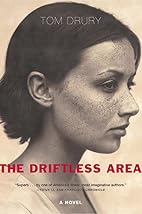
1. The Driftless Area by Tom Drury
Pierre Hunter is like a creature out of time or a hero in a fable or perhaps just like anyone else living in the Midwest in the Driftless Area. He falls in love, he goes to school, he gets a job, he almost dies, and like a backache, trouble is right behind him. He partakes of both the particular and the universal and he isn’t entirely sure which is which. But fate, it seems, has something in store for Pierre.
Drury’s novel is punctuated by his trademark irony and humour. But it is the near-mythic quality of the story that marks it out. It feels at times almost Gaiman-esque. And that might put some readers off who were expecting something closer to gritty realism. But there is plenty of grit here, even borderline noir. And if there is some uncertainty about what it all amounts to, I’d have to say that is probably a good thing.
Always a writer worth reading. And this novel confirms that he is continuing to challenge himself to seek out the writer he will become. Recommended.
6RandyMetcalfe
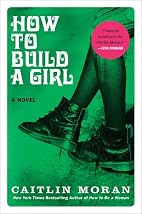
2. How to Build a Girl by Caitlin Moran
Johanna Morrigan, at fourteen, is still unformed. Not that there isn’t plenty of heft to her. It’s just that living on benefit in a large family on a council estate in Wolverhampton has her thinking there may be something more to life. There is. But she is going to have to find it herself and to do so she’ll have to start by becoming someone else. Thus begins a process of self-creation that inevitably leads to sex and drugs and rock-n-roll. Also alcohol and cigarettes, but who’s counting. In her alter-ego as Dolly Wilde, the enfant terrible of the indie music magazine D&ME, Johanna starts cutting a swath through puerile pop as she wordsmiths her way to freedom and more than one epiphany.
Caitlin Moran’s writing is full of zest, almost tiringly irrepressible, but always with a hint of insight to justify the excess. You can’t help but feel bound to Johanna’s quest for whatever it is she is really seeking — and even she may not be fully aware what that is until the end. But even when her choices are bad choices, they are undoubtedly hers; she owns them. Fortunately, you can have some hope that she has the inner resources, either wit or waggery, to face down her mistakes and rebuild if her first efforts at girl building go awry.
Be prepared for some frank eye-opening and a fair number of laughs. Gently recommended to fourteen year olds and others in need of inspired reconstructive self-surgery.
*******
This is the reason I’m glad to participate in a book club. I would never have read this book had it not been the book for next month. And I would have missed out on a small piece of the zeitgeist. It reminds me that there is probably a fair bit more going on, even in Wolverhampton, than I would have guessed. And not all of it is cheery, despite the frosting Moran chooses to put on things. Although Johanna’s story is ultimately hopeful, it might just as easily have been dire in the extreme. It’s not just a question of choosing cynicism or glee. But then that’s probably just a sign that a novel such as this is not about realism despite the fact that many seem to take it as such.
7RandyMetcalfe
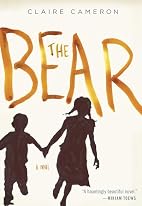
3. The Bear: a novel by Claire Cameron
This is a nightmarish tale of wilderness survival told from the point of view of a five year old girl. On a summer’s night, while she and her parents and her younger brother are camping on an island in a lake in Algonquin Park, her parents are attacked and killed by a black bear. Anna and her brother Alex, nicknamed ‘Stick’, survive due to their father’s quick thinking. He places them inside a large metal Coleman coolchest. Their harrowing escape and further day and night lost on the mainland are enough to bring your heart to a stop, or start it racing out of control. And in the affecting voice of young Anna, it is almost too much.
Certainly Cameron succeeds in emotionally capturing her reader. You’d be pretty hard hearted to be immune. But I worry that this kind of affecting narrative can never be really anything more than that. We have very few insights into the mind of a five year old with which to judge the aptness of this representation. And the demands of a lengthy narrative force the author to significantly expand a child’s vocabulary, insight, and foresight. In the end, however well written the story might be, we simply can’t judge it as either universally applicable or a perfect rendering of a very particular child. And that leaves us only with the emotional flow of the tale.
Perhaps that is enough for some. I confess I want more. So, although I too was caught up whilst reading it, I can’t really recommend this book, even if I would be willing to read something else by the author.
8RandyMetcalfe
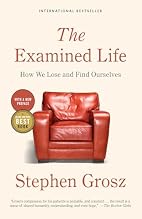
4. The Examined Life by Stephen Grosz
As a practising psychotherapist, Stephen Grosz has encountered a vast array of different cases in both his clinical and private practices. As he recounts some of these in this volume, we witness patients facing difficulties that are either self-inflicted, externally conditioned, or constitutive (i.e. neither subject to their will or the will of others). Grosz, for the most part, refrains from sweeping generalizations, startling insights, or specific therapeutic successes (or failures). Rather he opts for small gains, oblique observations, commonalities, gentle truths. This can make the cases seem anodyne and his analyses banal. But of course, as is often the case, what seems to be the case rarely is so.
A few cases stand out from the norm. In some, Grosz draws explicit parallels to literature (e.g. Dicken’s Christmas Carol, or Melville’s Bartleby, The Scrivener). Here, literature prefigures the kind of case he ends up dealing with. In such chapters, Grosz’ writing comes to life. More of this would have breathed life into the book as a whole. The other cases that stand out are ones in which Grosz turns from reflection on his patient to ruminations about himself, his practice, or his family. And here too, the writing catches fire perhaps because of the author’s more personal involvement.
Overall, however, I’d have to say that the book is less than gripping (some of the cover blurbs are risibly overstated) and can easily be passed over for other more compelling works. However, if the author chose a single focused topic (perhaps from his own life) to pursue in a future book, I would probably be willing to give that book a read. You can’t help feeling here as you read that Stephen Grosz has more to say and is still searching for his voice.
9PaulCranswick
All the books you have read so far look very interesting Randy despite the fact that I haven't heard of any of them!
I must say that you must be the best kept secret in the group when it comes to reviews - unerringly excellent.
I must say that you must be the best kept secret in the group when it comes to reviews - unerringly excellent.
10RandyMetcalfe
>9 PaulCranswick: That's very kind, Paul. You will have heard of the book that is currently absorbing me. I've been thoroughly enjoying War and Peace but it turns out it is rather long :-) I should, however, reach the end of it this week.
11PaulCranswick
>10 RandyMetcalfe: Ha! That explains where you've been.
12RandyMetcalfe

5. War and Peace by Leo Tolstoy
Rarely has a novel with such a thumping thesis (Tolstoy’s rejection of the so-called great man theory of history) been so affecting, so charming at times, and so brutally honest at others. Once you give yourself over to it, it is engrossing and the pages (the many, many pages) seem to fly by. And perhaps not surprising for such a long and complex work, your allegiances to characters develop and shift over the course of the novel. Whether it is the moral development of the seemingly dense Pierre, or the reclamation of the overly proud Prince Andrei, or even the dizzying excitement of Natasha and its aftermath, the care that Tolstoy takes with his fictional characters helps humanize the necessarily violent battle sections of the novel. Despite the frequent authorial disquisitions on the impossibility of the will of one man, be that man Napoleon or Alexander, directing the outcome of huge events, Tolstoy regularly brings the focus down to single individuals in the midst of a battle and we see how personally meaningful their individual actions are for them.
There is no need for me to recommend this novel. It stands as one of the bulwarks of imaginative fiction and for that reason alone, if no other, it deserves to be read. But what I would say is how surprisingly funny and charming and at other times heart-poundingly tense it can be. So as well as being an important, possibly a necessary, read, it is also a good read. Enjoy!
****
I started reading War and Peace in January last year and only made it to page 145. Since I have a tendency to have numerous books on the go at any one time, I found it hard to maintain my interest. This January I started again and decided to give it its due by dropping my other books for the duration. Some works just require one’s full attention. In no time, it seemed, I was through the first Volume and there was no stopping.
Although it sets an odd tone for the conclusion of such a long work, I think the second epilogue is very important. Without it, Tolstoy might come across as merely an ideologue not so subtly smuggling in an otherwise extraneous thesis into a modest, if lengthy, work of fiction. (You’ll be able to come up with other examples of this phenomenon.) The second epilogue confirms that Tolstoy is a clear thinker on the nature of free will, action, and especially joint action. Indeed the clarity with which he writes there sets him apart from many of his contemporary writers of philosophy. That epilogue almost reads like something Bertrand Russell could have penned sixty years later. I found it refreshing. The advantage being that if Tolstoy’s argument is wrong, it is at least clearly wrong.
13RandyMetcalfe
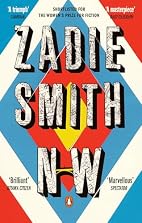
6. NW by Zadie Smith
Writing as vibrant and complex and irreducible as the city it evokes and the characters it follows. This is truly remarkable work. The kind of novel you read and wish you had read years ago.
Leah Hanwell and Keisha (now Natalie) Blake have been best friends since childhood. They are bound together through fate and accident. And while the novel sometimes follows Leah and sometimes Natalie, the real object here is the milieu in which they grew up, London’s northwest quadrant — poor, ethnically and racially mixed, burdened by crime and drugs, but suffused with hope.
Zadie Smith has a good ear for dialect and dialogue and the local idioms that arise and depart. So the years pass seamlessly and the reader always feels in touch with the real. The narrative takes different forms, including a long section of brief numbered segments that move Keisha from precocious youth to work in the Inner Temple as a pupil barrister, by which time she is known as Natalie. Leah is less fully explored but perhaps rightly since Keisha/Natalie is more difficult as a character. It is hard for even Natalie herself to get past her own defences. Little wonder then that Smith needs to approach her obliquely. And when we do get through, it may be hard to accept what we find. Yet, I think that makes Natalie all the more believable.
Smith brings real affection for her characters and their mix of unrequited hopes and self-critique. I could easily, having just finished reading the novel, sit down and read it again immediately safe in the knowledge that I would undoubtedly pick up far more on a second or a third reading. Highly recommended.
14RandyMetcalfe
I haven't been reading quite as slowly as my February entries might indicate. At some point I noticed that my electronic subscription to The New Yorker had been quietly stacking up on my Nexus 7. In fact, I had more than year's worth of magazines of which I had mostly just skimmed the always vital cartoons. Time to go back through them and actually read each of the short stories, poems, and a fair selection of the profiles and other articles. Otherwise it wouldn't make sense to keep the subscription.
So that's what I've been doing. More than a year's worth of New Yorker magazines in the span of the last couple of weeks. Not a bad way to spend one's reading time. And hey, there's some good stuff in there. I think I'll keep that subscription :-)
So that's what I've been doing. More than a year's worth of New Yorker magazines in the span of the last couple of weeks. Not a bad way to spend one's reading time. And hey, there's some good stuff in there. I think I'll keep that subscription :-)
15carlym
Your review of How to Build a Girl is interesting--I read two of Moran's memoirs last year, and from your description, her novel sounds like it is very autobiographical.
16RandyMetcalfe
>15 carlym: Yes, I believe How to Build a Girl is quasi autobiographical. But I hope not all of it! My book club all enjoyed the verve of the writing but had a few reservations about it as a novel. Fair enough.
17Cait86
I have to tell you how much I'm enjoying your thread! I have both How to Build a Girl and NW on my TBR, and after reading your reviews I want to read them both immediately. Looking forward to what else you will be reading this year!
18RandyMetcalfe
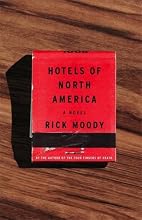
7. Hotels of North America by Rick Moody
Couched in the form of a series of introspective and oblique reviews of disparate hotels and inns by the mysterious Reginald Edward Morse, suitably prefaced by the improbable director of a society of hoteliers and innkeepers, and with by an afterword by none other than Rick Moody himself, Hotels of North America is a tour de force, a virtual Audubon of loneliness. Accompanied most frequently by his companion, K., who takes on the names of various birds as cover, Reginald records the thoughts that trouble him whilst staying in temporary lodgings. That these thoughts rarely have much to do with the actual establishments is hardly a criticism. Reginald’s fame, if Internet reviews constitute a substantive basis for fame, is due to his ruminations on his sad life, his failed marriage, his sexual fiascos, his occupation as an erstwhile motivational speaker (freelance), and his love for K. Sometimes funny, sometimes sad, sometimes acting entirely inappropriately, Reginald exists through the two years in which he contributes his online reviews and then, apparently, disappears as though he had never been. All that we are left with — all that “Rick Moody” is left with having been asked to write the afterword — are the reviews themselves, as though a sequence of extended opinions, rants, and ruminations could constitute a man. A man, quite literally, of words.
It is a fascinating performance. Moody sustains the dim illusion with grace and pathos, showing real care for his creation even when Morse reveals himself to be largely unlikeable. The writing, which is naturally first-person and confessional, matches Morse’s character perfectly, with bathetic language and idiosyncratic points of interest. This is not a series of one-off comic turns. It is a deeply considered whole, so bleak in some respects as to be potentially tragic. And yet the archness of the performance, the all-too-obvious framing for apparent verisimilitude, demands that the reader look closer, or perhaps stand further back to see what is really being accomplished here. I’m still pondering that.
Highly recommended.
19RandyMetcalfe
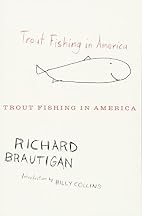
8. Trout Fishing in America by Richard Brautigan
More often spoken of in reverential tones than read, I suspect. So it comes as some surprise to me on finally reading Richard Brautigan’s fish tale to discover that it is entirely readable, playful in the extreme, and refreshingly undated. Of course it is entirely likely that the book has had so much influence on the two (or three) generations of writers that came after it that all of its eccentricity and absurdist turns just look like old hat these days. Not entirely. I definitely think it is still worth reading and shall endeavour to speak of it in reverential tones myself in order to promote that activity.
What exactly Trout Fishing in America is remains open to debate. It may not be a conventional novel, but there are so many books out there that aren’t conventional novels that its unconventionality hardly distinguishes it. What stands out is that it is filled to bursting with what you might call left-turn similes, i.e. similes that appear headed in one direction and suddenly take another tack. It is also, surprisingly, filled with a lot of actual trout fishing. So that must put it in the running against Moby Dick as one of those books that come to define America.
And so, gently recommended.
20RandyMetcalfe
>17 Cait86: Thanks, Cait. I seem to have a stack of books on my tbr shelf and a much larger stack on my virtual tbr shelf, so I'm looking for at least a few more months of good reading.
21RandyMetcalfe
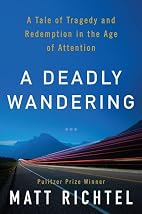
9. A Deadly Wandering by Matt Richtel
The dangers of distracted driving can hardly be over-stated. Mobile technology, either in the guise of telephone calls or texting, raises the potential for distraction exponentially. The ubiquity of cell phones and the apparently inability, especially among digital natives (people who have grown up using this technology), to relinquish even for a few minutes the devices that connect them to their friends has led to severe dangers on our roads. Using the case of one particular distracted driver whose inattention led the death of two rocket scientists, this book explores the rise of these new technologies, the science behind how they are affecting our brains and behaviour, and the growing consciousness that collectively we need to do more to curb our deadly distractedness.
With its origins in a Pulitzer prize winning series of articles by Matt Richtel, this book deepens and widens the research. It explores the lives of all of the players in the case of Reggie Shaw, whose inattention led to the death of two rocket scientists mentioned above. And it constructs a narrative that attempts to dramatically heighten the tension around the confluence of events that led to the deadly accident and the process of redemption for the principal actor. There is no doubt that Richtel is a capable researcher. And he is definitely a capable journalist. And the issue of distracted driving definitely deserves greater attention. The only question then is whether turning what is in essence an extended magazine article into a book of this length is the best way to go about accomplishing that end. You’ll have to decide that for yourself. But even if I’m reluctant to recommend this book, I do want to confirm, succinctly, its central message: do not text while driving!
22Tara1Reads
>21 RandyMetcalfe: I thought about reading this, but I just happened to see Reggie Shaw interviewed on Katie Couric's show awhile back; I feel like that told me all I need to know about the story. So I agree with you that maybe it didn't really need to be turned into a book. Also, I am not sure a book is the right format for people who need to learn that texting while driving is serious and not okay.
23RandyMetcalfe

10. The Complete Patrick Melrose Novels by Edward St. Aubyn
Although each of the Patrick Melrose novels has at times received praise, it is the first -- Never Mind -- which, to my mind, is what both establishes and justifies St. Aubyn as the worthy successor to Waugh. Perhaps no sequel in a series could hope to match the surprising density of wit, charm, and horror that the first in the line lays down. Although I enjoyed each of these novels in turn, it was the first alone that I keep coming back to in my mind. And it stands significantly above St. Aubyn's other non-Melrose novels as well. So, if you only have time to read one (short) St. Aubyn novel, do read the first of the Patrick Melrose novels.
Never Mind
In this first, short, Patrick Melrose novel, Edward St. Aubyn depicts, over the course of a single day, the horror that is young Patrick’s life. His father, David, is a sado-masochistic incestuous child molester. His mother, Eleanor, is a drug and alcohol addicted victim of her husband’s ritual humiliations. His father’s friends are as bad as he is, with the possible exception of the philosophy professor and social climber, Victor, whose rational delicacy (and his partner’s native good sense) at least prevent him from colluding with David in his depravity and abuse. However, Victor’s sensitivities do not prompt him or his partner to intervene on Patrick’s behalf. And so a chateau in the south of France becomes little more than an island of Dr. Moreau as one indignity follows another. The wealth, classical education, and breeding of this class of being results in what can only be termed ghastliness. Truly ghastly. And should you come to learn, extra-textually, that this in fact is a fair representation of St. Aubyn’s actual childhood, including his rape by his father, the ghastly just becomes all the more horrific. And yet, on the surface this reads like an Evelyn Waugh satire.
It is an auspicious beginning to what promises to be a riveting series of books.
Bad News
The ogre is dead. Patrick Melrose, now 22, receives the bad news that his estranged father has died in New York City. Is it bad news? The loss of a tyrannical malevolent force is surely a blessing unless you’ve lost other things as well — like the opportunity to have it out with him, to tell him what you really think of him, to hurt him as much as he has hurt you. And given Patrick’s misanthropy, his caustic excoriations, his constant abuse (even if that is primarily self-abuse) — it’s as though the old man is still there calling the shots. Nevertheless Patrick fulfils his filial duty by flying to New York to collect his father’s remains. And while there he plumbs new depths of drug-fuelled self-hatred accompanied by bon mots and fine dining.
Just as clever and corrosive as the first novel in the series, this second Melrose novel’s concentration on personal abasement and uncontrollable desires works as a counterpoint to the portrayal of Patrick’s father in the first novel. Less riveting perhaps if only because self-abuse is a manifestation of self-concern, which becomes tiresome. Patrick is no longer the sympathetic victim of his father’s abuse. But is he still sympathetic at all? Or merely pathetic? It is not yet clear whether Patrick will be able to rise above the muck or if we’ll want him to.
Already looking forward to the next book in the series.
Some Hope
Patrick is now 30, clean, but still burdened by memories of his father. Without the drugs with which to act out, he finds his life is all too bland and uneventful. He wonders whether he should find something to pass the time, perhaps a hobby, perhaps a job. But he doesn’t think about it too hard. After all there are country dinner parties to attend with the great and good, or at least the old monied class. And that might provide a bit of diversion.
St. Aubyn returns to his strength here in this short novel following the continuing adventures of Patrick Melrose. A whole array of party guests, distinct types and at least one royal, offer a wide canvas for deliciously cutting remarks, snobbery, sycophancy, and minor marital intrigue. Patrick crosses paths with a number of figures from his youth, all of whom knew his father and some of whom even speak well of him. And he has plenty of opportunity to reflect, having earlier in the evening confessed his great secret (his childhood rape by his father) to his best friend, Johnny Hall, a fellow ex-drug addict. Is it the beginning of a process of real unburdening or at least a distancing from his past? Perhaps it is too soon to tell.
Almost impossible not to recommend this if you’ve read the previous two Melrose novels. And equally impossible not to want to move on immediately to the penultimate volume.
Mother's Milk
Patrick, now 40, has a son, Robert, who is 5. Patrick has, perhaps surprisingly, turned his life around. He is now a barrister. He has a wonderful wife, Mary, and another son, Thomas is not far off. Is this the end of Patrick’s caustic self-loathing and self-destruction? Not hardly.
Each lengthy section in Mother’s Milk is told from a different central characters’ point of view. Only in the final section does St. Aubyn flit from one character to the next, which is his more usual technique. The advantage here is that we get to spend lengthy period’s of time outside Patrick’s head. We see his barbed comments and their impact on those around him. But only latterly do we experience his inner justifications for his behaviour, none of which is very convincing. Patrick seems to have exchanged alcohol and anti-depressants for his earlier dependence on heroin but his moods are just as erratic and destructive. He varies between petulance and self-pity, sufficient in his own mind to warrant an affair that might threaten his marriage. But the real source of his antagonism here is his mother, Eleanor. Eleanor has slipped into infirmity and dementia but not before passing on her wealth, including the house in the south of France, to a scheming charlatan guru. Patrick treats this as just a further betrayal and manages to pass on his outraged sense of injustice to his oldest son.
It’s hard to feel sorry for Patrick in this novel. Indeed, the only character who is consistently beyond reproach is his wife, Mary, and latterly the youngest son, Thomas. The litany of betrayals in the lineage of the fabulously wealthy is in the end, largely uninteresting — horrid people being horrid to each other either intentionally or unintentionally. Only the clever wordplay and the undoubted charm of young Thomas keeps the pages turning.
Weaker, I think, than the preceding Melrose novels, but still sufficiently engrossing to carry me on to the final novel.
At Last
It’s a return to form of sorts in this final Patrick Melrose novel. St. Aubyn literally returns to the form of his first Melrose novel — Never Mind — with a study of a single day, moving effortlessly through the thoughts of all the participants in the event in focus. The event in question is the funeral of Patrick’s mother, Eleanor. And the occasion provides the set-piece for St. Aubyn to reintroduce many of the characters who have played a part in Patrick’s life. We see old friends of Patrick’s father, such as the irrepressible Nicholas Pratt, Patrick’s old friend, Johnny, and Patrick’s sometime lover, Julia, as well as an eccentric representative, Annette, of the the shamanic Transpersonal Foundation established by Patrick’s mother. St. Aubyn is permitted to move trippingly from caustic wit, to bathetic spiritualism, to maudlin self-regard. And all in best of taste. If the characters seem sometimes to come from Waugh and at others from Wodehouse, so much the better.
Here, Patrick is less self-involved or perhaps more personally evolved. His marriage has ended but his relationship with the wife and his children looks to be on a firmer footing. And if he still feels periodically short-changed by life, at least an unlooked-for legacy will relieve the financial constraint that fuelled his animosity towards his mother.
In many ways, this is a fitting conclusion to Patrick’s tale.
24ursula
>19 RandyMetcalfe: I read In Watermelon Sugar and found it charmingly bizarre and totally engrossing. I am looking forward to getting around to Trout Fishing in America.
25RandyMetcalfe

11. Fifteen Dogs by André Alexis
An apologue is an allegorical tale with exaggerated details used to convey a useful lesson. It often involves animals as the principal actors. But little more constrains the apologue, leaving the author who chooses to take up the challenge free to invent at will. Here, André Alexis offers a marvellous construction for our consideration. Fifteen dogs are granted the ‘gift’ of human intelligence. Will any one of them die happy? It is a bet between the gods, Hermes and Apollo. But is it fair? Do any of us with human intelligence die happy? Is there much likelihood that a dog might succeed where so many humans fail?
The most immediate difference for the dogs who receive the gift is their newfound ability to perceive colour. But much more than that is their heightened linguistic and communicative skills. This is both a blessing and curse, and thus something that some will turn towards and others against. And this largely divides their individual tales subsequent to their escape from an animal hospital on the evening of their transformation.
What fascinates here is how Alexis sustains our interest without merely transforming his dogs into humans. They are clearly not human. Yet he makes no pretence that they are still dogs. Indeed, other dogs fear them just as they too become wary of their unnatural natures. As we follow first the pack and then individual dogs, it becomes clear that there may be many lessons to be learned in this apologue. And each lesson is doubtless as subtle as the manner in which the names of the dogs are embedded into the poems that one dog, Prince, writes. (A note on the poems is found at the end of the novel.)
This is remarkably deft writing, unsentimental, crisp, and vibrant. Easily recommended.
26RandyMetcalfe
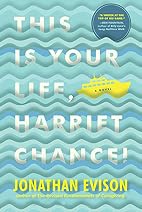
12. This Is Your Life, Harriet Chance! by Jonathan Evison
A life in full is always a worthy object for a novel. Here, Jonathan Evison presents the life of Harriet Chance. He does this through a series of snapshots of Harriet at different points throughout her life (she is 78 as the novel commences) in a manner not unlike the old television program, “This Is Your Life.” The snapshots jump about in time and are never more than a few pages in the voice of an omniscient narrator. In the present day scenes do we see Harriet interact with her son and daughter, her best friend, Mildred, and, curiously, with her recently deceased husband, Bernard. There are also a few chapters devoted to Bernard in the afterlife in some kind of way station from whence he makes forbidden dashes back to the real world to interact with Harriet. For the first third of the novel all of this proceeds in anodyne fashion. Then things take a serious turn.
The novel changes key significantly when a secret about Bernard is revealed. It jumps another octave when we learn through one of the snapshots something unsettling about the provenance of Harriet’s daughter. And things get very dark indeed when a history of Harriet’s sexual abuse by a family friend is revealed. What is odd in each case, however, is the voice of narrator. Stepping out of the neutral, insipid, mode, the narrator proffers judgements of Harriet that might surprise some readers. Or at least it surprised me. And this brings to light a general problem with Evison’s structure for the novel.
Because this is a life seen in brief snapshots, the reader never gets an opportunity to see Harriet in context. We don’t see her develop from one point to the next. And we are forced to rely solely on the viewpoint of the narrator. When that narrator suddenly starts chastising Harriet, even for actions which as a child she most certainly could not be held responsible, we have no resources with which to ascertain whether these judgements are at all fair. We simply have to take them as read. But that is a peculiar place to take your reader. Far from presenting a life and letting the reader reach their own judgements, Evison has decided to force the issue.
To be fair, I think that it is the structure itself that has tempted Evison to forego his better instincts as a novelist. But then the decision to use the snapshot view of a life was his as well, so he can’t be absolved completely. In the end, you’ll have to decide for yourself whether this works for you. It didn’t for me.
27arubabookwoman
Very much enjoying your reviews and your book choices!
28RandyMetcalfe
>27 arubabookwoman: Thanks, Deborah.
29RandyMetcalfe
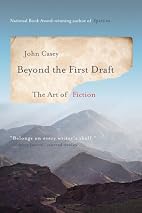
13. Beyond the First Draft: The Art of Fiction by John Casey
Almost certainly it would be better to have come to this after having read some of John Casey’s novels or short stories. He is probably a sensitive novelist. I suspect he is a good teacher as well, affable and constructive. But he isn’t a great essayist. And so this collection, though at times affable and constructive and sensitive to the real challenges that face writers, is not particularly helpful. In fact, where it succeeds best is when Casey moves away from the instructive essay and reflects upon his own life as a reader and as a writer. The essay “Childhood Reading” is delightful. It is filled with Casey’s early enthusiasm, his confusion with certain novels, and his pleasure in sharing a much-loved book with a close friend. He describes himself as a natural reader as opposed to a writer. But perhaps that is true for all writers. I also like the content (but not the form) of the final essay on mentors. Casey was lucky enough to have found a worthy mentor early in his career and wise enough to realize that mentoring is not just about instruction. If you are lucky, your mentor will point out something you’ve never seen before. Not unlike a friend.
I wish I could offer a stronger recommendation for this book. It isn’t pointless to read. Just not essential.
30RandyMetcalfe
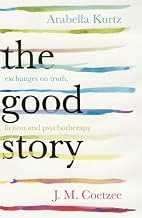
14. The Good Story: Exchanges on Truth, Fiction and Psychotherapy by J.M. Coetzee and Arabella Kurtz
A Nobel winning author and a practising psychotherapist engage in, what amounts to, an epistolary exchange on a variety of subjects. It sounds like it might be dramatic, a clash of ideologies, a contest of wills, or at least a communal effort to climb a hill. Alas, it is none of these. Coetzee sets the debate on its course and Kurtz consistently and without an ill will misses his points and talks past him. For the reader (some readers) it must look like a dramatization of their own lives. Coetzee is excruciatingly clear, precise in his language, appropriately well versed in both psychological and philosophical literature and anxious to explore the relationship between fiction and truth for individuals and for groups including nation states. Kurtz misunderstands his central points and offers tangential or irrelevant responses. At least that is the way it seemed to me. Coetzee is nonetheless polite and gracious and wouldn’t dream of saying that Kurtz was missing the point. All of which makes me wish he had simply written a book on this subject himself. Because that is the book I’d be interested in reading.
The epistolary exchange as a form has some history. But does it have any future? I kept thinking that if they were limited to the kinds of exchanges that you see in the comments on many website, they would conform to Godwin’s law in which at some point one of them would accuse the other of being a Nazi. Very soon in this book you will begin to imagine what might have taken place if Coetzee had undertaken this exchange with another novelist at his level, or a philosopher, or a whole room full of people other than Kurtz. Or at least someone who listened to what he actually was saying. Sigh.
I really wish this had been a book that I could get behind but as it is — not recommended.
31RandyMetcalfe
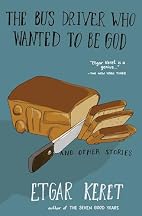
15. The Bus Driver Who Wanted To Be God and other stories by Etgar Keret
If you aren’t already familiar with Keret’s writing, it make take a few of these very short stories to sync up with his particular comic wavelength. Written originally in Hebrew and set, often, in Israel, there are commonplace life events such as universal military service that set the subject matter apart from much North American writing. The stories here are slight, almost oblique, more scene or sketch than story, really. Many carry an overt moral, which may or may not be subverted by the narrator. But the best of them are both ironic and non-ironic at the same time. And that is a delicate balance to strike.
There is one longer story here called, “Kneller’s Happy Campers”. It reveals, I think, what happens when you take this style and expand it. It almost begs to become surrealist or absurdist, depending on your point of view. In “Kneller’s Happy Campers”, all of the participants are actually suicides and this is what amounts to their afterlife. It’s a great premise, but you are probably already wondering, “Where do you go with that?” If you are Etgar Keret, you mostly just stay put, wander around a bit, and then head back to where you started. Which makes the afterlife pretty much like life.
Gently recommended.
32RandyMetcalfe
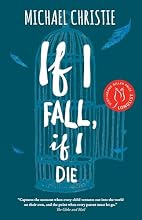
16. If I Fall, If I Die by Michael Christie
There is a sense in which If I Fall, If I Die attempts both too much and not enough. It has an admirable reach, addressing debilitating mental illness, native exploitation, the decline of one of Canada’s more honourable commodities, youth abandonment, fatal illness, and truancy. On the other hand, it devolves into a “Hardy Boys” mystery with a deflationary climax. Skateboards may be all about falling; novels too, if they don’t hold their nerve.
Young Will Cardiel has never been Outside. His mother is suffering extreme agoraphobia. She’s a famous film artist, or was before her fears set in. His absent father is a world famous architect. Will and his mother have moved back to her childhood home in Thunder Bay. But eventually Will is going to get tempted into the Outside. And his life will never be the same. Once he braves their yard, he eventually makes it to school, finds a friend or two, and takes up the skateboard as his instrument of fate. He is driven by a mystery that he wants to solve and that will, with complications, take him far beyond the Outside that he imagined.
Much of this novel is well written, vivid, and evocative. It is also uneven, as perhaps is common in first novels. Some important characters (e.g. Titus and Butler) are not integrated into the story as a whole. So at times it feels as though different novels have been bolted onto one another. That’s not a bad thing, in itself. And here it almost works.
Even if I don’t think I would recommend this novel, I would be willing to read something further from the author. He has talent and drive, and given his history on the skateboard, he has a habit of getting back up and trying again until he makes it.
33RandyMetcalfe
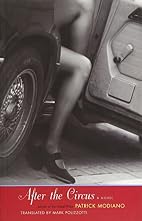
17. After the Circus by Patrick Modiano
A young man, Jean, on the cusp between adolescence and adulthood begins a tentative but amorous liaison with a slightly older but possibly far more experienced woman, Gisèle. Jean is an orphan, for all intents and purposes, his father having absconded and his mother uncertainly located in the south of Spain. With Gisèle, he both seeks and avoids learning too much about her. She has a past, he’s certain, but he prefers to leave it in the past. Her present “friends” are at least as shady as Jean’s absent father. The police have already interrogated Jean and Gisèle, and there is a lurking menace that they may be called upon again. With past unknown and the present indifferent, Jean places all his hopes on the future, a possible future he might have in Rome if only he can get out of Paris in time, ideally with Gisèle.
This may be Patrick’s Modiano’s most coherent, taut tale. It has his trademark uncertainties and suspicion, the threat of violence and more, and the wistfulness of memories being recaptured. Jean is affecting and innocent for the time being, and Gisèle is alluring and we wish for her to be innocent for Jean’s sake. It is a tempting combination.
Definitely recommended.
34PaulCranswick
Have a wonderful Easter.


35RandyMetcalfe
>34 PaulCranswick: Thanks, Paul. And to you as well.
36RandyMetcalfe
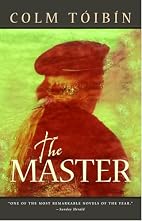
18. The Master by Colm Tóibín
“Life is a mystery and…only sentences are beautiful,” Colm Tóibín’s Henry James observes when asked, toward the end of The Master, the moral of his stories. And to be sure, there is no want of beautiful sentences in this novel of five years in Henry James’ life. It begins with his disastrous play, “Guy Domville”, in 1895 and ends with a rapprochement of sorts between Henry and his older brother, William, the noted psychologist. Through a series of studies of crucial events in James’ life over this period, Tóibín paints the portrait of an artist at peace with his life-choices, dedicated to his subtle art, always seeming to stand at the entrance to a room observing sensitively without ever giving away too much of himself.
The prose is wonderfully evocative. Not so much an imitation of James’ style as a worthy homage. It is richly dense, enough so that you will linger in reading it. But it is never ponderous. Tóibín’s love for James, both author and man, comes through clearly. It may indeed be Tóibín’s finest work.
The only hesitation I have in recommending it whole-heartedly is that I don’t understand why a writer of Tóibín’s talents would undertake such a work of fiction. This is a general bemusement not confined to this work in particular. Such a work of hagiographic historical fiction always, it seems to me, trades upon the reader’s often malformed assumptions about the historical figure or the historical period. In some ways this frees the author to concentrate on the portrait and ignore the frame. But it also constrains the meaning that might be conveyed. Of course this is merely a limitation on the form and not a comment on its execution, which here is done about as well as I could ever imagine it. And on that ground I feel confident in recommending it.
37RandyMetcalfe

19. The Problems of Philosophy by Bertrand Russell
More than 100 years after its publication, Russell’s “shilling shocker” is in no need of a review from me. Nevertheless, rereading this work over the past few days has sparked numerous memories and reflections. My copy has been ruthlessly interrogated by the younger me. Nearly every paragraph has sentences underlined. There are frequent questions in the margins. Sometimes the underlinings are in multiples (pencil, pen, highlighter) perhaps indicating how many times I have reread this slim volume. And reading it again I felt like I could easily have matched those with another set, for nearly everything that I had drawn attention to in the past is just as pertinent today. For anyone looking for an introduction to analytic philosophy, this is still a good place to start.
What I was thinking as I read it this time was how clear Russell is, how much his characterization of these problems sounds entirely current. That was startling back in 1912. Russell had already definitively broken with the prevailing idealist philosophy of Bradley and others as he sought the foundations of mathematics. By the time he wrote The Problems of Philosophy his bid to found mathematics in logic had, he decided, failed. But the manner in which he approached philosophical problems, the analytic method, had taken hold. Witness the manner in which Russell here dismisses Berkeley by simply pointing out that Berkeley has confused two different senses of the word “idea”. Consider his treatment of truth and falsehood as he edges tentatively towards the application of logical form that Wittgenstein would elaborate in his Tractatus Logico-Philosophicus. Observe Russell’s destruction of Hegel on the basis of a simple misapprehension of the nature of relations. It is not much of an exaggeration to claim that Russell sets the agenda here for the next hundred years of analytic philosophy, both in terms of the problems, as such, but also what ought to count as a philosophical problem and, more importantly, what doing philosophy will look like in the analytic mode.
I began thinking about Wittgenstein, who had joined Russell in Cambridge in 1911 with an engineering degree and absolutely no background in philosophy, wondering whether he avidly read this little introductory volume for the intelligent layman. I think that it might be persuasively argued that the Tractatus was Wittgenstein’s response, in a sense. And if so, just consider the relative impact of those two short works.
The only chapter of the book that falls flat is the final one, “The Value of Philosophy”. And it is here that Russell fails to observe the very method that he has deployed throughout the rest of the book. Here he argues like a public policy wonk rather than reasoning like the philosopher of the preceding pages. It is the only chapter where my earlier self didn’t do any underlining. But maybe it is a chapter that really didn’t need to be written. Because if you’ve read the chapters before it and still have to ask this question, it’s probably a sign that you weren’t paying attention.
I’m thinking that I shall do some more rereading this year of key works that my earlier self read back in the day. But as with this book, I probably won’t be offering a review of the work’s page in LT.
38dajashby
12 RandyMetcalfe -> I've just added War and Peace to my ToRead list, actually because I've been reading a book of essays by Ursula LeGuin The wave in the mind (who I love), and she says it's the greatest novel ever written. Although she does say that the bits where Tolstoy intrudes into the story are a problem. (I think this is an example of the old "show, don't tell" exhortation)
39RandyMetcalfe
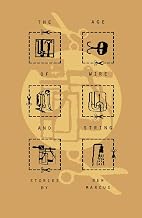
20. The Age of Wire and String by Ben Marcus
It’s entirely possible that I am wrong about all of this.
The Age of Wire and String presents as a response in eight sections to an initial “argument” that sets the conditions of the piece. The sections have headings like “Sleep” or “Food” or “Weather”. Each has a ‘Terms’ section closing it off which appears to give definitions for words or phrases. But both individually and collective what we have here is a nonsense. Not in the frivolous fun sense of nonsense. Rather this is non-sense. None of these sentences, despite cohering to semantic rules, in fact makes any sense.
Initially you might think that Marcus has written something in an obscure code. If only you could work it out, then it would all make sense. I don’t think that is the case. On the other hand it isn’t gibberish. Unlike gibberish, this always has the semblance of sense. That must very hard to do. Imagine writing 140 pages that is utter nonsense but never devolves into gibberish or slides into frivolous sense-based nonsense. It must take immense effort. But then your next question is bound to be, “Why?”
Why indeed.
I suppose on some level this could be taken as a form of concrete poetry or sound poetry. That’s about the best option I have come up with. But I don’t really believe it. And so I’m left with thinking this is merely an exercise, remarkable perhaps in its execution, but with no further meaning. And that just doesn’t do it for me.
Of course, as noted, it’s entirely possible that I am wrong about all of this.
40PaulCranswick
>37 RandyMetcalfe: Thought and memory provoking review, Randy. Like yourself I read a lot of philosophical works in my late teens at University and Russell was always a favourite.
41RandyMetcalfe
>40 PaulCranswick: Thanks, Paul.
42RandyMetcalfe
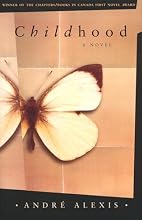
21. Childhood by André Alexis
Thomas MacMillan is in mourning. His mother has just died and so has the man who served as his father for much of his life. He is overwhelmed but not sure by what. His relationship with his mother, other than the actual birth, didn’t begin until he was 9. She came to claim him after the death of her mother, his grandmother, whom he had been living with in the small town of Petrolia, Ontario. Katarina (his mother) arrives and takes him on a bit of an odyssey that ends in Ottawa, where, broke and abandoned by her current lover, she seeks shelter for herself and her son with Henry Wing, a curious figure devoted to her, with whom she maintains a distant relationship. Thomas recounts first his life with his grandmother, Edna, then his strange trek to Ottawa and finally the somewhat peculiar life that Katarina, Henry, and Thomas eked out in the nation’s capital.
Thomas is fluently bilingual having learned French from his Trinidadian-born grandmother. But he also encounters numerous other French speakers even in Petrolia. And so the story is interspersed with some french dialogue and carefully observed distinctions between French as Thomas was taught it (very strictly) and that spoken by one of Katarina’s French-Canadian lovers. Likewise the fact of Thomas and his family being black is underplayed, only to emerge when he encounters overt racism as a child and later. It’s just part of the fabric of his life; it isn’t his whole life. In fact, most of his life is lived in books and there he finds a true kindred spirit in Henry, whose house in Ottawa is stuffed to the rafters with books.
The language of the novel is rich, as befits a bookish narrator looking back. But he is a narrator who is uncertain about his own life and especially the significance of events and people. So he tends to focus at times on what appear to be distractions as tries to piece together what it all means. The narrative appears to be addressed to Thomas’ lover who we only see tangentially at the end. But in reality he is writing this for himself.
At times emotionally abrupt, at times lyrical, at times awkwardly attempting to place some order on disparate events — this is a novel whose maturity belies the fact that it was André Alexis’ first. And reading it now, it makes his later success seem inevitable. Gently recommended both for itself and for what it heralds in this writer.
43RandyMetcalfe

22. A Lost Lady by Willa Cather
The lost lady of Willa Cather’s novella is Marian Forrester, wife to Captain Forrester who of late was instrumental in the building of the railway. She is the very breath of light and spring to many a young boy in Sweet Water. In particular, Niel Herbert falls under Mrs. Forrester’s spell as a boy when she tends him after he has fallen and broken his arm. But her charms captivate one and all, not least the Captain’s many powerful friends. Yet hers is a free spirit and, in some senses, even from the outset she is already a lost lady. However, her losses only become apparent years later after the Captain first loses his fortune and then, following a stroke, much of his mobility. His infirmity traps her in Sweet Water, preventing her from joining with her friends in Colorado for the winters. And that is when Niel begins to really notice her changing.
Along with a vividly painted portrait of a woman very much of her own mind, this story treads through both the beautiful meadows and the marshy backwater of the American hinterland. Early in the story we witness perhaps the most awful example of wanton cruelty I have ever encountered in a story. It is so startling that it makes it hard to even focus on what Cather is doing here. But I suppose that, since nothing much comes of that act at the time or later, it must be meant to serve as a caution on how we ought to treat of Marian’s own actions. Fate, it seems, can be as cruel as the cruelest of young boys.
Cather’s writing is never less than riveting. She seems to evoke a prairie locale with the mere wave of her hand, but it is surely the work of a great artist. Her central characters are as complex as any imaginable: full of contrary actions, missteps, magnanimity, and baseness. Almost too much for such a slight work. But gently recommended, as ever.
44RandyMetcalfe
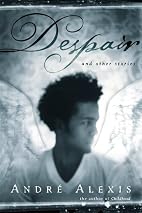
23. Despair and other stories by André Alexis
The stories in this collection tend towards the eerie, and some go well beyond the eerie into the macabre. Variously about or at least tied to Ottawa as a locale, the stories touch on pivotal moments in a life - the transition to adulthood, love, marriage, death, and especially the rites associated with death. The narrator’s tone is often distant or neutral despite what might be happening. Characters may be English or French speakers and the text will switch back and forth seamlessly. Usually a metaphysical aspect will emerge in the telling of the tale.
It is always interesting to go back and read a well-entrenched author’s earliest work. Here, many of Alexis’ later themes are evident, including the peculiar obsession with street addresses numbered “128” (I don’t know what that is about). The best of the stories are probably the most macabre ones such as “The Night Piece” or “The Third Terrace”. It seems a proof of their strength in that I like these stories even though I wouldn’t normally express any interest in such dark themes. I’m not sure this collection will stand up in the long run as having quietly heralded a great writer in gestation (as compared to say Lorrie Moore’s first collection). But it does enough to justify reading now whilst Alexis is mid-career. Gently recommended.
45RandyMetcalfe
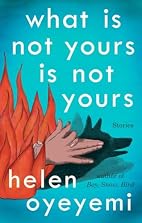
24. What is not yours is not yours: stories by Helen Oyeyemi
In this series of loosely connected stories, Helen Oyeyemi demonstrates her mastery of a distant and distancing style of writing. Both place and characterization are vague. Gender assignments are unspecified (typically). Emotion is muted. And standard rules of cause and effect may not apply. The effect is rather like overhearing the telling of a fairytale. It’s not a unique style. You can see it most prominently in Ali Smith’s work and probably the later Ishiguro novels. However, it does seem to point up a divide between what is going on in North America in short story writing versus what is happening in Britain.
Many of the stories here, such as “books and roses,” or “‘sorry’ doesn’t sweeten her tea,” or “drownings,” involve violence intermingled with passion. They can be unsettling and also opaque. Sometimes that push to the extremes overshoots into the macabre or the ghostly, as in “presence”. And it can make a more straightforward Cambridge University story like, “a brief history of the homely wench society,” seem almost out of place.
It may be that I’m just not well placed to fully appreciate these stories. There is no doubting Oyeyemi’s skills. But I find this style of writing so emotionally flat and texturally empty that there is nothing to engage with. The characters do not come alive for me. And neither do their locales. And for the most part, neither do their plots. That leaves me with little more than respect for Oyeyemi’s linguistic control. But that isn’t enough for me to recommend these stories to others.
46RandyMetcalfe

25. The Family Fang by Kevin Wilson
Caleb and Camille Fang are performance artists creating live instances of chaos and confusion with the coerced participation of their children, Annie and Buster, otherwise known as child A and child B. Annie and Buster are now adults whose lives have not gone especially well. Though they live far away from their parents, by choice, events will bring the entire family back together. As the plot works towards this point, the main storyline is interspersed with shorter chapters detailing some of the extreme artistic happenings that the family participated in together when child A and B were young. Once they are all back together it seems inevitable that their parents will attempt yet another event and force Annie and Buster to become participants whether they want to or not.
This novel has a quirky premise and a promising structure that lends itself well to a setup with pace and verve. And it’s funny. That it loses its way in the always challenging middle section is regrettable. I found myself wondering why this happened. Did the author simply lose his nerve? Was he unwilling to go where the premise and setup was taking him? Had he failed to fully think through the real possibilities? Was there an editorial hand at work here looking for something that would be more saleable? The truth is, we’ll never know. And so the entire second half of the novel just meanders until it finally comes to an end through lack of will as much as anything else. Maybe that wouldn’t have been so disappointing if I hadn’t been so enthused by the promise of the first half of the novel.
Even if I won’t be recommending this novel, I do want to keep an eye on the author. There is every likelihood that one of his future productions will fulfil the hopes that some of his writing here encourages.
47RandyMetcalfe
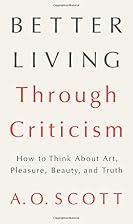
26. Better Living Through Criticism: How to Think About Art, Pleasure, Beauty, and Truth by A.O. Scott
A.O. Scott makes his living through criticism as chief film critic at the New York Times. So it’s entirely possible that the better living spoken of in the title is the one he hopes to achieve through the publication of this thoughtful and wide-ranging book on the practice and purpose of criticism. Everyone, says Scott, is a critic. That’s how we engage with the works of artistic creation that are presented before us. Some people are also journalists — writers paid by the word or hired to be on staff by periodicals. A critic, in the sense Scott is primarily interested, is a journalist who engages with works of artistic creation. When he or she does this very well (yes, criticism can also be done poorly), the prose that the critic produces attains the level of art itself. Which raises the question of whether this book reaches those lofty heights.
Scott offers six chapters considering aspects of criticism and the role of the critic. These read like chatty public lectures, with sufficient nods to the long tradition of criticism (and of artistic creations) to present as erudite, but enough asides and digressions to never be mistaken for deep thought. He regularly deploys full paragraphs of rhetorical questions, but presumably only as a rhetorical flourish. And to further deflate any grandiose posturing, Scott intersperses his lecture chapters with dialogues, question and answer sessions between himself and himself in which he takes himself to task on various points and also tries to defend himself. These might be considered light relief though in fact their tone and tenor is very much in keeping with the rest of the book. Scott is well-read and well-educated (though not a scholar), and he writes with great facility and verve. (He’s rather like an American James Wood.) So all of this is diverting reading even if it doesn’t really get beyond the superficial.
A case in point is his second chapter, “The Eye of the Beholder.” Here he approaches the heart of the problem. If everyone’s opinion is just a matter of taste (and there’s no accounting for taste), then all we can ever have is the cacophony of competing opinions. But the critic must maintain that there is more to art than his or her own prejudices. The critic says that the object under discussion (poem, play, film, painting, etc.) has features in which its beauty (if it has beauty) inheres. In drawing attention to these, the critic is pointing to something that can be discerned by anyone (perhaps with sufficient training) and, moreover, each of us ought to reach the corresponding judgment. Scott is drawing explicitly on Kant’s Critique of Judgment here. It is, I think, the starting point for any serious exploration of the validity or potential significance for criticism. Yet, having acknowledged Kant as the clearest characterizer of the problem, a few pages later Scott declares “that philosophy and science are of limited use in addressing these questions.” I don’t know why. Perhaps he felt he had delved as deep as he was capable. But that’s not a reason to think that philosophy is of limited use; it’s a reason to clear the field so that philosophers can get on with the hard work to be done.
But perhaps I’m hoping for more than what Scott set out to achieve with book, despite its aspirational sub-title. It remains an amiable book which deserves to be gently recommended, especially if you’ve never seriously considered these issues before. Besides, you can’t help but like someone who is so enamoured of the Pixar film Ratatouille!
48RandyMetcalfe
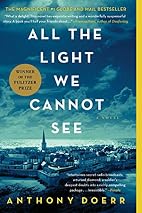
27. All The Light We Cannot See by Anthony Doerr
Marie-Laure is the young, blind daughter of the Master of Locks at the Museum of Natural History in pre-WWII Paris. Werner is an orphan growing up in a mining town in Germany. About 500 pages later their paths are going to cross in St. Malo on the coast of France. Meanwhile there are miles to go, so to speak, and lots of twists. But the pages will turn, and quickly. So quickly that you’ll be surprised at how you’ve been swept along and swept up in the all too evident emotions of that most dangerous time.
In its tone and tenor, this is really a YA novel. So it may be a bit surprising that it won the Pulitzer. It is written in a clear filmic style — short, one scene, chapters of about a page and a half in length. Then a quick cut to another character’s point of view. The tension remains high throughout. And you really can’t get bored. There isn’t time. But it is so self-consciously filmic — almost like it is really a “treatment” for a film, preferably directed by Spielberg — that you may find it tiring.
Of course just because this is a YA novel doesn’t mean that bad things don’t happen. They do. And some of them are truly awful. But awful in a way that would really look good in a cinema. (That’s maybe too harsh; they would also look good on TV.) I longed for more seriousness, less contrivance of plot, less blatantly heart-tugging characters. But I suppose that would simply have been a different book. And the author would be in his rights to suggest that I ought to go read that one instead. Perhaps I will. And maybe you’ll join me. Because for now, despite the accolades, this one is not recommended.
50RandyMetcalfe
>49 Tara1Reads: I had to look up what LMAO meant. Sounds painful.
51RandyMetcalfe

28. My Name Is Lucy Barton by Elizabeth Strout
Lucy Barton is an author looking back on her life. She uses the nine week stay she had in hospital, at a time when her marriage was troubled and her children were still small, as the centre point around which most of her thoughts revolve. During this time her mother, from whom she was estranged, flew out to spend five days with her in the hospital. And that, as much as anything, draws the focus towards motherhood and marriage, though for Lucy these are not pleasant images, having grown up in extreme poverty with what appear to have been disturbed parents. Nevertheless, Lucy has got on with her life, imperfect though it may be. And she is still capable of finding kindness in strangers, even if their being strangers is perhaps a prerequisite for the possibility of kindness.
This is extraordinarily fine writing — subtle, perceptive, painful, kind. It is as much a meditation on fine writing as it is on living. Watching Strout’s Lucy sidestep the central horrors of her own life, yet delicately trace them out for us, is like participating in a masterclass on characterization. Absolutely fascinating.
Very highly recommended.
******
Although marketed as a novel, My Name Is Lucy is really only of novella length. And it’s narrative style will remind you more of a short story than anything else. To my mind, it instantly prompted comparisons to Alice Munro or Elizabeth Hay. Fine company indeed. I had read and enjoyed Strout’s Olive Kitteridge, but this still took me by surprise. I feel like I should read it again right away before I have to return it to the library.
52RandyMetcalfe

29. The Sellout by Paul Beatty
Like a cross between Chris Rock and Philip Roth. Or Chuck Palahniuk and Richard Pryor. Or just Paul Beatty all over. This is a novel that effervesces, full of energy both zestful and angry, that has a lot to say and to think about and almost very nearly accomplishes something remarkable. The eponymous hero of the novel, once his bona fides are laid out, sets about re-segregating the nominal city of Dickens which has been incorporated into greater Los Angeles and effectively effaced. He doesn’t so much have a plan, at least initially, as merely a series of good intentions and a firm belief in social engineering. So when he adds an official-looking “whites only” decal to the priority seats on a city bus, all for benefit of an elderly black actor who has curious memories of the “good old days”, the consequences are far-reaching and suggest further possibilities, some of which can be guessed at and others which are truly surprising.
Beatty writes with such verve that his enthusiasm often gets the better of the narrative. And while that is very fun for about 50 pages, it begins to get tiresome eventually. The narrative is at best ramshackle and you feel when you read it that pretty much anything could happen. That’s a good thing. But that too begins to wear. And despite the closure that the protagonist claims he seeks, there may be no viable closure for the issue of race in America. But as here, with enough inventiveness and hope and determination, there is what will stand in for closure for a time.
Not “uproariously funny” as some back-cover blurbs would have you believe. But quirky and thought-provoking and periodically, yes, very funny. Gently recommended.
53drneutron
It's interesting that every book trying to be funny is "uproarious". I suppose nobody wants to market a mildly amusing book. :)
54RandyMetcalfe
>53 drneutron: Indeed. And I wonder whether anything is actually uproariously funny without pharmaceutically enhanced perception ;)
55RandyMetcalfe
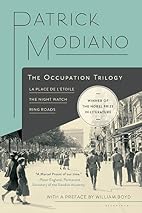
30. The Occupation Trilogy by Patrick Modiano
La Place de L’Étoile
It is entirely understandable why La Place de L’Étoile had not been translated into English until after Patrick Modiano won the Nobel prize, despite being his first novel. Well-regarded at the time of its publication in 1968, it is virtually opaque for non-French readers. There are so many non-contextual references to figures from French literary history and their works that the 10 pages of notes at the end of the collection are virtually essential (if you know they are there!). But it isn’t merely literary figures that are touched on here. There are philosophers, politicians, famous collaborators and resistance fighters. And all are referenced in a non-linear near non-narrative. The pace is frenetic but it’s not clear whether the reader is being carried along or merely holding on by their fingertips as Modiano races ahead. Indeed, it would be foolhardy to attempt any synopsis of the plot, such as it is.
On the other hand, I can well imagine how this novel would have been a shot across the bow to the sleepy post-war intelligentsia. Modiano stakes out his territory and presents his literary-historical credentials. But he doesn’t even hint at the nuanced style that he will later be known for. So this brief novel is probably best treated as a kind of juvenilia. Nevertheless, it still might have been worthy of a more carefully proofed translation than what appears to have been hastily put together.
The Night Watch
By contrast, The Night Watch begins to play with the themes that Modiano becomes famous for later in his career. A young man is caught between a gang of thugs holding sway in Paris during the chaos that was the occupation and a fearless group he resistance fighters. He has been accepted by both groups and, by each, set upon the task of infiltrating the opposite group. Although he frequently describes himself as being untroubled by morals, he recognizes the vice-grip that holds him immobile. He must decide who to betray but can he do that without also betraying himself? There is more narrative progression in this short novel than in La Place de L’Étoile, but still the pace is sometimes frenetic and there is little on which the reader can balance.
Ring Roads
With Ring Roads, Patrick Modiano has reached the subject that will grip him the rest of writing life — the uncertain role of his father immediately prior to and during the occupation of Paris during WWII. Both the troubled and troubling life of the father and what it might mean for the relationship between father and son are the focus. Here their characters are displaced into Chalva Deyckecaire and Serge Alexandre, assumed names since no one’s identity is solid. Modiano, of necessity, has to fictionalize his relationship with his father during the war since he was not even born until 1945. And so this novel become a series of increasingly detailed speculations as to what his father might have been doing at that time. Always tentative, never certain. The noirish scenario plays out with a kind of grinding fate.
The tone is lighter here, less self-aggrandizing, and all the better for it. As people and their choices become more nuanced, more dangerous, the black and white moralizing of Modiano’s first novels drops away. What remains is a young man desperately trying to hold on to something that may have never existed. It is a futility that will give depth to Modiano’s life and to his later writing.
While the first two short novels in this “trilogy” might be read as curiosities, this final one deserves attention for all that it presages of the writer to come.
56RandyMetcalfe
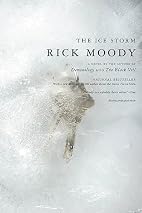
31. The Ice Storm by Rick Moody
During the long Thanksgiving weekend in 1973, the commuter village of New Canaan, Connecticut, is the focal point for a transformative series of events that bring sexual satisfaction and frustration, emotional distress and elation, marital collapse, a heck of a big ice storm, and death. Apparently told from the various points of view of the four members of the Hood family (though in fact the real narrative voice is singular and backward looking from a distance of twenty years), the novel concentrates on what must have been foremost in all of their lives in 1973: sex. Benjamin Hood is involved in a desultory way in an extra-marital affair; his wife, Elaine, longs for something more in her marriage and in her life; their daughter, Wendy, is learning about sex with two brothers in the house next door; and Paul, who is away at prep school, is making his own plans for sexual conquest. The family is about to come apart, and from the looks of the television news with Watergate and Vietnam, it looks as though the country will too.
Rick Moody catches the Hood family at the cusp. Nothing will be the same after this weekend. But will anything really change? It may be a moot point. Certainly the writing here is enough to fascinate. The period detail will enthral those readers old enough to be able to experience real nostalgia of this time period in America. And the speculations of the wider significance of ‘family’ in life and in comics will propel some readers into further thoughts on the meaning or meaninglessness of marital vows, sexual dalliance, and alcohol abuse.
This is not a novel with all the answers. And it even doubts some of its own questions. But it is a novel with a lot to offer and needs to be read if only to remind us when Rick Moody found his form. Recommended.
*******
I come to this novel long after having seen the wonderful Ang Lee film based upon it. Until recently I hadn’t read anything by Rick Moody. Then I was given his remarkable Hotels of North America for Christmas. So now I’m going back to read his earlier works.
Rick Moody observes, in an essay accompanying this edition of his novel, that coming to write the climatic third section of the book forced him to take stock of what kind of a writer he really wanted to be. And that has, apparently, set the path for all his writing since this book. Perhaps. As a rule, I don’t think writers should not be asked to comment on their writing. They tend to be weak critics (of their own work) inevitably suffering in their critiques from the intentionalist fallacy, since they naturally assume they can discern the author’s real intentions behind what he has written. Similarly they should not be asked to render judgement on film adaptions of their work. No doubt Moody had an interesting experience in witnessing his novel’s transformation into cinematic form. But everything he writes here simply confirms that he does not have sufficient filmic understanding to appreciate or give insight into Ang Lee’s process and its outcome. Enjoy the film for what it is. Enjoy this novel for what it is. And leave it at that.
58RandyMetcalfe
>57 PaulCranswick: Thanks Paul. I also counted The Complete Patrick Melrose Novels as one as well. On the other hand, War and Peace was significantly longer than both those books combined yet it couldn't reasonably count as more than one. So I'm guess I'm counting volumes rather than titles.
However, if I fall short of my goal at the end of the year I may have a sudden rethink of this practice ;-)
Have a great weekend yourself. Here in Canada it is our Victoria Day long weekend which is traditionally when it is safe to start putting in plants outside. Or maybe that tradition is only for southern Ontario. It's a rather larger country so local traditions of planting tomatoes vary :-)
However, if I fall short of my goal at the end of the year I may have a sudden rethink of this practice ;-)
Have a great weekend yourself. Here in Canada it is our Victoria Day long weekend which is traditionally when it is safe to start putting in plants outside. Or maybe that tradition is only for southern Ontario. It's a rather larger country so local traditions of planting tomatoes vary :-)
59RandyMetcalfe
I seem to have disappeared from this thread for a while. Some of that was a short but pleasant vacation in Montreal. In part as prep for that visit and in part to get back to a goal I set myself periodically (without any real expectation of succeeding), I've been reading through some children's books in French, some of which I've muddled through before. I'm not counting these for my 75 book challenge, but I thought I'd list them here to remind myself, in future, what I've been up to.
Le Prisonnier du Temps by Adam Roy - a time-travelling teenage astronaut slips into hyperspace and encounters the ultimate challenge. Good fun!
Autour de la Lune by Jules Verne - this is a much-simplified version of the Verne original, but still full of adventure and life. A charming vision of what a journey to the moon might have been like from a 19th century perspective.
Le Tour du monde en 80 jours by Jules Verne - again, an abridged and simplified version. Very charming and quaint.
Kamo L'Agence Babel by Daniel Pennac - this is a great book for children. It is all about a young boy tasked with learning English in three months. It sounds like an impossible challenge, but his clever mother has found the perfect motivation for him -- love. It's a treat.
Kamo et Moi by Daniel Pennac - another in the Kamo series and once again told from the point of view of his unnamed best friend. This one reminds us of the exacting French pedagogical technique of the dictée. Pennac is really a great writer, whether for children or adults.
Le Petit Prince by Antoine de Saint-Exupéry - the classic story which is always so full of heart that it practically reads itself.
Ma Petite Soeur d'Occasion by Éric Sanvoisin - young Hugo Blanc has just learned that his parents intend to adopt a young girl from Africa. He is astonished. And he's got a lot of growing up to do in the next few weeks before she arrives. An absolutely charming book. I came upon it in the Drawn & Quarterly bookstore in Montreal and added it to my haul. Well worth it.
Kamo L'Idée du Siècle by Daniel Pennac - Kamo has a great idea to help prepare himself and his classmates for what many adults keep warning them will be the severe challenges of the next grade at school. But his great idea comes with challenges of its own. As ever, another delightful Kamo book from Daniel Pennac.
L'Évasion de Kamo by Daniel Pennac - while Kamo's mother is off in Russia exploring one of the roots of his family, he finds himself in hospital after a severe accident on a bicycle while staying with his friend's family. No one knows whether Kamo will survive. And his friends fear that he has somehow taken on the life of his great grandfather who, they believe, dies tragically in Siberia. His friends will do anything to help him escape his fate. The last in the Kamo series of books.
Le Prisonnier du Temps by Adam Roy - a time-travelling teenage astronaut slips into hyperspace and encounters the ultimate challenge. Good fun!
Autour de la Lune by Jules Verne - this is a much-simplified version of the Verne original, but still full of adventure and life. A charming vision of what a journey to the moon might have been like from a 19th century perspective.
Le Tour du monde en 80 jours by Jules Verne - again, an abridged and simplified version. Very charming and quaint.
Kamo L'Agence Babel by Daniel Pennac - this is a great book for children. It is all about a young boy tasked with learning English in three months. It sounds like an impossible challenge, but his clever mother has found the perfect motivation for him -- love. It's a treat.
Kamo et Moi by Daniel Pennac - another in the Kamo series and once again told from the point of view of his unnamed best friend. This one reminds us of the exacting French pedagogical technique of the dictée. Pennac is really a great writer, whether for children or adults.
Le Petit Prince by Antoine de Saint-Exupéry - the classic story which is always so full of heart that it practically reads itself.
Ma Petite Soeur d'Occasion by Éric Sanvoisin - young Hugo Blanc has just learned that his parents intend to adopt a young girl from Africa. He is astonished. And he's got a lot of growing up to do in the next few weeks before she arrives. An absolutely charming book. I came upon it in the Drawn & Quarterly bookstore in Montreal and added it to my haul. Well worth it.
Kamo L'Idée du Siècle by Daniel Pennac - Kamo has a great idea to help prepare himself and his classmates for what many adults keep warning them will be the severe challenges of the next grade at school. But his great idea comes with challenges of its own. As ever, another delightful Kamo book from Daniel Pennac.
L'Évasion de Kamo by Daniel Pennac - while Kamo's mother is off in Russia exploring one of the roots of his family, he finds himself in hospital after a severe accident on a bicycle while staying with his friend's family. No one knows whether Kamo will survive. And his friends fear that he has somehow taken on the life of his great grandfather who, they believe, dies tragically in Siberia. His friends will do anything to help him escape his fate. The last in the Kamo series of books.
60RandyMetcalfe
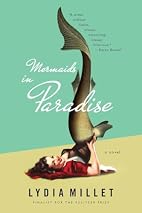
32. Mermaids in Paradise by Lydia Millet
Deb and Chip get married, head to a Caribbean resort for their honeymoon, go snorkelling, and find themselves in a ecological murder mystery that places their commitment to each other and the planet on the line. Or something like that. At any rate, Deb narrates and it is her voice that is the real charmer here: her wry comments on cruise ships and the kinds of people who populate them; her instinctual fear of and yet attraction to the “heartland” peoples; her friend Gina’s insistently ironic stance (which is really Deb’s own stance); her periodic personality breakdowns; and the kindness that she and others display even in this time of duress. This is a novel with a sting in the tail, but there’s more than enough in what is mentioned above to warrant giving it a go without spoiling anything.
There is a lightness of touch here that masks a deeper seriousness. And sadness. The latter can come as a shock but if you look back you’ll see that a lot of it was there from the beginning. Nevertheless, I could have stood a bit more at the end.
Gently recommended.
61RandyMetcalfe
33. Fat City by Leonard Gardner
Rock meets bottom in this visceral tale of boxers, young and old, making it or failing to at the edge of possibility. Billy Tully is washed up at 29. Divorced and reduced to day crop work in the California heat, he dreams of one last chance but knows in his heart that one chance was always more than he ever had. Ernie Munger is 18, still a kid without a professional bout, but Billy thinks he has potential and introduces him to his old manager. They travel different paths, both looking for some kind of meaning in the ring, or out of it, both filled with hope but drowning in despair. And both finding, in the end, what they think of as their due.
It is easy to see why, in an introduction by Denis Johnson, this work is held out as a model of gritty realism. Johnson claims that everything he’s ever written has been an attempt to match the effortless realism that Gardner attains here. High praise indeed. I might not see the truth that Johnson does at the sharp end of a 16-oz glove. But I recognize that Gardner stands in line with Steinbeck as a master of descriptions of work, both in the fields of California and in the ring. These men are workers in a heavy trade no worse than others and no better. And so inevitably the gritty realism melds seamlessly into elegy and romance.
Well worth reading.
62RandyMetcalfe
34. Worldly Goods by Alice Petersen
Each of the stories in this collection is quietly centred, modest in display, but incisive, detached, and kind. Petersen is neither full of the bravado of a young writer, nor hesitant and uncertain. She writes with a measured pace, perhaps with an eye more to the British form of the short story rather than the American. She has feet in many worlds with ties in Canada, New Zealand, and England, and this comes out in the settings and characters within her stories.
I especially like the musical theme of “Morendo”, as well as the related themes of effort and excellence (in music) found in the opening and closing stories, “Music Minus One” and “The Parisian Eye”, which were originally published together. I enjoyed the near-epistolary nature of “Dear Ian Fairfield” and the unease the narrator takes on in “A Nice, Clean Copy.” There is much here to admire. I shall eagerly await new works from Alice Petersen and gently recommend this collection for those looking for an otherwise unassuming new voice in the short story form.
63RandyMetcalfe

35. The Virgin Suicides by Jeffrey Eugenides
A compelling first person plural narrative voice (“we”) relates the events and atmosphere of a dreadful year in which five young girls, sisters, take their own lives. The narration is from many years later, looking backward, in the form of a quasi-official report with “exhibits” mentioned such as photographs and items collected from the girls’ home. The collective voice identifies a number of young boys who lived on or near the street on which the Lisbon girls lived. These boys are the principle source of information on the girls, though their hormonal voyeurism suggests that their information may not be entirely trustworthy. In addition to the boys, now men, there is additional input from “interviews” with others either directly connected to the girls, e.g. their parents, or tangentially connected, such as their teachers, doctors, or therapists. Together with the gathering gloom of a neighbourhood and nation of declining economic significance and moral rectitude, the year of the so-called virgin suicides marks these boys for life. So much so that it is hard to know what precisely they may have made of their lives.
Eugenides’ narration is entrancing and troubling from the outset. With the youngest Lisbon sister’s initial suicide, and the eddying speculation on its cause and meaning, Eugenides sets us wondering about our own relations to neighbours, community, and history. The pluralized narrator of the story is never satisfied with any explanation of the girls’ actions, whether simple or complex. But his/their insistence on digging deeper and deeper begins to feel unhealthy, almost predatory. And that unease begins to pervade the whole account, leaving the reader fascinated but disquieted. A very curious effect to produce, or to wish to produce.
Definitely a novel that deserves to be read and thought about. And sufficient warrant to read further in Eugenides’ oeuvre. Recommended.
64RandyMetcalfe
36. The Buried Giant by Kazuo Ishiguro
Two elderly Britons, the chivalrous Axl and his wife Beatrice, undertake a journey to a neighbouring village to see their son. Why doesn’t he live in their village? Why did he leave? They can’t remember. It’s as though the mist which enshrouds their land also obscures their memories. Yet they hold to their conviction that their son eagerly awaits them, wherever he might be. Their journey, which might better be described as a quest, sees them meet unexpected friends and foes and forces them to partake of adventures they had not planned but which become essential. And everything, in the end, has something to do with the mist and whether it is a force of good or ill.
Ishiguro has a special fondness for the theme of forgetfulness, especially as it relates to personal and political identity. His early novels examined this issue from the perspective of an individual corruption of memory/history. Here he broadens his canvas to a collective forgetting, a necessary forgetting (possibly). The land is steeped in blood, in the horrors of war, and in the atrocities that are committed even by those whose aim is just. How can there be peace in such a land if the victims remember the harms that have been done to them? Without forgetfulness is there any hope at all for peace? Or is the peace that passeth understanding all that we can hope for?
These are serious matters. So it is perhaps wise for Ishiguro to dig into the founding myths of British identity in order to explore them. On the surface is a tale of a journey. But below, swirling in the mist, is so much more. I don’t know whether Ishiguro is ultimately successful here. But it is good to see him once again tackling the hard questions. Recommended.
65RandyMetcalfe
37. Proust and the Squid: The Story and Science of the Reading Brain by Maryanne Wolf
Our brains are not designed for reading. So it may seem remarkable that over thousands of years we gradually developed symbols and the rules for manipulating them that constitute a written language. Despite the fact that reading is not a natural ability, we obviously must gain a huge advantage through being able to communicate through written text. And it turns out that our brains adapt to this situation, deploying multiple abilities that work in concert and improve their efficiency dramatically over time in order to fully exploit our environment of written language. It is a story, both evolutionary and socio-cultural, that borders on the unbelievable. Yet it doesn’t come to the fore until we encounter and have to deal with individuals whose brains have not developed along the lines that lead to reading efficiency. For the dyslexic, reading can be a gargantuan challenge.
Maryanne Wolf presents this story of reading from the perspective of a neuroscientist, but rooted both professionally and personally in working directly with people burdened with dyslexia. Of course that burden itself is culturally enforced. Since no brain is designed, as it were, for reading, it can hardly have been an evolutionary disadvantage (at least throughout most of history) to not develop this remarkable skill. And indeed the evidence suggests that many of those suffering from the stigma of dyslexia have brains that are better designed, in terms of their wiring, for artistic or conceptual work. And so the effort to understand precisely what is going on in the reading brain is both an effort to ease the path for those who do not quickly attain fluency and to acknowledge that there are a wealth of equally valuable other paths that a “successful” brain might take.
This was a fascinating account told with humility and grace. It contains enough of the neuroscience to fully inform even the most ardent scientific reader, but enough of the humane aspects of what reading is and means to keep the reader focussed on what really matters. Recommended.
66RandyMetcalfe
38. All That Man Is by David Szalay
From the nine stories in this collection, all that man is might seem to be a bit sad, a bit disappointed, and yet precious all the same. Of course David Szalay isn’t trying to capture all that man is. Rather, I suspect each story here captures its principal male lead at a moment in time that sums up his character. In that case, probably only Simon, from the first story, and Tony, Simon’s grandfather, from the final story (these are the only two stories that have a direct connection), are entirely positive portrayals. Each of the other men at the other stages of life between 18 and 73 are variously stunted, shallow, self-absorbed, despairing, or vile. So, not a pretty picture. Nevertheless, each of them is a compelling portrait running across types, European nations, and political persuasions. I was riveted.
The writing here is precise and nuanced. Szalay brings each story to life with just enough detail to allow us to situate his protagonist. And enough interiority for us to appreciate his plight. Sometimes these are men you don’t really want to spend too much time with, which lends support to the choice of form that Szalay has made. But with others, I would gladly have followed them over the course of a novel. So the brevity cuts both ways.
The overall impression is simply of a writer in complete command of his palette. If this is the first book by Szalay that you have read, as it was for me, you’ll immediately want to search out anything else he might have written and hope, given his relative youth, that there is a great deal more to come. Highly recommended.
67RandyMetcalfe
39. Flimsy Little Plastic Miracles by Ron Currie, Jr.
The author Ron Currie, Jr. is fictional. He may wish that he were mythical but for purposes of this novel he is fictional. And as such, he promises at the outset that everything he will tell us is capital-T True. What follows is a tale of suicidal infatuation, lust, hard drinking, fisticuffs, sex, misapprehension, deception, and self-absorption. All of which is counterpointed by a superficial exploration of the meaning and plausibility of the notion of the AI Singularity. The insights, such as they are, amount to little more than the platitude that the “lies” of fiction are all “true”. It’s a lengthy journey to get to such a banal observation, which is not, surprisingly, shortened by the fact that many or most of the pages in the novel have only a brief paragraph of text.
Ron Currie, the character (I can’t speculate about the author), is clearly enamoured of the hard men of 20th century literature. He seems to model himself on their behaviour of prodigious drinking, brawling, and the kind of sex that he proudly tells us brings his partner to epiphanies. It’s probably just as well that he is fictional. He’d be insufferable if he were real. Of course such narcissistic men are burdened by a self-love that they try desperately to disguise as self-loathing. But the egoism wins out. So even Ron Currie’s suicide (the fictional suicide, I mean) eventuates in an astounding surge in his popularity as a novelist, so much so that he is forced to return to “life” in order to face his adoring audience. A Huck Finn for the ages, surely.
Additionally, in what passes these days as seriously dealing with end of life issues, Currie (the character) recounts episodically the sad decline and death of his father due to cancer. Here it just seems like one more unconnected thread in the life of the character.
Not even a nicotine patch, the eponymous flimsy little plastic miracles, can breathe life into this “comic” novel. And thus, not recommended.
68RandyMetcalfe
40. nothing to be frightened of by Julian Barnes
Memoir, of necessity, treads old ground, well-worn paths. For those ruminants transfixed by a particular idea or motif, these routes can get very rutted indeed. Julian Barnes claims to be an inveterate death idler, concerned with his own death, with the deaths of his family members, the deaths of 19th century French writers, and death in general. His brother, the Aristotelian philosopher Jonathan Barnes, would say he is soppy. It is a rebuke that Julian takes to heart, both because he suspects it of himself already but also because he imagines it might mark the division between himself and his histrionically rational brother. And so his thoughts meander here and there without clear direction bounded only by death as an overarching theme, God as a (probably) non-existent delimiter of existence, and a storage box of quotations, literary historical anecdotes, and epitaphs.
The best of the book is probably the opening 70 pages. Here Barnes is reflecting on his family history, often with cutting interjections from his older (and wiser?) brother. The tone is light and self-deprecating, and the effect is utterly charming. Then the book moves into God-bothering. Does he exist or doesn’t he? And if he does, what’s he like? But probably he doesn’t, right? It’s an unfortunate turn because it has no viable means of taking us forward. Barnes instead is forced to dip into his box of quotes and anecdotes as the work takes on a workmanly tone - one damn word after another. But don’t give up on it. Eventually Barnes winds his way back to his family and his earlier thoughts. He walks the same paths again and again, even to the point of reusing numerous personal anecdotes and literary quotations. But then those reuses themselves begin to take on a special character as Barnes’ native talent for narrative, as opposed to research and philosophical argument, takes hold. And so the end of the book causes you to reconsider the opening, not least because Barnes learns that a number of his family stories were just wrong. Memory played false is corrected by narrative.
Julian Barnes is a fine writer, so nearly any topic he turned his hand to would have made compelling reading. Here, your reaction may depend upon whether you share his affinity for dread in the face of his own death. (He admits to a creeping suspicion that this might be an unacknowledged ‘writerly’ preoccupation.) I don’t. But I suspect for those who do, this book will be even more pleasurable than it was for me. Gently recommended.
69ursula
>63 RandyMetcalfe: Terrific review of a book I loved! I think you really captured the feeling with "fascinated but disquieted."
70RandyMetcalfe
>69 ursula: Thanks, Ursula. Very kind.
71RandyMetcalfe
I haven't been reading too much lately. Summer distractions. The most recent, and last, of these will be a two-week visit to London (U.K.). Heading there later today and really looking forward to touching base with old friends. I may also do some reading :-)
73RandyMetcalfe

41. Best British Short Stories 2016 edited by Nicholas Royle
The twenty-one stories collected here display a wide range of styles and techniques. Some are very short, little more than atmospheric reflections. A number have non-standard narratives arcs (a few have no arc at all). At times a reader might begin to think that the British have a different concept of “short story” than is prevalent in North America. But at least a few would sit comfortably alongside the stories of Alice Munro or George Saunders. So your final assessment might be simply that the British short story is a healthy animal, a bit unpredictable but full of purpose and drive.
Of special note, for me, would be Janice Galloway’s, “Distance,” Claire-Louise Bennett’s, “Control Knobs,” and Graham Mort’s, “InTheory, Theories Exist.” But all of the stories are certainly worth reading and future yearly collections will be much anticipated. Gently recommended.
74RandyMetcalfe
42. The Road to Little Dribbling: More Notes From a Small Island by Bill Bryson
Twenty years on, lovable curmudgeon Bill Bryson revisits some of the locales from his breakthrough travel memoir Notes from a Small Island as he loosely follows a straight line from Bognor Regis to Cape Wrath, which he has dubbed the “Bryson Line”. As ever, Bryson gives the reader as much history, both social and economic, as he does information about the current state of Britain’s tourist destinations. But best of all are his wanderings, small diversions, quiet rants, and mumbling grumbles about the state of the world (by which he means Britain) today. He’s an Anglophile that desperately wants the country he loves to be worthy of the affection he has laboured upon it over these many years. And it’s hard for a reader not to concur (because would you really be reading this book if you weren’t an Anglophile as well?). He’s reached an age where he can look back and tell readers, from personal experience, how things used to be. And many of those things are much changed, most for the worse, but some also for the better.
Bryson’s style is ambling, possibly rambling, but there is purpose in his digressions. Frequently he becomes irate about the present state of things, or the “idiot” he is dealing with, only to reveal moments later that he had completely misunderstood the situation or not been where he thought he was because he was reading the wrong side of the map. He’s like an elderly grumbling uncle who periodically is led away to a quiet corner of the room by his gently caring wife.
If you’ve read and enjoyed Notes from a Small Island, you will certainly find this book a pleasant read. And if you haven’t read the earlier book, I think you will still find this an enjoyable ramble with a good sort of walking companion.
75RandyMetcalfe
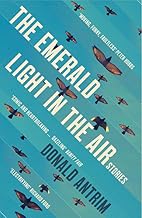
43. The Emerald Light in the Air: Stories by Donald Antrim
Almost without exception, there is something askew in the stories of Donald Antrim. Typically the perception of the central figure or figures will be a bit off. That might be due to a mania that has seized them or a dependency of some kind that is not being addressed, or they may have a history of mental illness and be on the cusp of another episode.
In the earliest story here, “An Actor Prepares,” what emerges is something zany, beyond whatever norms you might expect to hold, but ruthlessly pursued and realized. In each of the other stories, something sadder finds expression. Characters are in the grip of forces they acknowledge are beyond their control. They are helpless in their plight, and worse, do not seem able to be helped even by those around them who love them. Suicide is a real possibility at any point, but more typically resignation and dissolution are all that can be managed. In each of these sadder stories, with the possible exception of the title story, “The Emerald Light in the Air,” grim reality awaits whether institutional or otherwise.
The title story, which is the most recent of those in the collection, reveals a new twist, an almost redemptive possibility that stems not from direct action but from acceptance of the path one is forced upon. Toward the end of this story, the main character, Billy French, shoots a padlock off a chained gate and achieves a kind of modest freedom, even if it only means allowing Billy to get his car back to a road from which he will be able to find his way home. In short, Billy effects his own possibility for hope. But it is like a breath of fresh air.
Each of the stories here is well worth reading. And the collection as a whole is to be recommended.
76RandyMetcalfe

44. Strange Weather in Tokyo by Hiromi Kawakami
Tsukiko Omachi likes to frequent a saké bar after work. She likes to sit and drink and eat the food prepared there and pass the time. She is a solitary drinker. But her solitude is disturbed one evening when she notices the elderly man sitting a few seats further down the bar. She recognizes him as Mr Harutsuna Matsumoto, but her whole life she has always thought of him and called him “Sensei”. He was her Japanese literature teacher in school. Now he is long retired, another solitary drinker who likes to quietly partake of saké and bar food. Over the course of the next two years, Tsukiko and Sensei will move closer, both literally in starting to sit beside one another but also in the development of tender feelings. This is a winter/summer romance that is as fresh and fragile as any new love. That it can only last a limited time is a mere detail since all lovers are finite though love is not.
Sensei is extremely formal, rigid, and concerned with propriety. Yet he quickly develops affection for his former pupil (despite chastising her for being such a poor student). Tsukiko is perhaps more difficult to fathom. She is in her late thirties at the outset, single but self-sufficient. She works in an office is all we know but we never learn what kind of work she does. She does not appear to have had too many romantic entanglements over the years. But even she acknowledges that she suffers from a kind of arrested development. Indeed, she increasingly sounds more like a schoolgirl than a mature woman. Is this a curious aspect of her particular character, or is it a kind of infantilization which serves to underwrite (and justify?) the protective tone that Sensei takes on? It is difficult to tell. Certainly Tsukiko seems excessively young — far younger than her actual age. And that exaggerates the difference between her and Sensei. (Indeed, the fact that she insists on thinking of and referring to him as “Sensei” enforces the disparity between their relative positions in the relationship.) Yet the overall story continually strives for a poignancy that could not be achieved if any crass exploitation of their differences were at hand. In the end, this is a quietly observed love story (accompanied by a prodigious amount of alcohol). It is, as others have described it, enchanting. Gently recommended.
77RandyMetcalfe
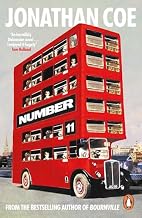
45. Number 11 by Jonathan Coe
Through five distinct periods, Jonathan Coe follows the lives of Alison and Rachel, two friends from Leeds who we first encounter in 2003, shortly after the death of David Kelly on Harrowdown Hill. They are spending a week visiting Rachel’s grandparents in Beverly. But their lives are changed immeasurably by events within the house at Number 11 Needless Alley. And so it goes. A few years later we encounter Alison again and this time another number 11 seems to play a significant part in her ongoing story. In each period the number 11 applies to something different. At times, either Alison or Rachel are the main characters. But at others they are just bit players. However, Coe has an intricate web that he is weaving that will bring nearly every character, large or small, into the fold. And in the course of his weaving he’ll canvass some of the highs and lows of middle class and upper-middle class Britain in the new millennium.
Coe is often touted as one of the supreme satirists in British literature. But, except in a few brief set-pieces, this is not satire. Certainly he has an agenda and without doubt some stereotypical members of the upper-middle class come in for some ridicule and judgement. But this is weak satire. It is rather more like polemic. Which is fine as it goes, but can’t be expected to carry the richness or subtlety that satire typically manifests. That said, I did enjoy much of the book. I just didn’t feel as though I got much of a nuanced view of Britain. The characters did not come to life or seem fully real. And so I’m left with a bit of a meh response. Maybe it would work better for another reader, but as for me, not recommended.
78RandyMetcalfe
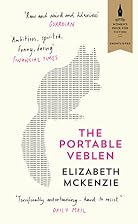
46. The Portable Veblen by Elizabeth McKenzie
Veblen Amundsen-Hovda is engaged in temporary secretarial work. She has a fascination for her namesake, Thorstein Veblen, the 19th century economist and academic outlier. She contributes to translation work for the Norwegian Diaspora project. She sometimes talks to squirrels. She is in love with Dr Paul Vreeland, a medical researcher who has invented a portable device for emergency craniotomies. Paul is ambitious but susceptible to temptation. When a representative from a powerful medical supply corporation lures him with riches and potential fame, everything that Paul holds dear is put at risk. Mostly Veblen.
This is a wild and raucous story of debilitating families, misplaced ambition, guilt, greed, and capitalist critique. Not to put too fine a point on it, it is rather difficult to pin down. Perhaps “fun” would be the best word to describe it. Despite the zaniness of many of the characters, you’ll find that you come to care for them all, even Veblen’s mother. A very fun read. Recommended.
79RandyMetcalfe
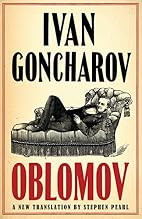
47. Oblomov by Ivan Goncharov
Ilya Ilyich Oblomov is not merely indolent. He is virtually inert. He can almost not even wake up, let alone wash or put his clothes on. And as for leaving his apartment, that is out of the question. Everything is too much for him. Thinking is too much. Reading is too much. He can barely muster enough energy to eat and drink and breathe. And he is as defenceless as he is inactive. So it may not be surprising that his “friends” are taking advantage of him and kind heart. All that is except for Andrei Stoltz. Oblomov grew up with Stoltz and the latter has an undying appreciation for Oblomov’s pureness of soul and kind heart. He refers to Oblomov’s intelligence as well, though we rarely see evidence of this. It is Stoltz who initiates much of the action in the novel — the offer (declined) to go abroad, the introduction to Olga, the rescue from the fiends bilking Oblomov of the wealth from his estate, and the care for Oblomov’s inheritance. If Stoltz is the figure of action and industry, then Oblomov is his mirror opposite in inaction and passivity. And yet their love and respect for each other binds them together, perhaps against reason and inclination.
There can be little doubt that Goncharov has created a number of vivid and lasting characters, even beyond the titular figure who lends his name to a recognized condition. But it may be his account of love, indeed of different forms of love, that makes this novel more remarkable. The burgeoning of love between Olga and Oblomov is beyond touching. Its consequences are painful. But equally valuable is the more stable love that each arrives at for another. And of course the love of friendship that Stoltz feels towards Oblomov is richly explored.
It might not stand up against some of the well-acknowledged classics of 19th century Russian literature, but Oblomov is still well worth reading. Just don’t get too comfortable on that divan! Gently recommended.
80RandyMetcalfe
48. The Hidden Keys by André Alexis
Tancred Palmieri is a thief with honour. Willow Azarian is a heroin addict with a vast fortune and a mystery she can’t let go of: five siblings, five artworks heavily invested with personal meaning and a potentially collective direction to a hidden treasure. When Willow convinces Tancred to gather (i.e. steal) the four other artworks from her siblings, she sets him on a path of danger and intrigue, crossed loyalty, and filial devotion.
Things are never exactly what they seem. And it’s possible this novel is not exactly what it seems. Alexis’ acknowledged playfulness with form and substance will have you reading with slight suspicion. And when one of the central characters of his previous novel, Fifteen Dogs, makes a cameo appearance, alarm bells might start to go off. But the novel does not change course. Tancred continues to pursue his goal with the legerdemain typical of the pickpocket he once was. The wonder here is that even almost absurd scenes (stealing a man’s prosthetic leg in order to enter a reputedly impregnable condo fortress) seem just by the way.
Tancred and Willow and Tancred’s childhood friend, Detective Daniel Mandelshtam, are sympathetic figures in their way, but the reader doesn’t get close enough to them to fully engage. And so we stand at an emotional distance to the action. And inevitably that limits our likely enthusiasm for the novel. Unless we learn later, in Alexis’ fifth novel in this Quincunx, that we’ve overlooked some essential hidden key. That’s a real possibility.
Gently recommended.
81RandyMetcalfe

49. Revision and Self-Editing by James Scott Bell
My suspicion is that there may be as many different ways to write a novel as there are novels. Certainly there are a lot of books on the market to aid and abet this questionable enterprise. There are probably also some books on how to write books providing advice to aspiring authors. Such a book would no doubt draw heavily on James Scott Bell’s highly regarded effort. It has many of the virtues of a book directed at motivated self-starters (i.e. those who’ve already completed a first draft of their future masterpiece). It doesn’t talk down. Bell assumes he is writing for writers like him who want practical advice on how to improve their fiction. It doesn’t seek to inspire or nurture the nascent writer. This is a book for people who’ve already been inspired and are now prepared to get thoroughly mucky turning their initial effort into something worth harvesting. It offers straightforward exercises that any author could perform in order to test their characters, plots, scenes, or dialogue. And the final, lengthy, section of the book is touted as “The Ultimate Revision Checklist”, though Bell suggests varying it to suit your needs. All of which makes this a very practical and useful resource. But if I’m right about there being a nearly infinite number of ways to write a novel, then there is still a chance that it might not be the book for you. In which case, you should probably set about writing your own book on how to write a novel. Or, just skip that step and get busy writing that novel itself.
For me, it wasn’t until chapter nine, “Voice and Style”, that I felt Bell had something important to convey. Unfortunately he immediately acknowledges that these are the two things it’s virtually impossible to teach. His advice — go read a lot of good stuff (novels, poetry, short stories) and write a lot of stuff too (novels, poetry, short stories). Eventually you’ll find your voice and when you do, well, you’ll really have something. It’s surprisingly sensible advice. Sensible in that I sometimes wonder if the people reading books advising authors have done enough reading themselves. Indeed, sometimes such books are written as though the reader may possibly never have encountered a novel before. If that is the case, then do start with chapter nine of this book and follow Bell’s advice. I think you can then skip on to chapter twelve, “Theme”. It’s the aboutness bit of a novel. If your novel isn’t about anything, then it would definitely be a good idea to think about how to work a theme into it. If you’ve got an idea of what your novel is about and you’ve got enough experience reading and writing to have found your unique voice and style, then all of the rest of the chapters of this book will help you in the practical project of turning your first draft into something polished. I look forward to reading the result.
82RandyMetcalfe
50. Get in Trouble by Kelly Link
The nine stories in this collection might best be described as inventive. Their invention takes different forms. For some, such as “Light” or “The Lesson” it is the situation of the story that catches the eye. For others, the situation might be standard fare — lovers spat, teen angst, indenture — but the setting is peculiar or extreme. In “Origin Story”, for example, the complicated tryst between Bunnatine and her lover is unexceptional, except that he’s a super hero crime fighter who regularly saves the planet and she’s, well, a bit flighty. At other times, both situation and setting are beyond the ordinary, as in “Valley of the Girls” or “Two Houses”.
I can’t say that I warmed to any of these stories. But I recognize the skill that must be involved in writing them. At times they verge over into George Saunders territory, as in “The New Boyfriend” or perhaps “Secret Identity”. But for the most part they mark out their own new ground. Whether that’s somewhere you will want to spend a lot of time is, of course, up to you as a reader.
83RandyMetcalfe

51. The Journey Prize Stories 28 compiled by Kate Cayley, Brian Francis, and Madeleine Thien
This year’s solid collection of stories chosen from Canada’s literary journals and magazines includes two each from Souvankham Thammavongsa and J.R. McConvey. That’s remarkable because the three esteemed judges read these stories “blind”, not knowing who wrote them or from which journal they came. But it is not surprising once you read the stories in question, since all four are excellent. Indeed, looking over the eleven stories in this collection, I’m hard pressed to pick a favourite. I enjoyed the muscular grief of Alex Leslie’s “The Person You Want to See”, and awkward perceptions of Mahak Jain’s “The Origin of Jaanvi.” I thought Carleigh Baker’s “Chins and Elbow” to be vivid while Paige Cooper’s “The Roar” might be described as uncanny, and though it seems unusual to find a ghost story that reaches this select crowd, Charlie Fiset’s “If I Ever See the Sun” definitely earns its place here. You’ll find your own favourite. Enjoy!
84RandyMetcalfe
52. Broken Monsters by Lauren Beukes
It’s often recommended to writers that, when in doubt, write the book you would most want to read. By the evidence of this book, Lauren Beukes would like to read a book with two put-upon female heroines, one mother and one daughter, who face down countless instances of sexism, misogyny, assault, and vilification. Just another walk in the park of realism then? Nope. Individual and systemic misogyny just doesn’t warrant that kind of scrutiny anymore. It’s not that men are pigs and society is mostly about raising pigs. There’s got to be something else that explains things. Really? I guess that might explain why this novel takes the turns it does. It doesn’t work for me, but then I’m probably just not the target reader for such a book.
************
Sigh. This was another bookclub selection. I really struggled to read it at all. I can’t say I look forward to discussing it for an hour next week.
85RandyMetcalfe

53. The Best American Short Stories 2016 edited by Junot Diaz
This yearly collection of short stories never fails to impress. Junot Diaz’ selection is both varied and revelatory, but the quality is there throughout. I especially like Andrea Barrett’s “Wonders of the Shore,” and Louise Erdich’s “The Flower”, and Ben Marcus’ chilling “Cold Little Bird”, and Karen Russell’s “The Prospectors”. I could go on. There were many writers here that were new to me, though it is clear from the notes at the end that none of them are new on the scene or previously unheralded. And there were a few whose paths I’ve crossed before. Enjoy it in itself, or treat it as a sampler for authors whose other work you might want to read. Well worth a read.
86RandyMetcalfe
54. A Kite in the Wind: Fiction Writers on Their Craft edited by Andrea Barrett and Peter Turchi
The authors of these twenty essays have each taught, at some point, in the Warren Wilson College MFA Program for Writers. If the program as a whole is anything like the quality of these essays, then that is clearly an MFA program worth considering. Each of the essayists is also an author of novels and usually more than one collection of short stories. So this is not merely theoretical thoughts on writing we are dealing with. This is mostly hard won experience. But importantly, none of the authors is concerned with the mere basics of production. This isn’t a ‘how-to’ book for beginning writers. It is for writers who are thinking seriously about their work and some of the challenging issues that can arise in crafting a fine novel or short story.
Rather than recount the many articles that I found very useful here, I’d prefer to concentrate on one aspect that they all seem to share. When turning to examples, each of the authors draws upon great works of fiction. Typically an essay will look at three examples, perhaps from Virginia Woolf or Cormac McCarthy or Herman Melville or E.M. Forster. I so appreciate that. These, and others, are the authors I’d want to emulate in my writing. And they are the authors whom these essayists as fiction writers seek to emulate, in a way. It lends a degree of seriousness to the essays, but no more so than I think is appropriate for the endeavour of novel writing. Well worth reading. Recommended.
87RandyMetcalfe
55. The Gap of Time: The Winter's Tale Retold by Jeanette Winterson
Jeanette Winterson stretches her remarkable imaginative and literary talents in reshaping and making borderline plausible the extremities of the plot of Shakespeare’s The Winter’s Tale. Leontes becomes Leo. Polixenes becomes Xeno. Hermione becomes Mimi. And so on. In the retelling, sexual tensions are multiplied though there remains no accounting for Leo’s mad jealousy. And since that madness drives the plot, it can’t fully escape its essentially irrational base. And yet. And yet I liked it. Winterson’s writing is appropriately playful, sometimes full of light, and it revels in the possibilities of love. Less well adapted perhaps to darker themes. These come across murkily and sometimes opaque. But overall cleverness wins out, or at least leads to a winsome tale, if not a cautionary tale.
Winterson offers, before the end, a helpful analysis of both the play and the notion of forgiveness in Shakespeare’s late plays. I found this to be insightful and almost enough to change my opinion of the relative merits of the play. But in the end, for me, it comes back to Leontes/Leo’s inexplicable mad jealousy. And I just can’t get past that. Nevertheless, I recommend this retelling as a worthy exercise and more. And it may prompt me to try some of the other retellings in The Hogarth Shakespeare series.
88RandyMetcalfe
56. Outline by Rachel Cusk
The main character of Rachel Cusk’s novel, Outline, identifies the Agora as her favourite site in Athens. This ancient market place of goods and ideas quietly symbolizes the narrator’s role as a conduit for those around her to speak. From her neighbour on her flight to Athens where she will be teaching a writing workshop, to her students, to her writing colleagues, Cusk’s narrator seems preternaturally open to letting her interlocutors take the lead. She is not shy about providing frank criticisms (though not of her students), but for the most part she just lets people speak. And thus we get a series of narratives told by others or reported by Cusk’s narrator. These stories or proto-stories are typically reports of some incident in the life of the speaker (they do not originate as “fiction”). Some of these are brief and some are lengthy. Many involve accounts of the dissolution of a marriage. Many involve trauma in some form. Most touch on forms of love, a kind of symposium if you will. Through these narrations, Cusk’s narrator’s time in Athens is measured out. Indeed we know more about her through the kinds of stories people tell her than through any other means. And although she too sometimes speaks publicly — one of the ancient purposes of the Agora — she is usually brusque, providing little more than a summary of her own life situation.
I was mesmerized from the start. This is thoroughly excellent writing akin to the stylized semi-autobiographical prose of Sebald or Lerner. It challenges the reader to forego the novelistic norms which we rely upon and to reconsider what a novel is and what it can achieve. For me, that is perhaps the highest achievement for any novel.
Certainly recommended.
89RandyMetcalfe
57. Imagine Me Gone by Adam Haslett
In this finely written intergenerational exploration of love and sadness, a mother’s love for her troubled partner is unable to halt his decline beyond depression. His absence reverberates across the years in each of their three children, especially in his oldest son, Michael, with whom he perhaps shares anxietal dysfunction.
Written sectionally from each of their points of view, Haslett displays a sensitivity to tone that may set this novel apart from others covering similar ground. Michael’s mania in particular and his obsessional knowledge of the roots of techno in disco show remarkable flourish. Less intimately observed perhaps is the voice of Margaret, the mother of the family, and Celia, the only daughter. But over time each of these voices also gains in clarity.
I enjoyed this novel without warming to it substantially. I’m not sure why. It may be that the varying viewpoints undermine the overall emotional arc of the story. But that may have been deliberate given what one character warns us of towards the end, i.e. the red herring of searching for defining explanatory moments which might be prised loose in some cathartic emotional confession. Or perhaps we should avoid grasping at declarative pronouncements from characters later in a novel in hopes that those might be the ideal lens with which to refract the action into its constitutive parts. I don’t know. I think I would gently recommend this but with reservations.
90RandyMetcalfe
58. Speak, Memory: An Autobiography Revisited by Vladimir Nabokov
In these fifteen essays, Vladimir Nabokov covers personal, and familial territory traversing his first forty years up to his emigration to America in 1940. Those were varied years. From a childhood of opulence in St. Petersburg, his family was reduced both monetarily and personally by the upheaval in Russian following the 1917 revolution. His important and influential father was assassinated in Berlin in 1922. His younger brother died in a Nazi concentration camp in 1945. But these are merely markers in a life filled with incident and history. Perhaps more interesting is Vladimir’s reflections on his boyhood, his education (via tutors, and latterly schools, eventually attending Cambridge University), his profound passion for lepidoptery, and later for poetry. Throughout, one is struck by his singular experience, which may have been substantially different from that of other forced émigrés. And ever and always it comes back to his languorous prose. It almost doesn’t matter the subject of any particular chapter. It is all so delicious to read.
This is not a systematic autobiography. Each of the chapters contained herein was published separately in various journals only to be collected later as a ’kind of’ autobiography. This explains the literary aspect of much of the writing, which is forced to entice and appeal in its own right quite apart from a readers specific interest in the man who would later become such a famous author. As such, Speak, Memory fully justifies the label of literary autobiography. It may well be read and appreciated even apart from Nabokov’s novels. But more likely it will inspire readers to return to the novels which have the roots in such rich soil.
Recommended.
91RandyMetcalfe

59. Public library and other stories by Ali Smith
Sometimes a collection of previously published stories is just that. Which is fine. But for Ali Smith it can also be an opportunity, a chance to leverage the public attention that greets her works these days to a laudable end. The laudable end in this instance is a celebration of the public library in the UK (and elsewhere). And so Smith leads into each of her stories with a few pages of thoughts, reflections, reported conversations, or emotional connections to or about public libraries. She draws on her wide circle of peers, including writes like Helen Oyeyemi and Miriam Toews. But she also turns to librarians and others who have worked in libraries for their thoughts. It is an interesting project. Commendable, surely. The desecration of the public library system in the name of “austerity” is hard to read as anything other than an attack on the weak, the vulnerable, and the underlying bonds of community and society. (Actually, why public libraries weren’t attacked more viciously back in the 80’s is now hard to fathom.) But I’m unconvinced that what Smith accomplishes here is anything more than a platform for raising the spectre of their demise. There is a pressing need for reasoned argument, political and social, for the defence of the public library. But warm and fuzzy expressions of how much a library meant to any particular person in their youth is unlikely to impact the kind of people and the kind of thinking that has led to the present decline. Well, I don’t think so at least.
Turning to the twelve stories contained in this collection, you will find the Smith you expect. The writing is full of life, delighting in wordplay, bouncing so quickly from one idea to the next that you have to race just to keep up. As per usual, the voices of precocious adolescent girls ring most true. But sometimes Smith stretches to adults (with a suspiciously youthful tone). There is a lot of monologuing here. But that’s perhaps to be expected when the focus is on an individual’s captivation by words and poetry and novels and dreams, as opposed to the revelation of character through interaction and action. For my part, I enjoyed the stories. (I enjoyed the public library reflections too.) And for wit and wisdom, Ali Smith can always be gently recommended.
Oh, and yes, I was reading a copy that I borrowed from my local public library.
92RandyMetcalfe
60. Blood Meridian by Cormac McCarthy
Oh my! From the meteor shower that heralds his birth to the similar cosmic event years later that suggests he has reached his full orbit, we follow The Kid (latterly, The Man) from his rough home in Tennessee to a rougher home on the road in the American southwest in 1849. One violent act follows close upon another as The Kid lends his allegiance initially to Toadvine and eventually to “Captain” Glanton, a murderous leader of a scalping party that goes bad (if that doesn’t sound like a contradiction). And always, hovering on the edge of the action is The Judge, a malicious provocateur, larger than life in size but also in breadth of interest, learning, experience, and contemplation. The Kid, wisely, is cautious of The Judge. But that does not prevent his participation in the symphony of brutality that will follow. It is unrelenting, always moving forward, always exceeding one’s expectation as to the limits of the actors’ depravity.
McCarthy’s writing here — in diction, tone, and structure — is like the oil from which a great artist paints a portrait. Everything depends upon it as substrate, but how exactly it achieves its ends, both monumental and particular, is obscure. It is immersive. It entirely envelops you as you follow The Kid’s trail. And at some point you hardly even notice the arcane locutions, the quasi-biblical descriptions, the obscure technical argot of mid-19th century violence. I was overwhelmed.
More difficult is the reckoning that might be made of Blood Meridian. It is certainly awesome, in many senses of that word. It presents a world so steeped in violence and corruption as to be nearly unbelievable. And yet is it unbelievable? Is it even far-fetched? When we look around us, there seem to be no depths we will not plumb. I’m left thinking that the novel is all too real. So horrific that we are forced to take aesthetic pleasure, perhaps, in the evening redness of humanity. Well, clearly reading such a novel infects my writing about it. By all means, read it. But read it with care and caution. And perhaps do a few calisthenics beforehand.
Recommended.
93RandyMetcalfe
61. On Beauty by Zadie Smith
The comic campus novel in the tradition of Lodge or Russo or Chabon or even Amis is an opportunity for large ideas and low farce to intermingle. Howard Belsey is a Rembrandt scholar who doesn’t like representational paintings. His arch-rival, academically speaking, is Monty Kipps, who is perhaps even more famous as a public intellectual and conservative Christian. So naturally when Howard’s university invites Professor Kipps for a visiting fellowship there is going to be trouble. If that weren’t enough (and it isn’t), Howard is about to have the white lie he told to his wife about his recent infidelity open up to reveal an even greater betrayal. Kiki, Howard’s wife of 30 years, is struggling to accommodate his uncharacteristic deceit. And their three children, two in college and one in high school, have their own challenges with representation and loyalty. It’s a heady mix that could lead to fireworks.
It could, but it doesn’t. There seems to be something dampening the field. Perhaps it is the maneuvering that is typically called for in the satirical novel of ideas. Smith’s movement of characters here seems clunky, a bit too pat at times, a bit too forced. While her characters seem to come to life for moments, I didn’t really believe in them throughout. Or perhaps she is too generous to them, insisting that they all have complex motivations and lives whose points of view we need to appreciate. And that makes it feel like Smith had crossed purposes in the writing of this novel, as though there were three or more other novels that she felt more interested in pursuing. As though she didn’t want to commit herself. Which is only a reminder to the reader that the central farce is just not panning out in the excruciating manner it could have done.
There is no question about Zadie Smith being a fine novelist. She is a fine novelist. And there are intimations here of the fine work she will later accomplish with NW. But better to go read that novel and leave this one for now. Regrettably not recommended.
94RandyMetcalfe

62. Half-Blood Blues by Esi Edugyan
Two black jazz musicians from Baltimore, Chip and Sid, narrowly escape Berlin in 1939 only to find their dreams come true in meeting up with Louis Armstrong in Paris, but also their nightmares as they watch the Nazis march into the city even as they are struggling to record their finest disc, “Half-Blood Blues”. In the aftermath of the occupation, Sid does something that will haunt him all his remaining days, but which he will not reveal until fifty years later at the end of a quest of reconciliation in Poland.
Esi Edugyan’s story is rich with history and horror. Jazz greats file past and interact with the characters. And the tension between individual glory, even if that glory is just a jazz record, and conscience is achingly portrayed.
The prose is saturated in what passes for early 20th century Baltimore dialect. But while that at first locates and brings the characters to life, it later loses its effectiveness and starts to seem like affect. It is unclear why they speak in this apparent dialect even in German (Chip and Sid are fluent). And other characters, such as Delilah and Hiero, sound remarkably similar to Chip and Sid. But that is part of a more general concern in that we don’t really get to know any of these characters in any depth. The structure of the crisis and its milieu is adequately portrayed but Sid’s critical action is hard to judge given that we don’t really have a strong sense of him. However, maybe these are minor complaints. Because in general I did enjoy the story and I was, throughout, fascinated to learn about these black musicians in those dark days.
Gently recommended.
95RandyMetcalfe

63. Zeno's Conscience by Italo Svevo
As part of his psychoanalytic treatment, Zeno is encouraged to keep a journal and write about various aspects of his life. This begins with the apparently banal subject of Zeno’s cigarette addiction. But each further attempt turns to more serious subjects — the death of Zeno’s father, the story of Zeno’s marriage, his mistress, and his business partnership with his brother-in-law. Zeno concludes with a final section written during the first world war decrying psychoanalysis itself. Throughout, Zeno is sceptical about the efficacy of this writing component of his cure. Yet he becomes increasingly enamoured with the story of his own life, regardless of how poorly he understands himself or others. Indeed, Zeno is the kind of unreliable narrator who is sceptical of his own narration. And so he often undercuts his accounts, sometimes even in the following sentence. And yet there is a charm here that captivates. Zeno is assuredly a fool. But no more so than each of the men he encounters in his life. Meanwhile all of the women he encounters (his wife, her sisters, their mother, his mistress) are paragons of virtue, kindness and forgiveness. Yet he also insists both that they know nothing, and worse that he knows nothing about what goes on in their heads. As you might suspect, we are moving swiftly in the territory of farce. So it is all the more surprising to find, by the end, how much pathos surrounds Zeno.
An unremitting, self-absorbed, untrustworthy first-person narrator can get tedious even over the short run. Yet Zeno continues to fascinate even as he drones on. Plus, with the level of self-effacement at hand, and the outright lies (enough of which get revealed to hint of more), it is hard to fathom what exactly to make of Zeno’s confessions here. His weaknesses, it seems, are his strength. And his all-too-human frailty, is in the end what confirms his humanity.
Well worth reading for its place in the history of modernism. But also worth reading because it is often very funny. And so, gently recommended.
96RandyMetcalfe
64. Swing Time by Zadie Smith
The rhythms of life, of a life, may pulse and flow, pivot and roll like a dance compelled by unheard music. For the unnamed narrator of Swing Time, life is always just a bit out of step. She is the child of mixed parents, like her best friend, Tracey. She feels the pull of the heritage that her relentless Jamaican-born mother pursues through her self-directed education. (Her mother eventually finishes school, completes a part-time university degree, and then moves into local and finally national politics.) But she also knows that it is her father’s care and kindness, however weak he may be, that cushions her bumping path through childhood. It’s what her friend Tracey lacks. Still, Tracey is the better dancer.
The story moves easily between the childhood of the two girls and the later life of the narrator as she completes a media degree, joins the staff of the nascent British YTV, and later steps into the role of personal assistant (one of four) to Aimee, an international pop star and perpetual force in the celebrity culture. It is through the latter association, in one of Aimee’s fits of generous enthusiasm, that the focus shifts to a small west-African village where Aimee is determined to build a school for girls. There is plenty of opportunity for misunderstanding and, at least for some, growth. Here our narrator slowly develops the moral and spiritual resources to dance like a native. Of course, merely getting in step with life won’t necessarily see you through. But it may prompt the crisis that pushes you onto the next part of your life, whatever that might involve.
The writing here is compelling, soulful and insightful in equal measure. Smith’s narrative voice never becomes overly familiar. The reader always feels like there is more to her. And the world around her, whether that be north London, New York, or west-Africa, is always being freshly revealed. Even characters who are problematic, such as Tracey or Lamin, or Aimee herself, are always a step beyond easy summary, or summary dismissal. I felt like I was fully immersed in the narrator’s life, even when that life was not such a comfortable place to reside. It is a lovely achievement for any writer.
Certainly recommended.
97RandyMetcalfe
65. Hag-Seed by Margaret Atwood
In this playful retelling of Shakespeare’s The Tempest, a temperamental theatre director, Felix Philips is out-manoeuvred and ousted from his role as Artistic Director of the Makeshiweg Festival by his arch-rival Tony. Felix was in the midst of rehearsing what would have proven to be a memorable rendering of The Tempest. Instead he is escorted off the premises. Banished. And thus begins his long sojourn in the wilderness (of southern Ontario). Years later, Felix gains the opportunity to exact his revenge, curiously enough during a production of The Tempest by the The Fletcher Correctional Players, a troupe of amateurs at the local prison where Felix teaches a course in theatre. There will be lightening and thunder and spirits malevolent and kind, but more important there will be revenge. As well as a dollop of forgiveness.
Hag-Seed reads like the unproduced fourth season of Slings and Arrows, a short-lived comic television tribute to the profundity and absurdity that is regional theatre. There is humour aplenty as well as the likelihood of madness. But the larger story arc is always in the service of one of Shakespeare’s fine dramas. There is plenty here for even the uninitiated, but I suspect those with some knowledge of the backstages of the theatre will catch even more than I did. So, entertaining. And there is also a fair bit of insight into the characters and dramatic situation of the play, as couched in the voices of the students at the correctional institute. So, a bit of education as well, gently.
I couldn’t help but enjoy this tale, even at its most absurd. Gently recommended whether you know the play or are new to it.
98RandyMetcalfe
66. New York Stories edited by Diana Secker Tesdell
Almost any collection of stories spanning more than 70 years might be able to cough up some gems. But there is something about stories set in New York that bring out the best in many writers. And certainly there are many very, very good stories here. A fair number in this collection are absolute classics. Think of Damon Runyan’s “Social Error”, or O. Henry’s “The Making of a New Yorker”, or James Baldwin’s “Sonny’s Blues”. From those titles alone you can see that this collection runs the gamut. Almost every story is in a different style, a different mode. Indeed, what stands out most from such a collection is the sheer versatility of the short story form. Since these are stories of New York, they tend to focus on making it or failing to make it, high hopes and utter despair, and especially newcomers. Is everyone in New York from away? Or does everyone merely feel like they are from away until they make it?
I’m loathe to pick one story over another from such a fine collection. But a few either surprised me or forced me to rethink their authors, to want to look again. Bernard Malamud’s “The Magic Barrel” was one of those as was, in a different way, Truman Capote’s “Master Misery”. I loved the ironic play of John Cheever’s “O City of Broken Dreams”, and William Maxwell’s tone painting in “The Thistles in Sweden”. You’ll find your own favourites.
Recommended.
99RandyMetcalfe
67. Speedboat by Renata Adler
Observational and uncommitted, the sometimes life of a journalist, Jen, who doesn’t like to ask questions forms the backdrop of this novel of — I was going to say “ideas” but I think “impressions” is closer. We glimpse life in school, life in college, life in grad school, life travelling in Europe, life at parties, life in politics, life especially in New York, but also life in the hinterlands, and yet it’s hard to put your finger on anything that has been said. Wry philosophical pronouncements compete with banal domestic itineraries. Nothing too much is made of anything, yet everything seems suspiciously portentous. And insistently but slyly funny.
Speedboat is a difficult novel to summarize, and a difficult novel to assess. Perhaps that is because it undercuts so much of what typically constitutes a novel in terms of plot, action, character development, or mise en scène. But if you set aside your expectations for these and just go along for the ride, you’ll find that Speedboat gets you there and back again; and wasn’t it the ride that was the important thing in any case? Adler’s writing is smart and twisting and so oblique that a left turn looks like a straight line. But I enjoyed it. And I’d like to read more by her. Which is about as good a compliment, I suspect, as any writer can hope for.
Recommended.
100RandyMetcalfe
68. On Elizabeth Bishop by Colm Tóibín
This is a beautifully written appreciation of Elizabeth Bishop’s understated poetry. Bishop is a poet that Tóibín has read intensely since he was a teenager, an key influence upon his own poetry and prose along with a few other significant writers. The care with which he reads her work and her life speaks to his respect for her gifts as well as how much reading her has given him. Indeed, some of the most affecting passages here are Tóibín writing frankly about his own life and development as a writer.
Bishop’s published output was relatively small. It was, however, painstakingly crafted, some poems more than a decade in the making. Tóibín also draws upon her work that has emerged since her death in 1979. He clarifies matters through appeal to biographical details of Bishop’s life which did not become well-known outside her circle of close friends until after her death. Although she disavowed confessional poetry, Tóibín sees much revealed in the gaps between the published words, in what was not said.
Tóibín explores connections to the poetry of Thom Gunn (another life-long influence on Tóibín’s writing), Robert Lowell, Marianne Moore and Anne Sexton. All of which is illuminating. To see the direct impact of these poets on each other through critiques of early drafts which prompted changes in poems, to complimentary imitations of each other’s forms, to the wary critical distance they sometimes maintained. It is fascinating. Especially as seen through the eyes of such a sensitive reader as Tóibín.
Highly recommended.
101RandyMetcalfe
69. Faces in the Crowd by Valeria Luisella
In a kind of revery, a young latin novelist working as a translator at a small publishing house in New York, begins a project to translate poems of another expatriate latin poet who died seventy years earlier. But her “translations” are in fact mere inventions (though the “mere” may not apply). She identifies so closely with this dead latin poet that her novel becomes a translation, as it were, of his life, interspersed with a quasi-autobiographical account of her own writing of the novel. The storylines — fictional, autobiographical, translation, and forgery — become increasingly blurred. And all is interwoven with a very knowing post-modern sprinkling of references (either reverential or ironic) to philosophers (especially Wittgenstein) and poets (especially Pound) and others.
This is fresh and poetic writing that washes over readers even as they are held at bay due to the rapidly alternating storylines. It might not be sustainable in a long novel, but in this short novel form it holds its charms. Gently recommended.
102PaulCranswick

Wouldn't it be nice if 2017 was a year of peace and goodwill.
A year where people set aside their religious and racial differences.
A year where intolerance is given short shrift.
A year where hatred is replaced by, at the very least, respect.
A year where those in need are not looked upon as a burden but as a blessing.
A year where the commonality of man and woman rises up against those who would seek to subvert and divide.
A year without bombs, or shootings, or beheadings, or rape, or abuse, or spite.
2017.
Festive Greetings and a few wishes from Malaysia!
103RandyMetcalfe
>102 PaulCranswick: Thanks, Paul. I too hold out hope for 2017. All the best to you and yours at this time and throughout the year ahead.
104RandyMetcalfe
I don’t think that I will complete any more books this year, so I will post my top reads for 2016 now.
Five best reads of 2016
NW by Zadie Smith - Writing as vibrant and complex and irreducible as the city it evokes and the characters it follows. The kind of novel you read and wish you had read years ago.
All That Man Is by David Szalay - All that man is might seem to be a bit sad, a bit disappointed, and yet precious all the same. Szalay presents a compelling portrait running across types, European nations, and political persuasions. I was riveted.
My Name is Lucy Barton by Elizabeth Strout - Extraordinarily fine writing — subtle, perceptive, painful, kind. It is as much a meditation on fine writing as it is on living.
Hotels of North America by Rick Moody - A fascinating performance. So bleak in some respects as to be potentially tragic, yet so arch and absurd as to foster delight.
Blood Meridian by Cormac McCarthy - Oh my! Certainly awesome, in many senses of that word. Presents a world so steeped in violence and corruption as to be nearly unbelievable. Unrelenting, monumental, immersive and arcane. I was overwhelmed.
Almost 32% of the books I read this year were rated by me at 4 stars or higher. That’s not too bad. Only 19% of my reads got 2 stars or less. I only managed 69 books, but overall it seems to be have been a good year for reading. I also tackled one of the tomes that I’d always been meaning to get around to, War and Peace.
I would like to thank all those who visited my thread, whether they added comments or not. I enjoyed visiting many threads and followed a number closely even though I’m not good about adding comments of my own. In what often seemed a distressingly chaotic year, this LT group always felt like home.
Best wishes to all for the year ahead, especially in your reading choices.
Five best reads of 2016
NW by Zadie Smith - Writing as vibrant and complex and irreducible as the city it evokes and the characters it follows. The kind of novel you read and wish you had read years ago.
All That Man Is by David Szalay - All that man is might seem to be a bit sad, a bit disappointed, and yet precious all the same. Szalay presents a compelling portrait running across types, European nations, and political persuasions. I was riveted.
My Name is Lucy Barton by Elizabeth Strout - Extraordinarily fine writing — subtle, perceptive, painful, kind. It is as much a meditation on fine writing as it is on living.
Hotels of North America by Rick Moody - A fascinating performance. So bleak in some respects as to be potentially tragic, yet so arch and absurd as to foster delight.
Blood Meridian by Cormac McCarthy - Oh my! Certainly awesome, in many senses of that word. Presents a world so steeped in violence and corruption as to be nearly unbelievable. Unrelenting, monumental, immersive and arcane. I was overwhelmed.
Almost 32% of the books I read this year were rated by me at 4 stars or higher. That’s not too bad. Only 19% of my reads got 2 stars or less. I only managed 69 books, but overall it seems to be have been a good year for reading. I also tackled one of the tomes that I’d always been meaning to get around to, War and Peace.
I would like to thank all those who visited my thread, whether they added comments or not. I enjoyed visiting many threads and followed a number closely even though I’m not good about adding comments of my own. In what often seemed a distressingly chaotic year, this LT group always felt like home.
Best wishes to all for the year ahead, especially in your reading choices.
105PaulCranswick
Looking forward to your continued company in 2017.
Happy New Year, Randy
107RandyMetcalfe
>105 PaulCranswick: Thanks, Paul. All the best in the year ahead.
>106 carlym: I definitely considered that, Carly :-)
>106 carlym: I definitely considered that, Carly :-)

