On This Page
Description
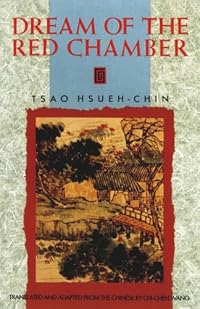
The classic eighteenth-century saga-a masterpiece of Chinese literature- about an aristocratic family and a forbidden love during the Qing dynasty. Considered one of the four great classical novels of Chinese literature, The Dream of the Red Chamber is believed to be a semiautobiographical account of author Cao Xueqin and his aristocratic family's rise and fall, and focuses particularly on the women in his life, including servants. Originally circulated in hand-copied manuscripts, The Dream show more of the Red Chamber is not only rich with psychological insight, but also enlightening in its portrayal of Chinese society during the Qing dynasty. It is an engrossing epic of imperial politics, friendship, and romantic rivalry, with an extraordinary cast of characters. show lessTags
Recommendations















Member Recommendations
Member Reviews
I was hesitant to start reading this, because I was afraid it would be difficult to read as a non-chinese reader, and because I was afraid it would be long. Well, yes, it is long, but surprisingly enough it didn't feel like it was very long - the story drew me in and kept me reading, and though there are some aspects of Chinese culture that take some getting used to, it wasn't very difficult to read either.
Xueqin tells the story of a very wealthy Chinese family; he focuses mainly on the women of the house and one of the sons, Paoyu. Paoyu grows up in a protected environment, the favourite of his grandmother, pampered by numerous servants, spending his time gallivanting with his nieces in the beautiful gardens adjacent to the house. show more However, even rich households can get into trouble, and even Paoyu can't always get what he wants...
I very much enjoyed the story. I found the beginning (the first volume) a bit long winding, as it is mainly an introduction to the characters and the household, but from the second volume the story really takes off. We get to know the different members of the families and their likes and dislikes, and share in the worries of the family. Each character has his/her own story and though some of the female characters are slightly hysterical, you do get drawn into their stories and feel for the characters.
Aside from that, the novel gives a great historical view of Chinese society and tradition. I really didn't know much about Chinese culture before I started reading, and I very much enjoyed getting to know the ways of an ancient, wealthy family - the rules of conduct, the social connections, the household and the servants are all described and give a vivid idea of what life was like.
Though the writing style is somewhat different from the style in Western novels, I didn't find it difficult or daunting. Xueqin's descriptions are beautiful, and I enjoyed the way in which the story alternately slows down and speeds up, which works very well for a very long work like this. show less
Xueqin tells the story of a very wealthy Chinese family; he focuses mainly on the women of the house and one of the sons, Paoyu. Paoyu grows up in a protected environment, the favourite of his grandmother, pampered by numerous servants, spending his time gallivanting with his nieces in the beautiful gardens adjacent to the house. show more However, even rich households can get into trouble, and even Paoyu can't always get what he wants...
I very much enjoyed the story. I found the beginning (the first volume) a bit long winding, as it is mainly an introduction to the characters and the household, but from the second volume the story really takes off. We get to know the different members of the families and their likes and dislikes, and share in the worries of the family. Each character has his/her own story and though some of the female characters are slightly hysterical, you do get drawn into their stories and feel for the characters.
Aside from that, the novel gives a great historical view of Chinese society and tradition. I really didn't know much about Chinese culture before I started reading, and I very much enjoyed getting to know the ways of an ancient, wealthy family - the rules of conduct, the social connections, the household and the servants are all described and give a vivid idea of what life was like.
Though the writing style is somewhat different from the style in Western novels, I didn't find it difficult or daunting. Xueqin's descriptions are beautiful, and I enjoyed the way in which the story alternately slows down and speeds up, which works very well for a very long work like this. show less
This enormous novel occupies the same central place in the literary culture of the Chinese as the works of Shakespeare do in English, as Pushkin’s verse novel Eugene Onegin does in Russian, and as Dante’s Divine Comedy does in Italian literature. Like them, it creates a whole world that is at once very specific to a time and place (China in the middle of the 18th century) and yet also universal. Like them it embodies the paradox of great art, best expressed by Matisse: All art bears the imprint of its historical epoch. Great art is that in which this imprint is most deeply marked.
And yet in the West the novel is hardly known at all. Reasons for this no doubt include unfamiliarity with the world the novel describes and creates, the show more vast number of characters (with names which are more than usually difficult for Western readers to remember) and its sheer length. It’s even difficult to arrive at a fixed title for the work, compounded by the fact that in Chinese it has many names, all of them given in the text itself. These titles include: The Story of the Stone, The Precious Mirror of Love, The Twelve Beauties of Jingling, and Dream of Red Mansions. The Penguin translation by David Hawkes uses the first of these titles. A Dream of Red Mansions is the closest translation (by Yang Hsien Yi and Gladys Yang) of the most common Chinese title, but other translations of this title might also include A Dream of the Red Chamber, or Dreams in a Red Chamber. This plethora of titles and translations of titles neatly reflects the great difficulties of translating a work from a language in which ambiguity is prized and preserved, into language where it is not.
Given these difficulties for a Western reader, perhaps the best way to approach this work is to look closely at the three characters which make up the most common title in Chinese. In so doing, we shall see that each one loosely defines a category that might help us to orient ourselves in the multifarious world of the Hong Lou Meng….
Read the full review on The Lectern show less
And yet in the West the novel is hardly known at all. Reasons for this no doubt include unfamiliarity with the world the novel describes and creates, the show more vast number of characters (with names which are more than usually difficult for Western readers to remember) and its sheer length. It’s even difficult to arrive at a fixed title for the work, compounded by the fact that in Chinese it has many names, all of them given in the text itself. These titles include: The Story of the Stone, The Precious Mirror of Love, The Twelve Beauties of Jingling, and Dream of Red Mansions. The Penguin translation by David Hawkes uses the first of these titles. A Dream of Red Mansions is the closest translation (by Yang Hsien Yi and Gladys Yang) of the most common Chinese title, but other translations of this title might also include A Dream of the Red Chamber, or Dreams in a Red Chamber. This plethora of titles and translations of titles neatly reflects the great difficulties of translating a work from a language in which ambiguity is prized and preserved, into language where it is not.
Given these difficulties for a Western reader, perhaps the best way to approach this work is to look closely at the three characters which make up the most common title in Chinese. In so doing, we shall see that each one loosely defines a category that might help us to orient ourselves in the multifarious world of the Hong Lou Meng….
Read the full review on The Lectern show less
As to the series, please see my review in "the Three Kingdoms" volume.
This volume in particular was a fun recap of a book i had already read. That said, in being simplified for an immature reader, it was helpful in pointing out things that i had missed as culturally immature/ignorant reader. I kinda wish I had read this before reading the actual novel.
(2024 Review #6)
This volume in particular was a fun recap of a book i had already read. That said, in being simplified for an immature reader, it was helpful in pointing out things that i had missed as culturally immature/ignorant reader. I kinda wish I had read this before reading the actual novel.
(2024 Review #6)
A truly outstanding novel with richness of thought and design at every scale. The juxtaposition of mundane power/money grabbing and supernatural is unbelievably original, amazingly well executed and deeply moving.
Also known as Hong Lou Meng, this is arguably China's greatest literary masterpiece. A chronicle of a noble family in the eighteenth century; but the splendor of enchanting gardens, pleasure pavilions, and daily life of the most sophisticated refinements hides the realities of decay and self-destruction.
It is a classic and understandably so, but in my opinion it is quite a strenuous and tedious task to read it in its entirety. I just can't over so many pages follow the story and its multiple and diverse characters. This may be a fault on my part, but I'd rather spend the time with something a bit easier to get into. Perhaps, just an annotated edition would have made the deal and helped me to get into this influential work.
Le premesse dicevano che sarebbe stato il piu' grande romanzo della letteratura cinese (o almeno uno dei migliori). Ma la trama non era poi cosi' coinvolgente, sinceramente ci si aspettava molto di piu'.
Members
- Recently Added By
Published Reviews
ThingScore 100
Lists

Classics you know you should have read but probably haven't
421 works; 407 members

1001 Books You Must Read Before You Die
1,448 works; 1,132 members

100 Books to Read in a Lifetime (That Are Older Than 200 Years)
415 works; 173 members

Best of World Literature
431 works; 51 members

Philip Ward's Lifetime Reading Plan
592 works; 22 members

Best Family Stories
241 works; 22 members

Best family sagas
244 works; 34 members

Blue Pyramid 1,276 Best Books of All Time
1,248 works; 32 members

Books Read in 2016
4,666 works; 199 members

SHOULD Read Books!
354 works; 9 members

Must read
30 works; 2 members

Plan to Read Books
75 works; 1 member

Books Read in 2022
5,164 works; 113 members

My TBR
371 works; 3 members

The Books I Read in 2016
54 works; 1 member

Greatest Books, allegedly
484 works; 9 members

New Lifetime Reading Plan by Fadiman and Major
225 works; 5 members

Juggernauts (fiction)
21 works; 3 members

Recommended Reading : 600 Classics Reviewed, Editors of Salem Press, 2015
634 works; 6 members

Famously Incomplete Novels
16 works; 1 member

DigitalDreamDoor top 300
300 works; 4 members

Books We Resisted Reading
173 works; 102 members
Talk Discussions
Past Discussions
Story of the Stone, Red Chamber - Read along, Part II in Ancient China (February 2016)
Story of the Stone, Red Chamber - Read along in Ancient China (October 2011)
Author Information

102+ Works 5,380 Members
All Editions
Some Editions
Awards and Honors
Notable Lists
Daniel S. Burt's Novel 100 (050 – 50)
Series

The Story of the Stone (Collections and Selections — Complete)
Belongs to Publisher Series
Penguin 60s Classics (13)
insel taschenbuch (0292)
Bibliothèque de la Pléiade [Gallimard] (Coffret, 293, 294)
Work Relationships
Is contained in
Contains
Is retold in
Has as a student's study guide
Common Knowledge
- Canonical title
- Dream of the Red Chamber
- Original title
- 紅樓夢
- Alternate titles
- Hong Lou Meng; The Story of the Stone; A Dream of Red Mansions; Il sogno della camera rossa; The Precious Mirror of Love; The Twelve Beauties of Jingling
- Original publication date
- 1791 (120 chapters ∙ Gao E. ed.) (120 chapters ∙ Gao E. ed.); 1932 (German: Kuhn) (German: Kuhn); 1980 (English: Hawkes and Minford) (English: Hawkes and Minford); 1980 (English: Xianyi Yang and Gladys Tayler Yang) (English: Xianyi Yang and Gladys Tayler Yang)
- People/Characters
- Jia Baoyu; Lin Daiyu
- Important places
- China
- First words*
- Unsere Geschichte beginnt in Su Tschou, der festen Stadt im Südostzipfel der chinesischen Tiefebene.
- Original language*
- Chinees
- Disambiguation notice
- This is the complete work variously known as A Dream of Red Mansions , The Dream of the Red Chamber, or The Story of the Stone, by Cao Xueqin (also known as Tsao Hsueh-chin) and Kao Ngo (also known as Kao... (show all) Hgo, or Gao E). Please distinguish it from any abridged versions, and from any parts published separately. Thank you.
As A Dream of Red Mansions it tends to be divided into 3 volumes; as The Story of the Stone it is divided into 5. Other editions consist of 2 volumes. Please do not combine Volume 1 of a 3 volume edition with Volume 1 of a 5 (or 2) volume edition (and likewise for other volumes).
If it is unclear from the titling how many volumes there are in a particular edition, please use the ISBN to identify to which set a particular volume belongs.
*Some information comes from Common Knowledge in other languages. Click "Edit" for more information.
Classifications
- Genres
- Fiction and Literature, General Fiction
- DDC/MDS
- 895.1 — Literature & rhetoric Literatures of other languages Literatures of East and Southeast Asia Chinese
- LCC
- PL2727 .S2 — Language and Literature Languages and literatures of Eastern Asia, Africa, Oceania Languages of Eastern Asia, Africa, Oceania Chinese language and literature Chinese literature Individual authors and works
- BISAC
Statistics
- Members
- 900
- Popularity
- 29,698
- Reviews
- 9
- Rating
- (3.91)
- Languages
- 10 — Chinese, Dutch, English, Finnish, French, German, Hungarian, Italian, Russian, Spanish
- Media
- Paper, Audiobook, Ebook
- ISBNs
- 194
- ASINs
- 36