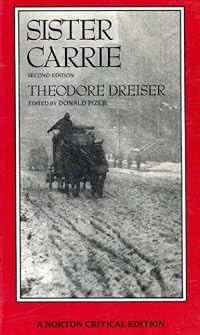
Sister Carrie: An Authoritative Text, Backgrounds and Sources, Criticism (A Norton Critical Edition)
by Theodore Dreiser
On This Page
Description
The story of a young woman from Wisconsin who goes to Chicago, becomes an actress, marries and moves to New York, and when her husband loses his job, returns to the stage.Tags
Recommendations










































Member Reviews
A tough book to recommend. In all honesty, I hated this book for much of its first hundred pages. The writing was overstuffed with details and the dialogue very much like the farcical plays which later in the story take precedence. None of the characters seem sympathetic or even remotely interesting. But, and some others out there seem to be of similar minds about this, this book, everything about it, the characters, the dialogue, the descriptive detailing of nearly every aspect of the world of the setting, grows on you. Not so much in likeability or attractiveness but rather I became drawn by the downward spiral the story was taking. The search for something akin to genuine happiness and contentment in a world where artifice, image, show more and decadence are all that are made to matter, is very effectively done. Though long and drawn out (and the story certainly stretches) by the end it all feels very necessary as looking at the characters beginnings and where their endings, is truly incredible. Basically an incredibly long very detailed downward spiral for most of the characters involved. Definitely not an uplifting story, but very affecting if you give it a lot of time and patience. show less
Sister Carrie was one of Dreiser’s first novels. It was not well-received when first published in 1900 for a variety of reasons, my favorite being that people of that day had a hard time with the book’s female protagonist not getting her due (as in negative consequences for all of her naughty decisions). She succeeds and shines to the very end even though she made a series of immoral decisions, which in those days should have ensured her doom. Evidently Dreiser and his wife toned it down a bit and that was why it was published at all. Interestingly, the altered version of the book was published consistently from 1900 until about 1980 when the original version finally became available. And for that, I am grateful.
I loved this story. show more There was something so soul-full about the characters. The “everyman” quality of Carrie, a very young woman who is initially too silly to know that glamour and and easy lifestyle comes with a price. At the outset she is just what a young woman might have been back then, relatively naive, ambitious to obtain trinkets and beautiful clothes, to be one of the beautiful people, and thus she was a rather silly girl. Carrie meets a Mr. Drouet on the train in from Chicago, beginning a friendship that would lead her to attaining her dreams. Drouet himself is almost the male equivalent of Carrie–enamoured with fine things, clothes, and beautiful women. But since he is making his own way in the world, he does work hard at his trade and makes a success of himself. Through Drouet, Carrie meets Hurstwood, a married, successful bar and hotel manager who is a the top of the society food chain in Chicago–at least for those in society who must work to attain or maintain their wealth. Each of the three make a succession of decisions, that in the novel’s time and indeed to a large extent in our own time, are considered immoral and create difficulties to which the characters must react.
I think for me that is one of the most powerful parts of the story. The point at which in anyone’s life, you have made a decision and must “suffer the consequences,” it is usually then where it seems that many future decisions are taken from you. You must then merely react to consequences upon consequences instead of having the upper hand and taking steps to determine your fate.
I found myself waiting many times during the first half of the novel for Carrie’s decisions to catch up with her. For whatever reason, I assumed that a book from this time, focusing on the human element and our penchant for making bad decisions worse, would have Carrie end up having to walk the streets or die of some venereal disease. I am astonished now at the outcome. And I applaud Dreiser’s courage to break away from the “evil fallen woman must suffer a thousand agonies and indignities” formula that literature had proscribed to since the first wronged man ever captured such a story on sheep’s guts. Because let's face it--literary immoral men seemed to do just fine most of the time.
It is not without some tedium though. At first, I was enchanted by the many, many details that Dreiser provided. You could close your eyes and picture Carrie on the train from Wisconsin to Chicago–going to the big city with stars in her eyes. By the 400th page of such description though, I confess to skimming through some of that detail. And yet, it’s not like many other detailed stories where I wish to heavens that the author had just stopped 200 pages earlier. The detail is needed, for the most part, to really get you into the minds and even the lodgings of the characters. It leaves you with a more complete view of the desperation of the two main characters–desperation that leads them in decidedly different ways. show less
I loved this story. show more There was something so soul-full about the characters. The “everyman” quality of Carrie, a very young woman who is initially too silly to know that glamour and and easy lifestyle comes with a price. At the outset she is just what a young woman might have been back then, relatively naive, ambitious to obtain trinkets and beautiful clothes, to be one of the beautiful people, and thus she was a rather silly girl. Carrie meets a Mr. Drouet on the train in from Chicago, beginning a friendship that would lead her to attaining her dreams. Drouet himself is almost the male equivalent of Carrie–enamoured with fine things, clothes, and beautiful women. But since he is making his own way in the world, he does work hard at his trade and makes a success of himself. Through Drouet, Carrie meets Hurstwood, a married, successful bar and hotel manager who is a the top of the society food chain in Chicago–at least for those in society who must work to attain or maintain their wealth. Each of the three make a succession of decisions, that in the novel’s time and indeed to a large extent in our own time, are considered immoral and create difficulties to which the characters must react.
I think for me that is one of the most powerful parts of the story. The point at which in anyone’s life, you have made a decision and must “suffer the consequences,” it is usually then where it seems that many future decisions are taken from you. You must then merely react to consequences upon consequences instead of having the upper hand and taking steps to determine your fate.
I found myself waiting many times during the first half of the novel for Carrie’s decisions to catch up with her. For whatever reason, I assumed that a book from this time, focusing on the human element and our penchant for making bad decisions worse, would have Carrie end up having to walk the streets or die of some venereal disease. I am astonished now at the outcome. And I applaud Dreiser’s courage to break away from the “evil fallen woman must suffer a thousand agonies and indignities” formula that literature had proscribed to since the first wronged man ever captured such a story on sheep’s guts. Because let's face it--literary immoral men seemed to do just fine most of the time.
It is not without some tedium though. At first, I was enchanted by the many, many details that Dreiser provided. You could close your eyes and picture Carrie on the train from Wisconsin to Chicago–going to the big city with stars in her eyes. By the 400th page of such description though, I confess to skimming through some of that detail. And yet, it’s not like many other detailed stories where I wish to heavens that the author had just stopped 200 pages earlier. The detail is needed, for the most part, to really get you into the minds and even the lodgings of the characters. It leaves you with a more complete view of the desperation of the two main characters–desperation that leads them in decidedly different ways. show less
Although I enjoyed this novel immensely, and marvel at the determined if ambivalent ambition of Carrie to use everything and everyone around her in order to rise to success as an actress, reading Theodore Dreiser can be likened to eating a meal in a greasy spoon diner. There is a rushed, vulgar, and gruff quality about the prose--as if an enormous waitress were plunking down in front of you a huge platter of meatloaf, potatoes, and gravy and ordering you to "Eat!" George Hurstwood, who exercises poor judgment throughout his relationship to Carrie, and who descends from a swank manager of a bar in Chicago to a strike breaking worker who commits suicide in a flophouse, is a tragic figure. If I am less persuaded by Carrie's claims to show more suffer from a sense of emptiness and futility at the height of her success on stage, it is perhaps because existential angst can have a kind of aesthetic appeal when viewed from expensive apartments and silk sheets. show less
Dreiser does a lot of moralizing. He means well, with his moralizing, but I would wonder: "who died and put him in charge of every one's morals?" He is sexist, calling all young women"girls," "the little girl," "the little soldier," and various other patronizing terms. Towards the end of the book, his descriptions of the homeless people (all men! where are the homeless women?) are touching, sad, and bring to mind all the people in San Jose and San Francisco, crowded out by gentrification, living on the streets in 2019.
Some quotes:
P.38
"under better material conditions, this kind of work would not have been so bad, but the new socialism which involves pleasant working conditions for employees had not been taken hold upon our manufacturing show more companies.
"The place smelled of the oil of the machines and the new leather -- a combination which, added to the stale odors of the building, was not pleasant even in cold weather. The floor, though regularly swept every evening, presented a littered surface. Not the slightest provision had been made for the comfort of the employees, the idea being that something was gained by giving them as little and making the work as hard and unremunerative as possible. What we know of footrests, swivel - back chairs, dining rooms for the girls, clean aprons and curling iron supplied free, and a decent cloakroom, were unthought-of. The washrooms were disagreeable, crude, if not foul places, and the whole atmosphere was sordid."
This is Carrie's first workplace, when she comes to make her own life in Chicago.
P.212
"Hurstwood , being an older man, could scarcely be said to retain the fire of youth, though he did possess a passion warm and reasoning. It was strong enough to induce the leaning toward him which, on Carrie's part, we have seen. She might have been said to be imagining herself in love, when she was not. Women frequently do this. It flows from the fact that in each exists a bias towards affection, a craving for the pleasure of being loved. The longing to be shielded, bettered, sympathized with, is one of the attributes of the sex. This, coupled with sentiment and a natural tendency to emotion, often makes refusing difficult. It persuades them that they are in love."
If that isn't a sickening platitude. This is a description of why Carrie settled to live with a has-been like Hurstwood. show less
Some quotes:
P.38
"under better material conditions, this kind of work would not have been so bad, but the new socialism which involves pleasant working conditions for employees had not been taken hold upon our manufacturing show more companies.
"The place smelled of the oil of the machines and the new leather -- a combination which, added to the stale odors of the building, was not pleasant even in cold weather. The floor, though regularly swept every evening, presented a littered surface. Not the slightest provision had been made for the comfort of the employees, the idea being that something was gained by giving them as little and making the work as hard and unremunerative as possible. What we know of footrests, swivel - back chairs, dining rooms for the girls, clean aprons and curling iron supplied free, and a decent cloakroom, were unthought-of. The washrooms were disagreeable, crude, if not foul places, and the whole atmosphere was sordid."
This is Carrie's first workplace, when she comes to make her own life in Chicago.
P.212
"Hurstwood , being an older man, could scarcely be said to retain the fire of youth, though he did possess a passion warm and reasoning. It was strong enough to induce the leaning toward him which, on Carrie's part, we have seen. She might have been said to be imagining herself in love, when she was not. Women frequently do this. It flows from the fact that in each exists a bias towards affection, a craving for the pleasure of being loved. The longing to be shielded, bettered, sympathized with, is one of the attributes of the sex. This, coupled with sentiment and a natural tendency to emotion, often makes refusing difficult. It persuades them that they are in love."
If that isn't a sickening platitude. This is a description of why Carrie settled to live with a has-been like Hurstwood. show less
Sister Carrie is one of a specific handful of American novels that I learned about in school, but (until now) never actually read. Along with those of Upton Sinclair, H.L. Mencken, Sinclair Lewis, Edward Bellamy and to a certain extent Stephen Crane, the works of Theodore Dreiser were always presented to me as more important to history than interesting as literature - not exactly the kind of ringing endorsement that inspires a person to run out and buy a book today. These authors were exposing social ills and introducing literary naturalism; they were unafraid to confront the American public with previously-taboo topics like the lives of prostitutes, or corrupt business interests. But lord, implied my high-school textbooks, were they show more ever dry and boring. Even in English classes, these authors were lauded mainly for paving the way for those writing after them, who took the social freedoms they pioneered and added a livelier prose style and a more compelling cast of characters. Recently, thinking about everything ELSE my high-school textbooks got wrong, I began to wonder if this generation of authors are really as unreadable as all that, and figured I should do my own bit of experimentation. Sister Carrie was my first foray into this early-20th-century American naturalist enclave, and it was an enlightening journey.
First of all, let me say that I can understand why Dreiser has been neglected. I would describe his prose as "utilitarian": it gets the job done, but doesn't involve any pyrotechnics. With the likes of Hemingway and Welty bursting onto the American scene a few short decades later, I can see why Dreiser's businesslike approach came to seem outdated and clunky. It's an odd, transitional-seeming style: more journalistic and less ornamented than your purple Victorian prose, yet not so aggressively streamlined or giddily experimental as the work of many Modernists.
(I chose this passage because it gives a fair idea of Dreiser's style, but also because I think it's hilarious that "clean aprons and curling irons supplied free" would be an item on the agenda for workers' rights. Where have my free curling irons been all these years of working, I'd like to know?)
I can also understand the criticism of Dreiser's characters for being undeveloped or unsympathetic, but I think he's actually making a conscious choice here: his super-naturalistic narrative method, combined with some cynicism about people rationalizing their own laziness, means that this is more a novel about circumstances acting on players than about individuals taking control of their own destinies. The young protagonist, Carrie, moves to the big city and quickly becomes overwhelmed with how hard a working-class woman has to labor in order to earn her living. When she's presented with the opportunity of being taken care of by a man and living with him out of wedlock, she drifts into it without ever taking decisive action. Similarly, Drouet (the young man) never plans to lure Carrie into a life of sin; he just finds it distasteful to be tied down in a real marriage, and so puts off the wedding indefinitely. The other characters drift similarly through their lives, finding reasons not to disrupt the momentum that has built up around them. I think Dreiser, like many socially- or socialist-minded writers, is using Carrie, Drouet and Hurstwood as Everyman characters; his book is more a portrait of the material conditions and social forces in turn-of-the-century Chicago and New York than of particular individuals within those cities.
I wrote in my thoughts on The Good Earth that this universalizing approach is not my favorite novelistic technique; I tend to prefer stories with highly-individualized characters and distinctive narrative voices, not to mention innovative, well-crafted prose. Nevertheless, it's a tribute to Dreiser's storytelling ability that I had a hard time putting Sister Carrie down. He uses the tools at his disposal in compelling, sometimes surprising ways: one of my favorites was the way in which he played the characters off each other, enlisting the reader's sympathy first for one, then for another. All three of the main characters act very poorly at certain points, and all three fall prey to the lure of habit and drift along in their unsatisfactory lives for painfully long periods before they are finally spurred to make some kind of change. As a reader, I found myself either frustrated with or cheering for all three characters in sequence as the novel progressed. And although any given character may be acting badly at a certain juncture, the fact that I had been rooting for them only fifty pages earlier meant that none of the three was every wholly unsympathetic.
In fact, Dreiser works so hard to keep Carrie, Drouet and Hurstwood emotionally accessible to the reader, even at their most selfish and unlikeable, that I was reminded of the work of contemporary writers like Toni Morrison and Dorothy Allison - writers who make a point of empathizing with characters usually beyond the pale. I remember how conflicted I felt, reading Morrison's The Bluest Eye, at the author's empathic portrayal of a father who rapes his own daughter, and I wonder whether readers in 1900 would have found Dreiser's subject matter to be equally shocking and conflicting. Probably so, judging by its history: it was withdrawn from publication for being "too sordid," and only after Dreiser cut many suggestive passages did Doubleday agree to publish the expurgated version. In another triumph for Norton Critical Editions, I read the appended catalog of the passages cut in the initial publication, which was fascinating. To my surprise, many of them involved scenes in which Carrie gets cat-called and solicited on the street - surely the fact that this happens is no mystery to any urban woman? I certainly deal with it whenever I walk downtown. But maybe, at the turn of the century, men only felt confident cat-calling women who looked working-class, so the middle-class readers of Sister Carrie would not have encountered the behavior? I'm not sure how to feel about the suggestion that public humiliation of women has been democratized in American cities over the past century, but it's interesting to think about.
But cat-calling is just one small aspect of the loving-yet-critical portraits of 1890s New York and Chicago in this novel. Dreiser is at his most vivid when depicting the inhumane conditions of city life and the unfettered, dog-eat-dog realities of pre-regulation American capitalism. It's this, along with the frank portrayals of cohabiting out of wedlock, that made the book famous, and I think the urban landscape is really the star of Dreiser's show. The reader gets a strong sense of a world full of possibility ripe for the picking - all the young men, like Drouet, streaming in from the countryside to secure sales positions, the newly-constructed glass-fronted buildings housing newly-incorporated retail firms, the movers, shakers, and hangers-on in the untamed melee of exponential urban growth. And one also sees vividly how the skirmish-and-grab for that pool of possibility creates a class of casualties, left even more to their own devices than the modern urban homeless. Dreiser does a good job of communicating the extent to which all his characters are performing without a safety net, and even the highest is capable of a dramatic fall. I think I preferred Sister Carrie to The Good Earth because Dreiser's cities-as-characters are so dynamic. I'm not sure turn-of-the-century American urban literature will become my new favorite genre, but Sister Carrie was certainly enough to convince me to give it another try. show less
First of all, let me say that I can understand why Dreiser has been neglected. I would describe his prose as "utilitarian": it gets the job done, but doesn't involve any pyrotechnics. With the likes of Hemingway and Welty bursting onto the American scene a few short decades later, I can see why Dreiser's businesslike approach came to seem outdated and clunky. It's an odd, transitional-seeming style: more journalistic and less ornamented than your purple Victorian prose, yet not so aggressively streamlined or giddily experimental as the work of many Modernists.
The place smelled of the oil of the machines and the new leather - a combination which, added to the stale odours of the building, was not pleasant even in cold weather. The floor, though regularly swept every evening, presented a littered surface. Not the slightest provision had been made for the comfort of the employees, the idea being that something was gained by giving them as little and making the work as hard and unremunerative as possible. What we know of footrests, swivel-back chairs, dining-rooms for the girls, clean aprons and curling irons supplied free, and a decent cloak room, were unthought-of. The washrooms were disagreeable, crude, if not foul places, and the whole atmosphere was sordid.
(I chose this passage because it gives a fair idea of Dreiser's style, but also because I think it's hilarious that "clean aprons and curling irons supplied free" would be an item on the agenda for workers' rights. Where have my free curling irons been all these years of working, I'd like to know?)
I can also understand the criticism of Dreiser's characters for being undeveloped or unsympathetic, but I think he's actually making a conscious choice here: his super-naturalistic narrative method, combined with some cynicism about people rationalizing their own laziness, means that this is more a novel about circumstances acting on players than about individuals taking control of their own destinies. The young protagonist, Carrie, moves to the big city and quickly becomes overwhelmed with how hard a working-class woman has to labor in order to earn her living. When she's presented with the opportunity of being taken care of by a man and living with him out of wedlock, she drifts into it without ever taking decisive action. Similarly, Drouet (the young man) never plans to lure Carrie into a life of sin; he just finds it distasteful to be tied down in a real marriage, and so puts off the wedding indefinitely. The other characters drift similarly through their lives, finding reasons not to disrupt the momentum that has built up around them. I think Dreiser, like many socially- or socialist-minded writers, is using Carrie, Drouet and Hurstwood as Everyman characters; his book is more a portrait of the material conditions and social forces in turn-of-the-century Chicago and New York than of particular individuals within those cities.
I wrote in my thoughts on The Good Earth that this universalizing approach is not my favorite novelistic technique; I tend to prefer stories with highly-individualized characters and distinctive narrative voices, not to mention innovative, well-crafted prose. Nevertheless, it's a tribute to Dreiser's storytelling ability that I had a hard time putting Sister Carrie down. He uses the tools at his disposal in compelling, sometimes surprising ways: one of my favorites was the way in which he played the characters off each other, enlisting the reader's sympathy first for one, then for another. All three of the main characters act very poorly at certain points, and all three fall prey to the lure of habit and drift along in their unsatisfactory lives for painfully long periods before they are finally spurred to make some kind of change. As a reader, I found myself either frustrated with or cheering for all three characters in sequence as the novel progressed. And although any given character may be acting badly at a certain juncture, the fact that I had been rooting for them only fifty pages earlier meant that none of the three was every wholly unsympathetic.
In fact, Dreiser works so hard to keep Carrie, Drouet and Hurstwood emotionally accessible to the reader, even at their most selfish and unlikeable, that I was reminded of the work of contemporary writers like Toni Morrison and Dorothy Allison - writers who make a point of empathizing with characters usually beyond the pale. I remember how conflicted I felt, reading Morrison's The Bluest Eye, at the author's empathic portrayal of a father who rapes his own daughter, and I wonder whether readers in 1900 would have found Dreiser's subject matter to be equally shocking and conflicting. Probably so, judging by its history: it was withdrawn from publication for being "too sordid," and only after Dreiser cut many suggestive passages did Doubleday agree to publish the expurgated version. In another triumph for Norton Critical Editions, I read the appended catalog of the passages cut in the initial publication, which was fascinating. To my surprise, many of them involved scenes in which Carrie gets cat-called and solicited on the street - surely the fact that this happens is no mystery to any urban woman? I certainly deal with it whenever I walk downtown. But maybe, at the turn of the century, men only felt confident cat-calling women who looked working-class, so the middle-class readers of Sister Carrie would not have encountered the behavior? I'm not sure how to feel about the suggestion that public humiliation of women has been democratized in American cities over the past century, but it's interesting to think about.
But cat-calling is just one small aspect of the loving-yet-critical portraits of 1890s New York and Chicago in this novel. Dreiser is at his most vivid when depicting the inhumane conditions of city life and the unfettered, dog-eat-dog realities of pre-regulation American capitalism. It's this, along with the frank portrayals of cohabiting out of wedlock, that made the book famous, and I think the urban landscape is really the star of Dreiser's show. The reader gets a strong sense of a world full of possibility ripe for the picking - all the young men, like Drouet, streaming in from the countryside to secure sales positions, the newly-constructed glass-fronted buildings housing newly-incorporated retail firms, the movers, shakers, and hangers-on in the untamed melee of exponential urban growth. And one also sees vividly how the skirmish-and-grab for that pool of possibility creates a class of casualties, left even more to their own devices than the modern urban homeless. Dreiser does a good job of communicating the extent to which all his characters are performing without a safety net, and even the highest is capable of a dramatic fall. I think I preferred Sister Carrie to The Good Earth because Dreiser's cities-as-characters are so dynamic. I'm not sure turn-of-the-century American urban literature will become my new favorite genre, but Sister Carrie was certainly enough to convince me to give it another try. show less
I had heard about Sister Carrie prior to deciding to read it, but nothing specific. I knew that it had some sort of feminist theme and that it discussed the working class at some point, but that was about all I knew. It was mostly happenstance that I decided to read it - an offhand mention in a talk thread on LT, seeing it available that same week on Bookmooch in my favorite Norton Critical Edition, and then when it came in the mail, having it match a challenge topic.
For all of the chance that brought the book to my attention and got me to read it ahead of other books on my TBR list, I truly love it and am so glad that things fell out the way they did. I don't know if I would have quite appreciated it had I read Sister Carrie when I was show more younger, or during my undergraduate program - I suspect that as a teenager, I wouldn't have appreciated a lot of the book, and if I had to read it as part of a class assignment, it would have felt too much like a boring chore.
In fact, the book is a little bit difficult to read. Dreiser doesn't spare the details, and many sections run the risk of being too dry or tedious. But, and I think this is because I didn't have a time limit on my reading nor was it an assigned book, I appreciated all those details for giving me a more vivid picture of what Chicago, New York, and the characters' circumstances were like. It felt rather like looking at an old photograph. The other difficult aspect of the book is that I didn't really care to read about Carrie's life when she was living well with plenty of money, as in the second quarter of the book. I thought it was much more interesting to read about her search for employment than to read about her going to the theatre and fancy restaurants all the time.
There are several things about the story and characters that I would like to comment on, but I shan't or else this review would be far too long. To make it short, I should just say that I found the characterisations to be really quite good. All the characters were likable and sympathetic in at least one way, but also they all had faults that made me irritated with them - these and the compelling plot all kept my attention. I didn't want to put the book down in the last hundred pages, because I wanted to find out if Carrie would succeed in her quest and what would happen to Hurstwood.
I am a big fan of annotated and critical editions of books, so it goes without saying that I love my Norton Critical Edition of Sister Carrie. The special additions in this edition are writings by Dreiser and others that show historical people and events that characters and plot elements were based on. There is also a series of letters that describe the publishing process the book went through, as well as several critical essays. I liked the essays a lot for helping me give words to many of the impressions and gut feelings I had about the book, such as the importance of the rocking chair where Carrie is often found. show less
For all of the chance that brought the book to my attention and got me to read it ahead of other books on my TBR list, I truly love it and am so glad that things fell out the way they did. I don't know if I would have quite appreciated it had I read Sister Carrie when I was show more younger, or during my undergraduate program - I suspect that as a teenager, I wouldn't have appreciated a lot of the book, and if I had to read it as part of a class assignment, it would have felt too much like a boring chore.
In fact, the book is a little bit difficult to read. Dreiser doesn't spare the details, and many sections run the risk of being too dry or tedious. But, and I think this is because I didn't have a time limit on my reading nor was it an assigned book, I appreciated all those details for giving me a more vivid picture of what Chicago, New York, and the characters' circumstances were like. It felt rather like looking at an old photograph. The other difficult aspect of the book is that I didn't really care to read about Carrie's life when she was living well with plenty of money, as in the second quarter of the book. I thought it was much more interesting to read about her search for employment than to read about her going to the theatre and fancy restaurants all the time.
There are several things about the story and characters that I would like to comment on, but I shan't or else this review would be far too long. To make it short, I should just say that I found the characterisations to be really quite good. All the characters were likable and sympathetic in at least one way, but also they all had faults that made me irritated with them - these and the compelling plot all kept my attention. I didn't want to put the book down in the last hundred pages, because I wanted to find out if Carrie would succeed in her quest and what would happen to Hurstwood.
I am a big fan of annotated and critical editions of books, so it goes without saying that I love my Norton Critical Edition of Sister Carrie. The special additions in this edition are writings by Dreiser and others that show historical people and events that characters and plot elements were based on. There is also a series of letters that describe the publishing process the book went through, as well as several critical essays. I liked the essays a lot for helping me give words to many of the impressions and gut feelings I had about the book, such as the importance of the rocking chair where Carrie is often found. show less
A good novel for its time but dated and mostly of historical interest for the rabid reaction from the righteous sex police, who have now moved on to Huckleberry Finn and probably Ovid's Metamorphosis. Remarkably realistic characterizations, for the time. Women will likely appreciate Sister Carrie more than men do, suggesting another star. If that's not sexist.
Members
- Recently Added By
Lists

1001 Books You Must Read Before You Die
1,448 works; 1,131 members

Best Books Read for TIOLI
49 works; 13 members
Author Information

156+ Works 13,761 Members
Theodore Dreiser was born in Terre Haute, Indiana, the twelfth of 13 children. His childhood was spent in poverty, or near poverty, and his family moved often. In spite of the constant relocations, Dreiser managed to attend school, and, with the financial aid of a sympathetic high school teacher, he was able to attend Indiana University. However, show more the need for income forced him to leave college after one year and take a job as a reporter in Chicago. Over the next 10 years, Dreiser held a variety of newspaper jobs in Pittsburgh, St. Louis, and finally New York. He published his first novel, Sister Carrie in 1900, but because the publisher's wife considered its language and subject matter too "strong", it was barely advertised and went almost unnoticed. Today it is regarded as one of Dreiser's best works. It is the story of Carrie, a young woman from the Midwest, who manages to rise to fame and fortune on the strength of her personality and ambition, through her acting talent, and via her relationships with various men. Much of the book's controversy came from the fact that it portrayed a young woman who engages in sexual relationships without suffering the poverty and social downfall that were supposed to be the "punishment" for such "sin." Dreiser's reputation has increased instrumentally over the years. His best book and first popular success, An American Tragedy (1925), is now considered a major American novel, and his other works are widely taught in college courses. Like Sister Carrie, An American Tragedy also tells the story of an ambitious young person from the Midwest. In this case, however, the novel's hero is a man who is brought to ruin because of a horrible action he commits - he murders a poor young woman whom he has gotten pregnant, but whom he wants to discard in favor of a wealthy young woman who represents luxury and social advancement. As Dreiser portrays him, the young man is a victim of an economic system that torments so many with their lack of privilege and power and temps them to unspeakable acts. Dreiser is also known for the Coperwood Trilogy - The Financier (1912), The Titan (1914), and the posthumously published The Store (1947). Collectively the three books paint the portrait of a brilliant and ruthless "financial buccaneer." Dreiser is associated with Naturalism, a writing style that also includes French novelist Emile Zola. Naturalism seeks to portray all the social forces that shape the lives of the characters, usually conveying a sense of the inevitable doom that these forces must eventually bring about. Despite this apparent pessimism, Dreiser had faith in socialism as a solution to what he saw as the economic injustices of American capitalism. His socialist views were reinforced by a trip to the newly socialist Soviet Union, and in fact, Dreiser is still widely read in that country. There, as here, he is seen as a powerful chronicler of the injustices and ambitions of his time. Dreiser officially joined the Communist Party shortly before his death in 1945. (Bowker Author Biography) show less
All Editions
Series
Belongs to Publisher Series
Work Relationships
Common Knowledge
- Canonical title
- Sister Carrie: An Authoritative Text, Backgrounds and Sources, Criticism (A Norton Critical Edition) (A Norton Critical Edition)
- Original title
- Sister Carrie
- Original publication date
- 2006 (3rd ed.) (3rd ed.); 1970 (1st ed.) (1st ed.)
- Important places
- Chicago, Illinois, USA; New York, New York, USA
- Dedication
- TO MY FRIEND
Arthur Henry
WHOSE STEADFAST IDEALS AND SERENE
DEVOTION TO TRUTH AND BEAUTY
HAVE SERVED TO LIGHTEN THE METHOD
AND STRENGTHEN THE PURPOSE OF
THIS VOLUME - First words
- When Caroline Meeber boarded the afternoon train for Chicago, her total outfit consisted of a small trunk, a cheap imitation alligator-skin satchel, a small lunch in a paper box, and a yellow leather snap purse, containing he... (show all)r ticket, a scrap of paper with her sister's address in Van Buren Street, and four dollars in money.
Theodore Dreiser (1871-1945) is one of the most controversial figures in American literary history. (Preface) - Last words
- (Click to show. Warning: May contain spoilers.)In your rocking-chair, by your window dreaming, shall you long, alone. In your rocking-chair, by your window, shall you dream such happiness as you may never feel.
(Click to show. Warning: May contain spoilers.)There will probably never be critical agreement on the meaning and worth of Sister Carrie, but there is widespread acknowledgement of its significant role in the history of the modern American literary imagination. (Preface) - Original language
- English
- Disambiguation notice
- Do Not Combine: This is a "Norton Critical Edition", it is a unique work with significant added material, including essays and background materials. Do not combine with other editions of the work. Please maintain the p... (show all)hrase "Norton Critical Edition" in the Canonical Title and Series fields.
Classifications
Statistics
- Members
- 1,049
- Popularity
- 24,371
- Reviews
- 21
- Rating
- (3.65)
- Languages
- English
- Media
- Paper, Ebook
- ISBNs
- 5
- ASINs
- 4