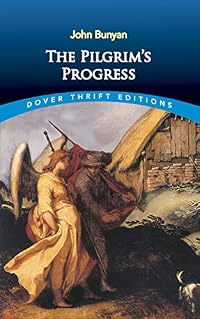
The Pilgrim's Progress
by John Bunyan
On This Page
Description
Next to the Bible, The Pilgrim's Progress has probably been more widely read than any other book in the English language, and rightfully so. It is considered by many critics to be the greatest allegory in any language. And to think that it was written by a jailed tinker who received very little formal education! This classic allegory tells of a Christian's epic journey toward heaven and the many temptations and distractions he encounters along the way. With a burden on his back, Christian show more reads a book that tells him that the city in which he and his family dwell will be set ablaze. Christian flees from the City of Destruction and journeys through the Slough of Despond, the Valley of Humiliation, the Valley of the Shadow of Death, Vanity Fair, Doubting Castle, and the Delectable Mountains before finally reaching the Celestial City. show lessTags
Recommendations





Member Recommendations

Member Reviews
*Pilgrim's Progress* is one of those books I approached with high expectations for all the wrong reasons. My father recommended it enthusiastically, saying "It's great, you should definitely read it!" I also wanted to read it because it's such a major theme in *Little Women*, which I absolutely loved. Later, I discovered my father had barely started the book himself, and I have to keep reminding myself that *Little Women* is set in a very different time than mine—what resonated with the March sisters in the 1860s doesn't necessarily translate to a modern reader.
Regardless of some of the religious elements not aligning with my personal faith, what struck me most was how genuinely *weird* this book is. Rather than feeling like show more traditional religious fiction, it often reads more like horror or an absurd fairy tale. John Bunyan's allegorical journey is filled with disturbing, nightmarish imagery that caught me completely off guard.
For example, there's Apollyon, the hideous demon who confronts Christian in the Valley of Humiliation—a creature covered in scales like a fish, with dragon wings, bear feet, and a lion's mouth spewing fire. Their battle is described with shocking violence, with Apollyon hurling flaming darts and Christian fighting for his life. The grotesque imagery in some portions—hobgoblins, satyrs, terrible torturous giants, and dragons—feels more like something from a horror novel than inspirational religious literature.
These aren't gentle moral lessons—they're terrifying encounters designed to frighten readers into righteousness. Instead, they leave the reader feeling hopeless and inadequate, as if they can never love the Lord enough or maintain faith through such trials. I do appreciate this aspect in a way: the book reinforces my belief that persevering in faith depends solely on the Lord's strength when we depend on Him, not on any natural strength of our own mind or faith.
While I can appreciate the book's historical significance and literary influence, the reading experience itself was more unsettling than uplifting. It's certainly not what I expected based on its reputation or its role in *Little Women*. show less
Regardless of some of the religious elements not aligning with my personal faith, what struck me most was how genuinely *weird* this book is. Rather than feeling like show more traditional religious fiction, it often reads more like horror or an absurd fairy tale. John Bunyan's allegorical journey is filled with disturbing, nightmarish imagery that caught me completely off guard.
For example, there's Apollyon, the hideous demon who confronts Christian in the Valley of Humiliation—a creature covered in scales like a fish, with dragon wings, bear feet, and a lion's mouth spewing fire. Their battle is described with shocking violence, with Apollyon hurling flaming darts and Christian fighting for his life. The grotesque imagery in some portions—hobgoblins, satyrs, terrible torturous giants, and dragons—feels more like something from a horror novel than inspirational religious literature.
These aren't gentle moral lessons—they're terrifying encounters designed to frighten readers into righteousness. Instead, they leave the reader feeling hopeless and inadequate, as if they can never love the Lord enough or maintain faith through such trials. I do appreciate this aspect in a way: the book reinforces my belief that persevering in faith depends solely on the Lord's strength when we depend on Him, not on any natural strength of our own mind or faith.
While I can appreciate the book's historical significance and literary influence, the reading experience itself was more unsettling than uplifting. It's certainly not what I expected based on its reputation or its role in *Little Women*. show less
I don't know if this is the worst book that I've ever read or if the audiobook was so atrocious that it made it into the worst thing ever. This book was a nightmare. I get it, I get it, I know it's supposed to be a Christian allegory, but listening to six hours of this (fully fucking dramatized) was hell. HELL. I wanted to bleach my ears. I couldn't handle it anymore, did Satan narrate this? This book made the Lord of the Rings trilogy look like a cake walk!! The Pilgrim's Progress was a long ass journey to heaven made by "Christian" and other people he runs into. They face all sorts of dumb shit and get into dumb trouble and make lots of dumb decisions but SOME FUCKING HOW still make it to heaven (spoiler alert). Christian loses lots show more of companions, walks into dumb scenarios every other page, but luckily for him, he had some faith so he made it. UGH. I hate everything. I'm glad this nightmare book is over. show less
Pilgrim's Progress by John Bunyan is a landmark work in both Christian theology and English literature. Since its publication in 1678, it has encouraged countless Christians on their journey from this world to the next, and its impact on the literary tradition of England has been profound.
Pilgrim's Progress is an allegory in the purest sense of the word; everything in the book has a one-to-one correlation with a spiritual principle. In part one, a man living in the City of Destruction becomes troubled by what he reads in a book (the Bible) and leaves his home, warning his scoffing family and neighbors that their city is going to be destroyed. He carries a heavy weight on his back and initially undertakes his journey to find a way to show more take it off. Along the way he meets a man named Evangelist who speaks truth to him, but not all fellow travelers are so congenial. He meets with characters with names like Mr. Worldly-wiseman, Formalist, Hypocrisy, Timorous, Mistrust, and Wanton, as well as Apollyon (an archdevil) and the Giant Despair, among others. Through a landscape of theological traps and oases Christian (for that is now his name) must make his way ever onward to the Celestial City, sustained on his travels by the Lord of Pilgrims.
The second part recounts the story of Christiana, Christian's wife, who eventually follows her husband's path from the City of Destruction to eternal life in the Celestial City. In terms of sheer dramatic effect, part two is far inferior to part one; instead of fleeing her city in despair over its coming destruction, Christiana receives an invitation from the Lord of Pilgrims to join Him and her husband in His city. She takes along her four sons and her handmaid Mercy, and they are aided on their journey by a Mr. Great-heart. There seems to be less action and more catechizing in this section of the book, but there are some valuable theological refinements as well. There are some pilgrims who probably wouldn't have been considered worthy of pilgrimage in the first part, like Mr. Fearing, Mr. Despondency, and his daughter Much-Afraid. These pilgrims are characterized by fear and weakness, but they are still loved by their Lord and they too eventually come to the Celestial City.
Nowadays I think there is an attitude of amused condescension that many feel toward Pilgrim's Progress because of its theological themes sticking out in plain sight under the see-through fictional covering. I know I felt that way... oh Bunyan, my dear man, you mean well but must you be so hamfisted? Can't you cover things up a little more artistically, add some adornment to your catechismic dialogues? Don't you know that straight allegory is far, far out of fashion just now? But this was before I read it, before I understood the narrative power that can come from an author being completely honest about his themes and intentions. By stripping away every non-essential, Bunyan can get down to the theology while still working within his fictional frame. The result is rich doctrine with the immediacy of a gripping story — a heady mix that is very rarely imitated successfully.
And you can't doubt the man's sincerity. Bunyan knew what it meant to be persecuted; he started the book from a prison cell where he ultimately spent twelve years of his life, imprisoned for holding church services outside the bounds of the Church of England. His imprisonment was costly not just to him, but to his family. His message is given weight by his experiences — here is a man who knows what it means to be on pilgrimage through lands ruled by the enemy. Persecution is inevitable; Christians will suffer in this world. But equally true is our reward in the Celestial City, where our Lord Himself will welcome us home. What a hope, what a joy on our journey!
I have said that Pilgrim's Progress is stripped down, but maybe a truer statement would be that our conceptions of the Christian life are covered in needless accretions that both complicate and hinder our journey. Vanity Fair, the Slough of Despond, Doubting Castle, the Valley of the Shadow of Death — these are universal places we all visit. Bunyan's characters also have their counterparts in our world. Bunyan dramatizes the Christian life not to change it or present it as something it's not, but to show us where our experience is deceptive. Things are clearer in the realm of allegory. If we have never had pilgrimage experiences like those of Christian, we ought to check that we're on the right road and that we've come in through the right gate.
The language is beautiful and not at all hard to understand. It has its quaint 1678-isms, but for me they added to the flavor. In many places I just stopped to savor it. I read this with my adult Bible fellowship, and most people read a version that was updated with modern English. I wouldn't advise that. The original writing is not that difficult, and while the updated version isn't terrible, it does lack Bunyan's indefinable force of language. Also there were some odd additions in the new version, theology I agreed with but that was not part of the original text. Hmm.
I had read an abridged version as a child which didn't really grab me, but now I'm a pilgrim and have had some experience of the road. And now I see how powerful this story is and why it has informed the Christian imagination for centuries. In some sections I would just stop and marvel at Bunyan's fantastic theology and fertile imagination. And it doesn't hurt that the narrative is soaked in Scripture! Of Bunyan, Charles Spurgeon said, "'Prick him anywhere, his blood is Bibline, the very essence of the Bible flows from him. He cannot speak without quoting a text, for his very soul is FULL of the Word of God.'" I couldn't get enough of it; who knew that Pilgrim's Progress could induce late-night reading vigils? I will certainly be rereading this!
In the "apology" poem at the beginning, Bunyan writes, "this book will make a traveler of thee." Indeed it will. show less
Pilgrim's Progress is an allegory in the purest sense of the word; everything in the book has a one-to-one correlation with a spiritual principle. In part one, a man living in the City of Destruction becomes troubled by what he reads in a book (the Bible) and leaves his home, warning his scoffing family and neighbors that their city is going to be destroyed. He carries a heavy weight on his back and initially undertakes his journey to find a way to show more take it off. Along the way he meets a man named Evangelist who speaks truth to him, but not all fellow travelers are so congenial. He meets with characters with names like Mr. Worldly-wiseman, Formalist, Hypocrisy, Timorous, Mistrust, and Wanton, as well as Apollyon (an archdevil) and the Giant Despair, among others. Through a landscape of theological traps and oases Christian (for that is now his name) must make his way ever onward to the Celestial City, sustained on his travels by the Lord of Pilgrims.
The second part recounts the story of Christiana, Christian's wife, who eventually follows her husband's path from the City of Destruction to eternal life in the Celestial City. In terms of sheer dramatic effect, part two is far inferior to part one; instead of fleeing her city in despair over its coming destruction, Christiana receives an invitation from the Lord of Pilgrims to join Him and her husband in His city. She takes along her four sons and her handmaid Mercy, and they are aided on their journey by a Mr. Great-heart. There seems to be less action and more catechizing in this section of the book, but there are some valuable theological refinements as well. There are some pilgrims who probably wouldn't have been considered worthy of pilgrimage in the first part, like Mr. Fearing, Mr. Despondency, and his daughter Much-Afraid. These pilgrims are characterized by fear and weakness, but they are still loved by their Lord and they too eventually come to the Celestial City.
Nowadays I think there is an attitude of amused condescension that many feel toward Pilgrim's Progress because of its theological themes sticking out in plain sight under the see-through fictional covering. I know I felt that way... oh Bunyan, my dear man, you mean well but must you be so hamfisted? Can't you cover things up a little more artistically, add some adornment to your catechismic dialogues? Don't you know that straight allegory is far, far out of fashion just now? But this was before I read it, before I understood the narrative power that can come from an author being completely honest about his themes and intentions. By stripping away every non-essential, Bunyan can get down to the theology while still working within his fictional frame. The result is rich doctrine with the immediacy of a gripping story — a heady mix that is very rarely imitated successfully.
And you can't doubt the man's sincerity. Bunyan knew what it meant to be persecuted; he started the book from a prison cell where he ultimately spent twelve years of his life, imprisoned for holding church services outside the bounds of the Church of England. His imprisonment was costly not just to him, but to his family. His message is given weight by his experiences — here is a man who knows what it means to be on pilgrimage through lands ruled by the enemy. Persecution is inevitable; Christians will suffer in this world. But equally true is our reward in the Celestial City, where our Lord Himself will welcome us home. What a hope, what a joy on our journey!
I have said that Pilgrim's Progress is stripped down, but maybe a truer statement would be that our conceptions of the Christian life are covered in needless accretions that both complicate and hinder our journey. Vanity Fair, the Slough of Despond, Doubting Castle, the Valley of the Shadow of Death — these are universal places we all visit. Bunyan's characters also have their counterparts in our world. Bunyan dramatizes the Christian life not to change it or present it as something it's not, but to show us where our experience is deceptive. Things are clearer in the realm of allegory. If we have never had pilgrimage experiences like those of Christian, we ought to check that we're on the right road and that we've come in through the right gate.
The language is beautiful and not at all hard to understand. It has its quaint 1678-isms, but for me they added to the flavor. In many places I just stopped to savor it. I read this with my adult Bible fellowship, and most people read a version that was updated with modern English. I wouldn't advise that. The original writing is not that difficult, and while the updated version isn't terrible, it does lack Bunyan's indefinable force of language. Also there were some odd additions in the new version, theology I agreed with but that was not part of the original text. Hmm.
I had read an abridged version as a child which didn't really grab me, but now I'm a pilgrim and have had some experience of the road. And now I see how powerful this story is and why it has informed the Christian imagination for centuries. In some sections I would just stop and marvel at Bunyan's fantastic theology and fertile imagination. And it doesn't hurt that the narrative is soaked in Scripture! Of Bunyan, Charles Spurgeon said, "'Prick him anywhere, his blood is Bibline, the very essence of the Bible flows from him. He cannot speak without quoting a text, for his very soul is FULL of the Word of God.'" I couldn't get enough of it; who knew that Pilgrim's Progress could induce late-night reading vigils? I will certainly be rereading this!
In the "apology" poem at the beginning, Bunyan writes, "this book will make a traveler of thee." Indeed it will. show less
For those too lazy to read the Bible or too dumb to form even a surface level interpretation of Christianity, there’s The Pilgrim’s Progress. The journey of the Christian spirit cloaked in the thinnest of allegory, The Pilgrim’s Progress is a book in two parts, the first part dealing with a man named Christian making his way to the celestial city (heaven, obviously). Part two follows his wife Christiana making a very, very similar journey. The names are indicative of the level of both subtlety and creativity that Bunyan put into this book.
The lack of subtlety is perhaps an unfair criticism, as Bunyan was clearly writing this book for the absolute lowest common denominator, but that proves to be a problem in its own right. For show more instance, Bunyan writes about brothers Passion and Patience to illustrate that patience is a virtue and that rash passion is bad: this is the 1678 precursor to the kid shows that nowadays run on the Christian TV channels to teach young children how to behave. Though Bunyan litters the book with Bible quotes, this book doesn’t contain any hint of the moral complexity that the Bible often explores: these lessons are black-and-white, the completely one-dimensional characters identified as on the side of good or evil immediately once their names are revealed (Goodwill, Faithful, and Old Honest are all good, surprise surprise). Not only does Bunyan make everything as simple as possible to promote mass consumption, but he also tries to gussy up the lessons by adding action scenes throughout the journey. In part 1 Christian fights a demon, and then in part 2 no less than four giants are slain, and the beast from the Book of Revelation is driven off as well (suggesting that Bunyan never grasped any of the symbolic meaning of the Book of Revelation at all). This is the Hollywood blockbuster of its time, designed to entertain and make the ideas within palatable to as broad an audience as possible, not to challenge the reader in any way. Unfortunately, the Bible isn't something that can be reduced to this type of bland and bite-sized entertainment without losing much of what makes it great.
What makes this book so painful to read is that Bunyan’s purpose in writing it, to set out the path a person needs to follow to get into heaven, has been done so much better elsewhere. Specifically Dante’s Divine Comedy puts Pilgrim’s Progress to shame in every way that I can think of, not to mention the Bible of course. Dante’s Divine Comedy is the closer parallel, as Dante is also using the journey of a man to illustrate the necessary traits and steps for getting into heaven and what steps to avoid. Dante not only wrote of the circles of Hell, levels of purgatory, and spheres of heaven to illustrate how a person should act, he was also doing a myriad of other things as well: writing about Italian politics at the time, merging the classical myths and teachings with the Christian system of morality, writing a moving letter to his deceased first love Beatrice, redefining the Italian language, and mapping the heavenly cosmos in detail. Not only did Dante do all of this, but he also did it all exceptionally well. For instance, each of the three stairs at the entrance to the mountain of Purgatory has a specific meaning- nothing is added at random, everything is in its place. Bunyan's Pilgrim's Progress, in comparison, seems slapdash and lazy. Bunyan isn’t trying to do very much, just sketch some moral lessons that lead a soul to heaven in the least nuanced manner possible. Why is the Slough of Despond located where it is? Or the arbor called Slothful’s Friend? And why does Christian run into Atheist when he does? And why doesn’t Christiana run into Atheist at all? The answer seems to be that Bunyan decided to put those challenges where they are because that's when he thought up the lesson while writing the story, not because he had a clear concept of a soul’s journey, or that the placement was particularly symbolic, or any other good reason. He could have switched around the challenges the pilgrims faced in their journeys and nothing would have been lost. Thus, you finish Pilgrim’s Progress and feel nothing comparable to the unified vision of the universe that you get with Dante, just a bunch of disjointed lessons that are mostly mind-numbingly simplistic. It doesn’t help that Bunyan decides to go over the same journey twice, with only slightly different challenges the second time around.
Bunyan’s The Pilgrim’s Progress is a story of the soul’s journey to heaven that delivers only the simplest lessons, told in an uncreative way, and which seems thrown together instead of set in a specific order for a specific purpose. Despite the action added by Bunyan the journey isn’t a particularly interesting one- it's lacking all subtlety and moral complexity- and it’s rendered even more boring by the journey happening twice. There is no reason to read this book while there are still copies of The Divine Comedy and the Bible left in the world. Your time is much better spent reading one of those- a few pages of either have more worth than the entirety of The Pilgrim's Progress. show less
The lack of subtlety is perhaps an unfair criticism, as Bunyan was clearly writing this book for the absolute lowest common denominator, but that proves to be a problem in its own right. For show more instance, Bunyan writes about brothers Passion and Patience to illustrate that patience is a virtue and that rash passion is bad: this is the 1678 precursor to the kid shows that nowadays run on the Christian TV channels to teach young children how to behave. Though Bunyan litters the book with Bible quotes, this book doesn’t contain any hint of the moral complexity that the Bible often explores: these lessons are black-and-white, the completely one-dimensional characters identified as on the side of good or evil immediately once their names are revealed (Goodwill, Faithful, and Old Honest are all good, surprise surprise). Not only does Bunyan make everything as simple as possible to promote mass consumption, but he also tries to gussy up the lessons by adding action scenes throughout the journey. In part 1 Christian fights a demon, and then in part 2 no less than four giants are slain, and the beast from the Book of Revelation is driven off as well (suggesting that Bunyan never grasped any of the symbolic meaning of the Book of Revelation at all). This is the Hollywood blockbuster of its time, designed to entertain and make the ideas within palatable to as broad an audience as possible, not to challenge the reader in any way. Unfortunately, the Bible isn't something that can be reduced to this type of bland and bite-sized entertainment without losing much of what makes it great.
What makes this book so painful to read is that Bunyan’s purpose in writing it, to set out the path a person needs to follow to get into heaven, has been done so much better elsewhere. Specifically Dante’s Divine Comedy puts Pilgrim’s Progress to shame in every way that I can think of, not to mention the Bible of course. Dante’s Divine Comedy is the closer parallel, as Dante is also using the journey of a man to illustrate the necessary traits and steps for getting into heaven and what steps to avoid. Dante not only wrote of the circles of Hell, levels of purgatory, and spheres of heaven to illustrate how a person should act, he was also doing a myriad of other things as well: writing about Italian politics at the time, merging the classical myths and teachings with the Christian system of morality, writing a moving letter to his deceased first love Beatrice, redefining the Italian language, and mapping the heavenly cosmos in detail. Not only did Dante do all of this, but he also did it all exceptionally well. For instance, each of the three stairs at the entrance to the mountain of Purgatory has a specific meaning- nothing is added at random, everything is in its place. Bunyan's Pilgrim's Progress, in comparison, seems slapdash and lazy. Bunyan isn’t trying to do very much, just sketch some moral lessons that lead a soul to heaven in the least nuanced manner possible. Why is the Slough of Despond located where it is? Or the arbor called Slothful’s Friend? And why does Christian run into Atheist when he does? And why doesn’t Christiana run into Atheist at all? The answer seems to be that Bunyan decided to put those challenges where they are because that's when he thought up the lesson while writing the story, not because he had a clear concept of a soul’s journey, or that the placement was particularly symbolic, or any other good reason. He could have switched around the challenges the pilgrims faced in their journeys and nothing would have been lost. Thus, you finish Pilgrim’s Progress and feel nothing comparable to the unified vision of the universe that you get with Dante, just a bunch of disjointed lessons that are mostly mind-numbingly simplistic. It doesn’t help that Bunyan decides to go over the same journey twice, with only slightly different challenges the second time around.
Bunyan’s The Pilgrim’s Progress is a story of the soul’s journey to heaven that delivers only the simplest lessons, told in an uncreative way, and which seems thrown together instead of set in a specific order for a specific purpose. Despite the action added by Bunyan the journey isn’t a particularly interesting one- it's lacking all subtlety and moral complexity- and it’s rendered even more boring by the journey happening twice. There is no reason to read this book while there are still copies of The Divine Comedy and the Bible left in the world. Your time is much better spent reading one of those- a few pages of either have more worth than the entirety of The Pilgrim's Progress. show less
To think that The Pilgrim's Progress was first published in 1678 and it’s still around speaks to its enduring relevancy. The level of sophistication is significant. Each character, location, and event in the story symbolizes spiritual truths and moral lessons. The book explores themes such as the nature of faith, the trials and tribulations of the Christian life, and the ultimate reward awaiting the faithful. Overall, it’s a profound allegorical representation of the Christian journey in simple and straightforward words, which makes it accessible to us modern readers and relevant for readers interested in spiritual and moral reflections.
Pilgrim's Progress is a work of genius, a truly original work that does not borrow grandeur from classics but becomes a classic by its own simplicity and profundity. Bunyan writes with clarity and structure, and insights into human nature.
In his essay "Why I am not a Christian", Bertrand Russell named the disbelief in a literal Hell as one of the chief reasons. I didn't get far into this book on my first attempt more than twenty years ago, perhaps for the same unbelief. I could not (and still cannot) relate to the feelings and thoughts of "Christian" concerning the Last Judgment, which compelled him to escape the "City of Destruction" and venture on a journey to the "Celestial City".
In Pilgrim's Progress, Bunyan shares the story of his show more Christian life, not as a preacher from the pulpit, but as a fellow traveller on a journey, warning others of the pitfalls and dangers to avoid along the way, and sharing the knowledge he gained by painful experience. The Pilgrim knows where he came from and where he is going, for the Lord Who went before him is the Way, and this book is a good travel companion for comfort and guidance; for an unbeliever, however, life is not a spiritual journey, but a drunkard's walk, without origin, progress or destination, and this book is nothing more than another drink from the cup, which neither quenches the thirst nor wakes the drunkard.
(Read full review at Nemo's Library) show less
In his essay "Why I am not a Christian", Bertrand Russell named the disbelief in a literal Hell as one of the chief reasons. I didn't get far into this book on my first attempt more than twenty years ago, perhaps for the same unbelief. I could not (and still cannot) relate to the feelings and thoughts of "Christian" concerning the Last Judgment, which compelled him to escape the "City of Destruction" and venture on a journey to the "Celestial City".
In Pilgrim's Progress, Bunyan shares the story of his show more Christian life, not as a preacher from the pulpit, but as a fellow traveller on a journey, warning others of the pitfalls and dangers to avoid along the way, and sharing the knowledge he gained by painful experience. The Pilgrim knows where he came from and where he is going, for the Lord Who went before him is the Way, and this book is a good travel companion for comfort and guidance; for an unbeliever, however, life is not a spiritual journey, but a drunkard's walk, without origin, progress or destination, and this book is nothing more than another drink from the cup, which neither quenches the thirst nor wakes the drunkard.
(Read full review at Nemo's Library) show less
I'm not a Christian and this is essentially Christian propaganda. Why then do I appreciate this work? I listened to the masterful reading by actor David Shaw-Parker (Naxos Recordings, 2013) and savoured the stately seventeenth century English prose, that's why. It is the same reason why certain passages in the King James bible are fragments of prose that should be experienced by all speakers and lovers of good English.
Members
- Recently Added By
Lists

1001 Books You Must Read Before You Die
1,448 works; 1,132 members

Classics you know you should have read but probably haven't
421 works; 407 members
501 Must-Read Books
508 works; 71 members
Best of British Literature
226 works; 41 members

PBS The Great American Read
100 works; 21 members

The Guardian's 100 greatest novels of all time
100 works; 16 members

Folio Society
831 works; 53 members

Harold Bloom - The Western Canon: B. The Aristocratic Age
231 works; 13 members

Church Times 100 Best Christian Books
106 works; 26 members

1964 College Preparatory Reading List
202 works; 8 members

Western World's Greatest Books - Project Gutenberg
295 works; 15 members

150 Best Novels Selected by Brander Matthews (1883)
150 works; 7 members

Christianity Books You've Read
179 works; 19 members

Publisher's Weekly Bestsellers Prior to 1895 in Chronological Order
95 works; 6 members

Out of Copyright
244 works; 14 members

The Guardian's 100 Best Novels Written in English
105 works; 13 members
The Well-Educated Mind Reading Challenge
75 works; 7 members

Books You Read During High School (For School)
301 works; 52 members

Religious Fiction
58 works; 12 members

17th Century
14 works; 6 members
College Reads (Lit Edition)
75 works; 5 members

Mensa for Kids Excellence in Reading Award Program (Grades 7-8)
62 works; 3 members

Well-Educated Mind
150 works; 3 members

BBC Top Books
78 works; 3 members

University literature
145 works; 5 members

Books Read in 2005
173 works; 7 members
F. B. Perkins' List of 100 Best Fiction
100 works; 5 members

Books to buy
8 works; 1 member
Books on my Kindle
162 works; 3 members

Books Read in 2022
5,164 works; 113 members
100
56 works; 1 member
Trinity College Booklist (1951): Class Ten, English Literature
358 works; 5 members

BOOKS READ IN 1980's and 1990's
52 works; 4 members

Books Read in 2006
417 works; 8 members

Ambleside Year 3
47 works; 1 member
Books You Read For University
184 works; 3 members

My List
302 works; 1 member

In Our Time books
4,934 works; 2 members

The "A" List
67 works; 8 members

Christian Classics (Old and Modern)
53 works; 3 members

DigitalDreamDoor top 300
300 works; 4 members
The Well-Educated Mind, Susan Wise Bauer, 2016
179 works; 3 members

Recommended Reading : 600 Classics Reviewed, Editors of Salem Press, 2015
634 works; 6 members

Read For Your Life
157 works; 1 member
New Lifetime Reading Plan by Fadiman and Major
225 works; 5 members

Books We'd Want on a Desert Island
203 works; 131 members

Ambleside Books
459 works; 18 members

N.T. McQueen's Inspiration List
23 works; 1 member

Classical Conversations Challenge II Exposition
18 works; 1 member

Book Titles Mentioned In Newberry Medal And Honor Books
884 works; 3 members

Before Austen Comes Aesop
318 works; 9 members

Greatest Books, allegedly
484 works; 9 members
Honey For a Child's Heart
1,152 works; 25 members

Literary Works Read in College
316 works; 15 members

Worst religious books
19 works; 8 members

Mensa for Kids Excellence in Reading Award Program (Grades 7-8)
62 works; 1 member

My TBR
371 works; 3 members
Literary Classics To Read (pre 1900)
19 works; 2 members

Alphabetical Books
211 works; 3 members

RZIM Introductory Christianity List
12 works; 1 member

Books We Resisted Reading
173 works; 102 members

Unread books
1,063 works; 83 members

Best of World Literature
431 works; 51 members
Author Information

697+ Works 38,503 Members
John Bunyan was born in Elstow, Bedfordshire, England, in 1628. He learned to read and write at the village school and was prepared to follow his father's trade as a brazier when the English Civil War broke out in 1644 and he was drafted into the Parliamentary army. His military service brought him into contact with Oliver Cromwell's Puritan show more troops. Beginning in 1648, Bunyan suffered a crisis in religious faith that lasted for several years. He turned to the Nonconformist church in Bedford to sustain him during this period. His first writings were attacks against the Quakers. Then Charles II was restored to the throne and Bunyan was arrested for conducting services not in accordance with the Church of England. He spent 12 years in jail. During this time, he wrote his autobiography, Grace Abounding, in which he described his spiritual struggle and growth. During his last years in prison, Bunyan began his most famous work, The Pilgrim's Progress, a two-part allegorical tale of the character Christian and his journey to salvation. Part I was published in 1678 and Part II in 1684. The second part deals with the spiritual journey of Christian's wife and sons, as they follow in his footsteps. With its elements of the folktale tradition, The Pilgrim's Progress became popular immediately. Well into the nineteenth century it was a book known to almost every reader in England and New England, second in importance only to the Bible. So great was the book's influence that it even plays a major role in Little Woman by Louisa May Alcott. Such expressions as "the slough of despond" and "vanity fair" have become part of the English language. Bunyan's other works include The Life and Death of Mr. Badman and The Holy War. He also wrote A Book for Boys and Girls, verses on religious faith for children. Bunyan died in London on August 31, 1688. (Bowker Author Biography) show less
Some Editions
Awards and Honors
Notable Lists
Series
Belongs to Publisher Series
Work Relationships
Is contained in
Contains
Is retold in
Has the adaptation
Is abridged in
Inspired
Has as a reference guide/companion
Has as a study
Common Knowledge
- Canonical title
- The Pilgrim's Progress
- Original title
- The Pilgrim's Progress from This World, to That Which Is to Come
- Alternate titles
- Bunyan's Pilgrim's Progress; The pilgrim's progress as originally published by John Bunyan : being a fac-simile reproduction of the first edition; 天路歷程
- Original publication date
- 1678 (first part ∙ English original) (first part ∙ | English original); 1681 (1st North American edition) (1st North American edition); 1681 (Dutch translation) (Dutch translation); 1684 (second part ∙ English original) (second part ∙ | English original); 1703 (German translation) (German translation); 1727 (Swedish translation) (Swedish translation)
- People/Characters
- Mr Fearing; Gaius, friend of the Apostle John; Giant Slay-Good; Mr Feeble-Mind; Phoebe; Mr Ready-to-Halt (show all 16); Mr Mnason; Grace; Martha of Bethany; Mr Despondency; Much-Afraid; Mr Valiant-for-Truth; Mr Stand Fast; Madame Bubble; Shining Ones; Ill-favored Ones
- Important places
- City of Destruction; Slough of Despond; Mount Sinai, Egypt; Wicket Gate; House of the Interpreter; Cross and Sepulchre (show all 25); Hill of Difficulty; House Beautiful; Valley of Humiliation; Valley of the Shadow of Death; Galus's Inn; Vanity Fair; Plain Ease; Hill Lucre; The Pillar of Salt; River of God; River of the Water of Life; By-Path Meadow; Doubting Castle; The Delectable Mountains; The Enchanted Ground; The Land of Beulah; The River of Death; The Celestial City; Mount Zion
- Epigraph
- I have used similitudes.
Hosea xii.10 - Dedication
- To 'trav'lers of the past, their mem'ry to secure,
That cloud of witnesses, alive in Heaven pure.
For travelers today, to aid them in their trip;
To help them follow on, in Christ's directorship.
And future trav'l... (show all)ers, too, to help them run the race;
To heighten their resolve, their foes to all out-pace.
To my wife, who paid a price--putting up with me,
While I dwelt with Christian, and all this company,
To my children, each unique; help them hear a call
From the Lord of Glory, to give to Him their all.
And to the task ahead, in Bunyan's type of rhyme,
We send you, Pilgrim, out--again another time.
--LEH (in Modern English version)
And they admitted that they were aliens and strangers on earth. People who say such things show that they are looking for a country of their own. If they had been thinking of the country they had left, they would have had ... (show all)opportunity to return. Instead, they were longing for a better country--a heavenly one. Therefore God is not ashamed to be called their God, for he has prepared a city for them
(Hebrews 11:13-16).
(in Modern English version) - First words
- As I walk'd through the wilderness of this world, I lighted on a certain place, where was a Denn; And I laid me down in that place to sleep; And as I slept I dreamed a Dream.
When at the first I took my Pen in hand,
Thus for to write; I did not understand
That I at all should make a little Book
In such a mode; Nay, I had undertook
To make another, which when almost done;
Bef... (show all)ore I was aware, I this begun.
The author's apology for his book.
The first edition of The Pilgrim's Progress, of which an exact reproduction is now placed before the public, was issued by "Nath. Ponder at the Peacock in the Poultrey near Cornhill, 1678." ... (show all)
Preface (1875 facsimile ed.).
Since it's publication in 1678, The Pilgrim's Progress, has gone through thousands of editions and versions.
Preface (Pure Gold Classics ed.).
John Bunyan's The Pilgrims' Progress, first published in 1678, is acknowledged by many to be second only to the Bible as a Christian publication.
Foreword (Pure Gold Classics ed.).
The Pilgrim's Progress is a book which in the three hundred years of its existence has crossed most of the barriers of race and culture that usually serve to limit the communicative power of a classic.
Introduction... (show all) (Penguin ed. by Roger Sharrock). - Quotations
- And all the trumpets sounded for him on the other side.
- Last words
- (Click to show. Warning: May contain spoilers.)Meantime I bid my reader Adieu.
(Click to show. Warning: May contain spoilers.)So I awoke, and behold it was a dream.
(Click to show. Warning: May contain spoilers.)[Preface (Pure Gold Classics edition)] It is truly a monument to the heart of the man, and to his God and Savior.
(Click to show. Warning: May contain spoilers.)[Foreword (Pure Gold Classics edition)] Also Hazelbaker's work of further annotating Bunyan's classic is commendable. - Original language
- English
Classifications
- Genres
- Christian Fiction, Fiction and Literature, General Fiction
- DDC/MDS
- 828.407 — Literature & rhetoric English & Old English literatures English miscellaneous writings English miscellaneous writings 1625-1702 Works without identifiable literary form
- LCC
- PR3330 .A1 — Language and Literature English English Literature 17th and 18th centuries (1640-1770)
- BISAC
Statistics
- Members
- 20,331
- Popularity
- 282
- Reviews
- 195
- Rating
- (3.74)
- Languages
- 28 — Afrikaans, Chinese, Cree, Czech, Danish, Dutch, English, English (Middle), Esperanto, Finnish, French, Frisian, German, Scottish Gaelic, Hawaiian, Interlingua, Italian, Japanese, Korean, Latin, Norwegian (Bokmål), Norwegian, Polish, Russian, Spanish, Swedish, Tamil, Portuguese (Portugal)
- Media
- Paper, Audiobook, Ebook
- ISBNs
- 576
- UPCs
- 13
- ASINs
- 704