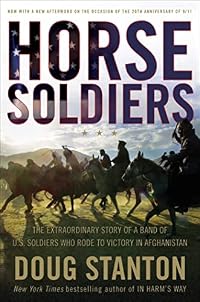
Horse Soldiers
by Doug Stanton
On This Page
Description
Now a major motion picture from Jerry Bruckheimer and Lionsgate!The New York Times bestselling "spellbinding true-life story" (USA TODAY) of a United States Special Forces team deployed to the war-ravaged Afghanistan mountains in the weeks immediately following 9/11, overcoming great odds to become heroes of our era.
In the weeks following the attacks of September 11, a small band of Special Forces soldiers secretly entered Afghanistan. Riding on horseback, they pursued the Taliban over show more the stark and mountainous Afghanistan terrain. After a series of intense battles, they captured the strategically essential city of Mazar-i-Sharif.
The bone-weary American soldiers were welcomed as liberators as they rode into the city, and the streets thronged with Afghans overjoyed that the Taliban regime had been overthrown. Then the action took a wholly unexpected turn. During a surrender of six hundred Taliban troops, the Horse Soldiers were ambushed by the would-be POWs. Dangerously overpowered, they fought for their lives in the city's immense fortress, Qala-i-Jangi, or the House of War. At risk were the military gains of the entire campaign: if the soldiers perished or were captured, the entire effort to outmaneuver the Taliban was likely doomed.
Previously published as Horse Soldiers, 12 Strong "is not just a battle story—it's also about the home front. An important book" (the TODAY show). A thrilling, inspiring tale of a group of men on horses who did the impossible and an incredible account of real life bravery and heroism in the face of insurmountable odds. show less
Tags
Recommendations

Member Reviews
Doug Stanton was born in the Reed City Public Library. In fact I have heard him say this. Of course at the time it was the Reed City Hospital, but it still makes a great opening line for a review of Doug's newest book, HORSE SOLDIERS, recently released by Scribner. Because Stanton writes like he was born to it. Here is history that reads like the best fiction of the action-adventure type.
Now a resident of Traverse City where he grew up, Doug is a product of the Interlochen Arts Academy and the Iowa Writer's Workshop. His first book, IN HARM'S WAY (2001), was an international bestseller. After reading HORSE SOLDIERS, I strongly suspect it will enjoy similar success.
The subtitle of Stanton's new book may be problematic for some. It show more reads: The Extraordinary Story of a Band of U.S. Soldiers Who Rode to Victory in Afghanistan. And, in a nutshell, it's a good description of the book's content. Because the soldiers described in these pages are indeed extraordinary people who deserve to be recognized. The problem for some more politically oriented readers, however, will be the word "victory." They will argue that the U.S. has not achieved victory in Afghanistan and probably never will.
But this is not a book about politics. This is a book about ordinary people, military men and officers, who have trained hard and dedicated their lives to safeguarding the security of our nation, both here and abroad. They are not political people. They were given a mission, and they carried it out to the best of their abilities, despite extreme hardships and unbelievably primitive conditions. They suffered hunger, thirst, cold, exhaustion, sickness and wounds incurred in battle. Against what appeared to be insurmountable odds, these Special Forces soldiers and Special Ops pilots (and a few CIA paramilitaries) persevered and were indeed successful in carrying out their mission, the taking of the town of Mazar-e-Sharif from the Taliban forces. Working in concert with the combined forces of several Afghan warlords of the Northern Alliance, the SF teams lived in caves or in the open, and ate what their Afghan allies ate - often little or nothing. They traveled on horseback, even though many of them had never been on a horse before. This initially prompted some rather comical scenes reminiscent of episodes from F Troop. But despite the too-small wooden saddles, too-short stirrups, and bleeding sores, they quickly adapted. And once mounted, these few dozen courageous soldiers became the first Americans of the twenty-first century to participate in a cavalry charge, racing up and down ridges against vastly superior Taliban forces as they marched steadily north to their objective of Mazar-e-Sharif. In a strange combination of spaghetti western and Star Wars, the Americans, packing radios, GPS devices and laser sights, called in gunships and pinpointed bomb strikes to put the fear of Allah into their numerically superior black-turbaned enemies.
The story told here covers no more than a couple of months' time shortly after the 9/11 bombings of New York. But, sticking to the style that earned him such success in his first book, Stanton fleshes out the narrative with personal details on all the principals involved, having interviewed the men, their friends, families and superior officers. He was able to do this by gaining unprecedented access to the lives of soldiers who are ordinarily very silent about their activities. Stanton logged literally thousands of miles of travel in the six years he spent researching his story, not just here in the U.S., but also in Afghanistan, where he interviewed some of the warlords involved in the operation, as well as various citizens and shopkeepers of Mazar-e-Sharif, the town liberated from the Taliban in November 2001. You will meet men - and their families - from Alabama, Kentucky, Minnesota, West Virginia, California, Kansas, Texas and Michigan. Any one of them could be your neighbor.
The story reaches a horrific climax in the closing chapters when several hundred Taliban prisoners being held in the ancient mud fortress of Qala-i-Janghi rise up and attack their Northern Alliance jailers, and the SF soldiers are caught in the middle of the ensuing siege and resulting bloodbath.
I am sure HORSE SOLDIERS will have its detractors, people who will argue that invading Afghanistan was not the proper response to the 9/11 attacks. And I would not completely disagree with them. And perhaps neither would Doug Stanton, judging by his epilogue critique of the war as it has been waged since 2001. Stanton's intent, however, was not to justify the war, but to honor the men who followed orders and prepared the way, at great cost to them and to their families. In this he has succeeded admirably.
Here is how Stanton explains his motives, at least in part, for writing this book about a period of just a few weeks which may one day be no more than a blip on history's radar -
"... I wanted to know what it was like to wake in the predawn hours on a tree-lined street in the middle of America and leave for war ... Children's toys fill the cracked driveways of the neighbors' houses up and down the street ... This was the face I wanted to see ... the face of that man, in those private hours."
Stanton found that man - those men - who left for war, and he is Everyman. Yet he is unique, apart. And we owe him.
- Tim Bazzett is the author of the Cold War memoir, Soldier Boy: At Play in the ASA. He lives in Reed City. show less
Now a resident of Traverse City where he grew up, Doug is a product of the Interlochen Arts Academy and the Iowa Writer's Workshop. His first book, IN HARM'S WAY (2001), was an international bestseller. After reading HORSE SOLDIERS, I strongly suspect it will enjoy similar success.
The subtitle of Stanton's new book may be problematic for some. It show more reads: The Extraordinary Story of a Band of U.S. Soldiers Who Rode to Victory in Afghanistan. And, in a nutshell, it's a good description of the book's content. Because the soldiers described in these pages are indeed extraordinary people who deserve to be recognized. The problem for some more politically oriented readers, however, will be the word "victory." They will argue that the U.S. has not achieved victory in Afghanistan and probably never will.
But this is not a book about politics. This is a book about ordinary people, military men and officers, who have trained hard and dedicated their lives to safeguarding the security of our nation, both here and abroad. They are not political people. They were given a mission, and they carried it out to the best of their abilities, despite extreme hardships and unbelievably primitive conditions. They suffered hunger, thirst, cold, exhaustion, sickness and wounds incurred in battle. Against what appeared to be insurmountable odds, these Special Forces soldiers and Special Ops pilots (and a few CIA paramilitaries) persevered and were indeed successful in carrying out their mission, the taking of the town of Mazar-e-Sharif from the Taliban forces. Working in concert with the combined forces of several Afghan warlords of the Northern Alliance, the SF teams lived in caves or in the open, and ate what their Afghan allies ate - often little or nothing. They traveled on horseback, even though many of them had never been on a horse before. This initially prompted some rather comical scenes reminiscent of episodes from F Troop. But despite the too-small wooden saddles, too-short stirrups, and bleeding sores, they quickly adapted. And once mounted, these few dozen courageous soldiers became the first Americans of the twenty-first century to participate in a cavalry charge, racing up and down ridges against vastly superior Taliban forces as they marched steadily north to their objective of Mazar-e-Sharif. In a strange combination of spaghetti western and Star Wars, the Americans, packing radios, GPS devices and laser sights, called in gunships and pinpointed bomb strikes to put the fear of Allah into their numerically superior black-turbaned enemies.
The story told here covers no more than a couple of months' time shortly after the 9/11 bombings of New York. But, sticking to the style that earned him such success in his first book, Stanton fleshes out the narrative with personal details on all the principals involved, having interviewed the men, their friends, families and superior officers. He was able to do this by gaining unprecedented access to the lives of soldiers who are ordinarily very silent about their activities. Stanton logged literally thousands of miles of travel in the six years he spent researching his story, not just here in the U.S., but also in Afghanistan, where he interviewed some of the warlords involved in the operation, as well as various citizens and shopkeepers of Mazar-e-Sharif, the town liberated from the Taliban in November 2001. You will meet men - and their families - from Alabama, Kentucky, Minnesota, West Virginia, California, Kansas, Texas and Michigan. Any one of them could be your neighbor.
The story reaches a horrific climax in the closing chapters when several hundred Taliban prisoners being held in the ancient mud fortress of Qala-i-Janghi rise up and attack their Northern Alliance jailers, and the SF soldiers are caught in the middle of the ensuing siege and resulting bloodbath.
I am sure HORSE SOLDIERS will have its detractors, people who will argue that invading Afghanistan was not the proper response to the 9/11 attacks. And I would not completely disagree with them. And perhaps neither would Doug Stanton, judging by his epilogue critique of the war as it has been waged since 2001. Stanton's intent, however, was not to justify the war, but to honor the men who followed orders and prepared the way, at great cost to them and to their families. In this he has succeeded admirably.
Here is how Stanton explains his motives, at least in part, for writing this book about a period of just a few weeks which may one day be no more than a blip on history's radar -
"... I wanted to know what it was like to wake in the predawn hours on a tree-lined street in the middle of America and leave for war ... Children's toys fill the cracked driveways of the neighbors' houses up and down the street ... This was the face I wanted to see ... the face of that man, in those private hours."
Stanton found that man - those men - who left for war, and he is Everyman. Yet he is unique, apart. And we owe him.
- Tim Bazzett is the author of the Cold War memoir, Soldier Boy: At Play in the ASA. He lives in Reed City. show less
Fascinating story of how the US galloped into Afghanistan (literally) just after 9/11. As if riding back in time, confronting the war lords of the 19th century, except it was the 21st century.
An interesting look at the first US soldiers to go into Afghanistan in 2001. Most military history will focus on one man, unit or event. Here, like in many modern books on Special Forces, it covers too many people and they all tend to blend together. It's comprehensive but not as cohesive as it could have been. Having said that this is a good book telling an interesting story, which gets better as it goes along. The amount of research done is very impressive.
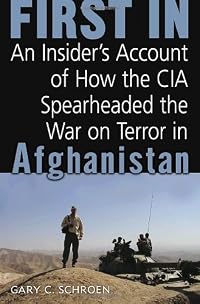
Although this book was better than the previous First In (2005) by the CIA’s Gary Schroen which covers some of the same material, it has serious flaws as well. Schroen is mentioned in Horse Soldiers as the main provider of bribes of CIA money to the warlords soon to be known as the Northern Alliance. This book purports to document the Army Special Forces soldiers (Fifth Group) along with others who were sent into Afghanistan to spearhead an armed military response to the attacks on the US after 9/11. Osama bin Laden had claimed credit for the attack and his operatives had carried out previous attacks which killed many innocents to make a point of showing that Islamic Jihad would use any means to kill westerners where they could be show more found. This Jihad would be a war against unarmed western civilians.
For some reason, Stanton believes that during the Vietnam War, Survey and Operations Group (SOG or MACV-SOG), SOG was responsible for the assassination and Coup of South Vietnamese President Diem (p. 92). Actually, it was the CIA but in Stanton’s mind SOG and the CIA were the same entity. And that, therefore, Army Special Forces were guilty of war crimes atrocities. SOG was comprised of Special Forces volunteers and directed out of the Pentagon (Headquartered in Saigon) and allied with the CIA intelligence apparatus but it is asinine legal sleight of hand to elide the CIA with SOG during Vietnam. It is silly to assume that since the CIA and Special Forces had the same origin in WWII’s Office of Strategic Services that the CIA & Army Special Forces were identical organizationally. It is a historical commonplace to blame the US military for the failures of the CIA during that time. The CIA alone was blamed by The Church Commission for the Vietnamese regime change in 1963. This shows Stanton to be uninformed but if he wanted the book to be blurbed by CIA people he would be pressured by the publisher to say this.
The book does not focus on the US troops themselves but on “key players”: Warlord Dostum, US Captain Mitch Nelson, and, strangely enough, American Jihadi John Walker Lindh. The book’s Afterward addresses the issue of nation building which became a farce at the end of the Bush Presidency with the so-called Freedom Agenda ending with Democracy in a Box. This book doesn’t go into that sad tale but gives the proposition that Special Forces should have led the Afghan nation building process (unification of tribes) for all of NATO and not just the USA alone footing the bill. This is a very weak analysis because it assumes that the Afghans are even interested in patriotic nation status at all. I would not recommend this book to serious readers but maybe selections for high schoolers who want to read past their grade comprehension level about recent historical events.
The bibliography is probably more worthwhile reading that the book itself which does not pay sufficient respect to the Operators who did the unbelievable work of uniting the militias to reclaim Afghanistan.
Decent Bibliography, Photos, Epilogue & Afterward, No Index show less
For some reason, Stanton believes that during the Vietnam War, Survey and Operations Group (SOG or MACV-SOG), SOG was responsible for the assassination and Coup of South Vietnamese President Diem (p. 92). Actually, it was the CIA but in Stanton’s mind SOG and the CIA were the same entity. And that, therefore, Army Special Forces were guilty of war crimes atrocities. SOG was comprised of Special Forces volunteers and directed out of the Pentagon (Headquartered in Saigon) and allied with the CIA intelligence apparatus but it is asinine legal sleight of hand to elide the CIA with SOG during Vietnam. It is silly to assume that since the CIA and Special Forces had the same origin in WWII’s Office of Strategic Services that the CIA & Army Special Forces were identical organizationally. It is a historical commonplace to blame the US military for the failures of the CIA during that time. The CIA alone was blamed by The Church Commission for the Vietnamese regime change in 1963. This shows Stanton to be uninformed but if he wanted the book to be blurbed by CIA people he would be pressured by the publisher to say this.
The book does not focus on the US troops themselves but on “key players”: Warlord Dostum, US Captain Mitch Nelson, and, strangely enough, American Jihadi John Walker Lindh. The book’s Afterward addresses the issue of nation building which became a farce at the end of the Bush Presidency with the so-called Freedom Agenda ending with Democracy in a Box. This book doesn’t go into that sad tale but gives the proposition that Special Forces should have led the Afghan nation building process (unification of tribes) for all of NATO and not just the USA alone footing the bill. This is a very weak analysis because it assumes that the Afghans are even interested in patriotic nation status at all. I would not recommend this book to serious readers but maybe selections for high schoolers who want to read past their grade comprehension level about recent historical events.
The bibliography is probably more worthwhile reading that the book itself which does not pay sufficient respect to the Operators who did the unbelievable work of uniting the militias to reclaim Afghanistan.
Decent Bibliography, Photos, Epilogue & Afterward, No Index show less
Stanton documents the actions of U.S. Special Forces soldiers who entered Afghanistan in October 2001 with the mission of assisting Northern Alliance forces in their battle against the Taliban. The description of 21st Century horse cavalry charges alone are worth reading the book for. Besides the stories of the men involved Stanton also documents the activities of John Walker Lindh. The book culminates in the riot at Qala-i-Jangi where Lindh was captured and Mike Spann became the first U.S. casulty of the Afghan war.
While the U.S.'s lack of preparation and intelligence prior to the start of the war is apparent throughout, the Special Forces troops helped the Northern Alliance take control of Afghanistan. The epilogue explains how it show more was then lost when the U.S. stopped using the tactics that had worked in the first place, it was also critical of the methods used in Iraq.
One issue I had with the book was Stanton often ascribed words or thoughts to people he was unlikely to have interviewed. In one case he wrote about something Mike Spann was thinking shortly before he was killed, however from the time he had these "thoughts" until his death a few minutes later, he didn't speak to anyone. While in all likelihood Stanton used these for narrative effect, it does make me question what else he may have invented. Regardless, a good book well worth reading. show less
While the U.S.'s lack of preparation and intelligence prior to the start of the war is apparent throughout, the Special Forces troops helped the Northern Alliance take control of Afghanistan. The epilogue explains how it show more was then lost when the U.S. stopped using the tactics that had worked in the first place, it was also critical of the methods used in Iraq.
One issue I had with the book was Stanton often ascribed words or thoughts to people he was unlikely to have interviewed. In one case he wrote about something Mike Spann was thinking shortly before he was killed, however from the time he had these "thoughts" until his death a few minutes later, he didn't speak to anyone. While in all likelihood Stanton used these for narrative effect, it does make me question what else he may have invented. Regardless, a good book well worth reading. show less
Doug Stanton asserts that wars in the 21st century will require as much diplomacy from soldiers as knowledge of warfare. His work narrates the compelling story of a small group of American Special Forces soldiers who fignt alongside anti-Taliban Afghanis in the weeks after 9/11, combining advanced tecnnology with ancient warefare, riding small, hardy horses through rugged terrain to quickly defeat the unpopular oppressors. Their methods of developing mutual trust and respect with the Afghan warlords and soldiers are starkly contrssted with the experience in Iraq, especially with the dissolution of the Iraqi army. Carefully researched, Stanton creates memorable characters in the background stories of these brave soldiers and homey family show more men, and makes the reader wonder why the general American population doesn't know their remarkable story. show less
This is a heavy read about the first military into Afghanistan after 9/11. It was a good "boots on the ground" war saga-educating me on the beginnings of our hunt for Bin Laden. The author gives you background on the Special Forces who dropped immediately after the Towers fell, spanning approximately 6 weeks. I found the research done by the author excellent and his story telling acceptable. I just felt that in a lot of places the verbiage could have been cut down and it would have been a better read. What I did gain from it was a ton of respect for the men and woman who protect us. What these people sacrifice, in family life and personal time is extra ordinary. I always try to thank any military personal I see-this book will remind me show more to keep doing that, it's the least we can do. show less
Members
- Recently Added By
Lists

Best Military History Books
123 works; 21 members
Author Information

5+ Works 2,915 Members
A former contributing editor at Esquire & Outside, Doug Stanton is now a contributing editor at Men's Journal. He received an MFA from The Writers' Workshop at the University of Iowa. He lives in Traverse City, Michigan. (Bowker Author Biography)
Awards and Honors
Common Knowledge
- Canonical title
- Horse Soldiers
- Original title
- Horse Soldiers Horse Soldiers : The Extraordinary Story of a Band of US Soldiers Who Rode to Victory in Afghanistan
- Alternate titles
- 12 Strong: The Declassified True Story of the Horse Soldiers
- Original publication date
- 2017-12-01
- Important places
- Mazar-i-Sharif, Afghanistan
- Important events
- 9-11
- Related movies
- Horse Soldiers (2012 | IMDb); 12 Strong (2018 | IMDb); Zero Dark Thirty (2012 | IMDb)
- Epigraph
- I am the kit fox,
I live in uncertainty
If there is anything difficult,
If there is anything dangerous to do,
That is mine.
--Sioux warrior's song - Dedication
- This book is dedicated to the men and women
of Fifth Special Forces Group and their families
And to my family,
Anne, John, Kate, and Will;
and to my parents
Bonnie and Derald Stanton;
and Deb, Tony, Gene... (show all)ssa, and Wylie Demin.
And, finally, Grant and Paulette Parsons.
I also wish to acknowledge a heartfelt debt of gratitude to
Sloan Harris, Colin Harrison, and Blake Ringsmuth. None finer
Without their unwavering support,
this book would not have been written. - First words
- Trouble came in the night, riding out of the dust and the darkness.
- Last words
- (Click to show. Warning: May contain spoilers.)He believed that it was.
- Blurbers
- Flynn, Vince; Brokaw, Tom; Lambert, Geoffrey C.; Mortenson, Greg; Sides, Hampton; Barcott, Bruce (show all 8); Seeger, J.R.; Carroll, Ward
- Original language
- English
Classifications
Statistics
- Members
- 1,183
- Popularity
- 20,992
- Reviews
- 26
- Rating
- (3.89)
- Languages
- English, Spanish, Portuguese (Portugal)
- Media
- Paper, Audiobook, Ebook
- ISBNs
- 31
- ASINs
- 13