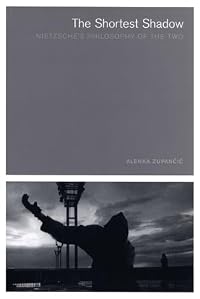
The Shortest Shadow: Nietzsche's Philosophy of the Two
by Alenka Zupancic
On This Page
Description
Restoring Nietzsche to a Nietzschean context--examining the definitive element that animates his work. What is it that makes Nietzsche Nietzsche? In The Shortest Shadow, Alenka Zupančič counters the currently fashionable appropriation of Nietzsche as a philosopher who was "ahead of his time" but whose time has finally come--the rather patronizing reduction of his often extraordinary statements to mere opinions that we can "share." Zupančič argues that the definitive Nietzschean quality show more is his very unfashionableness, his being out of the mainstream of his or any time. To restore Nietzsche to a context in which the thought "lives on its own credit," Zupančič examines two aspects of his philosophy. First, in "Nietzsche as Metapsychologist," she revisits the principal Nietzschean themes--his declaration of the death of God (which had a twofold meaning, "God is dead" and "Christianity survived the death of God"), the ascetic ideal, and nihilism--as ideas that are very much present in our hedonist postmodern condition. Then, in the second part of the book, she considers Nietzsche's figure of the Noon and its consequences for his notion of the truth. Nietzsche describes the Noon not as the moment when all shadows disappear but as the moment of "the shortest shadow"--not the unity of all things embraced by the sun, but the moment of splitting, when "one turns into two." Zupančič argues that this notion of the Two as the minimal and irreducible difference within the same animates all of Nietzsche's work, generating its permanent and inherent tension. show lessTags
Recommendations
Member Reviews
This book is a Lacanian psychoanalytic study of certain issues and themes in Nietzsche's work. Author Zupančič is primarily concerned to offer a reading in which Nietzsche's writing upholds and advances a Lacanian idea (I think? I have not read Lacan) of "the Real as the minimal difference of the same," which is her interpretation of the figure of "the shortest shadow" among Nietzsche's important "noon" tropes. According to Zupančič, this notion is the crux of a "philosophy of the two" to escape the sort of complementarity which reduces itself to unity.
I came to this book with a very different reading of "the shortest shadow," and while Zupančič did not persuade me that hers was better, I did enjoy the book. The general gist show more is antimetaphysical without becoming a rationalist empiricism or materialist positivism -- a feature of Nietzsche's own work, to be sure. It is demanding, though; I found that even the least fatigue on my part could reduce the writing here to gobbledygook. There was more of value for me in the first half of the book than the second, although that was perhaps a function of my limits as a reader.
Zupančič appends an essay "On Love as Comedy," which treats some of the same issues, without any direct references to Nietzsche. It had been written as a separate project. Somewhat disorientingly in the context of a volume on Nietzsche, its definition of the comedic genre does not relate to classical or even Shakespearean sources. Instead, the exemplars are the Marx Brothers and Charlie Chaplin. And yet references to tragedy are still to Aeschylus, following Lacan.
I might read other volumes in this series edited by Slavoj Zizek -- of which The Shortest Shadow is the second. But the experience of this one suggests that I could benefit from a little "remedial" reading in Lacan before I do. show less
I came to this book with a very different reading of "the shortest shadow," and while Zupančič did not persuade me that hers was better, I did enjoy the book. The general gist show more is antimetaphysical without becoming a rationalist empiricism or materialist positivism -- a feature of Nietzsche's own work, to be sure. It is demanding, though; I found that even the least fatigue on my part could reduce the writing here to gobbledygook. There was more of value for me in the first half of the book than the second, although that was perhaps a function of my limits as a reader.
Zupančič appends an essay "On Love as Comedy," which treats some of the same issues, without any direct references to Nietzsche. It had been written as a separate project. Somewhat disorientingly in the context of a volume on Nietzsche, its definition of the comedic genre does not relate to classical or even Shakespearean sources. Instead, the exemplars are the Marx Brothers and Charlie Chaplin. And yet references to tragedy are still to Aeschylus, following Lacan.
I might read other volumes in this series edited by Slavoj Zizek -- of which The Shortest Shadow is the second. But the experience of this one suggests that I could benefit from a little "remedial" reading in Lacan before I do. show less
Insightful but uneven and kind of underdeveloped. I kept getting the strangest feeling that I was seeing ideas later used by Zizek without attribution. But who knows, maybe it was the other way around.
Ratings
Members
- Recently Added By
Lists

New philosophy
65 works; 2 members
Author Information
23 Works 405 Members
Alenka Zupancic, a Slovenian psychoanalytic theorist and philosopher, teaches at the European Graduate School and is a researcher at the Institute of Philosophy at the Slovenian Academy of Sciences and Arts. She is the author of The Shortest Shadow: Nietzsche's Philosophy of the Two and The Odd One In: On Comedy, both in the Short Circuits series, show more published by the MIT Press. show less
Series
Belongs to Publisher Series
Short Circuits (2)
Common Knowledge
- Canonical title
- The Shortest Shadow: Nietzsche's Philosophy of the Two
- People/Characters
- Nietzsche, Friedrich Wilhelm, 1844-1900
Classifications
Statistics
- Members
- 84
- Popularity
- 377,726
- Reviews
- 2
- Rating
- (4.21)
- Languages
- English, Slovenian
- Media
- Paper, Ebook
- ISBNs
- 4
- ASINs
- 2