On This Page
Description
When a bear hunt culminates in the discovery of a brutally murdered woman in a northern Swedish village, Rebecka Martinsson delves into the victim's tragic family history, only to be blocked from the case by an arrogant prosecutor.Tags
Recommendations



















Member Reviews
The Second Deadly Sin‘ (2012) is the fifth book featuring Recka Martisson, a prosecutor working in the far north of Sweden, having abandoned her high-powered job in Stockholm to come back to the village she was raised in.
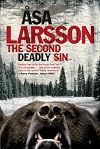
The cover and the publisher's summary seem determined to represent 'The Second Deadly Sin' as a thriller with a long investigator search for the truth against all odds. It sets the expectation of lots of arctic action and derring-do and completely misrepresents what this book is about. The book is filled with violent confrontations and has many moments of high tension but it's not a book that sets out to thrill the reader. The second deadly sin that gives the book its title is greed. It seems to me that what Åsa show more Larsson sets out to do is to get the reader to experience and consider the ugly actions and emotions that greed generates in people.
This a dark book, even darker than the ones that went before it. It’s set in two timelines, the present day and the early twentieth century when what is now a quiet village was a booming mining town, dominated by a single employer. Larsson pulled no punches in describing the violence, misogyny, and oppression of the poor. Sadly, her descriptions of the present day show only a superficial improvement.
The link between the early twentieth-century timeline and the present day wasn't immediately apparent, except as a likely explanation of the motivation for the present-day killings. At times, I resented being pulled away from the actions of the present-day characters who I know well in order to drop back a few generations into a world where violence, greed, poverty, privilege and misogyny were so prevalent that they were taken for granted. Then, bit by bit, I got wrapped up in the story of the doomed efforts a young school teacher trying to make a life for herself in a raw scar of a town set in the beauty of the far north. It was a depressing story, made more so by being entirely plausible.
The present-day timeline delivered a solid mystery and some very tense action. The plot echoed the themes of greed and a sort of structural misogyny which normalises violence against women. The ending was tense, surprising and satisfying.
What I enjoyed even more than the mystery was watching the relationships grow between Martinsson and the police officers and Martinsson's former boss in Stockholm. I particularly enjoyed the descriptions of the prosecutor who is trying to push Martisson aside. Larsson uses him to give an insight into the self-justifying narrative that an upper-class man with more ambition than ability and with an unassailable belief in his own worth, generates to exonerate himself from all blame.
I immerse myself completely in these books, even when that means being mired in sadness and confronted with ugliness. I think the reason for that is that, in the face of it all, Martinsson manages to retain her empathy and search for a little happiness.
There's only one book left in the series now, 'The Sins Of Our Fathers'. I'm almost reluctant to read it because I know it will be my last visit with Rebecka Martinsson. show less
The cover and the publisher's summary seem determined to represent 'The Second Deadly Sin' as a thriller with a long investigator search for the truth against all odds. It sets the expectation of lots of arctic action and derring-do and completely misrepresents what this book is about. The book is filled with violent confrontations and has many moments of high tension but it's not a book that sets out to thrill the reader. The second deadly sin that gives the book its title is greed. It seems to me that what Åsa show more Larsson sets out to do is to get the reader to experience and consider the ugly actions and emotions that greed generates in people.
This a dark book, even darker than the ones that went before it. It’s set in two timelines, the present day and the early twentieth century when what is now a quiet village was a booming mining town, dominated by a single employer. Larsson pulled no punches in describing the violence, misogyny, and oppression of the poor. Sadly, her descriptions of the present day show only a superficial improvement.
The link between the early twentieth-century timeline and the present day wasn't immediately apparent, except as a likely explanation of the motivation for the present-day killings. At times, I resented being pulled away from the actions of the present-day characters who I know well in order to drop back a few generations into a world where violence, greed, poverty, privilege and misogyny were so prevalent that they were taken for granted. Then, bit by bit, I got wrapped up in the story of the doomed efforts a young school teacher trying to make a life for herself in a raw scar of a town set in the beauty of the far north. It was a depressing story, made more so by being entirely plausible.
The present-day timeline delivered a solid mystery and some very tense action. The plot echoed the themes of greed and a sort of structural misogyny which normalises violence against women. The ending was tense, surprising and satisfying.
What I enjoyed even more than the mystery was watching the relationships grow between Martinsson and the police officers and Martinsson's former boss in Stockholm. I particularly enjoyed the descriptions of the prosecutor who is trying to push Martisson aside. Larsson uses him to give an insight into the self-justifying narrative that an upper-class man with more ambition than ability and with an unassailable belief in his own worth, generates to exonerate himself from all blame.
I immerse myself completely in these books, even when that means being mired in sadness and confronted with ugliness. I think the reason for that is that, in the face of it all, Martinsson manages to retain her empathy and search for a little happiness.
There's only one book left in the series now, 'The Sins Of Our Fathers'. I'm almost reluctant to read it because I know it will be my last visit with Rebecka Martinsson. show less
The sin, of course, is greed, but it is difficult to see how it ties in to the murder of a grandmother and the pursuit of a very young boy. The reader learns about the family history through a parallel story two generations back, and so knows more than the police, until Rebekka Martinsson connects the murder to other family disasters. In the meantime, the usual political idiocy prevails. A good entry in this series, but I suspect the author has a bleak view of human frailty.
The Rebecka Martinsson mysteries written by Asa Larsson were among the top reasons Scandinavian crime fiction became a favorite of mystery readers years before Steig Larsson's books were published. They are dark, with insights into souls whose lives were far from perfect but who carried on until the day or night they could not.
The series also has always been as much about Rebecka Martinsson's search for herself after she left a succssful law practice in Stockholm and returned to her rural roots. Over the course of the books, she has become a little bit more comfortable about herself and has become closer to other people, especially to some who are as damaged on the outside as she thinks herself to be on the inside. That is one of the show more most interesting aspects of this series -- Martinsson thinks she deserves the worst, yet in earlier books readers don't see the validity of that opinion.
But now, Martinsson has been maneuvered by her creator into performing a terrible deed in the climax of a murder investigation, apparently to make it more believable why she would seek comfort from a corner where she should have sought it long ago. That the source of that comfort does something out of the kindness of his heart that looks cruel and ridiculous on the outside -- as two scandal-seeking reporters prove -- doesn't make this manipulation any more fitting.
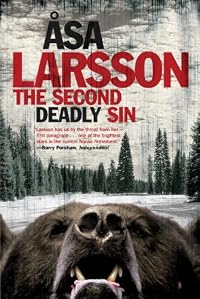
Until that happens, however, and after a graphic opening involving a hunting dog and a bear, The Second Deadly Sin is an interesting investigative novel. A neighbor of Martinsson's is found dead one day, killed and marked as a whore, a reference to old gossip. The grandson she was caring for is missing. Martinsson and her friends are first on the scene, and the story is suspenseful, tighty written and as good as any thriller. Because it is also character-based as much as plot-based, it provides a highly satisfying reading experience.
Martinsson is taken off the case by her prosecutor boss out of the jealousy of a colleague, who is portrayed as well as any other power-hungry, egotistical character who gets in the way of a crime fiction leading character. This one, however, refers to Martinsson and a female police officer as "little [n-word] boys", which is one of the most egregious use of that hate word seen in quite some time. A white male character does not have to refer to two white women as that word to be shown as a clueless jerk; there were plenty of other examples. Whether the author originally used this hate word in her work or whether it was used by the translator, "inappropriate" is about as calm a description as can be used.
That word choice and violence against animals tip the balance against recommending this book, because the main story is as good as the earlier Martinsson novels. The story of the murder victim and her family, including passages from the past in which the unfortunate family tree originated, are fascinating and well-written.
This is a series I shall miss. show less
The series also has always been as much about Rebecka Martinsson's search for herself after she left a succssful law practice in Stockholm and returned to her rural roots. Over the course of the books, she has become a little bit more comfortable about herself and has become closer to other people, especially to some who are as damaged on the outside as she thinks herself to be on the inside. That is one of the show more most interesting aspects of this series -- Martinsson thinks she deserves the worst, yet in earlier books readers don't see the validity of that opinion.
But now, Martinsson has been maneuvered by her creator into performing a terrible deed in the climax of a murder investigation, apparently to make it more believable why she would seek comfort from a corner where she should have sought it long ago. That the source of that comfort does something out of the kindness of his heart that looks cruel and ridiculous on the outside -- as two scandal-seeking reporters prove -- doesn't make this manipulation any more fitting.
Until that happens, however, and after a graphic opening involving a hunting dog and a bear, The Second Deadly Sin is an interesting investigative novel. A neighbor of Martinsson's is found dead one day, killed and marked as a whore, a reference to old gossip. The grandson she was caring for is missing. Martinsson and her friends are first on the scene, and the story is suspenseful, tighty written and as good as any thriller. Because it is also character-based as much as plot-based, it provides a highly satisfying reading experience.
Martinsson is taken off the case by her prosecutor boss out of the jealousy of a colleague, who is portrayed as well as any other power-hungry, egotistical character who gets in the way of a crime fiction leading character. This one, however, refers to Martinsson and a female police officer as "little [n-word] boys", which is one of the most egregious use of that hate word seen in quite some time. A white male character does not have to refer to two white women as that word to be shown as a clueless jerk; there were plenty of other examples. Whether the author originally used this hate word in her work or whether it was used by the translator, "inappropriate" is about as calm a description as can be used.
That word choice and violence against animals tip the balance against recommending this book, because the main story is as good as the earlier Martinsson novels. The story of the murder victim and her family, including passages from the past in which the unfortunate family tree originated, are fascinating and well-written.
This is a series I shall miss. show less
The Second Deadly Sin is set in northern Sweden and opens with the hunt for a wounded bear. When it is finally brought down, the hunters make a grisly discovery. The story then moves to the seemingly disconnected but equally horrific murder of a woman and her missing grandson. Prosecutor Rebecka Martinsson is initially assigned to the case but a less skilled but extremely ambitious rival manages to claim it for himself. Martinsson refuses to take a less important case and instead decides to take her vacation time. However, she can’t let it go. She discovers there are threads tying the bear hunt and the murder together and that they may also be linked to other sudden and unexplained deaths.
The novel alternates between Martinsson’s show more investigations in the present and the story of the love affair between a young school teacher and an important mining official in the years leading up to WWI. As Martinsson digs deeper, she begins to suspect that these events of the past are somehow related to those in the present and that, if she doesn’t solve the case quickly, there will be more deaths.
This is the fifth in this series by Swedish author Asa Larsson but it is the first I have read and it worked very well as a standalone. Larsson has a deft hand with descriptions of both time and place. Her forays into the past are very well written and seem likely to be true to the time period including her portrayal of the pre-WWI cultural and class values. The story is both intelligent and suspenseful and, like so many of the thrillers coming out of the Scandinavian countries, very dark. But it is with her characters where Larsson shines. She has created a group of memorable characters who are at once sympathetic and flawed and who make us care about what happens to them. Best of all, I never guessed who the murderer was until the big reveal at the end, something that happens too rarely. Definitely a high recommendation from me especially for fans of Nordic Noir. show less
The novel alternates between Martinsson’s show more investigations in the present and the story of the love affair between a young school teacher and an important mining official in the years leading up to WWI. As Martinsson digs deeper, she begins to suspect that these events of the past are somehow related to those in the present and that, if she doesn’t solve the case quickly, there will be more deaths.
This is the fifth in this series by Swedish author Asa Larsson but it is the first I have read and it worked very well as a standalone. Larsson has a deft hand with descriptions of both time and place. Her forays into the past are very well written and seem likely to be true to the time period including her portrayal of the pre-WWI cultural and class values. The story is both intelligent and suspenseful and, like so many of the thrillers coming out of the Scandinavian countries, very dark. But it is with her characters where Larsson shines. She has created a group of memorable characters who are at once sympathetic and flawed and who make us care about what happens to them. Best of all, I never guessed who the murderer was until the big reveal at the end, something that happens too rarely. Definitely a high recommendation from me especially for fans of Nordic Noir. show less
This is the fifth in the prosecutor Rebecka Martinson of Kiruna, Sweden series. From my perspective, it is the most enjoyable, with a lighter touch - despite the title - than the previous ones, thank goodness. But, winter is approaching, there are some strange sounds out there, and then there's the concluding pursuit through some dark, scary woods. So it does have its share of Swedish doom and gloom. The light moments however give more than adequate relief and come via a passel of pet dogs and Marcus, a seven year old boy, survivor of the violent murder of his guardian grandmother, Sol-Britt. As self-therapy following the violent event he has witnessed Marcus pretends that he is a dog, and he is delighted to bark, eat on all fours and show more even sleep in the kennel at night with his trusted friends. The story continually shifts between the present and events that happened in the same town 90 years ago, events which focused on the death of Marcus's great, great-grandmother, Elina. And it turns out, there have been other violent deaths in the family tree which links Marcus and Elina. Why? What is the link? Many of the characters in "Sin" have appeared in earlier books; they are all well done, including an evil bureaucrat who is attempting to derail Rebecka's career (another deadly sin - oh, and let me add that despite the title this book does not have the strong moral-sin-righteousness tone that some may expect from such a title). The plot is very interesting and Rebecka is stronger than in previous books. And she seems to be drawn to police officer Erickson a bit more, while beau Mans faithfully pines away in Stockholm. What is up with that ? I strongly recommend this book and it can be read as a stand-alone very easily. I also suggest that readers check out Kiruna on Google Maps; "walk" around town a bit to get a feel for the place. I just wish Larsson would crank these books out a bit faster. show less
The book opens with what is, for this city dweller anyway, a somewhat confronting depiction of a bear hunt in the wilds of northern Sweden at the end of which it is discovered this particular bear has eaten a human being. In a seemingly disconnected episode in a nearby town a woman has been violently murdered and her young grandson is missing from the house. Prosecutor Rebecka Martinsson is initially assigned to the murder investigation but one of Martinsson’s colleagues, jealous of her experience on big cases, contrives to have her removed. While he takes over the official investigation Rebecka is on holidays but can’t quite let go of her notion that something connects the two events and so she continues to look into matters.
One of show more the things I enjoy most about Åsa Larsson’s writing is that she takes risks. They’re not always entirely successful but they do allow her to take her storytelling and character development in unpredictable directions and collectively result in a refreshing lack of that formulaic feeling that often accompanies a crime series. It struck me, for example, as I read the fifth novel in which she stars, that Rebecka Martinsson is almost the exact opposite of the traditional crime fiction protagonist who starts out relatively normal but acquires the trappings of the stress-filled job (alcoholism, broken relationships, mental illness etc) over time. Martinsson had her mental breakdown at the end of the first book in which she appeared and has worked her way back from there to the point that in THE SECOND DEADLY SIN she is content, confident and self reliant. She can catch her own food, distill her own alcohol and follow her instincts intelligently. Frankly that would be enough to make her interestingly different from most of her fictional counterparts but Larsson doesn’t leave it there. At the end of the book Rebecka is placed in a horrible situation where she chooses to do something most people would find almost impossible. I love that Larsson doesn’t give her a ‘just in the nick of time’ escape from the brutal reality of her circumstances (as 95% of novels would do) and shows that even though she did the awful thing for the right reason Rebecka struggles with the guilt of her actions.
The novel does have some similarities to its predecessors, perhaps most notably in the author’s continued thoughtful exploration of the connection between humans and the natural world, especially animals. This theme crops up in a variety of ways in THE SECOND DEADLY SIN but most particularly in the relationships that several of the key characters have with their various dogs. One element that was completely new to me in this novel though was the gentle humour that runs subtly through it. There are some laugh-out-loud jokes and a dry wit that gives the novel a more upbeat tone than the earlier books, a couple of which were almost unbearably bleak.
The storytelling here is first rate. Along with the modern-day events there’s a story from a hundred years ago, when Kiruna was the world’s newest town and a young schoolteacher headed there to make a new life for herself. But all these seemingly random threads are surprisingly easy to follow and each one is compelling in its own right. The reader is gripped by the plight of the schoolteacher as she falls in love with someone who proves unworthy. But we easily switch our interest to what will become of Marcus, the young boy who might have seen what happened to his grandmother but is so traumatised he pretends to be a wild dog. Fortunately he is watched over by Eriksson, the police dog handler who is in love with Rebecka but believes he’ll never have more than her friendship. And just when we think we don’t want to be pulled away from that thread we’re thrown into the official investigation which is being led by a pompous, foolish man whom the police, including Rebecka’s friend Detective Anna-Maria Mella, struggle to be civil to let alone follow into battle as it were.
The nuns who terrorised my childhood imprinted upon me that greed and avarice, very clearly the subjects of this novel, are the third rather than the second of the seven deadly sins so perhaps I have missed the meaning of the book’s title but even if so I loved the book itself. Ably translated by Laurie Thompson it is the best thing Åsa Larsson has written so far (and yes I realise I said that last time too) and I would recommend it to any reader. It’s funny, exciting, thoughtful and thought-provoking and if the ending doesn’t leave you with your heart in your mouth and a tear in your eye then I’m not sure I want to know you. show less
One of show more the things I enjoy most about Åsa Larsson’s writing is that she takes risks. They’re not always entirely successful but they do allow her to take her storytelling and character development in unpredictable directions and collectively result in a refreshing lack of that formulaic feeling that often accompanies a crime series. It struck me, for example, as I read the fifth novel in which she stars, that Rebecka Martinsson is almost the exact opposite of the traditional crime fiction protagonist who starts out relatively normal but acquires the trappings of the stress-filled job (alcoholism, broken relationships, mental illness etc) over time. Martinsson had her mental breakdown at the end of the first book in which she appeared and has worked her way back from there to the point that in THE SECOND DEADLY SIN she is content, confident and self reliant. She can catch her own food, distill her own alcohol and follow her instincts intelligently. Frankly that would be enough to make her interestingly different from most of her fictional counterparts but Larsson doesn’t leave it there. At the end of the book Rebecka is placed in a horrible situation where she chooses to do something most people would find almost impossible. I love that Larsson doesn’t give her a ‘just in the nick of time’ escape from the brutal reality of her circumstances (as 95% of novels would do) and shows that even though she did the awful thing for the right reason Rebecka struggles with the guilt of her actions.
The novel does have some similarities to its predecessors, perhaps most notably in the author’s continued thoughtful exploration of the connection between humans and the natural world, especially animals. This theme crops up in a variety of ways in THE SECOND DEADLY SIN but most particularly in the relationships that several of the key characters have with their various dogs. One element that was completely new to me in this novel though was the gentle humour that runs subtly through it. There are some laugh-out-loud jokes and a dry wit that gives the novel a more upbeat tone than the earlier books, a couple of which were almost unbearably bleak.
The storytelling here is first rate. Along with the modern-day events there’s a story from a hundred years ago, when Kiruna was the world’s newest town and a young schoolteacher headed there to make a new life for herself. But all these seemingly random threads are surprisingly easy to follow and each one is compelling in its own right. The reader is gripped by the plight of the schoolteacher as she falls in love with someone who proves unworthy. But we easily switch our interest to what will become of Marcus, the young boy who might have seen what happened to his grandmother but is so traumatised he pretends to be a wild dog. Fortunately he is watched over by Eriksson, the police dog handler who is in love with Rebecka but believes he’ll never have more than her friendship. And just when we think we don’t want to be pulled away from that thread we’re thrown into the official investigation which is being led by a pompous, foolish man whom the police, including Rebecka’s friend Detective Anna-Maria Mella, struggle to be civil to let alone follow into battle as it were.
The nuns who terrorised my childhood imprinted upon me that greed and avarice, very clearly the subjects of this novel, are the third rather than the second of the seven deadly sins so perhaps I have missed the meaning of the book’s title but even if so I loved the book itself. Ably translated by Laurie Thompson it is the best thing Åsa Larsson has written so far (and yes I realise I said that last time too) and I would recommend it to any reader. It’s funny, exciting, thoughtful and thought-provoking and if the ending doesn’t leave you with your heart in your mouth and a tear in your eye then I’m not sure I want to know you. show less
The Second Deadly Sin by Asa Larsson (translated by Laurie Thompson)
The Second Deadly Sin is the fifth book in the Rebecka Martinsson mystery series and the first book by this author for me. I have enjoyed previous Scandinavian crime fiction from the Norwegian author, Jo Nesbo and Stieg Larsson of Dragon Tattoo fame. The author had received numerous literary awards for previous works so I decided it was time to dip my toe into the Swedish countryside.
The title's reference to second "deadly sins" took me to internet for a refresher; second on the list is avarice or greed. The author's foreword informs the reader of the fury of God for those failing to follow His laws. His punishments are pretty harsh. She specifically refers to Moloch show more (Leviticus, Chapter 20) and the wrath of God on all future generations of his family. That was a hint of things to come.
The book opens with a graphic description of man versus man-eating bear, and ends with the death of the bear and the discovery of human bones in its stomach.
Chapter headings indicate the action takes place over five days in October. We are introduced to District Prosecutor Rebecka Martinsson and given a tour of her family home where we meet Brat and Vera, her dogs. Her first visitor is a physically disfigured policeman, Krister Eriksson and his sheepdogs, Tintin and Roy. A neighbor arrives looking for a ride to check out the welfare of a friend, Sol-Britt.
Sol-Britt Uusitalo has been savagely murdered and her young grandson, Marcus is missing. One-by-one the characters appear in the story line. Police and associated forensic associates are introduced with the requisite narcissistic officer determined to undermine our heroine, Rebecka.
It turns out that Sol-Britt's family has a history of unexplained tragedies. Sol-Britt's father, Frans Uusitalo, was the man eaten by the bear. Her grandmother was raped and beaten to death. A brother was run over in a hit-and-run accident.
The story abruptly lurches into April 15, 1914 and begins a parallel story line with a schoolteacher, Elina Pettersson. I felt the transition between the two stories, one in World War I and the other in the present, was a little awkward at times. It was difficult at times to figure out the decade being discussed as more unfortunate family members turn up dead in what was determined initially to be accidents.
I felt the story of Elina and her lover was drawn out way too long. The crazed villain who murdered Elina was a detestable character but the story failed to define the reasons for his intense hatred of women. The detailed descriptions of the Swedish mining industry with its concomitant international importance to the war was interesting.
Sprinkled throughout the story was the developing intimacy between Rebecka and Krister that ended sweetly but predictably. Rebecka has a mysteriously absent fiance, Måns, who probably could have been left out of the book.
Overall I would say the book was a good read but not a great read. There were suspenseful moments that captured my attention and I am glad to have had the chance to read this book as an advance copy. show less
The Second Deadly Sin is the fifth book in the Rebecka Martinsson mystery series and the first book by this author for me. I have enjoyed previous Scandinavian crime fiction from the Norwegian author, Jo Nesbo and Stieg Larsson of Dragon Tattoo fame. The author had received numerous literary awards for previous works so I decided it was time to dip my toe into the Swedish countryside.
The title's reference to second "deadly sins" took me to internet for a refresher; second on the list is avarice or greed. The author's foreword informs the reader of the fury of God for those failing to follow His laws. His punishments are pretty harsh. She specifically refers to Moloch show more (Leviticus, Chapter 20) and the wrath of God on all future generations of his family. That was a hint of things to come.
The book opens with a graphic description of man versus man-eating bear, and ends with the death of the bear and the discovery of human bones in its stomach.
Chapter headings indicate the action takes place over five days in October. We are introduced to District Prosecutor Rebecka Martinsson and given a tour of her family home where we meet Brat and Vera, her dogs. Her first visitor is a physically disfigured policeman, Krister Eriksson and his sheepdogs, Tintin and Roy. A neighbor arrives looking for a ride to check out the welfare of a friend, Sol-Britt.
Sol-Britt Uusitalo has been savagely murdered and her young grandson, Marcus is missing. One-by-one the characters appear in the story line. Police and associated forensic associates are introduced with the requisite narcissistic officer determined to undermine our heroine, Rebecka.
It turns out that Sol-Britt's family has a history of unexplained tragedies. Sol-Britt's father, Frans Uusitalo, was the man eaten by the bear. Her grandmother was raped and beaten to death. A brother was run over in a hit-and-run accident.
The story abruptly lurches into April 15, 1914 and begins a parallel story line with a schoolteacher, Elina Pettersson. I felt the transition between the two stories, one in World War I and the other in the present, was a little awkward at times. It was difficult at times to figure out the decade being discussed as more unfortunate family members turn up dead in what was determined initially to be accidents.
I felt the story of Elina and her lover was drawn out way too long. The crazed villain who murdered Elina was a detestable character but the story failed to define the reasons for his intense hatred of women. The detailed descriptions of the Swedish mining industry with its concomitant international importance to the war was interesting.
Sprinkled throughout the story was the developing intimacy between Rebecka and Krister that ended sweetly but predictably. Rebecka has a mysteriously absent fiance, Måns, who probably could have been left out of the book.
Overall I would say the book was a good read but not a great read. There were suspenseful moments that captured my attention and I am glad to have had the chance to read this book as an advance copy. show less
Members
- Recently Added By
Published Reviews
ThingScore 75
Det är miljöerna, människorna och den underliggande värmen som lyfter Åsa Larssons deckare. Lotta Olsson läser den nya boken ”Till offer åt Molok” och blir riktigt överraskad.
Det är inte intrigerna som gör att man älskar Åsa Larssons deckare. Men det brukar man inte komma på förrän efteråt.
I stället är det miljöerna, människorna, språket och den underliggande show more värmen. Och hundarna, förstås. Åsa Larsson älskar sina personer, hon kliar både människor och hundar bakom öronen och väver in dem i en mänsklighet där allt går åt helvete men ändå är värt besväret. show less
added by annek49
Lists

Scandinavian Crime Fiction
224 works; 37 members

Female Protagonist
1,056 works; 56 members
Author Information

47+ Works 5,693 Members
Awards and Honors
Awards
Series

Common Knowledge
- Canonical title
- The Second Deadly Sin
- Original title
- Till offer åt Molok
- Original publication date
- 2012 (Original Swedish) (Original Swedish); 2014 (English) (English)
- People/Characters
- Rebecka Martinsson (district prosecutor); Anna-Maria Mella (police inspector); Sivving Fjällborg (neighbour of Rebecka); Krister Eriksson (police dog handler); Sven-Erik Stålnacke (police); Tommy Rantakyrö (police) (show all 23); Fred Olsson (police); Sol-Britt Uusitalo (victim); Marcus Elias Uusitalo (7, grandson of Sol-Britt); Lars Pohjanen (pathologist); Carl von Post (district prosecutor); Alf Björnfot (chief prosecutor); Elina Pettersson (schoolteacher, grandmother of Sol-Britt); Hjalmar Lundbohm (mining director, grandfather of Sol-Britt); Klara "Lizzie" Andersson (housekeeper of Lundbohm); Fasth (mine manager-in-chief); Frans Olof Uusitalo (father of Sol-Britt, son of Elina and Lundbohm); Matti Uusitalo (father of Marcus, son of Sol-Britt); Maja Larsson (cousin of Sol-Britt); Örjan Bäck (boyfriend of Maja); Jocke Häggroth (client of Sol-Britt); Jenny Häggroth (wife of Jocke); Måns Wenngren (boyfriend of Rebecka)
- Important places
- Kurravaara, Norrbotten County, Sweden; Kiruna, Sweden
- First words
- How can a dog possibly scream like that?
- Last words
- (Click to show. Warning: May contain spoilers.)"I'd love to have breakfast with you."
- Publisher's editor*
- 'First published by Albert Bonniers Förlag, Stockholm, Sweden.'
- Original language
- Swedish
*Some information comes from Common Knowledge in other languages. Click "Edit" for more information.
Classifications
- Genres
- Fiction and Literature, Mystery
- DDC/MDS
- 839.738 — Literature & rhetoric German & related literatures Other Germanic literatures Swedish literature Swedish fiction 2000-
- LCC
- PT9877.22 .A78 .T5613 — Language and Literature German, Dutch and Scandinavian literatures Swedish literature Individual authors or works 2001-
- BISAC
Statistics
- Members
- 549
- Popularity
- 53,754
- Reviews
- 28
- Rating
- (3.85)
- Languages
- 16 — Catalan, Czech, Danish, Dutch, English, Finnish, French, German, Italian, Norwegian (Bokmål), Norwegian, Polish, Portuguese, Russian, Spanish, Swedish
- Media
- Paper, Audiobook, Ebook
- ISBNs
- 64
- ASINs
- 13