On This Page
Description
Looks at all the different microbes that inhabit the Earth and examines the varied jobs they do.Tags
Recommendations

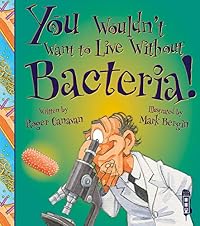
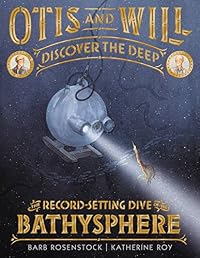
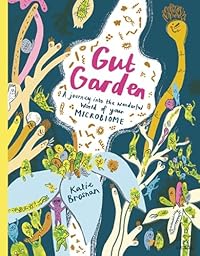
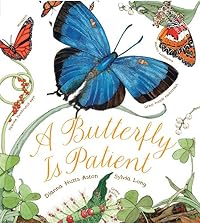




Member Recommendations
themulhern If this book has piqued your child's interest, "Inside Your Insides" is a nice step up. Great illustrations, more text, and some really funny bits.
Member Reviews
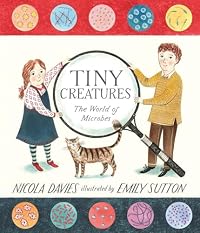
British author/illustrator team Nicola Davies and Emily Sutton explore the fascinating world of microbes in this informative, beautifully-produced picture-book. Using simple, clear language and artwork which perfectly depicts the subject under discussion, they describe how these microscopic but prolific creatures reproduce, the diverse tasks they accomplish, and their great importance to humanity and to the larger world. Tiny they may be, but they are mighty as well...
I initially sought out Tiny Creatures: The World of Microbes because I was looking for more of Sutton's work, after enjoying her illustrations in such titles as Delia Huddy's The Christmas Eve Tree and Katherine Rundell's One Christmas Wish, but I ended up enjoying it as show more much for Davies' deceptively simple text as for the beautiful artwork. This wasn't much of a surprise, as I have also enjoyed many of the author's other books, both fiction and non-fiction. This one does an excellent job of explaining a complicated subject, dealing with everything from the incredibly small size of microbes to their outsized role in shaping the planet in a way that will be readily understandable for younger children. Recommended to picture-book readers looking for excellent science titles for children ages four through seven. For my own part, I intend to seek out other books from this pair! show less
I initially sought out Tiny Creatures: The World of Microbes because I was looking for more of Sutton's work, after enjoying her illustrations in such titles as Delia Huddy's The Christmas Eve Tree and Katherine Rundell's One Christmas Wish, but I ended up enjoying it as show more much for Davies' deceptively simple text as for the beautiful artwork. This wasn't much of a surprise, as I have also enjoyed many of the author's other books, both fiction and non-fiction. This one does an excellent job of explaining a complicated subject, dealing with everything from the incredibly small size of microbes to their outsized role in shaping the planet in a way that will be readily understandable for younger children. Recommended to picture-book readers looking for excellent science titles for children ages four through seven. For my own part, I intend to seek out other books from this pair! show less
Nicola Davies is one of my absolute favorite authors of nonfiction for young children (the others are basically all Peachtree authors, in case you're wondering). She doesn't disappoint in this new book tackling a unique subject: microbes!
The book starts out by giving some scales of the size and number of microbes, then talks about how they are everywhere. There are comparative images of large and small microbes, and then my favorite spread which shows lots of different kinds of microbes so you can see all the unique shapes and patterns.
The book then explains how microbes can eat anything and that they transform things into something else, like milk into yoghurt! Davies attempts to explain how rapidly they split and increase with a show more stunning visual across two pages.
The story finishes with talking about how "the wrong kind of microbes" can make you sick and some simple precautions (like washing your hands) but reassures readers that there are very few microbes that will make you sick. The book ends with two gorgeous spreads showing the amazing BIG things that tiny microbes can do. "They are the invisible transformers of our world."
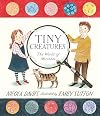
Sutton's illustrations are the perfect accompaniment to Davies' simple but beautiful text. She draws both cozy, cheerful pictures relating the abstract idea of something so tiny you can't see to the things you can see, and also stunning, delicate illustrations of microbes themselves.
Verdict: This will work in a storytime with an older audience; probably four and up. It will also be a great book for teachers and families to enjoy in smaller groups to pique children's curiosity about the world around them. Highly recommend.
ISBN: 9780763673154; Published 2014 by Candlewick; Borrowed from another library in my consortium; Added to the library's order list show less
The book starts out by giving some scales of the size and number of microbes, then talks about how they are everywhere. There are comparative images of large and small microbes, and then my favorite spread which shows lots of different kinds of microbes so you can see all the unique shapes and patterns.
The book then explains how microbes can eat anything and that they transform things into something else, like milk into yoghurt! Davies attempts to explain how rapidly they split and increase with a show more stunning visual across two pages.
The story finishes with talking about how "the wrong kind of microbes" can make you sick and some simple precautions (like washing your hands) but reassures readers that there are very few microbes that will make you sick. The book ends with two gorgeous spreads showing the amazing BIG things that tiny microbes can do. "They are the invisible transformers of our world."
Sutton's illustrations are the perfect accompaniment to Davies' simple but beautiful text. She draws both cozy, cheerful pictures relating the abstract idea of something so tiny you can't see to the things you can see, and also stunning, delicate illustrations of microbes themselves.
Verdict: This will work in a storytime with an older audience; probably four and up. It will also be a great book for teachers and families to enjoy in smaller groups to pique children's curiosity about the world around them. Highly recommend.
ISBN: 9780763673154; Published 2014 by Candlewick; Borrowed from another library in my consortium; Added to the library's order list show less
This book takes you on a trip through the world of microbes. Small and smaller, microbes are described with comparisons that help you understand the real size of them. The book also talks about the many jobs microbes perform, and how much we really need them, as well as about the bad ones that can hurt us.
I love the illustrations in this book. It is informative, yet the microscope view illustrations seem so artistic and eye-catching. This would really be fun to share with students as a part of a science unit or a unit about hygiene. The comparisons of size put the tininess of microbes in perspective for me, and the positive view of microbes as performing many beneficial roles we couldn't live without, is something that kids need to learn!
I love the illustrations in this book. It is informative, yet the microscope view illustrations seem so artistic and eye-catching. This would really be fun to share with students as a part of a science unit or a unit about hygiene. The comparisons of size put the tininess of microbes in perspective for me, and the positive view of microbes as performing many beneficial roles we couldn't live without, is something that kids need to learn!
Ahhhhh! LOVE this little picture book! Cannot stop raving about it to educators and parents. The main thing about this book are its illustrations. Beautiful, detailed, and definitely recognizable for what they are - my favorite was the paramecium. Teachers could even go into depth and have students label the parts such as the central vacuole, nucleus,... etc. These pictures are large - large enough for students to enjoy them while being read to at the front of the class. My favorite thing about this book however, is the positive light it puts bacteria in. Most of the time, it is hard to present this type of material without straying from its 'icky' nature. However, this book does an excellent job of telling about all the important and show more totally normal jobs microbes do. Love this book and cannot wait to introduce it to all my classroom future biologists. show less
I loved this book for a few of reasons. The book is a VERY informative text but, it is very child friendly. It doesn’t overwhelm the reader with facts. This is such a heavy topic and there are so many details that go into it that it could easily be an overwhelming topic. The way the author describes and explains concepts are great. They are straight and to the point and easy to understand. "Microbes are very very small and come in all shapes in sizes" and one microbe splits into 2, then 4, then 8, then 16".The second reason is because the author talks to the reader in a conversation like tone. Although informative texts are not supposed to have that type of tone I think it is appropriate for the age of the target audience. “All show more around the world -- in the sea, in the soil, in the air, and in your body -- there are living things so tiny that millions could fit on an ant's antenna. They're busy doing all sorts of things, from giving you a cold and making yogurt to eroding mountains and helping to make the air we breathe. If you could see them with your eye, you'd find that they all look different, and that they're really good at changing things into something else and at making many more microbes like themselves!” The last reason is because of the illustrations. I love bright illustrations. I love when drawings have color because I feel like they are engaging that way. The book is also great for non-readers because they can just look at the pictures and follow what the book is about. I love how the little boy and girl are drawn, children reading this book can relate to them. show less
This book is all about microbes! It is actually super fun to read which surprised me. The illustrations are AMAZING. They are so cute and bright and really add to the story! I love the use of colored pencils mixed with watercolor. It just look so good. I also live the use of color throughout the illustrations. They really fill the page and help keep the reader engaged through the astounding pictures that really add to the text. This book basically just explains what microbes are, the good and the bad, and how they work. It is actually really informative for not being extensively science filled. After reading it, I feel as though I know a lot more about microbes and what they are. I didn't even know what they were before but now I feel show more as though I could explain them to someone else if they asked. I would say that means the book did a great job explaining what they are in a way that is easy to understand. This book would be a good way to introduce children to microbes in the classroom and open up a discussion about them as well. This could also be a fun circle time book during a week where microbes are part of the lesson plan in the science part of the day. Overall, this a great read and I will definitely be including it in my classroom. show less
Information
This was a very informative book about microbes. I actually thought this book was kind of terrifying in a way; I could imagine some germaphobic kids being horrified to learn that there are tiny creatures on and in them all the time that they can't see or control. However, I think this is a great science book for curious kids who appreciate the natural world. It would be great as a classroom teaching tool for probably like 2nd graders, during a life-science lesson.
This was a very informative book about microbes. I actually thought this book was kind of terrifying in a way; I could imagine some germaphobic kids being horrified to learn that there are tiny creatures on and in them all the time that they can't see or control. However, I think this is a great science book for curious kids who appreciate the natural world. It would be great as a classroom teaching tool for probably like 2nd graders, during a life-science lesson.
Members
- Recently Added By
Lists

Children's Books About Science and Math
461 works; 12 members

Favorite Picture and Board Books
480 works; 1 member

Favorite Kids Science Books
129 works; 1 member
Author Information

88 Works 11,172 Members
Nicola Davies was born on May 3, 1958. She is an English zoologist and writer. She was one of the original presenters of the BBC children's wildlife programme The Really Wild Show. She has also made her name as a children's author. Her books include Home, which was shortlisted for the Branford Boase Award, and Poo (2004), which was illustrated by show more Neal Layton, and was shortlisted for a Blue Peter Book Award in 2006; in the United States, the book is published as Poop: A Natural History of the Unmentionable. She has also written several novels for adults under the pseudonym Stevie Morgan. Her title,The Promise, was shortlisted for the Kate Greenway Medal in 2015 for best illustrator. (Bowker Author Biography) show less
All Editions
Awards and Honors
Awards
Distinctions
Series

Common Knowledge
- Canonical title
- Tiny Creatures: The World of Microbes
- Alternate titles
- Tiny: The Invisible World of Microbes
Classifications
Statistics
- Members
- 449
- Popularity
- 67,722
- Reviews
- 34
- Rating
- (4.24)
- Languages
- English, French, Italian
- Media
- Paper, Ebook
- ISBNs
- 9
- ASINs
- 2