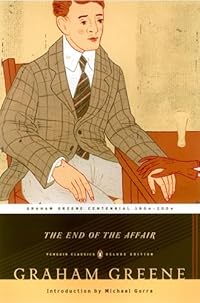
The End of the Affair
by Graham Greene 
On This Page
Description
Maurice Bendrix, a writer in Clapham during the Blitz, develops an acquaintance with Sarah Miles, the bored, beautiful wife of a dull civil servant named Henry. Maurice claims it's to divine a character for his novel-in-progress. That's the first deception. What he really wants is Sarah, and what Sarah needs is a man with passion. So begins a series of reckless trysts doomed by Maurice's increasing romantic demands and Sarah's tortured sense of guilt. Then, after Maurice miraculously show more survives a bombing, Sarah ends the affair-quickly, absolutely, and without explanation. It's only when Maurice crosses paths with Sarah's husband that he discovers the fallout of their duplicity-and it's more unexpected than Maurice, Henry, or Sarah herself could have imagined. show lessTags
Recommendations


























Member Recommendations


Member Reviews
Bitter and obsessive, Maurice Bendrix, a rising novelist finds the love of his life in World War II London only to lose her to the greatest lover of all, God. This "diary of hate," based partially on one of Graham Greene's love affairs, was Greene's final "Catholic novel," and what a novel it is—perhaps Greene's best. Contemplative and incisively written on one hand, it is sometimes a vicious and unfeeling work of selfishness and wounded pride bereft of compassion on the other hand. Hatred, contempt, and jealousy just leech out from every chapter, as written by the lonely, pathetic, and arrogant Bendrix.
More than just a psychological work on the obsessive and destructive nature of the love affair, Greene also examined in The End of show more the Affair the relationship of individuals to God. I think that there are two Catholic themes to this work: (1) the all mortal love pales in comparison to the love found in God, and (2) that God exists even from without.
What was it the vicars used to say? “God is love. God is forgiveness.” And that all love and joy springs from God?
Bendrix becomes obsessed with knowing why his former lover Sarah left him. He assumes that she left him for another lover and that it is all her fault for being a floozy. However, as the plot thickens, we learn that he was both right and wrong.
Sarah was not in love with a man; she found solace and love in her restored Catholicism. The ties and vows of her faith made her leave Bendrix forever. Even in death, she would not and could not be with him. Such a reality, the only reality that stares back at him despite all of his analysis and investigations, is something he can understand but can never accept, tolerate, surrender, nor forgive.
As Greene wanted us to believe, God exists, even from without.
Bendrix, an atheist, is slowly and (unconventionally) converted into a believer of sorts. For Bendrix, there had to be a reason for Sarah to leave him, and, in his jealous mind, that reason had to be another lover. However, in his search for that lover and for the implications brought up by the other inexplicable mysteries he encounters on his hunt he realizes the truth. If there had to be a target for his hatred, that target, he learns, is none other than God. Bendrix's obsession leads him to believe that God spites him for his hubris, his atheism, and unholy affair with Sarah by stealing her away from him, forever. And even as hates God, he acknowledges that God exists.
As a final point, I saw the 1999 film adaptation with Ralph Fiennes before reading the novel. Bendrix’s inner dialogue was slyly and superbly written in the novel and this was not conveyed as effectively or at all in the 1999 film. Bendrix, as he was written, was a character who was not only alive but far removed from and more cerebral than his novelist creator. He seemed to have volition in the novel while he and Sarah were but reactionary in the film. While the film wasn’t perfect, however, it was far more succinct and potent with the conversations, imagery, and scenes from the novel. I felt much more passion and venom in the adapted scenes from the film than from the original passages in the novel. Regardless, I feel that I have a much better grasp of the story and what Greene was trying to communicate having read and seen both.
In conclusion, while The End of the Affair is a great novel of individuals and one of Graham Greene’s best works. While it is necessarily a vicious and angry work about love, more obsessive love, I am disappointed with the absence of passion and empathy integral to love.
[1 ½ thumbs up!] show less
More than just a psychological work on the obsessive and destructive nature of the love affair, Greene also examined in The End of show more the Affair the relationship of individuals to God. I think that there are two Catholic themes to this work: (1) the all mortal love pales in comparison to the love found in God, and (2) that God exists even from without.
What was it the vicars used to say? “God is love. God is forgiveness.” And that all love and joy springs from God?
Bendrix becomes obsessed with knowing why his former lover Sarah left him. He assumes that she left him for another lover and that it is all her fault for being a floozy. However, as the plot thickens, we learn that he was both right and wrong.
Sarah was not in love with a man; she found solace and love in her restored Catholicism. The ties and vows of her faith made her leave Bendrix forever. Even in death, she would not and could not be with him. Such a reality, the only reality that stares back at him despite all of his analysis and investigations, is something he can understand but can never accept, tolerate, surrender, nor forgive.
As Greene wanted us to believe, God exists, even from without.
Bendrix, an atheist, is slowly and (unconventionally) converted into a believer of sorts. For Bendrix, there had to be a reason for Sarah to leave him, and, in his jealous mind, that reason had to be another lover. However, in his search for that lover and for the implications brought up by the other inexplicable mysteries he encounters on his hunt he realizes the truth. If there had to be a target for his hatred, that target, he learns, is none other than God. Bendrix's obsession leads him to believe that God spites him for his hubris, his atheism, and unholy affair with Sarah by stealing her away from him, forever. And even as hates God, he acknowledges that God exists.
As a final point, I saw the 1999 film adaptation with Ralph Fiennes before reading the novel. Bendrix’s inner dialogue was slyly and superbly written in the novel and this was not conveyed as effectively or at all in the 1999 film. Bendrix, as he was written, was a character who was not only alive but far removed from and more cerebral than his novelist creator. He seemed to have volition in the novel while he and Sarah were but reactionary in the film. While the film wasn’t perfect, however, it was far more succinct and potent with the conversations, imagery, and scenes from the novel. I felt much more passion and venom in the adapted scenes from the film than from the original passages in the novel. Regardless, I feel that I have a much better grasp of the story and what Greene was trying to communicate having read and seen both.
In conclusion, while The End of the Affair is a great novel of individuals and one of Graham Greene’s best works. While it is necessarily a vicious and angry work about love, more obsessive love, I am disappointed with the absence of passion and empathy integral to love.
[1 ½ thumbs up!] show less
Graham Greene masterfully navigates the complex experience of adultery and the power of God to meet his children through suffering, developing saints even in their darkest wanderings. He explores the relationships between hate and love and belief, which are often one and the same coin. It was obvious from the first few pages that Greene knew the inner workings of adultery personally, and this is one of his most autobiographical works, reflecting his own love affair. Ultimately, this novel excels because it tells the truth.
The End of the Affair by Graham Green is an outstanding story of adultery and it’s aftermath and another happy surprise from the 1,001 List for me. I was not expecting a story with such depth of emotion but, perhaps, because I listened to an audio version as read by Colin Firth, I was quite taken and touched with this story.
We come into the story after the affair has ended. Maurice Bendrix, a novelist, had met and taken up with a neighbour’s wife, Sarah. They fell passionately in love, yet Maurice could never quite convince himself that Sarah was true to him. The time is during WW II and when a bomb falls on his house while they are together and Maurice is almost killed, Sarah ends the affair. The next few years sees the end of the show more war and Maurice sinking into bitterness and hatred of Sarah. When her husband comes to him and talks about his fears that she may currently be involved with someone, Maurice hires a private detective to have her followed. What the detective uncovers and what is revealed in Sarah’s stolen diary produces the drama and emotion that left me breathless and near to tears.
Although slightly dated, the overall story of the agony of two people caught up in an impossible situation is totally compelling. Apparently the author himself went through a long and difficult adulterous affair and, in fact, this book is dedicated to his mistress, Catherine. This fact perhaps explains why the writing brings such a sense of authenticity to the story and why the poignant moments held such a ring of truth. Obviously this author was also conflicted in his religious beliefs as well, which is something that has come up in other books by him that I have read. I can’t praise Colin Firth’s narrative highly enough, his was the perfect voice to bring this story to life, and make The End of the Affair one of my top vocal experiences. I would have given this book a 4 star rating but the audio performance raises this to a 4.5. show less
We come into the story after the affair has ended. Maurice Bendrix, a novelist, had met and taken up with a neighbour’s wife, Sarah. They fell passionately in love, yet Maurice could never quite convince himself that Sarah was true to him. The time is during WW II and when a bomb falls on his house while they are together and Maurice is almost killed, Sarah ends the affair. The next few years sees the end of the show more war and Maurice sinking into bitterness and hatred of Sarah. When her husband comes to him and talks about his fears that she may currently be involved with someone, Maurice hires a private detective to have her followed. What the detective uncovers and what is revealed in Sarah’s stolen diary produces the drama and emotion that left me breathless and near to tears.
Although slightly dated, the overall story of the agony of two people caught up in an impossible situation is totally compelling. Apparently the author himself went through a long and difficult adulterous affair and, in fact, this book is dedicated to his mistress, Catherine. This fact perhaps explains why the writing brings such a sense of authenticity to the story and why the poignant moments held such a ring of truth. Obviously this author was also conflicted in his religious beliefs as well, which is something that has come up in other books by him that I have read. I can’t praise Colin Firth’s narrative highly enough, his was the perfect voice to bring this story to life, and make The End of the Affair one of my top vocal experiences. I would have given this book a 4 star rating but the audio performance raises this to a 4.5. show less
Summary: A writer struggles to understand why the woman he has had an affair with broke it off, discovering who ultimately came between them.
Maurice Bendrix, a rising writer, encounters Henry Miles, the successful but dull civil servant Bendrix had cuckolded by having a five year affair with Sarah Miles, his attractive wife. The affair, hidden from Henry had ended nearly two years earlier. All that Henry knew (or claimed to know) was that Bendrix had been a great friend. Now he comes to Bendrix with a problem. He is concerned that Sarah may be seeing someone else and wonders about hiring a private detective.
Bendrix discourages this plan, but ends up hiring the detective himself. He’s never understood why Sarah broke off their affair, show more although at some level, he knows his jealousy of Henry, who she will not leave, had been driving them apart. But they had a powerful love that drew them together. They were parted toward the end of the war when a German V-1 struck the building they were in, leaving him apparently dead underneath some debris. But in fact, he survived. Their affair did not.
Only when the private detective purloins a journal does Bendrix discover the truth. Sarah had found him under the debris, apparently lifeless and made a plea, a promise to God for his life. If he lived, she would not see him again. And the others Sarah was seeing? An atheist and a priest helping her sort out the question of belief. In the end, Bendrix finds out it is not Henry or any of these rivals who came between him and Sarah. It was God. The God he hated who did not exist.
He discovers something else as he reads the journal, and talks with Henry, the atheist, the priest, and the detective. There had been a saintly goodness about Sarah that Bendrix hadn’t seen amid their torrid affair. Even that affair was a longing for passionate love, a love she hadn’t found with Henry. There was more–Henry’s life given back, a disfigurement that disappeared, a sickly child healed. I’m intrigued that Greene includes this “miraculous” element in the story.
We discover that neither Henry Miles nor Maurice Bendrix truly took the measure of Sarah during her life. There was a higher love in her life unsatisfied by being the trophy wife of a civil servant or the possessive passion of Bendrix’s love. The question we are left with is whether Bendrix will respond with love or with hate both to Sarah and Sarah’s God.
Greene, who wrote several novels touching on religious themes raises a searching question: can God call for ultimate love and loyalty? Even when it means the end of the affair? It may be one of the marks of modernity that this is even a question. show less
Maurice Bendrix, a rising writer, encounters Henry Miles, the successful but dull civil servant Bendrix had cuckolded by having a five year affair with Sarah Miles, his attractive wife. The affair, hidden from Henry had ended nearly two years earlier. All that Henry knew (or claimed to know) was that Bendrix had been a great friend. Now he comes to Bendrix with a problem. He is concerned that Sarah may be seeing someone else and wonders about hiring a private detective.
Bendrix discourages this plan, but ends up hiring the detective himself. He’s never understood why Sarah broke off their affair, show more although at some level, he knows his jealousy of Henry, who she will not leave, had been driving them apart. But they had a powerful love that drew them together. They were parted toward the end of the war when a German V-1 struck the building they were in, leaving him apparently dead underneath some debris. But in fact, he survived. Their affair did not.
Only when the private detective purloins a journal does Bendrix discover the truth. Sarah had found him under the debris, apparently lifeless and made a plea, a promise to God for his life. If he lived, she would not see him again. And the others Sarah was seeing? An atheist and a priest helping her sort out the question of belief. In the end, Bendrix finds out it is not Henry or any of these rivals who came between him and Sarah. It was God. The God he hated who did not exist.
He discovers something else as he reads the journal, and talks with Henry, the atheist, the priest, and the detective. There had been a saintly goodness about Sarah that Bendrix hadn’t seen amid their torrid affair. Even that affair was a longing for passionate love, a love she hadn’t found with Henry. There was more–Henry’s life given back, a disfigurement that disappeared, a sickly child healed. I’m intrigued that Greene includes this “miraculous” element in the story.
We discover that neither Henry Miles nor Maurice Bendrix truly took the measure of Sarah during her life. There was a higher love in her life unsatisfied by being the trophy wife of a civil servant or the possessive passion of Bendrix’s love. The question we are left with is whether Bendrix will respond with love or with hate both to Sarah and Sarah’s God.
Greene, who wrote several novels touching on religious themes raises a searching question: can God call for ultimate love and loyalty? Even when it means the end of the affair? It may be one of the marks of modernity that this is even a question. show less
The writing is superb, the characters are very detailed and alive, Colin Firth's voice adds this something extra to the experience, and yet I hated the book.
It took me ages to finish as I kept putting it aside and coming back again and again. The reason is simple - I could not sympathize with the major characters. Both are so very self centered, so despicably immoral in their decisions (and I'm not talking about morals in terms of having an affair), and so afraid of truth, of real responsibilities, of real life.
It took me ages to finish as I kept putting it aside and coming back again and again. The reason is simple - I could not sympathize with the major characters. Both are so very self centered, so despicably immoral in their decisions (and I'm not talking about morals in terms of having an affair), and so afraid of truth, of real responsibilities, of real life.
The End of the Affair has all the hallmarks of Greene's best writing - an adrift, unlikable, self-hating protagonist, penetrating examinations of memory and regret, the collision of personal drama amid greater geopolitical crises and war - but also the recurring themes of his worst work, particularly dealing with religion: straw men providing weak arguments against Christianity to be easily outmaneuvered, an endless Catholic persecution complex, and characters changing their opinions on large issues way too conveniently to suit the author. Ultimately, I just didn't believe most of it. I didn't buy Maurice and Sarah's love, which doesn't go far beyond sexual desire and is described by both with the maturity of overdramatic teenagers, and show more I didn't buy Sarah's belabored conversion, so what came after was boring and ineffective. There is a strange misconception among many Christians that nonbelievers are people who in actuality do believe in a god, and are just angry with him. As a militant agnostic, I can tell you this is not the case. If there is an all-knowing deity, I have no qualms with it; I simply object to the assumption of its existence, and the assumption that its existence would in any way absolve Catholicism of its treatment of women/gays/children/the list goes on. Maurice's obsession with Sarah's newfound religion seemed forced, the author manipulating his characters and making them do what he wanted them to do rather than what they would do, and for the last 60 pages or so of the book, I was begging for it to end. show less
The End of the Affair, whilst a short read, is a thick soup of a novel, intense with passionate love, simmering jealousy and religious fervour. Set in war-torn London towards the end of WWII, a chance encounter with the husband of his ex-lover two years after the end of their affair reignites the narrator's brooding over his loss, and as his jealousy grows so too does his need to inflict pain as a means of healing his own wounds.
There's a melancholy intensity to this book that reminded me in some ways of Anita Brookner's style of writing, which is rarely joyful yet somehow sucks you willingly into its vortex of despair.
In real life Graham Greene was a vociferous atheist before eventually arguing himself full circle into converting to show more Catholicism. This tug-of-war between belief and non-belief and the effect of each on how one leads one's life is developed as a key theme within this novel, and although it got lost in itself in a few passages it felt original and an interesting concept within the context of the novel.
4 stars - heady and intense, but those who like their fiction with a liberal sprinkle of joyfulness it may be too bleak. show less
There's a melancholy intensity to this book that reminded me in some ways of Anita Brookner's style of writing, which is rarely joyful yet somehow sucks you willingly into its vortex of despair.
In real life Graham Greene was a vociferous atheist before eventually arguing himself full circle into converting to show more Catholicism. This tug-of-war between belief and non-belief and the effect of each on how one leads one's life is developed as a key theme within this novel, and although it got lost in itself in a few passages it felt original and an interesting concept within the context of the novel.
4 stars - heady and intense, but those who like their fiction with a liberal sprinkle of joyfulness it may be too bleak. show less
Members
- Recently Added By
Published Reviews
In "The End of the Affair" the splendidly stupid private detective, Alfred Parkis, and his apprentice son, and the maudlin grifter who is the heroine's mother, equal the best of the seedy supernumeraries of his other novels. It is savage and sad, vulgar and ideal, coarse and refined, and a rather accurate image of an era of cunning and glory, of cowardice and heroism, of belief and unbelief.
added by John_Vaughan
Great romantic novels are about pain and hate, and among the greatest is Graham Greene's searing The End of the Affair. It is one of the most forensic and honest analyses of love you will ever read.
added by John_Vaughan
Lists

The Guardian's 1000 Novels Everyone Must Read
1,005 works; 549 members

1001 Books You Must Read Before You Die
1,448 works; 1,132 members
20th Century Literature
1,161 works; 54 members

Favorite Literary Love Stories
182 works; 101 members

Best Books Set in London
157 works; 42 members

Favourite Books
1,817 works; 316 members

1950s
340 works; 22 members
Readable Classics
110 works; 15 members

Canon de la narrativa universal del siglo XX
254 works; 6 members

War Literature
101 works; 19 members

Top Five Books of 2018
802 works; 265 members

One Book, Many Authors
441 works; 40 members

The Guardian's 100 Best Novels Written in English
105 works; 13 members

Love Triangles in Literature
108 works; 15 members

Short and Sweet
242 works; 23 members

1,001 BYMRBYD Concensus
723 works; 27 members
Best First Lines
133 works; 8 members

Top Five Books of 2019
387 works; 107 members

Global Reads: Books Set in the United Kingdom and Ireland
109 works; 5 members

A Novel Cure
742 works; 23 members

Best Antiheroes and Antiheroines
119 works; 6 members

Religious Fiction
58 works; 12 members

Books about World War II
241 works; 22 members
United Kingdom
82 works; 4 members
Best War Fiction Books
41 works; 4 members

Books Read in 2023
5,547 works; 145 members
Five star books
1,755 works; 108 members
Books Read in 2016
4,666 works; 199 members
Best Books of the 20th Century
193 works; 5 members

Books Read in 2017
4,248 works; 130 members

Favorite Books from the 1950s
33 works; 2 members
Literature About Adultery
69 works; 10 members

Nifty Fifties
129 works; 14 members

Tammen Keltainen kirjasto
81 works; 1 member
.
396 works; 1 member

Books That Made Us Cry
278 works; 145 members
Canon de la narrativa universal del s. XX (cicutadry)
499 works; 3 members

Retrospective of 20th- and 21st-century literature
154 works; 1 member
DigitalDreamDoor top 300
300 works; 4 members
Books With Our Favorite First Lines
168 works; 104 members

My TBR
371 works; 3 members

Mustich's 1000 Books to Read Before You Die: A Life Changing List
1,001 works; 18 members
Recommend the 20 best books you've read in the last five years
2,167 works; 600 members

Books Read in 2019
4,052 works; 108 members

Books Read in 2018
4,360 works; 110 members

KayStJ's to-read list
1,616 works; 11 members

Unread books
1,063 works; 87 members
Author Information

Born in 1904, Graham Greene was the son of a headmaster and the fourth of six children. Preferring to stay home and read rather than endure the teasing at school that was a by-product of his father's occupation, Greene attempted suicide several times and eventually dropped out of school at the age of 15. His parents sent him to an analyst in show more London who recommended he try writing as therapy. He completed his first novel by the time he graduated from college in 1925. Greene wrote both entertainments and serious novels. Catholicism was a recurring theme in his work, notable examples being The Power and the Glory (1940) and The End of the Affair (1951). Popular suspense novels include: The Heart of the Matter, Our Man in Havana and The Quiet American. Greene was also a world traveler and he used his experiences as the basis for many books. One popular example, Journey Without Maps (1936), was based on a trip through the jungles of Liberia. Greene also wrote and adapted screenplays, including that of the 1949 film, The Third Man, which starred Orson Welles. He died in Vevey, Switzerland in 1991. (Bowker Author Biography) show less
Graham Greene has a Legacy Library. Legacy libraries are the personal libraries of famous readers, entered by LibraryThing members from the Legacy Libraries group.
Some Editions
Awards and Honors
Awards
Distinctions
Notable Lists
Series
Belongs to Publisher Series
Work Relationships
Is contained in
Has the adaptation
Common Knowledge
- Canonical title*
- Het einde van het spel
- Original title
- The End of the Affair
- Alternate titles*
- Het eind van de relatie
- Original publication date
- 1951
- People/Characters
- Maurice Bendrix; Sarah Miles; Henry Miles; Parkis; Roger Smythe
- Important places
- London, England, UK; Clapham Common, Clapham, London, England, UK
- Important events
- World War II (1939 | 1945)
- Related movies
- The End of the Affair (1999 | IMDb); The End of the Affair (1955 | IMDb)
- Epigraph
- Man has places in his heart which do not yet exist, and into them enters suffering in order that they may have existence.
Leon Bloy - Dedication
- To C.
- First words
- A story has no beginning or end: arbitrarily one chooses that moment of experience from which to look back or from which to look ahead.
- Quotations
- Henry had his tray, sitting up against two pillows in his green woollen dressing-gown, and in the room below, on the hardwood floor, with a single cushion for support, and the door ajar, we made love.
I suppose Germany by this time had invaded the Low Countries: the spring like a corpse was sweet with the smell of doom,... - Last words
- (Click to show. Warning: May contain spoilers.)I wrote at the start that this was a record of hate, and walking there beside Henry towards the evening glass of beer, I found the one prayer that seemed to serve the winter mood: O God, You’ve done enough, You’ve robbed me of enough, I’m too tired and old to learn to love, leave me alone for ever.
- Blurbers
- Faulkner, William; Golding, William; Waugh, Evelyn
- Original language
- English
- Canonical DDC/MDS
- 823.912
- Canonical LCC
- PR6013.R44
*Some information comes from Common Knowledge in other languages. Click "Edit" for more information.
Classifications
Statistics
- Members
- 7,242
- Popularity
- 1,594
- Reviews
- 191
- Rating
- (3.93)
- Languages
- 22 — Catalan, Czech, Danish, Dutch, English, Estonian, Finnish, French, German, Greek, Hungarian, Italian, Japanese, Korean, Norwegian (Bokmål), Norwegian, Portuguese, Romanian, Slovenian, Spanish, Swedish, Turkish
- Media
- Paper, Audiobook, Ebook
- ISBNs
- 108
- UPCs
- 1
- ASINs
- 76