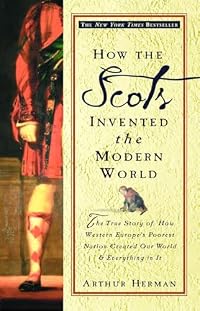
How the Scots Invented the Modern World: The True Story of How Western Europe's Poorest Nation Created Our World & Everything in It
by Arthur Herman
On This Page
Description
Who formed the first literate society? Who invented our modern ideas of democracy and free market capitalism? The Scots. As historian and author Arthur Herman reveals, in the eighteenth and nineteenth centuries Scotland made crucial contributions to science, philosophy, literature, education, medicine, commerce, and politics, contributions that have formed and nurtured the modern West ever since. This book is not just about Scotland: it is an exciting account of the origins of the modern show more world. No one who takes this incredible historical trek will ever view the Scots, or the modern West, in the same way again. show lessTags
Recommendations









Member Recommendations
Member Reviews
As someone who has always been fascinated by history, “The Scottish Enlightenment: The Scots’ Invention of the Modern World” by Arthur Herman was an absolute delight to read. Herman masterfully weaves together the stories of Scotland’s greatest minds, from Adam Smith to David Hume, showcasing how their revolutionary ideas shaped the modern world.
What truly captivated me was Herman’s ability to make complex philosophical and economic concepts accessible and engaging. His writing is both scholarly and approachable, making it easy to understand how the Scottish Enlightenment laid the groundwork for many aspects of contemporary society.
The book is a treasure trove of insights, revealing how a small nation with a tumultuous history show more managed to produce such a remarkable intellectual legacy. It’s inspiring to see how the Scots’ emphasis on education, critical thinking, and innovation led to advancements that still resonate today.
In short, this book is a must-read for anyone interested in history, philosophy, or the origins of modern thought. It’s a brilliant reminder of the power of ideas and the enduring impact of a few determined individuals. I couldn’t recommend it more highly show less
What truly captivated me was Herman’s ability to make complex philosophical and economic concepts accessible and engaging. His writing is both scholarly and approachable, making it easy to understand how the Scottish Enlightenment laid the groundwork for many aspects of contemporary society.
The book is a treasure trove of insights, revealing how a small nation with a tumultuous history show more managed to produce such a remarkable intellectual legacy. It’s inspiring to see how the Scots’ emphasis on education, critical thinking, and innovation led to advancements that still resonate today.
In short, this book is a must-read for anyone interested in history, philosophy, or the origins of modern thought. It’s a brilliant reminder of the power of ideas and the enduring impact of a few determined individuals. I couldn’t recommend it more highly show less
A refreshingly unsentimental exploration of Scottish history (for all the hyperbole conveyed in the title). It's a little too enamored of Adam Smith and capitalism, and a little too forgiving of British imperialism, but conveys the progression of Scottish society through the 18th and 19th centuries.
This was a bit of a disappointment: I was expecting a book about the great flowering of intellectual life in eighteenth-century Scotland, which is rather what the UK title (The Scottish Enlightenment : the Scots' invention of the modern world) implies. In the US, the title is much more brazen: How the Scots Invented the Modern World: The True Story of How Western Europe's Poorest Nation Created Our World & Everything in It, and gives the potential reader fair warning that we should expect more tripe hype than serious history.
The book starts off well enough, with a discussion of the political situation of Scotland at the end of the 17th century, and a lively account of the negotiations for the Treaty of Union. Then we get a clear but show more very condensed run though the lives and ideas of Lord Kames, David Hume, Adam Smith et al. All well and good, although rather disappointingly superficial if you already know something about the subject and were hoping to learn a little more. But this only gets us about halfway through the book. The remaining chapters are a bit of a ragbag: the author leaps about here and there in 19th and 20th century history, picking out significant figures who were, or could be considered on the author's rather free definition, Scottish. In places, it's a bit like being trapped in one of those silly coffee-break conversations, where someone is trying to prove the superiority of a particular nation or group with increasingly far-fetched examples ("...and he was Scottish, ...and he had a Scottish grandmother, ... and he went to lectures by a Scottish professor, ... and he once read a novel by Scott..."). Or, to put it another way, like reading a history of the nineteenth century where someone has Tippexed out all Russians, Germans, French, and English.
This is a rather silly exercise, and the off the cuff judgments it leads the author into undermine what might otherwise have been quite a sensible book (what is the point of bringing in Asquith [married to a Scot] but not mentioning Lloyd George [Welsh], for instance?). But there are some good bits - the discussion of Sir Walter Scott and his influence on the way Scotland is perceived, for instance. It would have been nice to see Herman take the discussion of why Scotland (compared to England, in particular) was so successful at producing great thinkers a bit further. Why were the Scottish universities better than the English ones? Was it the absence of control by a state church? Was it that the universities took on vocational training that was done by professional associations in England? Why were Scottish universities more accessible to men from poorer backgrounds, and how common was it really that the sons of farmworkers and small tradesmen went to university?
Herman's real agenda with this book seems to be not so much to defend the Scots - after all, anyone who reflects for a moment could work out for themselves that Scots have played an important part in history - as to make a plea for the liberal humanist way of looking at the world that 18th century Scottish thinkers did so much to establish as the common currency of the academic world, and which took such a battering in the latter part of the 20th century. This is perhaps also why he doesn't mention any women (except Flora MacDonald) and doesn't discuss women's role in Scottish society at all - a remarkable omission for a book written in 2003. However, he does offer a useful corrective to the "Mel Gibson" view of Scottish history inadvertently encouraged by Scott and propagated by modern Scottish Nationalists. He reminds us that the Scots-speaking culture of Edinburgh, Glasgow and the lowlands is a part of Scotland's heritage every bit as important as that of the the Gaelic-speaking Highlanders. show less
The book starts off well enough, with a discussion of the political situation of Scotland at the end of the 17th century, and a lively account of the negotiations for the Treaty of Union. Then we get a clear but show more very condensed run though the lives and ideas of Lord Kames, David Hume, Adam Smith et al. All well and good, although rather disappointingly superficial if you already know something about the subject and were hoping to learn a little more. But this only gets us about halfway through the book. The remaining chapters are a bit of a ragbag: the author leaps about here and there in 19th and 20th century history, picking out significant figures who were, or could be considered on the author's rather free definition, Scottish. In places, it's a bit like being trapped in one of those silly coffee-break conversations, where someone is trying to prove the superiority of a particular nation or group with increasingly far-fetched examples ("...and he was Scottish, ...and he had a Scottish grandmother, ... and he went to lectures by a Scottish professor, ... and he once read a novel by Scott..."). Or, to put it another way, like reading a history of the nineteenth century where someone has Tippexed out all Russians, Germans, French, and English.
This is a rather silly exercise, and the off the cuff judgments it leads the author into undermine what might otherwise have been quite a sensible book (what is the point of bringing in Asquith [married to a Scot] but not mentioning Lloyd George [Welsh], for instance?). But there are some good bits - the discussion of Sir Walter Scott and his influence on the way Scotland is perceived, for instance. It would have been nice to see Herman take the discussion of why Scotland (compared to England, in particular) was so successful at producing great thinkers a bit further. Why were the Scottish universities better than the English ones? Was it the absence of control by a state church? Was it that the universities took on vocational training that was done by professional associations in England? Why were Scottish universities more accessible to men from poorer backgrounds, and how common was it really that the sons of farmworkers and small tradesmen went to university?
Herman's real agenda with this book seems to be not so much to defend the Scots - after all, anyone who reflects for a moment could work out for themselves that Scots have played an important part in history - as to make a plea for the liberal humanist way of looking at the world that 18th century Scottish thinkers did so much to establish as the common currency of the academic world, and which took such a battering in the latter part of the 20th century. This is perhaps also why he doesn't mention any women (except Flora MacDonald) and doesn't discuss women's role in Scottish society at all - a remarkable omission for a book written in 2003. However, he does offer a useful corrective to the "Mel Gibson" view of Scottish history inadvertently encouraged by Scott and propagated by modern Scottish Nationalists. He reminds us that the Scots-speaking culture of Edinburgh, Glasgow and the lowlands is a part of Scotland's heritage every bit as important as that of the the Gaelic-speaking Highlanders. show less
During a school exchange to McCook, Nebraska, in the early 90s, my wife was asked whether they had television in Scotland. ‘We invented it,’ she frowned. Admittedly at the time this was somewhat disingenuous, since Nebraska even then had dozens of channels whereas Scotland had four (all of which were regularly interrupted by the fateful words ‘…except for viewers in Scotland’), but still, the point was made.
It's one of the eternal mysteries why so much of the modern world seems to have come out of this remote, rainy corner on the edge of Europe. Most people will point to the technology – television, telephones, macadamised road surfaces, pneumatic tyres, the bicycle, penicillin, Buckfast. But even more important were the new show more concepts and attitudes that made it all possible. For two hundred years, from the start of the eighteenth century to the end of the nineteenth, Scotland churned out ideas at a ridiculous pace: David Hume remade empiricist philosophy, Adam Smith invented economics, Francis Hutcheson invented modern liberalism, James Hutton invented modern geology, Walter Scott invented modern fiction….
I said it was an eternal mystery; one of the problems with this book is that the Scottish Enlightenment remains a bit of a mystery even after finishing it. Herman never quite escapes the sense of merely delivering a laundry-list of great names and inventions, most of which could be more or less grasped by consulting Wikipedia's article on Scottish inventions and discoveries.
That said, Herman does make a few helpful suggestions. He is – at least historically – resolutely pro-Union, and identifies the creation of Great Britain in 1707 as the primary enabler of the Enlightenment, something that ‘in the span of a single generation […] would transform Scotland from a Third World country into a modern society, and open up a cultural and social revolution’. He also recognises the crucial importance of education, pinpointing Scotland as ‘Europe's first modern literate society’ – and this, in turn, is referred back to John Knox's insane but thorough religious reformation. (This has interesting consequences: the main figures of the French Enlightenment, to take one obvious comparison, were furiously anti-religion, but that was never the case in Scotland, where even atheists like Hume did not get very worked-up about it.)
In the end, though, the explanations are speculative at best and distracting at worst – as are the sections which look at how Scots contributed to the founding principles of the United States. Herman is American, so perhaps this just reflects his own biases. In any case, without a convincing narrative through-line it's easy to find that the potted biographies start to blur into one another – though there are definitely people here that I'd like to read up on in more detail. I was particularly taken with the splenetic judge Lord Kames, who counted Hume, Boswell and Adam Smith among his protégés. When he stepped down from the justiciary in 1782, he took leave of his colleagues with the cheerful and surprisingly OG exclamation, ‘Fare ye weel, ye bitches!’, which I have now started saying whenever I leave the room. show less
It's one of the eternal mysteries why so much of the modern world seems to have come out of this remote, rainy corner on the edge of Europe. Most people will point to the technology – television, telephones, macadamised road surfaces, pneumatic tyres, the bicycle, penicillin, Buckfast. But even more important were the new show more concepts and attitudes that made it all possible. For two hundred years, from the start of the eighteenth century to the end of the nineteenth, Scotland churned out ideas at a ridiculous pace: David Hume remade empiricist philosophy, Adam Smith invented economics, Francis Hutcheson invented modern liberalism, James Hutton invented modern geology, Walter Scott invented modern fiction….
I said it was an eternal mystery; one of the problems with this book is that the Scottish Enlightenment remains a bit of a mystery even after finishing it. Herman never quite escapes the sense of merely delivering a laundry-list of great names and inventions, most of which could be more or less grasped by consulting Wikipedia's article on Scottish inventions and discoveries.
That said, Herman does make a few helpful suggestions. He is – at least historically – resolutely pro-Union, and identifies the creation of Great Britain in 1707 as the primary enabler of the Enlightenment, something that ‘in the span of a single generation […] would transform Scotland from a Third World country into a modern society, and open up a cultural and social revolution’. He also recognises the crucial importance of education, pinpointing Scotland as ‘Europe's first modern literate society’ – and this, in turn, is referred back to John Knox's insane but thorough religious reformation. (This has interesting consequences: the main figures of the French Enlightenment, to take one obvious comparison, were furiously anti-religion, but that was never the case in Scotland, where even atheists like Hume did not get very worked-up about it.)
In the end, though, the explanations are speculative at best and distracting at worst – as are the sections which look at how Scots contributed to the founding principles of the United States. Herman is American, so perhaps this just reflects his own biases. In any case, without a convincing narrative through-line it's easy to find that the potted biographies start to blur into one another – though there are definitely people here that I'd like to read up on in more detail. I was particularly taken with the splenetic judge Lord Kames, who counted Hume, Boswell and Adam Smith among his protégés. When he stepped down from the justiciary in 1782, he took leave of his colleagues with the cheerful and surprisingly OG exclamation, ‘Fare ye weel, ye bitches!’, which I have now started saying whenever I leave the room. show less
The English media company, The Tortoise, opened its editorial meetings to a Zoom public early in the pandemic. Among the many insights the meetings provided to a citizen of the US, the casual disdain English people expressed for Scots stood out. Had I not witnessed that, I wouldn't have understood the competitive subtext that runs through this excellent history. Thoroughly enjoyable and wonderfully read.
Although I enjoyed reading this, I think it would have been a better book with a narrower focus. I enjoyed learning about the Scottish Enlightenment and would have enjoyed more depth on that but it started including a great many other topics that started to feel less and less connected to the Enlightenment period and by the the end it felt more like a collection of potted biographies of famous Scottish people.
Cosma Shalizi once wrote a fascinating blog post titled "The Singularity in Our Past Light-Cone" musing how the much-discussed Singularity that Kurzweil and company have made careers out of promoting has actually already happened - it was called the Industrial Revolution, and it was over before World War I. The Industrial Revolution was a saltation nearly unmatched by anything in human history save maybe fire or agriculture, and one of the commentaries on that post dredged up an apropos Nietzsche quote: "The press, the machine, the railway, the telegraph are premises whose thousand-year conclusion no one has yet dared to draw."
Perhaps no single culture made as many or as crucial contributions to all of those elements of the Industrial show more Revolution as as the Scottish, even as they began the 18th century as one of the poorest, most miserable peoples in Europe. This history of their involvement in that leap is a story of people, not data, which might increase its appeal to casual history fans (or simply ethnic Scots looking for a pat on the back - I'm a quarter Scottish on my father's side and that element certainly doesn't hurt), but although Herman succeeds in presenting a lot of good background information, as well as restoring a lot of Scottish Enlightenment figures to the prominent places they deserve, I don't think this is as satisfying work as could have been.
One reason is that Herman is not as analytical about the causes of Scotland's transformation as I expected. The book is primarily a paean to the character of the nation, which is fine, but it would have been nice to see not only a bit more data (i.e., exactly how over-represented were Scots in the echelons of of the British Empire) but more comparison to other nations, even if only Ireland and Wales. It's all very well to gloat over kilt power, but I'm not sure the majority of readers would read this book and come away having a clear idea of the exact steps aside from a focus on education the Scots took to get where they did, or, to put it another way, if the steps that they did take were generalizable to anything other than their specific historical/geographical position. Invest in education, get absorbed by a mostly aloof yet indulgent brother nation next door, insert your countrymen into key positions in the new union's administrative machinery, profit? A key sentence states that after England bailed out Scotland after the disastrous Darien colonization scheme, "Scots ended up with the best of both worlds: peace and order from a strong administrative state, but freedom to develop and innovate without undue interference from those who controlled it.". Why exactly didn't Scotland suffer the fate of Ireland?
Another place where the lack of comparison is keenly felt is in the section discussing the differing effects of the Scottish diaspora on the United States and Canada. There's some nods to David Hackett Fisher's theories, most memorably chronicled in Albion's Seed, of how the distinct culture of the Scotch-Irish differentiated the Appalachian territories where they settled from the rest of America, but even though Herman does vaguely theorize that American-bound Scots were more individualistic and less bureaucratic than the ones who went to Canada, there's no attempt to quantify this or say what it meant to the characters of the countries (I've spent a lot of time in heavily Scottish-influenced provinces like Ontario, so it jumped out at me). I can't help but compare this section unfavorably to a book like Isabel Wilkerson's magnificent The Warmth of Other Suns that discusses the Great Migration of African-Americans north in the early 20th century, with plenty of both personal narratives and hard data on what changing demographics meant to culture, industry, and character.
One more issue I had with the book is that all too often Herman will drop ex cathedra pronouncements on history that are either flat-out wrong or amateurish, unworthy of a serious historian. You can't expect a book cheerleading an ethnic group to be completely neutral about world history, but when the dusty old bones of Edmund Burke get hauled out to "prove" that the French Revolution "went too far", all you can do is roll your eyes and wish that an editor had advised Herman to leave that sort of thing to people who specialize in it. I get that he really likes some of these figures, and it's fine if he agrees with their opinions, but he isn't very artful about expressing his own point of view. Sometimes he also misses what would seem to be enlightening context. One example is during his discussion of Sir Walter Scott - Mark Twain famously blamed Scott's novels for prompting the Civil War by deluding Southerners with unrealistic ideals of chivalry and honor. Right or wrong, that would have been very interesting to investigate, given how much space Herman spends pointing out Scottish influence in other places. I also caught an outright error where he stated that Thomas Telford's Caledonian Canal cost a billion pounds; the actual figure is slightly less than a million pounds, but what's a factor of a thousand between friends?
The major strength of the book is simply that it puts all in one place an impressive parade of luminaries that most people will not have consciously thought of as Scottish. Philosophers like Francis Hutcheson, Adam Smith, and David Hume; writers like Walter Scott, Robert Burns, and James MacPherson; and inventors like James Watt, Samuel Morse, and Alexander Graham Bell, Andrew Carnegie achieved amazing things, and there are plenty of other less famous people Herman profiles that don't get the respect from history that they might deserve. Herman's focus on the Industrial Revolution causes him to miss or relegate to the Conclusion some Scotsmen who would otherwise have deserved some more space, such as James Clerk Maxwell, Arthur Conan Doyle, Robert Louis Stevenson, James Barrie, or Ian Fleming, but otherwise it feels like he covered just about everyone (except for John Buchan, a favorite of mine who is sorely missed here), and while inevitably the capsule biographies often elide important information or present a particular point of view, this is probably unavoidable in any short history.
I finished this book right before Scotland held its long-awaited independence referendum, so it's clear that the Scottish themselves are ambivalent about their place in the British Empire and the UK. I would be remiss in not mentioning that famous meditation on Scottish nationalism in the movie Trainspotting:
Tommy: Doesn't it make you proud to be Scottish?
Mark: It's SHITE being Scottish! We're the lowest of the low. The scum of the fucking Earth! The most wretched, miserable, servile, pathetic trash that was ever shat into civilization. Some hate the English. I don't. They're just wankers. We, on the other hand, are COLONIZED by wankers. Can't even find a decent culture to be colonized BY. We're ruled by effete assholes. It's a SHITE state of affairs to be in, Tommy, and ALL the fresh air in the world won't make any fucking difference! show less
Perhaps no single culture made as many or as crucial contributions to all of those elements of the Industrial show more Revolution as as the Scottish, even as they began the 18th century as one of the poorest, most miserable peoples in Europe. This history of their involvement in that leap is a story of people, not data, which might increase its appeal to casual history fans (or simply ethnic Scots looking for a pat on the back - I'm a quarter Scottish on my father's side and that element certainly doesn't hurt), but although Herman succeeds in presenting a lot of good background information, as well as restoring a lot of Scottish Enlightenment figures to the prominent places they deserve, I don't think this is as satisfying work as could have been.
One reason is that Herman is not as analytical about the causes of Scotland's transformation as I expected. The book is primarily a paean to the character of the nation, which is fine, but it would have been nice to see not only a bit more data (i.e., exactly how over-represented were Scots in the echelons of of the British Empire) but more comparison to other nations, even if only Ireland and Wales. It's all very well to gloat over kilt power, but I'm not sure the majority of readers would read this book and come away having a clear idea of the exact steps aside from a focus on education the Scots took to get where they did, or, to put it another way, if the steps that they did take were generalizable to anything other than their specific historical/geographical position. Invest in education, get absorbed by a mostly aloof yet indulgent brother nation next door, insert your countrymen into key positions in the new union's administrative machinery, profit? A key sentence states that after England bailed out Scotland after the disastrous Darien colonization scheme, "Scots ended up with the best of both worlds: peace and order from a strong administrative state, but freedom to develop and innovate without undue interference from those who controlled it.". Why exactly didn't Scotland suffer the fate of Ireland?
Another place where the lack of comparison is keenly felt is in the section discussing the differing effects of the Scottish diaspora on the United States and Canada. There's some nods to David Hackett Fisher's theories, most memorably chronicled in Albion's Seed, of how the distinct culture of the Scotch-Irish differentiated the Appalachian territories where they settled from the rest of America, but even though Herman does vaguely theorize that American-bound Scots were more individualistic and less bureaucratic than the ones who went to Canada, there's no attempt to quantify this or say what it meant to the characters of the countries (I've spent a lot of time in heavily Scottish-influenced provinces like Ontario, so it jumped out at me). I can't help but compare this section unfavorably to a book like Isabel Wilkerson's magnificent The Warmth of Other Suns that discusses the Great Migration of African-Americans north in the early 20th century, with plenty of both personal narratives and hard data on what changing demographics meant to culture, industry, and character.
One more issue I had with the book is that all too often Herman will drop ex cathedra pronouncements on history that are either flat-out wrong or amateurish, unworthy of a serious historian. You can't expect a book cheerleading an ethnic group to be completely neutral about world history, but when the dusty old bones of Edmund Burke get hauled out to "prove" that the French Revolution "went too far", all you can do is roll your eyes and wish that an editor had advised Herman to leave that sort of thing to people who specialize in it. I get that he really likes some of these figures, and it's fine if he agrees with their opinions, but he isn't very artful about expressing his own point of view. Sometimes he also misses what would seem to be enlightening context. One example is during his discussion of Sir Walter Scott - Mark Twain famously blamed Scott's novels for prompting the Civil War by deluding Southerners with unrealistic ideals of chivalry and honor. Right or wrong, that would have been very interesting to investigate, given how much space Herman spends pointing out Scottish influence in other places. I also caught an outright error where he stated that Thomas Telford's Caledonian Canal cost a billion pounds; the actual figure is slightly less than a million pounds, but what's a factor of a thousand between friends?
The major strength of the book is simply that it puts all in one place an impressive parade of luminaries that most people will not have consciously thought of as Scottish. Philosophers like Francis Hutcheson, Adam Smith, and David Hume; writers like Walter Scott, Robert Burns, and James MacPherson; and inventors like James Watt, Samuel Morse, and Alexander Graham Bell, Andrew Carnegie achieved amazing things, and there are plenty of other less famous people Herman profiles that don't get the respect from history that they might deserve. Herman's focus on the Industrial Revolution causes him to miss or relegate to the Conclusion some Scotsmen who would otherwise have deserved some more space, such as James Clerk Maxwell, Arthur Conan Doyle, Robert Louis Stevenson, James Barrie, or Ian Fleming, but otherwise it feels like he covered just about everyone (except for John Buchan, a favorite of mine who is sorely missed here), and while inevitably the capsule biographies often elide important information or present a particular point of view, this is probably unavoidable in any short history.
I finished this book right before Scotland held its long-awaited independence referendum, so it's clear that the Scottish themselves are ambivalent about their place in the British Empire and the UK. I would be remiss in not mentioning that famous meditation on Scottish nationalism in the movie Trainspotting:
Tommy: Doesn't it make you proud to be Scottish?
Mark: It's SHITE being Scottish! We're the lowest of the low. The scum of the fucking Earth! The most wretched, miserable, servile, pathetic trash that was ever shat into civilization. Some hate the English. I don't. They're just wankers. We, on the other hand, are COLONIZED by wankers. Can't even find a decent culture to be colonized BY. We're ruled by effete assholes. It's a SHITE state of affairs to be in, Tommy, and ALL the fresh air in the world won't make any fucking difference! show less
Members
- Recently Added By
Lists

Non-fiction that you shouldn't waste your time on
45 works; 15 members

Most Popular Books Tagged Scotland
35 works; 2 members

All Things Great Britain
66 works; 1 member

Books Read in 2024
4,623 works; 126 members
Author Information

16+ Works 6,274 Members
Arthur Herman, PhD, is the author of the New York Times bestseller How the Scots Invented the Modern World, which has sold a half million copies worldwide, and Gandhi and Churchill, which was a finalist for the Pulitzer Prize. He is the author of six previous books and a senior fellow at the Hudson Institute in Washington, DC.
Some Editions
Awards and Honors
Notable Lists
Common Knowledge
- Original title
- The Scottish enlightenment : the Scots' invention of the modern world
- Alternate titles
- How the Scots invented the modern world : the true story of how western Europe's poorest nation created our world & everything in it
- Original publication date
- 2001
- People/Characters
- John Hunter (surgeon); Adam Smith; Hume, David, 1711-1776; Alexander Graham Bell; Sir Walter Scott; Thomas Aikenhead
- Important places
- Edinburgh, Scotland, UK; Glasgow, Scotland, UK; Scotland, UK
- Important events
- Trial of Thomas Aikenhead (1696)
- Epigraph
- Is it not strange that at a time when we have lost our Princes, our Parliaments, our independent government, even the Presence of our chief Nobility, are unhappy in our accent and pronunciation, speak a very corrupt Dialect o... (show all)f the Tongue which we make use of, I say, that in these Circumstances, we shou'd really be the People most distinguished for Literature in Europe? -David Hume, 1757 (Part One: Epiphany)
The constant influx of information and of liberality from abroad, which was thus kept up in Scotland in consequence of the ancient habits and manners of the people, may help to account for the sudden burst of genius, which to... (show all) a foreigner must seem have sprung up in this country by a sort of enchantment, soon after the Rebellion of 1745. -Dugald Stewart (Part One: Epiphany) - First words
- Preface
People of Scottish descent are usually proud about their history and achievements.
Prologue
The Tron Church stands on Edinburgh's High Street, almost at the midpoint of the Royal Mile, which rises to Edinburgh Castle at one end and slopes down to Holyrood Palace at the other.
Chapter One
Just as the German Reformation was largely the work of a single individual, Martin Luther, so the Scottish Reformation was the achievement of one man of heroic will and tireless energy: John Knox. - Last words
- (Click to show. Warning: May contain spoilers.)The Scottish mind grasped how, in Hume's words, "liberty is the perfection of civil society," but "authority must be acknowledged essential to its very existence"; and how a strong faith in progress also requires a keen appreciation of its limitations.
- Original language
- English
Classifications
Statistics
- Members
- 2,897
- Popularity
- 6,158
- Reviews
- 39
- Rating
- (3.78)
- Languages
- English
- Media
- Paper, Audiobook, Ebook
- ISBNs
- 14
- ASINs
- 15